My neighbor’s dog bit my granddaughter.
Drew blood.
Nine stitches.
On her face.
She was five years old.
Five.
The dog came through a gap in the fence while she was riding her scooter on the sidewalk.
One second she was laughing.
The next she was screaming.
I’ve heard a lot of sounds in my seventy-one years.
None of them stay with me like that one.
At the emergency room, the doctor cleaned the wound while my granddaughter held her mother’s hand and cried.
I stood in the hallway because I couldn’t bear to watch.
The surgeon said she’d likely have a scar.
My daughter cried.
I didn’t.
Not then.
I was too angry.
The next morning, I called animal control.
They told me to file a report.
So I filed it.
Nothing happened.
A week later, I called again.
Same answer.
More paperwork.
More waiting.
Meanwhile, the dog was still in that yard.
Still behind that same fence.
The owner acted like it was an unfortunate accident.
Like my granddaughter had scraped her knee.
When I knocked on his door, he didn’t even ask how she was doing.
He said,
“Dogs will be dogs.”
I nearly lost my temper right there.
Instead, I walked away.
Then I called the police.
The officer listened politely.
Took notes.
Then said words I’ll never forget.
“It’s a civil matter.”
A civil matter.
My granddaughter had stitches across her face.
And somehow it was a civil matter.
That night I sat at my kitchen table staring at photographs from before the attack.
Pictures of birthday parties.
Pictures of playgrounds.
Pictures of a little girl who wasn’t afraid of anything.
Then I looked at a photo taken three days earlier.
She was smiling.
But not with her eyes.
That’s when I decided I wasn’t letting it go.
I hired a lawyer.
Money I didn’t have.
Money I couldn’t afford.
When my daughter found out, she said,
“Dad, are you sure?”
I looked at my granddaughter sitting quietly in the living room.
Then I answered.
“No.”
“But I’m sure somebody has to fight for her.”
Three weeks later, my lawyer called.
And what he told me changed everything.…
Three weeks later, my lawyer called.
His voice sounded different.
Focused.
Serious.
“You’re not going to believe this,” he said.
I gripped the phone tighter.
“What?”
“The dog has bitten before.”
I sat up straight.
“What do you mean, before?”
“There are two previous complaints.”
My stomach dropped.
Two.
Not one.
Two.
Neither had resulted in serious injuries.
Neither had gone to court.
But both reports existed.
The owner knew.
He knew his dog could be dangerous.
And he did nothing.
The next few months became a blur of paperwork, medical records, photographs, and depositions.
Every time I thought about quitting, I’d look at my granddaughter’s scar.
And I’d keep going.
The owner’s lawyer tried everything.
They claimed she startled the dog.
Claimed she got too close to the fence.
Claimed it was a freak accident.
A five-year-old child.
Against a grown man who refused to accept responsibility.
Then came the day of the hearing.
My granddaughter wasn’t supposed to testify.
She was too young.
But the judge wanted to meet her privately.
Just for a few minutes.
Afterward, the judge came back into the courtroom looking different.
Quieter.
The owner suddenly didn’t seem so confident anymore.
When the evidence was presented, things got worse for him.
Photographs showed the damaged fence.
Witnesses testified they’d warned him about it.
One neighbor even admitted she’d stopped letting her children play outside because she was afraid of the dog.
The courtroom fell silent.
The owner stared at the table.
For the first time, he looked nervous.
Then my lawyer introduced the medical photographs.
I couldn’t look.
I didn’t need to.
I’d seen them already.
Too many times.
When court adjourned for lunch, I stepped outside.
My granddaughter’s mother joined me.
“Do you think we’ll win?” she asked.
I looked through the courthouse windows.
At the man who’d spent months pretending none of this mattered.
And I answered honestly.
“I don’t know.”
“But now the truth is finally in the room.”
Three weeks later, the judge delivered the ruling.
And when he did, nobody in the courtroom expected what happened next.
Three weeks later, the judge delivered the ruling.
The courtroom was packed.
Neighbors.
Lawyers.
A few curious reporters.
And my family.
My granddaughter sat beside her mother, swinging her legs beneath the chair.
Still too young to understand most of what was happening.
But old enough to know it mattered.
The judge reviewed the evidence one final time.
Then he looked directly at the dog owner.
The room became silent.
Painfully silent.
Finally, the judge spoke.
“The defendant failed to maintain a safe enclosure despite prior warnings.”
The owner lowered his eyes.
“The court finds in favor of the plaintiff.”
I squeezed my daughter’s hand.
Then came the judgment.
Medical expenses.
Future treatment.
Pain and suffering.
A total of $28,000.
The owner looked stunned.
But the judge wasn’t finished.
Because the court had already received the animal control findings.
The dog had a documented history.
The fence violations were real.
And the risk to the neighborhood was ongoing.
The order required the dog to be removed.
The fence moved back and rebuilt to code.
Then something happened that none of us expected.
The judge looked at my granddaughter.
Then back at the owner.
“Before we conclude,” he said, “I believe an apology is owed.”
The owner’s attorney stood up immediately.
“Your Honor—”
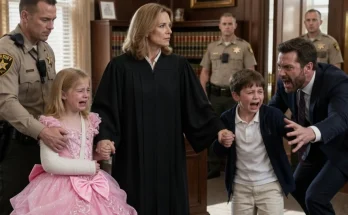
The judge raised a hand.
“No.”
The courtroom fell silent again.
The owner slowly stood.
His face was pale.
My granddaughter looked down at her shoes.
For a moment, nobody moved.
Then the judge said quietly,
“Look at her.”
The man swallowed.
Slowly, he turned toward my granddaughter.
And finally saw her.
Not a case.
Not a complaint.
Not a lawsuit.
A little girl.
A little girl with a scar.
His voice cracked.
“I’m sorry.”
The words barely came out.
Neither did the next ones.
“I should have fixed the fence.”
Tears filled his eyes.
And for the first time, he seemed to understand.
My granddaughter didn’t say anything.
She simply nodded once.
The hearing ended.
People began filing out.
The lawyers shook hands.
The reporters packed their notebooks.
Life moved on.
But for my granddaughter, healing took longer.
For weeks afterward, she barely spoke.
She stopped riding her scooter.
Stopped playing in the front yard.
Stopped smiling the way she used to.
Then one evening, months later, I found her sitting on the porch watching the sunset.
She patted the empty chair beside her.
I sat down.
After a long silence, she asked,
“Grandpa?”
“Yeah, sweetheart?”
“Am I brave?”
My throat tightened.
“Why would you ask that?”
She touched the faint scar on her cheek.
And whispered,
“Because I’m still scared sometimes.”
I wrapped my arm around her shoulders.
Then I told her the truth.
“The bravest people are.”
Years later, that little girl grew up.
The scar faded into a thin silver line.
But every time she looked in the mirror, she remembered something important:
Not the dog.
Not the courtroom.
Not even the apology.
She remembered that when she was hurt, her family stood beside her and refused to look away.
And sometimes that’s what courage looks like.
Not winning.
Not revenge.
Just refusing to leave someone to face their fear alone.
The End. ❤️