I never asked for much, just a peaceful retirement and a well-kept yard. But my neighbor’s massive oak tree had other plans. Every fall, it dropped a relentless ocean of leaves all over my perfect lawn. I tried being neighborly. I went over and asked her nicely if we could split the cleanup, but she just laughed in my face and told me it was “nature.”
That laugh cost her.
The next day, I bought the most powerful heavy-duty leaf blower the hardware store carried. I spent three grueling hours blowing every single stray leaf back over the wooden fence, aiming right for her pristine, uncovered swimming pool. It didn’t just float on the surface; it clogged her filters entirely and cost her $800 to fix.
She was livid. She called the police, but they just laughed it off and told her it was a civil neighborhood dispute. When she threatened to sue me, I just smiled. I thought I had won the leaf war.
I was wrong.
The next morning, I stepped out onto the back porch with a bowl of food, calling for my dog. He didn’t come running. I found him lying stiff and still near the edge of the fence. She had poisoned him.
The grief cut clean through me, instantly turning into a cold, blinding rage. I didn’t bother calling the police this time. I marched straight across the property line, went up to her front porch, and pounded on the door. When she opened it, I looked her dead in the eye and told her exactly, detail by detail, what I was going to do to her for killing my boy.
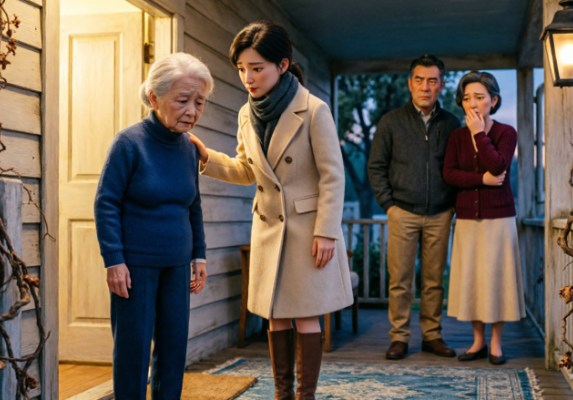
She looked absolutely terrified. But as I stared at her, I realized her wide, shaking eyes weren’t actually fixed on me. She was looking past my shoulder, her face draining of all color, staring at the man who had just quietly stepped up onto the porch right behind me.
A man who looked exactly like my dead husband.
The man didn’t move. He just stood there under the porch light, wearing the same faded flannel shirt my husband, David, had worn the day he vanished in the woods three years ago. The resemblance was uncanny—the same sharp jawline, the same graying temples, the same piercing blue eyes.
“David?” I choked out, my voice dropping to a whisper as the cold rage in my chest instantly turned to confusion. “How… how are you here?”
“He’s not David, Evelyn,” the man said, his voice a pitch lower, carrying a gravelly tone my husband never had. He stepped fully into the light, revealing a jagged scar running down the left side of his neck. “I’m his twin brother, Thomas.”
My breath hitched. David had never mentioned a twin. In fact, he had always told me he was an only child, raised by a single mother who passed away before we met.
Thomas looked past me, his eyes locking onto the trembling neighbor. “I’ve been watching this house for a week, waiting for the right time to approach Evelyn. But then I saw what you did to the dog this morning. David always told me how much he loved that animal. I couldn’t sit in the shadows anymore.”
The neighbor slammed the door shut, the heavy deadbolt clicking into place. Neither of us cared.
“Why didn’t he tell me about you?” I asked, turning to face him, my heart hammering against my ribs. “Why did he lie to me for ten years?”
“Because David wasn’t who you thought he was,” Thomas said quietly, reaching into his pocket and pulling out a small, tarnished silver key. “He didn’t die in a hiking accident, Evelyn. He was running. And the people he was running from have finally tracked this house down. That’s why I’m here. We need to leave. Right now.”
Thomas didn’t wait for me to process the words. He grabbed my arm and pulled me off the porch just as the high-pitched wail of a siren began to echo from a few blocks away. The neighbor had called the police on us.
“My car is down the street,” Thomas muttered, hurrying me toward the edge of the property. “If the bureau tracks David’s old financials to this address, they won’t just question you. They’ll use you as bait.”
“The bureau?” I scrambled to keep up, my mind spinning. “David was a high school accountant, Thomas! What could he possibly have done?”
“He wasn’t an accountant, Evelyn. He was a clean-up man for a private defense contractor,” Thomas said, opening the door to a nondescript gray sedan parked beneath a broken streetlamp. “Three years ago, he found out they were selling decommissioned tracking tech to domestic syndicates. He stole the master decryption ledger—the silver key I showed you opens the safety deposit box where he hid it.”
As the engine roared to life, I looked back at my house, tears blurring my vision as I thought of my poor dog left behind in the yard, a casualty of a war I didn’t even know we were fighting.
“If he had the ledger, why didn’t he go to the authorities?” I asked, gripping the dashboard as Thomas threw the car into drive and sped away from the flashing blue lights arriving at my neighbor’s house.
Thomas looked at me in the rearview mirror, his expression grim. “Because the authorities are the ones who bought it. And right now, your neighbor’s pool isn’t the only thing with a hidden filter. The data on that key is about to go live, and we have exactly six hours to get to the coast before they shut down the grid.”
The tires shrieked as Thomas took a sharp left corner, navigating the dark, winding backroads that led away from the suburbs. In the distance behind us, the flashing red and blue lights of the police cars faded into the thick night fog.
I looked down at the small silver key resting in the palm of my hand. The cold metal felt impossibly heavy. For three years, I had mourned a man I thought I knew inside and out. Now, I was fleeing into the night with a ghost’s brother, leaving my entire life behind in a cloud of exhaust.
“Where is the safety deposit box?” I asked, my voice finally steadying as the initial shock began to harden into determination.
“A small private transit hub near the old coastal shipping docks,” Thomas replied, his knuckles white against the steering wheel. “David knew they would monitor the major banks, so he used an offshore, un-networked security vault. If we don’t physically insert this key and broadcast the ledger to the public servers before 6:00 AM, the contractor’s automated system will wipe the files permanently. The truth will die, and they’ll come for both of us to ensure it stays that way.”
The miles blurred together. For hours, the only sound was the low drone of the sedan’s engine and the occasional crackle of a police scanner Thomas had tucked under the dashboard. Every headlight that appeared in our rearview mirror made my stomach drop, but Thomas drove with a calculated, frozen precision.
At 5:15 AM, the salty, damp air of the coast hit us. Thomas pulled into the gravel lot of a weathered, industrial warehouse complex bordering the dark ocean.
“We’re here,” he muttered, killing the headlights. “Stay close.”
We moved quickly through a side service door and into a dimly lit corridor lined with rows of reinforced steel lockers. Thomas led me to the very back of the facility, stopping in front of a heavy, biometric-override vault panel. He didn’t use a fingerprint; instead, he bypassed the electronic interface entirely, exposing a concealed manual keyhole hidden beneath the digital casing.
“This is it,” Thomas whispered, stepping back and nodding toward me. “He coded the vault access to require two manual inputs. I have the master override code, but the final physical release… it has to be turned by someone who holds the key he left behind. He knew I’d find you if things went sideways.”
I stepped forward, my hand trembling slightly as I lined the silver key up with the lock. I slotted it in.
“On three,” Thomas said, his fingers typing a rapid sequence into the hidden mechanical keypad. “One… two… three.”
I turned the key. With a deep, metallic thud, the heavy steel door clicked open, revealing a compact, military-grade hard drive wired directly to an outdated satellite uplink terminal. A single green indicator light began to blink rapidly.
On the ancient monitor above the terminal, lines of encrypted data began to scroll at blinding speed. A progress bar appeared: Broadcasting Ledger to Public Data Servers… 45%… 72%… 98%…
With a sharp beep, the screen flashed a single, definitive message: TRANSMISSION COMPLETE. ACCESS CODES PUBLICLY INDEXED.
Thomas let out a long, ragged breath, his shoulders finally dropping as he sank slightly against the metal frame of the vault. “It’s over. The decryption algorithms are in the hands of every major news outlet and independent server on the planet. By sunrise, the contractor’s network will be completely dismantled. They have nothing left to hide, and no reason to hunt us.”
A strange, quiet calm washed over the room. The frantic, high-stakes adrenaline of the night vanished, leaving only the steady hum of the cooling server.
I looked out a small, grimy window facing east, watching the very first pale orange hues of the morning sun break over the dark horizon of the ocean. The leaf war, the suburban drama, the secret life of the man I loved—it had all led to this cold, quiet room at the edge of the world.
I was a widow who had lost her home, her quiet retirement, and her faithful dog in the span of less than twenty-four hours. But as the morning light caught the silver key in my hand, I realized I wasn’t running anymore.
“What do we do now?” I asked, turning back to Thomas.
A genuine, weary smile crossed his face, making him look more like David than he ever had before. “Now, Evelyn… we go find a place where nobody knows our names, and we finally get to live in peace.”