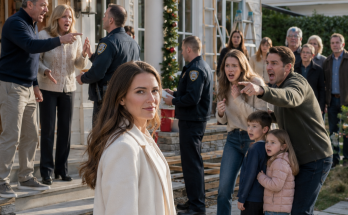
I Was About To Sit At The Dinner Table. My Father Stopped Me And Pushed The Chair Away. Without Looking At Me, He Said, “I Don’t Sit With A Poor, Useless Kid.” Some People Laughed. Others Looked Away. My Sister Pulled Out Her Phone And Started Recording. I Stood Up, Calm. Then I Said, “You Just Made A Very Expensive Mistake.”
### Part 1
The chair screamed across the dining room floor before I even understood I had been pushed.
It was an ugly sound, sharp and humiliating, wood scraping against polished oak while every fork at the table froze halfway to someone’s mouth. My knees bent toward empty air. For one breathless second, I thought I was going to fall in front of all of them—the cousins in pearls, the uncles in tailored jackets, my father’s business friends pretending to be family, and my older sister, who had been waiting all evening for something exactly like this.
I caught myself on the edge of the table.
A crystal water glass trembled beside my hand. Candlelight shook inside it.
My father stood over me with one hand still extended, as if moving my chair away from the table had been no different from brushing lint off his sleeve.
“Don’t sit there,” he said.
His voice wasn’t loud at first. That made it worse. The whole room leaned into the silence, hungry for the rest.
I straightened slowly and looked at him.
Grant Whitaker had built his entire life around being watched. He owned a shipping company, three vacation homes, and the kind of confidence that made waiters apologize before they knew what they’d done wrong. At sixty-two, he still looked expensive—silver hair, pressed navy suit, gold cufflinks, mouth trained into permanent disappointment.
He pointed at the empty space where my chair had been.
“I don’t sit with poor, useless children.”
A few people laughed.
Not loudly. They were too careful for that. But I heard it—the tight little coughs, the smirks hidden behind napkins, the soft exhale of people relieved that cruelty had chosen someone else tonight.
My sister, Vanessa, lifted her phone.
Of course she did.
She was thirty, beautiful in a sharp way, with a diamond bracelet my father had bought her after her third failed business idea. She aimed the camera at me with a smile that looked practiced.
“Ellie,” she said sweetly, “say something inspiring. Maybe about independence?”
More laughter.
My mother, seated at the other end of the table, did not look at me. She studied the centerpiece as if the white roses had suddenly become very interesting.
I had imagined this evening a hundred different ways during the ferry ride to Martha’s Vineyard. I had imagined cold politeness. I had imagined questions about where I worked now. I had even imagined my father refusing to speak to me at all.
I had not imagined the shove.
I had not imagined the chair sliding away like I was a stain he could remove from his dinner.
For a moment, the old version of me tried to come back—the girl who used to apologize before she knew what she’d done, who used to swallow insults because the alternative was being locked out of every room that mattered.
Then I felt my phone inside the pocket of my coat.
The metal edge pressed against my palm.
That tiny weight reminded me why I had come.
I turned toward my father. My voice came out calm enough to surprise even me.
“You just made a very expensive mistake.”
The room went still again.
Vanessa’s smile widened. “Oh my God. Did everyone hear that?”
My father stared at me for three seconds.
Then he laughed.
It was not an amused laugh. It was a dismissal. A sound meant to remind me that I was still, in his mind, the twenty-year-old daughter who had left with two suitcases and no permission.
“Stand by the wall if you insist on staying,” he said. “But don’t embarrass yourself further.”
I stepped back from the table.
The servers moved around me carefully, their faces blank in that trained way staff learn when rich people misbehave. One young woman avoided my eyes while refilling wine glasses. I wondered if she had heard worse in this house. Probably.
The dining room smelled of roast duck, expensive perfume, melting candle wax, and the ocean drifting faintly through the old windows. Outside, beyond the glass, the lawn rolled black toward the water.
I stayed near the bay window.
No one asked me to leave. That would have required acknowledging that I mattered enough to remove.
Dinner resumed.
Plates clinked. Wine poured. Someone asked about the charity gala next month. Vanessa leaned back in her chair and began telling Cousin Paige about the Italian marble statues she had ordered for the garden path.
“They’re arriving tomorrow morning,” she said. “Dad says the whole property needs to look refreshed before the donors come.”
My father nodded, pleased.
I looked past his shoulder toward the driveway.
A black sedan sat near the security gate, half-hidden beneath the bare branches of a winter oak.
Norman Hale had arrived early.
Our family attorney had been coming to this house since I was a child. He had watched my father cut people apart with smiles. He had watched my mother pretend not to notice. He had watched Vanessa learn the family language fluently.
Tonight, Norman had not come for dinner.
He had come because three weeks earlier, I had signed my name on documents that changed who owned my father’s debt.
And my father had just failed the one test he never knew he was taking.
When the grandfather clock struck seven-thirty, Norman finally walked in carrying a leather briefcase so full the seams looked ready to split.
My father’s smile faded.
Vanessa lowered her phone.
For the first time that night, no one looked at me.
They were all looking at the man with the papers.
And Norman looked terrified.
### Part 2
Norman stopped just inside the doorway, as if crossing the threshold required permission from the room itself.
My father wiped his mouth with a linen napkin.
“Norman,” he said, irritated. “You’re late.”
“I apologize, Grant.”
His voice was thin.
He didn’t remove his coat. Snowmelt dotted the shoulders in dark patches, and his glasses had fogged at the edges. He looked less like a powerful attorney and more like a man who had spent the last hour deciding whether to run.
My father gestured impatiently toward the empty chair beside him.
“Sit down and make it quick. We’re having dinner.”
Norman did not sit.
That was the first thing my father noticed.
The second was the briefcase.
Norman carried it to the table and placed it between the silver candlesticks. The sound was heavy, final. Conversation died piece by piece. Aunt Lydia stopped buttering her roll. My cousin’s husband lowered his wineglass. Vanessa’s phone slipped flat against the table.
My father’s jaw tightened.
“What is this?”
Norman opened the case and removed a stack of documents bound with red tabs. I knew those tabs. I had reviewed every one of them until my eyes burned in my apartment in Boston, sitting barefoot under a desk lamp while rain tapped against the window.
Default exposure.
Asset encumbrance.
Collateral recovery.
Cross-default triggers.
Words that looked clean on paper and brutal in real life.
Norman cleared his throat.
“Grant, I need to discuss the Whitaker Maritime refinancing package.”
My father’s shoulders relaxed slightly. He thought he understood now.
“Finally.” He reached into his jacket and pulled out his gold pen. “Where do I sign?”
A strange little pulse moved through the room.
Hope.
Not mine.
Theirs.
Vanessa sat up straighter. My mother let out a soft breath. Uncle Paul muttered, “Good, good,” as if the storm had passed before it ever arrived.
My father tapped the pen against the table.
“Norman, I do not have the patience for another lecture from the bank. Put the signature page in front of me.”
Norman’s fingers tightened around the top document.
“There is no signature page.”
My father blinked.
“What?”
“The bank did not extend the refinancing.”
The room changed temperature.
I watched my mother’s face carefully. Not because I hated her less, but because she had always been the weather vane in our house. She sensed danger before anyone else, not out of courage, but self-preservation. Her hand moved to the pearl necklace at her throat.
Vanessa laughed once.
It came out wrong.
“That can’t be true. Dad said it was handled.”
My father turned on Norman.
“You told me First Atlantic was prepared to move forward.”
“They were prepared to discuss options,” Norman said. “Then the portfolio was reviewed again. After that, the bank sold the debt.”
No one moved.
The candles hissed softly.
My father leaned back as though Norman had spoken in another language.
“Sold it to whom?”
“A private asset management firm.”
“Which one?”
Norman swallowed.
“They have requested an in-person assessment before making any decision about emergency funding.”
My father’s face darkened. “Assessment?”
“Yes.”
“Of my company?”
“Of your company,” Norman said, then hesitated, “and of you.”
That landed harder than the shove had.
For my father, money was not just money. It was proof. It was his shield, his religion, his favorite weapon. But reputation—that was the polished frame around everything. The idea that strangers had decided he needed to be assessed was almost more insulting than being denied.
He rose from his chair.
“You tell these people I built Whitaker Maritime before they were old enough to balance a checkbook.”
Norman said nothing.
My father slapped his palm against the table. Silverware jumped. Someone gasped.
“I asked you a question. Who owns the debt?”
Norman’s eyes moved.
Not much. Just a flicker.
Toward me.
Vanessa saw it first.
She turned slowly, her expression pinched with confusion. Then she looked back at Norman and laughed again, sharper this time.
“No.”
My father didn’t turn around yet.
He was still staring at Norman, waiting for the world to make sense.
Norman removed one more document from the file. This one had a seal on the front page and my signature near the bottom.
“Grant,” he said carefully, “the controlling interest in the debt portfolio is now held by a private fund called Alder Ridge Capital.”
I stepped away from the window.
The floor did not creak beneath me. The house was too well built for that. My father had paid a fortune to make sure nothing in this mansion ever sounded weak.
I walked to the table.
Vanessa whispered, “What are you doing?”
I placed one hand on the back of the chair my father had shoved away earlier.
“My firm reviewed the Whitaker Maritime file three weeks ago,” I said. “The bank wanted out. We bought the paper.”
My father finally turned.
The color had not left his face yet. That would come later.
At first, he only looked annoyed, like I was a child interrupting adults.
“What did you say?”
I looked directly at him.
“You don’t need to call anyone. The person deciding whether your company receives emergency funding tonight is me.”
Vanessa burst out laughing.
Loud, ugly, relieved.
“Oh, Ellie, please. This is humiliating.”
I removed a folded copy of the debt transfer certificate from my coat pocket and laid it beside his wineglass.
The red seal caught the candlelight.
My father stared at it.
His eyes moved across the page once.
Then again.
Then his hand reached for the document with a slowness that made everyone else hold their breath.
He saw the firm name.
He saw the signatures.
Then he saw mine.
For the first time in my life, I watched my father look at me and understand that I was not standing outside his power.
I was standing above it.
### Part 3
Nobody spoke for almost a full minute.
That was the strangest part.
My family had always filled silence quickly—with corrections, insults, gossip, orders, laughter at someone else’s expense. But now the dining room sat frozen under the chandelier while my father held a piece of paper that weighed more than the house around us.
Vanessa was the first to recover.
“This is fake,” she said.
Her voice shook just enough to betray her.
I looked at her.
She hated that. Vanessa had spent years curating a life where people looked at her jewelry, her hair, her vacations, her curated charity work. She didn’t like being looked at directly.
“It isn’t fake,” Norman said quietly.
My father’s head snapped toward him.
Norman flinched.
That tiny movement told the room more than any explanation could have.
My father threw the paper down.
“No. Absolutely not.”
He grabbed his wineglass, then seemed to remember his hand was shaking and set it down before anyone could comment.
“Alder Ridge Capital is not some firm my daughter controls.”
“I don’t control the firm,” I said. “I lead the distressed assets review division handling your portfolio.”
The words sounded cold even to me.
That was intentional.
If I said daughter, he would hear weakness. If I said hurt, he would hear opportunity. If I said remember when you stopped paying my tuition because I refused to work unpaid for Vanessa, he would call me dramatic. If I said I spent two years eating grocery-store soup while you told everyone I had chosen poverty to punish you, he would smile.
So I spoke in the only language he respected.
Risk.
Debt.
Authority.
Terms.
“I’m here as the appointed evaluator,” I continued. “Your management record, asset use, liquidity problems, and borrower conduct are all part of the emergency funding decision.”
Aunt Lydia whispered, “Borrower conduct?”
My father heard her. His face hardened with embarrassment.
“Everyone leave,” he said.
No one moved.
That, too, was new.
His voice had lost something.
Not volume. Not anger. Something underneath it. Certainty.
Vanessa stood halfway. “Dad, maybe we should—”
“Sit down,” he barked.
She sat.
I remembered being twelve years old at this same table, watching Vanessa spill cranberry sauce on my dress and then tell everyone I had done it for attention. My father had laughed. “Eleanor has always needed a scene,” he’d said.
Back then, I had run upstairs and cried into a guest towel because my bedroom had already been given to Vanessa’s visiting friend.
Tonight, I did not run.
My father leaned toward me.
“All right,” he said, lowering his voice. “Enough theater. Tell your people the assessment is complete.”
“It is.”
His eyes narrowed.
I opened the folder Norman had placed on the table and removed the top sheet.
“Whitaker Maritime has missed two vendor payments, delayed payroll taxes, drawn against restricted credit lines, and pledged the same equipment twice as collateral in separate agreements.”
A murmur moved through the relatives.
My father’s face flashed with rage.
“That is confidential.”
“Yes,” I said. “And extremely concerning.”
“You have no right to discuss this in front of my family.”
“Thirty minutes ago, you publicly called me poor and useless in front of the same audience while my sister recorded it.”
Vanessa’s face drained.
The phone.
She slowly reached for it, but I looked at her hand before she touched it.
“Don’t.”
She froze.
My father’s voice came out rough.
“You came here planning this.”
“No,” I said. “I came here hoping you could behave like a stable executive for one evening.”
For the first time, my mother looked at me.
Her eyes were wet, but not with sympathy. Fear. Fear had always been the only emotion in that house powerful enough to make her honest.
“Eleanor,” she whispered, “your father didn’t mean—”
“He meant every word.”
My voice was quiet.
That made her stop.
The room smelled colder now, though the fireplace was lit. Maybe it was the food cooling on plates. Maybe it was fear sweating through expensive clothes.
My father lifted one finger.
“You will approve the funds.”
I almost smiled.
Not because it was funny.
Because even standing on the edge of disaster, he still believed command was the same thing as control.
“No.”
The word dropped cleanly between us.
Vanessa gripped the table.
“Ellie.”
“My name is Eleanor.”
She blinked.
I turned back to my father.
“Based on the borrower’s financial instability, documented mismanagement, excessive personal withdrawals, and behavior demonstrating poor judgment under pressure, emergency funding is denied.”
My father’s mouth opened.
Nothing came out.
So I finished it.
“Effective immediately.”
### Part 4
My father did not explode right away.
That scared my mother more than shouting would have.
He stood completely still, one hand on the back of his chair, his gold pen lying beside his plate like a useless little trophy. His eyes moved around the table, measuring who had heard, who understood, who might repeat it.
Reputation first.
Always.
“Eleanor,” he said at last, voice low, “come into my study.”
“No.”
His face twitched.
My refusal was small, but it shifted something in the room again. I saw Cousin Paige look down at her lap to hide her expression. Uncle Paul took a long drink. Vanessa’s breathing grew shallow.
My father smiled.
It was a terrible smile.
“You’re upset. I understand. You’ve always been emotional.”
There it was.
The old hook.
I remembered being seventeen, holding an acceptance letter from Northwestern while he told me finance was not for girls who “took things personally.” I remembered being twenty-one, standing in the rain outside his office after he canceled my health insurance because I had refused to apologize to Vanessa for missing her engagement party while working a double shift.
I remembered every time anger had been used as proof that I was wrong.
Tonight, I felt anger.
But I did not hand it to him.
“I’m not upset,” I said. “I’m finished.”
Vanessa pushed back her chair.
“Okay, everybody needs to calm down. Ellie, you made your point. Dad was harsh, fine. He can apologize, right, Dad?”
My father’s eyes cut toward her.
She swallowed.
Then she turned back to me with a smile so fake it almost trembled off her face.
“We’re sisters. We don’t need lawyers and banks between us.”
I glanced at her phone.
“You didn’t feel that way when you were recording me.”
Color climbed her neck.
“I deleted it.”
“You deleted it because you realized I could cost you money.”
Her smile vanished.
Good.
Norman shifted beside the table. He looked like he wanted to disappear into the wallpaper.
I turned to him.
“Please confirm the denial in writing and send notice to the senior legal team.”
“Eleanor,” my father warned.
Norman hesitated only once.
Then he nodded.
“Yes, Ms. Whitaker.”
Ms. Whitaker.
Not Ellie.
Not Grant’s younger daughter.
Not poor.
Not useless.
A strange stillness opened inside me when I heard it. Not happiness exactly. Something quieter. Recognition from a man who had spent years watching my family erase me.
My father heard it too.
He slammed his fist onto the table.
This time, no one gasped.
They were too afraid of what came next.
“You work for me, Norman.”
Norman’s face went pale.
“No, Grant,” he said softly. “Not anymore.”
That sentence did what my denial had not.
It broke the room.
My mother covered her mouth. Vanessa whispered something I couldn’t hear. Aunt Lydia stood up and sat back down immediately, as if her body had tried to flee without permission.
My father stared at Norman like betrayal had walked in wearing a familiar suit.
I almost felt sorry for him.
Almost.
Then I remembered the chair.
Norman packed the documents with shaking hands.
“Under the terms of the transfer, Alder Ridge has authority to initiate protective actions if the borrower is deemed unstable or if collateral value is at risk.”
My father’s head turned slowly toward me.
“What protective actions?”
I picked up my phone.
Its screen lit my palm.
For a moment, I saw my reflection in the black glass. I looked calm. Older than twenty-six. Tired around the eyes. But not broken.
That mattered.
“The cross-default clause,” I said.
My father’s face changed.
He knew that term.
Vanessa did not.
“What does that mean?” she asked quickly.
No one answered her.
I tapped the secure contact I had saved before dinner.
The call connected on the second ring.
“Proceed,” I said.
My father moved around the table.
Not running. Men like him did not run in front of witnesses. But he came fast enough that Uncle Paul half-rose from his chair.
“Hang up.”
I held his gaze.
“Register default status across all secured instruments. Begin collateral recovery protocol. Freeze discretionary extensions pending legal review.”
The executive on the other end asked one confirming question.
I answered, “Yes. Full authorization.”
My father reached for my phone.
I stepped back before he touched me.
Not much. Just enough.
The entire room saw it.
For the first time, they saw him as something other than powerful.
They saw him as dangerous.
And they saw me refuse to be afraid.
The call ended.
Five seconds passed.
Then my father’s phone began to ring.
Vanessa’s followed.
Then my mother’s.
Then Uncle Paul’s.
One by one, the table lit up with screens and panic.
My father stared down at his phone. The color finally left his face.
Vanessa grabbed hers with both hands.
“What is this? Why is my card suspended?”
My mother stood so quickly her chair toppled backward.
Outside, beyond the black windows, headlights moved slowly up the driveway.
Not Norman’s sedan.
A white utility truck.
Then another.
My father looked at me.
For the first time that night, his voice was not angry.
It was afraid.
“What did you do?”
### Part 5
The first truck stopped near the front gate.
The second parked behind it.
No one inside the dining room breathed normally after that.
Vanessa rushed to the window, nearly slipping on the polished floor in her heels. She pressed one hand against the glass and squinted into the dark.
“There are people outside.”
My father shoved past her.
The motion was automatic, cruel even in panic. Vanessa stumbled sideways, but for once she did not complain. She only stared at the driveway with her mouth open.
My mother picked up her fallen chair with trembling hands because disorder embarrassed her even during disaster.
“Grant,” she whispered, “what’s happening?”
My father ignored her.
He was reading notifications. His thumb moved fast, then stopped, then moved again. I watched comprehension hit him in stages. First the corporate accounts. Then the credit lines. Then the estate liens. Then the personal guarantees he had signed because he believed he would always be rich enough to outrun consequences.
The walls of his life were not collapsing.
They were being inventoried.
He turned on Norman, who had almost reached the door.
“You fix this.”
Norman looked exhausted.
“I can’t.”
“You will.”
“No,” Norman said. “I warned you for months.”
That was new.
Everyone heard it.
My father’s eyes flashed.
Norman seemed to realize he had gone too far, but he did not take it back. Maybe fear had finally freed him too.
“I warned you about the withdrawals,” Norman said. “The delayed payments. The gala expenses. The yacht refit. The loans taken against assets already pledged. I warned you not to assume another extension would come.”
Vanessa turned from the window.
“Yacht refit?”
My father barked, “Quiet.”
But she was starting to understand that her marble statues had been purchased with borrowed money stacked on borrowed money.
Her face twisted.
“You told me everything was fine.”
“It was fine.”
“No, it wasn’t,” I said.
My father looked at me like he wanted to erase my voice from the air.
I continued anyway.
“Your company needed restructuring eighteen months ago. Instead, you kept spending to maintain the image. You drained operating accounts to fund personal expenses, then used family loyalty to silence anyone who questioned it.”
My mother sat down slowly.
For a second, I thought she might defend him.
Instead, she looked at the tablecloth.
“He said the new contracts would cover everything,” she murmured.
My father rounded on her.
“Not one word.”
There it was again.
That household rule dressed as a sentence.
My mother pressed her lips together, but this time the silence did not protect anyone.
Vanessa’s phone chimed again. She looked down and made a sound like she had been slapped.
“My apartment lease guarantee was through the company.”
No one comforted her.
That might have been the first honest moment in the room.
The doorbell rang.
The sound echoed through the foyer, bright and polite, absurdly normal.
My father did not move.
A server opened the front door because staff were trained to respond when the family froze.
Two men in dark coats stood outside with documents and badges clipped to their jackets. They were not police. Not yet. They were legal recovery agents, there to serve notice and secure records before assets could be moved.
One of them spoke calmly.
“We’re here for Mr. Grant Whitaker.”
My father’s face went gray.
“You are trespassing.”
“No, sir,” the man said. “We have authorization to serve emergency collateral preservation notice.”
The words rolled through the house like smoke.
Collateral preservation.
It sounded cleaner than ruin.
Vanessa turned to me.
“You can stop this.”
I looked at her.
She had tears in her eyes now. Real ones. But they were not for me. They were for her cards, her apartment, her garden project, her place in the hierarchy.
“You don’t want forgiveness,” I said. “You want access.”
Her mouth snapped shut.
My father stepped toward me again, slower this time.
“Eleanor.”
The way he said my full name felt unnatural. Like a man trying to pronounce a foreign word.
“Listen to me. We can resolve this privately.”
“We are resolving it professionally.”
“I am your father.”
“You reminded me what I was to you.”
His eyes flicked toward the dining chair still sitting several feet away from the table.
For one breath, I thought shame might appear.
Then he chose anger.
“I gave you everything.”
I laughed once.
I did not mean to.
It came out sharp, small, and completely humorless.
“You gave me invoices for being your daughter.”
The room went quiet again, but this silence was different. It was listening.
I stepped closer to him.
“You gave Vanessa opportunities. You gave me tests. You gave her rescue after rescue. You gave me consequences. You told everyone I was broke because I was lazy, but you never told them you cut me off when I refused to let you use my name on company paperwork.”
My father’s eyes widened.
There it was.
The red herring he had hoped would stay buried.
Vanessa whispered, “What paperwork?”
I looked at Norman.
He closed his eyes.
My father said, “Enough.”
But enough had always meant stop before the truth costs me something.
Tonight, the truth had arrived with legal notice at the front door.
And I was done stopping.
### Part 6
Vanessa stepped toward Norman.
“What paperwork?”
Norman looked at my father first.
That old habit again.
Permission.
Then he looked at me.
I gave him none. I only waited.
He removed his glasses and rubbed the bridge of his nose.
“Years ago,” he said carefully, “Grant wanted Eleanor listed as a junior signatory on a subsidiary account.”
Vanessa frowned. “So?”
“So,” I said, “the account was already being used to move money between failing divisions. If I signed, my name would have been attached to transactions I didn’t approve.”
My mother made a small sound.
I turned toward her.
“You knew?”
She didn’t answer.
She didn’t have to.
The chandelier hummed faintly overhead. Somewhere in the kitchen, a pan clattered and someone whispered an apology. The smell of duck fat and wine had gone sour.
Vanessa stared at our father.
“You told us Ellie left because she wanted to embarrass the family.”
“She did,” he snapped.
“No,” I said. “I left because I wouldn’t be useful in the way he wanted.”
My father pointed at me.
“Careful.”
That word used to work.
It had once made my stomach tighten, my voice shrink, my mind race for ways to fix what I had not broken.
Now it sounded almost pathetic.
“Or what?” I asked.
He had no answer.
The men at the door waited in the foyer with professional patience. They had probably seen worse. Rich families tend to collapse with the same sounds as poor ones—denial, blame, bargaining, then shouting.
Vanessa turned on me suddenly.
“So you bought the debt because of that? Because of something from years ago?”
“No.”
That stopped her.
I took a breath.
“I didn’t know it was your portfolio when it first crossed my desk. Not at first. The file was coded through holding companies. I recognized the estate address in the collateral schedule.”
My father stared at me.
I let him hear the rest.
“I could have recused myself. I almost did.”
My mother finally looked up.
“Why didn’t you?”
That question carried everything she had never asked.
Why didn’t you call?
Why didn’t you come home?
Why didn’t you forgive us quietly so we could feel decent again?
I looked at her pearl necklace, at the hands folded in her lap, at the woman who had taught me that survival meant smiling beside the person hurting you.
“Because the numbers were rotten,” I said. “Because employees’ paychecks were at risk. Because vendors were waiting on money while this family planned another gala. Because someone had to stop pretending.”
A knock sounded at the dining room entrance.
One of the recovery agents stepped in.
“Mr. Whitaker, we need acknowledgment of receipt.”
My father’s lips curled.
“I acknowledge nothing.”
“That is your choice,” the man said. “Service has been recorded.”
Vanessa whispered, “Recorded?”
The agent nodded toward the small camera clipped to his coat.
Vanessa looked sick.
That almost made me laugh again. After filming my humiliation, she was horrified by documentation.
My father stepped closer to the agent.
“You people have no idea who you’re dealing with.”
The agent remained calm.
“Sir, please don’t obstruct us.”
That sentence cracked something loose in the family.
Uncle Paul stood up.
“I think we should leave.”
My father spun toward him.
“Sit down.”
But Uncle Paul did not sit.
Aunt Lydia gathered her purse.
One by one, relatives rose from the table, suddenly remembering babysitters, early ferries, headaches, anything that would put distance between them and the sinking ship.
Vanessa watched them go with open betrayal.
“They can’t just leave.”
I said nothing.
That was exactly what people like them did when money stopped flowing toward the center.
They left.
Within minutes, the grand dining room emptied until only my father, my mother, Vanessa, Norman, the recovery agents, and I remained.
The table looked ridiculous now. Half-eaten plates. Melted candles. Wine rings. A feast abandoned in the middle of a financial autopsy.
My father lowered his voice.
“Eleanor, I am willing to apologize.”
Willing.
Even then.
Not sorry.
Willing.
Vanessa grabbed his arm.
“Dad, don’t phrase it like that.”
He shook her off.
“I was harsh,” he said. “You surprised me. I reacted poorly.”
I waited.
His jaw worked.
“You may have… misunderstood my meaning.”
There it was.
The apology rich men give when consequences stand nearby.
I picked up my coat from the velvet sofa.
My mother stood.
“Please don’t go.”
I looked at her for a long moment.
For years, I had wanted those words.
When I was twenty-one. When I was sick. When I spent Thanksgiving eating takeout alone. When Vanessa posted family photos and cropped me from the edge.
Please don’t go.
Now they sounded late.
And late love, I had learned, was mostly just fear wearing perfume.
“I have nothing left to do here,” I said.
### Part 7
My father followed me into the foyer.
The recovery agents remained near the study, speaking quietly with Norman about access to company records. Vanessa stood in the dining room doorway, crying into her phone now, calling someone who apparently was not answering.
My mother hovered behind us, wringing her hands.
The foyer was colder than the dining room. The front door had been opened too many times. Wind slipped in around the old frame, carrying the smell of salt water and winter leaves.
My father reached for my sleeve.
I stepped away before his fingers closed.
He stopped.
That tiny bit of restraint must have cost him more than any apology.
“Eleanor,” he said.
I turned.
He looked smaller beneath the chandelier in the entryway. Not physically. He was still tall, still dressed like power. But the house no longer seemed to bend around him.
“I made mistakes,” he said.
I watched him struggle with the sentence like it had thorns.
“You made choices.”
His eyes glistened, but I did not trust tears that arrived after bank alerts.
“Do you want me homeless?” he asked.
I almost answered too quickly.
The truth was complicated.
I did not want him sleeping under a bridge. I did not want my mother hungry. I did not want employees crushed because one man confused cruelty with leadership.
But I did want him to lose the throne he had built from fear.
“I want the law followed,” I said.
“That’s not an answer.”
“It’s the only one you’re getting.”
My mother began to cry softly.
Vanessa came rushing from the dining room.
“My card won’t work. My landlord just emailed me. Ellie, please. Please, I know I was awful, but you don’t understand what this does to me.”
I looked at her mascara streaks, her shaking hands, the diamond bracelet flashing under the light.
“I understand exactly what losing support feels like.”
She flinched.
Good.
Not because I wanted her pain.
Because recognition had finally entered the room.
“You enjoyed it when it was me,” I said. “You filmed it.”
“I was joking.”
“No. You were safe.”
Her face crumpled.
I had spent years imagining a moment where Vanessa would finally understand. In those fantasies, I explained everything perfectly. She cried. She apologized. I felt released.
Real life was uglier.
Her tears did not heal anything.
They only made the hallway feel smaller.
Norman appeared behind her.
“Eleanor, the legal team is asking whether to proceed with the Monday filing or wait for further review.”
My father seized on that.
“Wait. Yes. Further review.”
I looked at Norman.
“Proceed Monday.”
My father’s face emptied.
Monday was only two days away.
Not enough time to hide assets. Not enough time to charm creditors. Not enough time to rewrite the story.
Vanessa whispered, “You’re destroying us.”
“No,” I said. “I’m refusing to rescue you from what already existed.”
Outside, my car waited where I had parked it under the bare trees.
I opened the front door.
Cold air rushed in.
My father’s voice broke behind me.
“We are family.”
I stopped on the threshold.
The night was black beyond the porch lights. Somewhere far off, waves struck the rocks below the estate with slow, patient force.
I turned back one last time.
“This family ended when you moved my chair.”
He stared at me.
I corrected myself.
“No. That’s not true. It ended long before that. Tonight, you just said it out loud.”
Then I walked out.
My hands shook when I reached the car. I hated that. I hated that my body still reacted like the old house could call me back. I locked the doors as soon as I got in and sat there with the engine off, breathing through the leftover adrenaline.
Through the windshield, I could see them framed in the doorway.
My father rigid with disbelief.
My mother folded inward.
Vanessa sobbing into one hand.
For a second, they looked like strangers.
Then I realized they had been strangers for years. I had just kept calling them family because I was too young to know the difference.
I started the car.
As I pulled down the long driveway, my phone rang.
Nora.
My best friend’s name glowed on the screen.
I answered through the dashboard.
For several seconds, I couldn’t speak.
Nora didn’t rush me.
She knew.
Finally, I said, “It’s done.”
Her voice came through soft and steady.
“Are you safe?”
That was the first question she asked.
Not did you win.
Not what happened.
Are you safe?
My throat tightened so fast I had to pull over near the gate.
And for the first time that night, I cried.
### Part 8
The next morning, the story had already started changing.
By nine, Vanessa had posted nothing, which told me more than any statement could have. She had always posted through disaster—hospital waiting rooms, broken engagements, even our grandmother’s funeral, where she uploaded a black-and-white photo of herself staring out a window she had never actually cried beside.
Silence meant panic.
By ten, three missed calls from my mother sat on my phone.
By eleven, my father left a voicemail.
I did not listen to it.
Instead, I sat in my apartment kitchen wearing sweatpants, drinking coffee that had gone cold, and reading the first official reports from the legal team. My apartment was small compared to the Vineyard estate. One bedroom. Brick wall. A radiator that hissed too loudly. A kitchen table with a scratch across the corner from when Nora helped me move it in.
It was mine.
Every inch of it.
No one could shove my chair away here.
On Monday, Whitaker Maritime filed for Chapter 7 bankruptcy protection after emergency funding was formally denied and secured creditors initiated recovery actions. The news moved quickly through the circles my father cared about most. Not because the company was the biggest in New England. It wasn’t. But because Grant Whitaker had spent decades making sure everyone knew his name.
Now they knew it for different reasons.
By Wednesday, the estate entered foreclosure proceedings.
By Friday, the charity gala was canceled.
The imported marble statues arrived anyway.
That detail reached me through Norman, who sent a short email saying the delivery company had asked where to place them. I stared at the message for a full minute, then laughed until I had to sit down.
There was something perfect about it.
A truck full of statues arriving at a house already marked for loss.
Vanessa called me twelve times that week.
I blocked her after the third voicemail.
Not because I was weak.
Because I was finally allowed to choose silence without it being forced on me.
My mother sent a handwritten letter.
I recognized the envelope before I opened it—cream paper, careful cursive, the same style she used for thank-you notes after parties. She wrote that she had loved me in her own way. She wrote that my father had been under pressure. She wrote that Vanessa was fragile. She wrote that families should not be decided by one terrible night.
She did not write that she was sorry for looking away.
I folded the letter and placed it in a drawer.
Not the trash.
Not because I planned to answer.
Because some evidence deserved to be kept.
Three months later, I saw my father again.
Not in person.
In a photograph attached to a financial news article about the liquidation of Whitaker Maritime assets. He stood outside a courthouse in a dark overcoat, thinner, older, surrounded by attorneys who were no longer trying to please him.
The article mentioned mismanagement, overleveraged assets, and failed restructuring attempts.
It did not mention me.
That was fine.
I had never wanted public applause.
I had wanted distance.
The employees were transferred where possible. Some divisions were sold to competitors. A few people wrote to Alder Ridge thanking the firm for moving fast enough to preserve severance packages before everything disappeared into legal chaos.
Those emails mattered more to me than my father’s voicemails.
One Friday evening in spring, Nora came over with Thai food and a bottle of cheap wine. We ate from containers on my kitchen floor because I still had not bought a proper couch.
“You know,” she said, nudging my knee, “for a terrifying corporate executioner, you live like a graduate student.”
I smiled.
“I like knowing what everything costs.”
She lifted her plastic fork. “That is either wisdom or trauma.”
“Both.”
We laughed.
Later, after she left, I opened the window and let the city noise drift in—traffic, someone shouting on the sidewalk, music from an apartment downstairs. Ordinary sounds. Living sounds.
My phone buzzed once.
Unknown number.
The message was short.
Ellie, please. I have nowhere else to go. Dad won’t speak to me. Mom says you’re the only one who can fix this. I’m sorry. I really am.
Vanessa.
I looked at the message for a long time.
I thought about the phone raised at the dinner table.
I thought about the smirk.
I thought about every year she had mistaken my silence for defeat.
Then I typed one sentence.
I hope you learn how to stand without someone else paying for the floor beneath you.
I sent it.
Then I blocked the number.
People say revenge leaves you empty.
Maybe it does when revenge is the only thing you build.
But I had not built my life around destroying them. I had built it around surviving them. Their collapse was not my purpose. It was the consequence they met when I stopped protecting them from themselves.
A year after that dinner, I bought my first house.
Not a mansion. Not waterfront. Not something designed to impress relatives who would never be invited.
It was a narrow brick townhouse with blue shutters, creaking stairs, and a small back garden that caught sunlight in the mornings. The day I moved in, Nora brought coffee, and my new neighbor introduced himself over the fence with dirt on his gloves and a shy smile.
His name was Caleb.
He did not ask what my family did.
He asked if I needed help carrying the table.
That table now sits beside my kitchen window.
Four chairs around it.
No assigned places.
No tests.
No one seated according to income, obedience, or usefulness.
Sometimes, when sunlight hits the wood just right, I remember the sound of that chair scraping across my father’s dining room floor.
I remember the laughter.
I remember the way my voice stayed steady when I said he had made an expensive mistake.
And I know now that the expensive part was never the money.
It was the cost of believing I would always remain the girl standing by the wall, waiting to be invited back.
I don’t wait anymore.
THE END!