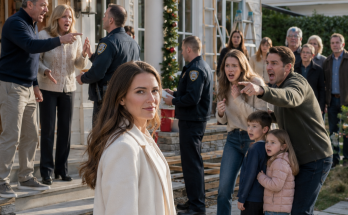
At My Father’s Funeral, My Sister Demanded All The Inheritance, Claiming She Was The Biological Daughter. I Said, “Fine. But For The Rest Of Your Life, Never Contact Me Under Any Circumstances.” She Smirked, “As Usual.” One Month Later, 99 Missed Calls From Her.
### Part 1
“It’s my right to take Dad’s entire estate because I’m his real daughter. You’re just the kid he picked up along the way.”
Marissa said it beside the funeral home’s back exit, where the smell of lilies had gone sour in the summer heat and the black ribbon on the door kept tapping softly against the glass.
For a few seconds, I forgot how to breathe.
The parking lot behind her shimmered under the late afternoon sun. Men in dark suits stood near their cars, loosening ties, speaking in low voices. Somewhere inside, someone was still crying. The funeral director was folding chairs. My father’s framed portrait was still in the chapel, his smile frozen under a wreath of white roses.
And my younger sister was talking about inheritance like we had just finished a business lunch.
“Say something, Nora,” Marissa snapped.
I looked at her. She had changed into a fitted black dress that still had the price tag tucked inside the sleeve. Her makeup was perfect except for one faint line of mascara under her left eye. Not from grief, I thought. From irritation.
“What do you want me to say?” I asked.
She gave a short laugh. “That you understand. That you won’t make this ugly. That you know where you stand.”
Where I stood.
That was always Marissa’s favorite subject.
I was eight when Robert Whitaker first came into my life. Back then, I still slept with the hallway light on and kept a backpack packed under my bed in case anyone decided they were done with me. My biological father had left when I was six, the kind of leaving that made adults lower their voices and made children wonder what was wrong with them.
My mother, Elaine, tried to hold herself together. She worked double shifts at a pharmacy and smiled so hard her face looked tired. Then she met Robert at a church fundraiser, where he was fixing a coffee machine nobody else knew how to fix.
The first time he came to our apartment, he brought sunflowers for my mother and a package of glow-in-the-dark stars for me.
“I heard you like space,” he said, crouching so his eyes were level with mine.
I did not answer him. I did not trust men who smiled too easily.
But that night, after he left, I found the stars on my dresser. He had not pushed. He had not demanded a hug. He had not acted wounded because a scared little girl didn’t know how to be sweet.
A month later, he came over and helped me stick those stars to my ceiling.
“You don’t have to call me anything you don’t want to,” he told me, standing on a chair with one hand pressed to the plaster. “But I’ll always answer if you need me.”
When I turned nine, he adopted me.
I remember the courthouse floor, polished and cold under my patent leather shoes. I remember my mother wiping tears with the corner of a tissue. I remember Robert squeezing my shoulder when the judge asked if I understood what was happening.
I didn’t understand the legal words.
I understood his hand.
I understood that after the hearing, he took us to a diner and let me order chocolate chip pancakes for lunch. I understood that when the waitress said, “Your daughter has your smile,” he did not correct her.
He just looked at me and said, “She sure does.”
That was the day I learned family could be chosen and still be real.
For years, it was enough.
Then Marissa was born.
I was ten when my mother placed that wrinkled baby in my arms. Marissa’s tiny fist grabbed the collar of my shirt, and I whispered, “I’m your big sister. I’ll help take care of you.”
And I meant it.
I taught her how to tie her shoes. I let her sleep in my bed during thunderstorms. I gave her the marshmallows from my cereal and took the burned pancakes so she could have the good ones.
Robert loved us both. He came to my debate competitions and Marissa’s dance recitals. He put both our drawings on the fridge, even when Marissa’s were mostly purple circles and mine were crooked houses with too many windows.
But something shifted after our mother died.
I was nineteen. Marissa was nine.
The accident happened on a wet Tuesday evening. A truck ran a red light three blocks from the grocery store. My mother never made it to the hospital.
At the funeral, Marissa screamed until her voice cracked. When I reached for her hand, she slapped me so hard my palm stung.
“It should have been you,” she said.
The room went silent.
Robert pulled her away from me and said her name in a voice I had never heard before. Sharp. Broken. Terrified.
But grief does not erase words. It only buries them somewhere deep enough to rot.
After that, Marissa began looking at me like I had stolen something by surviving.
Now, sixteen years later, she stood in front of me after our father’s funeral, wearing black silk and a diamond bracelet, telling me I was not family.
“I’m not fighting you today,” I said quietly.
Her eyebrows lifted. “Good.”
“But don’t confuse my silence with agreement.”
Her mouth tightened. “You always do this. You act calm so everyone thinks you’re better than me.”
Behind her, the funeral home door opened and a wave of cold air spilled out, carrying the scent of flowers, carpet cleaner, and old grief.
I looked at that door and thought of my father inside. Robert Whitaker, who had spent months getting thinner, quieter, more tired, but still found the strength to squeeze my hand and whisper, “Don’t let bitterness inherit your life, Nora.”
So I did not yell.
I did not cry.
I looked Marissa in the eye and said, “You can have whatever money you think makes you whole. But after today, do not call me. Do not come to my home. Do not ask me for anything. I am done paying for the fact that Dad loved me too.”
For the first time, her smirk faltered.
Then she laughed. “You’ll come crawling back. You always want to look like the good daughter.”
I walked away before she could see my hands shaking.
Halfway across the parking lot, my phone buzzed.
A message from Dad’s attorney appeared on the screen.
Nora, we need to discuss the private documents your father left for you. Please come by tomorrow morning. There is one matter Marissa is not aware of.
I stopped beside my car, the keys cold in my palm.
For the first time all day, grief took a step back, and fear moved in.
### Part 2
I did not sleep that night.
The house was too quiet, and every quiet thing inside it had my father’s fingerprints on it.
The brass lamp beside the sofa, the one Robert found at a flea market and insisted was “ugly enough to have character.” The chipped blue mug he used every morning. The porch swing that still creaked when the wind pushed it. Even the refrigerator hummed like it was trying to fill the silence he had left behind.
I sat at the kitchen table until dawn with a cup of coffee I never drank.
A week before he died, Dad had asked me to bring him the small cedar box from his bedroom closet. His voice had been thin, but his eyes were clear.
“The one with the brass latch,” he said.
I brought it to his bedside. He ran his fingers across the lid, smiling faintly.
“Your mom gave me this before we got married,” he said. “She told me every man needs a place to keep things he’s too sentimental to throw away.”
Inside were old photographs, birthday cards, my adoption papers, Marissa’s hospital bracelet, and a tiny silver key on a red string.
“What is that for?” I asked.
Dad’s thumb paused on the key. “Sometimes a key is not for opening a door. Sometimes it’s just a reminder that something is already yours.”
I thought it was the medication talking, or the exhaustion. By then, he drifted in and out of memory. Some afternoons he spoke to my mother as if she were standing at the foot of his bed.
So I kissed his forehead and told him to rest.
Now those words kept circling my mind.
Something is already yours.
At nine the next morning, I drove to Ellison & Graves, the law office my father had used for as long as I could remember. It sat above a bakery on Main Street, and the stairwell smelled like warm sugar and printer ink.
Mark Ellison met me at the door.
He was in his late fifties, with silver hair, tired eyes, and the careful gentleness of a man who had delivered bad news too many times.
“Nora,” he said. “I’m sorry.”
His voice was so kind that I nearly broke.
“Thank you,” I whispered.
He led me into a conference room with a long oak table and blinds that cut the morning sun into stripes. A legal pad sat in front of one chair. Beside it was a folder with my father’s name typed neatly on a white label.
I sat down slowly.
“Is Marissa coming?” I asked.
“Not for this meeting.”
My stomach tightened.
Mark placed both hands on the folder. “Your father was very clear that I was to meet with you privately before the general estate discussion.”
“Why?”
He studied me for a moment, as if deciding how much weight my shoulders could hold.
“Because Robert knew your sister would focus on the estate as if everything he owned was still available to divide.”
I swallowed. “And it isn’t?”
Mark opened the folder.
Inside was a stack of papers clipped together, a copy of my adoption decree, and a handwritten letter in my father’s familiar slanted script.
I reached for the letter first.
Nora,
If you are reading this, I am sorry I had to leave you before I could say all of it out loud.
I know your sister. I know her pain, and I know what that pain turned into. I blame myself for not knowing how to heal it. But I will not allow her anger to rewrite the truth.
You are my daughter. Not almost. Not legally only. Not because I was kind. You are my daughter because I chose you, and then every day after that, you chose me back.
There are things I arranged years ago. Do not let anyone shame you for accepting them.
Love,
Dad
The paper blurred.
I pressed my fingers to my mouth. For a moment, I was nine years old again in a courthouse, trying not to cry because happiness felt too big for my body.
Mark waited until I lowered the letter.
“Your father transferred the Maple Ridge house into a separate living trust six years ago,” he said. “You are the sole beneficiary of that trust.”
I stared at him. “The house?”
“Yes.”
“His house?”
“Your house, legally.”
The room seemed to tilt.
Maple Ridge was not just a house. It was the house where my mother had painted the kitchen yellow. The house where Marissa learned to ride a bike in the driveway. The house where Dad marked our heights on the pantry doorframe every September. It sat on three acres outside town, with a white porch, old maple trees, and a stone path my father had repaired every spring.
It was the only place I had ever felt completely safe.
“I don’t understand,” I said. “He never told me.”
“He wanted to,” Mark said. “Several times. But he was afraid it would create more conflict while he was alive. He said you would try to give it back to keep the peace.”
I looked down at my hands.
He was right.
Mark continued, “The remaining assets are separate. Bank accounts, investments, personal property, and other items. You are entitled to part of that as an adopted child. Legally, you and Marissa stand equally.”
I laughed once, but there was no humor in it. “She doesn’t think so.”
“I know.”
“She told me yesterday that I deserve nothing.”
Mark’s jaw tightened. “Your father expected that.”
Those words landed harder than I expected.
My father had seen it. He had known. He had carried that knowledge while dying.
“Can I refuse the rest?” I asked.
Mark leaned back slightly. “You can disclaim your share of the remaining estate, yes. But I would urge you not to make decisions from exhaustion.”
“I’m not exhausted,” I said.
He gave me a look.
I looked away.
Outside the blinds, people crossed the street carrying coffee cups, going on with their lives like fathers did not die and sisters did not tear families apart over paperwork.
“I don’t want her in my life,” I said. “If giving up the money ends it, I’ll do it.”
Mark was quiet for a long moment. “Nora, money rarely ends this kind of thing. Sometimes it only shows people where to aim next.”
I thought of Marissa’s smirk in the funeral home parking lot.
Then I thought of my father’s letter.
“Prepare the paperwork,” I said. “She can have the liquid assets. The investments. Whatever else. The house stays where Dad put it.”
Mark nodded slowly.
“There is one more thing,” he said.
Of course there was.
He reached into the folder and removed a smaller envelope. My name was written across it in Dad’s handwriting.
“This was in the cedar box,” Mark said. “He asked me to give it to you only after you understood about the house.”
I opened it with unsteady fingers.
Inside was the tiny silver key on the red string.
Beneath it, one line was written on a torn piece of paper.
Check the pantry doorframe before anyone paints over it.
My breath caught.
I knew then that the house was not the only thing Dad had left behind.
### Part 3
Marissa called me before I even made it back to my car.
Her name flashed across my phone screen, bright and aggressive, as if the phone itself were irritated.
I let it ring.
Then came the text.
Did you meet with Ellison? Don’t try anything stupid.
Another one followed before I could put the key in the ignition.
You know Dad wanted me taken care of. Don’t play victim.
I sat in the law office parking lot with the air conditioner blowing cold against my damp face. Across the street, a man in a baseball cap was loading boxes of bread into a van. The ordinary sound of cardboard scraping pavement felt almost insulting.
My father was dead. My sister was circling his estate like a vulture. And somewhere inside the house he had left me, there was something hidden in a pantry doorframe.
I should have driven straight to Maple Ridge.
Instead, I drove home to my apartment, locked the door, and sat on the floor beside my couch until the light changed.
I needed one place that did not smell like Dad yet.
That evening, Mark sent the formal disclaimer papers. I read every line. By signing, I would give up my claim to the remaining estate assets. Marissa would receive the bank accounts, the brokerage account, the car, the furniture not specifically assigned elsewhere, and whatever else Dad had not already placed in trust.
It was not a small amount.
Dad had been careful his whole life. He drove used cars, fixed his own gutters, clipped coupons he didn’t need, and told us, “Money is just a tool. Don’t let it become your personality.”
Marissa had made it her personality by seventeen.
At twenty-five, she worked for a digital marketing startup where job titles sounded like slogans. She spent more time photographing lattes than drinking them. Every holiday, she arrived late wearing something expensive, kissed Dad on the cheek, and immediately asked if the lighting was better near the window.
But Dad still loved her.
That was the part that hurt in a complicated way.
He saw her clearly, but he loved her anyway.
I signed the papers two days later.
When I called Marissa to tell her, she answered on the first ring.
“Finally,” she said. “I was wondering how long you’d drag this out.”
“I signed the disclaimer.”
There was a pause. In the background, I heard music, glasses clinking, a woman laughing too loudly.
“Everything?” Marissa asked.
“Everything in the estate process that I was entitled to claim.”
Her voice turned sweet, which was worse than anger. “See? That wasn’t so hard.”
“I meant what I said at the funeral,” I told her. “Do not contact me again.”
“Oh my God, Nora. Stop being dramatic.”
“I’m not being dramatic. I’m done.”
“You’re done because you know you lost.”
I looked at the wall above my desk, where a photo of Dad and me from my college graduation hung in a cheap black frame. He was holding my diploma like he had earned it himself.
“No,” I said. “I’m done because I finally understand winning has nothing to do with you.”
I hung up before she could answer.
For three weeks, I heard nothing.
I went to work. I answered emails. I helped my team finish a cybersecurity rollout for a hospital network. I bought groceries I barely tasted and put Dad’s letter in the top drawer of my nightstand.
On the fourth Saturday, I drove to Maple Ridge.
The road to the house curved past fields and old split-rail fences. It was late August, and the air smelled like cut grass and hot gravel. When I turned into the driveway, my chest tightened so hard I had to stop the car halfway up.
The house looked smaller than grief had made it.
White siding. Green shutters. Porch swing moving slightly in the wind.
I unlocked the front door with the key Mark had given me.
The inside was stale, the air thick with dust and lemon furniture polish. Someone had left the curtains closed. Thin lines of sunlight cut across the hardwood floor.
“Dad?” I whispered, then hated myself for it.
The silence answered.
I moved from room to room slowly, touching nothing at first. His reading glasses were still beside the recliner. A crossword puzzle lay on the coffee table with three empty squares left. In the kitchen, the yellow paint my mother had chosen had faded to the color of old butter.
The pantry door stood beside the refrigerator.
For a long time, I just stared at it.
On the inside frame were our height marks. Mine in black pencil. Marissa’s in blue. Dates beside each line in Dad’s careful handwriting.
Nora, age 10.
Marissa, age 3.
Nora, first day of high school.
Marissa, finally taller than the dog.
I laughed, then cried so suddenly I had to grip the counter.
When I could see again, I crouched near the bottom of the frame. The wood was nicked and uneven. Near the baseboard, behind a smudge of old paint, I saw a tiny circular hole.
The silver key fit perfectly.
Something clicked.
A narrow piece of trim loosened in my hand.
Behind it was a flat envelope wrapped in plastic.
I pulled it free, heart hammering.
Inside were photographs, a USB drive, and another note.
Nora,
Some truths are not meant to hurt you. They are meant to free you.
I read that sentence three times.
Then headlights swept across the kitchen wall.
A car door slammed outside.
And through the window, I saw Marissa walking up the porch steps.
### Part 4
I put the envelope back into the hidden space before Marissa reached the door.
My hands moved faster than my thoughts. Trim back in place. Key in my pocket. Face wiped with the heel of my palm.
Then the front door flew open.
Marissa stood in the entryway wearing oversized sunglasses, white jeans, and a blouse that probably cost more than my monthly car payment. She looked around the living room like she was inspecting a hotel room she had found disappointing.
“What are you doing here?” I asked.
She pulled off her sunglasses. “I could ask you the same thing.”
“This is my house.”
Her face hardened instantly. “Don’t start that.”
I felt something inside me go very still.
The old Nora would have softened her voice. She would have explained gently, offered tea, tried to lower the temperature in the room before Marissa set it on fire.
But the old Nora had been trained by years of being called fake.
“This is my house,” I repeated. “Dad made that decision years ago.”
“You manipulated him.”
The words came fast, ready-made. She had practiced them.
“I didn’t even know until after the funeral.”
“Convenient.”
She walked past me into the kitchen. Her perfume filled the room, sharp and floral, fighting with the old smell of dust and wood. She opened a cabinet, then another, as if looking for evidence that I had already moved in and stolen her childhood.
“I was going to live here,” she said.
“No, you weren’t.”
She spun around. “Excuse me?”
“You have an apartment downtown.”
“I had an apartment. I gave notice.”
“Why would you do that?”
“Because this is Dad’s house.” Her voice rose. “My father’s house.”
“Our father.”
Her eyes narrowed. “You really believe that, don’t you?”
I looked at the pantry doorframe behind her. The marks were still there. My name. Her name. Both written by the same hand.
“Yes,” I said. “I do.”
She gave a bitter laugh and yanked open the refrigerator. Empty. She slammed it shut.
“You don’t need this place. You have your cute little job and your boring little apartment. I’m the one who actually stayed with him.”
“You stayed here because it was free.”
“I took care of him.”
I thought of the nights I drove over after work to change Dad’s sheets because Marissa was at a rooftop bar. I thought of the pill organizer I filled every Sunday. I thought of the way she posted a selfie from his hospital room with the caption, Hardest season of my life, while Dad slept behind her with an oxygen tube under his nose.
“You visited when people could see it,” I said.
Her face flushed.
For a second, I saw the little girl she had been after our mother died. Angry. Lost. Looking for a place to put the pain.
Then she disappeared, and the woman in front of me pointed at the hallway.
“I’m moving in next week.”
“No.”
“You can’t stop me.”
“I can.”
Her lips parted.
The word hung between us, simple and final.
“No,” I said again. “You are not moving into this house. You are not taking anything from it without written permission. And after today, you are not coming here again.”
Marissa stared at me as if I had slapped her.
Then she smiled.
Not happily. Not confidently.
Dangerously.
“You think paperwork makes you untouchable?”
“I think the law makes the owner clear.”
“You stole my inheritance.”
“I gave up your inheritance.”
Her smile twitched.
“You gave up cash because you already had the big prize,” she said. “That was your plan.”
I almost told her about the letter. About the trust. About Dad planning this because he knew exactly what she would do.
But something stopped me.
Maybe it was the envelope hidden inches away from her hand. Maybe it was the memory of Mark’s warning.
Money rarely ends this kind of thing. Sometimes it only shows people where to aim next.
So I said nothing.
Marissa grabbed a ceramic bowl from the counter, one my mother used to fill with peaches every summer.
“Put that down,” I said.
She looked at the bowl, then at me.
“You don’t get Mom too.”
Before I could move, she threw it.
It hit the wall beside the pantry and shattered into yellow pieces.
The sound cracked through the house like a gunshot.
For a moment, neither of us moved.
Then I pulled out my phone.
“What are you doing?” she demanded.
“Calling the police.”
Her eyes widened. “You wouldn’t.”
I looked at the broken bowl on the floor, the same bowl my mother’s hands had washed a hundred times.
“I already did.”
That was a lie. I had only unlocked my screen.
But Marissa believed me.
She backed toward the door, face pale with rage. “You’ll regret this.”
“No,” I said. “I regret not doing it sooner.”
She left with the door still swinging behind her.
I waited until her car tore down the driveway before I slid to the floor and picked up one broken piece of the bowl.
Only then did I realize the trim beside the pantry had loosened again.
The envelope was visible.
And one of the photographs had slipped halfway out.
It showed Marissa at sixteen, standing beside a man I did not recognize, handing him an envelope outside Dad’s garage.
On the back, in Dad’s handwriting, were three words.
This is why.
### Part 5
I took the envelope to my car and drove straight to Mark Ellison’s office.
It was Saturday, and the office was closed, but Mark answered on the third ring. When I told him what I had found, he was quiet for a long time.
“Do not look through the USB drive alone,” he said.
His voice had changed.
No softness now. No careful sympathy.
“Why?” I asked.
“Because if Robert hid it there, he likely wanted it preserved properly.”
“Mark, what is this?”
A pause.
“Bring everything Monday morning. Until then, keep it somewhere safe.”
I wanted answers immediately, but grief had taught me that wanting did not make the world kind. So I placed the envelope in a lockbox at my bank and spent the rest of the weekend feeling as if the walls around my life had shifted by an inch.
On Monday, I sat in Mark’s conference room while he inserted the USB drive into an old laptop that was not connected to the internet.
Beside him sat another attorney from the firm, a woman named Patrice Klein, who specialized in estate disputes. That detail alone made my stomach twist.
The USB drive contained folders.
Bank Statements.
Emails.
Repair Receipts.
Marissa.
Nora.
My father had organized even his secrets.
Mark opened the folder with Marissa’s name.
Inside were scanned documents, screenshots of messages, and short notes written by Dad. Not dramatic. Not accusing. Just dated observations.
Marissa asked for $3,000 for rent. Paid directly to landlord.
Marissa claimed tuition balance unpaid. Confirmed with school. Already paid.
Marissa used my credit card without permission. Canceled card. Did not pursue.
Marissa brought Dylan to house again. Missing watch from dresser.
I pressed my hand flat against the table.
Dylan.
I remembered him vaguely. A boyfriend from Marissa’s senior year of high school. Bad posture, silver chain, eyes that never stayed in one place. Dad disliked him, but he never said much in front of Marissa.
Mark clicked on a video file.
The footage came from Dad’s old garage camera. I recognized the angle at once: the driveway, the side door, the workbench where he kept jars of screws sorted by size.
In the video, Marissa and Dylan entered the garage. Marissa opened a drawer near the back wall. Dylan removed a small metal box.
My father’s emergency cash box.
I stared, cold spreading through my ribs.
Another video showed Marissa alone in Dad’s office, taking papers from his desk and photographing them with her phone.
Another showed her arguing with him on the porch two years before he died. There was no audio, but her gestures were sharp. Dad looked tired. So tired.
Patrice paused the video.
“Nora,” she said gently, “your father appears to have been documenting a pattern.”
“Why didn’t he tell me?”
Mark removed his glasses and rubbed the bridge of his nose.
“Because he was ashamed.”
“Of her?”
“Of what he felt he had failed to stop.”
The words hurt more than I expected.
My father, who had saved me from feeling unwanted, had spent his final years feeling like he had failed another daughter.
Patrice opened another document. “There’s more.”
It was a notarized statement written three years before Dad died.
In it, he explained that Marissa had repeatedly taken money under false pretenses, pressured him to change estate documents, and once threatened to accuse Nora of exploiting him if he did not “fix the will.” He wrote that he feared Marissa would try to remove Nora from the family history after his death.
My throat closed.
Then Patrice turned the page.
The Maple Ridge house had not simply been transferred to me because Dad loved me.
It had been transferred after Marissa tried to convince him to sell it and give her the money.
There were emails.
Dad, you don’t need that big place. Nora doesn’t deserve it anyway.
If you really loved your real daughter, you’d help me now.
Don’t make me tell people Nora is manipulating you.
Each sentence felt like stepping on glass.
I had spent years blaming myself for not trying harder with Marissa. I had told myself she was damaged by our mother’s death. I had excused the cruelty because grief had entered her young.
But this was not a child screaming at a funeral.
This was an adult sharpening that scream into a tool.
“What happens now?” I asked.
Mark folded his hands. “Legally, the house is secure. Your disclaimer of the remaining estate is valid. However, if Marissa continues to harass you or spreads false claims, this evidence matters.”
“Can she challenge the trust?”
“She can try,” Patrice said. “People can always try. Winning is another matter.”
I looked at the frozen video still on the laptop. Marissa’s face was turned toward the camera, clear as daylight.
“She already thinks I tricked him,” I said.
“Then she may escalate,” Mark replied.
He was right.
By noon the next day, Marissa posted online.
She did not use my name at first.
Some people pretend to be family until there’s money involved. Imagine stealing a grieving daughter’s childhood home after manipulating a sick old man.
By evening, the comments were full of heart emojis, angry faces, and strangers saying things like, Sue her and Blood doesn’t lie.
I read them in my apartment with the blinds closed and a thunderstorm shaking rain against the windows.
Then Marissa tagged me.
This is my stepsister. She took everything.
My phone began to buzz.
Coworkers. Cousins. Old neighbors. People I had not heard from in years.
I sat there, listening to the storm and the endless vibration of my phone across the table.
For one moment, the old fear came back.
The fear of being the abandoned child.
The outsider.
The one nobody would believe.
Then Mark emailed me one scanned page from Dad’s statement.
The last paragraph read:
If Marissa attacks Nora after my death, let the record show that Nora did not steal her place. Marissa tried to steal Nora’s.
I stood up, wiped my face, and called my manager before Marissa could bring the war to my workplace.
But she was already there.
### Part 6
Janet from reception called me at 8:17 the next morning.
Her voice was tight.
“Nora, I need you to stay where you are.”
I was in the elevator, holding coffee in one hand and my laptop bag in the other. The doors had just closed on the parking garage level.
“Why?” I asked.
“There’s a woman in the lobby.”
My skin went cold.
“Is it Marissa?”
“She says she’s your sister. She’s handing out papers.”
The elevator climbed.
Second floor.
Third.
My reflection in the metal doors looked pale and older than thirty-five.
“What do the papers say?” I asked, though I already knew.
Janet hesitated. “They have your photo.”
Fourth floor.
Fifth.
“Tell security not to let her past the lobby,” I said.
“They’re already with her. She’s yelling.”
The doors opened.
I stepped into the hallway, and even from five floors up, I could hear her.
“You people should know who you’re employing!”
Her voice echoed through the atrium below. Sharp. Triumphant. Hungry.
By the time I reached the lobby, half the office had heard enough to stop pretending not to listen.
Marissa stood near the front desk, waving a stack of flyers. Her hair was curled, her lips painted red, and her face was bright with the reckless energy of someone who believed attention was the same thing as justice.
A security guard stood between us.
The flyer on the floor near my shoe showed my company headshot, the one from our website.
Under it, in huge letters, Marissa had written:
SHE STOLE HER DEAD FATHER’S HOME FROM HIS REAL DAUGHTER.
For a second, all I could hear was blood rushing in my ears.
Then my manager, Paul, appeared beside me.
“You don’t have to handle this alone,” he said quietly.
That steadied me.
I walked forward until Marissa saw me.
Her face lit up. “There she is.”
“Leave,” I said.
She laughed. “Afraid they’ll learn the truth?”
“No. I’m afraid you’ll force me to do what I should have done weeks ago.”
Something flickered in her eyes, but she pushed past it.
“You think a fancy job makes you better than me? You think Dad’s house makes you his daughter?”
“No,” I said. “Dad made me his daughter.”
Her mouth twisted.
Around us, the lobby had gone still. The security guard’s radio crackled. Someone’s phone camera was raised, then lowered when Paul gave a hard look.
Marissa stepped closer to the guard. “Ask her why she gave up the money but kept the house. Ask her how she got an old sick man to sign papers.”
I reached into my bag and pulled out a folder.
Mark and Patrice had prepared it the night before. A cease-and-desist letter. Copies of public records showing the trust transfer date. A summary of my legal position.
No videos. No private family evidence.
Not yet.
I handed the letter to Marissa.
“This is formal notice,” I said. “You are not to contact me, come to my workplace, distribute false statements about me, or come onto my property. If you continue, I will pursue every legal option available.”
She stared at the papers as if they were written in another language.
Then she tore them in half.
The sound was small but final.
A woman near the elevators gasped.
Marissa dropped the pieces at my feet. “Sue me.”
I looked at Paul.
He looked at security.
“Escort her out,” Paul said.
Marissa screamed as they guided her toward the doors.
Not cried.
Screamed.
“You’re nothing, Nora! You were never one of us! He felt sorry for you! That’s all!”
The words hit old bruises, but they did not open me the way they used to.
Maybe because my father had left me proof.
Maybe because I was finally tired enough to stop bleeding for people who enjoyed the sight of it.
When the glass doors slid shut behind her, the lobby remained silent.
Then Janet came around the desk and picked up one of the torn flyers.
“This is harassment,” she said.
Paul nodded. “We’re filing an incident report.”
“I’m sorry,” I said automatically.
He frowned. “Don’t apologize for being targeted.”
That sentence stayed with me.
Don’t apologize for being targeted.
By noon, HR had security footage saved. By two, Mark had copies of everything. By four, I was at the police station giving a formal statement.
The officer who took the report was a calm woman named Hernandez. She listened without interruption, asked clear questions, and did not once make me feel foolish for saying, “She’s my sister, but I’m afraid of what she’ll do next.”
When I finished, she said, “Family can still commit harassment. Family can still defame you. Family can still trespass.”
I nodded, though my throat burned.
That evening, an official warning was issued. Marissa was told to stop contacting me and to stay away from my workplace and property. Mark filed the civil paperwork. Patrice prepared for the possibility of a trust challenge.
For six days, there was silence.
No calls.
No posts.
No flyers.
I slept through the night for the first time since Dad died.
On the seventh day, I drove to Maple Ridge to meet a locksmith and install security cameras.
The front porch smelled like rain and old wood. The maple leaves had begun to turn gold at the edges.
For one fragile moment, I felt peace.
Then the locksmith pointed to the side of the house.
“Ma’am,” he said carefully, “was that window broken before I got here?”
I followed his gaze.
The basement window was shattered inward.
And on the grass below it lay Marissa’s bracelet, glittering in the dirt.
### Part 7
I did not go inside.
That may have been the first truly wise thing I did.
Every part of me wanted to run through the front door, shouting Marissa’s name. I wanted to catch her in the act. I wanted to demand how far she planned to go before she admitted Dad’s death had not made me her enemy.
But Officer Hernandez’s words came back to me.
Family can still trespass.
So I stepped back, called 911, and waited beside the locksmith’s van with my arms wrapped around myself.
The house stood quiet.
Too quiet.
A curtain moved in the upstairs hallway.
The locksmith saw it too. His face changed.
“Let’s move farther back,” he said.
We crossed the driveway.
Ten minutes later, two police cars rolled up without sirens. Officer Hernandez was in the first one. She nodded to me, then approached the house with her partner.
I heard the front door open.
Then voices.
A crash.
A shout.
“Put it down.”
My knees weakened.
The locksmith offered me a bottle of water from his cooler. I took it but could not open it.
A few minutes later, the officers brought Marissa out.
Her hair was messy. Dust streaked her black sweater. Her eyes landed on me, and for once, there was no performance in them.
Only hatred.
“You called the cops on me?” she yelled.
“You broke into my house.”
“It’s not yours!”
Officer Hernandez guided her toward the car. “Marissa Whitaker, you’re being detained for unlawful entry and violation of a no-contact warning. We’ll sort out the rest at the station.”
Marissa twisted around. “Tell them, Nora! Tell them I lived here! Tell them this is my home!”
I said nothing.
That silence enraged her more than any argument could have.
Inside, the house looked wounded.
The basement window was broken. Mud tracked across the floor. Drawers had been opened in Dad’s office. His files were scattered, some torn. The cedar box from his bedroom closet lay open on the carpet.
She had been looking for something.
My stomach dropped.
I ran to the pantry.
The trim was intact.
The hidden compartment was empty because I had already taken everything.
For the first time since Marissa began her war, I understood the title of the story she thought she was writing.
She believed Dad had left me one thing by accident.
But Dad had left me evidence by design.
At the station, Marissa refused to answer questions until she could call someone. I did not stay to hear the rest. Mark told me to go home, save my strength, and let the process work.
But the process became uglier before it became clean.
Marissa challenged the trust.
Her petition claimed I had manipulated Dad during his illness, isolated him from his “only real child,” and coerced him into transferring the Maple Ridge house. She asked the court to freeze the property and review the estate documents.
When Mark read the petition aloud, I felt my old fear stir.
Lies are strange things. Even when you know they are lies, hearing them spoken formally gives them weight.
Patrice saw my face.
“Look at me,” she said. “Your father prepared for this.”
The hearing took place in a county courthouse that smelled like paper, old coffee, and floor wax. Marissa arrived wearing a navy dress and a fragile expression she must have practiced in a mirror. She sat beside her attorney, dabbing her eyes with a tissue.
I sat between Mark and Patrice, hands folded so tightly my knuckles ached.
When Marissa testified, her voice trembled.
“Dad was sick. Nora controlled everything. She always wanted to be the favorite. I didn’t even know about the house until after he died.”
Part of that was true.
She did not know about the house.
That was the detail she missed.
Her attorney asked, “Did you feel excluded from your father’s final decisions?”
Marissa looked at me, then lowered her eyes.
“Completely.”
Then Patrice stood.
She did not raise her voice. She did not dramatize. She simply opened a binder.
“Ms. Whitaker,” she said, “is this an email you sent to your father three years before his death?”
Marissa glanced at the screen where the email appeared.
Her face changed.
Patrice read only enough for the room to understand.
In the message, Marissa had urged Dad to sell Maple Ridge and give her the proceeds because Nora “was not real family.”
“Did you send this?” Patrice asked.
Marissa’s attorney stood. “Objection.”
The judge allowed the question.
Marissa swallowed. “I was upset.”
Patrice nodded. “Were you also upset when you entered your father’s office and photographed his financial documents?”
Another exhibit.
A still image from the garage camera.
Then another.
Then Dad’s notarized statement.
The courtroom became very quiet.
Patrice did not need to attack her. The truth did it without raising its voice.
Finally, Mark submitted the trust documents. They had been executed six years earlier, when Dad was medically evaluated as fully competent. The transfer had been recorded properly. The taxes had been paid. The title was clean.
The judge reviewed everything, then looked over his glasses at Marissa.
“Ms. Whitaker, disappointment is not evidence. Biology is not a legal argument against a valid adoption. And grief does not entitle you to trespass, harass, or defame.”
Marissa’s face went white.
The petition was dismissed.
The trust stood.
The house was mine.
Outside the courtroom, Marissa waited near the vending machines. Her attorney had already left. For the first time in my life, she looked small.
“Nora,” she said.
I stopped, though Mark’s hand hovered near my elbow.
Her eyes were red. Whether from rage or humiliation, I could not tell.
“I have nowhere to go.”
There it was.
Not an apology.
Not remorse.
A need.
For years, I would have mistaken that for a bridge.
This time, I recognized it as a hook.
“I’m sorry you’re in trouble,” I said. “But I’m not your solution.”
Her mouth trembled. “Dad would hate this.”
“No,” I said. “Dad hated watching you hurt me.”
She flinched.
I walked away before pity could dress itself up as responsibility.
Behind me, she whispered, “You’re really leaving me like this?”
I did not turn around.
“Yes,” I said. “I am.”
### Part 8
The first thing I did after the court dismissed Marissa’s petition was paint the pantry doorframe with clear sealant.
Not over it.
Never over it.
The contractor looked confused when I asked him to preserve the pencil marks exactly as they were. He stood in the kitchen wearing a paint-splattered cap, staring at the uneven lines and old dates.
“Most folks sand these down,” he said.
“I’m not most folks.”
He smiled. “Fair enough.”
Maple Ridge needed more work than I expected. The basement window had to be replaced. Dad’s office needed repairs. The porch boards groaned underfoot, and one section of gutter sagged like a tired shoulder. For weeks, I spent evenings there after work, changing locks, sorting papers, cleaning drawers, learning the shape of grief in practical tasks.
Grief, I discovered, smells like dust and lemon oil.
It sounds like a tape dispenser ripping across cardboard boxes.
It feels like finding your father’s handwriting on an old grocery list and having to sit down on the floor because milk, eggs, batteries should not be enough to break your heart.
I found pieces of him everywhere.
A birthday card he forgot to mail to me, already signed.
A recipe for my mother’s chicken soup written badly from memory.
A box labeled Christmas lights, probably broken, because Dad never threw away anything that still had a theoretical chance.
In his desk, I found a photo of me and Marissa as children.
We were lying on the living room carpet, heads together, coloring in the same book. My hair was in two messy braids. Marissa had marker on her cheek. On the back, Dad had written:
My girls before the world taught them to compare love.
I cried over that one for a long time.
Not because I wanted Marissa back.
Because I missed the version of us that had existed before cruelty became her language.
After the hearing, Marissa’s life unraveled quickly.
The trespassing charge did not disappear. The harassment reports remained. The defamation case moved forward until she agreed to a settlement that required her to remove the posts, issue a written retraction, and never contact me again except through attorneys.
She signed it.
Not because she was sorry.
Because she had run out of options.
I heard pieces of her life through relatives who thought they were helping by reporting updates I never requested. Her startup fired her after the videos of her lobby scene made their way to people in her industry. Her boyfriend left. Friends who had once filled her comment sections with fire emojis stopped answering her calls. Debt collectors found her faster than sympathy did.
Once, my aunt called and said, “Nora, maybe you could just talk to her. She’s still your sister.”
I was standing on the back porch at Maple Ridge, watching rain drip from the maple leaves.
“No,” I said.
My aunt sighed. “Your father would want peace.”
“Peace is exactly what I’m choosing.”
She did not know what to say to that.
People often confuse forgiveness with access. They think if you stop screaming, you must be ready to open the door. But some doors stay closed not because hate is inside, but because peace is.
I did not hate Marissa.
Hate would have kept me tied to her.
I wished her accountability. I wished her distance. I wished her a life where she might one day look in a mirror and stop blaming my reflection for what she saw.
But I did not wish her back into mine.
That fall, HR offered me a leadership role at a smaller branch office closer to Maple Ridge. It felt like Dad nudging the pieces around one last time. The commute took me past fields and farm stands, past a coffee shop where the owner remembered my order after three visits.
My team was small, kind, and direct. Nobody cared about my family drama. They cared whether the servers stayed online and whether someone remembered donuts on Fridays.
I began breathing normally again.
In November, I hosted Thanksgiving at Maple Ridge for the first time.
Not for relatives who measured love by blood or money.
For people who had shown up without demanding ownership of my pain.
Janet from reception came with sweet potato casserole. Paul brought his wife and two kids. Mark stopped by with a bottle of cider and pretended he was not emotional when he saw Dad’s recliner still in the living room. My neighbor, Mrs. Alvarez, brought tamales because, as she said, “Turkey needs friends.”
The house filled with sound.
Laughter in the kitchen. Football from the living room. Rain tapping softly against the windows. The old furnace clicking on like a familiar throat clearing.
For years, I had thought family was something you had to defend your place inside.
That night, watching people pass plates around my father’s table, I realized family could also be something that made room without being asked.
After dinner, I stepped into the pantry alone.
The doorframe marks were still there.
Nora, age 10.
Marissa, age 3.
Nora, first day of high school.
Marissa, finally taller than the dog.
I touched my name lightly.
Then I touched Marissa’s.
For a moment, sadness moved through me, clean and quiet.
“You tried, Dad,” I whispered.
And he had.
He had loved two daughters. One accepted that love as a home. The other treated it like a prize someone could steal.
In the end, Marissa bragged about taking Dad’s entire estate. She called herself the real daughter. She counted the money before the funeral flowers had wilted.
But she missed one detail.
Dad had never measured family by blood.
He had measured it by who stayed gentle when they had the power to be cruel. By who protected memories instead of selling them. By who understood that love was not smaller because it was shared.
The house was mine, yes.
But not because I tricked him.
Because he knew me.
Because he chose me.
Because long before Marissa tried to erase me, my father had already written me into the only place that mattered.
Home.
I turned off the pantry light and walked back toward the noise of my new life.
For the first time since the funeral, I did not feel like the stepchild standing outside the family door.
I felt exactly where I belonged.
THE END!