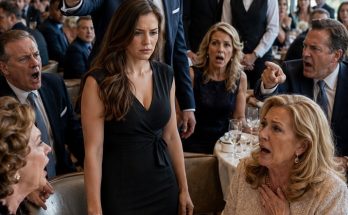
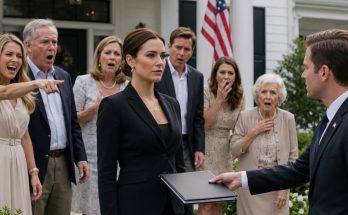
Billionaire Broke His Pregnant Wife’s Arm After His Mistress Lied—Then America’s Most Feared Woman Stepped Through the Door
**PART ONE: THE GLASS KINGDOM.**
**Ava Huxley learned that a marriage could end before the ring ever left your finger.**
It ended on a winter night above Manhattan, in a penthouse so high the city looked like a field of broken diamonds beneath the windows.
It ended with snow tapping the glass, a champagne flute trembling in another woman’s hand, and Grant Huxley standing over his pregnant wife as if she were an inconvenience dropped at his feet.
“Touch that phone, Ava, and I’ll make sure no one believes a word you say.”
His voice had the polished cruelty of a man who had never needed to raise it.
Grant was the kind of billionaire people obeyed before they understood the order.
He built towers, bought senators dinner, ended careers with a quiet phone call, and wore his power like a dark tailored suit.
That night, he wore a midnight-blue tuxedo jacket, his bow tie loosened at his throat, his silver cuff links catching the chandelier light.
Ava sat on the marble floor beside the shattered glass coffee table, one hand wrapped around her eight-month pregnant belly and the other held carefully against her lap.
Her left wrist had bent where no wrist should bend.
Pain moved through her in white flashes, but she did not scream.
**Her silence was the first thing everyone remembered.**
Savannah Vale stood near the champagne cart in a red satin gown, her diamond bracelet shaking lightly against her glass.
She had a face made for gossip columns and a smile made for ruining women in rooms full of men who pretended not to notice.
Ava had heard the whisper that started it all.
“She’s been talking to reporters, Grant.”
Savannah had said it softly, close to his ear, as though the lie were intimate enough to be true.
“She is going to destroy the Stanton merger.”
“She said the baby might not even be yours.”
Ava had seen the change in Grant before his hand touched her.
His eyes went empty.
His mouth tightened.
The man who once kissed her knuckles in a rainstorm disappeared, and the CEO took his place.
Then his fingers closed around her upper arm.
Then the room tilted.
Then the edge of the coffee table rose up like a blade of light.
Now her wedding ring lay somewhere beneath the table, catching a thin reflection of the skyline.
Ava did not reach for it.
She could hear the ice melting in Grant’s untouched whiskey.
She could hear the forced calm in Savannah’s breathing.
She could hear the private elevator rising from the lobby, floor by floor, carrying the one woman Grant Huxley had tried to keep away from his home, his business, and his secrets.
“Get up,” Grant said.
Ava lifted her eyes.
“Call an ambulance.”
Savannah laughed, though it came out too high.
“Isn’t that a little dramatic?”
Ava turned her face toward her once.
It was not a glare.
It was not a plea.
It was the look of a woman who had finally understood exactly who was in the room with her.
Savannah’s smile vanished.
Grant crouched in front of Ava, his expensive shoes avoiding the broken glass.
“This life exists because I allow it.”
Ava’s lips were pale, but her voice did not shake.
“No, Grant.”
“This prison exists because I stopped pretending it was a marriage.”
Something flickered behind his eyes.
It came and went so quickly that Ava almost thought pain had invented it.
For one second, he looked less like a king and more like a man watching the floor collapse beneath him.
Then Savannah stepped forward and placed Ava’s wedding ring on the glass table like a trophy.
“You were going to leak documents,” Grant said.
“No.”
“You spoke to Patricia Lowell at the Chronicle.”
“No.”
“You told her I falsified the Stanton acquisition.”
Ava looked past him, toward New York glowing below the windows.
“I told Patricia Lowell nothing.”
“But now I understand what you are terrified she will discover.”
The room changed.
Savannah’s confidence weakened first.
Grant’s hand stilled on his knee.
He was used to Ava being graceful, patient, and quiet at dinner parties where women discussed her dress as if she were not standing there.
He was used to Ava lowering her eyes when his board members called her charming in the same tone they used for hired pianists.
He was used to underestimating her.
But this Ava sounded prepared.
This Ava sounded like a door had been opened inside her long before the elevator arrived.
The private elevator chimed.
The sound was delicate, almost polite.
In that enormous room of marble and glass, it struck like a verdict.
Grant turned.
For the first time that night, fear touched his perfect face.
The elevator doors slid open.
Senator Victoria Wren stepped out in a winter-white coat, her silver hair swept back, her black gloves buttoned at the wrist.
Two federal marshals stood behind her.
A third figure, a woman in a dark medical coat, followed with a leather emergency bag in her hand.
Victoria’s gaze moved across the penthouse with terrible calm.
She saw the shattered table.
She saw Savannah’s diamonds.
She saw Ava’s torn silk dress.
Then she saw Ava’s wrist.
The senator’s face changed by one inch, and the temperature in the room seemed to fall.
“Grant Huxley,” she said, removing one glove finger by finger.
“Step away from my daughter.”
Savannah gasped.
Grant did not move.
The old arrogance tried to return to his face, but it found no place to land.
“Senator Wren,” he said.
Victoria ignored him and walked toward Ava.
The marshals moved with her, silent and broad-shouldered.
The doctor knelt beside Ava and touched two fingers to her pulse.
Ava closed her eyes for one moment, not because she was weak, but because she could finally stop measuring every breath.
“Mom,” she whispered.
Grant heard the word as if it were spoken in another language.
He looked from Ava to Victoria and back again.
“Your daughter.”
Victoria did not look at him.
“My daughter.”
Savannah’s champagne glass slipped from her fingers and shattered.
The sound made everyone flinch except Ava.
Victoria lifted her eyes then, and there was nothing soft in them.
“You refused medical care to a pregnant woman with a visible fracture.”
Grant’s jaw tightened.
“I did not refuse.”
Ava looked at him.
“Yes, you did.”
The four words landed harder than a scream.
Grant stared at her, and something like shame touched him, but it was too young to have a name.
The marshal nearest the elevator stepped forward.
“Sir, keep your hands visible.”
Grant’s eyes flashed.
“You have no idea what she has done.”
Victoria’s laugh was quiet.
“I know more than you have ever feared.”
Ava reached with her uninjured hand toward the doctor, then stopped.
Her face tightened as the baby shifted.
The doctor looked at Victoria.
“She needs the hospital now.”
Grant took a step forward.
No one knew whether he meant to help, explain, command, or reclaim.
The nearest marshal blocked him.
Grant looked at the man as if disbelief could move him aside.
It did not.
Ava looked at Grant one last time from the floor of the kingdom he had built above the city.
In her eyes was pain, yes.
There was also something he had never seen there before.
There was farewell.
**PART TWO: THE WOMAN HE NEVER BOTHERED TO KNOW.**
Grant Huxley first met Ava Merrill at a rooftop benefit in late September, three years before the night he broke her arm.
He had arrived late, surrounded by lawyers, bankers, and the quiet panic that followed men whose signatures moved markets.
The benefit was held on the roof of the Lorne Hotel, where white roses floated in glass bowls and waiters carried silver trays past women in gowns that cost more than most mortgages.
Grant hated charity events.
He understood their function, endured their photographs, and donated enough money to make applause unnecessary.
Then he saw Ava standing near the edge of the terrace, holding a plate of untouched salmon and speaking with an elderly waiter in Spanish.
She wore a navy dress with no visible designer label.
Her hair was pinned loosely at the back of her neck.
She looked out of place, but not embarrassed by it.
That caught his attention first.
The women of his world were experts at belonging.
Ava seemed more interested in the old waiter’s swollen hands than in the billionaire standing ten feet away.
Grant approached because he was used to approaching anything that interested him.
Ava turned when his shadow touched the table.
He expected her to recognize him instantly.
She did, but she did not perform the recognition.
“Grant Huxley,” she said.
“Ava Merrill,” he replied, after glancing at her name card.
“Are you enjoying the evening?”
“I am enjoying the view.”
“Not the company?”
“That depends on whether the company is asking because he cares or because he needs to begin a conversation.”
Grant almost smiled.
It had been years since anyone spoke to him without fear or calculation.
“I have been accused of worse openings.”
“I am sure you have paid people not to repeat them.”
He did smile then.
It surprised him.
Their courtship became a quiet rebellion against everything his family expected.
Ava took him to small restaurants in Queens where owners remembered her name and asked about her students.
Grant took her to private dining rooms where the wine was older than both of them.
She spoke of books, aging parents, public schools, and the dignity of ordinary work.
He spoke of acquisitions, leverage, loyalty, and the brutal discipline required to inherit an empire built by a brutal man.
Ava listened without worship.
That was what undid him.
She never asked for jewelry, never photographed his cars, never trembled when he said his board was waiting.
She once told him that wealth was not impressive unless it made someone kinder.
Grant had answered with a joke.
Then he had gone home and thought about the sentence for three nights.
What he did not know was that Ava Merrill was not truly Ava Merrill.
She was Ava Wren Stanton, the only daughter of Senator Victoria Wren and Owen Stanton, a brilliant biochemist who died before his company became a prize men killed reputations to own.
After Owen’s death, Victoria sent Ava to live quietly with her aunt in Maine.
Threats had come first in envelopes, then in phone calls, then in the form of a black car idling outside Ava’s school.
Victoria did not cry when she sent her daughter away.
She was a senator even then, young, cold, and already feared by men who mistook maternal restraint for lack of feeling.
Ava grew up with two names and one lesson.
Love could protect you, but power could also turn you into property.
When she returned to New York as an adult, she did not want her mother’s name or her father’s fortune.
She taught adult literacy classes, volunteered at a prenatal clinic, and used her inheritance through anonymous foundations.
She chose a modest apartment with old pipes and sunlight in the kitchen.
Then Grant Huxley entered her life like weather.
He was cold at first.
Then he was curious.
Then he was almost gentle.
Ava saw the boy beneath the empire long before she saw the danger.
Grant had been raised by Conrad Huxley, a father who believed affection made heirs soft.
When Grant was twelve, Conrad made him fire a driver who had worked for the family for twenty years, just to teach him that loyalty was a tool and mercy was a liability.
When Grant was sixteen, Conrad told him that apologies were for people without lawyers.
When Grant was twenty-eight, he took over Huxley Global after Conrad suffered a stroke, and the business world called him brilliant.
No one called him wounded.
Ava did.
Not aloud at first.
She saw it in the way Grant stood near windows but never with his back to a door.
She saw it in the way he read every contract twice but never read letters from his father.
She saw it in how he held her after their wedding, as if love were a language he could understand only in the dark.
They married in a small ceremony at the New York Public Library.
Grant wanted a cathedral and a guest list full of governors.
Ava wanted vows in a place that belonged to everyone.
He gave in because he loved her.
Or because he wanted to believe he could be the kind of man who gave in for love.
For a while, they were happy.
Their happiness was not loud.
It lived in morning coffee, books left open on the bed, and Grant pretending not to enjoy the cheap cinnamon rolls Ava bought from a bakery under the train tracks.
When Ava became pregnant, Grant stared at the test in his hand for nearly a full minute.
Then he sat on the bathroom floor in his custom suit and wept without sound.
Ava knelt in front of him and touched his face.
“You can be different from him,” she said.
Grant closed his eyes.
“I do not know how.”
“Then learn.”
For months, he tried.
He attended doctor appointments, read books on fatherhood, and secretly ordered a handmade cradle from a craftsman in Vermont.
He spoke to Ava’s belly when he thought she was asleep.
He called the baby “little comet,” because she kicked hardest whenever the city lights flashed through the bedroom windows.
Then the Stanton merger began.
Huxley Global wanted to acquire Stanton BioSystems, the company Ava’s father had founded and the company Ava secretly controlled through a family trust.
Grant did not know that.
Ava had planned to tell him after the first trimester, then after the merger discussions cooled, then after she found the first false valuation buried in the documents.
The problem was not the acquisition itself.
The problem was the lie inside it.
Someone inside Huxley Global had falsified clinical trial liabilities, inflated projected revenue, and hidden pension losses that would destroy thousands of retired employees if the deal closed as written.
Ava found the irregularities by accident while reviewing a foundation grant connected to Stanton’s patient program.
Then she found them again in a separate report.
Then she found Savannah Vale.
Savannah was Grant’s public relations consultant, former lover, and the kind of woman who entered rooms as if she already knew where the bodies were buried.
She laughed too warmly at Grant’s jokes.
She touched his arm too often.
Most dangerously, she knew how to speak the language of Grant’s fear.
“She is sweet,” Savannah once told him after a board dinner.
“But sweet women often hide expensive surprises.”
Grant had frowned.
“Ava is not like that.”
“Of course not.”
The words sounded innocent.
The tone did not.
Savannah fed him doubts slowly, the way poison is given to a man who checks his wine.
She mentioned Ava’s private calls.
She mentioned unnamed reporters.
She mentioned that pregnancy made some women emotional, secretive, unpredictable.
Grant dismissed her at first.
Then a forged message appeared on his private phone.
Then a board member warned him that a leak could cost him the Stanton deal.
Then Savannah showed him a photograph of Ava entering the Chronicle building.
It was real, but the meaning was false.
Ava had gone there to meet Patricia Lowell, not to leak Grant’s secrets, but to stop a story from running before she could confirm who inside Huxley had forged the documents.
Patricia was an old college friend and one of the few journalists Ava trusted.
Ava begged her for seventy-two hours.
“People could lose their pensions,” Patricia said.
“And if you publish before I know who built the fraud, the guilty person will burn the evidence and blame the weakest person in the room.”
“Who is that?”
Ava had looked down at her swollen belly.
“Me.”
By the time Ava returned to the penthouse that night, Savannah was already there.
Grant had already heard the lie.
The snow had begun.
The table had broken.
Ava’s wrist had snapped beneath the weight of his disbelief.
**PART THREE: THE HOSPITAL LIGHTS.**
At Lenox Hill Hospital, the lights were too bright and the sheets smelled of bleach.
Ava lay on her side while a nurse adjusted the monitor around her belly and the baby’s heartbeat filled the room in rapid, stubborn beats.
The sound was small and mighty.
It was the first sound that made Ava cry.
Victoria stood near the window, still in her white coat, though the hem was stained from kneeling on the penthouse floor.
She had faced cabinet nominees, defense contractors, oil lobbyists, and men with private islands who thought law was something for poorer people.
Yet she could not look at her daughter’s cast without pressing her lips together.