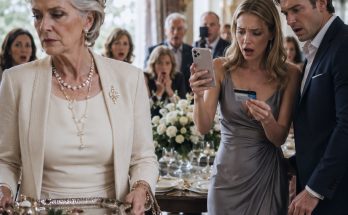
“You Can’t Afford The Premium Dinner Option,” Mom Told The Coordinator. They Seated Me Far From The “Important Guests.” I Watched The Hotel Owner Approach With Acquisition Papers. The Venue Bill Landed On Their Table.
### Part 1
The first time my mother ordered me chicken fingers in front of a hotel full of crystal chandeliers, I was thirty-two years old and sitting in a chair that cost more than my first used car.
The Grand Meridian Hotel smelled like polished oak, white roses, and money. Afternoon light poured through the tall arched windows of the private event room, bouncing off the silver water pitchers and the untouched plates of lemon cookies arranged down the center of the conference table. My brother’s wedding planning meeting was supposed to be about floral arches, signature cocktails, and whether the string quartet would play during cocktail hour.
Instead, as usual, it turned into a review of my failures.
My mother, Sylvie Vale, sat near the head of the table with her pearl earrings glowing against her perfect cream blazer. She had brought a leather binder filled with color-coded notes, seating charts, clipped magazine pages, and the kind of tight smile that meant she had already decided everyone’s place in the room, both literally and spiritually.
My father, Brant, sat beside her, checking his watch every few minutes like the meeting was stealing time from more important people. My younger brother, Callum, the groom, looked tired but happy in a navy suit. His fiancée, Elodie Pierce, kept smoothing the edge of her pale blue dress with nervous fingers.
I sat at the far end with my laptop open, pretending to answer emails.
Pretending was easier than reacting.
The event coordinator, a careful woman named Tessa, tapped her tablet and asked, “For the plated dinner, we still need final selections for immediate family. Beef tenderloin, sea bass, or the vegetarian risotto.”
My mother clicked her pen. “Callum and Elodie will have the beef. Brant and I will also have the beef. Elodie’s parents, of course, should have the sea bass unless they prefer the beef. They’re paying for the rehearsal dinner, so we want them comfortable.”
Tessa nodded.
Then my mother glanced down at the chart as if she were reading a grocery receipt.
“And for Mara, she’ll have the children’s menu option. The chicken fingers, I think.”
For a second, nobody moved.
The air conditioner hummed quietly above us. Somewhere outside the room, a bellhop laughed, then rolled a luggage cart across the marble floor with a soft metallic rattle.
Tessa looked up slowly. “I’m sorry?”
“The children’s menu,” my mother repeated, louder, as though the problem was Tessa’s hearing. “Chicken fingers. Fries. Whatever comes with it.”
Elodie’s hand froze on her lap.
Callum looked at me.
I kept my eyes on the screen. My inbox was open, but the words blurred into blue and black lines. I had survived my mother’s sharp little comments for years. I had learned not to flinch when she compared me to my brother, not to argue when my father called my job “unstable,” not to explain myself when relatives asked whether I had finally moved into a “real career.”
But chicken fingers at my brother’s wedding, at a luxury hotel, in front of strangers, had a special sting to it.
Tessa shifted in her chair. “Ma’am, the children’s menu is generally for guests twelve and under.”
My mother gave a small laugh. “Yes, but Mara won’t mind. She’s practical.”
“Mom,” Callum said quietly.
Sylvie kept going. “She works retail. We’re already helping with her bridesmaid dress, which frankly was more expensive than I expected. The least she can do is choose something economical.”
There it was.
Retail.
The word my family used like a damp towel thrown over everything I had built.
Technically, they weren’t completely wrong. I worked in retail hospitality. Hotels, resorts, guest experience, operations, revenue strategy. But my family had heard one word ten years ago and sealed me inside it like a bug in amber. Retail meant folding sweaters at a mall. Retail meant name tags and clearance racks. Retail meant failure politely dressed as employment.
I closed my laptop.
“The children’s menu is fine,” I said.
My voice was quiet enough that I almost didn’t recognize it.
Elodie leaned forward. “Mara, you don’t have to do that.”
“It’s fine,” I said again. “I’m not picky.”
My father cleared his throat. “Your sister has always been sensible about money. Modest lifestyle. Modest career. Nothing wrong with that.”
He said it like he was being generous.
My phone lit up beside my water glass. A message preview from Gideon, my CFO, flashed across the screen.
Final paperwork arrived. Grand Meridian transition on schedule. Need your approval on Morrison event requests.
I turned the phone facedown before anyone could read it.
My mother flipped to another page in her binder. “Now, seating.”
The word landed harder than it should have.
Tessa brought up the floor plan on a small monitor at the end of the room. The ballroom appeared in neat circles and rectangles, elegant and harmless, until my mother started assigning human worth to table numbers.
“Callum and Elodie at the head table, obviously. Our family near them. Brant’s business contacts at table three. Elodie’s father’s medical colleagues near the dance floor. Sterling Investments people close to the bar. Very visible. We want the room to feel successful.”
Successful.
My mother’s favorite fragrance.
She tapped one manicured nail against the far corner of the chart.
“Mara can sit at table twelve.”
Tessa frowned. “Table twelve is behind the south support column. Guests there won’t have a clear view of the speeches.”
“That’s fine,” my mother said. “Mara won’t mind being in the background.”
I felt Callum looking at me again, but I didn’t give him my face. I stared at the floor plan, at the little circle tucked behind the thick square column, like a mistake the designer forgot to erase.
Tessa said carefully, “Since she’s the groom’s sister, we normally place her closer to the family tables.”
Sylvie’s smile tightened. “This wedding has a certain image. Callum works in finance. Elodie comes from a respected family. We’ll have business leaders, doctors, serious people. Mara gets uncomfortable in those conversations.”
I almost laughed.
Not because it was funny.
Because the last three conversations I’d had that morning were with a lender in Boston, a historic preservation attorney in Savannah, and the general manager of a seaside resort whose payroll crisis I had solved before breakfast.
But at my brother’s wedding, I was apparently a social risk.
Tessa’s eyes flicked toward me, soft with embarrassment. I hated that most of all. Not my mother’s insult. Not my father’s silence. The pity of a stranger.
My phone buzzed again.
This time I looked.
Gideon: They’re asking whether ownership will waive part of the venue fee because of “family connection.” Do you want me to decline directly?
I typed under the table with one thumb.
Not yet. I’ll handle it.
Then I set the phone down and looked at my mother’s seating chart.
Table twelve. Children’s menu. Background.
My family had finally put their opinion of me into a contract.
And for the first time in years, I decided I was going to let them sign it.
### Part 2
My family did not become cruel all at once. They became cruel in small, polished ways that looked acceptable from a distance.
When I was nine, my mother used to introduce me as “our creative one,” which sounded sweet until she introduced Callum as “our future success story.” When I was sixteen, my father told me I had a good heart but not much business sense because I had spent my summer money repairing a neighbor’s flooded basement instead of buying a used car. When I was twenty-two, I bought a failing bed-and-breakfast on the coast of Maine with a loan, a terrifying spreadsheet, and the kind of stubbornness that makes other people call you irresponsible until it starts making money.
My parents called it a phase.
Callum called it brave, once, when nobody else was listening.
Then he got a job at Sterling Investments, and my father began saying his name like a stock that kept climbing.
I learned to stop bringing good news home.
At Thanksgiving, I tried to explain that my little inn had turned profitable in eighteen months. My mother interrupted to ask Callum whether his boss had mentioned bonuses.
At Christmas, I mentioned I was hiring my first full-time operations manager. My father asked whether I still had to clean rooms myself.
At Easter, I said we were expanding into Vermont. My aunt patted my hand and said, “Well, some people are happy with simple things.”
Eventually, I let them have the version of me they preferred.
Retail.
Small.
Background.
It was easier than watching them reject the truth in real time.
That afternoon at the Grand Meridian, after the chicken fingers and table twelve were settled, Tessa moved on to flowers. White hydrangeas, pale pink garden roses, touches of greenery. Elodie perked up when the sample images appeared on the monitor.
“I like this one,” she said, pointing. “It feels romantic but not too formal.”
“It’s beautiful,” I said.
Elodie looked relieved, like she had been waiting for me to speak so she could remind the room I was human.
My mother glanced at the picture. “Lovely, but we need to make sure nothing looks cheap.”
I watched Tessa’s jaw tighten by half an inch.
The Grand Meridian staff were trained well. They knew how to absorb difficult clients without letting it show. Still, the room had a pulse now. An awkward, uneven pulse. My family didn’t notice because people like my parents rarely noticed discomfort they were causing.
My father leaned back. “What about the bar package?”
Tessa scrolled. “You selected premium open bar for four hours.”
“Good,” he said. “We don’t want people thinking we cut corners.”
My eyes drifted toward the window. Below, the hotel courtyard spread out in perfect late-spring color. Boxwood hedges framed the stone path. White umbrellas shaded the patio. A fountain sent water whispering over dark slate. I had stood in that courtyard three months earlier with Orson Kell, the hotel’s former owner, while he explained why he didn’t want to sell to a chain.
“They’ll strip the soul out of her,” he’d said, looking up at the brick facade like the building was a woman he loved. “You won’t.”
I had promised him I wouldn’t.
That promise had cost me two sleepless months, three negotiations that nearly collapsed, and one emergency flight to New York in a thunderstorm. But by the time my mother was ordering me chicken fingers, the Grand Meridian was already mine in every meaningful way.
Only the final signatures remained.
My phone buzzed again.
Gideon: Property manager says Mrs. Vale requested complimentary suite upgrades for “family of staff.” Do you want to approve any goodwill gesture?
I glanced at my mother. She was telling Tessa that Elodie’s distant cousins should not be seated near the surgeon’s partners because “they’re perfectly nice, but they don’t elevate the room.”
No goodwill gesture, I typed. Contract only.
“Work again?” my father asked.
I looked up.
His mouth held that familiar half-smile, the one he used when he wanted everyone to know he was about to be clever.
“Yes,” I said.
“What kind of work emails come through during business hours for retail?” he asked.
Callum rubbed his forehead. “Dad.”
“No, I’m curious.” Brant turned toward me. “Inventory? Coupons? Someone need help at the register?”
My cheeks warmed. Not with shame. With memory.
Memory of being twenty-four and sleeping on a mattress in a half-renovated guest room because I couldn’t afford rent and payroll in the same month.
Memory of unclogging a toilet in a silk blouse ten minutes before meeting with a local bank manager who assumed I was an assistant.
Memory of signing my first seven-figure management contract in a diner booth while the waitress refilled my coffee and called me honey.
“Mostly approvals,” I said.
“Approvals,” my mother repeated, amused.
I smiled faintly. “Yes.”
Elodie looked between us. She was not a cruel woman. That made the meeting harder, not easier. Cruel people are simple. Uncomfortable people become mirrors.
Tessa cleared her throat. “The total balance due next Friday is forty-eight thousand dollars. That includes the ballroom, catering, standard floral setup, service staff, security, and the four-hour premium bar package.”
My mother nodded. “We’ll have the check ready. Though I do want to speak to someone about a family discount.”
Tessa’s professional smile returned, thin as paper. “A family discount?”
“My daughter works in retail,” Sylvie said. “And hotels have shops, don’t they? Gift boutiques? Spa counters? Surely she can put in a word.”
The room went still again.
I could hear the fountain through the glass. Soft, steady, patient.
“Mom,” I said, “I don’t work in the hotel gift shop.”
“Wherever you work, dear. The point is, you must know someone who can help.”
Tessa glanced at her tablet.
Something changed in her face. Recognition, maybe. Or confirmation.
She looked at me, then quickly away.
My phone buzzed one more time.
Gideon: Orson is on his way up with the documents. Should arrive in ten minutes.
I placed both hands flat on the conference table and listened to my mother negotiate with my employee about whether my supposed poverty could save her money.
There are moments in life when anger arrives like fire.
Mine arrived like ice.
### Part 3
By the time the meeting ended, my mother had reduced me to three things on paper: chicken fingers, table twelve, and possible discount source.
She closed her binder with a satisfied snap. “I think that covers everything.”
Tessa’s smile remained intact, but her eyes had sharpened. “I’ll send the final updated notes to the email on file.”
“Wonderful,” Sylvie said. “And please make a note that we’d like ownership to review our request for a reduced rate.”
“Of course,” Tessa replied.
My father stood and adjusted his cuffs. “A hotel like this should value local families who bring in good business.”
I looked at the ceiling for half a second.
Good business. Forty-eight thousand dollars and a demand for free upgrades.
In my experience, the clients who talked most about value were usually the ones who understood it least.
Callum lingered while Elodie stepped out to answer a call from her mother. He came around the table toward me, hands in his pockets.
“Hey,” he said.
“Hey.”
“That got weird.”
I looked at him. “Did it?”
He winced. “Mara.”
There were old habits in his voice. Childhood habits. When we were kids, Callum used to stand outside my room after family arguments and slide candy under the door instead of knocking. He had never been as sharp as our parents. He had simply learned to survive by staying agreeable.
“I’m sorry about the menu thing,” he said.
“Are you?”
“Yeah. I mean, Mom shouldn’t have said it like that.”
I waited.
He looked away.
There it was. Not that she shouldn’t have done it. Just that she shouldn’t have said it where someone could hear.
“Elodie felt bad,” he added.
“I noticed.”
“I should’ve said more.”
“Yes,” I said. “You should have.”
He swallowed. “I don’t want drama before the wedding.”
A laugh escaped me before I could stop it. It was small and tired.
“Of course,” I said.
His face reddened. “That’s not what I meant.”
“It usually is.”
Before he could answer, my mother called from the doorway. “Callum, we’re going down to look at the courtyard again. Your father wants to check the valet area.”
Callum looked torn for three seconds.
Then he followed her.
I stayed seated after they left, surrounded by empty glasses and the faint smell of lemon cookies. Tessa remained near the monitor, pretending to organize digital files.
Finally, she said, “Ms. Vale?”
I looked at her.
“I apologize if this is inappropriate, but I want you to know that the staff will follow whatever instructions you give regarding the event.”
I studied her face. “Whatever instructions I give?”
She held my gaze carefully. “Yes.”
So she knew.
Orson must have told someone. Or Gideon’s transition memo had circulated. Either way, the secret had started moving through the hotel’s walls like warm air through vents.
“Thank you, Tessa,” I said. “For now, the contract stands exactly as written.”
She nodded. “Understood.”
“And the children’s menu?”
Her expression softened. “We can correct that.”
“No,” I said. “Leave it.”
“But—”
“I want the notes to reflect what was ordered.”
She hesitated, then nodded again. “Of course.”
I closed my laptop and slipped it into my leather bag. It was old, scuffed near the handle, and my mother hated it because she thought a woman my age should carry something prettier. I kept it because I had bought it with the first profit check from my first property.
In the hallway, the Grand Meridian performed its quiet theater. Guests rolled suitcases across marble. A little girl in a yellow dress pressed both hands against the lobby aquarium. A man near the concierge desk argued into his phone about dinner reservations. Behind the front desk, my new staff moved with practiced calm.
My staff.
The thought still startled me.
Not because I doubted the deal, but because every property felt personal at the beginning. Buildings had moods. Teams had fears. Guests had expectations. A hotel was never just rooms and rates. It was a living machine built out of clean sheets, hot coffee, working elevators, invisible labor, and the fragile hope that strangers would feel cared for.
At the far end of the lobby, near the grand staircase, I saw Orson Kell step out of the elevator.
He was in his late sixties, tall and silver-haired, wearing a brown suit that probably cost too much and shoes polished to a mirror shine. He carried a blue folder under one arm. When he spotted me, his face brightened with genuine warmth.
“Mara,” he called.
My mother heard him first.
She turned from the courtyard doors with my father and Callum beside her. Her brows drew together, irritated by the familiarity of a stranger calling my name across a luxury lobby.
Orson approached with his hand extended.
“There you are,” he said. “I’m sorry to interrupt your family business, but we need your signature before the bank closes the final file.”
My father’s expression changed.
“Final file?” he asked.
Orson glanced politely at him. “Yes. The acquisition documents.”
My mother gave a brittle laugh. “I’m sorry, who are you?”
“Orson Kell,” he said. “Former owner of the Grand Meridian.”
“Former?” Callum repeated.
Orson smiled at me.
“Very soon, officially former. I’m just here to finish the transfer to Ms. Vale.”
My mother looked around as if there must be another Ms. Vale standing behind me.
“What transfer?” she asked.
Orson held out the folder.
“The hotel,” he said. “Ms. Vale is the new owner.”
The lobby noise seemed to drop away all at once.
My mother stared at me, her mouth slightly open.
My father’s jaw hardened.
Callum whispered, “Mara?”
And I knew the moment had arrived.
Not because I had planned it perfectly.
Because they had finally run out of wrong assumptions.
### Part 4
I had imagined telling my family the truth a hundred different ways.
At a dinner table, maybe. Over coffee. In my office, where the city stretched behind the glass and nobody could confuse me for a woman begging for approval. In those imagined scenes, I was always sharper, cooler, more elegant. I had the perfect sentence ready. I made them understand in one clean strike.
Real life gave me a hotel lobby, a blue folder, and my mother standing near a valet stand with her wedding binder clutched to her chest like a shield.
“The new owner?” my father said, each word slow.
“Yes,” Orson replied pleasantly. “Ms. Vale’s company completed the purchase last quarter. We’re finalizing operational transition this week.”
My mother shook her head once. “No. That can’t be right.”
Orson blinked. “I assure you it is.”
Callum looked at me like he was seeing a person step out from behind a painted backdrop.
“What company?” he asked.
I took the folder from Orson and opened it on the small marble-topped table near the lobby flowers. My signature tabs were marked in neat yellow flags.
“Vale & Rowan Hospitality,” I said.
My mother’s lips parted. “Vale?”
“Yes.”
“But you work retail.”
I looked at her. “Hospitality is a retail industry.”
My father made a sharp sound. “Don’t play word games.”
“I’m not.”
Orson’s smile faded a little as he began to understand the shape of the conversation. He stepped back, but not far.
My mother’s voice dropped. “You own this hotel?”
“Yes.”
“And a company?”
“Yes.”
Callum stared. “How big?”
I signed the first page. The pen moved smoothly over the paper. I focused on the curve of my name because it was easier than looking at their faces.
“Twelve properties before this,” I said. “Thirteen now.”
The silence after that felt almost physical.
A bell chimed at the elevator. Guests walked past us, laughing, carrying shopping bags from some downtown boutique. The world continued, which seemed rude considering my family’s universe had just tilted on its axis.
My father recovered first. Men like him always did, because confidence had been rewarded in him even when he had no information.
“You should have told us,” he said.
I looked up. “I tried.”
“No, you didn’t.”
“I did.”
My voice stayed calm, but my hands were cold.
“Three Thanksgivings ago, I told you I was expanding into New Hampshire. You asked Callum about Sterling. Last Christmas, I mentioned a property acquisition in Virginia. Mom interrupted me to talk about Elodie’s ring. At Easter, I said we’d had our strongest revenue year yet, and you asked if I had considered applying for management at a department store.”
Callum shut his eyes.
My mother whispered, “I thought you meant retail management.”
“I know what you thought.”
Orson cleared his throat gently. “For what it’s worth, Ms. Vale has an excellent reputation. When her firm approached me, I had offers from two national chains. I chose her because she understood what this place needed.”
My father turned red. “We’re not questioning her competence.”
I almost smiled. “You’ve been questioning my competence for ten years.”
“That’s not fair,” my mother said.
“Isn’t it?”
She looked down at her binder, then back at me. “Mara, sweetheart, if we had known—”
I set the pen down.
That sentence sliced deeper than the chicken fingers.
“If you had known what?” I asked.
Her face trembled. “That you were doing so well.”
“You would have ordered me the sea bass?”
The words landed hard enough that Elodie, who had returned quietly and heard more than anyone wanted her to, covered her mouth.
My mother flinched. “That’s not what I meant.”
“It is exactly what you meant.”
I signed the second page.
“You would have seated me closer. Introduced me proudly. Asked about my work. Maybe even told people I was your daughter without that little apology in your voice.”
My father glanced around, aware now of staff nearby, of Orson watching, of Tessa standing near the hallway with her tablet held against her chest.
“Lower your voice,” he said.
I looked at him then.
Really looked.
At the man who had spent my adulthood treating me like an unfinished project. At the mother who believed love should be arranged by status. At the brother who had known better but found silence more convenient.
“My voice is not the embarrassing part,” I said.
Elodie stepped forward, pale. “Mara, I’m so sorry. I had no idea.”
“I know.”
She swallowed. “I should have said more in there.”
“Yes,” I said. “You should have.”
Callum looked wounded by that, though it wasn’t aimed only at her.
Orson placed one final document before me. “This last signature transfers the remaining operational authority.”
My mother’s eyes snapped to the page.
“Wait,” she said. “Operational authority means you control the wedding contract?”
“I control all contracts,” I said. “Through the management team.”
My father shifted immediately. I saw the calculation arrive before the words did.
“Then we can discuss the discount properly.”
I laughed once. Not loudly. Not kindly.
“No.”
“Mara,” my mother said. “We’re family.”
“You were family when you put me behind a support column.”
Callum rubbed both hands over his face. “God.”
“The contract stands,” I said. “Forty-eight thousand dollars. No complimentary suite upgrades. No waived fees. No special bar extension. No discounted meals. You’ll receive exactly what you selected.”
My mother whispered, “Including yours?”
“Especially mine.”
Orson looked at me with something close to pride.
My father’s face hardened again. “So this is revenge.”
“No,” I said. “Revenge would be canceling the wedding and letting you explain it to two hundred guests.”
Elodie’s eyes widened.
I slid the signed document back into the folder.
“This is business.”
For once, my father had no answer.
I turned to Tessa, who had gone very still.
“Please keep all Morrison-Pierce wedding arrangements exactly as submitted,” I said.
She nodded. “Yes, Ms. Vale.”
My mother’s head jerked slightly at the sound of it.
Ms. Vale.
Not Mara, the retail worker. Not the practical daughter. Not the background sister.
Ms. Vale.
The owner.
I picked up my laptop bag and looked at my family one last time.
“I have a transition meeting upstairs,” I said. “Enjoy the courtyard.”
Then I walked away through my own hotel while their silence followed me like shattered glass.
### Part 5
The six weeks before the wedding became a test of how quickly people could rewrite history when money entered the room.
My mother called first.
Not the next day. Not even that night. She waited forty-six hours, which meant she had either rehearsed or been told by my father that waiting made her look less desperate.
I was in my office above the Grand Meridian ballroom when my phone rang. Outside my window, workers were installing new brass fixtures along the courtyard path. The old ones had been charming but unreliable, and charm without maintenance was just future disappointment.
I let the call go to voicemail.
She called again.
Then texted.
Sweetheart, we need to talk as a family. There has been a misunderstanding.
A misunderstanding.
That was the word people used when they had understood perfectly but disliked the consequences.
I didn’t answer.
My father emailed, which was worse. His message had bullet points. He wrote that they were proud of my “unexpected success,” that they had always believed in my “work ethic,” and that a “reasonable accommodation” on the wedding invoice would show maturity. He copied Callum, Elodie, and, for some reason, my childhood email address that I hadn’t used since college.
I forwarded it to Gideon with one note.
Please confirm receipt of payment deadline.
Gideon replied three minutes later.
Gladly.
Callum came in person.
He found me on a rainy Tuesday afternoon walking through the banquet kitchen with my culinary director, Nessa Bloom, as she tested sauces for the summer menu. The kitchen smelled like butter, lemon zest, roasted garlic, and hot stainless steel. Steam clouded the windows. Line cooks moved around us in white coats, focused and fast.
Callum stood near the swinging doors in a charcoal suit, looking painfully out of place.
“Mara,” he said.
Nessa glanced at me.
“It’s fine,” I told her. “Give me ten minutes.”
Callum followed me into a quiet service corridor stacked with linen carts and boxes of glass votive holders.
“This place is intense,” he said.
“It has to be.”
“I didn’t know hotels were this complicated.”
“I know.”
He winced. “I deserved that.”
I leaned against the wall, arms crossed. “Why are you here?”
His eyes were tired. “To apologize. Not for Mom. Not for Dad. For me.”
That got my attention, though I didn’t soften.
He looked down the corridor toward the kitchen noise. “I keep thinking about all the times you tried to tell us things. I remember some of them. Not all, but some. And I remember being relieved when Mom changed the subject because I didn’t want tension at dinner.”
I said nothing.
He continued, “I let them make you small because it made my life easier.”
There it was.
Not perfect. Not enough. But honest.
“I’m sorry,” he said. “I am.”
The corridor lights hummed above us. Somewhere behind the wall, a dishwasher roared.
“Thank you,” I said.
He looked hopeful, which made the next part harder.
“That doesn’t fix it.”
His shoulders dropped. “I know.”
“Do you?”
“Yes.”
“Because I’m not going to show up at the wedding and pretend we’re a close family for photographs.”
He nodded slowly.
“I’m not moving tables,” I said. “I’m not changing my meal. I’m not giving a speech about how proud I am while Mom smiles like she didn’t spend ten years treating me like a cautionary tale.”
“I understand.”
“And I’m not discounting the bill.”
He let out a breath, almost a laugh. “I figured.”
I studied him. “Does Elodie know you’re here?”
“Yes. She told me not to ask for anything.”
That surprised me.
Callum saw it. “She’s embarrassed. She said if we want to be respected, we should act respectable.”
I liked Elodie more in that moment than I had in the entire year I’d known her.
“Smart woman,” I said.
“She is.”
“Then don’t ruin her wedding by turning this into a family negotiation.”
He nodded again. “I won’t.”
But my parents did.
They tried everything.
My mother sent old photos of me as a child holding Callum in the hospital, as if nostalgia could be redeemed for suite upgrades. My father had one of his business friends call the hotel under the pretense of discussing a corporate event, then casually ask whether “family courtesy” was common in hospitality. Gideon enjoyed declining that one so much he called me afterward just to describe the silence.
Then came the guest list changes.
My mother wanted to move me.
Not because she had suddenly realized I deserved a better view, but because people knew.
The news traveled in the quiet, efficient way status always travels. Someone from Sterling had heard about the acquisition. Someone from Elodie’s father’s hospital board had invested in a fund that knew my company. By the third week, my mother texted that table twelve might “create awkward optics.”
I wrote back one sentence.
I’m comfortable with the seating arrangement you chose.
She replied with a long paragraph about healing.
I didn’t read it.
The night before the wedding, I walked through the ballroom alone.
The Grand Meridian looked beautiful. Better than beautiful. The chandeliers had been cleaned until they threw stars across the ceiling. The linens fell perfectly. The dance floor gleamed. Tall arrangements of white hydrangeas and blush roses stood on every table like soft explosions. At table twelve, the support column blocked half the room.
My place card sat there, waiting.
Mara Vale.
Chicken fingers.
No plus-one.
I ran my thumb along the edge of the card and felt, strangely, calm.
For years, I had wanted my family to see me.
Now they would.
But I no longer needed them to.
### Part 6
On the day of the wedding, the Grand Meridian woke before sunrise.
By eight in the morning, the loading dock smelled like coffee, rain on pavement, and fresh flowers. By ten, the bridal suite was full of hairspray and champagne flutes. By noon, the lobby had become a moving painting of tuxedos, satin dresses, garment bags, nervous relatives, and guests asking where to park.
I stayed out of the way.
That was the funny part. In my own hotel, on the day my family finally knew who I was, I chose not to perform importance. I wore a simple navy dress, low heels, and a pair of pearl earrings I had bought myself after closing my third property. My hair was pinned back. My makeup was clean. I looked like a woman attending her brother’s wedding, not one waiting for applause.
My mother saw me near the lobby staircase and rushed over so quickly her heels clicked unevenly on the marble.
“Mara,” she said, breathless. “You look lovely.”
“Thank you.”
She glanced around to see who was nearby. “Listen, we adjusted some things. There’s still time to move you closer. Table four has space.”
“No, thank you.”
Her smile twitched. “Sweetheart, don’t be stubborn.”
“I’m not being stubborn. I’m respecting your plan.”
Her eyes filled with frustration. “Why are you punishing me?”
I looked at her cream silk dress, her perfect hair, the diamond bracelet she only wore when she expected admiration.
“I’m eating the meal you ordered at the table you chose,” I said. “If that feels like punishment, you should think about why.”
She looked away first.
A photographer called her name, and she turned instantly bright, as if someone had switched on a lamp inside her face.
That was my mother’s gift. She could become warm for cameras.
The ceremony took place in the courtyard under a white floral arch. The rain had cleared, leaving the stones dark and shining. Sunlight slipped between the clouds and lit the water in the fountain. Guests murmured as string music floated over the hedges.
From my seat in the family section during the ceremony, I watched Callum stand at the front, nervous and pale. When Elodie appeared, he looked like the ground had vanished under him. For all his failures as a brother, he loved her. That much was real.
Their vows were sweet. Not original, but sincere.
When Callum said, “I promise to listen even when it’s easier not to,” his eyes flicked toward me for half a second.
I didn’t smile.
But I didn’t look away.
After the ceremony, the ballroom opened.
It was exactly the kind of room my mother wanted people to see. Candlelight glittered in crystal stems. White roses climbed around the cake table. The band played old soul songs soft enough for conversation. Waiters moved through the room with trays of sparkling wine, each step choreographed by months of training and twenty minutes of pre-service briefing.
I found table twelve behind the column.
The view was worse than I remembered.
From my seat, I could see half the head table, one corner of the dance floor, and the kitchen doors swinging open and shut. If I leaned left, I could see Elodie’s father laughing with a group of surgeons. If I leaned right, I could see my mother collecting compliments like tips.
A woman in a silver dress sat beside me. One of Elodie’s distant cousins, I guessed. She smiled kindly and introduced herself as Wren.
“So how do you know the couple?” she asked.
“I’m the groom’s sister.”
Her eyes widened before she could hide it. “Oh.”
I almost laughed. “It’s fine.”
“It’s just…” She glanced at the column, then at my place card. “Interesting table choice.”
“Very.”
Dinner service began.
The premium meals came out first. Beef tenderloin with rosemary jus. Sea bass with citrus beurre blanc. Risotto with shaved parmesan and asparagus tips.
Then a waiter approached me carrying a smaller plate.
He was young, maybe twenty-three, with nervous eyes. I recognized him from staff orientation.
He set the plate down carefully. Golden chicken fingers. Crisp fries. A small ramekin of honey mustard. Fresh fruit cut into neat cubes because Nessa refused to let even a children’s plate look careless.
His ears turned red. “Ms. Vale, I’m so sorry.”
I smiled up at him. “Don’t be. It looks perfect.”
He relaxed a little. “Chef said to make sure it was hot.”
“Tell Chef it’s excellent.”
Across the room, my mother watched me take my first bite.
I held her gaze while I ate.
The chicken was, annoyingly, delicious.
Wren leaned closer and whispered, “I have to ask. Is there a story here?”
I swallowed, wiped my fingers on the linen napkin, and said, “There’s always a story behind the worst seat in a beautiful room.”
Before she could respond, a man in a dark suit stopped beside our table.
He looked from my face to my place card, then back again.
“Excuse me,” he said. “Are you Mara Vale of Vale & Rowan Hospitality?”
The fork paused halfway to my plate.
The evening had just changed direction.
### Part 7
The man’s name was Alden Price, and he worked with Callum at Sterling Investments.
I knew him by reputation. Private equity background. Hospitality portfolio. Good instincts, according to Gideon. Too aggressive, according to me.
He looked deeply uncomfortable standing beside table twelve while I sat behind a column with a children’s meal in front of me.
“I’m sorry to interrupt your dinner,” he said. “I didn’t realize you were Callum’s sister until someone mentioned it during cocktail hour.”
“That happens,” I said.
His eyes flicked to the plate, then away. Smart man.
“I’ve followed your Charleston restoration project,” he said. “Beautiful work. You took a property most people wrote off and turned it into one of the strongest boutique performers in the region.”
Wren’s eyebrows climbed.
“Thank you,” I said.
“Our firm has been looking at independent hospitality groups with disciplined growth. If you’re open to it, I’d like to set up a conversation.”
From across the ballroom, I saw my father notice Alden. Then I watched him notice Alden noticing me.
That was when the real reception began.
I took a business card from my clutch and handed it to Alden. “Contact my CFO. If there’s a real proposal, he’ll route it to me.”
Alden accepted it with both hands, as if the card weighed something. “Of course.”
After he left, Wren turned slowly toward me. “So you don’t work at a store.”
I looked at the chicken fingers. “Not exactly.”
She laughed so hard she covered her mouth with her napkin.
Within twenty minutes, table twelve became the strangest destination in the ballroom.
A hospital board member stopped by to ask about luxury recovery retreats. A real estate attorney wanted to discuss a coastal property in North Carolina. One of Elodie’s cousins worked in architecture and had read about my Savannah project. Two of Callum’s colleagues came over with the careful smiles of men who had heard a story and wanted to see if it was true.
Each time, they looked confused by the table.
Each time, I stayed seated.
My mother arrived after the fourth visitor.
She moved fast, smiling too brightly, one hand pressed to her necklace. “Mara, darling, there you are.”
“There I am.”
She glanced at Wren, then at the two men standing near my chair. “We’ve been looking for you.”
“No, you haven’t.”
Her smile froze.
One of the men suddenly found the ceiling fascinating and excused himself.
My mother lowered her voice. “People are asking why you’re sitting back here.”
“Tell them you liked the column.”
“Mara.”
“Or tell them the truth.”
Her eyes flashed. “This is your brother’s wedding.”
“I know. That’s why I’m not making a scene.”
“You call this not making a scene?”
I looked around. “I’m sitting where you placed me, eating what you ordered me, and speaking politely when guests approach. Which part is the scene?”
Her face tightened with panic. Not guilt. Panic. Guilt looks inward. Panic checks who’s watching.
“Come to table four,” she said. “Please. We’ll move someone.”
“No.”
“Mara, don’t embarrass us.”
The old sentence. The family anthem.
Don’t embarrass us.
Not don’t hurt. Not don’t leave. Not let’s make this right.
Don’t embarrass us.
I set down my napkin.
“Would you move me if Alden Price hadn’t come over?” I asked.
She looked away.
“Would you introduce me to your friends if you still thought I sold sweaters at a mall?”
“Mara, that’s cruel.”
“No,” I said. “Cruel was ordering your adult daughter a children’s meal because you thought she was poor.”
Her lips trembled. “I was trying to be practical.”
“You were trying to make my supposed failure convenient for your budget.”
Wren quietly stood. “I’m going to get some coffee.”
Bless her forever.
My mother sat in the empty chair without being invited. For the first time all day, she looked her age. Not old. Just tired in a way makeup couldn’t hide.
“When did you become so hard?” she asked.
I stared at her. “The day I realized being soft with you only gave you somewhere to press.”
She flinched.
Good.
Across the room, my father was approaching with Callum behind him. Elodie watched from the head table, her face pale with dread.
My father reached us and spoke in a low, angry voice. “Enough.”
I leaned back in my chair. “Of what?”
“This public humiliation.”
I smiled then, not because I was happy, but because some things become absurd if you step far enough away.
“Dad, I’m behind a column. You put me here specifically to avoid the public.”
Callum made a sound that might have been a laugh and might have been pain.
Brant glared at him, then turned back to me. “You made your point.”
“No,” I said. “You made it. I just stopped hiding it.”
His face darkened. “After everything we did for you—”
I stood.
The chair legs scraped the floor, louder than I intended. A few nearby guests looked over.
“For me?” I said quietly.
My father opened his mouth.
I didn’t let him.
“You gave Callum introductions, internships, business dinners, your full attention. You gave me advice on humility and coupons for work shoes. You didn’t know my company existed because knowing would have required listening.”
His jaw worked.
“And now you want the room to believe you supported me all along because the alternative makes you look small.”
My mother whispered, “Please stop.”
I picked up my clutch.
“I am stopping,” I said. “That’s what you don’t understand.”
Callum stepped forward. “Mara, wait.”
I looked at him, and some of the anger loosened. Not enough to become forgiveness, but enough to become clear.
“Enjoy your wedding,” I said. “Mean that. Be better than them.”
Then I walked away before anyone could turn my pain into a family discussion.
But I didn’t leave the hotel.
Not yet.
There was one more bill to settle.
### Part 8
I went to my office on the mezzanine level, closed the door, and stood in the dark for a full minute before turning on the lamp.
The sound of the wedding came through the floor in softened waves. Bass from the band. Applause. A burst of laughter. Chairs shifting. Life continuing below, bright and expensive.
My office still smelled faintly of fresh paint and old wood. Orson had left behind a brass desk lamp, a framed black-and-white photograph of the hotel from 1928, and a small ceramic dish shaped like an oyster shell. I had kept all three. Some things deserved to remain.
I sat behind the desk and opened my laptop.
For years, I thought the thing I wanted most was a moment like the one downstairs. A clean reveal. Their faces changing. The truth arriving in a room where they could not dismiss it.
But victory felt quieter than I expected.
It did not erase the Thanksgiving interruptions or the Christmas smirks. It did not restore the version of Callum who slid candy under my bedroom door. It did not make my mother love me without conditions or my father respect anything he couldn’t brag about.
All it did was confirm what I already knew.
I had built a life without their applause.
That meant I could keep living it without their permission.
A soft knock came at the door.
“Come in,” I said.
Elodie stepped inside, still in her wedding dress. Without the ballroom lights, she looked less like a bride from a magazine and more like a young woman exhausted by everyone else’s expectations. She held a pair of heels in one hand and stood barefoot on my office rug.
“I’m sorry,” she said.
“You should be downstairs.”
“I needed a minute.”
I gestured to the chair.
She sat carefully, arranging the dress around her like it belonged to someone else.
“I didn’t know everything,” she said. “But I knew enough to know your mother was being unkind. I should have pushed harder.”
“Yes,” I said.
She nodded, accepting it. No excuses. That mattered.
“I told Callum that after tonight, things change,” she said. “Not just with you. With his parents. I’m not spending my marriage performing for people who measure human worth by table placement.”
I studied her.
“Good.”
Her mouth trembled. “Do you hate him?”
“No.”
“Do you forgive him?”
I looked at the old photograph on the wall. Men in hats standing proudly outside the hotel almost a century ago, unaware of all the weddings, arguments, secrets, and fresh starts the building would hold.
“Not yet,” I said. “Maybe not for a long time.”
She nodded again.
“But he has a better chance than they do,” I added. “If he earns it.”
Elodie exhaled like she had been holding the breath all day. “That’s fair.”
A second knock came, harder.
My father didn’t wait for permission. He opened the door with my mother behind him and Callum at the back, still in his loosened bow tie.
Elodie stood immediately. “Brant, Sylvie, this is not the time.”
My father ignored her. “Mara, we need to talk privately.”
“No,” I said.
He blinked. He was not used to that word landing and staying there.
My mother’s eyes were red. “Sweetheart, please. We handled this badly.”
“Yes.”
“We were shocked.”
“That happened after you handled it badly.”
Callum closed the door quietly behind them. “Dad, don’t.”
Brant pointed at me. “I will not be spoken to like I’m some villain.”
I stood slowly.
“You’re not a villain,” I said. “You’re a man who loved his daughter less when he thought she had less.”
He recoiled as if I had slapped him.
My mother began to cry. Softly at first, then with little broken breaths.
“I’m your mother,” she said.
“I know.”
“I made mistakes.”
“Yes.”
“Doesn’t that count for anything?”
I wanted to say yes.
The child in me wanted it desperately. She wanted to climb out of some locked room in my ribs and believe tears meant change. She wanted a mother who cried because she understood the wound, not because someone had finally named the knife.
But I was not a child anymore.
“No,” I said. “Not tonight.”
Her face collapsed.
My father put an arm around her and looked at me with disgust. “Cold.”
“Maybe.”
“You’re really going to throw away your family over a seating chart and dinner plate?”
I laughed once, and this time it was sad.
“No, Dad. You threw me away in pieces for ten years. The seating chart just gave me a map.”
Callum looked down.
Elodie reached for his hand.
My mother whispered, “Can we fix this?”
I looked at her carefully. I wanted to remember the moment, not because it softened me, but because it completed something.
“No,” I said. “You can behave differently. You can stop lying about how proud you always were. You can pay your bill. You can treat people better when you think they have nothing to offer you. But you and I are not going back to what we were.”
“What are we, then?” she asked.
“Polite,” I said. “At a distance.”
The word broke her in a way anger had not.
Polite.
At a distance.
The final form of a daughter who had begged silently for years and finally stopped.
My father looked like he wanted to argue, but Callum stepped between us.
“Enough,” he said.
Brant turned on him. “Stay out of this.”
“No.” Callum’s voice shook, but held. “I won’t. That’s the problem. I always stayed out of it.”
The room went still.
Callum faced me. “I’m sorry. I know that doesn’t fix it. I know you don’t owe me anything. But I’m going to try anyway. Not because of the company. Not because of the hotel. Because you’re my sister and I failed you.”
I believed him.
Not completely. Not safely. But enough to answer.
“Then start by taking your wife back to your reception,” I said. “And tomorrow, leave me out of whatever story Mom and Dad tell themselves.”
He nodded. “Okay.”
Elodie squeezed my hand before she left. “Thank you for the wedding. It’s beautiful.”
“You paid for it,” I said.
She smiled faintly. “Still.”
When they were gone, my parents remained.
My mother looked smaller without an audience.
“I don’t know how to be at a distance from my own daughter,” she whispered.
“You’ll learn,” I said. “I did.”
They left after that.
No hug. No dramatic collapse. No sudden healing.
Just a door closing softly.
Downstairs, the music changed to something bright and fast. Guests cheered. A wedding continued in the ballroom I owned, under chandeliers I had restored, served by people I respected more than most of the family I had been born into.
I returned to the reception twenty minutes later.
Not to table four.
Not to my mother’s side.
Table twelve.
My chicken fingers were gone, cleared by a staff that knew better than to leave cold food in front of the owner. In their place sat a small plate from the kitchen: sea bass, still warm, with citrus sauce and asparagus tips. No note. No announcement. Just care.
I knew Nessa had sent it.
I ate slowly while the band played and people danced around the column.
Near the end of the night, Gideon appeared in a black suit, holding a folder and wearing the expression of a man who had enjoyed himself without smiling.
“Final payment cleared,” he said.
“All of it?”
“Every cent.”
I looked across the ballroom at my parents. My mother sat stiffly near the head table. My father stared into his drink. They looked less powerful than I remembered.
That was the final surprise.
They had not shrunk.
I had simply stopped kneeling.
Callum caught my eye from the dance floor. He lifted one hand, uncertain.
I lifted mine back.
A beginning, maybe.
Not forgiveness.
Not yet.
Maybe not ever in the easy way people like to imagine. But a boundary with a doorbell was still kinder than the locked gate I gave my parents.
When the last guests left and the ballroom emptied, I walked alone through the quiet hotel. Staff folded linens. Someone laughed in the kitchen. The fountain whispered in the courtyard under clean white moonlight, and the Grand Meridian settled around me like a house that finally knew my name.
At the front desk, the night manager straightened when he saw me.
“Evening, boss,” he said.
I smiled.
For once, the word did not feel like proof.
It felt like peace.
My family had given me the children’s menu because they thought I could not afford a better meal. They had hidden me behind a column because they thought I did not belong among important people. They had mistaken my silence for failure, my patience for weakness, and my work for something small enough to mock.
They were wrong about all of it.
And the best part was no longer that they knew.
The best part was that I no longer cared whether they did.
**THE END**
THE END!