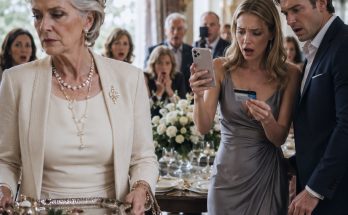
The silk of my wedding dress felt less like a garment and more like a beautifully tailored shroud. It was heavy, embroidered with pearls that caught the light of the Hamptons estate, pulling at my shoulders as I stood alone in the cavernous, marble-floored hallway. The music from the reception downstairs—a string quartet playing something aggressively classical—was a muffled hum beneath my feet. I was twenty-two, the daughter of a diner waitress and an auto mechanic from a dying town in Ohio. And as of three hours ago, I was Victoria Sterling, wife to Arthur Sterling, a sixty-one-year-old titan of New York real estate.
I stared at the heavy oak doors of the master suite. My hands were trembling so violently I had to press them against my thighs to stop the satin from rustling. I was terrified.
“Admiring the cage, Victoria?”
The voice was a dry, scraping whisper that sent a shard of ice down my spine. I turned.
Eleanor Sterling, Arthur’s younger half-sister, materialized from the shadows of the corridor. She wore a gown the color of dried blood and a smile that held all the warmth of a morgue. For the past six months, Eleanor had looked at me as if I were a particularly stubborn stain on the Sterling family crest. Tonight, however, the polite contempt had vanished, replaced by naked, predatory malice.
“Eleanor,” I managed, my voice sounding thin and childish even to my own ears. “I was just going inside.”
“I’m sure you were.” She stepped closer, the sharp scent of expensive lilies and gin suffocating the air between us. She didn’t offer a congratulations. Instead, she reached into her clutch and withdrew a folded document, crisp and white. She pressed it against my chest, forcing me to take it.
“What is this?” I whispered.
“An exit strategy,” Eleanor sneered, her eyes dark and flat. “Let’s skip the fairy tale, little girl. You think you’ve won the lottery. You think Arthur looks at you and sees a wife. He sees a decorative vase to put on his shelf to prove to the board he isn’t dying of old age. That document is a non-disclosure and a severance agreement. You have exactly six months. Play the devoted bride for the cameras, smile at the galas, and when the time is up, you sign that, take your two million dollars, and vanish. If you don’t…”
She leaned in, her lips brushing the air near my ear. “…I will tie you up in so much litigation your grandchildren will be paying my legal fees. I will see you thrown back into the trailer park you crawled out of, with nothing but the clothes on your back. Do not mistake my brother’s temporary senility for a permanent victory.”
She stepped back, her smile returning like a weapon being sheathed. “Have a lovely wedding night, dear.”
I watched her walk away, the document burning a hole in my hand. My chest hitched, oxygen refusing to enter my lungs. Two million dollars. Six months. Trailer park. The whispers of the tabloids, the warnings of my few friends back home, the suspicious glares of the wedding guests—they were all coalescing into a suffocating reality. I wasn’t a wife. I was prey.
I shoved the paper into the deep pocket of my gown and pushed open the heavy oak doors.
The master suite was vast, bathed in the silver light of a full moon spilling through the floor-to-ceiling windows. The bed was enormous, pristine, and terrifying. Arthur was already there. He had discarded his tuxedo jacket and unbuttoned his collar, looking surprisingly tired. His silver hair caught the moonlight.
He didn’t rush toward me. He didn’t demand his rights as a husband. He simply stood by a small silver tray on the nightstand, pouring warm, golden liquid into two porcelain cups.
“Chamomile,” he said, his voice a low, resonant rumble that somehow made the vast room feel smaller. “You look like you’re about to shatter, Victoria.”
I stepped forward, my legs feeling like lead. I took the cup he offered. The heat seeped into my freezing palms. I stared at the liquid. Was it drugged? Was this the part where the trap snapped shut? Eleanor’s venom was still coursing through my veins.
Arthur noticed my hesitation. Without a word, he reached over, took my cup, and took a slow, deliberate sip. He swallowed, then handed it back to me.
Then, he sat on the edge of the bed and gently, so gently it made my heart ache, placed his large, calloused hand over my trembling one.
“Victoria,” he whispered, his eyes locking onto mine with an intensity that stripped away every defense I had left. “You do not have to be my wife tonight. You do not have to perform, or pretend, or owe me anything.” He paused, his thumb brushing my knuckle. “You only have to be safe.”
The dam broke.
It wasn’t a delicate, cinematic cry. It was a visceral, ugly, gasping sob that tore its way out of my throat. It was the sound of a girl who had been holding her breath, terrified of the world, terrified of poverty, terrified of the monsters in expensive suits, finally being told she could breathe.
I collapsed onto my knees beside the bed, burying my face in the mattress. The teacup clattered to the floor, spilling golden liquid across the Persian rug. I waited for him to get angry, to call me hysterical, to demand I act my age or my new station.
Instead, Arthur slipped off the bed, kneeling on the floor beside me in his custom suit. He didn’t pull me into a suffocating embrace. He simply wrapped his arm around my shoulders, anchoring me to the earth while I fell apart.
“I’m sorry,” I choked out, gasping for air. “I’m so sorry.”
“You are crying because everyone told you to be afraid of me,” Arthur said softly, his cheek resting against my hair. “And because my sister just cornered you in the hallway and threatened your life.”
I froze, the tears instantly drying into a cold dread. I lifted my head, staring at him in shock.
Arthur’s eyes were no longer soft. They were dark, flinty, and terrifyingly cold. He reached into the pocket of his trousers and pulled out a small, black audio device.
“The estate is heavily secured, Victoria. I know exactly what Eleanor is.” He stood up, offering me his hand. “Dry your tears. The weeping bride was for tonight. Tomorrow, we start building your armor.”
Three months later, the gilded cage had morphed into a battlefield.
I refused to sit in the Hamptons and arrange flowers. I demanded a job at Sterling Global. Arthur, true to his word about building my armor, didn’t give me a vanity title. He placed me as a Junior Analyst in the Acquisitions department. I was the lowest on the totem pole, working eighty-hour weeks, learning the intricate, brutal dance of corporate real estate.
The whispers followed me into the elevators. Gold digger. The old man’s pet. She won’t last till Christmas.
I ignored them. I absorbed data like a sponge. I learned to read financial sheets until the numbers bled together. I learned the names of every assistant, every janitor, every mid-level manager. Kindness, I discovered, was a highly undervalued currency in a building built on ruthlessness.
Then, the trap snapped.
It was a Tuesday afternoon. The sky over Manhattan was a bruised purple, threatening rain. I was summoned to the executive boardroom on the fiftieth floor. When I walked in, the air was practically vibrating with tension. Arthur sat at the head of the table, his face carved from granite. Eleanor sat to his right, a triumphant, razor-thin smile playing on her lips. Around them sat the twelve members of the board—older men and women who looked at me like I was a virus.
“Close the door, Victoria,” Eleanor commanded, not looking up from her tablet.
I did. I walked to the end of the table and stood. “What is this about?”
“A catastrophic breach,” a board member named Vance spat. “Confidential bidding data for the Hudson Yards expansion was leaked to our primary competitor, the Vesper Group. They outbid us by a fraction of a percent this morning. We lost a two-billion-dollar contract.”
My stomach plummeted. “That’s terrible. But why am I here?”
Eleanor finally looked at me. She tapped a button on the remote, and the massive screen behind Arthur flared to life. It displayed a string of emails, IP logs, and file transfer receipts.
“Because, Victoria,” Eleanor purred, her voice dripping with venomous delight, “the digital footprint leads directly back to your secure login. The files were accessed from your terminal at 2:00 AM on Saturday, downloaded to an external drive, and subsequently sent to a Vesper executive from an encrypted server. A server, I might add, that was leased using a shell company registered in your maiden name.”
The room spun. The silence was absolute, heavy, and crushing. I looked at Arthur. His face was unreadable. He wasn’t defending me. He was watching me.
She’s framing me. She actually did it.
“This is absurd,” I said, my voice remarkably steady despite the hurricane in my chest. “I wasn’t even in the city on Saturday. I was at the Brooklyn townhouse. And I don’t know the first thing about encrypted servers.”
“The evidence is irrefutable,” Eleanor countered, standing up. “Arthur, I warned you. The board warned you. You brought a viper into our nest because you were blinded by a pretty face. She has cost this company billions. She needs to be escorted from the building by security, and our legal team will be filing criminal charges for corporate espionage before the hour is out.”
A few board members nodded in grim agreement. The execution block had been prepared.
I took a slow, deep breath. I remembered Arthur’s words on our wedding night. Tomorrow, we start building your armor.
“Irrefutable,” I echoed, taking a step toward the table. “That’s a strong word, Eleanor. Tell me, if I am such a masterful corporate spy, why would I use a shell company in my own maiden name? That seems rather… sloppy, doesn’t it?”
“Arrogance often breeds stupidity,” she snapped.
“Or,” I said, reaching into my leather portfolio and pulling out a thick, black-bound folder, “someone was desperate to create a paper trail that looked obvious to a room full of panicked executives.” I tossed the folder onto the mahogany table. It hit the wood with a heavy, satisfying thud.
The room stared at it as if it were a bomb.
“I may be a Junior Analyst,” I said, my voice rising, filling the room, “but I am not stupid. Two days ago, an IT tech named Marcus—a man whose wife I helped get into a specialist clinic last month—noticed an anomaly. Someone had cloned my security badge.”
Eleanor’s smile faltered. Just a fraction of a millimeter. But I saw it.
“Marcus and I spent the last forty-eight hours doing a deep dive into the security footage and the server logs,” I continued, walking around the table, forcing the board members to meet my eyes. “The files were indeed accessed from my terminal at 2:00 AM. But the security cameras show my office was dark. However, the camera in the IT sub-basement caught a very interesting physical override at exactly 1:58 AM.”
I looked directly at Arthur. He gave a microscopic nod.
“Open the folder, Vance,” I commanded.
Vance blinked, surprised by my tone, but he reached out and flipped the cover open.
“Page three,” I instructed. “You’ll find high-resolution security stills of Richard Helms, Eleanor’s personal executive assistant, using a physical override key to access the mainframe and route the terminal ghosting through my IP. Page five shows the financial wire transfers. Vesper Group didn’t pay me. They paid a Cayman account belonging to an offshore holding firm called Apex Solutions. And if you look at page seven…”
I stopped right behind Eleanor’s chair. I leaned down, lowering my voice so only the room could hear the absolute finality in it.
“…you will see the incorporation documents for Apex Solutions. The sole beneficiary is you, Eleanor.”
The color drained from Eleanor’s face, leaving her looking like a wax corpse. The boardroom erupted into chaos. Men were shouting, papers were being shoved around.
“This is a fabrication!” Eleanor screeched, her aristocratic poise shattering completely. “She forged this! Arthur, you can’t possibly believe this trailer-trash—”
“Enough.”
Arthur’s voice didn’t just fill the room; it crushed the air out of it. Silence fell instantly. He stood up slowly, looking older than I had ever seen him, but radiating a terrifying, absolute power.
“Security is waiting in your office, Eleanor,” Arthur said, his voice devoid of any brotherly affection. “You will surrender your access cards, your company phone, and your laptop. You are suspended from the board pending a full federal investigation. Get out of my building.”
Eleanor stared at him, her chest heaving. She looked back at me, her eyes burning with a hatred so pure it was almost religious. She didn’t say another word. She turned and fled the room.
The board sat in stunned silence. Arthur looked at them, then looked at me. A fierce, unmistakable pride burned in his eyes.
“Meeting adjourned,” he declared.
Later that night, we celebrated in the private dining room of a quiet Italian restaurant in Tribeca. I was riding a high of adrenaline and victory. I had fought the dragon and won. I was taking a sip of Barolo, laughing at something Arthur had said, when his sentence trailed off.
He dropped his fork. It clattered loudly against the china.
“Arthur?” I asked, the smile dying on my face.
His left hand clawed at his chest, gripping the fabric of his shirt. His face turned an alarming shade of gray. His eyes, usually so sharp, rolled back, and he slumped sideways, collapsing heavily onto the floor before I could even scream.
The hospital waiting room smelled of industrial bleach and stale coffee—the universal scent of purgatory. I sat on a rigid plastic chair, staring blankly at the wall, my hands covered in dried blood from where Arthur had hit his head on the restaurant floor.
It was a massive myocardial infarction. A widow-maker. He had been in surgery for six hours.
The double doors swung open, and I shot to my feet. But it wasn’t the surgeon. It was Eleanor.
She wasn’t alone. She was flanked by three men in sharp, predatory suits—corporate lawyers. She looked remarkably composed, the humiliation of the boardroom entirely erased by the scent of fresh blood in the water.
“Victoria,” she said, her voice dripping with faux sympathy. “You look terrible.”
“What are you doing here, Eleanor? You don’t care if he lives or dies.”
“I care about the Sterling legacy,” she replied smoothly, signaling one of the lawyers. He stepped forward, handing me a thick sheaf of legal documents.
“What is this?” My hands were shaking so badly I could barely hold the paper.
“A reality check,” Eleanor smiled. “While you were sitting here weeping, I convened an emergency board meeting. Given Arthur’s… incapacitation, and the criminal charges I am filing against you for forging evidence and attempting a hostile takeover, the board has voted to grant me emergency acting CEO powers.”
She stepped closer, invading my space. “Furthermore, my legal team has just filed an injunction with the state court. I am challenging your medical proxy. You are a twenty-two-year-old child with zero medical background, and you are currently under investigation. The judge is signing the order as we speak. I am taking control of his medical decisions. And my first decision will be to ensure the company’s stability isn’t threatened by a lingering, expensive vegetable.”
A cold, horrifying realization washed over me. She was going to let him die. Or worse, she was going to pull the plug the second she had the legal right, just to secure the throne.
My despair vanished. It didn’t fade; it evaporated, replaced by a cold, searing fury. The frightened girl from Ohio was dead. In her place stood a woman forged in the fires of the Sterling family’s malice.
“You really think you’ve won,” I whispered.
Eleanor laughed. “Oh, honey. I won the day you put that ring on. You just didn’t know it.”
“Excuse me.” A new voice cut through the tension.
We both turned. Standing in the hallway was an older woman with iron-gray hair, carrying a battered leather briefcase. I recognized her immediately. Margaret Vance, one of the most ruthless and brilliant family law attorneys in Manhattan. She was the woman Arthur had quietly introduced me to a month after our wedding.
“Ms. Sterling,” Margaret said, nodding at Eleanor, completely unfazed by the lawyers surrounding her. “I suggest you tell your lapdogs to recall that injunction immediately. It is entirely frivolous and legally void.”
“Who the hell are you?” Eleanor snapped.
Margaret ignored her, turning to me. “Victoria. Are you ready?”
“Ready for what?” Eleanor demanded.
I looked at the documents in my hand, then let them fall to the floor. I stepped past Eleanor, shoulder-checking her slightly, and stood beside Margaret.
“Eleanor,” I said, my voice echoing loudly in the sterile hallway, “Arthur knew exactly what you would do the moment his heart failed. He knew you’d try a coup.”
Margaret opened her briefcase and pulled out a single, beautifully bound document. “This is a fully executed, airtight Postnuptial and Medical Proxy Agreement, signed by Arthur and Victoria, witnessed by three independent federal judges, and filed privately. It supersedes any prior corporate bylaws or family trust agreements.”
Eleanor scoffed. “A post-nup doesn’t give her control of my company.”
“No,” Margaret smiled thinly. “But Section 4, Paragraph B does. It stipulates that in the event Arthur Sterling is medically incapacitated, his voting shares do not revert to the board. They revert entirely to his wife, Victoria Sterling. That gives her fifty-one percent. Absolute veto power over the board. Absolute control over his medical care. Absolute control over you.”
Eleanor’s face contorted into a mask of pure rage. “That’s illegal! He can’t do that!”
“He did,” I said, stepping right into Eleanor’s face, forcing her to look up at me. “I am the CEO now, Eleanor. I am the board. I am the Sterling empire. And my first executive order is that if you take one step closer to my husband’s hospital room, I will use my fifty-one percent to dissolve your trust fund and liquidate every asset you have ever touched. Now get out of my sight before I call security and have you thrown out like the trash you are.”
For a long, agonizing moment, Eleanor stared at me. She searched my eyes for weakness, for bluffing. She found nothing but titanium.
She turned on her heel and marched down the hallway, her lawyers scurrying after her like frightened mice.
I exhaled a shaky breath, leaning against the wall. Margaret placed a hand on my shoulder. “You did well, Victoria.”
Before I could reply, the double doors of the surgical wing burst open. The lead surgeon stepped out, pulling off his mask. His scrubs were stained dark red.
“Mrs. Sterling?” he asked, his voice grave.
My heart stopped. “Is he…?”
“He’s alive,” the surgeon said, wiping sweat from his brow. “He’s awake. But Mrs. Sterling, you need to prepare yourself. The damage is catastrophic. We stabilized him, but his heart is failing fast. He doesn’t have long, and he has a choice to make about what happens next. He’s asking for you.”
Arthur lived for five more years.
They were not easy years. They were years of oxygen tanks, midnight panic attacks, and a slow, agonizing physical decline. But they were also the most profoundly beautiful years of my life. He mentored me. He taught me the architecture of power, not to wield it as a weapon, but as a shield. I became the CEO of Sterling Global in practice, while he remained the guiding spirit in the shadows.
When he finally died, it was a quiet Tuesday morning in our Brooklyn townhouse. It was raining. He held my hand, smiled tiredly, and simply closed his eyes. He was sixty-six. I was twenty-seven.
The grief felt like a physical amputation. I wandered the house for weeks, a ghost haunting my own life.
But Eleanor did not allow me the luxury of peace.
Three weeks after Arthur was buried, the storm broke. Eleanor held a massive, televised press conference. Standing beside her was a man I hadn’t seen in nearly a decade—Danny, a bitter ex-boyfriend from my hometown.
“The public deserves to know the truth,” Eleanor declared into the bank of microphones. “My brother was manipulated. Victoria Hayes engaged in a systematic, years-long campaign of psychological abuse and isolation. This man, Danny, has sworn testimony that Victoria bragged to him about her plan to marry an old, sick billionaire and drain the estate. We are filing a massive lawsuit to invalidate the will and strip her of every asset she stole.”
The media went feral. The “Gold Digger Widow” headlines dominated the news cycle. The tabloids tore into my past, interviewing anyone who had ever harbored a grudge against me.
I was summoned to the downtown offices of Arthur’s estate attorneys for the formal reading of the final will. The massive mahogany table was surrounded by Arthur’s extended family, all of them looking at me with undisguised hatred, waiting for their payout. Eleanor sat at the head, practically vibrating with triumph.
“Let’s get this over with,” Eleanor sneered as the lead attorney, an old man named Harrison, cleared his throat. “Read the part where she gets nothing.”
Harrison adjusted his glasses. “Before we review the financial disbursements, Mr. Sterling left very specific instructions. A multimedia addendum must be played for all present parties.”
He clicked a remote. The heavy curtains closed, and a projector hummed to life, casting a massive image onto the far wall.
It was Arthur.
The video had clearly been recorded months ago, in his library. He looked frail, wearing a thick wool sweater, but his eyes were as sharp and terrifying as the day he crushed Eleanor in the boardroom.
The room fell into a deathly silence.
“If you are watching this,” Arthur’s recorded voice boomed, deep and resonant, “it means I am dead. And it means my sister, Eleanor, has predictably attempted to destroy my wife.”
Eleanor shifted uncomfortably in her chair.
“I am of sound mind,” Arthur continued, looking directly into the camera lens. “I am leaving my entire estate, the controlling shares of Sterling Global, and all personal properties to my wife, Victoria. She did not manipulate me. She saved me from dying a bitter, paranoid old man.”
Arthur leaned forward, resting his hands on his cane. “But this video is not a defense of my wife. It is an execution, Eleanor.”
Eleanor gasped, her hands gripping the edge of the table.
“Did you really think I didn’t know?” Arthur’s voice dropped an octave, heavy with disgust. “Did you think I was so blinded by age that I missed it? For twenty years, Eleanor, you have been siphoning money from the Sterling Family Foundation. Charity money. You funneled over forty million dollars into offshore shell companies to fund your gambling addictions and your pathetic attempts to buy social influence.”
Pandemonium erupted in the room. The family members began whispering furiously. Eleanor turned bone white. “Turn it off!” she screamed. “This is a deepfake! Turn it off!”
Harrison ignored her.
“I spent the last five years of my life quietly compiling the evidence,” Arthur said on screen. “Bank records, wire transfers, audio recordings of your meetings with offshore fixers. I have compiled a dossier so airtight a first-year law student could convict you.”
Arthur smiled, but it was a terrifying expression. “As of this exact moment, my attorneys are holding that dossier. Eleanor, you have twenty-four hours to publicly retract your absurd allegations against Victoria, drop your lawsuit, and sign over your remaining shares in this company to my wife. If you do, I will allow you to slink away into obscurity. If you fight her, if you speak her name to the press ever again, Harrison has standing orders to courier that dossier directly to the Director of the FBI. You will die in federal prison.”
The screen went black.
The silence in the room was absolute. It was the sound of an empire falling.
Eleanor sat frozen, her mouth opening and closing like a suffocating fish. She looked around the table. Her own family was staring at her in horror. She had no allies left. Her coup was utterly, permanently crushed. She stood up, her legs trembling, and without a single word, she walked out of the room. She was never seen in New York high society again.
The attorneys began packing up their briefcases. The family members scattered, terrified of catching the shrapnel of Eleanor’s destruction.
I sat there, stunned, tears streaming down my face. Arthur had reached beyond the grave to protect me one last time.
As I stood up to leave, Harrison approached me. He looked sad, older than his years. He reached into his breast pocket and pulled out a thick, wax-sealed envelope.
“He told me to give you this when it was over, Victoria,” Harrison said quietly. “He said you needed to know the whole truth.”
I took the envelope. My name was written on it in Arthur’s elegant, sprawling script. A cold sense of foreboding washed over me as I broke the seal.
I didn’t open the letter until I was back in the library of the Brooklyn townhouse. It was raining outside, drumming a gentle rhythm against the tall glass windows. I sat in Arthur’s leather armchair, pulling my knees to my chest, and unfolded the heavy parchment.
My dearest Victoria,
If you are reading this, the war is over. Eleanor is gone, the company is secure, and you are finally safe. That was the only promise I ever cared about keeping.
But there is something I must confess, and I pray you can forgive me for the choice I made.
Do you remember the day I woke up from surgery, five years ago? Do you remember the doctor telling us we had a choice regarding my treatment?
I closed my eyes. I remembered it vividly. The doctor had offered two paths. One was a radical, aggressive pacemaker implant and a cocktail of experimental drugs that would manage his heart, potentially giving him another ten to fifteen years of relatively normal life. The other path was palliative—managing the symptoms but letting the heart naturally, slowly fail. The doctor had warned that the aggressive treatment carried a massive risk of cognitive decline and early-onset dementia due to the heavy medication.
Arthur had chosen the palliative route. He had told me he’d rather have five years with a clear mind than fifteen years as a stranger in his own body. I had respected his choice, even though it broke my heart.
I looked back down at the letter.
I lied to you, Victoria.
The doctor did not tell us the whole truth in that room. I had spoken to him privately before they wheeled me into surgery. The aggressive treatment—the one that would have given us ten more years together—did carry a risk of cognitive decline. But it was a small risk. Highly manageable.
So why did I choose to let my heart fail?
Because of Eleanor.
When I had that heart attack, I realized how vulnerable you truly were. The post-nup protected your money, but it didn’t protect you from the legal and public warfare Eleanor was preparing to wage. She had deep roots, corrupt allies, and decades of stolen money to fund her war against you. If I lost my cognitive sharpness even for a month due to those drugs, she would have found a loophole. She would have destroyed you.
I needed absolute, razor-sharp clarity. I needed to build a fortress so impenetrable that not even the devil himself could breach it. I needed to trace her offshore accounts, gather the evidence of her fraud, and orchestrate her downfall with zero margin for error. That kind of work required every ounce of my intellect, unclouded by experimental medication.
So, I made a trade, my love. I traded a decade of our time together for the cognitive clarity required to build your armor. I chose to die sooner, so that you could live forever without fear.
Do not weep for my sacrifice. I am a businessman, Victoria, and it was the greatest deal I ever struck. You gave an old, cynical man a reason to care about the future again. You were the only true thing in a life built on transactions.
Do not let grief become a new cage. Step into the light. Run the company. Build the foundation. Live loudly, furiously, and beautifully. The fortress is yours now. You only had to be safe. But now, my love, you are free.
Forever yours,
Arthur.
The letter slipped from my fingers, fluttering to the Persian rug.
A wail tore itself from my chest, echoing off the high ceilings of the library. It was a grief so profound, so immense, it felt as though it might crack my ribs. He hadn’t just protected me. He had bought my freedom with his own life, day by agonizing day, hiding his pain behind a smile so I wouldn’t know the price he was paying.
I sat in that chair as the sun set and the moon rose, the shadows stretching long across the room. I cried until there were no tears left, until there was nothing but a hollow, echoing silence inside me.
But slowly, as the first light of dawn began to creep through the windows, painting the room in shades of bruised purple and gold, the emptiness began to fill with something else.
It wasn’t just strength. It was absolute, unshakeable purpose.
I stood up. I walked to the window and looked out at the city waking up. The skyline belonged to Sterling Global. It belonged to me. The girl from Ohio who was terrified of a five-dollar coffee was gone, burned away in the crucible of the Sterling family’s greed and Arthur’s incomprehensible love.
I walked over to Arthur’s massive oak desk. I didn’t sit in the guest chair. I walked around to his side, and I sat in his leather chair. I picked up his gold pen.
I had a company to run. I had a foundation to launch—one designed to protect young women caught in the crosshairs of wealthy, predatory families. I was going to turn the Sterling name from a symbol of ruthless acquisition into a fortress for the vulnerable.
I looked at the framed photo of Arthur on the desk. He was smiling, looking off camera.
“Watch me,” I whispered.
The war was over. The fortress stood. And the queen was finally ready to rule.
If you want more stories like this, or if you’d like to share your thoughts about what you would have done in my situation, I’d love to hear from you. Your perspective helps these stories reach more people, so don’t be shy about commenting or sharing.