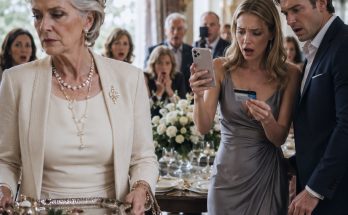
My Sister Left My Daughter Behind — Until The Lawyer Said My Grandmother Saw Everything
My Sister Took My Daughter To Buy A Gift And Came Back Alone. “Oops,” She Smirked. “I Left Her At Target.” My Mother Laughed. “Good. She Was Getting Too Much Attention.” They Abandoned My 5-Year-Old Because Grandpa Called Her His Favorite. I Didn’t Scream. I Made One Phone Call To Grandpa. Thirty Minutes Later, My Sister Was Crying, And My Mom Lost All Color.
### Part 1
My name is Maren Whitfield. I am thirty-four years old, a widow, a mother, and the kind of woman my family called “strong” only because they had spent years putting weight on my back and watching me stay upright.
On Saturday, May 2nd, 2026, my younger sister Blair walked into my mother’s white marble kitchen carrying an empty Target bag. The bag made that thin plastic crackling sound as she set it on the counter, right beside a bowl of lemons my mother never used but always arranged for company.
Blair smiled like she had just remembered a funny story.
“Oops,” she said.
My mother, Sylvia Carrington, looked up from her coffee. “What now?”
Blair flicked her sunglasses onto the top of her head. “I left Lily at Target. She was dawdling again.”
For half a second, the house went so quiet I could hear the ice maker drop two cubes into the freezer bin down the hall.
Lily was my five-year-old daughter.
At that exact moment, I would later learn, my little girl was sitting alone at the guest services desk at the South Park Target, her white Mary Jane shoes swinging above the tile floor, both hands wrapped around a wooden picture frame she had chosen for her great-grandfather’s birthday. She had asked a woman in a red vest, “Did I do something bad?”
But in my mother’s kitchen, Blair only lifted one shoulder, like she had forgotten milk, not a child.
My mother laughed.
Not a startled laugh. Not nervous. Not the kind of laugh people make when their mind refuses to accept horror.
It was satisfied.
“Good,” she said, stirring cream into her coffee. “That child has been monopolizing your grandfather’s affection far too long. Perhaps now she’ll learn she is not the center of this family.”
Something inside me went still.
I did not scream. I did not grab Blair. I did not throw the coffee cup in my hand, although I remember noticing the blue rim around it, the one my grandmother had bought in Asheville years ago. I remember the smell of bacon grease in the pan, the sunlight falling across the counter, the slow way my father lowered the sandwich knife he was holding.
Then my father, Graham, did what he had done my entire life.
He walked away.
He stepped through the sliding glass door to the patio and pulled it shut behind him, leaving me in that kitchen with my mother’s cruel little smile and my sister’s careless one.
I rinsed my coffee cup. I dried my hands on the striped towel hanging beside the sink. I walked into the powder room, locked the door, and made one phone call.
My voice sounded like it belonged to someone else when I said, “My name is Maren Whitfield. My five-year-old daughter, Lily, was brought to your store by her aunt and left there alone. I need you to confirm she is safe.”
The woman on the line stopped breathing for a beat. Then her tone changed.
“Ma’am, please hold.”
Forty seconds later, a police officer came on the phone.
“Mrs. Whitfield? Your daughter is safe. She’s with store staff at guest services. We initiated a child safety alert at 11:21.”
I pressed my palm flat against the wallpaper.
The wallpaper had tiny green vines on it. I had stared at those vines during Thanksgiving arguments, Christmas insults, and family lunches where my mother pretended not to hear what Blair said to me. I had always survived by counting small details.
One vine. Two leaves. Three pale flowers.
“Was she alone?” I asked.
The officer paused.
“Yes, ma’am.”
The pause told me more than the word did.
I called my grandfather next. Arthur Ellison answered on the first ring, his voice gravelly but sharp.
“Maren?”
“Lily is safe,” I said quickly, because I knew that was the only way to keep him standing. “Blair left her at Target. I’m going to get her now.”
He asked three questions.
“Where is she? Is she hurt? Are you driving?”
I answered all three.
Then he said, very quietly, “Callahan will meet us. Your grandmother planned for this.”
My hand tightened around the phone.
My grandmother, Lenora Ellison, had been dead for twenty months.
Before I could ask what he meant, my grandfather said, “Get your daughter first. Then come to the lake house.”
When I came back into the kitchen, Blair was eating grapes from the bowl my mother had washed for brunch. She popped one into her mouth and raised her eyebrows.
“You look dramatic.”
My mother sighed. “Maren, don’t turn this into one of your widow panic episodes. Blair made a judgment call.”
“A judgment call,” I repeated.
Blair leaned against the counter. “She was being slow. I told her to wait by the front. She’s fine.”
I looked at my mother. “You laughed.”
Her expression hardened. “Because you’ve made that child impossible. Everyone worships her because of what happened to Cole, and because Dad is lonely, and because you let her act precious.”
Cole was my husband. He had died four years earlier when an SUV ran a red light while he was biking home from work. Lily had been eighteen months old.
My mother said his name like it was an inconvenience.
I picked up my purse.
“Do not follow me,” I said. “Do not call me. I will be in touch when I decide to be.”
Blair rolled her eyes. “Oh my God, Maren. She’s at Target, not in a ditch.”
I opened the door.
Behind me, my mother said, “You are going to regret making an enemy of your own family.”
I turned back once.
“No,” I said. “I think you just forgot I had witnesses now.”
I did not know yet how true that was.
### Part 2
The drive to Target should have taken fourteen minutes. It felt like crossing a continent.
Every red light seemed personal. Every slow car in front of me made my chest burn. My hands stayed locked at ten and two on the steering wheel because I was afraid if I let go, the rage would come up through my arms and take over my body.
I kept seeing Lily that morning.
She had stood beside my bed in her daisy-print dress, holding two pairs of socks and asking, “Which ones look more birthday-ish?” She said “birthday-ish” like it was a legal category. She had brushed her own curls badly, leaving one side flat and the other wild, and I had fixed it while she explained that Pop-Pop Arthur needed a “real grown-up present.”
She had saved eighteen dollars in a little canvas bag with a faded rabbit on it.
“Not candy,” she had told me seriously. “A thing he can keep.”
At my mother’s brunch, she had barely touched the fruit salad. She had stayed close to my chair, one small hand resting on my knee whenever the room got too loud. When Blair asked if she wanted to go to Target, Lily had looked at me first.
She had not said yes.
She had not said no.
That silence would live under my skin for years.
I should have protected it.
Instead, I had smiled because I was tired of being accused of keeping Lily away from “family.” I had said, “Be back by noon.”
Blair had smiled too brightly. “Of course.”
At 11:35, I had checked Lily’s GPS watch from habit. The little dot sat at South Park Target. I texted Blair.
“Everything okay?”
She replied, “Still picking. She’s being picky. Lol.”
I had almost called then. I had almost listened to the old feeling in my stomach, the one my grandmother used to call “the bell before the storm.”
But my mother was talking about my grandfather again.
“He’s been forgetting things,” she said, slicing a strawberry into perfect halves. “He asked me twice last week what day the yard service comes.”
“He’s eighty-two,” I said. “That’s not confusion.”
“He’s vulnerable,” my mother replied. “People take advantage of lonely old men.”
Blair had looked right at me when she said, “Especially when they have cute little kids to parade around.”
There it was.
The real bruise beneath every conversation lately.
My grandfather adored Lily. Not in a spoiled way. In a quiet, astonished way, as if she had brought a light back into rooms that had been dim since my grandmother died. Lily sat on his left side at dinner because my grandmother had once whispered to her, “Pop-Pop’s eyes work better from that side. Remember that.”
And Lily remembered.
After Lenora’s funeral, when adults treated my grandfather like furniture, Lily climbed into the chair to his left, held his hand, and described everything happening on the right side of the room.
“Aunt Blair is eating the corner brownie. Grandma Sylvia is whispering. Mama is pretending she isn’t sad.”
My grandfather had cried into his napkin.
No one asked why.
When I pulled into the Target parking lot, a police cruiser was parked near the entrance. The red circles painted on the giant concrete balls outside looked too cheerful, too ordinary. People were walking in with reusable bags and iced coffees, living normal Saturday lives, while mine had cracked open.
Inside, the air smelled like popcorn, floor cleaner, and plastic packaging.
A young employee led me to guest services. “She’s right here.”
Lily sat in a molded plastic chair, legs dangling. Her cheeks were blotchy. She was not crying anymore, which somehow hurt worse. She held the wooden frame in both hands like someone might take it away.
When she saw me, she stood slowly.
“Mama?”
I knelt before she reached me, and she folded into my arms, small and stiff at first, then shaking.
“I waited like Auntie said,” she whispered into my neck. “Was that the game?”
I closed my eyes.
I wanted to tell her there was no world in which adults made games out of children being afraid. I wanted to say her aunt was cruel, her grandmother worse, and I had failed by letting them near her.
But she was five.
So I held her face in my hands and said, “There was no game, baby. It was not your mistake. You did everything right.”
Her lip trembled. “I stayed by the red balls, but then a man looked at me funny, so I went inside.”
The officer standing nearby looked down at his notebook.
I kissed Lily’s forehead. “That was smart.”
“I asked the lady for help,” Lily said. “I told her my watch knows where I am.”
“You were very brave.”
She looked down at the frame. It was plain wood, with a little carved border. “Does Pop-Pop still want his present?”
My throat closed.
“Pop-Pop wants you,” I said. “He wants the present too. But those are not the same kind of wanting.”
The officer gave me the report number. His tone was careful, professional, but his eyes were not neutral.
“Security footage shows your sister leaving the store at 10:58,” he said. “Your daughter appears alone near the entrance for approximately twenty-two minutes before approaching staff. We also confirmed a purchase at the Starbucks across the street at 11:10 under your sister’s card.”
I stared at him.
“She left Lily,” I said. “Then she went for coffee.”
“Yes, ma’am.”
In that moment, the fear inside me sharpened into something cleaner.
Blair had not forgotten.
She had not panicked.
She had abandoned my child, bought coffee, lied to me by text, and returned to my mother’s house to watch my reaction.
That was not carelessness.
That was choreography.
And someone else had seen the dance before I did.
### Part 3
The lake house sat on a bend of Lake Norman, where pine trees leaned over the water and the dock creaked even when no one stood on it. My grandparents had bought it in 1989, back when the kitchen still had yellow counters and my grandmother was young enough to carry sacks of mulch over one shoulder.
By the time I pulled into the gravel drive that Saturday afternoon, Lily had fallen asleep in the back seat with the wooden frame tucked against her chest.
My grandfather was waiting on the porch.
Arthur Ellison had always been tall, but grief had made him narrow. His white hair lifted in the lake wind. He held the porch railing with one hand, not because he needed it, but because he was containing himself.
Behind him stood a man I recognized only from my grandmother’s funeral.
Malcolm Callahan.
Attorney. Navy tie. Silver glasses. The kind of man who could make silence feel notarized.
My grandfather came down the steps before I could open Lily’s door. He looked through the window at her sleeping face, then turned away for a second. His jaw moved like he was chewing words he did not trust himself to say.
“Bring her inside,” he said.
Lily woke as I unbuckled her. The first thing she saw was my grandfather.
“Pop-Pop,” she mumbled.
His face changed. It broke and rebuilt itself in the same breath.
“There’s my girl.”
She held out the frame. “I got your present. But Auntie left before I paid.”
Malcolm stepped forward. “The store manager allowed us to purchase it over the phone. It is officially yours now, Miss Lily.”
Lily blinked at him, still sleepy. “Are you a lawyer?”
“I am.”
“Are lawyers good or bad?”
He glanced at me, then at my grandfather. “Depends who hired them.”
Lily seemed to accept that. She let my grandfather carry the frame into the house.
Inside, the lake house smelled like cedar, old books, and lavender hand cream. My grandmother’s presence lived in small, stubborn things: the copper kettle on the stove, the blue quilt over the couch, the wind chimes she said were “almost music but less needy.”
Lily curled under that quilt and fell asleep again.
Only then did my grandfather motion for me to sit at the dining table.
My grandmother’s chair was still at the head. No one sat in it. No one moved it.
Malcolm placed a leather briefcase on the table. He opened it, but did not remove anything yet.
“Maren,” my grandfather said, “your grandmother left instructions.”
“She knew Blair would leave Lily somewhere?”
His face tightened. “She knew your mother and sister would eventually punish you through your child.”
The words landed like cold water.
Malcolm folded his hands. “Mrs. Ellison documented a pattern over several years. She did not want to cause a family rupture while she was ill unless there was immediate danger. But she prepared legal triggers.”
“Legal triggers,” I repeated.
“Events that would activate certain changes,” he said. “Attempts to remove Mr. Ellison’s authority. Attempts to interfere with Lily’s school or medical access. Financial pressure. And any incident involving Lily’s safety.”
I looked at my grandfather.
He stared at the empty chair.
“She saw more than I wanted to see,” he said.
That was my grandmother.
Lenora Ellison had never shouted. She did not slam doors or make dramatic speeches. She noticed things. She noticed who refilled a glass and who emptied a room. She noticed how my mother called me “capable” whenever she wanted to take my labor. She noticed how Blair cried only after consequences appeared.
When Blair was three, she broke my grandmother’s porcelain vase and my mother blamed me for not watching her. I was five. My grandmother had looked at the broken pieces, then at my mother.
“Sylvia,” she said, “the truth does not become rude because it is inconvenient.”
My mother did not speak to her for two weeks.
When Blair cut four inches off my hair while I slept, my mother said, “It will grow back.”
My grandmother took me to a salon, bought me hot chocolate afterward, and told me, “People who laugh at harm are asking you to call cruelty a joke. Don’t.”
I remembered those words while Malcolm removed a sealed envelope from the briefcase.
“This was prepared eighteen months ago,” he said. “Your grandmother requested that I play it only if Lily was deliberately endangered by a family member.”
My skin prickled.
“She recorded something?”
“Several things,” Malcolm said. “But not all today. Mrs. Ellison was very specific about order.”
From the living room, Lily sighed in her sleep.
I looked toward her, then back at the envelope.
“Does my mother know?”
My grandfather’s mouth hardened.
“She will.”
At 1:42 p.m., Malcolm, my grandfather, Lily, and I returned to my mother’s house.
My father’s truck was still gone. My mother’s Audi sat in the driveway. Blair’s white SUV was parked crookedly near the mailbox, as if even her car believed rules were suggestions.
When my mother opened the door, she looked past me at Malcolm.
Her face changed.
Not guilt.
Recognition.
“Dad,” she said carefully, “why is your lawyer here?”
My grandfather walked in without answering.
Blair came from the kitchen holding a glass of iced tea. She saw Lily beside me and had the nerve to smile.
“There she is,” she said. “See? Totally fine.”
Lily moved behind my leg.
Malcolm set his briefcase on the coffee table.
“Mrs. Carrington,” he said to my mother, “Ms. Carrington. Please sit down.”
My mother lifted her chin. “This is my home.”
My grandfather looked at her.
“No,” he said. “It is a room where you laughed after my great-grandchild was abandoned.”
The color left her face.
And then Malcolm took out my grandmother’s old phone.
### Part 4
There are sounds a family makes when it realizes the performance is over.
My mother’s bracelet clicked against her coffee mug. Blair’s ice shifted in her glass. Somewhere in the hallway, the air conditioner hummed through the vents, steady and indifferent.
Malcolm placed my grandmother’s phone on the coffee table like evidence in a courtroom.
My mother stared at it.
“Is that Mom’s phone?”
“Yes,” Malcolm said.
“That should have been with her personal things.”
“It was,” my grandfather said. “Until she gave it to me.”
Blair let out a sharp laugh. “This is insane. You’re all acting like I dropped Lily in the woods. It was Target.”
Lily’s hand tightened around mine.
I looked down and saw that her little knuckles had gone pale.
My grandfather noticed too.
His voice was quiet when he said, “Blair, if you speak about my great-granddaughter like that again, you will leave before you hear what your grandmother wanted you to hear.”
Blair’s mouth opened, then closed.
My mother sat on the edge of the sofa. “Dad, please. You’re upset. Maren is upset. This does not need lawyers.”
“That sentence,” Malcolm said mildly, “is almost always spoken by the person who benefits from not having them.”
My mother’s eyes flashed.
For the first time in my life, I saw her calculate and come up short.
Malcolm unlocked the phone. He did not scroll. He knew exactly where to go.
“The first recording is dated January 14th, 2025,” he said. “Mrs. Ellison asked that it be played in the presence of Diane Carrington and Blair Carrington only after an incident involving Lily’s physical safety or custodial access.”
Blair crossed her arms. “Custodial access? I’m her aunt.”
“No,” I said. “You are the adult who left her alone.”
Blair looked at me with pure hate.
Then Malcolm pressed play.
My grandmother’s voice filled the room.
It was thinner than I remembered, scraped down by illness, but still unmistakably hers. Calm. Clear. A little breathless between phrases.
“Sylvia. Blair. If you are hearing this, then something has happened to Lily.”
My mother covered her mouth.
My grandmother continued.
“I hope I was wrong. I have prayed to be wrong. But I have watched this family excuse small cruelties until they grew teeth. I watched Maren carry blame that was never hers. I watched Blair learn that tears could erase consequences. I watched Sylvia mistake control for love.”
Blair whispered, “No.”
The recording kept going.
“Lily is a child. She is not a rival. She is not a symbol of anyone’s inheritance. She is not proof that Maren is loved more than you. If you endangered her to teach Maren a lesson, then you have only proved that Edmund and I were right to prepare.”
My grandfather closed his eyes when she said his name.
My mother was crying now, but quietly, almost elegantly. She had always known how to make tears look dignified.
My grandmother’s voice softened.
“Sylvia, I loved you. I saw you. I always saw you. That is why this hurts. Blair, sweetheart, there is help for the anger you carry. Take it. But I will not allow you to feed it with Maren’s child. I cannot save you from consequences anymore.”
The recording ended.
No one moved.
It lasted less than a minute, but the room felt rearranged, as if the walls had shifted while we listened.
Blair’s eyes were wet, but her face was furious.
“That is disgusting,” she said. “She recorded that while she was dying? She set me up?”
My grandfather opened his eyes.
“No,” he said. “You arrived exactly where she feared you were going.”
My mother turned to him. “Dad, you cannot honestly believe Blair meant harm.”
Malcolm reached into the briefcase again.
“There is a second recording.”
My mother’s tears stopped.
Blair looked at the phone in his hand like it had become alive.
“This one,” Malcolm said, “was recorded in June of 2022.”
Three months after Cole died.
I felt the room tilt.
June of 2022 was a blur in my memory: sympathy casseroles, insurance forms, Lily crying for a father too young in her mind to stay gone. I had been sleeping two hours a night, if that. My grandmother had practically moved into my house. My mother visited when people were watching.
“What is that?” I asked.
Malcolm looked at me with something like regret.
“It was recorded on a device Mrs. Ellison kept in her sunroom after she began to worry about certain conversations happening when she left the room.”
My mother stood. “Do not play that.”
My grandfather did not raise his voice.
“Sit down, Sylvia.”
She sat.
Malcolm pressed play.
There was static first. Then the clink of glass. Then Blair’s voice, younger but unmistakable.
“I’m just saying, if something happens to Maren, or God forbid the kid, then Mom and I would inherit a real piece of this. Right now, Lily is just a problem standing between us and what’s ours.”
My blood went cold.
The recording captured my mother’s voice next, low and sharp.
“Don’t say things like that where anyone can hear you.”
Blair laughed.
“Relax. Grandma’s asleep.”
My mother said, “Your grandfather is sentimental. Sentimental men can be managed.”
The audio ended.
For several seconds, no one breathed.
Then Lily whispered from behind me, “Mama?”
I turned and saw her face.
She did not understand the words. Not fully. But she understood the room. Children always do.
I picked her up, even though she was almost too big now, and held her against me.
Blair stood so fast her glass tipped over. Tea spread across my mother’s pale rug.
“That was taken out of context.”
Malcolm looked at the spilled tea, then at her.
“Ms. Carrington,” he said, “some sentences do not improve with context.”
### Part 5
That night, Lily slept at my grandfather’s lake house under my grandmother’s blue quilt.
I sat beside her until the moon appeared on the water. The room smelled faintly of lavender and old cedar. Lily’s breathing was soft, uneven at first, then finally deep. Every few minutes, she reached in her sleep for the wooden picture frame, which sat on the nightstand like proof that she had gone through something frightening and still tried to finish what she started.
When I came back to the kitchen, my grandfather had set out two mugs of tea.
Then, after a moment, he set out a third at the empty chair.
My grandmother’s chair.
He did not explain it. He did not need to.
Malcolm had gone home after leaving a thick folder on the dining table. The folder looked harmless enough, brown paper, white label, metal clasp. But inside it was the map of everything my grandmother had done while the rest of us thought she was only dying.
My grandfather pushed it toward me.
“She left nine instructions,” he said.
“Nine?”
He nodded. “She called them safeguards. I called them unnecessary at the time.”
His voice cracked on that last part.
I opened the folder.
The first page was a letter in my grandmother’s handwriting. Not shaky. Not confused. Careful, slanted, blue ink.
My dearest Edmund, if you are reading this with Maren, then I did not exaggerate. Please do not waste time feeling guilty before doing what needs to be done.
I put my hand over my mouth.
My grandfather looked toward the lake.
“She knew me too,” he said. “She knew I would blame myself before I acted.”
I read through the instructions slowly.
The first told him to change the locks after her funeral if my mother asked for a key “for emergencies.” She had. He had said no, and my mother had sulked for two months.
The second told him not to let Sylvia move him into assisted living without an independent doctor’s evaluation. That explained the appointment he had taken in January, the one my mother called “paranoid.”
He had scored twenty-eight out of thirty.
The third predicted my mother would “accidentally” forget to invite me to Thanksgiving and then blame grief. She had done exactly that, texting me at 8:17 p.m. on Thanksgiving Day, “I assumed you wanted space.”
The fourth warned that Blair would ask for money disguised as temporary help. She had, three times.
The fifth instructed him to document every conversation about selling the lake house.
The sixth involved Lily’s school.
I stopped reading.
“What happened at school?”
My grandfather’s face hardened. “Blair tried to sign Lily out in February.”
My chest tightened. “No one told me.”
“I didn’t know until later. The school called your emergency list and reached your mother first. Sylvia told them Blair had permission. The office manager hesitated because Blair wasn’t on the authorized pickup form anymore after that winter flu incident.”
I remembered the flu incident. Blair had offered to bring Lily home from preschool, then taken her to my mother’s house instead and posted photos online before telling me where she was. I had removed her from the pickup list that night.
“My grandmother knew?”
“She found out through a friend whose daughter works in the school office,” he said. “She told me to watch for escalation.”
Escalation.
The word made my skin feel too tight.
The seventh safeguard had triggered that day: any abandonment, concealment, unauthorized removal, or safety incident involving Lily.
The eighth instructed Malcolm to amend trust distributions.
The ninth was sealed.
I touched the sealed envelope. My name was written across it.
“Can I open this?”
My grandfather shook his head. “Not yet. Lenora said you would know when.”
Part of me wanted to tear it open anyway. Another part trusted my grandmother more dead than I trusted most people alive.
So I left it sealed.
On Monday morning, I began cutting lines.
I removed my mother and Blair from Lily’s school records completely. I changed the password at the pediatrician’s office. I updated the daycare summer camp form, the dentist, the church nursery, even the emergency contact sheet taped inside Lily’s backpack.
I changed my door codes.
I changed my Wi-Fi password.
I stopped sharing my location with my mother.
The notification must have gone through immediately, because at 9:18 a.m., my phone lit up.
Mom: Are you proud of yourself?
A minute later:
Mom: Your grandmother would be ashamed of this cruelty.
I looked at Lily across the kitchen table. She was making a pancake face with blueberries and whipped cream, concentrating with the seriousness of a surgeon.
“Does this look happy or confused?” she asked.
“Confused,” I said.
She added one more blueberry. “Now?”
“Still confused, but with hope.”
She giggled.
I did not answer my mother.
By Wednesday, relatives began calling.
Aunt Carol left a voicemail saying, “Your mother is devastated, honey. Blair made a mistake, but destroying the family won’t help Lily.”
My cousin Meredith texted, “I heard there’s legal stuff now? Isn’t that extreme?”
My father did not call.
That silence surprised me less than it should have.
Then, on Thursday night, an envelope appeared in my mailbox.
No stamp. No return address.
Inside was a copy of a photo.
My grandmother, taken from behind, sitting in her sunroom.
Across from her sat Blair and my mother.
On the back, in my grandmother’s handwriting, were five words:
They think I am sleeping.
I stood in my driveway under the porch light, holding that photo while moths tapped themselves against the glass above me.
And for the first time, I understood that my grandmother had not merely suspected.
She had witnessed.
### Part 6
The formal meeting happened on Saturday, May 9th, at my grandfather’s lake house.
My mother arrived first, wearing a camel cardigan, dark sunglasses, and the expression of a woman prepared to be wronged in public. Blair came behind her in a black dress too dramatic for noon, her hair pulled back so tightly it made her face look sharper.
My father stepped out last.
Graham Carrington wore a gray suit without a tie. He looked older than he had the week before. Not weaker exactly. Just less protected by his own disappearing act.
No one hugged.
The lake glittered behind the house, too bright, almost rude in its beauty. Inside, the dining table had been cleared except for four chairs, one framed photograph, and Malcolm’s briefcase.
My grandfather sat on one long side.
I sat across from him.
My mother and Blair sat at the short ends.
My father remained standing.
He looked at Malcolm. “Where is my seat?”
Malcolm glanced toward the porch.
“Mr. Carrington, Mr. Ellison says you are welcome to stay or leave. There is a chair outside.”
My father’s face flushed.
My mother snapped, “That is unnecessary.”
My grandfather said, “No. It is accurate.”
For once, somebody had named the shape of my father’s absence.
He stood there another second, then took off his suit jacket and walked out to the porch. Through the window, I watched him lower himself into the wicker chair, elbows on knees, staring at the dock.
Malcolm opened the briefcase.
He laid out the police report first.
Then still images from Target security footage: Blair walking out at 10:58, Lily standing near the entrance, Lily turning in a slow circle, Lily entering the store alone.
My mother looked away.
“Look,” my grandfather said.
She did.
Malcolm placed down Blair’s Starbucks receipt from 11:10. Then Ring camera stills from my mother’s neighbor showing Blair’s SUV back in the driveway before noon. Then my text message at 11:35 and Blair’s reply claiming Lily was “still picking.”
One by one, the room lost its excuses.
Blair’s first defense was carelessness.
“I thought she followed me.”
The footage killed that.
Then it was confusion.
“I went back for coffee because I thought Mom had her.”
The texts killed that.
Then it was emotion.
“I was overwhelmed. Everyone acts like Lily is some angel and I’m nothing.”
My grandfather leaned back.
“At last,” he said. “Something honest.”
Blair’s mouth tightened.
My mother reached for her hand, but Blair pulled away.
Malcolm slid another document forward. “Mr. Ellison’s cognitive evaluation. Completed January 2026. He remains legally competent to amend, revoke, or restructure all trust-related decisions.”
My mother’s eyes flicked toward my grandfather.
“I never said you weren’t competent, Dad.”
“Yes,” he said. “You did. To Carol. To Meredith. To Dr. Vance’s receptionist. To the bank manager when you asked about access to my accounts.”
Her lips parted.
Malcolm added, “We have records.”
For the first time, my mother looked afraid.
Not sorry.
Afraid.
That difference mattered.
Then Malcolm placed a final document at the center of the table.
“Mrs. Carrington, Ms. Carrington,” he said, “Mr. Ellison has amended the family trust.”
Blair frowned. “What trust?”
My mother closed her eyes.
That told me she knew enough.
Malcolm continued. “Monthly discretionary distributions to Sylvia Carrington and Blair Carrington will reduce by sixteen and a half percent each month for six months. After that period, they will be zero.”
Blair sat forward. “You can’t do that.”
My grandfather said, “I can.”
“The condo lease currently paid through the trust for Ms. Blair Carrington will not be renewed,” Malcolm said. “You have ninety days to vacate or assume full financial responsibility yourself.”
Blair looked at my mother. “Mom?”
My mother whispered, “Dad, please.”
Malcolm did not pause. “The successor trustee role previously assigned to Sylvia Carrington has been reassigned. Maren Whitfield is now successor trustee.”
The room changed again.
Not loudly. No one screamed at first. But my mother’s hand slid off the edge of the table as if the wood had become ice.
“Maren?” she said, with the same disbelief she used when I won awards as a child.
“Yes,” my grandfather said. “Maren.”
Blair let out a bitter laugh. “Of course. Perfect Maren gets everything.”
I looked at her then.
For years, I had tried to explain that being “perfect” in our family meant being blamed quietly, needed constantly, and loved conditionally. But Blair did not want truth. She wanted a mirror that made her wound look like a crown.
“I got responsibility,” I said. “You got warnings.”
My mother turned to my grandfather, voice trembling. “Dad, can we talk without lawyers? Just family?”
My grandfather looked at the framed photograph of my grandmother in her wedding dress. Her smile was bright, young, almost mischievous.
Then he said, “Sylvia, look at your mother’s chair.”
My mother looked.
Her face crumpled.
But I knew that cry.
She was not crying for Lily.
She was not crying for me.
She was crying because her mother had seen her clearly and left proof.
Malcolm played the June 2022 recording one more time.
This time, no one interrupted.
Blair stood before it ended and walked into the hallway. Lily was in the living room with crayons and a stack of paper, supervised by my grandfather’s neighbor. She looked up when Blair passed.
“Hi, Aunt Blair,” Lily said softly.
Blair froze.
For one second, something human crossed her face.
Then she turned away.
That was the closest she came to an apology.
### Part 7
The meeting ended at 3:30.
My mother left with her sunglasses in her hand, not on her face. Blair walked ahead of her, arms crossed, jaw clenched, like the whole world had become unfair the moment it stopped bending around her.
At the door, my grandfather said, “Your mother saw both of you long before I did. Malcolm will mail the rest.”
My mother turned once.
“Dad, you’re letting Maren poison you.”
He looked so tired then, but not uncertain.
“No,” he said. “I am finally drinking clean water.”
She flinched as if he had slapped her.
Then she left.
Blair paused beside the bookshelf. The wooden picture frame Lily had chosen sat there now, holding a photo of my grandmother and grandfather on the dock. Beside it was a jar of lavender hand cream, the same kind Lily had rubbed into my grandmother’s cold hands during her last months.
Blair stared at the shelf.
I wondered if she remembered those Sundays.
Lily sitting beside Lenora’s bed, reading picture books out loud. My grandmother touching her curls. My mother standing in the doorway, complaining that the room smelled like medicine. Blair looking bored, checking her phone, asking if anyone had seen her sunglasses.
Then Blair turned and got into my mother’s Audi.
My father did not go with them.
He stayed on the porch.
For ten minutes, he sat in the wicker chair with his jacket over his knees. My mother started the car, waited, honked once, then drove away without him.
I watched from the kitchen window.
Part of me expected him to come inside and finally say everything he had never said. I expected a confession, a breakdown, maybe even anger at himself.
Instead, he took out his phone and called a ride-share.
That was my father. Even his first act of rebellion was quiet enough not to disturb anyone.
That evening, he sent me one text.
“I will not be returning to your mother’s house tonight.”
I stared at it for a long time.
Then I put the phone face down and helped Lily make grilled cheese.
A week later, I found an envelope in my mailbox. My father had written my name on it in blocky blue ink.
Inside were four lines.
“Maren, I should have said something years ago. I do not expect forgiveness. I saw it. I just did not know how to be in the room. I am sorry. Dad.”
I read it twice.
Then I placed it in the drawer with my grandmother’s letters.
Not every apology deserves immediate access.
My mother called three days after that.
I almost did not answer, but Lily was in ballet class, and the parking lot was quiet except for rain ticking on the windshield.
“Maren,” my mother said, breathless with outrage, “your father planted a magnolia at his rental without asking me.”
I looked through the glass at the dance studio. Lily was inside, wearing pink tights, turning in the wrong direction and laughing at herself.
“Good,” I said.
“What?”
“I hope it grows.”
Then I hung up.
After that, my mother sent long messages every few days. Some were furious. Some were wounded. Some sounded almost kind if you did not know how to read the hook beneath the bait.
“I miss my granddaughter.”
“You are punishing Lily by keeping her from family.”
“Your grandmother would want reconciliation.”
“You have always been hard.”
The last one made me laugh.
Not because it was funny.
Because for once, I understood the translation.
Hard meant I had stopped being usable.
Blair posted a photo outside a therapist’s office two weeks later. The caption said, “Healing from family betrayal.” She went three times. Stopped. Started again. Stopped again.
People sent me screenshots.
I deleted them.
Her healing was not my responsibility.
My responsibility was Lily.
So I found a child therapist with a waiting room full of soft chairs and wooden toys. Lily drew Target for three sessions: red circles outside, a big door, herself very small in the middle. In the fourth session, she drew me walking through the door.
In the fifth, she drew my grandmother as a star above the building.
The therapist said, “Children often make protectors out of people who made them feel safe.”
I drove home crying so hard I had to pull into a gas station parking lot.
Lily patted my arm from the back seat.
“Mama, are you sad because Nana Lenora died?”
“Yes,” I said. “And because she loved us so well.”
Lily thought about that.
“Can people love you after they’re gone?”
I looked at her in the rearview mirror.
“Yes,” I said. “Sometimes they leave instructions.”
The sealed envelope from my grandmother sat in my desk drawer for another eleven days before I opened it.
I knew it was time because Lily asked me one morning, “If Grandma Sylvia says sorry, do I have to hug her?”
The question was small.
The answer was not.
That night, after Lily fell asleep, I took the envelope to the kitchen table.
My hands shook as I broke the seal.
Inside was one letter.
My dearest Maren, if you are reading this, then the boundary has become real. Do not confuse grief with obligation. Do not hand your daughter back to people just because they are lonely after consequences. Love can forgive from a distance. Safety must stand at the door.
I pressed the letter to my chest.
Then I read the last line.
The people who abandoned you will ask to return through Lily. Do not let them.
For the first time since Target, I slept through the night.
### Part 8
By the end of May, our lives had become quieter.
Not easy. Quiet.
There is a difference.
Easy would have meant Lily forgot the red circles outside Target. Easy would have meant I stopped checking the school app three times a day. Easy would have meant my phone no longer made my stomach tighten when my mother’s name appeared.
Quiet meant we had space to breathe anyway.
On May 24th, Lily and I drove to my grandfather’s lake house for breakfast. The morning was warm, and the water shone silver through the trees. Lily wore shorts, rain boots, and a sweater because she had dressed herself “for all possible weathers.”
She brought a drawing in a purple folder.
It showed three people holding hands: Pop-Pop, Mama, and Lily. Above them was a yellow star with gray curls.
“That’s Nana Lenora,” she explained. “She is supervising.”
My grandfather studied it like it belonged in a museum.
“She was very good at that,” he said.
We put the drawing on the bookshelf beside the wooden frame. Next to it sat the lavender hand cream. Lily unscrewed the lid and smelled it, then carefully put it back.
A few minutes later, tires crunched on the gravel outside.
My body went rigid before I could stop it.
My grandfather looked through the front window. “It’s Graham.”
My father stepped out of a ride-share holding a bakery box.
No one had invited him.
He stood near the porch steps, uncertain, as if the yard itself might reject him. He wore jeans and a clean blue shirt. Without my mother beside him, he looked less like a husband and more like a man who had misplaced several decades.
I opened the door.
“Hi,” he said.
I did not say it back.
He held up the box. “Cinnamon rolls. From that bakery you liked as a kid.”
The memory came immediately: Saturday mornings, sticky fingers, my father buying extra icing when my mother said sugar made children dramatic.
I hated that the memory still had warmth in it.
My grandfather stepped beside me.
“Graham,” he said.
“Arthur.”
The two men looked at each other for a long moment.
Then my grandfather said, “You can come in. But do not mistake entry for repair.”
My father nodded.
“I won’t.”
Inside, Lily looked up from the table.
“Grandpa Graham?”
He smiled carefully. “Hi, Lily.”
She slid closer to my side, not hiding exactly, but choosing her place. I let her.
My father noticed. Pain crossed his face.
Good, I thought. Let truth arrive somewhere in him.
Breakfast was awkward, but not terrible. My father did not make speeches. He did not ask for hugs. He did not tell Lily to come sit on his lap. He placed the bakery box on the counter and asked my grandfather where the plates were.
After we ate, Lily went to the porch with a coloring book.
My father stayed at the sink, washing dishes by hand even though the dishwasher was empty. The old version of him would have escaped outside by now. This version seemed determined to remain where discomfort could find him.
“I moved into a small apartment,” he said.
I dried a mug. “Okay.”
“I’m seeing someone. A counselor.”
“That’s good.”
“I know I don’t get to ask anything from you.”
I set the mug down.
“No,” I said. “You don’t.”
He nodded.
“I watched your mother make you responsible for Blair’s feelings your whole life,” he said. “I told myself stepping back kept things calmer. But it didn’t. It just taught you that no one was coming.”
My eyes burned, but I refused to wipe them.
“Lily sat alone in Target,” I said. “Because everyone kept stepping back.”
His face folded.
“I know.”
“No,” I said. “You know now. There’s a difference.”
He accepted that too.
That was new.
Later, he asked Lily if he could see her drawing. She looked at me first. I said, “Your choice.”
She carried it over but did not hand it to him. She held it up from a safe distance.
He looked at the star above the three people.
“Is that your Nana Lenora?”
Lily nodded. “She’s supervising.”
My father swallowed. “She was always good at that.”
Lily studied him with the blunt seriousness of a child.
“Were you there when Aunt Blair left me?”
He went pale.
“No,” he said. “But I was there when people were mean before. And I should have helped.”
Lily considered this.
Then she said, “Mama says sorry does not mean access.”
My father looked at me.
I did not rescue him from the sentence.
“No,” he said softly. “It doesn’t.”
That was the beginning of whatever he would become. Not my job to name it. Not my job to reward it. He could grow like the magnolia he had planted, or he could wither. I did not have to stand in the yard and beg either way.
As for my mother and Blair, I did not let them back in.
My mother sent a birthday card to Lily in June with a note inside that said, “Grandma misses you more than you know.”
I returned it through Malcolm.
Blair emailed once, claiming she had been “in a dark place” and that I was “weaponizing a misunderstanding.”
I forwarded it to Malcolm too.
Some people call that cold.
I call it clean.
By autumn, Blair had moved out of the condo. My mother sold jewelry she used to pretend was sentimental but had always treated like currency. My grandfather updated the trust again, this time making Lily’s safety provisions permanent.
I remained successor trustee.
Not because I wanted control.
Because someone responsible had to hold the keys.
On the first anniversary of my grandmother’s death, we gathered at the lake house. Not the whole family. Just the people who had learned how to stand in a room without demanding someone else disappear.
My grandfather made salmon because Lenora hated funeral food. Lily placed wildflowers in a jam jar. My father came for one hour, brought napkins, washed every dish, and left before anyone had to ask.
That was enough.
After dinner, Lily climbed onto the porch swing beside me. The lake was dark blue by then, and the crickets had started their loud, uneven song from the grass.
“Do you think Nana Lenora can see us?” she asked.
“I don’t know,” I said.
She leaned against my arm. “I think she can.”
“Why?”
“Because she saw everything before.”
I looked through the window at the bookshelf.
The wooden Target frame sat beside Lily’s drawing and the lavender hand cream. In the frame was a photo of my grandmother on the dock, one hand raised against the sun, smiling like she knew a secret and was waiting for the rest of us to catch up.
My sister had left my daughter behind to teach her a lesson.
Instead, she taught me one.
People who abandon your child do not get to call it a mistake.
People who laugh at cruelty do not get to call it family.
People who disappear from the room do not get to pretend they were neutral.
And love that arrives only after consequences does not get to demand the old seat at the table.
My name is Maren Whitfield. I am thirty-four years old, a widow, a mother, and no longer the woman who carries what others refuse to face.
My grandmother had been gone for twenty months when my sister left Lily at Target.
But somehow, when the door finally opened and the truth walked in, it still sounded like Lenora’s voice.
THE END!