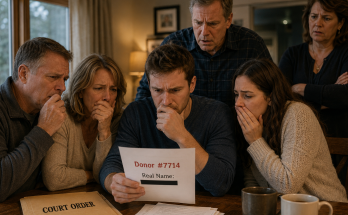
This Morning, When I Told My Husband I Wouldn’t Hand Over The Money For My Mother-In-Law’s Tour Of Europe, He Flew Into A Rage And Threw Scalding Hot Tea At My Face, Screaming, “Wire The Money Right Now Or Get Out Of This House!” So I Left. And The Next Morning, He Showed Up With His Mother—And The Moment He Saw What I Was Holding, He Froze…
### Part 1
My name is Nora Whitaker, I am thirty-four years old, and I have been a registered nurse long enough to know the difference between pain that shocks you and pain that changes you.
The morning my husband threw scalding tea at my face, the kitchen smelled like bergamot, burned toast, and the lemon cleaner I had used on the counters the night before. Pale October light was coming through the blinds in sharp little stripes, cutting across the white tile floor and the broken cereal bowl our dog, Milo, had nudged with his paw two minutes earlier.
Derek Whitaker stood three feet away from me, already dressed for work in a charcoal shirt and pressed slacks, one finger pointed at my chest like I was an employee who had missed a deadline.
“Transfer the money today,” he said, his voice flat in a way that scared me more than shouting would have. “I’m done asking.”
I had one hand wrapped around my coffee mug and the other resting on the edge of the island. My phone was beside me, face down, because I had learned over the last few months that every conversation about money somehow turned into a test I was failing.
“No,” I said. “My answer is still no.”
The ceramic mug left his hand so fast my mind did not understand what my eyes were seeing. For one stupid half second, I thought he had thrown it at the floor.
Then the rim struck my cheekbone.
The hot tea came after, splashing across my left cheek and jaw, running down my neck and soaking into the collar of my gray hoodie. The mug shattered against the tile with a crack that sounded too loud for our quiet little kitchen.
I did not scream. I think that is the part people don’t understand unless they have lived through a moment like that. Sometimes shock does not make you loud. Sometimes it makes the whole world shrink down to one sound, one breath, one impossible thought.
I looked at Derek, my husband of almost three years, and thought, “I do not know this man.”
He was still breathing hard. His mouth was open like he had more to say, but nothing came out at first. Tea dripped from my chin onto my sweatshirt. My skin felt like fire had gotten trapped underneath it.
Then he said, “Wire the money right now or get out of this house.”
That was when something inside me went very, very still.
I reached for the keys hanging by the garage door. My hand shook once, but I steadied it before he could see. I picked up my purse from the counter, stepped around the shattered mug, and walked past him without touching him, without arguing, without giving him the satisfaction of seeing me fall apart in his kitchen.
Behind me, he said, “Nora.”
I kept walking.
The garage smelled like cardboard boxes, motor oil, and the old Christmas wreath we never remembered to put away properly. I got into my car, shut the door, and sat there with both hands on the steering wheel while my cheek throbbed and my neck burned under the wet fabric.
In the rearview mirror, I watched the garage door lower behind me.
Only when it clicked shut did I let out the breath I had been holding.
I drove to my best friend Tessa Monroe’s apartment across town. The whole way there, I obeyed every speed limit, used my turn signal like a robot, and gripped the wheel so tightly that my knuckles went white. At a red light on Hawthorne Avenue, an older man in the car beside me glanced over, then looked away quickly when he saw my face.
That was the first time I understood how bad it looked.
Tessa opened her door wearing pajama pants, one fuzzy sock, and a panic I had never seen on her face before. She did not ask me what happened right away. She just pulled me inside, locked the door, and led me to her tiny galley kitchen.
The apartment smelled like vanilla candles and yesterday’s takeout. A half-finished puzzle covered her dining table. Her cat stared at me from the couch like even he knew something had gone wrong.
Tessa wrapped a bag of frozen peas in a dish towel and pressed it gently against my face.
“Who did this?” she whispered.
I looked at her.
She already knew.
Her eyes filled with tears, but her voice hardened. “You know what you have to do.”
“I know,” I said.
And I did.
But before I tell you about the police station, the attorney, and the moment Derek showed up at Tessa’s door with his mother standing behind him like this was still a family disagreement, you need to understand how a man who once seemed gentle became someone who could throw a mug at my face over six thousand two hundred dollars.
It did not happen all at once.
It almost never does.
It started with daily phone calls, closed doors, small comments, and a mother-in-law who smiled like a saint while quietly teaching her son that my boundaries were cruelty.
And by the time I finally saw the pattern clearly, Derek had already decided I was the obstacle standing between him and the woman he had been trained to obey.
### Part 2
I met Derek Whitaker when I was thirty-one, on a sticky late-August evening at a backyard barbecue I had almost skipped.
I had just finished a ten-hour shift at St. Arden Medical Center, where the fluorescent lights always made everyone look a little tired and the coffee tasted like it had been brewed through cardboard. My hair was still in a messy bun, my feet ached, and my navy scrubs smelled faintly of antiseptic, hand sanitizer, and the stale granola bar I had eaten standing up near the nurses’ station.
My friend Whitney had called me three times that afternoon.
“Just stop by for one drink,” she said. “You don’t even have to talk to anyone. Come stand near the chips and look mysterious.”
I almost said no, but I had spent the last hour of my shift helping a family say goodbye to their seventy-two-year-old father, and after watching grief fold people in half, I wanted to stand somewhere that life still felt ordinary.
Whitney’s backyard had string lights over the patio, a plastic table full of food, and music playing low from a speaker near the fence. People were laughing. Someone had burned the hot dogs. Kids were chasing each other around the lawn with glow sticks even though the sun had barely gone down.
Derek was standing near the fence, laughing with two men I did not know. He was tall, maybe six foot one, with dark hair, a plain white T-shirt, and a face that looked calm without looking bored. Nothing flashy. No loud watch, no aggressive cologne, no look-at-me energy.
When Whitney introduced us, he held out his hand and said, “You look like you were forced to be here.”
“I was bribed with potato salad,” I said.
He laughed like I had actually said something funny.
That laugh was the first thing I liked about him. The second was that he asked questions and seemed to listen to the answers. He asked about nursing without making the usual face people make when they want dramatic hospital stories. He told me he worked in commercial real estate, managing property portfolios for a firm downtown, but he did not talk about it like it made him special.
We talked for three hours.
By the time I left, the air had cooled and my feet hurt less. The next morning at exactly 9:03, my phone buzzed while I was brushing my teeth.
“Dinner Thursday?”
Not “hey.” Not “you up.” Not a lazy little breadcrumb.
A real invitation.
I said yes before I even rinsed my mouth.
We dated for fourteen months. Derek was steady in ways I had learned not to take for granted. He showed up when he said he would. He remembered that I liked extra lime in sparkling water and that I hated being called “sweetheart” by strangers. He did not mind that hospital shifts made my schedule strange. He once drove forty minutes to bring me soup when I had the flu, then sat on the floor beside my bed and read emails quietly while I slept.
When he proposed, there was no audience and no hired photographer hiding behind a tree. We were hiking at Bellmere Ridge, standing at an overlook where the valley opened below us in layers of green and gold. He pulled a small white-gold ring from his jacket pocket and looked so nervous I almost reached out to steady him.
“I want to do everything with you,” he said. “The hard stuff and the easy stuff.”
I believed him.
We got married the next October at a small vineyard with forty-seven guests. My mother cried before the music even started. My father walked me down the aisle and whispered, “You can still make a run for it,” because humor was how he survived emotion.
Derek’s father had died years earlier, so his mother, Marlene Whitaker, sat in the front row alone.
She wore navy blue, pearls, and an expression I could not read. During the ceremony, she looked at Derek like he was not just her son, but her entire reason for breathing. At the time, I thought it was sweet.
That was before I understood the weight of being loved by someone who believed love meant ownership.
After the wedding, I moved into Derek’s three-bedroom house in Clarksburg, a neat suburban place with gray shutters, a small porch, and a backyard that always seemed to need mowing. The house was in his name because he had bought it before we met, and at the time, that did not bother me. I had lived alone for six years. I had my own checking account, my own retirement account through the hospital, and my own credit card.
We split expenses in a way that felt fair. Derek paid the mortgage and HOA fees. I covered utilities, groceries, pet expenses, and most household basics. Each month, we put money into a joint savings account, usually around eight hundred dollars combined.
That account had two dreams attached to it.
A kitchen renovation and Portugal.
The kitchen had old cabinets with peeling corners, a flickering light over the sink, and a dishwasher that sounded like it was chewing rocks. Portugal was mine. I had wanted to go since nursing school, after seeing a photograph of blue tile buildings in Lisbon taped to a professor’s office door.
Derek said, “We’ll do both.”
The first year was good. We cooked more than we ordered takeout. We watched crime shows on the couch while Milo, our beagle mix, wedged himself between us like a tiny furry marriage counselor. We argued, but about normal things. Delivery spending. Who forgot to call the plumber. Whether Milo belonged on the bed.
Then there was Marlene.
She was sixty-three, recently retired from a twenty-year HR career, and lived forty minutes north in Fairfield Crossing. Derek was her only child. After his father died, their bond had tightened into something I did not have a name for yet.
She called him every single day.
Not texted. Called.
Sometimes twice.
And Derek always answered.
At first, I told myself it was harmless. I was close to my mother, too. Families were different. Grief changed people.
But Marlene never treated me like Derek’s wife. She treated me like someone who had moved into a room she still believed belonged to her.
She was polite enough that if I repeated her comments out loud, I sounded petty. That was her gift.
At our first Thanksgiving, she watched me make sweet potato casserole in my own kitchen and smiled.
“Derek’s tastes are very specific,” she said. “He might not tell you, but I always know.”
When Derek ate two helpings and said, “This is incredible,” Marlene took one bite and said, “It’s different.”
Just that.
Different.
I smiled, because what else do you do when someone insults you with perfect table manners?
But I filed it away.
That filing cabinet in my mind started filling fast.
### Part 3
The first time Derek took one of Marlene’s calls behind a closed door, I noticed because he had never done it before.
It was a Thursday night in March, eighteen months into our marriage. The house was quiet except for the dishwasher grinding away and Milo snoring under the coffee table. I was folding towels on the couch, matching corners carefully because small order can feel like control after a hospital shift full of chaos.
Derek’s phone buzzed on the coffee table.
“MOM” lit up the screen.
He glanced at it, picked it up, and walked toward the bedroom.
That was normal.
Then he shut the door.
That was not.
I sat there holding a white towel, staring at the hallway.
Their conversation lasted almost forty minutes. I could hear the low murmur of his voice but not the words. Once, it rose slightly, then dropped again. When he came back, he looked like someone had handed him a problem he did not want me to see.
“Everything okay with your mom?” I asked.
“Yeah,” he said. “She’s fine.”
He picked up the remote, turned on the television, and did not look at me.
The living room lamp threw a warm line down one side of his face. Milo rolled over in his sleep. Nothing in the house had changed, but my body knew something before my mind did.
A few weeks later, Derek started taking his phone everywhere.
Bathroom. Garage. Back porch. Laundry room.
It was always in his pocket or face down near his hand. When I walked into a room, sometimes he would lock it without looking, casual enough to make me feel foolish for noticing.
I did not accuse him of cheating. That would have been the easy story, the obvious one, the red flag everyone knows how to name.
This was stranger.
He became more protective of conversations with his mother than any man I knew had ever been of another woman.
Then the money conversations began.
It was a rainy Saturday morning in late April. The kind of rain that made the windows look blurred and kept the neighborhood quiet. I was sitting at the kitchen table with coffee, scrolling through grocery coupons, when Derek sat across from me and rubbed both hands over his face.
“My mom is having a hard time financially,” he said.
I looked up. “I thought she had her pension.”
“She does, but it’s not as much as she expected.” He paused. “The house costs more than she thought. Insurance went up. Utilities. Everything.”
I waited.
“I was thinking we could help her monthly.”
“How much?”
“Three hundred.”
Three hundred dollars was not nothing. But it was not impossible either. Marlene lived alone. Derek was her only child. I did not love the idea of sending money without seeing what was actually happening, but I also did not want to be the kind of wife who sounded cold when someone’s mother needed help.
So I said yes.
That was my first mistake.
Not because helping someone is wrong, but because I agreed without asking questions. I confused generosity with silence. I confused being supportive with giving up my right to understand where our money was going.
For the first two months, the transfer showed up in our joint account history like a small bruise.
Then three hundred became four hundred fifty.
“The property taxes hit harder than she expected,” Derek said.
Then there was a furnace issue.
Then brakes on her car.
Then a dental bill.
Each reason sounded reasonable by itself. That was how it worked. One reasonable request at a time, stacked until the shape of our life started changing.
By our second anniversary, we were sending Marlene six hundred dollars a month, and our joint savings had stopped growing.
Portugal became a joke Derek made when he wanted to sound light.
“Guess Lisbon can wait,” he said once, smiling without warmth.
The kitchen renovation disappeared entirely.
I brought it up one evening while folding laundry in our bedroom. The room smelled like dryer sheets and the lavender lotion I used after showers. Derek was sitting on the bed, scrolling through his phone with one thumb.
“We need to talk about the savings account,” I said.
“What about it?”
“We haven’t added anything in months. Everything extra is going to your mom.”
His jaw tightened. “She’s my mother, Nora.”
“I know that.”
“What do you want me to do? Cut her off?”
“I want us to have a financial plan.”
“We’re fine.”
“We’re not fine if we can’t talk about it.”
He dropped his phone onto the comforter. “Stop making this into something.”
There it was.
That sentence became a door he closed in my face again and again.
Stop making this into something.
I stopped that night, not because he was right, but because I was tired. My body ached from work. My brain was full. I did not have the energy to fight a battle he had already decided I should lose.
But I began watching more carefully.
I noticed that Marlene’s “emergencies” often came right after she saw photos of us doing something normal. Dinner out. A weekend day trip. A new rug I bought on sale. If we had any comfort, she suddenly had a crisis.
When I bought myself new running shoes after my old ones split at the heel, Derek mentioned that his mother had called about her car battery.
When I suggested booking a small cabin for our anniversary, Marlene’s roof needed repairs.
When I picked up an extra shift and said the money could go toward Portugal, Derek spent the next evening in the bedroom with the door closed, murmuring into his phone.
The clue was there. I could feel it.
But feeling something and proving it are two different things.
And Marlene was careful.
She never demanded money in front of me. She never said, “Give me what belongs to your wife.” She spoke through Derek, using his guilt like a language only they understood.
By summer, I started having dreams where I was standing in my own kitchen, opening cabinets, and finding them empty.
No dishes. No food. No cups.
Just empty shelves and Marlene’s voice from another room saying, “Derek always knows what matters.”
I would wake up with my heart pounding and Derek asleep beside me, his phone tucked under the edge of his pillow.
That phone would become important later.
But not in the way I expected.
### Part 4
The Europe trip entered our marriage on a Thursday evening with Derek carrying takeout and wearing the brightest expression I had seen on his face in weeks.
I was in the kitchen chopping cilantro for soup, the windows fogged slightly from steam rising off the stove. Milo was circling my feet because he believed anything dropped on the floor belonged to him by law.
Derek set the paper bag on the island and said, “My mom wants to do a real Europe tour.”
I kept chopping. “That sounds nice.”
“London, Paris, Rome, Amsterdam. Fourteen days.”
The knife paused in my hand.
He was speaking too quickly, with that polished tone people use when they have rehearsed a conversation alone.
“She’s always wanted to go,” he said. “Dad promised her they would someday, but then he got sick, and after he passed, she never did anything big for herself.”
That was the emotional frame. He put it up before I even knew what picture I was supposed to see.
“How much is it?” I asked.
He opened a drawer, took out a spoon, closed the drawer, then opened it again like he had forgotten what he was doing.
“The package is sixty-two hundred. Flights included.”
Steam hissed from the pot behind me.
I set the knife down.
“And?”
“And I told her we’d cover it.”
The kitchen changed temperature. Not literally, but that is how it felt. Like warmth had been pulled out of the room.
“You told her we would pay six thousand two hundred dollars?”
He leaned against the island. “It’s once in a lifetime.”
“We have eleven thousand in joint savings, Derek.”
“I know.”
“That is two years of saving. You want to spend more than half of it on your mother’s vacation without asking me?”
“I’m asking now.”
“No,” I said. “You already told her yes.”
His face shifted then. The hopeful husband vanished, and something colder stepped into place.
I explained calmly. I remember that because later, when he tried to say I had attacked him, I held on to the truth of my own voice.
I said we could give Marlene one thousand dollars as a gift. We could help her find a cheaper trip. We could review her finances together and help her make a plan. But we were not emptying our savings for a vacation.
Derek looked at me like I had slapped his mother in front of him.
“She sacrificed everything for me,” he said.
“I’m not denying that.”
“She never got to travel because she was raising me and taking care of my dad.”
“I understand.”
“No, you don’t.” His voice sharpened. “You have no idea what she gave up.”
“And what exactly am I supposed to give up?”
He looked away.
That was the question he did not want answered.
For three days, he barely spoke to me. He moved around the house like a tenant avoiding an unpleasant landlord. He made coffee for himself and not for me. He ate dinner after I went to bed. He took every call from Marlene in the bedroom with the door closed.
On Sunday afternoon, I came home from the grocery store and found him sitting at the dining table, laptop open, Marlene’s voice coming through on speaker.
He slapped the laptop shut so fast the sound cracked across the room.
I stood there with grocery bags cutting into my fingers.
“What was that?” I asked.
“Nothing.”
“Derek.”
“Planning options.”
“For the trip I said we’re not paying for?”
He stood. “You don’t have to say it like that.”
“Like what?”
“Like my mother is some greedy stranger.”
“She is not a stranger,” I said. “But she is asking for our money.”
He stepped closer. “She is asking her son for help.”
“And her son is married.”
He laughed once, without humor. “There it is.”
“What?”
“You making me choose.”
I stared at him.
That phrase began showing up every day after that.
“You’re making me choose between my wife and my mother.”
At first, it made me defensive. I explained. I softened my words. I said I did not want him to abandon Marlene. I said boundaries were not cruelty. I said marriage meant decisions had to include both of us.
None of it mattered.
The phrase had not been designed to start a conversation. It had been designed to end one.
By the second week, the pressure campaign became louder.
“She may not be able to travel soon.”
“We can rebuild the savings.”
“You’re acting like money matters more than family.”
“My mom cried last night.”
“She said she feels unwanted.”
“She said Dad would be ashamed of me for letting her struggle.”
That last one told me Marlene had stopped being subtle.
One night, after Derek fell asleep, I got out of bed and went downstairs for water. The hallway was dark, the house quiet except for the hum of the refrigerator. His phone lit up on the kitchen island where he had left it charging.
A message preview appeared.
I did not touch the phone. I did not open anything.
But I saw enough.
“Just remind her whose house it is.”
The sender was Marlene.
I stood there barefoot on the cold tile, reading those seven words until the screen went dark.
Whose house it is.
Not “your home.” Not “your marriage.” Not “your wife.”
His house.
I went back upstairs and lay beside Derek until morning, staring at the ceiling while my mind rearranged the last two years.
The small comments. The money requests. The closed doors. The way Derek said “we” when he meant him and Marlene, and “you” when he meant the problem.
I did not confront him about the message. Some people will say I should have. Maybe they are right.
But by then, I was not looking for an argument.
I was looking for proof of what my life had become.
And four days later, Derek gave it to me with a mug of tea.
### Part 5
The last Thursday of October began so normally that, for a while, I hated myself for not sensing what was coming.
I woke at 5:42 because Milo was whining softly at the bedroom door. The room was still blue with early morning darkness, and Derek’s side of the bed was empty. I could hear movement downstairs, cabinet doors opening and closing harder than necessary.
I dressed in my gray hoodie and leggings because I had a rare late shift that day and planned to spend the morning catching up on laundry. In the bathroom mirror, my face looked tired but familiar. Hair pulled back. No makeup. A faint crease between my brows from weeks of holding in words.
Downstairs, the kitchen light was too bright.
Derek stood at the counter making tea in the ceramic mug Marlene had given him for his birthday. Pale blue glaze. Slight chip near the handle. I had washed that mug a hundred times.
The kettle clicked off.
I poured coffee.
Neither of us spoke for almost a minute.
Then he said, “I need you to transfer the money today. The booking deadline is tomorrow.”
I stared into my coffee and watched cream spread through it like smoke.
“My answer hasn’t changed.”
His shoulders lifted with one slow breath.
“Nora.”
“No.”
He turned. “Do not do this.”
“I’m not doing anything. I’m saying no to using our savings for a vacation.”
“You keep calling it a vacation because you know it sounds selfish.”
“That’s what it is.”
His eyes flashed.
For the first time, I saw that he was not just angry. He was afraid. Not afraid of losing me. Afraid of telling Marlene he had failed.
That should have made me sad.
Instead, it made me steady.
“I offered a compromise,” I said. “A thousand dollars as a gift. Help planning a cheaper trip. A budget conversation. You rejected all of it because she wants the big tour and you already promised it.”
“She deserves one beautiful thing.”
“So do I,” I said.
The words came out before I could soften them.
He stared at me.
I could hear the clock over the pantry ticking. Milo’s nails clicked in the hallway. Outside, a garbage truck groaned somewhere down the street.
Then Derek said, “Transfer the money today.”
“No.”
Four seconds.
That was all it took for my marriage to become something I could never repair.
His hand moved. The mug flew. The rim hit my cheekbone first, then the tea burned across my skin, down my jaw, into the soft skin of my neck.
Pain arrived in layers.
Shock first.
Heat second.
Understanding third.
The mug shattered on the tile. A piece slid under the island. Tea spread in a brown splash near my sock.
Derek shouted, “Wire the money right now or get out of this house.”
The house.
Marlene’s message came back to me with such clarity I almost heard her voice.
“Just remind her whose house it is.”
I looked at Derek. His chest was rising and falling. His face was red. For a moment, I saw a flicker of something like regret, but it was buried under pride before it could become an apology.
He expected tears. A fight. A plea. Maybe fear.
I gave him none of it.
I picked up my keys from the hook.
“Nora,” he said, and this time his voice cracked slightly.
I stepped around the broken mug.
My cheek throbbed. My hoodie was wet. The air smelled like tea, ceramic dust, and the burnt toast that had popped up untouched behind him.
When I reached the garage door, he said, “Where are you going?”
I did not turn around.
“Out of this house,” I said.
At Tessa’s apartment, reality arrived slowly.
First, the frozen peas.
Then the mirror.
The left side of my face was red and swelling, the skin along my jaw angry and raw. I had treated burns before. I knew what mine was and what it was not. Not life-threatening. Not severe enough for a dramatic emergency scene. But serious enough to hurt. Serious enough to document. Serious enough to matter.
Tessa sat on the bathroom floor while I stood at the sink.
Her voice was careful. “Do you want me to call your mom?”
“I’ll call her.”
“Do you want me to call the police?”
I looked at myself in the mirror.
For years, I had seen women at the hospital with careful explanations. Fell against a cabinet. Dropped a pan. Walked into a door. I had never judged them. Not once. But standing there with my own face burning, I understood the strange temptation to make the story smaller.
Because if you make it smaller, maybe your life does not have to change.
I pressed the towel-wrapped peas harder to my cheek.
“Yes,” I said. “But I’m going to do it myself.”
That night, I made three calls.
First, my mother.
She cried for exactly one minute, then became practical in the way women become practical when panic has no use.
“Where are your documents?” she asked. “Do you have your passport? Do you have access to your accounts? Are you safe? Is he calling you?”
Second, I called a divorce attorney named Paige Lenox. A coworker had recommended her two years earlier during a lunch break conversation I barely remembered until that moment.
Paige’s receptionist transferred me to an after-hours line. I left a message with my name, my number, and the sentence that made my voice shake for the first time.
“My husband threw hot tea at my face this morning after I refused to transfer money.”
Paige called back eighteen minutes later.
“Come tomorrow at nine,” she said. “Bring everything you can.”
Third, I called the Clarksburg Police Department non-emergency line.
The dispatcher’s voice was calm. She asked where I was, whether I needed medical attention, whether Derek had access to me, whether I felt safe for the night.
I answered like a nurse giving report.
Clear. Precise. Detached.
But when I hung up, I started shaking so hard Tessa wrapped both arms around me on the bathroom floor.
My phone buzzed at 11:14 p.m.
Derek.
Then again at 11:16.
Then a text.
“Come home. We need to talk.”
I stared at it until the screen dimmed.
A second message appeared.
“Don’t make this worse than it is.”
That was when I knew exactly what he was afraid of.
Not what he had done.
What would happen if other people knew.
### Part 6
At 8:00 the next morning, Tessa drove me to the police station.
The sky was a flat gray, the kind that made every building look colder. I wore a loose black sweater because anything touching my neck hurt, and I kept my hair pulled to the right side so it did not brush my cheek.
The station lobby smelled like old coffee, floor polish, and wet jackets. A television mounted in the corner played local news with the sound too low to understand. Someone had left a stack of forms on a clipboard beside a plastic plant with dusty leaves.
Deputy Elena Torres took my statement.
She was probably in her early forties, with tired eyes and a voice that never once suggested I was being dramatic. She led me to a small interview room where the walls were beige, the table was metal, and the air felt too dry.
“Start wherever you can,” she said.
So I started with the money.
Not because the money excused anything, but because it explained the shape of the argument. Six thousand two hundred dollars. A Europe trip for Marlene. Joint savings. Months of pressure. Closed-door calls. The message I had seen.
Deputy Torres did not interrupt much. She asked clean questions.
“How far away was he standing?”
“About three feet.”
“Did the mug strike you?”
“Yes.”
“Where?”
“My left cheekbone.”
“Was the tea hot?”
“Yes. Freshly poured.”
“Did he make contact with you after that?”
“No.”
“Did he tell you to leave?”
“Yes. He said, ‘Wire the money right now or get out of this house.’”
She had me repeat the sequence three times, not because she doubted me, but because details matter when someone later tries to rearrange them.
Then she photographed my face from three angles.
Front.
Left side.
Jaw and neck.
The camera click sounded louder than it should have.
Before I left, she gave me a case number and said, “You have options here. I want you to know that.”
“I do,” I said. “I’m exercising them.”
At 9:00, I sat in Paige Lenox’s office.
If Deputy Torres had made the morning feel official, Paige made it feel strategic.
Her office was on the third floor of a brick building downtown, with tall windows overlooking a parking garage and a waiting room that smelled faintly of peppermint tea. Paige was in her late forties, with silver-threaded dark hair, sharp eyes, and the calm of someone who had seen people at their worst and learned not to flinch.
She listened without interrupting, then opened a yellow legal pad.
“Joint savings?” she asked.
“Yes.”
“Balance?”
“A little over eleven thousand before this.”
“House deed?”
“Only his name. He bought it before we married.”
“Mortgage paid from?”
“His checking account.”
“Your retirement?”
“In my name only through the hospital.”
“Joint credit cards?”
“One. No balance.”
“Individual savings?”
“Yes. Mine.”
She nodded. “Good.”
The word startled me.
Nothing about my life felt good.
Paige looked up. “I do not mean good that this happened. I mean good that you kept financial separation. Today you send me everything. Bank statements. Joint account records. Any messages about the trip or money. Screenshots of calls if you have them. And get the burn documented by a physician.”
“I’m a nurse,” I said automatically.
“And today you are a patient,” she replied. “Documentation matters.”
Then she leaned back slightly.
“He is going to come looking for you.”
I swallowed.
“So will his mother,” she added.
That hit harder.
“Why?”
“Because people who believe they control the story panic when paperwork appears. Do not meet him alone. Do not go back to the house without someone with you. Do not discuss settlement terms in a hallway, a driveway, or over emotional texts. Everything important comes through me.”
For the first time since the mug hit my face, I felt something other than shock.
I felt protected.
Not rescued.
Protected.
There is a difference.
Tessa drove me to urgent care after that. The doctor documented the burn, cleaned it, gave me instructions, and spoke gently in a way that made me want to cry more than pain did.
Back at Tessa’s apartment, we spread my life across her kitchen table.
Bank statements.
Screenshots.
Insurance documents.
My retirement account.
Photographs of the injury.
A copy of the police report information.
The apartment was small, but that afternoon it became command central. Tessa made coffee neither of us drank. Her cat tried to sit on the bank statements twice. I labeled folders with sticky notes in handwriting that became steadier as the day went on.
At 4:37 p.m., Derek texted again.
“Mom is devastated. You need to call her.”
I almost laughed.
Not because anything was funny, but because even then, even with my face burned, the center of the story in his mind was Marlene’s feelings.
Another text came.
“You’re going to ruin my life over one mistake?”
I took a screenshot and sent it to Paige.
She replied ten minutes later.
“Do not respond.”
So I didn’t.
That night, Tessa ordered soup, and we sat at her tiny table while rain tapped against the window. I slept on her couch under a knitted blanket that smelled like detergent and lavender.
At 10:26 the next morning, the doorbell rang.
Tessa looked through the peephole and went still.
“It’s Derek,” she whispered. “And his mother is with him.”
My laptop was open on the table. The folders were stacked beside it. My cheek was still red, the mark along my jaw impossible to hide.
For one second, fear moved through me like cold water.
Then I stood.
I picked up my phone.
And I walked to the door myself.
### Part 7
When I opened Tessa’s apartment door, Derek looked smaller than I remembered.
Not physically. He was still tall, still broad-shouldered, still wearing the navy jacket he used when he wanted to look put together. But something in him had folded overnight. His hair was messy. His eyes were red. He had not shaved.
Marlene stood behind him in a beige coat, both hands wrapped around her purse like it was a life raft. Her lipstick was perfect. Her expression was not.
Then they saw my face.
Derek froze.
Marlene’s mouth opened, then closed again.
For two full seconds, no one spoke. Somewhere behind me, Tessa’s cat knocked something off the counter, and the small thud sounded absurdly normal.
Derek finally said, “Nora, I just want to talk.”
His voice was soft, almost tender, and that made anger move through me so cleanly it burned hotter than the tea had.
“Okay,” I said. “Then here’s what we’re going to talk about.”
I held up my phone.
On the screen was one of the photographs Deputy Torres had taken at the station. My face, my jaw, the red mark, the case number visible in the corner.
“I filed a police report yesterday morning,” I said. “I met with a divorce attorney at nine. She has our financial statements going back two years. I also have medical documentation of the injury.”
Derek stared at the screen.
The color drained from his face in a way I had only seen in hospital rooms when families realized the doctor was not speaking in hypotheticals anymore.
Marlene whispered, “Oh my God.”
I looked at her.
For once, she had no polished sentence ready.
“So if you came here to ask me to transfer six thousand two hundred dollars for your Europe trip,” I said, “the answer is still no. And if you came here to ask me to come home and pretend this did not happen, the answer is also no.”
Derek’s jaw moved, but no words came.
Marlene found hers first.
“Nora, I think you’re being extremely—”
“Marlene,” I said.
She stopped.
I had never interrupted her before. Not once. The shock of it hit her harder than my words.
“I have been extremely patient for two and a half years.”
Her eyes flicked toward Derek, like she expected him to step in.
He didn’t.
“I watched you call your son every day,” I said. “I watched you pull him behind closed doors whenever I said something you did not like. I watched you turn every boundary into proof that I was selfish. I watched you use guilt and money to make me smaller in my own marriage.”
Marlene’s face tightened. “I never told him to hurt you.”
“No,” I said. “You told him to remember whose house it was.”
Her expression changed.
It was quick, but I saw it.
Derek saw it too.
I did not tell them I had only seen the preview. I did not need to. The truth had landed.
Derek turned slowly toward his mother. “What is she talking about?”
Marlene swallowed.
And there it was, the red herring I had lived under for months cracking open.
I had thought the secret was money. I had thought maybe Marlene was broke, or lying, or hiding expenses. I had thought Derek was weak because he was trying to save her.
But standing in Tessa’s hallway, watching Derek look at his mother with confusion instead of loyalty for the first time in years, I realized the deeper secret was not that Marlene needed money.
It was that she had been teaching him to see me as temporary.
A wife who could be managed.
A guest in his house.
A woman whose “no” only counted until he raised his voice.
Marlene recovered fast. “I was upset. I said things. Mothers say things when their children are being mistreated.”
“Mistreated?” Tessa said from behind me, her voice sharp.
I held up one hand slightly, not because I wanted silence, but because this moment was mine.
Derek looked back at the phone in my hand. He was not staring at my injury anymore. He was staring at the case number.
That was when I understood what Paige had meant.
Paperwork changes the air.
Before paperwork, people like Derek can hope the story will become blurry. They can say it was an accident. They can say emotions were high. They can ask for privacy, forgiveness, context, understanding.
But paperwork has dates.
Times.
Photos.
Statements.
Case numbers.
The story could no longer be rewritten over dinner with Marlene’s calm voice and Derek’s guilty eyes.
“You filed a report,” he said.
“Yes.”
“I didn’t mean—”
“Do not finish that sentence,” I said.
His eyes lifted to mine.
“You threw a mug at my face because I would not empty our savings account for your mother’s vacation,” I said. “There is no version of that sentence that gets better with explanation.”
Marlene’s voice trembled. “This could destroy him.”
I looked at her beige coat, her perfect lipstick, her hands clutching that purse.
“No,” I said. “He did that.”
Derek stepped back like the hallway had tilted under him.
For a moment, I saw the man from the barbecue. The man from the overlook. The man who had brought me soup when I was sick.
Then I saw the man from the kitchen.
The two could not live in the same body for me anymore.
“I’ll have Paige contact your attorney once you have one,” I said. “Do not come here again.”
Marlene touched Derek’s arm.
He did not look at her.
Without another word, they turned and walked down the hallway. Their footsteps faded on the carpeted stairs.
I closed the door.
Only then did my knees almost give out.
Tessa caught my elbow and guided me to the couch. Milo, who had been staying with Tessa’s neighbor during the morning chaos, scratched at the door ten minutes later and launched himself into my lap like a small, warm reminder that not every love demands your disappearance.
I buried my face in his fur and cried.
Not because I wanted Derek back.
Because I finally understood I was never going home again.
### Part 8
The divorce took four months.
People say that sentence like four months is quick, and legally, maybe it was. Emotionally, four months can be a whole season of waking up with your heart racing, checking your email before your feet touch the floor, and learning that grief does not always mean you want something back.
Sometimes grief is just your body releasing the future it had rehearsed.
Paige handled Derek’s attorney with the calm precision of someone trimming dead branches from a tree. Because the house was in Derek’s name and had been bought before our marriage, I did not receive equity. Paige had warned me early, and I had accepted it.
I did receive half of the joint savings, just over five thousand dollars after fees and account adjustments.
My retirement remained mine.
My individual savings remained mine.
The joint credit card stayed clean.
The kitchen renovation disappeared, which felt strangely poetic. That kitchen had shown me the truth. I did not need to remodel it. I needed to leave it.
Derek’s attorney asked twice whether I would withdraw or soften the police complaint.
Twice, I declined.
The district attorney did not move forward with prosecution. First offense. Limited injury classification. No prior record. Legal decisions have their own language, and not all of it feels like justice.
But the report exists.
The photographs exist.
The medical documentation exists.
The timestamp exists.
That mattered to me more than people expected.
Derek emailed once through his attorney, asking if I would consider mediation “with the goal of healing.” Paige read the message aloud over the phone, and I laughed before I could stop myself.
Healing, I had learned, is not the same as restoring access.
I told Paige, “No.”
That was the whole answer.
Marlene got to Europe eventually. I heard it from Whitney, who heard it from someone’s cousin who still saw Derek at community events. He paid for it himself after the divorce filing, from his personal savings and a loan he apparently regretted by Christmas.
Good.
I hope she saw Paris.
I hope she stood under gray skies in London and took photos in Rome and ate pastries in some tiny café with gold-rimmed plates. I hope the trip was everything she wanted it to be.
But she did it without using me.
That mattered.
I moved into a two-bedroom apartment in Riverside Crossing, twelve minutes from the hospital. Third floor. Small balcony. A strip of trees outside my bedroom window that turned bright yellow in November and bare by January.
The first night, the apartment smelled like cardboard, dust, and the lemon soap my mother used to wipe down the counters. Milo explored every corner, sneezed at the heating vent, then claimed the patch of sunlight near the balcony door like he had signed a lease.
My mother came that weekend to help build furniture.
We assembled a bookshelf incorrectly twice, ordered pizza, and sat on the floor of my half-finished living room drinking soda from plastic cups because I had not found the glasses yet.
She looked at me over a slice of pepperoni and asked, “Are you okay?”
I thought about lying because daughters like to protect their mothers, even when they are grown women with retirement accounts and divorce attorneys.
But the room was quiet. The door was locked. My dog was asleep beside me. No one was upstairs on the phone with his mother. No one was turning my boundaries into a trial.
“Yes,” I said. “I think I am.”
And I meant it.
Tessa threw me a small housewarming party with six people, one cheese board, and a bottle of sparkling wine she had been saving for “something worth surviving.” My coworker Dana brought a plant in a blue ceramic pot and said, “This thing is dramatic but hard to kill. It reminded me of you.”
The plant still sits on my kitchen windowsill, alive and growing.
I still work my three twelve-hour shifts. I still come home with sore feet and dry hands from too much sanitizer. I still keep snacks in my purse because nurses learn hunger can ambush you at inconvenient times.
But now my money is mine.
Every month, my savings account grows.
Not dramatically. Not in some movie way where I become rich overnight and buy a house on a cliff.
It grows by discipline.
By overtime shifts I choose.
By groceries I plan.
By bills I pay without anyone asking me to prove I am kind by becoming smaller.
There is a passport application on my kitchen counter.
Portugal is still my dream.
For a while, I thought going alone would feel sad. Now I think it might feel honest. I want to stand in Lisbon under all that blue tile and know I did not trade my dream for someone else’s guilt.
There is a small mark on my left jaw. In certain lighting, especially in the bathroom at dawn, I can still see it. At first, I covered it with makeup even on days I did not wear makeup anywhere else.
I thought it made me look foolish.
Like everyone could see I had trusted the wrong man.
Now I see it differently.
That mark is the place where my silence ended.
I did not destroy my marriage by leaving. Derek destroyed it in four seconds with one mug of tea, one demand, and one belief that I would protect his reputation more than my own life.
He was wrong.
I do not forgive him.
Maybe that sounds harsh to people who love tidy endings, but I am not interested in making my pain easier for strangers to digest. I hope Derek becomes a better man someday. I hope he learns that love is not obedience and guilt is not family duty.
But I do not need to witness it.
I do not need an apology dinner.
I do not need closure wrapped in soft music and regretful eyes.
The police report was my closure.
The apartment key was my closure.
The first quiet morning I made coffee without fear was my closure.
My name is Nora Whitaker. My husband threw scalding tea at my face because I refused to fund his mother’s Europe trip. The next morning, when he came to take me home, I showed him the police report.
And for the first time in our marriage, he had nothing to say.
The End.
THE END!