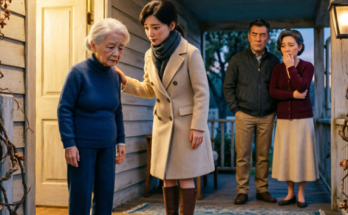
### Part 1
My phone started vibrating at exactly six on Christmas Eve, then refused to stop.
Dad called first. Mom followed. Then my younger brother Jason, my sister Hannah, two cousins, an aunt I hadn’t heard from since Easter, and three numbers I didn’t recognize. Within fifteen minutes, I had twenty-three missed calls and a wall of angry messages.
“Where are you?”
“The caterer says nobody paid.”
“The lake house is locked.”
“The kids are crying.”
“You ruined Christmas.”
I read that last message twice before turning my phone facedown on my desk.
Outside my office window at Naval Station Norfolk, winter light faded behind rows of gray ships. Sailors crossed the pavement carrying duffel bags, some heading home, others reporting for watch. Somewhere down the hall, somebody had plugged in a cheap string of Christmas lights, and their reflection blinked against the glass.
My name is Claire Morgan. I had spent almost three decades in the Navy and eventually earned four stars.
I could make decisions affecting thousands of sailors without losing sleep. I could sit through brutal briefings, face angry officials, and handle emergencies at sea.
But for twenty-six years, I had been unable to say one word to my own family.
“No.”
Christmas had not always been like this.
Growing up outside Richmond, our house smelled of pine needles, cinnamon, and turkey every December. Mom, Diane, decorated every doorway. Dad, Robert, insisted on cutting down a real tree. Jason and Hannah argued over ornaments while I untangled lights.
Then I graduated from the Naval Academy.
That first Christmas, Mom called and said Dad had struggled financially.
“We thought about renting a cabin so everyone can be together,” she said. “Maybe you could help?”
I sent the money without hesitation.
The next year, the cabin became a cabin plus groceries. Then presents. Then decorations. Jason had lost a job. Hannah had a baby. Dad’s truck needed work.
“You’re doing so well, honey,” Mom always said.
So I paid.
Year after year, the requests grew until nobody bothered asking.
“We found the lake house.”
“The caterer needs the deposit.”
“Jason’s kids want new laptops.”
“Hannah thinks prime rib would be nicer this year.”
What nobody said was the sentence everyone understood.
Claire will pay.
The strangest part was that I often wasn’t even there.
I spent Christmases aboard ships, in foreign ports, in command centers under fluorescent lights. One year, I ate dry turkey with sailors crossing the Atlantic while my family sent me photographs from a beautiful lake house I had financed.
Still, every bill was paid before I arrived—or even when I didn’t.
Six months before this Christmas, everything changed.
I was attending a conference in Washington when I stepped into a quiet hotel hallway to return a call. Around the corner, I heard Mom speaking to Hannah on speakerphone.
I stopped when I heard my name.
Mom laughed.
“As long as Claire feels guilty about never being home, she’ll keep paying.”
Hannah laughed too.
“Don’t thank her too much. She likes feeling important.”
Then Dad’s voice came through the speaker.
“She’s easier to manage than Jason.”
All three laughed.
I stood behind that wall holding my phone while decades of Christmases rearranged themselves in my head.
The lake houses.
The vacations I had canceled.
The loans nobody repaid.
The expensive gifts mailed from deployment.
I had always believed I was helping because they loved me.
That afternoon, I understood something colder.
They expected my generosity because they believed they had trained me never to refuse.
I didn’t confront them.
I didn’t threaten them.
I simply went back into the conference room and made one quiet decision.
This year, I would arrange nothing.
And on Christmas Eve, when Dad finally reached me and demanded, “What are we supposed to do now?”
I looked toward the ships outside my window.
“I guess,” I said, “you’ll have to celebrate like everyone else.”
Then I hung up.
What my family didn’t know was that Christmas wasn’t the only thing I had stopped paying for.
### Part 2
For several seconds after I ended the call, I expected guilt to hit me.
Instead, I heard a knock.
A young lieutenant stood outside my office. “Ma’am, everyone’s gathering in the mess. We saved you a seat.”
“I’ll be there.”
The dining room looked nothing like the Christmases my family preferred. Paper snowflakes hung crookedly from the ceiling. Battery candles flickered beside plastic cups. Local schoolchildren had mailed handmade cards covered with stick-figure sailors.
One said, “I hope you get cookies.”
I smiled harder at that card than I had at any expensive decoration I’d paid for in years.
Chief Alvarez waved me over. “Admiral, we protected the good pie.”
“That may be the most important operation you’ve conducted this month.”
The table laughed.
For an hour, nobody needed anything from me except conversation.
Meanwhile, my family’s carefully planned Christmas was collapsing.
I learned later that the lake house reservation had canceled automatically because no deposit was received. The caterer had held the date until late afternoon before giving it away. Jason tried ordering food, but every nearby restaurant had long holiday waits.
Eventually, everyone drove back to my parents’ house.
The grandchildren ate frozen pizza around an old folding table while the adults argued over whose fault everything was.
According to Mom, mine.
Around eight, my sixteen-year-old niece Paige texted me.
She sent a photograph of paper plates, grocery-store soda, melting ice cream, and several adults looking furious.
“Grandma keeps saying you ruined Christmas.”
Then another message appeared.
“I don’t think you did.”
A few seconds later:
“Is there something I don’t know?”
That question stopped me.
For years, relatives had praised my parents for hosting extravagant holidays. I had never corrected them. I thought silence protected everyone’s dignity.
Now I realized silence had protected a lie.
I typed carefully.
“This year I decided not to organize Christmas or pay for it.”
Her reply came immediately.
“Why?”
“Because people stopped appreciating it and started expecting it.”
The typing bubble appeared, vanished, then returned.
“I never knew you paid.”
That sentence hurt more than the accusations.
Christmas morning arrived quietly on base. Ships still needed watches. Security teams still patrolled. Young sailors called home from hallways because they didn’t want roommates hearing them cry.
I walked through the barracks shaking hands.
A nineteen-year-old petty officer told me his mother was sending pictures of cinnamon rolls.
“She keeps zooming in on them just to torture me, ma’am.”
“Sounds like effective psychological warfare.”
He laughed.
Near lunch, my cousin Ethan called.
“Claire, can I ask something?”
“Sure.”
“Who normally pays for Christmas?”
I stared into my coffee.
“I do.”
“The house?”
“Yes.”
“The food?”
“Yes.”
“The gifts for your parents?”
“Yes.”
“My kids’ stockings?”
“Yes.”
There was silence.
“I thought Uncle Robert paid.”
“So did most people.”
By afternoon, the angry calls had nearly stopped.
Questions replaced them.
Ethan called his mother. His mother called another aunt. Cousins began comparing memories. People remembered my father accepting compliments for the lake houses. They remembered Mom saying everything was “already handled” whenever anyone offered money.
Then the family group chat exploded.
“Did Claire really pay for all this?”
“I thought Robert did.”
“Why was everyone blaming Claire if she was the one financing it?”
Jason finally wrote, “This is nobody’s business.”
Ethan answered, “It became our business when you blamed her in front of everyone.”
That night, I volunteered to serve dinner in the enlisted dining facility.
A young seaman named Owen sat across from me afterward.
“Can I ask something personal, ma’am?”
“You can ask.”
“Do you have family?”
Behind him, sailors shared pie, called parents, traded jokes, and passed packages around.
I looked at them and smiled.
“Tonight? I do.”
At nine, my phone rang again.
Dad’s older brother, Thomas.
His first words were not “Merry Christmas.”
They were, “Claire, I owe you an apology.”
Then he added quietly, “And there’s something your parents never wanted you to understand.”
### Part 3
I stepped into the cold hallway and pressed the phone tighter against my ear.
“What didn’t they want me to understand?”
Uncle Thomas was silent for several seconds.
“Your success changed them.”
I almost laughed. “People usually say success changes the successful person.”
“Not always.”
He reminded me of the day I received my Naval Academy appointment. I remembered Dad shaking my hand so hard my fingers hurt. Mom cried while everyone hugged me.
“I thought she was proud,” I said.
“She was. But after everyone left, she cried again.”
“Why?”
“She said she was losing you.”
The words landed differently than I expected.
Thomas explained that as my career grew, relatives constantly praised my parents. Dad began talking about my achievements as if they proved something about him. Mom loved telling neighbors what command I had received.
At first, it was ordinary parental pride.
Then money entered the picture.
The first time I helped my parents financially, Dad had been embarrassed. He had lost overtime, and they were short on property taxes. I covered the difference.
The second request was easier.
So was the third.
“Eventually,” Thomas said, “asking became expecting.”
I leaned against the painted cinder-block wall.
“That explains a lot.”
“There’s more.”
Apparently, relatives had repeatedly offered to split holiday expenses.
My aunt offered to bring food one year. A cousin suggested everyone contribute toward a cabin. Thomas himself once offered Dad money for Christmas groceries.
Dad refused every time.
“He always said everything was taken care of.”
“Because I was paying.”
“Yes.”
Suddenly, I remembered dozens of compliments.
“Your father sure knows how to host.”
“Your mother always makes Christmas beautiful.”
And my parents had smiled.
They had never technically claimed they paid.
They simply allowed everyone to believe it.
My stomach tightened.
“They weren’t just depending on me.”
“No,” Thomas said. “They were protecting an image.”
Two days later, my financial adviser and I reviewed years of transfers.
He placed a spreadsheet in front of me.
Holiday rentals. Family vacations. Jason’s vehicle repairs. Hannah’s legal expenses. College help for nieces and nephews. Home repairs. Business rescues. Christmas after Christmas.
At the bottom was a number:
$418,763.19.
I stared at it.
“How much has been repaid?” he asked.
We both knew the answer.
Nothing.
He adjusted his glasses. “I don’t normally comment on family relationships, Claire.”
“I know.”
“But this stopped looking like generosity a long time ago.”
“What does it look like?”
“Dependency.”
That word stayed with me.
Three days after Christmas, I received a handwritten card with no return address.
Inside was one sentence:
“Generosity should never be mistaken for obligation.”
That same evening, Mom left me a voicemail.
For several seconds, there was only breathing.
“Claire… I’ve been thinking.”
A long pause.
“Maybe we went too far.”
Then the message ended.
Months earlier, six words like that would have sent me racing home.
Not anymore.
I had learned the difference between an apology and discomfort after being exposed.
I didn’t return the call.
Two days later, Dad called.
“Your mother isn’t sleeping.”
I waited.
“She keeps replaying everything.”
Still, I said nothing.
Finally, his voice softened.
“Would you come home Saturday? Just for an afternoon?”
“What for?”
“To talk.”
“About money?”
“No.”
That answer surprised me.
“I don’t want you bringing anything,” he continued. “No gifts. No checks. Nothing.”
I looked through my office window at the gray Elizabeth River.
“I’ll come.”
Saturday morning, I drove toward Richmond with one overnight bag in my trunk.
No gifts.
No envelopes.
No emergency checkbook.
But I did bring one leather portfolio.
Inside was twenty-six years of evidence.
And for the first time in my life, my family was going to see exactly what their version of “Christmas” had cost me.
### Part 4
Dad opened the door before I knocked.
“Hi, Claire.”
He looked older than he had a week earlier.
“Hi, Dad.”
The Christmas decorations were still up, but several outdoor inflatables had collapsed across the lawn. Inside, the tree had dried enough that needles crunched beneath my shoes.
Mom sat in the living room with red-rimmed eyes.
“Thank you for coming.”
“I almost didn’t.”
“I know.”
Hannah arrived twenty minutes later. Jason came last, wearing the same expression he used as a teenager when he knew Dad wanted answers.
Nobody hugged.
Nobody asked whether I wanted coffee.
We simply sat.
Finally, Dad said, “Claire deserves to speak first.”
That alone felt unfamiliar.
I placed my leather portfolio on the table.
Jason frowned. “What’s that?”
“Our family history.”
I handed them folders.
Inside were copies of transfers, receipts, checks, and invoices arranged by year.
1999: the first holiday cabin.
2002: Jason’s vehicle repair.
2004: Hannah’s medical bills after her first child.
2007: my parents’ kitchen renovation.
2010: the family vacation.
2013: the roof.
2016: Jason’s failed business.
2019: Christmas at the lake.
2022: Hannah’s legal expenses.
2025: the last Christmas I paid for.
Pages turned.
No one spoke.
Finally, Mom whispered, “I never realized it was this much.”
“Yes, you did.”
She looked up.
“You never added it together,” I continued. “That’s different.”
Her eyes dropped.
Jason cleared his throat. “I always figured you had plenty.”
“I did have money.”
He looked relieved for half a second.
I leaned forward.
“Did having it mean you were entitled to it?”
His face changed.
“No.”
“Then why did you act like you were?”
He rubbed his palms against his jeans.
“Because it was easier not to think about.”
“Exactly.”
Hannah stared at one of the pages.
“I kept telling myself I’d repay you.”
“But you never did.”
She nodded, crying quietly. “No.”
Dad removed his glasses.
“I failed you.”
I didn’t answer.
“I taught you that family helps family, then I used that lesson against you. At some point, I stopped seeing you as my daughter and started seeing you as the person who could fix everything.”
Mom reached toward my hand.
I moved mine back.
Her fingers stopped on the table.
That small motion seemed to hurt her more than anything I had said.
“I need you all to understand something,” I told them. “This wasn’t about one ruined Christmas.”
They listened.
“I missed vacations because someone here had an emergency. I changed travel plans. I came home exhausted after deployments because you convinced me the holiday depended on me. And whenever I arrived, the first questions were about bills, reservations, gifts, repairs.”
Nobody interrupted.
“No one asked whether I was lonely.”
Mom covered her mouth.
“No one asked whether I was tired. No one asked what I wanted for Christmas. You congratulated yourselves for having a successful daughter while treating my success like family property.”
The room became painfully still.
Then I placed one final page on the table.
“My boundaries.”
Jason stared at it.
“I will never finance another family holiday.”
Nobody objected.
“I will not fund vacations, businesses, vehicles, or lifestyle expenses.”
Dad nodded.
“If there is a genuine emergency, I will decide whether I want to help. Asking does not guarantee anything.”
Another nod.
“And I will not keep pretending nothing happened just because you finally feel guilty.”
Mom began crying again.
“Does that mean you’ll never forgive us?”
I looked at her for a long moment.
“I may stop being angry someday.”
She waited.
“But that doesn’t mean we go back.”
Dad swallowed.
Before I left, he asked, “Will you come next Christmas?”
“I don’t know.”
His face fell.
“If I ever come home for Christmas again, it will be because you want your daughter there.”
I picked up my coat.
“Not because you miss her credit card.”
### Part 5
The next eleven months were quieter than any year I could remember.
That quiet taught me something.
My family had always claimed they called because they missed me.
Once money disappeared from the relationship, the phone rang far less often.
Mom checked in occasionally. Dad sent short messages. Hannah apologized twice without asking for anything afterward.
Jason disappeared almost completely.
I didn’t chase him.
For the first time, I stopped treating distance as a problem I was responsible for solving.
I took a vacation that spring.
A real one.
No family emergency interrupted it. When Jason texted halfway through asking whether I could “temporarily” help with a business expense, I replied with one sentence.
“No, but I hope you find a solution.”
My hands actually shook when I sent it.
His answer came twenty minutes later.
“Wow.”
That was all.
I stared at the word, then laughed.
Twenty-six years of being dependable, and one refusal turned me into “wow.”
I put the phone away and went back to my coffee.
By Thanksgiving, something unexpected happened.
Mom called.
“We’re doing Christmas at the house this year.”
“Okay.”
“We’re keeping it simple.”
“Good.”
Silence.
Then she asked, “Do you have any food allergies?”
I almost smiled.
“You’ve known me for fifty years.”
“I know. I’m trying to ask normal questions.”
That made me smile for real.
“I’m not allergic to anything.”
“Your old room is available if you decide to come.”
Not “when.”
“If.”
I noticed the difference.
“I’ll think about it.”
No one asked for money.
No lake house links appeared.
No gift lists arrived.
A week before Christmas, Paige texted a photograph of homemade ornaments scattered across my parents’ table.
One had my name painted on it.
“You coming?” she asked.
I stared at the picture longer than I expected.
My first instinct was yes.
My second was fear.
Not fear that they would ask me to pay.
Fear that one peaceful afternoon might convince everyone that twenty-six years had disappeared.
I called Mom.
“I’m coming for dinner.”
She inhaled sharply. “Really?”
“Yes.”
“We’d love that.”
“But I’m returning to Norfolk that night.”
“Of course.”
“And Mom?”
“Yes?”
“I’m not ready for everything to be normal.”
Her voice softened.
“I don’t think it should be.”
That answer mattered.
Christmas Eve, I drove to Richmond with three modest gifts and a tin of cookies from the chief’s mess.
No expensive presents.
No checks.
No backup credit card “just in case.”
Dad opened the door and hugged me.
For once, nobody looked toward my hands to see what I had brought.
The house smelled like roasted turkey and cinnamon.
Hannah was hanging handmade ornaments with her children. Paige rushed over and squeezed me.
Jason stood in the kitchen wearing an apron.
I stopped.
“You’re cooking?”
“Apparently rock bottom looks like learning mashed potatoes.”
I laughed despite myself.
Dinner was imperfect.
The gravy had lumps. One tray of rolls was too dark. A grandchild spilled cranberry juice and everyone grabbed towels instead of blaming someone.
Dad raised his glass before dessert.
“I owe Claire an apology in front of everyone.”
I stiffened.
He continued.
“For years, I accepted praise for celebrations my daughter paid for. I treated her generosity like an entitlement and let everyone believe I was providing what she actually provided.”
Nobody moved.
“I’m ashamed of that.”
Mom spoke next.
“So am I.”
Jason looked down.
Hannah wiped tears from her cheek.
They were saying everything I once dreamed of hearing.
And strangely, I no longer needed it.
After dinner, Mom asked quietly, “Does tonight change anything?”
I looked around the room.
“Yes.”
Her face brightened.
I shook my head gently.
“It proves you can do better.”
Then I added the part they weren’t expecting.
“But doing better doesn’t erase what happened.”
### Part 6
I left Richmond that night instead of staying in my childhood bedroom.
Mom offered.
Dad offered.
Paige asked twice.
But I had learned that boundaries only mattered when I honored them after the emotional part was over.
The highway back to Norfolk was nearly empty. Christmas lights flashed from distant houses, appearing and disappearing between bare trees.
For years, driving away from my family had filled me with guilt.
That night, I felt peaceful.
Not triumphant.
Not bitter.
Free.
The next morning, Mom had packed several containers of leftovers for me.
“They’re for the sailors,” she had said.
“Not for me?”
She smiled. “Some of them are spending Christmas away from their families. They’re somebody’s children too.”
That was the closest I came to believing she truly understood.
I carried the food into the dining facility.
Chief Alvarez lifted a lid and breathed in dramatically.
“Admiral, whoever made this stuffing deserves a medal.”
“My mother.”
“Then tell your mother the fleet approves.”
Around us, young sailors ate, laughed, opened packages, and took turns calling home. One sailor was teaching another how to play cards. Someone had burned coffee badly enough that the smell reached the hallway.
It wasn’t glamorous.
It was warm.
A few months later, Jason asked me for money again.
I said no.
He became angry and stopped speaking to me for almost a year.
That told me more about our relationship than any apology he had made at Christmas.
Hannah was different.
She found steady work, created a repayment plan without my asking, and began sending small amounts each month.
I told her she didn’t have to repay everything.
“I know,” she said. “I want to.”
Those words mattered.
Mom and Dad changed too, but I never gave them back the access they once had to my life.
We spoke.
We occasionally shared meals.
I helped when I genuinely wanted to.
But the days when a phone call from home could rearrange my finances, my schedule, or my peace were finished.
Did I forgive them?
Eventually, I stopped carrying anger.
That was enough for me.
Forgiveness did not mean pretending Dad never called me “easy to manage.”
It did not mean forgetting Mom laughed about using my guilt.
It did not mean trusting Jason because he behaved himself for one holiday.
I cared about them.
I simply stopped caring whether they approved of my boundaries.
There is freedom in that distinction.
Our Christmases became smaller after that.
No luxury lake houses.
No catered dinners.
No piles of expensive electronics.
Everyone brought something.
Dad bought the turkey. Mom cooked. Hannah handled desserts. Paige decorated. Cousins contributed whatever they could.
Sometimes I attended.
Sometimes duty kept me away.
Sometimes I simply chose not to go.
And something remarkable happened.
Christmas continued without me.
The world did not collapse.
The children still laughed.
Dinner still reached the table.
My parents discovered they could host a holiday they could actually afford.
My siblings discovered that “family tradition” sounded very different when they were expected to contribute to it.
And I discovered that love requiring constant payment was never the kind of love I needed.
Years in uniform had taught me that responsibility must be shared. A ship cannot function when one sailor carries everyone else’s watch. A command cannot survive if one person solves every problem while others simply wait.
Families are no different.
People sometimes ask whether staying on base that Christmas was revenge.
It wasn’t.
The frozen pizza wasn’t revenge.
The canceled lake house wasn’t revenge.
The family group chat exposing the truth wasn’t revenge.
My victory was much quieter.
It was sitting in my office on Christmas Eve, hearing my father demand that I fix everything, and realizing I finally had the courage not to.
For twenty-six years, my family told me I ruined Christmas whenever I failed to give them exactly what they wanted.
That year, I learned the truth.
I hadn’t ruined Christmas.
I had simply stopped buying it for them.
And once I stopped paying for everyone else’s happiness, I finally had enough room in my life to protect my own.
THE END!