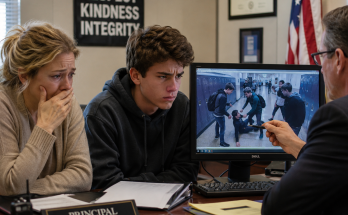
On My Daughter’s Birthday, I Stopped By Her Office With Flowers. As I Walked In, I Heard, “You Broke Little Rat! How Dare You Touch My Stuff?” Through The Cracked Door, I Saw My Daughter On Her Knees, Sobbing. Then I Saw Who Was Yelling At Her—And My Blood Boiled. It Was…
### Part 1
My daughter’s birthday was supposed to begin with sunflowers. I bought twelve dollars’ worth from a street vendor on Wilshire, thick green stems and bright yellow heads that always reminded me of summer in Pasadena. My daughter, Emma, had loved them since she was four, when her mother, Laura, planted a crooked row along our back fence. Laura had been gone six years. Cancer took her in eleven weeks, and for a long time afterward I learned how useless money could be beside a hospital bed.
That morning, though, I wasn’t thinking about grief. I was thinking about surprising Emma at work. She had taken an internship at Bellamy Fashion Group eight months earlier and told me only after signing the papers. She never used my name professionally. To everyone there, she was simply a twenty-three-year-old design intern from Pasadena who worked hard and kept her private life private. I respected that.
I even wore my old olive jacket, frayed at the cuffs, instead of one of the suits my assistant, Grant Keller, kept insisting made me look “appropriately terrifying.” Grant had served with me in the Marines before becoming my right hand in business. He looked at the jacket and said, “You own clothes without holes.” I told him, “I’m aware.” He smiled because he understood. Some days call for the person you were before the money.
I parked two blocks away, signed in as a visitor, and rode to the fourth floor carrying the flowers. The design department sat behind frosted glass doors. I was three steps away when I heard a woman say, “Look at yourself.” The voice was controlled and sharp. Then came Emma’s quieter answer: “I’m sorry. I was told to move the portfolio.”
My hand tightened around the bouquet. The woman snapped, “A broke little nobody like you thought you had the right to touch this collection?” I moved toward a narrow gap beside the glass and saw Emma on her knees gathering portfolio pages from the floor. Her shoulders were shaking. Two employees stood nearby staring at their screens. Standing over my daughter was my second wife, Vanessa.
Beside Vanessa stood her daughter from a previous relationship, Brooke Mercer, twenty-eight, polished and bored. “Mom, she’s so slow,” Brooke said. “They really do hire anyone now.” Vanessa looked down at Emma and raised her voice. “How dare a filthy little rat like you touch my things?” I had heard Vanessa charm investors, comfort friends, and speak softly over dinner. I had never heard that voice.
Emma finished stacking the pages. Vanessa smiled. “Perhaps this internship isn’t the right fit for everyone.” She turned toward the exit. Brooke followed, but first swept the neat stack from Emma’s hands. “Oops.” Pages scattered again.
I stepped backward into an alcove before they came through the door. Vanessa passed less than ten feet from me without seeing me. So did Brooke. I wanted to confront them, but I stayed hidden and watched my daughter kneel a second time while everyone around her remained silent. Something inside me stopped feeling like rage. It became a decision.
This was not a chance encounter. Vanessa had arrived prepared, Brooke had come with her, and somehow they knew exactly where Emma worked. On her birthday. I left the sunflowers against the building, called Grant, and said, “Pull everything you can on Bellamy Fashion Group. Then find out how long Vanessa has known Emma works there.”
Three hours later, Grant was waiting at my kitchen table with a stack of notes. The first page was bad. The second was worse. By the third, I understood the humiliation at Bellamy was only the part they had allowed my daughter to see.
And the woman sleeping beside me had been planning something much larger.
### Part 2
Grant confirmed Vanessa had known about Emma’s internship for at least three weeks. She had lunch with Bellamy’s managing director, paid with our household account, then arranged a private VIP appointment two days later. She never mentioned either meeting to me. “That could still be social,” I said, though neither of us believed it.
Grant slid another page across the table. For twenty-two months, money had been leaving our household accounts in amounts small enough to avoid ordinary review. Different dates, different descriptions, same destination pattern. Total: $840,000. Most of it moved through a Nevada shell company before landing in an account connected to Brooke.
I stared at the number. Vanessa knew I personally checked large transfers. Whoever designed this pattern knew exactly where my attention usually began. Then Grant opened a second folder. My estate attorney, Nolan Price, had been billing Vanessa privately for “document preparation.” The references were vague, but clear enough to point toward a rewritten estate plan.
A new will.
My mouth went dry. Four months earlier, I had laughed when Vanessa teased me about becoming forgetful. I misplaced keys, repeated questions, lost my train of thought during meetings. My hands had developed a faint tremor that my doctor blamed on age and stress. I was sixty-eight, so I accepted the explanation because it was convenient.
Grant had not. He showed copies of my old blood work to an independent specialist, who said some unusual markers could also appear after repeated exposure to a strong sedating medication. I immediately thought about dinner. Every evening Vanessa poured my wine herself, from the bottle she chose, and placed the glass beside my right hand.
That night I texted Emma: Happy birthday, sweetheart. I love you. A minute later she replied with a sunflower emoji and, “Love you, Dad.” I did not tell her what I had seen or what Grant had found. For the first time, keeping my daughter uninformed felt like protecting her.
At 6:15 the next morning, I drove south to a private clinic for independent testing. I was halfway home when a nurse called and said Emma had been in a car accident. For several seconds, I could not understand the words. Then I understood the only ones that mattered: she was alive.
At the hospital, Emma sat upright with a bandage above one eyebrow, bruised ribs, and her left wrist wrapped. She tried to smile. “Dad, I’m okay.” I pulled a chair closer. “No. You’re alive. That’s different.” Then I asked her to tell me everything strange that had happened during the last month.
The truth came out in pieces. Her laptop had vanished two weeks earlier. Someone had keyed her car in the employee garage. Three days before the crash, HR received an anonymous accusation claiming she had stolen design material. When I asked about Vanessa and Brooke, she looked away. “You know?” she whispered. I told her, “I saw enough.”
My phone rang before I could say more. The clinic specialist said my new test showed evidence consistent with repeated exposure to a prescription sedative over a period of months. Not accidental. Repeated.
I walked into the hallway so Emma would not see my face. Grant called almost immediately. Traffic footage had identified the SUV that struck Emma: a rental paid with a card linked to the same Nevada company draining our accounts.
The money, my health, Emma’s accident—three separate fears suddenly became one pattern.
And I was no longer asking whether Vanessa was hiding something. I was asking how far she and Brooke had already gone.
### Part 3
I gave Grant three instructions. Freeze every joint account Vanessa could legally reach. Find a family-law attorney with no connection to my existing legal team. And remove every bottle Vanessa routinely served me from the house before she came home, without explaining why.
Grant already knew an attorney: Rachel Bennett, a courtroom specialist with no patience for wealthy clients expecting special treatment. That was exactly what I wanted. Then I went to see my executive assistant, Helen Park, who had worked beside me for twelve years and knew every flight, board meeting, and birthday I forgot to put on my own calendar.
When I asked whether Vanessa had ever requested access to my schedule, Helen went pale. Brooke had discovered an old financial mistake involving Helen’s adult son, something long repaid and legally resolved, and used it as leverage. Helen had been forced to share parts of my calendar and confirm where Emma worked.
“I’m sorry,” she whispered. “I thought I could contain it.” I asked what else they wanted. “Your medical portal.” My stomach turned. “Did you give it to them?” Helen shook her head. “No. That was the one line I wouldn’t cross.” She wrote a complete statement that afternoon and sent it directly to Rachel.
The next morning Grant arrived with an envelope and did not sit down. “Her name isn’t Vanessa Hale.” He laid out a birth record, old marriage documents, and a faded photograph. Her legal identity appeared to be Valerie Mason, born in Fresno. The San Francisco family story, private schools, and much of the childhood she had described to me had been constructed years earlier.
Grant had also found two earlier marriages tied to versions of the same false identity. One former husband, a property developer, lost millions during their marriage. Another, a surgeon, died unexpectedly a little over a year after marrying her, leaving an estate fight with his children. None of that proved an old crime, but the pattern made my skin crawl.
Rachel explained that the identity deception could radically change the legal battle over my marriage and assets, though she refused to promise an outcome. I trusted her more for saying that.
Then Grant opened a second envelope. Security footage from a Bellamy storage room showed Brooke beside an evening gown worth nearly forty thousand dollars. In the next image, the gown was damaged. It was the same gown Vanessa planned to accuse Emma of ruining.
Another still came from the parking garage. Brooke was crouched beside Emma’s car several days before the crash, tampering near a wheel assembly. I stood and walked to the window. Traffic moved below my office as if nothing had changed. “What do we have that will hold?” I asked.
“Enough to bring in law enforcement.”
Detective Lucas Moreno took the financial records, medical findings, Helen’s statement, rental trail, and surveillance images. He accepted nothing on faith. His team independently verified the vehicle records and arranged a forensic inspection of Emma’s car.
Then I made a move Vanessa never expected. Bellamy Fashion Group was privately held, and one of its largest shareholders, Martin Cole, had been trying to exit for months. I called him personally. By that afternoon, after a cash deal at a premium price, I controlled sixty percent of Bellamy.
No announcement. No press release. No warning.
I did not buy the company to hand Emma a job. I bought control because Vanessa and Brooke had chosen Bellamy as their stage. I intended to leave the stage exactly where it was.
Detective Moreno said they were preparing warrants, but he needed one thing. “Where will both women be tomorrow night?”
I knew.
Bellamy’s annual gala. Four hundred guests. Executives, investors, clients, cameras.
I went to the hospital to tell Emma everything before anyone else could. But before I finished, she pulled a battered black notebook from the drawer beside her bed.
“Dad,” she said, opening it. “There’s something you need to know.”
The first dated entry was seven months old.
My daughter had started investigating Vanessa long before I had.
### Part 4
Seven months earlier, Emma had accidentally seen an email thread on our shared cloud account. Attached was a draft of a new will. In that version, Emma received almost nothing. Most of my estate went to Vanessa, with a separate trust benefiting Brooke.
Emma did not know whether I had requested the changes myself, and that uncertainty kept her silent. “I didn’t want to become the daughter who accused your wife because she was afraid of losing money,” she told me. So instead of confronting anyone, she watched.
She wrote down dates when I seemed unusually slow after dinner. She noted questions I repeated and evenings Vanessa insisted on pouring my drink herself. She recorded a dinner party where Brooke casually mentioned Bellamy by name months before Vanessa claimed she knew Emma worked there.
Then Emma told me something that changed how I understood Grant’s investigation. “Remember when Grant pushed you to get extra blood work in February?” I nodded. “That was me.” She had called him privately because she was worried about changes in my behavior. She had no proof, only a pattern, so Grant quietly kept the concern in mind without making accusations.
“We’ve been running the same operation from opposite ends,” Emma said. Despite everything, I almost laughed. “That sounds like your mother.” She smiled for the first time all day.
We compared notes until sunset. Her notebook filled holes in Grant’s timeline. My financial records explained things she had only suspected. Together, the chaos stopped looking random.
It looked designed.
The gala was the next night. I wore the black suit Laura had helped me choose years earlier for an occasion neither of us knew would become her funeral. Four hundred people filled the Beverly Hills ballroom beneath hard white chandeliers. Grant stood near the back. Detective Moreno had plainclothes officers around the room. Emma sat near the stage, her wrist still wrapped.
At 7:40, Vanessa took the microphone without being introduced. Brooke followed. Vanessa began talking about “standards” and “integrity,” then claimed a valuable gown had been deliberately destroyed by “a junior employee with no respect for the privilege she had been given.”
Brooke took the microphone next and stopped pretending. “How someone like Emma Hale was ever trusted near that collection is beyond me.”
Heads turned toward my daughter.
Emma stayed perfectly still.
That was when I stood.
I walked to the stage. Vanessa finally saw me, and for half a second real fear broke through her expression. Then the smile returned. “Richard,” she said softly, as if we were at home.
I took the microphone. “My name is Richard Hale. Emma is my daughter.”
The room went silent.
Then I looked at Vanessa. “And the woman beside me was not born Vanessa Hale.”
Her smile disappeared.
I said the name Grant had uncovered.
“Valerie Mason.”
I explained that legal proceedings had already begun regarding our marriage and the transfer of $840,000 through a Nevada shell company. Then I held up the verified security image showing Brooke with the gown shortly before it was damaged.
Brooke shouted, “That’s fake!”
“The police have the original footage,” I said.
She stopped.
Then I turned toward Bellamy’s managing director, Cynthia Ross. Financial records showed sixty thousand dollars moving from the same shell company into an account tied to her consulting business while Emma’s evaluations were being quietly sabotaged.
Cynthia covered her mouth.
I had one fact left.
“As of yesterday afternoon, I own sixty percent of Bellamy Fashion Group.”
Brooke ran for the exit.
She made it twelve feet before an officer stepped into her path.
And as Detective Moreno climbed the stage carrying the warrants, Vanessa looked at me as if I had suddenly become a stranger.
For the first time, I understood exactly how that felt.
### Part 5
The ballroom did not explode the way scandals do in movies. It fractured. Some guests stood, others pulled out phones, and board members began demanding answers from Cynthia. Brooke shouted that everything was a setup. Vanessa said nothing.
Detective Moreno approached her, spoke quietly, and asked her to step away from the microphone. That was when I finally saw disbelief on her face. She had planned around my habits, my age, my trust, and my reluctance to embarrass family publicly. What she had not planned around was Emma.
My daughter had been the variable she underestimated.
Nolan Price, my estate attorney, appeared near Grant twenty minutes later looking gray and shaken. He wanted to “explain his role.” Grant simply let him talk. Nolan described private instructions Vanessa had given him, including documents she wanted drafted while my judgment appeared increasingly impaired. By the time he understood the conversation was being formally documented, he had already said enough to end any future relationship with me.
Before leaving the ballroom, I asked Emma to come onto the stage. She hesitated. “I don’t want a rescue speech.” I told her, “You won’t get one.”
I put an arm carefully around her bruised ribs and told the room who she actually was: a UCLA honors graduate who applied to Bellamy without my name, earned her position on her own, endured months of humiliation, and quietly documented wrongdoing while trying to protect a father who did not know he needed protecting.
“She didn’t need my influence to deserve respect,” I said. “Some of you needed my influence before you were willing to give it.”
Nobody looked comfortable.
Good.
Later that night, an officer told me Vanessa had asked to see me. I went to the station but did not enter the interview room. Through the glass, I saw her sitting alone in the gala dress, hair no longer perfect, shoulders bent. For two years I had watched her perform every emotion beautifully. That night she finally looked like someone with no audience.
The officer said she had repeated one sentence during intake: “I didn’t plan to stay this long.”
I never asked what she meant. Maybe the marriage began as a scheme and became something more complicated. Maybe it did not. The distinction no longer mattered.
People imagine betrayal ending with one satisfying confession. Mine ended with lawyers, hearings, forensic reports, and weeks of waking at three in the morning remembering ordinary dinners differently.
Brooke eventually accepted a plea that included state custody, restitution, and a permanent restraining order keeping her away from Emma. Vanessa faced separate criminal and financial consequences, including supervision, restitution, and court-ordered counseling. The exact legal labels mattered less to me than one fact: neither woman would ever again have access to my home, my money, my business, or my daughter.
Cynthia stayed at Bellamy only long enough to cooperate with the investigation, face the board, and apologize directly to Emma. Then my attorneys handled the rest.
Helen’s coercion was formally documented. She returned to work the following Monday. When I walked into my office, coffee was already on my desk. “I can resign if you want,” she said.
“No.”
She looked surprised.
“You made a mistake,” I told her. “Then you drew a line when it mattered and told the truth when it became dangerous.”
There was still one decision left: what to do with Bellamy.
Everyone assumed I would hand Emma a title.
Emma assumed it too.
When I asked what she wanted, she gave me an answer that made me prouder than any revenge ever could.
“I want a fair interview.”
### Part 6
Three months later, Emma became Bellamy’s director of creative development. Not because I appointed her. I recused myself from the process and required independent board members to make the decision.
Emma presented a restructuring plan, a mentorship program, and an anonymous reporting system that allowed employees to bypass direct supervisors when complaints involved senior leadership. She got the job on a split vote.
When she called afterward, she said, “See? Much better than being handed something.” I told her, “You got that stubbornness from your mother.” She paused. “Which one?” For a second there was silence. Then we both laughed.
It was the first time Vanessa’s shadow did not enter the room with her name.
My marriage was eventually unwound through the courts. I recovered much of what had been taken, though not every dollar. By then money had stopped being the thing I counted. I counted mornings when my head felt clear, dinners where no one placed a glass beside me unless I asked, and the number of times Emma called for no reason.
I sold the Malibu house. Not because Vanessa had lived there, but because I realized I had spent too many years choosing homes meant to impress people I did not actually like. I bought a smaller place near the coast with terrible closet space and a kitchen Emma said belonged to “a divorced fisherman.” She helped me choose the furniture.
In December, I saw the same flower vendor on Wilshire and pulled over. “Sunflowers?” he asked. “Two bunches.”
I carried them into Bellamy myself. Emma’s office was on the fourth floor, behind the same frosted glass doors. The first time I walked through them, I had heard my daughter being called worthless while other people looked away. This time I heard her arguing with a designer about fabric costs.
“Dad,” she said when I appeared, “you can’t keep showing up without an appointment.”
“I own the building.”
“You own shares in the company.”
“Technical distinction.”
She pointed to a chair.
On her desk sat a coffee mug holding the dried remains of the birthday sunflowers I had left outside months earlier. I stared at them. “Where did those come from?”
“A security guard found them after everything happened and brought them upstairs.”
“You kept them?”
“Until they’re done.”
“They look done.”
“They’re not.”
That answer hit me harder than I expected.
For years, I believed trust was proof of love. I know better now. Trust without attention can become permission. I had trusted Vanessa because questioning her felt disloyal. Emma noticed what I refused to notice because she loved me enough to risk being wrong.
People do not become safe because they are family. A marriage certificate does not make someone loyal. Shared blood does not make someone kind. And love that arrives only after exposure, consequences, or fear of losing access to you is not love worth rebuilding your life around.
Vanessa sent me three letters after the case ended.
I returned all three unopened.
Brooke tried once, through an attorney, to send Emma an apology.
Emma declined it.
Neither of us needed closure from the people who created the wound. We had evidence, distance, and each other.
Before I left Emma’s office that evening, I placed the fresh sunflowers beside the dried ones. She looked at both bouquets for a long moment.
“The new ones don’t erase the old ones,” she said.
“I know.”
“But they can sit beside them.”
I nodded.
That became the lesson I kept. You do not have to erase what happened to move forward. You do not have to forgive people who calculated your pain. You only have to stop giving them access to the next chapter.
I walked out of Bellamy beside my daughter into cold California sunlight.
For the first time since her birthday, I did not look over my shoulder.
THE END!