### Part 1
At my daughter’s wedding, I handed her an envelope she believed contained the deed to sixty acres of her late mother’s orchard. Madison lifted her champagne glass beneath a ceiling of string lights, looked directly at me, and smiled. “All my life, I wished I had a different father,” she announced. “And today, that dream finally came true.”
Nearly two hundred people laughed. She turned toward Victor Caldwell, her new father-in-law, a silver-haired real-estate developer in a perfectly fitted tuxedo. He raised his glass like a king accepting tribute. Beside him, Madison’s new husband, Ethan, grinned. I sat in my rented tuxedo with both hands flat on the tablecloth. And I smiled.
Because the envelope beside Madison’s plate did not contain a deed.
Three weeks earlier, I still believed my daughter and I were okay. I’m Grant Holloway, fifty-eight. Thirty-two years ago, I started Holloway Precision Systems in a rented machine shop with two used lathes and a loan that kept me awake at night. Today the company manufactures structural components for aerospace contractors and employs more than three hundred people.
Most people at the wedding didn’t know that. Eighteen years ago, when my wife Laura died, I stepped away from daily operations to raise Madison. She was nine. I traded boardrooms for school pickups, burned casseroles, awkwardly braided hair, and sat through every dance recital and parent conference. I never cared whether anyone thought I looked successful.
Madison used to love that about me. Then she met Ethan Caldwell.
At first, I liked him. He was attentive, polished, curious. He asked smart questions about my company without seeming impressed by the answer. But within months, Madison started using words that didn’t sound like her: legacy, positioning, generational wealth.
Victor was worse. He developed luxury communities near the coast and had the kind of charm that made disagreement feel rude. At the engagement dinner, Madison introduced me to his partners with four words. “My dad. He’s retired.” Then she changed the subject.
That same night, Victor asked about Briarwood Orchard. The sixty acres had belonged to Laura’s family for three generations. Apple trees covered most of it, including an old row Laura’s grandfather planted by hand. Laura’s will placed the land in trust for Madison, but under probate supervision until she turned thirty.
Victor saw something different. “Imagine homes along the ridge,” he said. “Private road. Clubhouse. Maybe forty units.”
“It already has a purpose,” I told him.
He laughed. “Apples?”
“Exactly.”
For six months, he kept pushing. Drawings arrived in my mailbox. Ethan brought up development at dinners. Madison began saying things like, “Dad, it could be good for everyone.”
Then one Tuesday morning, my longtime attorney, Samuel Briggs, called before nine. That alone told me something was wrong.
“Grant,” he said, “there’s a purchase agreement filed at the county recorder’s office for Briarwood Orchard.”
I laughed because the alternative was panic. “That’s impossible.”
“Your signature is on it.”
When Samuel emailed me the scan, I stared at my name for several minutes. It looked almost perfect.
Almost.
The loop in the G was closed. Mine never closes. It was a strange habit I’d had since childhood, one Madison used to tease me about whenever I signed birthday cards. Someone had studied my signature closely enough to copy it—but not closely enough to know me.
That night I called Madison and asked whether she knew anything about paperwork involving the orchard.
“Victor said things were finally moving forward,” she replied over the noise of wedding planning. “You should be happy, Dad. You don’t have to fight this anymore.”
I went silent, because I had never agreed to sell anything. And for the first time, I wondered whether my daughter believed I had.
Four days later, Samuel called again.
This time he said, “Grant, stop asking whether this is a mistake. We need to find out who did it.”
That was when the real nightmare began.
### Part 2
Samuel introduced me to a forensic accountant named Nina Shah, a woman who spoke in numbers and never softened bad news. Six days later, she sat at my kitchen table and slid a report toward me.
Over the previous eleven months, four transfers totaling $180,000 had been taken from Briarwood Orchard’s maintenance reserve and sent to Caldwell Shore Development, Victor’s company. The reserve paid property taxes, irrigation repairs, and insurance. It was not investment money.
I wanted an innocent explanation so badly I could feel myself reaching for one. Then Nina showed me the trust rules. Any withdrawal above $10,000 required two signatures: Madison’s and mine. All four transfers had both.
I had signed none of them.
Five forged signatures now existed—the purchase agreement and four withdrawals.
Then it got worse.
The bank officer told us each transfer had been confirmed by phone. “Mr. Holloway personally approved them,” she said.
I checked my calendar. Two of those calls happened while I was flying to a supplier conference, my phone in airplane mode. Someone had not only copied my signature. Someone had found a way to impersonate me.
That night I stopped trusting my own house.
Years earlier, I’d installed a small security camera near my study after repeated break-ins to the garage. I pulled months of footage. Five Sundays back, I found Ethan.
Madison and Ethan had come over for dinner. On camera, twenty minutes into dessert, Ethan excused himself. Instead of turning toward the bathroom, he entered my study. He walked directly to the second desk drawer.
No hesitation.
He removed my spare house key and pressed it against a handheld copying device. Then he picked up an old signed supplier contract, photographed the page with his phone, and put everything back.
Ninety seconds.
Then he returned to dinner and asked Madison to pass the Parmesan.
I watched that clip four times. By the third, I wasn’t watching Ethan. I was watching Madison in the background, laughing at something, completely unaware that her fiancé had just copied my key and photographed eleven samples of my handwriting.
I took the footage to Samuel. He watched once.
“Do not confront him,” he said.
“I wasn’t planning to.”
That part surprised him. Running a manufacturing company taught me something useful: anger is not a strategy.
Two days later, Madison came by to collect old wedding photos of her mother. She left her phone charging on my kitchen counter while she carried a box to her car.
The screen lit up. A preview from Victor appeared.
Just a few words.
Make her emotional. Make Grant feel guilty.
My chest went cold.
Madison’s passcode was still her mother’s birthday. I knew I shouldn’t open the phone. I did anyway.
Most of the message thread looked normal—flowers, seating charts, jokes, dinner plans. Then I found the rest. A message from Victor to Ethan had been forwarded into the thread.
Make her emotional. Make Grant feel guilty. Once the deed is recorded, he can scream all he wants.
I read it three times. Then I photographed the screen with my own phone and put hers back exactly where I found it.
That was the moment everything changed.
They weren’t simply influencing my daughter. They were using her. Every dinner, every speech about “family,” every promise that she would never “live small” again—it was all part of something larger.
Madison was the door. Briarwood Orchard was what they wanted behind it.
When she came back inside carrying another box of photographs, she held up a picture of Laura laughing in a summer dress.
“Mom looked so happy here,” she said.
I smiled at my daughter. “She was.”
It was the first time in my life I looked Madison directly in the face while hiding something that could destroy her world.
And I knew I would have to do it again.
### Part 3
Two weeks before the wedding, I made one last attempt to reach Madison privately. I chose Bellini’s, the little Italian restaurant where Laura used to take her after dance recitals. When Madison was seven, she once fell asleep in that booth with spaghetti sauce on her sleeve.
I brought a clean copy of the forged purchase agreement. No notes. No accusations. I placed it between us.
“I didn’t sign this.”
Madison glanced at it. “Maybe you did and forgot.”
I stared at her. “You know I don’t forget things like this.”
She tore a piece of bread and looked away. “You’re getting older, Dad.”
That hurt more than the wedding toast would later hurt. Not because she thought I was old, but because the sentence didn’t sound like her.
It sounded rehearsed.
I asked whether she remembered picking apples at Briarwood with her mother the summer before Laura got sick. I reminded her how Laura used to say the orchard was the one inheritance nobody could spend recklessly because, if necessary, you could simply grow another crop.
For one second, Madison’s eyes filled.
Then the wall came back.
“I have an early morning with the florist.”
She left half her dinner untouched. I sat alone for twenty minutes after she walked out.
That was when I stopped trying to save her from the truth.
The next morning, Samuel and I changed the battlefield. Within four days, he created the Laura Holloway Land Trust, an irrevocable structure that moved Briarwood out of the compromised trust. Madison remained the sole lifetime beneficiary, but any sale, development, or loan against the land required unanimous approval from three independent trustees.
Not Victor. Not Ethan. Not even me.
Samuel also filed a formal fraud notice against the supposed purchase agreement, freezing any attempt to act on it. Then he tracked down the notary listed on the document.
She had never met me. Her actual seal did not match the one used on the filing. Someone had counterfeited that too.
A forensic document examiner, Dr. Evelyn Hart, compared fourteen genuine samples of my signature to the forged ones. Her report highlighted unnatural pen lifts, identical pressure patterns, and the closed loop in my G.
A childhood habit had become evidence.
With the orchard protected, I filed a police report. Detective Luis Moreno from the county economic-crimes unit took the case. He collected the study footage, the bank records, the signature report, and the screenshots from Madison’s phone.
Then the district attorney’s office stepped in.
Assistant District Attorney Rachel Torres read the entire file without speaking. When she finished, she closed the folder.
“This is not a family disagreement, Mr. Holloway. This is fraud, forgery, theft, and conspiracy.”
I asked the only question I cared about. “Can we do this without destroying my daughter’s wedding?”
Rachel studied me.
“No version of this ends without something breaking.”
That answer followed me home.
I considered confronting Victor privately. But I could already hear him explaining everything away. I considered telling Madison the morning of the ceremony. But one phone call from Victor could turn me back into the bitter, jealous father she had been trained to see.
So I made a decision Rachel hated at first.
I wanted the truth delivered in public.
Not for revenge.
For witnesses.
Three days before the wedding, the charges were prepared. Detective Moreno and Rachel agreed to remain nearby until I signaled.
Then I did the hardest thing.
Nothing.
I let Victor believe he had won. I let Ethan believe the deed was his family’s future. I let Madison believe I had finally surrendered.
On the wedding morning, she found me outside the bridal suite. She looked so much like Laura that for a second I nearly confessed everything.
Instead, she hugged me and whispered, “Thank you for coming, Dad. I know this hasn’t been easy.”
My throat closed.
During the ceremony, my phone buzzed once.
A message from Detective Moreno.
We’re in position. Your call.
I watched my daughter marry into the family that had spent nearly a year stealing from her.
And I waited for the envelope to reach her hands.
### Part 4
The reception moved like a dream I couldn’t wake from. Glasses clinked. The band played softly. Waiters carried plates I never tasted.
During the appetizer course, Victor leaned toward me.
“No hard feelings, Grant,” he murmured. “Business is business. She’s happy. Isn’t that what matters?”
I looked at him and said nothing. Ethan avoided my eyes.
At 9:47, Madison stood for her toast. She thanked the wedding party. She thanked Ethan.
Then she turned toward me.
“All my life, I wished I had a different father.”
Laughter rolled across the ballroom.
My daughter smiled wider.
“And today, that dream finally came true.”
She raised her glass toward Victor.
More laughter.
Victor stood and kissed her forehead. “You’re a Caldwell now,” he said. “You’ll never live small again.”
That was my signal.
I stood.
“Madison,” I said, “open the envelope.”
She smirked. “Later, Dad.”
“Open it now.”
Something in my voice quieted the people nearest us.
She sighed dramatically, picked up the envelope, and tore it open. She expected a deed.
Instead, she pulled out the first page of a criminal complaint.
Her smile disappeared.
“What is this?”
“That is not the deed,” I said.
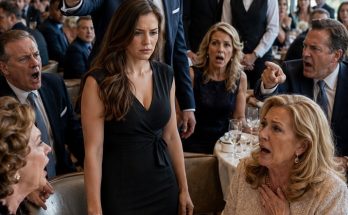
The ballroom slowly fell silent.
“It is a criminal complaint filed against Victor Caldwell for stealing $180,000 from your mother’s trust and forging my signature five separate times.”
Victor’s glass froze halfway to his mouth.
“That’s absurd.”
Too loud. Too fast.
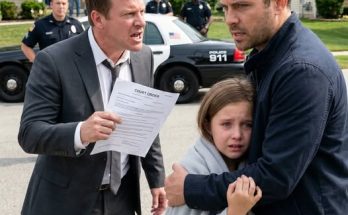
The ballroom doors opened.
Rachel Torres entered first, followed by Detective Moreno and two uniformed officers.
Two hundred conversations died at once.
Victor’s face changed.
For months, I had watched that man smile through every objection, every question, every uncomfortable truth.
Now the smile vanished.
“Victor Caldwell,” Rachel said, “you are being taken into custody in connection with multiple fraud and forgery offenses.”
He stood so quickly his chair toppled backward.
“This is a misunderstanding.”
Nobody laughed.
He turned toward Madison.
“Tell them.”
Madison did not move.
Detective Moreno approached Ethan. “I need you to come speak with us.”
Ethan’s face went pale.
“Am I under arrest?”
“Not at this moment.”
Those three words hit him harder than shouting would have.
Victor was led away past the gift table. Ethan followed Moreno toward the terrace.
Madison remained at the head table, holding the complaint with both hands.
Then she looked at me.
I wish I could tell you she ran into my arms.
She didn’t.
She looked shattered. Humiliated. Angry.
Not only at Victor.
At me too.
And I understood why.
The truth was necessary. The public setting was necessary. But necessary things can still hurt people.
She stared at the doorway where Victor had disappeared, then down at the document again.
“Did you know?” she whispered.
“For three weeks.”
Her eyes snapped up.
“You let me marry him?”
“I let you hear the truth where they couldn’t rewrite it before you understood it.”
Her face hardened.
“You could have told me.”
“I tried.”
That landed.
Bellini’s. The forged deed. You’re getting older, Dad.
I watched the memory return to her expression. But shame is a powerful thing, especially in a room full of witnesses.
She shook her head.
“I can’t do this.”
Then she walked out of her own reception.
I did not follow.
For the first time since Laura died, I chose not to chase my daughter when she was hurting.
Because love had already made me interfere enough.
That night, I drove home alone. The orchard was safe. Victor was in custody. The evidence was finally in the right hands.
I should have felt victorious.
Instead, when I entered my silent kitchen, I saw the framed photograph Madison had shown me weeks earlier—Laura laughing in the orchard.
And I wondered whether protecting my daughter had cost me the daughter herself.
### Part 5
The answer did not come quickly.
Victor’s company began collapsing within weeks. Investors pulled out. Lawsuits followed. He eventually accepted a plea agreement that included prison time and restitution, though Nina warned me we would probably recover only part of the missing money.
Ethan was charged eleven days after the wedding. His attorney saw the footage from my study and convinced him to cooperate. Ethan admitted copying my key, photographing my signature, and helping his father create access to documents they needed.
He avoided prison, but received probation and a long restitution schedule.
Madison filed for divorce before the year ended.
She did not ask what I thought.
I did not offer an opinion.
Some decisions should belong completely to the person forced to live with them.
For almost six weeks after the wedding, she did not call me. I didn’t call her either.
That was harder than any courtroom, any bank meeting, any night I spent reading fraud reports at two in the morning.
Every Sunday, I found myself glancing at the phone.
Nothing.
Then one Sunday afternoon, it rang.
Madison.
I answered.
Neither of us said hello right away.
Finally she asked, “Do the Honeycrisp trees need thinning this year?”
I nearly laughed.
“Probably.”
“Mom used to hate doing that.”
“She hated deciding which apples didn’t get to grow.”
A long silence.
Then Madison said, “I remember.”
That became our beginning.
Not an apology.
Not forgiveness.
A beginning.
She started calling most Sundays. We talked about small things: the north fence, the old tractor, whether the scarecrow near the Gravenstein row still leaned to the left after storms.
We did not talk about the wedding.
Months later, she came to Briarwood for the first time since everything happened. I was repairing a broken irrigation line when I saw her car.
She walked toward me wearing jeans and boots, no designer coat, no polished version of herself built for someone else’s approval.
For a while, we worked beside each other without speaking.
Then she said, “I really believed you were trying to keep me small.”
I tightened a fitting and wiped my hands on a rag.
“I know.”
“I said horrible things.”
“Yes.”
She looked at me, waiting.
Maybe she expected me to rescue her from the discomfort.
I didn’t.
She swallowed.
“I don’t know how to fix what I did.”
“You don’t fix it by pretending it didn’t happen.”
Her eyes filled.
“So what do we do?”
“We see what’s still here.”
That was all I could offer.
And it was enough for that day.
Briarwood Orchard is protected now. Three independent trustees must agree before anyone can sell it, borrow against it, or develop it. No copied key, forged signature, charming developer, or desperate fiancé can change that.
One day, the land will be fully Madison’s under the terms her mother intended.
Not because Victor decided she deserved a bigger life.
Not because Ethan married her.
Because Laura left it to her.
Quietly.
Without applause.
Madison and I are not back to what we were. I don’t think we ever will be.
Trust doesn’t return because someone finally discovers they were wrong. It grows slowly, if it grows at all.
And I did not forgive the wedding toast simply because she became a victim too.
I love my daughter.
I care what happens to her.
But love is not the same thing as erasing what someone did to you.
So now we have Sunday phone calls, occasional afternoons at the orchard, and a careful honesty neither of us had before.
The night of her wedding, Madison told two hundred people she had finally found a better father.
She hadn’t.
She had found a man who wanted what her mother left behind.
And I was the father who made sure he never got it.
THE END!