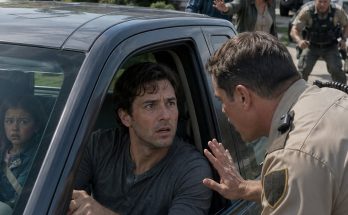
The report says my son-in-law had been hurting my daughter for months.
I sat in the school counselor’s office, staring at the stack of drawings.
Fourteen pictures.
Six months.
At first, they looked like ordinary drawings from a five-year-old.
A house.
A family.
A little girl holding her mother’s hand.
But then I noticed the same detail in almost every picture.
There was always a dark figure standing behind my daughter.
Sometimes the little girl had drawn herself between them.
Sometimes she had drawn her mother crying.
And in one picture, there was a large red X across the man’s face.
The teacher explained that she had saved every drawing because my granddaughter kept returning to the same theme.
“She never told us exactly what was happening,” the teacher said. “But she kept drawing it.”
My daughter sat beside me, silent.
Then the counselor placed one final drawing on the table.
It showed three people walking away from a house.
My granddaughter.
Her mother.
And me.
Above them, in uneven letters, she had written:
“Grandma will keep Mommy safe.”
My daughter covered her face.
I reached across the table and held her hand.
That was the moment she finally stopped saying, “I fell.”
She looked at me and whispered,
“Mom, I need help.”
And this time, she wasn’t alone.
That Monday afternoon, I wrote the first check to the lawyer.
Four hundred dollars an hour suddenly felt like the cheapest thing I’d ever bought.
“We’re going to do this carefully,” she said. “No surprises. No warnings.”
My daughter nodded, but her hands wouldn’t stop shaking.
The lawyer asked for dates.
Texts.
Photos.
Medical visits.
Anything that showed a pattern.
My daughter looked down.
“I deleted most of it.”
I thought we’d lost our chance.
Then the school counselor spoke.
“You haven’t lost it.”
She opened a folder.
Inside were attendance notes, emails, and fourteen dated drawings my granddaughter’s teacher had quietly preserved.
Each one had been scanned and logged the day it was made.
The counselor explained that the teacher had noticed my granddaughter becoming unusually anxious whenever it was time to go home on Fridays.
She hadn’t ignored it.
She documented it.
The lawyer carefully arranged the drawings across the conference table.
“They don’t prove everything by themselves,” she said gently, “but they help tell a consistent story.”
My daughter began to cry.
Not because she was ashamed.
Because someone had believed her child before she was ready to believe she deserved help herself.
As we were leaving, the counselor handed my granddaughter a small stuffed rabbit she’d kept in her office.
“Can Bun-Bun come with me?” she asked.
The counselor smiled.
“He was waiting for you.”
My granddaughter hugged the rabbit, took her mother’s hand, and looked up at me.
“Grandma?”
“Yes, sweetheart?”
“Are we going home with you today?”
I looked at my daughter.
She squeezed my hand.
For the first time in months, she answered without hesitation.
“Yes,” she said. “We’re going home with Grandma.”
We didn’t go back to my daughter’s house that night.
The lawyer had arranged a safe place for them to stay while the paperwork was being handled.
My granddaughter thought it was an adventure.
She called the little room a “sleepover hotel.”
Her mother smiled for her.
But after my granddaughter fell asleep, my daughter sat beside me on the couch.
“I should have left sooner.”
I shook my head.
“Don’t do that to yourself.”
She stared at the floor.
“I kept thinking I could fix everything.”
“You didn’t cause this.”
She finally looked at me.
“What if he gets the kids?”
The question broke my heart.
“The lawyer is working on that. And we’re going to follow every instruction she gives us.”
The next morning, the lawyer called.
She had reviewed the school records and the other documentation.
“There is enough here to take the next step,” she said.
My daughter closed her eyes.
“What happens now?”
“We request protection and let the court review the evidence.”
For the first time, my daughter seemed to understand that she didn’t have to convince everyone by herself.
She had records.
She had witnesses.
She had her daughter’s drawings.
And she had people willing to stand beside her.
That afternoon, my granddaughter sat at the kitchen table and started drawing again.
I glanced over.
It was another picture of three people.
Her.
Her mother.
And me.
But this time there was something different.
There was no dark figure behind them.
The three of us were standing underneath a huge yellow sun.
She held up the picture proudly.
“Grandma, look!”
I smiled.
“That’s beautiful.”
She pointed at the sun.
“That’s because we’re safe now.”
My daughter heard her.
She turned away for a moment and wiped her eyes.
Then my granddaughter added one more thing to the drawing.
A tiny door.
And above it, in crooked letters, she wrote:
“Our new home.”
Three days later, the lawyer called us into her office.
She had good news.
The court had granted the protective order.
My daughter sat completely still.
“Does that mean he can’t come near us?”
“For now, yes,” the lawyer said. “And we’ll keep working through the proper legal process.”
My daughter let out a breath she seemed to have been holding for months.
Then the lawyer turned toward my granddaughter.
“Your daughter doesn’t need to be involved in the legal decisions. That’s the adults’ job.”
My granddaughter nodded seriously.
“I know.”
On the drive home, she asked me something I’ll never forget.
“Grandma, did Mommy do something wrong?”
I looked at my daughter in the passenger seat.
She was crying silently.
“No, sweetheart,” I said. “None of this was Mommy’s fault.”
My granddaughter thought for a moment.
“Then why didn’t she tell me?”
My daughter turned around.
“Because Mommy was scared.”
My granddaughter reached forward and held her mother’s hand.
“You don’t have to be scared anymore.”
My daughter broke down.
She pulled her little girl into a hug.
That evening, we went back to the drawings.
Fourteen pictures.
Six months of things my granddaughter couldn’t explain with words.
The teacher had preserved every one.
The lawyer had documented them.
And now they were part of the record.
But the most important thing wasn’t the paperwork.
It was that a little girl had noticed something was wrong and kept trying to tell someone.
Someone finally listened.
Before bed, my granddaughter brought me one final drawing.
It showed three people standing together.
This time, there was a fourth person.
A small figure wearing a cape.
“Who’s that?” I asked.
She grinned.
“That’s Mommy.”
My daughter laughed for the first time in weeks.
And I realized my granddaughter hadn’t drawn a victim.
She had drawn her mother as a hero.
Six months later, my daughter had started rebuilding her life.
It wasn’t easy.
There were court dates, paperwork, difficult conversations, and days when fear came rushing back.
But there were also ordinary mornings.
Pancakes.
School drop-offs.
Movie nights on the couch.
And Saturday mornings when my granddaughter would climb into my bed and whisper,
“Grandma, are we okay?”
I’d always give her the same answer.
“Yes. We’re okay.”
One afternoon, her teacher called me.
“I found something you should see.”
When I arrived at the school, she handed me a folder.
Inside was a new drawing.
My granddaughter had drawn herself, her mother, and me standing in front of a bright yellow house.
There were flowers everywhere.
The three of us were smiling.
And above the house she’d written:
“HOME IS WHERE EVERYONE IS SAFE.”
I couldn’t hold back my tears.
Her teacher smiled.
“She hasn’t drawn the dark figure in months.”
I looked at that little picture for a long time.
Fourteen drawings had helped adults understand what a five-year-old couldn’t put into words.
But that final drawing told me something even more important.
She was no longer drawing what she was afraid of.
She was drawing what she hoped for.
That Thanksgiving, exactly one year after the day she climbed into my lap, she did it again.
She wrapped her little arms around my neck.
“Grandma?”
“Yes, sweetheart?”
“Remember when I asked you why Mommy had marks?”
“I remember.”
She smiled.
“I don’t have to ask anymore.”
Behind her, my daughter was setting the table.
She looked over at us.
Her smile was different now.
Not the careful smile she’d worn when she was trying to convince everyone she was fine.
A real smile.
The kind that reaches your eyes.
I hugged my granddaughter tighter.
Sometimes, children don’t have the words to explain what they’re experiencing.
But they notice.
They remember.
And when someone finally listens, their voice can become the beginning of a whole new life.