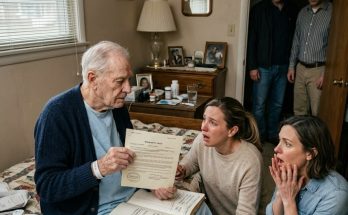
“Dad, Mom, and My Brother Are Going to Paris for New Year’s. You Stay With That Old Woman.” That Was The Note I Found On The Table When I Came Home For New Year’s. Grandma Was Sitting On The Sofa, Waiting For Me. She Smiled And Asked, “Do You Want To Make Them Regret It With Me?” I Nodded. Two Weeks Later, When They Returned, They Screamed In Horror When They Saw Who Was Inside The House…
### Part 1
The yellow note was sitting in the middle of the kitchen island like somebody had left me a grocery list.
“Dad, Mom, and Tyler are spending New Year’s in Paris. You stay here and take care of Grandma.”
That was it.
No “please.”
No phone call.
Not even my name.
I stood in the kitchen of my parents’ sprawling Buckhead home with my coat still on and my school tote hanging from one shoulder, staring at those words while the refrigerator hummed behind me.
My name is Natalie Whitmore. I was twenty-eight years old, taught history at a public high school in Atlanta, paid my own bills, worked late most nights, and somehow still occupied the role my family had assigned me when I was sixteen:
The responsible daughter.
Which, translated into the language of my family, meant the daughter whose plans could always be canceled.
I called Dad.
Straight to voicemail.
Mom too.
Then Tyler, my twenty-five-year-old brother.
His phone rang twice before he declined the call.
A minute later, a photo appeared in the family group chat.
Tyler was holding a glass of champagne in an airport lounge while Dad grinned beside him and Mom posed beneath a departures board.
PARIS.
Mom had added a little champagne emoji.
“Happy New Year!”
I stared at the picture until my cheeks felt hot.
Then I typed, “You left without telling me?”
Three dots appeared.
Disappeared.
Appeared again.
Dad finally replied.
“You’re home anyway. Grandma needs someone responsible.”
I almost laughed.
Home anyway.
I had planned to spend the first half of winter break preparing a new curriculum unit, meeting friends I had barely seen all semester, and enjoying the revolutionary luxury of waking up without someone calling my name from another room.
Apparently none of that counted as having plans.
I dropped my bag beside the island.
“Grandma?”
No answer.
The house felt strangely hollow.
The living room fireplace was cold. The Christmas tree still glittered beside the windows, but there were no suitcases near the stairs, no coffee cups abandoned on tables, no television murmuring from Dad’s office.
My parents had not simply gone out.
They had evacuated.
And left Grandma Evelyn behind like an inconvenient piece of furniture.
I found her in the formal living room.
I had expected blankets.
A cane beside her knee.
Maybe a tired expression.
Instead, my seventy-nine-year-old grandmother was sitting perfectly upright on the dark leather sofa wearing a burgundy cardigan, pressed black pants, pearl earrings, and an expression so alert that I stopped in the doorway.
She looked at the note in my hand.
Then at me.
“Paris?”
I nodded.
“They didn’t tell you either?”
“Oh, they told me.”
Something about her voice made me lower the note.
“What did they say?”
Grandma leaned back.
“That they deserved a proper holiday.”
I waited.
“And?”
“And you would handle me.”
There was no self-pity in her voice.
That bothered me more than anger would have.
I walked over and sat across from her.
“Are you okay?”
“I’m old, Natalie. I’m not incompetent.”
“I didn’t mean—”
“I know what you meant.”
Then, unexpectedly, she smiled.
Not warmly.
Not bitterly either.
It was the smile of someone who had finally confirmed something she had suspected for years.
She nodded toward the yellow note.
“Your father has been doing this to you for a very long time.”
My fingers tightened around the paper.
“I can manage.”
“That,” she said, “is exactly the problem.”
The room went quiet.
Outside, wind pushed dry leaves against the French doors.
Grandma studied me for several seconds before leaning forward, elbows resting lightly on her knees.
“Do you remember Thanksgiving last year?”
My stomach sank immediately.
Chicago.
The conference.
The suitcase.
Of course I remembered.
Grandma’s eyes sharpened.
“I remember everything.”
And suddenly I understood that this conversation had nothing to do with Paris.
She reached across the coffee table and took the yellow note from my hand.
Then she folded it once, very carefully.
“Tell me something, Natalie.”
“What?”
Her voice became almost unnervingly calm.
“Do you want to make them regret it with me?”
For the first time in my life, I did not ask what my father would think.
I nodded.
And Grandma Evelyn smiled.
### Part 2
Thanksgiving the year before was the moment I should have understood what my family thought I was worth.
I had spent months saving for a professional conference for history teachers in Chicago.
It wasn’t glamorous.
There were workshops on curriculum development, archival research, classroom technology, and ways to make teenagers care about events that happened before they were born.
I had paid the registration fee myself.
Booked my flight myself.
Reserved a tiny hotel room myself.
The night before I was supposed to leave, I was kneeling on my bedroom floor, forcing one last sweater into my suitcase, when my father walked in without knocking.
Richard Whitmore never knocked.
He simply entered rooms as though every door in the house existed for decorative purposes.
He dropped a plastic bag and a handwritten care schedule onto my clothes.
“Cancel Chicago.”
I thought I had misheard him.
“What?”
“Your mother and I are leaving tomorrow.”
“For where?”
“Florida.”
He said it while checking something on his phone.
“You need to stay with Grandma.”
I stared at him.
“Dad, I’ve already paid for this conference.”
“You can attend another one.”
“No, I can’t. Not this year.”
He finally looked at me.
That familiar expression appeared—the one suggesting my resistance was childish rather than reasonable.
“Family comes first, Natalie.”
It was remarkable how often people said that when they meant their own convenience came first.
“Why can’t Tyler stay?”
Dad actually laughed.
“Tyler already has plans.”
So did I.
Apparently his were made of granite and mine were written in pencil.
A few hours later, I watched my brother carry expensive winter gear through the foyer.
My parents had given him access to one of their credit cards for a ski trip with friends.
He complained the entire way to the front door about luggage fees.
I stood near the staircase holding my conference cancellation confirmation on my phone.
Tyler glanced at me.
“You’re not going?”
“No.”
“Bummer.”
Then he left.
That was the extent of his concern.
Back in Grandma’s living room a year later, I told her I remembered.
She nodded.
“I watched you unpack that suitcase.”
“You never said anything.”
“No.”
“Why?”
Her eyes lowered briefly.
“Because I was ashamed.”
That surprised me.
“Of what?”
“Of letting them use me as the excuse.”
She folded her hands.
“For ten years, I watched your father say I needed you whenever he wanted you available. Your mother learned to do the same thing. Then Tyler learned that if he waited long enough, somebody—usually you—would solve his problems.”
I looked toward the dark fireplace.
“They think I don’t mind.”
“They know you mind.”
Her answer came quickly.
“They simply decided your unhappiness costs them less than changing their behavior.”
That landed harder than I expected.
Grandma continued.
“They trained you to confuse obedience with love.”
I swallowed.
“And Tyler?”
“They trained him to confuse being loved with being served.”
I gave a humorless laugh.
“That sounds about right.”
Grandma did not laugh.
“I have spent years watching them behave badly while telling myself that age required patience.”
Her gaze shifted toward the family photographs on the mantel.
Dad at a charity dinner.
Mom at a country club event.
Tyler beside a new car.
Me at my college graduation, standing near the edge of the frame.
“I am no longer feeling patient.”
She reached into her cardigan pocket and removed an older gray cellphone.
She placed it on the glass table between us.
Dad’s international number was already on the screen.
“What are we doing?”
Grandma’s face was completely serious.
“We are going to learn whether they have a limit.”
“A limit to what?”
“Their selfishness.”
I didn’t like the chill that ran down my arms.
She explained that she wanted them to believe she had suffered a serious medical emergency.
Nothing graphic.
Nothing elaborate.
Only enough to require one simple choice.
Come home.
Help financially.
Or refuse.
I stared at her.
“Grandma, that’s a pretty extreme test.”
“So is leaving an elderly woman behind and appointing someone else as her caretaker without asking either person.”
I could not argue with that.
She pushed the phone toward me.
“I do not want money from them.”
“Then why mention money?”
“Because people reveal themselves fastest when compassion becomes expensive.”
That sentence stayed with me.
I picked up the phone.
Grandma sat back.
“Call your father.”
I hesitated with my thumb over the screen.
Because part of me still believed there would be a line my parents wouldn’t cross.
Maybe Dad would panic.
Maybe Mom would book the first flight home.
Maybe Tyler would finally sound like someone’s grandson instead of someone protecting a shopping budget.
I pressed call.
After several rings, Dad answered.
Music and laughter spilled through the speaker.
And before I could say one word, he snapped,
“Natalie, this had better be important.”
### Part 3
I could hear silverware touching plates behind Dad’s voice.
Someone nearby laughed.
There was music in the background, elegant and soft, the kind restaurants use to make people feel richer than they are.
“Dad, it’s Grandma.”
He sighed.
Not gasped.
Not “What happened?”
Just sighed.
“What about her?”
Grandma sat across from me, completely still.
I looked directly at her as I continued.
“She collapsed earlier. I had to get her to the hospital.”
There was finally silence on his end.
Then Dad said, “Okay.”
Okay.
Not “Is she conscious?”
Not “Can I talk to her?”
I continued with the version Grandma and I had agreed upon: the doctors believed she needed an urgent cardiac procedure, and there was a serious financial issue involving a $50,000 deposit.
Dad’s first response was immediate.
“Fifty thousand dollars?”
Grandma’s expression did not change.
“The hospital says it’s urgent.”
“That sounds ridiculous.”
“Dad—”
“Are you sure they aren’t trying to take advantage of you?”
I closed my eyes.
“Grandma is supposedly in serious condition, and that’s your question?”
His voice hardened.
“Don’t get dramatic.”
Then I heard Mom in the background.
“Who is it?”
“Natalie. Something with Mother.”
Something with Mother.
A moment later, Denise Whitmore took the phone.
“Natalie, what did you do?”
I actually looked down at myself.
“What did I do?”
“How did she end up in the hospital?”
“She collapsed.”
“You were supposed to be watching her.”
There it was.
They had left the country without asking me, yet within seconds, Grandma’s imaginary medical crisis had somehow become evidence of my incompetence.
“Mom, I’m telling you she needs help.”
“And I’m telling you to calm down.”
Her voice had that clipped, irritated rhythm she used whenever reality interrupted a plan she cared about.
“Can they arrange financing?”
“Financing?”
“You have a salary.”
I stared at Grandma.
Grandma stared back.
Mom continued.
“You can put something down and negotiate the rest. We are in Paris, Natalie. We cannot manage an American hospital billing issue from here.”
“You have online banking.”
“That’s not the point.”
“What is the point?”
“The point is that we have reservations. Museums. Tours. Your father spent months planning this.”
I almost corrected her.
My mother planned every trip.
Dad mostly complained about prices while paying them anyway.
Then another voice came through the speaker.
Tyler.
“Wait, how much does she need?”
Mom muffled the phone.
I could still hear them.
“Fifty.”
“Fifty thousand?”
“Yes.”
“Don’t put that on Dad’s card.”
My throat tightened.
Tyler continued, louder now.
“I’m serious. I haven’t finished shopping.”
For one crazy second, I thought I might laugh.
Not because anything was funny.
Because the alternative was screaming.
“Tyler,” I said, “Grandma could die.”
The restaurant noise seemed to fade.
Then he answered.
“So what exactly are we supposed to do from Paris?”
Grandma’s eyes closed for the first time.
Only briefly.
When she opened them again, whatever softness had been there was gone.
Tyler kept talking.
“There are facilities for older people, you know. Maybe this is a sign she needs professional care instead of everybody rearranging their life around her.”
Grandma slowly reached for the arm of the sofa.
I wanted to end the call.
She shook her head once.
Not yet.
Dad took the phone again.
“Natalie.”
His tone had changed.
Not kinder.
More final.
“Your grandmother has lived a long life.”
My hand went cold around the phone.
He continued.
“We are not destroying an expensive international vacation because another unexpected bill appeared.”
I stopped breathing for a second.
Dad kept going.
“You are there. Handle it.”
“What if handling it means she doesn’t make it?”
A pause.
Then:
“Stop trying to guilt us.”
Grandma looked straight at me.
Dad said, “Do not call this number again unless you have an actual solution.”
The line went dead.
For several seconds, neither of us moved.
The phone screen dimmed between my fingers.
I expected Grandma to cry.
Instead, she reached forward, took the device from me, and turned it off.
“That is enough,” she said.
Her voice was almost gentle.
Then she stood.
Without asking for my help.
Without reaching for the cane beside the sofa.
She crossed the living room toward a large oil painting I had seen a thousand times.
“Grandma?”
She reached behind the frame.
There was a soft electronic beep.
A section of the wall clicked open.
I stood so quickly my knee hit the coffee table.
Inside was a steel safe.
Grandma entered a code, opened it, and removed a thick leather portfolio.
She carried it back to the table and placed it in front of me.
“What is this?”
“The reason,” she said, “your parents should have been much kinder to the old woman they left behind.”
I opened the portfolio.
The first document had a county seal.
Then I saw the name listed under owner.
Evelyn Margaret Whitmore.
Not Richard Whitmore.
Not my father.
My grandmother.
I looked up.
“Grandma…”
She gave me a small, cold smile.
“Your father does not own this house.”
### Part 4
For most of my life, my father had spoken about the Buckhead house as if he had built it with his bare hands.
He complained about “the mortgage.”
Complained about property taxes.
Complained about landscaping.
Complained about supporting Grandma.
At family dinners, he played the exhausted provider so convincingly that I never questioned it.
The deed in my hands told a very different story.
The house had been purchased decades earlier.
In cash.
By my grandparents.
After my grandfather died, sole ownership transferred to Grandma Evelyn.
There was no mortgage.
There had not been one for years.
I read the document twice.
Then a third time.
“Dad lied.”
“Yes.”
“About all of it?”
“About enough.”
Grandma gestured toward the next documents.
I turned the page.
Investment statements.
Trust documents.
Property records.
The numbers made me blink.
Her portfolio contained roughly two million dollars in liquid investments and protected accounts, separate from the value of the house.
I looked at her.
“You have two million dollars?”
“Approximately.”
“You let Mom act like she pays for everything.”
Grandma raised one eyebrow.
“Your mother does not pay for everything.”
The household expenses were covered largely through Grandma’s own income and investments.
My parents lived there without paying market rent.
The grand dinners, landscaping, utilities, repairs—far more of that lifestyle came from Grandma’s money than I had ever understood.
Dad wasn’t supporting an elderly parent.
An elderly parent was supporting Dad.
And Mom.
And indirectly Tyler.
I sat back, stunned.
“Why didn’t you tell me?”
“Because I wanted to know how you treated me when you believed there was nothing to gain.”
That silenced me.
She reached across the table and touched my wrist.
“You passed that test years ago.”
My eyes burned unexpectedly.
I looked down.
“Then why let them keep doing this?”
Grandma’s mouth tightened.
“Cowardice, perhaps.”
I had never heard her describe herself that way.
“I kept telling myself Richard was my son. That Denise could improve. That Tyler would mature. I convinced myself preserving family peace was noble.”
She looked toward the phone.
“It was not peace.”
“No.”
“It was permission.”
She pulled another folder toward herself.
“Today, that permission ends.”
Grandma called her estate attorney, Grant Holloway.
She didn’t explain everything over the phone.
She simply said, “Grant, I need you at the house this morning. Bring everything necessary to restructure my estate and address the current occupants.”
Current occupants.
Not my son.
Not my family.
Current occupants.
Grant arrived in a dark sedan with a leather briefcase and the calm expression of a man who had spent thirty years watching wealthy families become enemies over paperwork.
He greeted Grandma warmly.
Then he looked at me.
“You must be Natalie.”
“How do you know me?”
Grandma answered.
“I have spoken about you.”
Grant set up at the dining table.
For the next several hours, he reviewed deeds, financial records, prior estate documents, and trust provisions.
Unlike Grandma, he refused to move quickly simply for dramatic effect.
“Everything needs to be lawful,” he said. “Especially if you expect resistance.”
Grandma replied, “I expect a war.”
Grant nodded.
“Then we build a wall with documents.”
That afternoon, Grandma changed her estate plan.
My father was removed as a beneficiary.
So was my mother.
So was Tyler.
I did not ask her to do it.
In fact, at one point I said, “You don’t have to leave everything to me.”
She looked almost offended.
“I am not rewarding you.”
“Then what are you doing?”
“Choosing someone I trust.”
Grant established updated structures that would protect Grandma’s assets while allowing her complete control for as long as she lived.
I was designated to inherit the house and significant financial assets after her death, with authority to help manage certain affairs if she ever became unable to do so.
But Grandma was not finished.
She wanted my parents out of the house.
Grant explained that removing long-term occupants required formal legal steps, proper written notice, and careful handling of personal property.
Grandma listened.
“Do it properly.”
“I will.”
“And immediately begin whatever the law allows.”
Grant looked at her.
“You’re certain?”
Grandma glanced at the yellow note lying beside her documents.
“My son told my granddaughter to stay behind with ‘that old woman.’”
Her eyes hardened.
“I think that old woman has been generous long enough.”
That evening, as the first formal notices were prepared, I heard the printer feeding sheet after sheet of paper across the dining room.
For once, the sound of paperwork did not feel boring.
It sounded like a door unlocking.
But I still didn’t understand how far Grandma intended to go until she looked at Grant and asked one more question.
“When Richard returns from Paris, can I make sure he never spends another night under my roof?”
Grant closed his folder.
“Yes,” he said carefully, “if we complete the process correctly.”
Grandma nodded.
“Then complete it.”
### Part 5
Over the following days, the Buckhead house began to change.
Not dramatically at first.
Quietly.
Legally.
Methodically.
Grant coordinated the required notices and documented everything.
Grandma instructed that my parents’ belongings be carefully inventoried and moved only as permitted, with nothing damaged, discarded, or “accidentally” lost.
She wanted consequences.
Not chaos.
A professional crew eventually arrived to box items under supervision.
My mother’s handbags went into padded storage.
Dad’s suits were covered and labeled.
His golf clubs disappeared from the hallway closet where they had stood for years like religious objects.
Tyler’s bedroom took the longest.
Shoes.
Electronics.
Gaming equipment.
Jackets he had worn once.
Shopping bags containing things he had apparently forgotten buying.
The amount of stuff was embarrassing.
I stood in the doorway while workers packed a shelf of sneakers.
One of them lifted another box.
“More shoes?”
I nodded.
“Unfortunately.”
The bedroom slowly became ordinary.
No piles.
No blinking monitors.
No luxury clutter.
Just carpet, walls, and sunlight.
I thought I would feel triumphant.
Instead, I mostly felt tired.
Grandma found me there.
“You regret this?”
“No.”
“You look sad.”
“I think I’m realizing how much of my life revolved around trying not to upset them.”
She leaned on her cane.
“That habit takes time to unlearn.”
Later, locksmiths and security technicians updated access to the property.
Codes changed.
Old remotes stopped working.
The driveway gate no longer responded to the devices my parents carried.
Everything was documented through Grant’s office.
No shortcuts.
No dramatic illegal lockout.
Just the steady removal of privileges my family had mistaken for permanent rights.
Once the important legal work was underway, Grandma surprised me again.
“We’re leaving too.”
“Leaving where?”
She smiled.
“The lake.”
I had heard about the cabin.
My grandfather bought it years before I was born.
Dad hated it.
Too small.
Too quiet.
Poor internet.
No staff.
No impressive staircase for Christmas photographs.
Grandma loved it.
We packed two cars.
The transition felt strange.
I was leaving a mansion with marble floors for a wooden cabin whose porch boards creaked whenever the temperature changed.
Yet the first morning at the lake, I woke up feeling lighter than I had in years.
No pounding on my bedroom door.
No Mom calling from downstairs because she couldn’t find something sitting directly in front of her.
No Tyler asking whether I could “just handle” some errand.
No Dad announcing a problem and assuming I would solve it.
I made coffee.
Grandma came into the kitchen carrying her own mug.
I started to stand automatically.
She pointed at my chair.
“Sit.”
“I was just—”
“I know.”
She poured her own coffee.
That tiny action affected me more than it should have.
My family had spent years talking about Grandma as if she needed constant supervision.
The truth was more complicated.
She had limitations.
Some days were harder than others.
She appreciated help.
But she was not helpless.
My parents had exaggerated her dependence because it gave them a reliable excuse to control my time.
Grandma took her coffee onto the porch.
We sat facing the lake while pale winter sun flashed across the water.
For the first time in years, silence did not feel like punishment.
It felt expensive.
Rare.
Earned.
That afternoon, I checked my phone.
Tyler had posted from Paris.
He stood inside a luxury boutique surrounded by shopping bags, grinning into the camera.
Mom had uploaded photographs outside jewelry stores.
Dad appeared in another picture raising a wineglass at dinner.
Nobody had mentioned Grandma since the call.
Not once.
I stared at their profiles.
Then I blocked Tyler.
Mom.
Dad.
Three taps.
Three disappearances.
Grandma was watering a pot of rosemary nearby.
“You all right?”
“Yeah.”
I placed the phone facedown.
“I think I actually am.”
The next ten days passed with almost insulting peacefulness.
I graded essays.
Grandma tended herbs.
We cooked simple meals.
Walked to the dock.
Talked about my grandfather.
Talked about my students.
Talked about everything except the three people spending their way across Paris.
But every peaceful day brought us closer to their return.
On their final evening abroad, Grandma and I sat outside wrapped in blankets.
“You nervous?” she asked.
“A little.”
“Good.”
I looked at her.
“Good?”
“Nerves mean you understand consequences.”
She took a sip of tea.
“Fear is different. You do not need to fear your father anymore.”
I watched the darkening lake.
Some part of me still expected Dad to walk through a door and restore the old order simply by raising his voice.
Grandma seemed to read my mind.
“When he comes back,” she said, “he will try to make you feel twelve years old again.”
My stomach tightened.
“What do I do?”
She smiled.
“Remember whose door he’ll be standing outside.”
### Part 6
Two weeks after I found that yellow note, Dad came home from Paris.
I wasn’t at the lake when it happened.
I was back at the Buckhead property with Grant because final documents and access arrangements were being checked before my family’s arrival.
Grandma deliberately stayed away.
“This is not a reunion,” she had said.
She wanted Grant present for every conversation.
Late that afternoon, a taxi stopped outside the gate.
Dad stepped out first.
Then Mom.
Then Tyler.
They looked exactly like people returning from an expensive vacation.
Designer luggage.
Shopping bags.
Long coats.
Exhausted expressions.
Dad tried the gate remote.
Nothing.
He tried again.
Then again.
The taxi driver stood beside the trunk watching.
Dad finally used the pedestrian entrance and marched toward the house.
By the time he reached the front steps, his face was red.
His key didn’t work.
He rattled the handle.
Then pounded on the door.
“Natalie!”
I stood in the foyer.
Grant was behind me.
Dad hammered again.
“Open this damn door!”
I looked at Grant.
He nodded.
I opened it.
Dad stared at me.
“What the hell did you do?”
Not hello.
Not “How is Grandma?”
That told me everything all over again.
“You changed the locks?”
“The property owner changed the security.”
He stepped forward.
“Move.”
I didn’t.
Dad looked genuinely shocked.
“Natalie.”
I had heard my name spoken that way thousands of times.
It meant obedience now.
I stayed where I was.
“You told me to stay and take care of Grandma while you went to Paris.”
His jaw tightened.
“I did.”
“So I did.”
“What is that supposed to mean?”
“It means I made sure Grandma and everything belonging to her were protected.”
Grant stepped forward.
“Mr. Whitmore, my name is Grant Holloway. I represent Evelyn Whitmore.”
Dad finally noticed the documents in his hands.
“What is this?”
Grant explained the situation in deliberately boring legal language.
Grandma owned the property.
She had modified her estate plan.
Their continued occupancy had been formally addressed through the proper legal process.
Their access to the residence had ended according to the notices and arrangements Grant had overseen.
Dad stared at him.
Then at me.
Then back at Grant.
“This is my house.”
Grant’s answer was simple.
“No, sir.”
Mom made a strange sound behind him.
She pushed forward.
“What do you mean, no?”
“The deed is held by Mrs. Evelyn Whitmore.”
Mom’s expensive handbag slipped from her shoulder and hit the porch.
Tyler stared past me.
“Where’s Grandma?”
“She’s safe.”
Dad’s eyes narrowed.
The change in his face happened slowly.
The hospital call.
The money.
His refusal.
He understood.
“You lied.”
I held his stare.
“Yes.”
Mom’s mouth fell open.
“You fabricated an emergency?”
“Grandma wanted to know what you would do if you believed she needed you.”
“That is sick.”
I almost smiled.
“You were told she might die, Mom.”
She flinched.
“You complained about museum tickets.”
“That was different.”
“How?”
No answer.
Tyler suddenly moved toward the doorway.
“I’m getting my stuff.”
Grant blocked him with one step.
“Do not enter.”
Tyler laughed.
“Seriously?”
“Very.”
“My computer is upstairs.”
“Your belongings have been inventoried and secured. You’ll receive lawful access to retrieve anything remaining through the arrangement already provided.”
Tyler looked at me.
“You touched my things?”
“Professionals handled them.”
“You had no right!”
The irony was so complete I almost admired it.
Dad turned on me.
“You manipulated an elderly woman.”
That was the moment something inside me finally snapped into place.
Not rage.
Clarity.
“No, Dad.”
My voice came out quieter than his.
“You spent years manipulating everybody around her.”
His face darkened.
“I am your father.”
“And she is your mother.”
Silence.
I continued.
“She supposedly needed emergency medical care, and you told me her life wasn’t worth interrupting your vacation.”
Mom started crying.
Not softly.
The dramatic kind.
“You’re destroying this family.”
“No.”
I shook my head.
“I’m refusing to keep repairing what you destroy.”
Dad stepped closer.
“Where is Mother?”
Grant answered.
“My client does not wish to see you.”
That hurt him.
I saw it.
For one moment, beneath the anger, Dad looked scared.
“Tell her I need five minutes.”
“No.”
“One conversation.”
“No.”
“She doesn’t mean this.”
I thought about Grandma turning off the phone.
“That is enough.”
She had meant every word.
Dad looked at me again.
“You think you’ve won?”
I took hold of the door.
“No.”
Then I realized something.
“I think I’m finished playing.”
And I shut the door.
The electronic lock clicked.
For years, that sound would have terrified me.
That day, it sounded like freedom.
### Part 7
The consequences did not arrive all at once.
That would have been easier for them.
Instead, they arrived slowly.
Bill by bill.
Privilege by privilege.
My parents had built a glamorous life on the assumption that Grandma’s house and money would always catch them when they fell.
Once that disappeared, they discovered how expensive their personalities were.
Dad called me repeatedly.
Then Mom did.
Tyler texted from new numbers after realizing I had blocked him.
At first, the messages were furious.
“You embarrassed us.”
“You stole our home.”
“You turned Grandma against us.”
Then they became practical.
“Where are we supposed to stay?”
“Can you at least cover the hotel?”
Then pleading.
“We are family.”
That phrase again.
Funny how family mattered most when they wanted something.
I forwarded any legitimate property-related communication to Grant.
I answered nothing personal.
Grandma answered nothing at all.
For several weeks, she seemed happier than I remembered seeing her.
She cooked again.
Not because anyone demanded it.
Because she wanted to.
One Saturday morning, I walked into the cabin kitchen and smelled cinnamon.
“You made pancakes?”
Grandma shrugged.
“I was hungry.”
“You never cooked at the Buckhead house.”
“Your mother criticized my pancakes.”
I laughed.
Grandma slid one onto my plate.
“So I stopped making them for thirty years.”
That sentence broke my heart more than the screaming at the front door had.
Toxic families rarely destroy you through one enormous act.
Usually, they shrink you slowly.
A preference here.
A plan there.
A dream canceled.
A hobby mocked.
A boundary ignored.
Until one day you look around and realize your entire life has been arranged around avoiding somebody else’s displeasure.
I returned to school after winter break different.
My colleague Jenna noticed before anyone.
We were standing beside the copy machine when she said, “You look rested.”
“I am.”
“Did you go somewhere?”
“The lake.”
“That’s it?”
“That was enough.”
I smiled.
She smiled back.
And that was all.
No dramatic new romance.
No stranger appearing to reward me because I had finally escaped a bad family.
I didn’t need my story to end with someone choosing me.
I needed to learn how to choose myself.
Grandma understood that.
A few months later, I was offered another professional conference opportunity.
This one was in Boston.
When the email arrived, I stared at the registration page longer than necessary.
Grandma walked by.
“What is it?”
“A history conference.”
“Go.”
I laughed.
“You don’t even know the dates.”
“Go.”
“What if you need something?”
“I have a phone.”
“What if—”
“Natalie.”
I looked at her.
“You are doing it again.”
She was right.
For years, the cage had been external.
Now part of it lived inside me.
I registered that night.
Dad heard about it somehow.
Maybe from an old family friend.
He emailed me.
“So you have money for conferences while your own parents are struggling?”
I deleted it.
No response.
By spring, stories about their situation traveled through the usual family network.
Dad’s finances were far worse than he had admitted.
Credit cards.
Car payments.
Vacation balances.
Membership fees.
Every luxury he once used to advertise success had become another monthly demand.
Mom found work.
Tyler did not.
That somehow felt predictable.
For a while, relatives tried to mediate.
My aunt called.
“Your father is still your father.”
“Yes.”
“You only get one family.”
“That’s exactly why people should treat theirs better.”
She did not like that answer.
Neither did several cousins.
Eventually they stopped calling.
Grandma and I did not celebrate anyone’s financial trouble.
We did not sit beside the lake toasting their misery.
We simply stopped rescuing them from it.
That distinction mattered.
Six months after Paris, I walked down the gravel driveway to check the mailbox.
Bills.
A catalog.
An envelope.
I recognized Mom’s handwriting immediately.
My name was written across the front in shaky blue ink.
No return name.
Only the address of a modest apartment complex across town.
I stood there holding it.
For a moment, the old Natalie returned.
The daughter who needed to know whether Mom was sorry.
The daughter who believed one perfect apology might undo twenty years of being taken for granted.
My thumb slipped under the edge of the envelope.
Then I stopped.
Because I suddenly understood that whether she was sorry no longer had anything to do with me.
I tore the envelope in half.
And for the first time, I didn’t wonder what I had missed.
### Part 8
By summer, the cabin had become home.
Not temporary home.
Not the place Grandma and I were hiding until everybody calmed down.
Home.
Jasmine climbed the trellis beside the porch.
Grandma kept pots of basil and rosemary along the steps.
My stack of summer school papers usually occupied one end of the dining table, while her crossword books covered the other.
The Buckhead house remained secure under the arrangements Grandma had chosen, but we rarely visited.
She eventually decided she didn’t want to live there again.
“Too many rooms,” she told me.
“You loved that house.”
“I loved who lived there once.”
She meant Grandpa.
That was different.
One July afternoon, I drove into Atlanta to meet Grant regarding some routine estate paperwork.
On the way back, I stopped for gas.
A man near the next pump kept staring at me.
It took me several seconds to recognize him as one of Dad’s former coworkers.
“Emily?”
“Natalie.”
“Right. Sorry.”
He looked uncomfortable.
“I heard about your dad.”
I kept the gas nozzle in the tank.
“What about him?”
His expression told me he had expected curiosity.
“He lost the car.”
“I see.”
“Repossession company came right to the office.”
I nodded.
“That must have been embarrassing.”
He studied me.
“You don’t seem surprised.”
“I’m not involved in his finances.”
That sentence felt incredible to say.
Not involved.
For most of my adult life, Dad’s emergencies automatically became mine.
Not anymore.
Through relatives, I heard the rest.
Mom had taken a cashier job at a discount grocery store.
Dad was still employed, but most of his income now disappeared into old debt and basic living expenses.
Tyler remained unemployed far longer than anyone expected.
Without Dad’s cards, Grandma’s house, and a permanent financial safety net, his lifestyle collapsed almost immediately.
No Paris.
No ski trips.
No designer shopping.
No expensive car.
His social media went quiet.
A cousin told me he complained constantly that Grandma had “ruined his future.”
I laughed when I heard that.
Grandma had paid for years of his past.
She simply declined to finance the rest.
That evening, I carried two mugs of tea onto the porch.
Grandma sat in her favorite rocking chair overlooking the water.
She accepted hers.
“You’re late.”
“Ran into someone.”
“Someone interesting?”
“Dad’s former coworker.”
Her eyebrow lifted.
“Oh?”
“He told me Dad lost his car.”
Grandma took a sip.
“That’s unfortunate.”
And then she looked back at the lake.
That was all.
No satisfaction.
No lecture.
No “I told you so.”
I sat beside her.
For several minutes, neither of us spoke.
Birds skimmed low across the water.
Warm air smelled like jasmine and damp wood.
Exam papers rested near my elbow, waiting for grades.
Finally, Grandma said, “Do you miss them?”
I considered lying.
Then decided she deserved the truth.
“Sometimes I miss what I wanted them to be.”
She nodded.
“That is different.”
“I don’t miss who they actually were.”
“Good.”
I looked at her.
“Do you?”
Grandma’s chair rocked slowly.
“Richard is my son.”
Her voice softened.
“I will probably love him until I die.”
I waited.
“But love does not require access.”
That sentence settled between us.
She continued.
“I forgave many things because I believed forgiveness meant restoring everything.”
“And now?”
“Now I know I can forgive something enough to stop carrying the anger without inviting the person back into my house.”
That was exactly what I needed to hear.
I had spent months wondering whether refusing contact made me cruel.
It didn’t.
I didn’t spend my days fantasizing about Dad losing his car or Mom working late shifts or Tyler staring at an empty bank account.
Their misery was not my victory.
My victory was this porch.
My coffee cooling beside a stack of student essays.
The Boston conference badge hanging from my bedroom mirror.
Sunday mornings that belonged to me.
A phone that no longer made my stomach drop every time it rang.
A grandmother who asked for help instead of demanding sacrifice.
A life no longer organized around three selfish people.
I picked up my red grading pen.
Across the lake, sunlight scattered over the water in broken gold lines.
Six months earlier, my father had gone to Paris believing I was the daughter who would always stay behind.
He had been right about one thing.
I did stay.
I stayed with the old woman they treated like a burden.
I stayed long enough to learn who actually owned the mansion.
Who actually paid the bills.
Who had been watching everything.
And who finally decided enough was enough.
My parents returned from Paris expecting me to open the door and resume my place in the family.
Instead, they found their luggage outside, an attorney inside, and every privilege they had mistaken for an entitlement disappearing beneath their feet.
They called it betrayal.
Grandma called it consequences.
I called it the first decision of my adult life that truly belonged to me.
And when I looked across the porch at Grandma Evelyn, peacefully drinking her tea while the lake moved gently beyond her chair, I realized something else.
The best revenge was never watching my family lose everything.
It was reaching the point where I no longer needed to watch at all.
THE END!