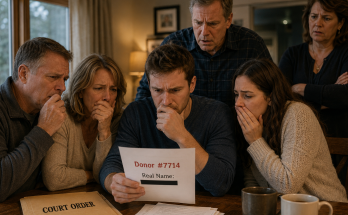
Dad bought an annuity in 2008.
$300,000.
He named me the beneficiary.
Every Christmas, he reminded me.
“When the company pays out, that money is yours.”
I never questioned it.
Dad kept the paperwork in a small fireproof box in his closet.
Then, in 2022, everything changed.
His Alzheimer’s diagnosis came in February.
Two months later, the beneficiary was changed.
Current beneficiary:
Debra Mitchell.
My stepmother.
I couldn’t believe it.
I called the insurance company.
The representative told me the change had been authorized by Dad’s financial advisor.
So I called the advisor.
He said, “Your father was competent when he signed.”
That wasn’t what I’d been seeing.
Dad thought it was 1997.
He asked for his first wife every morning.
She had died in 1988.
Sometimes he called me by my uncle’s name.
I started asking questions.
Eventually, I subpoenaed the advisor’s meeting notes.
One sentence stopped me cold:
“Client confused but cooperative.”
I filed everything with the probate court.
The judge ordered the original documents.
When they arrived, I examined the signature page.
There was Dad’s signature.
Below it was the witness signature.
Someone had been in the room when Dad supposedly agreed to change his beneficiary.
I knew the name.
I knew the handwriting.
And when I saw it, my hands started shaking.
The witness was my…
own sister.
My own sister.
I stared at her signature for nearly a minute.
My sister, Rachel, had always insisted she knew nothing about Dad’s finances.
When I called her, she didn’t answer.
I left one message.
“Rachel, I saw the witness signature.”
She called back eleven minutes later.
Her first words were:
“Please don’t make this worse.”
My stomach dropped.
“Make what worse?”
She started crying.
“I didn’t know what I was signing.”
“You witnessed Dad changing a $300,000 annuity.”
“I thought it was paperwork for his medical expenses.”
“Then why did you sign as a witness?”
“Because Debra told me Dad needed it.”
I sat down.
“Was Dad in the room?”
Rachel went silent.
“Yes.”
“Was he able to understand what he was signing?”
Another silence.
Then she said something that changed the entire case.
“He kept asking where Mom was.”
I knew exactly what she meant.
Dad’s first wife had been dead for decades.
Rachel continued.
“Debra kept telling him, ‘This is just something you need to sign for the house.’”
My hands went cold.
“Did Dad ever mention the annuity?”
“No.”
“Did he know I had been the beneficiary since 2008?”
“I don’t know.”
I asked her the question I had been avoiding.
“Why didn’t you tell me?”
She started sobbing.
“Because Debra made me promise.”
“Promise what?”
“She said if I told you, she’d make sure Dad’s money went to someone else.”
“Who?”
Rachel wouldn’t answer.
Then I heard a sound in the background.
A door closing.
Her voice dropped to a whisper.
“I have to go.”
“Rachel, wait.”
She hung up.
I immediately called the probate attorney.
I told him everything.
He asked me to send him the witness signature.
When he called back, his tone had changed.
“There may be a bigger problem.”
“What?”
“The witness signature isn’t the only thing that’s unusual.”
He told me the original beneficiary-change form had a second page.
A page the insurance company hadn’t initially provided.
It contained a handwritten note.
And the handwriting looked exactly like Dad’s.
Except Dad couldn’t have written it.
Because the date on the note was two weeks after he’d lost the ability to write his own name.
The note was only one sentence.
“I want Debra to have everything because she has taken care of me.”
I read it again.
Then again.
Something felt wrong.
Dad had barely been able to write his own name by that point.
His doctor had documented the decline.
So I asked the probate attorney to compare the handwriting.
He sent the note to a forensic document examiner.
Three days later, we got the answer.
The signature was Dad’s.
But the handwriting on the note wasn’t.
Someone had copied his signature onto the document.
The rest had been written by someone else.
The investigator then found something even more troubling.
The beneficiary-change form had been notarized at a law office.
The notary’s records showed that Dad had supposedly appeared in person.
But the office receptionist remembered something different.
She remembered Debra bringing the documents.
And she remembered Dad sitting in the car outside.
He had never entered the office.
That meant someone had potentially signed documents on his behalf and presented them as if Dad had personally approved them.
But we still needed proof.
The attorney subpoenaed the financial advisor’s phone records and appointment calendar.
There was no appointment with Dad on the date listed.
There was, however, an appointment with Debra.
The meeting lasted forty-seven minutes.
Dad wasn’t listed as an attendee.
My sister wasn’t listed either.
Yet Rachel’s signature appeared on the beneficiary form.
I confronted her again.
This time, she finally told me the truth.
Debra had asked Rachel to come to the house.
Dad was sitting in his chair, confused and asking about his first wife.
Debra placed papers in front of him.
Rachel said Dad picked up the pen.
But before he could sign, he asked:
“Why am I giving this to Debra?”
Rachel said Debra answered:
“Because she is your wife.”
Dad looked confused.
Then he said:
“I promised this to my daughter.”
My heart stopped.
Rachel told me Dad never signed the form willingly.
Debra took his hand and guided the pen.
Rachel said she was horrified.
But Debra told her that if she refused to witness the signature, she would tell Dad that Rachel was trying to steal his money.
Rachel signed because she was afraid.
I finally understood why she’d begged me not to make things worse.
But there was still one question.
If Dad had clearly said the money belonged to me, why had the financial advisor certified that he was competent?
We subpoenaed the advisor’s private notes.
At the bottom of the final page was a sentence that changed everything:
“Client’s wife instructed me beforehand that he would be changing his beneficiary.”
The note was dated three days before the meeting.
That sentence changed everything.
Debra hadn’t simply reacted to Dad’s decision.
She had arranged for the decision to happen.
My attorney filed the documents with the probate court.
The judge ordered Debra, the financial advisor, and the notary to appear.
Rachel was subpoenaed too.
At the hearing, the financial advisor tried to explain himself.
He said Dad had appeared to understand the transaction.
My attorney placed the doctor’s records in front of him.
“Your notes say the client was confused but cooperative.”
The advisor shifted in his chair.
Then my attorney asked:
“Did you personally ask Mr. Mitchell who he wanted as beneficiary?”
The advisor said yes.
“What did he answer?”
The advisor looked at Debra.
Then he said,
“He said his daughter.”
The courtroom went completely quiet.
I looked at Debra.
She didn’t look at me.
My attorney asked why the beneficiary had nevertheless been changed to Debra.
The advisor couldn’t answer.
Then the judge turned to Rachel.
“Did your father knowingly approve this change?”
Rachel began crying.
“No.”
Debra suddenly stood up.
“That is a lie.”
The judge ordered her to sit down.
Rachel continued.
“My father didn’t understand what the papers were. He thought they were related to the house.”
The judge asked why Rachel had signed as a witness.
She looked at me.
“I was scared.”
After the hearing, the judge ordered the insurance company to freeze the annuity until the dispute was resolved.
But the biggest surprise came the following week.
The financial advisor’s attorney contacted my lawyer.
He wanted to negotiate.
My attorney asked why.
The advisor had discovered something in his own files.
A recording.
Apparently, the office’s meeting room had a security system that captured audio whenever documents were being signed.
The recording had never been included in the original file.
My attorney played it for me.
I heard Dad’s voice.
Weak.
Confused.
But unmistakable.
Someone asked him:
“Who should receive the annuity?”
Dad answered:
“My daughter.”
Then Debra’s voice came through.
“She means after I take care of you.”
Dad replied:
“No. My daughter.”
There was a long silence.
Then Debra said something that made my blood run cold.
“You won’t remember this tomorrow.”
The recording ended.
I sat in silence.
For the first time since this began, I knew exactly what Dad had wanted.
The judge ruled that the beneficiary change was invalid.
The original designation from 2008 was restored.
The $300,000 annuity remained mine.
But I didn’t feel victorious.
Because Dad wasn’t there to see it.
He was still alive, but by then he barely knew my name.
I went to his room that evening.
I held his hand.
He looked at me for a long moment.
Then he smiled.
“You’re my daughter.”
I started crying.
“Yes, Dad.”
He squeezed my hand.
“I told them.”
I asked, “Told them what?”
He looked toward the window.
“That you were supposed to have it.”
And then he smiled again.
This time, I knew he remembered.
I didn’t tell Dad about the court case.
I didn’t tell him about Debra.
I simply sat beside him and held his hand.
For the first time in months, he seemed peaceful.
A few weeks later, the judge issued the final order.
The beneficiary change from 2022 was officially voided.
The original 2008 designation naming me as beneficiary was restored.
The $300,000 annuity was legally mine.
But the money wasn’t what mattered anymore.
The investigation had uncovered something else.
The financial advisor had received a substantial fee after the beneficiary change.
The payment came from an account controlled by Debra.
The advisor eventually admitted he had violated several professional rules.
He surrendered his license rather than face a longer investigation.
The notary’s commission was also suspended after investigators determined that the notarization records were inaccurate.
As for Rachel, I forgave her.
She had made a terrible decision by signing the document.
But she eventually told the truth when it mattered.
Debra was no longer allowed to manage Dad’s finances.
A court-appointed professional took over instead.
One afternoon, I visited Dad and showed him the judge’s order.
He stared at the paper.
I wasn’t sure he understood it.
Then he pointed at my name.
“That’s yours.”
I smiled.
“Yes.”
He looked relieved.
“Good.”
That was all he said.
Three months later, Dad passed away peacefully.
At his funeral, Rachel stood beside me.
Neither of us mentioned the money.
We talked about Dad.
The man he had been before Alzheimer’s.
The father who bought me my first bicycle.
The man who remembered every birthday.
The man who had quietly protected something for me for fourteen years.
After the funeral, Rachel handed me a small envelope.
“I found this in Dad’s desk.”
Inside was a handwritten note.
This time, I knew the handwriting was really his.
It said:
“I bought this for my daughter because I wanted her to have something that would always be hers. If I’m ever too confused to explain it, don’t let anyone change what I decided when I was well.”
I read it twice.
Then I folded it carefully.
I didn’t use the $300,000 to buy a house.
I didn’t buy a new car.
I put most of it into an account in my father’s name.
The rest I used to establish a small fund for families dealing with dementia who needed help with legal and financial planning.
Because Dad had taught me something without ever saying it directly:
When someone you love begins losing their memory, you have to protect the choices they made while they still had a voice.
And sometimes, the most important inheritance isn’t the money.
It’s knowing what your parent wanted you to have.
And knowing you fought hard enough to keep their promise.
Six months after Dad’s funeral, I received a letter from the insurance company.
I almost ignored it.
The annuity had already been settled.
The court had ruled.
There shouldn’t have been anything left to discuss.
But the letter contained a copy of an old beneficiary form.
The original.
Not the 2022 document.
The 2008 document Dad had signed when he first purchased the annuity.
I already knew what it said.
Beneficiary: His daughter.
But underneath my name was a handwritten note I’d never seen before.
I recognized Dad’s handwriting immediately.
It said:
“If anything happens to me, make sure she knows why I chose this.”
I called the insurance company.
They told me the note had been attached to the original policy but had never been digitized.
I asked why no one had shown it to me during the court case.
The representative said:
“We didn’t know it existed.”
I couldn’t stop thinking about it.
Why had Dad written that?
The next morning, I went through his old papers again.
Buried inside a folder marked “Retirement”, I found another document.
It was a letter from Dad to the insurance company dated 2008.
It explained why he had purchased the annuity.
He wrote that he wanted to make sure I had financial security because he knew he wouldn’t always be able to help me.
At the bottom, he wrote:
“My daughter has always taken care of everyone else. I want something to take care of her.”
I cried when I read that.
For years, I’d thought the $300,000 was simply an investment.
It wasn’t.
It was Dad trying to protect me long after he was gone.
Then I noticed something strange.
The letter was dated December 12, 2008.
But the annuity paperwork was dated December 15.
Three days later.
That meant Dad had planned it carefully.
It wasn’t an impulsive decision.
It wasn’t something he forgot.
It was one of the clearest choices he’d ever made.
I put the letter beside his photograph.
Then I realized something else.
Debra had tried to change the beneficiary in 2022.
But she couldn’t change what Dad had intended in 2008.
She could change a document.
She couldn’t change the reason he created it.
A week later, I received one final call.
It was from the judge’s office.
There had been a new development.
The court had discovered another financial account connected to Debra.
And the records showed that Dad’s money had been moved from it shortly before his diagnosis.
The judge wanted to know if I recognized the account.
I didn’t.
Until I saw the name of the account holder.
It wasn’t Debra.
It was someone I had never heard of.
And according to the records, that person had received payments from Dad for fourteen years.
The name on the account was Evelyn Carter.
I didn’t recognize it.
Neither did Rachel.
The judge’s office explained that Evelyn had received regular payments from an account connected to Dad.
The payments had started in 2008.
The same year Dad purchased the annuity.
I immediately wondered if the two things were connected.
My attorney subpoenaed the bank records.
What we found surprised everyone.
Evelyn wasn’t a stranger.
She had been Dad’s longtime secretary before he retired.
She had worked for him for nearly twenty years.
But the payments weren’t suspicious.
They were for something Dad had arranged himself.
Evelyn had been caring for a small trust Dad created for my education and future expenses.
I had never known about it.
The trust contained letters, financial records, and one final document.
Dad had written:
“I want my daughter to receive this when she is old enough to understand why I made it.”
I couldn’t believe it.
The account wasn’t connected to Debra at all.
It was something Dad had created years before he ever met her.
But then we found one payment that didn’t belong.
A transfer made two months after Dad’s Alzheimer’s diagnosis.
The recipient?
The financial advisor.
My attorney immediately contacted the court.
The advisor had previously claimed he had received only his normal professional fee.
The bank records showed otherwise.
There had been an additional payment.
And the transfer had been authorized by Debra.
The amount was exactly the same as the advisor’s fee for preparing the beneficiary-change paperwork.
The judge reopened the investigation.
This time, the financial advisor admitted what had happened.
Debra had promised him additional compensation if he helped process the beneficiary change quickly.
He claimed he didn’t realize Dad lacked capacity.
But the meeting notes proved otherwise.
He had written:
“Client confused but cooperative.”
The court ruled that the transaction was improper.
Debra was ordered to repay the money.
The advisor faced additional penalties.
And the entire matter was finally closed.
A few weeks later, I visited Dad’s grave.
I brought the original 2008 annuity document with me.
I sat there for a long time.
Then I said,
“You were right, Dad.”
I told him I had found the note.
I told him I understood why he’d created the annuity.
And I told him I would use the money responsibly.
Before I left, I placed the copy of his letter beside the flowers.
I didn’t leave the original.
That belonged to me.
Not because it was worth $300,000.
Because it was proof of something much more valuable.
My father had made a promise when he was healthy.
Years later, when his memory was fading, other people tried to rewrite that promise.
They failed.
Because the truth was still there.
In his handwriting.
In his records.
And in the choices he had made when he was still completely himself.
I walked away from his grave feeling strangely peaceful.
For the first time since his diagnosis, I wasn’t angry anymore.
I was grateful.
Because Dad had left me more than an inheritance.
He left me certainty.
I had always been his daughter.
And he had never stopped choosing me.
A year after Dad’s death, I finally closed the last account connected to the annuity.
The $300,000 was still there.
I had never touched most of it.
Every time I looked at the balance, I thought about Dad sitting at his desk in 2008, signing those papers while his mind was clear.
He hadn’t known what the future would bring.
But he had prepared for it anyway.
I decided to use the money differently than I’d originally planned.
I created a small scholarship in his name for students whose parents were dealing with dementia.
Not because Dad had been wealthy.
He hadn’t.
But because he understood something many families learn too late:
Planning ahead is an act of love.
Rachel helped me organize the scholarship.
It became the thing that finally repaired our relationship.
One evening, she asked me,
“Do you think Dad knew what Debra was doing?”
I thought about it.
“No,” I said. “But I think he knew something wasn’t right.”
Rachel nodded.
“He kept saying the same thing.”
“What?”
She smiled sadly.
“He kept saying, ‘My daughter knows.’”
I cried when she told me that.
Because even when Dad couldn’t remember the year, the house, or sometimes even the people around him, something inside him still remembered me.
His daughter.
The person he had chosen in 2008.
The person he had protected for fourteen years.
The person he trusted enough to leave behind a promise.
I still have the original annuity paperwork.
I also kept the year-end statements, Dad’s handwritten letter, and the court order restoring my beneficiary rights.
They’re all in the same fireproof box where Dad once kept his important documents.
But I added something new.
A photograph of him.
Healthy.
Smiling.
Holding me when I was a little girl.
On the back, I wrote:
“You kept your promise, Dad. So did I.”
Sometimes people think an inheritance is about money.
For me, it never was.
The $300,000 gave me financial security.
But the documents gave me something much more important.
They proved that when Dad was still completely himself, he made a choice.
He chose me.
And when his memory faded, other people tried to change that choice.
They couldn’t.
Because love isn’t only remembered in someone’s mind.
Sometimes it’s preserved in the decisions they make while they still can.
And that’s the inheritance I’ll keep for the rest of my life.
Two years after Dad’s death, I thought the story was finally over.
Then I received a package from his former attorney.
Inside was a folder I’d never seen before.
The attorney explained that he’d discovered it while closing Dad’s old files.
There was one document inside that made me sit down.
It was dated January 2008, months before Dad purchased the annuity.
At the top, Dad had written:
“For my daughter, if I am ever unable to speak for myself.”
I kept reading.
He had written about his wishes, his finances, and the people he trusted.
Then came a sentence that stopped me.
“If someone tries to change this after my memory begins to fail, don’t assume they are acting for me.”
Dad had anticipated exactly what eventually happened.
He had even listed the people he wanted involved in his financial decisions.
My name was first.
Rachel’s name was second.
Debra wasn’t listed at all.
I called the attorney.
“Why didn’t I know about this?”
He said Dad had specifically asked him to keep the document private until it was needed.
“He told me that one day you might have to prove what he wanted.”
I looked at the date again.
Dad had written it fourteen years before the beneficiary change.
He had been preparing for the possibility that his memory would someday fail.
That discovery changed how I remembered those final years.
I had spent so much time feeling angry that Dad couldn’t explain what had happened.
Now I realized he’d already explained it.
He had simply done it years earlier.
The attorney also gave me one final piece of information.
Before Dad’s diagnosis, he had updated his estate plan.
The new documents contained one instruction:
“My daughter is to receive what I have specifically designated for her. No later agreement should override this unless I personally confirm it while competent.”
That sentence became the foundation of everything the court later decided.
I folded the document carefully.
Then I called Rachel.
“I found Dad’s letter.”
She asked what it said.
I told her.
There was silence.
Then she laughed through tears.
“That sounds like Dad.”
“What do you mean?”
“He always planned three steps ahead.”
I smiled.
“He really did.”
That night, I placed the new document into the fireproof box beside the old annuity paperwork.
For the first time, the box contained everything.
The original promise.
The attempted change.
The evidence.
And Dad’s final instructions.
I closed the lid.
Then I realized something.
The $300,000 wasn’t really the inheritance.
The real inheritance was knowing my father had thought about my future long before I understood how much I would need him.
And even when he couldn’t remember the details of his own life, he had left behind enough truth to make sure I would never have to wonder what he wanted.
I finally understood the lesson Dad had been trying to teach me all along:
Protect your wishes while you can speak for yourself—and make sure the people you trust know where to find them.
Five years after Dad’s diagnosis, I opened the fireproof box one last time.
I wasn’t looking for anything.
I just wanted to remember him.
Inside were the documents that had changed my life:
The 2008 annuity.
The beneficiary form.
The court order.
Dad’s handwritten letter.
And the document he’d prepared months before buying the annuity.
I read that final document again.
At the bottom was a sentence I’d somehow overlooked.
“If my daughter ever doubts whether I loved her, tell her to look at the date.”
I looked at the date.
January 2008.
Months before the annuity.
Years before his Alzheimer’s diagnosis.
Years before anyone could have known what would happen.
Dad hadn’t created the annuity because he was sick.
He hadn’t created it because someone told him to.
He created it because he was my father.
He wanted to make sure that, whatever happened in the future, I would have something from him.
I called Rachel.
We sat together that evening and went through the old photographs.
There was one from 2008.
Dad was sitting at his desk with the annuity papers in front of him.
I remembered that day.
I’d stopped by his house after work.
He’d smiled and said,
“I took care of something for you.”
I had laughed.
“What did you do now?”
He never told me.
He just smiled.
Now I finally understood.
He had been talking about the annuity.
All those years ago, he knew exactly what he had done.
And every Christmas afterward, when he reminded me that the money would eventually be mine, he wasn’t bragging about an investment.
He was reminding me of a promise.
The final piece of the story came from the insurance company.
They sent me a copy of Dad’s original application.
Under Reason for Beneficiary, he had written:
“Because she is my daughter, and I want her protected.”
Six words.
That’s all it took.
I framed the sentence.
It hangs beside his photograph in my home.
The $300,000 eventually became part of the scholarship fund I created in his name.
Every year, I meet students whose families are facing the same difficult conversations about aging, memory, and planning for the future.
I tell them what Dad taught me without ever giving a speech:
Make your wishes clear.
Put them in writing.
And don’t assume the people around you will always protect them.
Because when Dad could no longer speak clearly for himself, his documents spoke for him.
His signature spoke for him.
His choices spoke for him.
And most importantly, his love spoke for him.
Debra eventually moved away.
Rachel and I became closer than we’d been in years.
And I stopped thinking of the court case as a fight over money.
It was never really about $300,000.
It was about whether my father’s final wishes would be respected.
They were.
I closed the fireproof box.
Then I placed one last note inside.
It said:
“Dad, you protected me when you were here. Your last gift was teaching me how to protect myself when you were gone.”
I shut the lid.
And for the first time, I didn’t feel like I was holding onto the past.
I felt like I was carrying his promise forward.
Years later, I still keep Dad’s original 2008 annuity paperwork in the same fireproof box.
Not because of the $300,000.
Because of what it represents.
Dad made that decision when his mind was clear. He chose me, documented it, and reminded me every Christmas for years.
When his memory began to fade, other people tried to rewrite that decision.
But they couldn’t erase what he’d already put in writing.
His choices spoke for him when he no longer could.
I eventually donated the annuity money to the scholarship fund I created in his name.
Every time a student receives help through that fund, I think of Dad.
He wanted to protect his daughter.
In the end, he did something even bigger.
He taught me that protecting someone you love sometimes means planning for the day you won’t be able to speak for yourself.
I keep one sentence from his original paperwork framed beside his photograph:
“Because she is my daughter, and I want her protected.”
That was Dad’s inheritance to me.
Not the money.
The certainty that, even when his memory disappeared, his love never did. THE END.