### Part 1
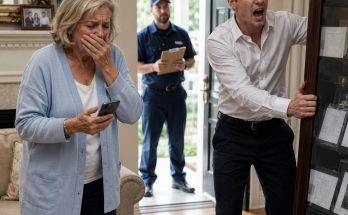
“Get your hands off my property and leave before I have you arrested.”
The voice belonged to my son.
The property belonged to me.
My hands were resting against the rough cedar frame of a cabin I’d owned for nineteen years, paid off in full, and driven four hours through the Tennessee mountains to reach on the first weekend of my retirement.
For a few seconds, I honestly wondered whether exhaustion had done something strange to my hearing.
Then my son, Evan, stepped farther into the doorway and stared at me like I was a trespasser.
Behind him, four strangers stood inside my living room holding wine glasses.
They wore expensive outdoor clothes so clean they looked like they’d been purchased on the drive up. One man had a quilted vest over a pressed button-down shirt. The woman beside him wore cream-colored hiking boots without a speck of dirt on them. A younger man leaned against my kitchen island, while a woman around Evan’s age stood frozen beside the fireplace.
My fireplace.
The one I’d rebuilt with river stone after my divorce.
They were all looking at me with the cautious discomfort people reserve for somebody who’s wandered into the wrong house.
And Evan let them.
“I’m sorry?” I said.
“This is private property,” he repeated, louder now. “You need to leave.”
I stared at him.
I’d watched that face since a nurse handed him to me in 1999. I’d seen it sticky with birthday cake, red from crying after his first broken arm, terrified before his driver’s test, embarrassed when I hugged him at his high school graduation.
I knew every version of my son’s face.
And I recognized exactly what happened in that doorway.
First, he recognized me.
Then he made a decision.
“Evan,” I said quietly. “Don’t do this.”
His jaw tightened.
“I don’t know who Evan is.”
That was when something inside me went cold.
Not angry.
Not yet.
Cold.
The young woman near the fireplace looked from him to me.
“Evan?” she repeated.
He ignored her.
“My name is on the deed to this cabin,” he said. “If you don’t leave, I’m calling the sheriff.”
I almost laughed.
Not because anything was funny.
Because I’d spent thirty-one years as a structural engineer, and there are moments when a structure fails so completely that all you can do is stare at the collapse.
Four hours earlier, I had been driving through the mountains feeling lighter than I had in years.
I’d retired the previous Thursday from an engineering firm in Charlotte, North Carolina. My coworkers had given me a cheap fishing hat, a card covered in signatures, and a grocery-store cake with blue frosting that stained everybody’s teeth.
My supervisor, Mark, had slapped me on the shoulder and said, “Don’t you dare answer your email Monday.”
I promised I wouldn’t.
I’d planned that weekend for nearly two years.
Coffee on the dock.
Fishing before sunrise.
No meetings.
No traffic.
No deadlines.
Just Douglas Lake, the mountains, and the quiet cabin I’d bought with my former wife when Evan was eight.
Back then, he’d sit on the dock for hours with a fishing pole almost as tall as he was.
He’d fall asleep in my truck afterward with his mouth open and one sneaker missing.
Those were the years when I thought I understood the man he would become.
I was wrong.
The first warning had come when I turned onto the gravel road leading to the cabin.
Three unfamiliar vehicles were parked outside.
A black Suburban.
A silver Range Rover.
And a Jeep packed with luggage.
Only three people knew the combination to the lockbox under the back porch.
Me.
My brother, Daniel, who was currently in Montana for his daughter’s wedding.
And Evan.
Through the front windows, I’d seen candles burning on the mantel.
My dining table had been extended for six.
Music played softly through my speakers.
For one stupid moment, I’d actually smiled.
I thought maybe Evan had planned a surprise.
Maybe retirement had reminded him of better years.
Maybe he’d finally decided to come spend a weekend with his father without asking for money.
Instead, he’d looked me in the eye and threatened to have me arrested.
The older man in the expensive vest stepped forward.
“Young man,” he said to Evan, “what exactly is going on?”
Evan didn’t hesitate.
“This man walked into our cabin.”
Our cabin.
The older man’s eyes narrowed.
“Your cabin?”
“Mine,” Evan said. “My grandfather built it. I inherited it four years ago.”
I stopped breathing for half a second.
My father had never owned this cabin.
He’d never even seen it.
The woman beside the older man set down her wine glass.
“Evan,” she said carefully, “you told us your grandfather built this place himself.”
“He did.”
“What was his name?”
Evan smiled.
“Arthur Bennett.”
My father’s name had been Samuel.
And I’d never known an Arthur Bennett in my life.
That was when I understood something far worse than finding strangers inside my cabin.
My son hadn’t improvised this lie because I unexpectedly walked through the door.
He’d been telling it for a long time.
And judging by the way those four people were looking at him now, whatever he’d built on top of that lie was about to come crashing down.
### Part 2
Nobody spoke for several seconds.
Outside, the lake moved softly against the dock.
Inside, a piece of firewood shifted in the fireplace with a sharp crack.
The sound made Evan flinch.
I didn’t.
The older man stepped closer.
He held himself differently from the others. Not aggressive, exactly. Controlled. Observant. The kind of man who studied a room before deciding what he thought about it.
“I’m Richard Mercer,” he said to me. “This is my wife, Elaine. Our son, Nolan. And our daughter, Sophie.”
Sophie.
So that was Evan’s girlfriend.
I’d seen her once before in a photograph he’d texted me seven months earlier.
Met someone. Thought you should know.
That was all he’d written.
No invitation to meet her.
No follow-up.
Nothing.
Now she was standing beside my fireplace looking at him as if she’d never seen him before.
“I’m Thomas Hale,” I said. “And this is my cabin.”
Evan gave a short, irritated laugh.
“Anybody can claim anything.”
I turned toward him.
“You know what year I bought it.”
“No, I don’t.”
“You know where the water shutoff is.”
His lips pressed together.
“You know which floorboard in the upstairs bedroom squeaks because you used to sneak downstairs at midnight for cookies.”
Sophie slowly looked at him.
“You told me there was no upstairs bedroom when you were a kid.”
Evan’s eyes flicked toward her.
“I remodeled.”
I almost admired the speed of the lie.
Almost.
Richard held up one hand.
“Thomas, can you prove ownership?”
“Yes.”
“Then let’s do that.”
Evan immediately stepped between us.
“This is ridiculous.”
Richard didn’t even raise his voice.
“Move.”
Something in his tone made Evan obey.
I took out my phone and opened the Sevier County property records.
I’d used county databases thousands of times during my career. Survey parcels, zoning overlays, permits, easements. It took me less than a minute to find the cabin.
I handed the phone to Richard.
He studied the screen.
Owner: Thomas A. Hale.
Purchase date: June 2007.
Property taxes: current.
Parcel number.
Recorded deed.
Everything.
Richard enlarged the screen with two fingers and read it again.
“Those websites make mistakes,” Evan said.
Richard looked up.
“I’m a senior partner at Mercer & Rowe Architectural Development. I work with county property records every week.”
Evan’s expression changed.
Only slightly.
But I saw it.
“Errors happen.”
“Not this kind.”
Richard handed me the phone.
Nolan had already pulled out his own.
“I’m checking it separately.”
“Nolan,” Evan snapped.
Nolan ignored him.
Sophie stepped away from the fireplace.
“Evan, you told us this cabin had been in your family for three generations.”
“It has.”
I couldn’t help myself.
“In a way, that’s technically closer to the truth than most things you’ve said tonight.”
Every face turned toward me.
I continued.
“I bought it while Evan was eight years old. So yes, it’s been used by two generations of my family. Just not the way he’s describing.”
Then I opened my photos.
If Evan wanted proof, I had nineteen years of it.
The first picture showed me standing beside the original dock, twenty pounds heavier and almost completely dark-haired.
The next showed eight-year-old Evan holding a tiny bluegill with both hands.
Then there was the summer I replaced the back porch railing.
My brother Daniel was standing beside me holding a level.
Then the fireplace renovation.
Then the new metal roof.
Then Evan at eleven, asleep in a hammock.
At thirteen, grilling burgers badly.
At fifteen, sitting on the dock with his first girlfriend.
At seventeen, pretending to hate being photographed.
Year after year.
Life after life.
I stopped on one picture.
Evan was nine, sitting on my shoulders in front of the cabin.
He was missing a front tooth.
His arms were wrapped around my forehead.
He looked happier than I’d seen him in years.
Sophie covered her mouth.
Richard turned toward my son.
“The name on the deed isn’t yours.”
Evan said nothing.
“The man in these photos is you.”
Still nothing.
Richard’s voice became quieter.
“How long have you been telling my daughter you own this property?”
Evan swallowed.
“It’s complicated.”
“No. It’s actually becoming very simple.”
Elaine had gone pale.
She picked up her wine glass, then seemed to think better of it and set it down again.
I noticed something else.
A leather folder sat open on the dining table.
Beside it were architectural drawings.
I stepped closer.
“What are those?”
Evan moved quickly.
“Nothing.”
Richard’s face changed.
That was the moment I knew the cabin was only part of the problem.
Nolan looked from the drawings to his father.
“Dad.”
Richard didn’t answer.
He was staring at Evan.
Finally, he said, “Tell him.”
Evan’s eyes widened.
“Richard—”
“Tell your father why we’re here.”
The air suddenly felt much heavier.
I looked at the plans again.
They weren’t renovation sketches.
They showed property boundaries.
Lot divisions.
And what appeared to be a proposed second structure near my shoreline.
“Evan,” I said, “what exactly were you planning to do with my cabin?”
### Part 3
Evan opened his mouth.
Nothing came out.
That frightened me more than another lie would have.
My son was rarely short on explanations.
For the better part of three years, explanations had practically become his profession.
At twenty-three, he needed money for an app he was developing with “two guys from Atlanta.”
I gave him $5,000.
The app never launched.
At twenty-five, he needed help with first and last month’s rent because his roommates had supposedly backed out.
I later learned he’d taken out a personal loan and was using most of his paycheck to service it.
Last winter came the food truck.
That one had sounded more serious.
He showed me menu ideas, talked about commercial kitchen space, permits, weekend markets.
He was excited in a way I hadn’t seen since college.
So when he asked for $8,000 to secure a kitchen lease, I gave it to him.
I told myself it was the last time.
I’d been telling myself that for years.
Richard moved to the dining table and closed the leather folder.
“We came here because Evan told us he was preparing to use this property as collateral for a business expansion.”
I stared at him.
“What business?”
Evan shut his eyes.
Richard watched him.
“The food truck.”
I looked at my son.
He looked at the floor.
Richard continued.
“He told Sophie the business had been operating successfully for almost a year.”
I felt something tighten behind my ribs.
Elaine spoke this time.
“We invested thirty thousand dollars in June.”
I thought I’d misheard her.
“Thirty thousand?”
Elaine nodded.
“Evan said he needed additional capital for equipment and licensing.”
Sophie finally spoke.
Her voice sounded small.
“He said he’d already put almost sixty thousand of his own money into it.”
I laughed once.
Again, not because it was funny.
Evan made roughly twenty-two thousand dollars a year working part-time at a sporting goods store.
I’d been paying part of his rent.
His cell phone.
His car payment.
His renter’s insurance.
For six months, I’d even been carrying an extra health insurance rider because he’d let his own coverage lapse.
Sixty thousand dollars of his own money.
He didn’t have sixty thousand dollars.
He barely had sixty dollars some weeks.
“Is the business real?” I asked.
Evan rubbed both hands over his face.
“Yes.”
Richard said, “That’s not what I asked.”
“The concept is real.”
“What does that mean?”
“I’ve been working on it.”
“Do you have a truck?”
“No.”
“A kitchen lease?”
“It fell through.”
“Business license?”
“Not yet.”
“Employees?”
“No.”
“Revenue?”
Evan looked away.
Richard nodded once, as though confirming an unpleasant calculation.
“So the answer is no.”
Sophie sat down.
Not gracefully.
Her knees seemed to give out beneath her.
“You told me you catered three corporate events last month.”
“I was trying to set those up.”
“You sent me pictures.”
“Those were test events.”
“Whose food was in the pictures?”
Silence.
Sophie stared at him.
“Whose food?”
“A friend’s.”
Her eyes filled, but she didn’t cry.
That somehow made it worse.
I leaned against the back of a chair.
The cabin smelled like cedar, wine, and the rosemary chicken someone had been cooking in my kitchen.
It should have felt familiar.
Instead, it felt like a crime scene.
Not legally.
Emotionally.
Every object around me had been folded into a story I knew nothing about.
My dock.
My fireplace.
My father’s old fishing creel hanging by the pantry.
Evan had used all of it as scenery.
He’d built another version of himself inside my life.
Richard opened the leather folder again.
He slid one page toward me.
It was a preliminary financing worksheet.
Property value.
Estimated equity.
Collateral source.
Owner: Evan Hale.
My stomach dropped.
“Where did this come from?”
Richard answered.
“An internal draft from my firm. Nothing has been filed or executed.”
I looked at him sharply.
“You were helping him borrow against my property?”
“Based on the understanding that he owned it.”
“I didn’t sign anything.”
“No. And nothing could have proceeded without title verification.”
Evan jumped in.
“I knew that.”
Everyone turned toward him.
He swallowed.
“I mean, I knew we’d deal with the title stuff later.”
Richard’s expression hardened.
“There is no ‘title stuff’ to deal with. You don’t own the property.”
“I was going to talk to Dad.”
That finally made something break loose inside me.
“Talk to me?”
My voice rose for the first time.
“About what? Transferring my cabin to you? Signing it over because you promised another business was finally going to work?”
“Dad—”
“You haven’t spoken to me in four months.”
“Because you stopped answering.”
“Because every conversation became an invoice.”
That landed.
Evan looked like I’d slapped him.
I didn’t enjoy it.
But I didn’t take it back.
The last time he’d called was in April from an unfamiliar number.
He’d needed help with his car insurance.
I said no.
He told me I didn’t understand how hard things were for his generation.
I’d told him I understood working just fine because I’d started at sixteen and hadn’t stopped until retirement.
He hung up.
That was our last conversation.
Until tonight.
When he told me to get off my own property.
Richard folded his arms.
“Evan, did you use this cabin to persuade us that your business was financially secure?”
Evan hesitated.
Richard’s voice sharpened.
“Yes or no.”
“Yes.”
Elaine closed her eyes.
Sophie whispered, “Oh my God.”
I looked at my son.
He seemed smaller suddenly.
Not like a child.
Like a man whose costume had been stripped away.
I could have stopped there.
I could have yelled.
I could have called the sheriff and made the entire thing even uglier.
Instead, I asked one last question.
“Why?”
Evan looked at Sophie.
Not me.
“I wanted them to think I had my life together.”
There it was.
Not greed.
Not desperation.
Something almost sadder.
Shame.
And the willingness to bury everyone else under it.
Then Richard said something that changed the whole room again.
“The cabin isn’t the only thing he lied about.”
### Part 4
Sophie turned toward her father.
“What else?”
Evan’s face drained of color.
“Richard, don’t.”
Richard’s jaw tightened.
“I think we’re past the point where you get to decide what gets said.”
I stayed quiet.
There are moments in an investigation when interrupting does more harm than listening.
I’d learned that from years of engineering failures.
A cracked beam tells you one story.
The connection plates tell another.
Sometimes the real problem is hidden three layers deeper than where the damage appears.
Richard looked at me.
“Evan told us you were deceased.”
For the first time that night, I genuinely couldn’t process the sentence.
“I’m sorry?”
Sophie whispered, “He said you died two years ago.”
My son stared at the floor.
“He said this cabin was part of what you left him,” she continued. “He told me he didn’t like talking about you because you were close.”
There are lies that make you angry.
And there are lies so strange they briefly leave you empty.
I looked at Evan and tried to reconcile the living man in front of me with the child who used to call my office to ask when I was coming home.
“You killed me off?”
“Dad—”
“You told your girlfriend I was dead?”
“I didn’t know how else to explain why you weren’t around.”
I almost couldn’t believe it.
“You didn’t invite me around.”
“Because you judge everything I do.”
“I paid for everything you did.”
“That’s exactly what I mean!”
His voice finally broke open.
For the first time, the polished performance disappeared.
“You always made me feel like I was failing. Every time I asked for help, there was that look.”
“What look?”
“That disappointed look. Like you were thinking, ‘Here he goes again.’”
I stared at him.
“Evan, you were coming to me for money.”
“I know.”
“Again and again.”
“I know!”
“Then what expression was I supposed to have?”
Sophie stood.
“Stop making this about him.”
Evan turned toward her.
“I’m not.”
“You told me your father was dead.”
Her voice trembled now.
“You took me to this cabin and stood on that dock and told me he taught you how to fish there before he died.”
I looked toward the dark window.
For a moment, I could see eight-year-old Evan out there.
Bare feet.
Red life jacket.
His little plastic tackle box.
“Did you really say that?”
He didn’t answer.
That was answer enough.
Sophie picked up her bag.
Evan immediately moved toward her.
“Can we please talk privately?”
“No.”
“Sophie.”
“No.”
One word.
Flat.
Final.
Elaine went upstairs to pack.
Nolan followed to collect their things from the second bedroom.
Richard stayed behind.
He looked tired now.
Older than when I’d walked in.
“Evan,” he said, “the thirty thousand dollars.”
“I’ll pay it back.”
“With what?”
“I’ll figure it out.”
“When?”
“I said I’ll figure it out.”
Richard’s eyes hardened.
“That’s not a plan.”
I nearly laughed at the irony.
How many times had I heard some version of that answer?
I’ll figure it out.
It’ll work out.
I’m close.
Just one more month.
Just one more payment.
Just one more loan.
I had spent three years turning those phrases into cash.
Suddenly I saw my part in it with painful clarity.
I wasn’t protecting Evan from consequences.
I was delaying them.
And every delay had taught him that someone else would eventually absorb the impact.
Usually me.
Sometimes his mother.
Now Sophie’s family.
I opened my banking app.
Evan noticed.
“What are you doing?”
“Ending my part.”
I pulled up the automatic car payment.
$412 a month.
Thirty-seven payments remaining.
I’d cosigned the loan when he claimed his credit score had been damaged by a medical billing error.
Another story I’d never verified.
I canceled my recurring transfer.
The confirmation appeared almost instantly.
Evan took a step toward me.
“Dad.”
Next was the phone plan.
My family account still had five lines.
His was one.
I scheduled his line to transfer out at the end of the billing cycle.
Then the renter’s insurance.
Canceled.
The storage unit I’d been covering because he supposedly needed it for business equipment.
Canceled.
Finally, the monthly transfer I’d been sending toward his apartment.
Canceled.
His face changed with each one.
By the end, anger had been replaced by something closer to panic.
“You’re seriously doing this right now?”
“Yes.”
“You can’t just cut everything off.”
“I just did.”
“My car payment is due next week.”
“Call the lender.”
“I can’t afford it.”
“Then you’ll need to decide whether you can afford the car.”
“What about my apartment?”
“You have a job.”
“It’s part-time.”
“Get another one.”
He stared at me.
There was a time when that look would have destroyed me.
I would’ve softened.
Made one more transfer.
Invented some compromise so I could go to bed believing I’d helped my son.
But then I remembered him standing in my doorway.
Get your hands off my property.
I put my phone in my pocket.
“You told these people I was dead. You claimed my home was yours. You tried to use it as proof of wealth. And when I walked through the door, you chose the lie over me.”
His eyes reddened.
“I panicked.”
“No. You committed.”
The difference mattered.
By the time Elaine and Nolan came downstairs, the room had gone quiet.
Richard gathered the folder.
Elaine took Sophie’s arm.
They were ready to leave.
But before they did, Richard stopped beside me.
“Thomas, I owe you an apology.”
“You didn’t know.”
“I should have verified more.”
“You’re verifying now.”
He nodded.
Then he turned toward Evan.
“I’ll be contacting you about repayment.”
Evan looked terrified.
Richard didn’t threaten him.
He didn’t need to.
The Mercers packed their things into their vehicles and drove away.
Sophie didn’t hug Evan.
Didn’t kiss him.
Didn’t even say goodbye.
She looked at me once before leaving.
“I’m sorry.”
“You were lied to,” I said. “You don’t owe me an apology.”
Then the vehicles disappeared down the gravel road.
And my son was left standing in my living room with one duffel bag.
“Dad,” he said.
I knew what was coming before he said another word.
“I don’t have anywhere to go.”
I looked at him for a long moment.
Then I said the sentence I’d avoided saying for three years.
“You’re twenty-seven years old, Evan. That’s something you’re going to have to solve.”
### Part 5
He didn’t leave immediately.
He stood in the center of the room holding that duffel bag like the cabin itself might change its mind.
I recognized the helplessness in his posture.
I’d seen it before.
When he was eight and dropped his ice cream cone off the dock.
When he was eleven and forgot his science project at home.
When he was sixteen and backed his mother’s car into a mailbox.
Each time, I had stepped in.
Bought another ice cream.
Driven the forgotten project to school.
Paid for the mailbox.
That’s what fathers do, I’d always told myself.
You solve what your children can’t.
The problem was that Evan had become a man without ever learning where my solving ended and his began.
“My car?” he asked.
“What about it?”
“If you stop paying, they’re going to repossess it.”
“Maybe.”
“I need it for work.”
“Then talk to the lender.”
“They’re not going to lower the payment enough.”
“Then sell it before they take it.”
“I owe more than it’s worth.”
“Then that’s another problem to solve.”
He looked at me with disbelief.
“Do you even care what happens to me?”
The question hurt.
It also made me angry.
“I care enough to stop making your life easier every time you make it harder.”
“That’s not caring.”
“It might be the first useful kind I’ve given you in years.”
He shook his head.
“Mom was right about you.”
I knew better than to ask.
I asked anyway.
“What did your mother say?”
“That retirement was going to turn you bitter.”
I almost smiled.
My ex-wife, Laura, and I had divorced when Evan was nineteen.
It hadn’t been dramatic.
No affair.
No screaming.
Just twenty-five years slowly separating into two different lives.
She kept the house in Charlotte.
I kept the cabin.
We stayed civil because of Evan.
Maybe too civil.
Whenever he needed something, he’d play us against each other without either of us realizing it.
If I said no, he’d call her.
If she said no, he’d call me.
If both of us said no, he’d change the story.
I wondered how long she’d known about Sophie.
I wondered what version she’d heard.
“You can call your mother,” I said.
He looked away.
“She said I can’t stay there.”
That surprised me.
“Why?”
“Her husband doesn’t want me moving in.”
Laura had remarried three years earlier.
I’d met her husband twice.
Calm man.
Accountant.
Apparently, he had stronger boundaries than either of Evan’s parents.
“So get a motel.”
“I don’t have money for that.”
“Call a friend.”
“They’re all in Nashville.”
“So drive to Nashville.”
He looked around the room.
“You’d really send me away tonight?”
The father in me screamed no.
The man who had walked into his own house and been called a trespasser said yes.
“You brought four people into my home without permission. You let them sleep in my rooms, drink my wine, and plan financing around property you didn’t own. So yes. You’re leaving tonight.”
His jaw tightened.
“I hate you right now.”
“I understand.”
“I mean it.”
“So do I.”
That confused him.
Good.
Maybe he’d spent too long believing anger could function as leverage.
He picked up his bag.
At the door, he stopped.
For one second, he looked like he might apologize.
Instead, he said, “I hope this retirement is worth losing your son.”
Then he walked outside.
I listened to his Jeep start.
The headlights swept across the windows.
Then the sound faded down the gravel road.
And I was alone.
Completely alone.
I expected to feel victorious.
I didn’t.
I sat at my dining table, surrounded by half-empty wine glasses and plates of cold food strangers had cooked in my kitchen.
A candle had burned down far enough that wax pooled onto the mantel.
I turned off the music.
The silence afterward felt enormous.
For nearly an hour, I cleaned.
Not because the cabin needed cleaning.
Because my hands needed something to do.
I rinsed wine glasses.
Folded blankets.
Carried luggage tags someone had dropped upstairs to the trash.
Then I found something beneath the couch.
A glossy brochure.
The logo at the top belonged to Richard’s architectural firm.
Inside was a rendering of a luxury lake development.
Cabins.
Private docks.
A clubhouse.
My stomach tightened.
One page had handwritten notes in Evan’s handwriting.
Phase two possibility?
Adjacent parcel?
Dad’s lot access?
I stared at those three words for a long time.
Dad’s lot.
Not Grandpa’s.
Not mine.
Dad’s.
So somewhere inside all those lies, Evan had always known exactly whose property he was using.
I took a picture of the page.
Then I called Richard.
He answered on the third ring.
“Thomas?”
“I found something.”
There was a pause.
“What?”
“A development brochure with notes in Evan’s handwriting.”
I read them aloud.
Richard went silent.
When he finally spoke, his voice had changed.
“Thomas, keep that brochure.”
“Why?”
“Because there may be more to this than the food truck.”
And just like that, the quiet retirement weekend I’d waited thirty-one years for wasn’t over yet.
### Part 6
Richard returned the next morning.
Alone.
I had already been awake for hours.
Retirement, apparently, did not erase thirty-one years of waking before sunrise.
I made coffee and sat on the dock while a thin layer of mist hovered above the water.
For the first time since arriving, the cabin felt like mine again.
Then tires crunched on gravel.
Richard walked down from the parking area carrying a leather briefcase.
“I’m sorry to bother you.”
“You didn’t create this.”
“No, but I may have helped give it momentum.”
We sat at the dining table.
I slid the brochure toward him.
He read Evan’s notes.
His mouth tightened.
“This brochure isn’t public.”
“What does that mean?”
“It was part of an internal presentation.”
“How did Evan get it?”
“I gave Sophie a copy.”
That answered one question.
Richard opened his briefcase and removed several printed emails.
“I went through correspondence last night.”
He pushed them toward me.
Evan had been talking with one of Richard’s junior project managers.
Not officially.
Just informal discussions.
Questions about easements.
Road access.
Waterfront development restrictions.
Parcel combinations.
Nothing illegal.
Nothing finalized.
But together, the messages painted a picture.
My son hadn’t only been pretending the cabin was his.
He’d been exploring whether the property could be folded into a larger development concept.
“He wanted to sell it?”
Richard shook his head.
“Not exactly. He’d talked about contributing the land as equity.”
I stared at him.
“Contributing my land.”
“Yes.”
The absurdity was almost impressive.
“How far did it go?”
“Nowhere official. Title verification would’ve stopped it immediately.”
“Then why didn’t it?”
“Because there was no transaction yet. Just conversations.”
He hesitated.
“Thomas, I need to tell you something else.”
I leaned back.
At this point, I was getting tired of that sentence.
Richard slid over another page.
It was an email from Evan.
He’d described me as his “late father.”
There it was again.
Dead.
Conveniently dead.
The email claimed the cabin had transferred informally after my death but probate paperwork had not been fully updated.
That was how he explained the ownership record.
I read it twice.
“That’s why he was so confident last night,” I said.
Richard nodded.
“He already had an explanation prepared.”
That bothered me more than anything.
Evan hadn’t expected me.
But he had expected questions.
He’d built contingency lies around the original lie.
Engineering, in its own twisted way.
A structure designed to carry deception.
“Can he get in legal trouble?”
“Potentially, depending on what representations he made regarding the thirty thousand dollars. But that’s between him and us.”
“I’m not asking you to protect him.”
“I know.”
“I mean it.”
Richard studied me.
“I believe you.”
We talked for another hour.
No police were called.
No lawsuit had been filed.
Richard told me he’d rather give Evan one opportunity to arrange repayment voluntarily before escalating.
That surprised me.
“You’re giving him more grace than I would.”
“Don’t confuse grace with trust.”
That sentence stayed with me.
Before leaving, Richard stopped at the door.
“Sophie ended the relationship last night.”
I wasn’t surprised.
“How is she?”
“Humiliated.”
“I imagine so.”
“She feels stupid.”
“She shouldn’t.”
“I told her that.”
He looked toward the lake.
“I think the worst part for her is realizing she doesn’t know which memories were real.”
That one hurt because I understood it.
After Richard left, I spent the rest of the weekend doing exactly what I’d originally planned.
I fished.
I drank coffee on the dock.
I grilled a steak Sunday night.
I watched the sun disappear behind the ridge.
But Evan was present in the negative space.
The empty chair.
The unused fishing rod hanging in the garage.
The old initials he’d carved into the underside of the dock when he was twelve.
E.H.
I wondered how a child who’d been so rooted in this place had grown into a man willing to steal its story.
Monday morning, I drove back to Charlotte.
My phone showed seventeen missed calls from Evan.
I didn’t return any.
By Wednesday, it was twenty-nine.
Then Laura called.
I almost let it go to voicemail.
Instead, I answered.
“Thomas, what did you do?”
No hello.
No question about whether I was okay.
Just accusation.
“I stopped paying his bills.”
“All of them?”
“The ones I was paying.”
“His car is going to be repossessed.”
“Then he should call the lender.”
“He can’t afford the payment.”
“Then he can’t afford the car.”
“He’s sleeping on someone’s couch.”
“He’s twenty-seven.”
Laura went quiet.
Then she said, “You’ve destroyed him.”
I leaned against my kitchen counter.
“No.”
“What do you call this?”
“He was already destroying himself. I was just helping it happen slower.”
She inhaled sharply.
“That’s cruel.”
“What was cruel was teaching him for three years that lying worked because someone else would cover the bill.”
“He’s our son.”
“Exactly.”
“And you’re willing to lose him?”
I looked out the window.
For years, that question would’ve ended the argument.
Not anymore.
“I already started losing him,” I said. “I just didn’t notice because I was writing checks.”
Laura hung up.
Three weeks later, the car was repossessed.
A month after that, Evan stopped calling.
And for the first time in his life, there was no one standing underneath him to catch the fall.
### Part 7
Autumn came quietly.
I spent more time at the cabin than I had in years.
At first, I told myself it was because I had nowhere else I needed to be.
That was partly true.
The other truth was harder.
The cabin reminded me that my life existed before Evan’s problems and could continue after them.
I repaired the dock.
Repainted the porch.
Bought a small aluminum fishing boat from a retired school principal down the road.
I started waking up without immediately checking my phone.
Laura called once in October.
Evan had found a second part-time job loading inventory overnight for a restaurant supply warehouse.
“He looks exhausted,” she said.
“Probably is.”
“You could help him.”
“No.”
“He isn’t asking.”
“Then why are you?”
She sighed.
“I don’t know.”
That was the first honest thing either of us had said about our parenting in years.
I learned, mostly through Laura, that Evan had moved into a rented room in East Nashville.
Not an apartment.
A room.
Shared kitchen.
Shared bathroom.
Apparently, the closet doors were missing and the mattress sat directly on the floor.
The old version of me wanted to fix that.
The new version learned to sit with discomfort.
In November, Richard called.
Evan had agreed to a repayment plan.
Small payments.
Painfully small.
But he was making them.
“He hasn’t missed one,” Richard said.
“Good.”
“I thought you’d want to know.”
“I do.”
Sophie never contacted me, and I was glad.
She deserved a clean exit from our family’s mess.
Thanksgiving passed.
Christmas passed.
I spent Christmas Day at my brother Daniel’s house in Asheville.
Evan wasn’t there.
Laura invited him to her place, but according to Daniel, he worked a holiday shift instead.
When January arrived, I’d settled into retirement enough that the days finally stopped feeling like weekends.
Then one Tuesday afternoon, my phone rang from a number I didn’t recognize.
Normally, I’d let it go.
Something made me answer.
“Hello?”
There was a pause.
Then Evan said, “I’m not calling to ask for anything.”
I said nothing.
He continued quickly.
“I wanted to say that first so you’d keep listening.”
I leaned back in my chair.
“I’m listening.”
His voice sounded different.
Not dramatically.
Just less polished.
He didn’t sound like someone preparing a pitch.
“I’ve been thinking about what happened.”
“At the cabin?”
“Before that.”
Another pause.
“A lot before that.”
I waited.
He exhaled.
“I’ve been building a fake version of my life for years.”
The words came slowly.
“I made everything sound bigger than it was. Better than it was. Jobs. Business plans. Money. Relationships.”
I looked out toward the bare winter trees.
“Why?”
“I thought people would stop respecting me if they knew how far behind I was.”
“Behind who?”
“Everybody.”
That answer made me sad.
Evan continued.
“I think it started when I realized you’d always bail me out.”
I didn’t interrupt.
“That’s not me blaming you,” he said quickly. “I made the choices. I lied. I spent money I didn’t have. I took your help and turned it into proof that consequences weren’t real.”
That sentence hit me.
Because it was almost exactly what I’d finally understood myself.
“But you did make it easy,” he said.
I surprised both of us by answering immediately.
“I know.”
Silence.
“I should’ve said no sooner.”
“Yeah.”
“I should’ve made you carry more.”
“Yeah.”
“But none of that excuses the cabin.”
“I know.”
“Or Sophie.”
“I know.”
“Or telling people I was dead.”
His voice cracked.
“I know.”
For the first time since August, I heard something in him that wasn’t self-pity.
Shame, maybe.
Real shame.
Useful shame.
Not the kind that demands rescue.
The kind that forces you to look at yourself.
“I’m not asking you to forgive me,” he said.
That mattered.
“I’m not asking to come back to the cabin. I’m not asking for money. I’m not even asking you to trust me.”
“What are you asking?”
He hesitated.
“I don’t know.”
There was a strange relief in that answer.
Finally, something he hadn’t rehearsed.
“I’m working both jobs,” he said. “I’m paying Richard back every month.”
“I heard.”
“Mom told you?”
“Richard did.”
“Oh.”
He sounded embarrassed.
“I started working on the food truck business plan again.”
I closed my eyes for a second.
“Evan.”
“No, listen. Not the fake version. I don’t have a truck. I don’t have financing. I’m not pretending I do. I’m just writing the actual plan. Costs. Licenses. What I need. What I don’t have.”
“Good.”
“I’m not asking you to invest.”
“Good.”
A small laugh escaped him.
“I knew you’d say that.”
Then he got quiet.
“Is there anything left between us?”
That was the question I’d known was coming eventually.
I thought about nineteen years of summers.
About a little boy asleep in my truck.
About a grown man standing in my doorway pretending not to know me.
Both were my son.
I couldn’t erase either one.
“There’s always going to be something,” I said.
He breathed out.
“But I’m not going back to what we had.”
“I understand.”
“I don’t trust you.”
“I know.”
“And I’m not giving you money again.”
“I know.”
“If you want a relationship with me, build a life that doesn’t depend on one.”
He was silent.
Then I said, “Give it a year.”
“A year?”
“One full year. Support yourself. Keep your commitments. Pay what you owe. Don’t ask me to rescue you. Don’t perform for me. Just live differently.”
“And after that?”
“We’ll see.”
He was quiet for so long I thought the call had dropped.
Then he said, “That’s fair.”
It wasn’t forgiveness.
It wasn’t reconciliation.
It was a boundary.
And for the first time in years, I realized boundaries didn’t have to be walls.
Sometimes they were the only honest doorway left.
### Part 8
A year passed.
Not dramatically.
That’s important.
People like stories where someone changes overnight.
One devastating argument.
One month of hardship.
One tearful apology.
Then suddenly everybody understands everything and hugs in the driveway.
Real life isn’t built that way.
Real change is boring.
It looks like rent paid on time.
Alarm clocks.
Second shifts.
Canceled vacations.
Cheap groceries.
Showing up when no one applauds.
I didn’t monitor Evan.
That would’ve defeated the purpose.
I heard occasional updates through Laura and, every few months, Richard.
The repayment continued.
Then Richard stopped mentioning it because there wasn’t much to mention.
Evan paid what he’d agreed to pay.
Month after month.
He eventually left the sporting goods store and got a full-time job with a local catering supplier.
Not glamorous.
But stable.
He kept the warehouse job on weekends for another six months.
The food truck dream changed too.
He didn’t buy a truck.
Instead, he started small.
Weekend catering.
Farmers markets.
Temporary event booths.
He rented kitchen space by the hour rather than pretending to own a commercial kitchen.
For once, reality came before presentation.
I respected that.
From a distance.
And distance mattered.
I never gave him another dollar.
Not for rent.
Not for a vehicle.
Not for business equipment.
Not even when Laura hinted that a small loan could help him “scale faster.”
I told her no.
She didn’t argue the second time.
A little over a year after our January call, Evan texted me.
Not from a new number.
Not with an emergency.
Just one sentence.
Would you be willing to have coffee sometime?
I stared at it for a while.
Then I replied.
Yes.
We met at a diner halfway between Charlotte and Nashville.
He arrived before me.
That alone was new.
He looked older.
Not physically much older.
Something in the eyes.
Less expectation.
Less performance.
He stood when I approached.
For a second, neither of us knew whether to shake hands or hug.
We shook hands.
That felt right.
We ordered coffee.
He didn’t show me financial projections.
Didn’t talk about how successful he was.
Didn’t ask whether I’d heard he’d paid Richard back.
He asked about retirement.
I told him about the boat.
He asked whether the dock still leaned slightly near the far end.
“It never leaned.”
“It absolutely leaned.”
“That was your side.”
He smiled.
For a moment, I saw the eight-year-old again.
But I didn’t let nostalgia lie to me.
Love and trust aren’t the same thing.
Memories don’t erase behavior.
And late apologies don’t restore what existed before.
Eventually, he put his coffee down.
“I finished repaying the Mercers.”
“I know.”
“Sophie got married.”
I hadn’t known that.
“Good for her.”
He nodded.
“I haven’t talked to her since the cabin.”
“Probably for the best.”
“Yeah.”
He looked at his hands.
“I still think about what I did to her.”
“You should.”
He nodded again.
No defense.
No explanation.
That was new too.
Then he looked at me.
“I’m sorry I told people you were dead.”
I held his gaze.
“I’m sorry I used the cabin. I’m sorry I tried to make your life into evidence that mine was successful.”
I said nothing.
“And I’m sorry that when you came through that door, I chose keeping the lie alive over treating you like my father.”
That was the apology I’d needed.
Not because it fixed anything.
Because it named the damage correctly.
“Thank you for saying that.”
He looked almost relieved.
Then he asked, “Do you forgive me?”
I had thought about that question for more than a year.
“No.”
His face fell slightly.
But he didn’t argue.
“I don’t hate you,” I continued. “I don’t want you punished forever. I’m glad you’re doing better. I’m willing to know you again.”
I paused.
“But forgiveness isn’t something I’m ready to give you because enough time passed.”
He nodded slowly.
“Okay.”
“And even if I forgive you someday, that doesn’t mean things go back to how they were.”
“I understand.”
We finished our coffee.
When we stood outside the diner, he asked one last question.
“Do you think I’ll ever come back to the cabin?”
I looked toward the highway.
“Maybe.”
He smiled faintly.
“Another year?”
“No.”
I looked at him.
“When it feels right.”
That spring, I returned to Douglas Lake alone.
I opened the windows and let mountain air move through the rooms.
The same river-stone fireplace stood where it always had.
My father’s fishing creel still hung near the pantry.
On the wall upstairs were old photographs of Evan as a child.
I didn’t take them down.
Pretending the good years hadn’t happened would’ve been another kind of lie.
But I didn’t let them rewrite the bad years either.
One morning, I carried my coffee down to the dock before sunrise.
Mist covered the lake.
A great blue heron stood in the shallows, perfectly still until it suddenly opened its wings and lifted over the water.
I watched it disappear around the bend.
For thirty-one years, I’d designed structures meant to carry weight.
Steel framing.
Concrete supports.
Load-bearing walls.
Bridges.
The math was usually straightforward.
Support something in the right place, and it becomes stronger.
Support it in the wrong place, and it learns to lean.
I should’ve understood that lesson sooner.
For years, I thought loving my son meant preventing him from falling.
What I actually taught him was that he never had to learn how to stand.
Stopping wasn’t cruelty.
It was the first time I’d trusted him with the full weight of his own life.
He shook.
He fell.
He lost things.
And then, slowly, without me holding him up, he began building something that could stand on its own.
That didn’t erase what he’d done.
It didn’t give him automatic access to my money, my property, or my trust.
And it didn’t mean I owed him forgiveness simply because he finally became the man he should’ve tried to become years earlier.
His growth belonged to him.
My peace belonged to me.
I picked up my fishing rod and cast into the quiet water.
The line landed with a soft splash.
Behind me stood the cabin I’d bought nineteen years earlier.
Not Evan’s inheritance.
Not somebody’s collateral.
Not proof of anybody’s success.
Mine.
And for the first time in longer than I could remember, I didn’t feel guilty about saying that.
THE END!