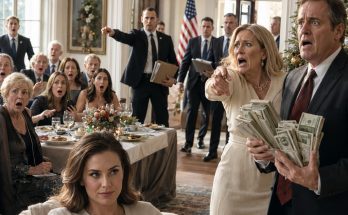
“Your Sister Earned A Car. You’ve Earned Nothing. You Never Do,” Dad Said, Tossing My Sister The Keys At Dinner. Fifteen Relatives Clapped. I Set My Fork Down, Calm. Then The Doorbell Rang. A Man In A Suit Stepped In, Looked Around, And Asked: “Which One Of You Is The Father?”
### Part 1
“You’ve earned nothing, Claire. You never do.”
My father said it across his Fourth of July dinner table while fifteen relatives watched.
A few seconds earlier, he’d tossed my younger sister, Lauren, the keys to a brand-new car.
Everyone clapped.
My mother smiled so hard you’d have thought she’d won the car herself.
Lauren squeezed the keys against her chest and laughed. “Maybe next year, Claire.”
More laughter.
I didn’t defend myself.
I didn’t remind them I’d put myself through nursing school working nights in a diner, or that I’d spent the last decade as a pediatric nurse at Milbrook General, or that I hadn’t taken a dollar from my parents since I was nineteen.
I simply set my fork beside my plate.
Because I knew something they didn’t.
A man was already coming up that driveway.
And eight months earlier, I’d discovered why.
In my family, love worked like payroll.
My father, Graham Mercer, kept the books.
He had rules for everything: work, money, gratitude, toughness. His favorite rule was that nobody deserved anything they hadn’t earned.
He’d repeated it my entire childhood.
When I got straight A’s but questioned him at dinner, I was disrespectful.
When Lauren brought home average grades but hugged him and called him the smartest man she knew, she was “a good kid.”
Lauren was five years younger than me and learned early that life around Graham Mercer became easier if you smiled, agreed, and never asked him to explain himself.
I was terrible at that.
I remembered contradictions.
I noticed when numbers changed.
I asked why.
By thirty-four, I had finally built a quiet life forty minutes from my parents’ house. Small apartment. Used Honda. A hospital job I loved. A few close friends.
My father respected none of it.
To him, renting meant failure. Nursing meant “playing with other people’s kids.” Independence only counted if he could take credit for it.
There was one story he respected above all others: his own.
Every holiday, he told the same legend.
He’d been twenty-three in 1991, broke, working two jobs, when he made “one smart move.”
Sometimes he called it an investment.
Sometimes a business opportunity.
Sometimes he’d simply tap his chest and say, “I bet on myself.”
Whatever version he chose, the ending was always the same.
That move created the money that eventually paid for the house on Larks Lane, Lauren’s private school, vacations, boats, and the comfortable life my parents still lived.
There was even a photograph in the hallway.
My father at twenty-three, standing outside a low brick building with a duffel bag slung over one shoulder.
He was grinning like he’d just beaten the world.
“The day my luck changed,” he’d say, tapping the glass.
I must have passed that photograph ten thousand times.
I never once cared what building stood behind him.
Until last November.
The reason I ordered a DNA test wasn’t family drama.
It was a four-year-old patient.
He’d been admitted with a genetic clotting disorder his parents hadn’t known existed in either family. His mother sat beside his bed, crying into her sleeve, and said something that followed me home.
“We had no idea it was in us.”
I’m a nurse.
I understood how much family history mattered.
Unfortunately, my father’s medical history was a locked door.
Whenever a doctor asked about grandparents, inherited conditions, or early deaths, Graham waved it off.
“Mercers don’t get sick.”
That was practically another family motto.
So I ordered one of those home DNA kits.
I told myself I was being practical.
I mailed the tube away and forgot about it.
Weeks later, the results arrived.
The health information was boring.
Then I opened the relatives tab.
And stopped breathing.
The website said I had seventeen half siblings.
Not distant cousins.
Not vague matches.
Half siblings.
People who shared one biological parent with me.
I stared at the screen until my coffee went cold.
My parents had been married longer than I’d been alive.
There were supposed to be two Mercer daughters.
Lauren and me.
That was the family.
That was the entire story.
Seventeen half siblings meant someone had lived a life nobody had told me about.
I shut the laptop.
For one night, I convinced myself the company had made a mistake.
The next morning, I checked again.
There were nineteen.
By the end of the week, twenty-two.
And strangers were beginning to message me.
“Hi. I think we might be related.”
One of them attached a photograph.
I stared at her face.
She had my eyes.
Not similar eyes.
My eyes.
That afternoon, I created a spreadsheet and began recording everything I could learn.
Names.
Ages.
Birthplaces.
Dates of birth.
I told no one.
Because in the Mercer family, bringing bad news never made you helpful.
It made you the problem.
By Christmas, twenty-nine strangers were sitting inside that spreadsheet.
And almost all of them had been born within the same strange five-year window.
The same years my father claimed he’d gone from broke to comfortable.
That Christmas, while Graham told his famous 1991 story again, I stood in the hallway and finally looked closely at the old photograph.
The brick building behind him suddenly mattered.
I took out my phone and photographed the photograph.
I couldn’t make out the faded sign.
But three weeks later, a woman I’d never met would tell me exactly what that building was.
And once she did, my father’s entire life would begin coming apart.
### Part 2
Her name was Mara Bennett.
She was thirty-five, worked as a NICU nurse in Cleveland, and had been researching our strange cluster of relatives for nearly two years.
Her first message to me was short.
“We don’t share a mother. I’ve ruled that out for almost everyone. We share a father.”
I called her during my break and stood in the hospital stairwell while she explained.
Mara had mapped birthdays and birthplaces.
Nearly all of our matches had been born within roughly a hundred miles of Columbus.
Most between 1991 and 1996.
Then she asked me a question so strange I laughed.
“Do you know where you were conceived?”
“No.”
“Do you know whether your parents ever used a fertility clinic?”
I stopped laughing.
“My parents were married. My dad has always acted like—”
I didn’t finish.
Like his blood was royal.
Like fathering two daughters was proof of some superior masculinity.
Mara spoke carefully.
Several of our half siblings had old medical paperwork showing their mothers had received fertility treatment at the same place.
Brightwater Fertility Center in Columbus.
It had closed years ago.
Recently, however, former patients and donor-conceived adults had filed lawsuits alleging that Brightwater’s founder, Dr. Conrad Bell, had repeatedly misrepresented donor material and reused some donors far beyond anything families had agreed to.
Mara didn’t claim we had our answer.
She just said, “Look up Brightwater.”
I did.
That night, I sat at my kitchen table scrolling through old articles.
The first few made my stomach tighten.
The fourth made the room disappear.
There was a photograph of Brightwater.
Low red brick.
Flat overhang.
Narrow front doors.
I grabbed my phone.
Opened the picture I’d taken at Christmas.
My father at twenty-three.
Duffel bag.
Huge grin.
Same building.
I enlarged both images until the pixels blurred.
There was no mistake.
The place Graham Mercer had spent thirty years calling the site of his “lucky investment” was Brightwater Fertility Center.
For several minutes, I sat perfectly still.
Then the nurse in me took over.
A building was not proof.
A coincidence wasn’t a diagnosis.
I needed something stronger.
Mara arranged comparisons among several members of the group. The genetics were complicated, but the result wasn’t.
We were half siblings.
And the paternal line tied directly back to the Mercer family.
My father wasn’t simply connected to Brightwater.
He was the donor.
The realization landed differently than I expected.
I didn’t immediately feel angry.
I felt ridiculous.
For years, Graham had preached about blood.
About family.
About earning.
And somewhere in his twenties, he’d helped create dozens of children, taken money, gone home, and eventually raised two daughters as if the others had never existed.
Me and Lauren.
The two he kept.
And somehow I was still the one who hadn’t earned my place.
Mara introduced me to more siblings.
Reed Nolan, a football coach in Indiana, had my exact jaw.
Dana Price, a pharmacist, laughed with her whole shoulders the same way I did.
Cole Harris had spent eleven years looking for his biological father.
When four of us finally met at a roadside diner in March, I expected grief.
Instead, something stranger happened.
I relaxed.
Nobody competed.
Nobody measured accomplishments.
Nobody asked what I’d earned.
Reed drummed his fingers on the table exactly the way I did when nervous.
Dana kept pushing fries toward everyone like feeding people was a reflex.
When I finally said, “I think I know who our biological father is. He raised me,” they all went quiet.
I told them about Graham.
The money sermons.
Lauren.
The constant comparison.
Being called ungrateful.
Being told I was difficult to love.
Dana reached across the table and put her hand over mine.
“He kept you,” she said softly, “and still treated you like that?”
Seven words.
They broke something open in me.
I’d spent thirty-four years assuming I was defective.
These strangers needed one afternoon to see the obvious.
The meeting might have ended almost peacefully if Mara hadn’t slid a medical letter across the table.
“There’s something else.”
Her expression changed.
Three siblings had recently been diagnosed with the same inherited heart condition.
Others had suspicious family histories.
The doctors involved believed it came from our shared biological father’s line.
“Every one of us needs screening,” Mara said. “And so do any children he raised.”
My eyes dropped to one name in my head.
Lauren.
For the first time, Graham’s secret wasn’t about pride.
It wasn’t even about money.
It was about whether people lived long enough to discover why they had been lied to.
And only a few of us knew where the danger came from.
### Part 3
I got screened first.
The cardiologist’s office smelled faintly of disinfectant and burnt coffee. A young technician moved a probe across my chest while a gray image of my heart pulsed on the monitor.
I watched every beat.
Afterward, I waited days for the official interpretation.
No visible cardiomyopathy.
Not then.
The doctor warned me that inherited conditions could surface later and recommended regular monitoring.
I should have felt relieved.
Instead, I thought about Lauren.
A genetic risk doesn’t care which child was favored.
Before I could convince my sister to get tested, the group lost someone.
Her name was Hannah Brooks.
She was thirty-five, a schoolteacher in Missouri, and usually quiet in our message thread. Every weekend she posted pictures of her twin boys playing baseball.
One Wednesday, she collapsed between classes.
She died before reaching the hospital.
Same inherited heart condition.
Our group went silent.
Then the pictures started appearing.
Hannah laughing in the sun.
Hannah holding two birthday cakes.
Hannah beside her boys in matching baseball caps.
I cried for a woman I’d never met.
After Hannah, our attorney changed the way he spoke about the case.
Martin Vale represented several donor-conceived families suing over Brightwater’s practices. Before Hannah’s death, most legal conversations centered on records, accountability, damages, and the clinic’s former operators.
Afterward, Martin used one phrase repeatedly.
Medical advisory.
“We cannot let identified relatives dismiss this as internet gossip,” he told us. “The warning needs to be documented.”
The group kept growing.
Thirty-six.
Forty-eight.
Sixty-one.
Then Brightwater’s old records began surfacing through discovery.
That’s when the money came into focus.
One evening, Mara called me.
“I found something.”
In the mid-1990s, as complaints against Brightwater began appearing, several highly used donors had been paid substantial sums in exchange for confidentiality agreements.
The records used donor codes instead of names.
But some codes had already been linked through old patient files and DNA results.
One of those codes belonged to our biological father.
Graham.
The payment had been made in 1996.
The year my parents suddenly paid off the house on Larks Lane.
The amount was almost identical to the number Graham had repeated for decades whenever relatives asked how much he’d made from his mysterious “investment.”
I sat on my kitchen floor staring at the scanned ledger.
So that was the miracle.
Not stocks.
Not a business.
Not grit.
My father’s fortune began with money from a fertility clinic that had used his genetic material again and again, then paid him to stay quiet.
I could have driven straight to Larks Lane.
I imagined dropping the ledger onto his table.
I imagined watching his face.
But I knew my family too well.
If I arrived screaming with evidence, Graham would make the evidence secondary.
The real story would become Claire’s attack.
Claire’s jealousy.
Claire’s instability.
In my family, the messenger always went on trial before the message.
So I went to my mother.
Elaine Mercer was trimming green beans at the kitchen sink when I asked.
“Mom, before I was born, when you and Dad were struggling financially, did he ever make money from something medical?”
Her hands stopped.
That was all.
No dramatic gasp.
No dropped bowl.
Just stillness.
It was the same stillness I used at work whenever panic tried to outrun training.
I had always assumed I learned it professionally.
Apparently, I’d learned it at home.
“Why would you ask that?” she said.
I kept my voice casual.
“A study. Donation. Something like that.”
She set the beans down.
Then she turned toward me.
Fear had replaced every familiar expression on her face.
“Whatever you think you’ve found,” she whispered, “you put it away.”
My stomach dropped.
“Mom.”
“You put it away, Claire. You do not bring this into this house.”
She knew.
There wasn’t even room left to pretend otherwise.
My mother had known while Graham told his story year after year.
She’d known when he bragged about his blood.
She’d known when he used money as proof that he was better than everyone who hadn’t accumulated as much.
She’d helped guard the lie because the lie paid the mortgage.
“They could be sick,” I said. “Some of his children already are.”
Her face hardened.
“There are no children.”
“There are dozens.”
“If you drag your father’s name through the mud over some website, don’t expect to have a family afterward.”
That sentence hurt more than anything Graham had said to me.
Because I’d spent my childhood believing my mother was quietly on my side.
I finally understood the truth.
Elaine had never been protecting me from him.
She had been protecting him from me.
I left without finishing the beans.
The next person I had to warn was Lauren.
And unlike my mother, she had absolutely no idea what was hiding inside our family.
### Part 4
Lauren agreed to lunch because she thought I wanted to hear about the Cabo vacation Dad was paying for.
She spent fifteen minutes showing me resort photos.
Finally, I interrupted.
“I need you to get your heart checked.”
Her fork stopped halfway to her mouth.
“My heart?”
“There’s an inherited condition on Dad’s side.”
She frowned.
“Dad’s side?”
“Yes.”
She laughed.
Not because it was funny.
Because Graham had trained both of us to laugh at facts that threatened his version of reality.
“Dad is the healthiest man I’ve ever met.”
“That doesn’t mean anything genetically.”
She leaned back.
“There it is.”
“What?”
“You always need something to be wrong.”
I felt the old ache.
She looked so much like him in that moment.
“You can’t just let this family be happy, Claire.”
“I’m asking you for one scan.”
“I’ll ask Dad.”
My stomach tightened.
“Lauren, please don’t make this about him.”
“Why wouldn’t I? It’s his family history.”
Two days later, Graham called me.
He didn’t say hello.
“What are you telling your sister?”
“That she needs a heart screening.”
“You’re telling people this family is diseased.”
“I’m telling one person there is a real inherited condition.”
He laughed.
“You know what this is? Jealousy.”
I leaned against a supply cabinet at the hospital.
There was his favorite trick.
If he couldn’t defeat the fact, he indicted the person saying it.
“Lauren has everything you wanted,” he continued. “So now you’ve invented some sickness to frighten her.”
“I’ve seen medical documentation.”
“You play nurse all day and think that makes you an expert on this family.”
“I am a nurse.”
“You rent an apartment and babysit other people’s children. You’ve earned nothing, Claire. You never do.”
Even through the phone, I could hear how satisfied he was with the sentence.
He believed it ended arguments.
For thirty-four years, it usually had.
Not anymore.
“I’m trying to keep Lauren alive.”
“Stay away from your sister.”
“Dad—”
“Stay away from all of us until you learn to act normal.”
He hung up.
I stared at my phone.
I’d just been exiled from my own family.
And strangely, it didn’t destroy me.
Because the truth no longer depended on whether Graham allowed me through his front door.
The truth had lawyers now.
Records.
DNA.
Doctors.
A dead schoolteacher.
It didn’t need his permission.
Eventually, Mara persuaded Lauren to get screened.
Not as my newly discovered half sister.
Not at first.
She contacted Lauren as a nurse participating in a study of inherited cardiac risk.
No accusations.
No family history lecture.
Just a calm suggestion that the test was free, simple, and worth doing.
Lauren booked it.
The result came back abnormal.
When she called me, her voice was so small I almost didn’t recognize it.
“They found something.”
Every argument between us vanished from my mind.
“What did they say?”
“They want more tests. They said it might be genetic.”
I closed my eyes.
“Okay. That’s good.”
“Good?”
“We found it early. Early matters. I’ll help you.”
There was a pause.
Then she whispered, “Where did it come from?”
Before I could answer, I heard my mother in the background.
“Is that Claire?”
The call ended.
I drove to Larks Lane that evening.
My mother met me outside before I could knock.
“Leave.”
“Lauren’s test is abnormal.”
“She’s seeing a doctor.”
“She needs someone who understands what this could be.”
“She doesn’t need your internet friends.”
The front door opened.
My father stepped onto the porch.
“Get off my property.”
The porch light buzzed over us. Moths kept tapping themselves against the glass.
I looked beyond him through the open door.
The old framed photograph hung in the hallway.
Twenty-three-year-old Graham.
Duffel bag.
Brightwater behind him.
“Lauren needs follow-up care,” I said.
“Lauren needs you to stop poisoning everything.”
“So she doesn’t die young like your—”
I stopped.
Your other children.
The words nearly escaped.
Graham stepped closer.
“Like my what?”
I swallowed.
Not here.
Not like this.
“You don’t have a point,” he said. “You’ve had a grudge since childhood because your sister was easy to love and you were work.”
My mother stared at the floor.
Graham kept going.
“Lauren is grateful. You’re not. That’s the difference. You’ve earned nothing, Claire. You never do.”
I looked at him.
For the first time, I felt no fear.
None.
He saw it too.
Something shifted in his face.
He was accustomed to hurting me with that sentence.
He didn’t know what to do when it failed.
“Get Lauren the follow-up tests,” I said.
Then I looked at my mother.
“The rest will find you without my help.”
Her face went pale.
Graham thought it was a threat.
My mother knew it wasn’t.
### Part 5
By early summer, our group had reached seventy-nine confirmed half siblings.
Seventy-nine.
People in Oregon.
Georgia.
Indiana.
Missouri.
Ohio.
A nineteen-year-old who had taken a DNA test as a birthday gift.
Twins who had always wondered why they looked nothing like their father.
A mechanic.
Two teachers.
Several nurses.
A veterinarian.
Parents.
Grandparents.
People who’d spent decades thinking they came from one story and discovered, with a small plastic tube, that they came from another.
Some wanted damages.
Some wanted Brightwater’s records made public.
Mara cared most about medical screening.
Cole still wanted only one thing.
He wanted to meet our father.
“I just want him to know I exist,” he told me.
That hurt in a way I couldn’t explain.
Because I knew the man Cole imagined.
A young donor who probably never knew what the clinic had done.
A man who might be shocked, remorseful, curious.
Maybe even grateful to discover his children.
I knew the real man.
Graham had raised two of us.
And love still hadn’t become natural to him.
Eventually, Lauren had follow-up testing, but my father found a specialist who minimized the danger.
That was all Lauren needed to hear.
When she invited me to the Fourth of July gathering, she sounded almost cheerful.
“Dad found a really good doctor. He thinks everyone overreacted.”
My stomach sank.
“Did he tell you to stop monitoring it?”
“Not exactly.”
“Lauren.”
“Dad says those lawsuit people scare patients because that’s how lawyers make money.”
There it was.
Graham had taken the one useful thing I’d done for Lauren and rewritten it.
He was now the hero protecting her from my hysteria.
For one night, I considered walking away from all of them.
Keep Mara.
Keep Reed and Dana and Cole.
Keep the strange new family that didn’t measure my worth.
Let Graham die inside his own legend.
Then attorney Martin Vale called.
The health cases had changed the court’s urgency.
Formal medical notifications were being delivered directly to identified biological fathers, along with documentation of the Brightwater claims.
Graham was scheduled to receive his notice during the holiday week, when he was expected to be at home.
Martin didn’t ask me to attend.
He simply warned me.
“The truth doesn’t need you to carry it alone anymore,” he said.
That sentence decided it.
I wouldn’t expose my father.
But I wouldn’t hide from his exposure either.
So when Lauren asked again if I was coming to dinner, I said yes.
I bought a pie.
I put on a blue dress.
And I drove to Larks Lane.
The new car was already in the driveway.
Bright white.
Red bow across the hood.
Of course.
Graham never gave anything privately.
Generosity only counted if there were witnesses.
Inside, fifteen relatives were eating, drinking, and talking loudly.
My mother opened the door.
She looked at my pie as if I’d brought explosives.
“You’re here.”
“I’m here.”
“Then behave.”
Walking into that room felt like walking into a courtroom after the verdict had already been read.
Faces turned.
Smiles tightened.
My aunt Patricia hugged me carefully.
My uncle Warren barely acknowledged me.
A teenager whispered something.
I knew the story my parents had spread.
Claire had become obsessed.
Claire had frightened Lauren.
Claire was jealous.
Claire wasn’t doing well.
I found Lauren in the kitchen.
She hugged me quickly.
“You look good,” I said.
She smiled.
“Dad’s in a great mood.”
That wasn’t reassuring.
Graham stood near the mantle telling his 1991 story.
Same gestures.
Same pauses.
Same triumphant ending.
I slipped into the hallway.
There was the picture.
I stared at young Graham outside Brightwater.
For the first time, I didn’t hate the boy in the photograph.
I felt sorry for him.
Somebody had apparently convinced him he was nothing long before he began saying it to me.
But pity isn’t forgiveness.
And understanding the source of cruelty doesn’t obligate you to keep accepting it.
Dinner began.
I was seated near the far end.
Graham sat at the head.
Elaine on one side.
Lauren on the other.
The golden evening light filled the dining room.
Plates passed.
Glasses clinked.
Then my father tapped his ring against his glass.
Everyone quieted.
“I’ve got something special before dessert.”
He reached into his pocket.
And held up the keys to the car outside.
I set down my fork.
The performance I’d been invited to witness had begun.
### Part 6
Graham smiled at Lauren.
“I believe in rewarding people who handle life the right way.”
Several relatives nodded.
“Lauren got some frightening health news recently. But she didn’t panic. She trusted her family. She went to the right doctors.”
His hand landed proudly on her shoulder.
“And she didn’t turn it into drama.”
A few people looked toward me.
There was the knife.
He simply wrapped it in wrapping paper first.
“So this is for the daughter who does things right.”
He tossed Lauren the keys.
She caught them and squealed.
The room erupted.
Applause.
Whistling.
My mother’s face glowed.
Lauren stared through the window toward the car.
Then Graham turned toward me.
The applause faded.
“Claire.”
I met his eyes.
“I’m not going to pretend this has been an easy year.”
His voice became sorrowful.
Performative.
“You’ve said ugly things about this family. You’ve frightened your sister. You’ve embarrassed your mother and me.”
My aunt stared at her plate.
“I keep waiting for you to earn your place here.”
He paused.
“You’ve earned nothing, Claire. You never do.”
Several relatives clapped.
Actually clapped.
Then Lauren laughed nervously and lifted the keys.
“Maybe next year.”
Everyone laughed.
That was the lowest moment.
Not discovering the siblings.
Not learning my mother had known.
That table.
My own blood applauding while my father reduced my entire life to nothing.
For a few seconds, every old instinct came back.
Maybe I really was impossible.
Maybe I should leave.
Maybe truth didn’t matter if nobody wanted it.
Then I remembered Hannah’s twin boys.
Mara.
Cole.
Seventy-nine names.
And the fact that somewhere outside, a car was approaching a house built on hush money.
I picked up my water.
Took one sip.
Waited.
The doorbell rang.
My father smiled and stood.
“Probably a neighbor.”
He walked through the hallway beneath the framed photograph and opened the door.
A moment later, a man in a pressed gray suit entered the dining room carrying a thick folder.
He introduced himself as Martin Vale.
Then he looked around the table.
“I’m sorry to interrupt. I’m here concerning a paternity matter.”
Nobody spoke.
Martin opened the folder.
“I need to identify which gentleman here is the biological father involved.”
My father laughed.
He actually laughed.
Then he raised his hand.
“That would probably be me. I’ve only got the two daughters.”
He motioned toward Lauren and me.
A few relatives chuckled.
Martin didn’t.
The laughter died.
“Mr. Mercer, I don’t believe you understand.”
He placed one document on the table.
“I represent a group of donor-conceived adults linked to Brightwater Fertility Center in Columbus.”
My mother’s hand gripped the tablecloth.
My father stopped smiling.
Martin continued.
“Seventy-nine individuals have currently been genetically connected to a single biological father.”
Graham stared at him.
“Our documentary evidence and DNA findings identify that father as you.”
The room became so quiet I heard the refrigerator humming in the kitchen.
Graham’s eyes snapped toward me.
“This is her.”
He pointed.
“My daughter has been making sick accusations for months. She hired you.”
Martin remained calm.
“I was not brought here by your daughter.”
“Then this is a scam.”
“It isn’t.”
Martin began laying pages on the table.
Brightwater records.
Donor codes.
Old photographs.
DNA relationship charts.
Then came photographs of the siblings.
Dozens of faces.
My face repeated through strangers.
My father’s jaw.
His eyes.
His smile.
Aunt Patricia leaned closer.
“Oh my God.”
Uncle Warren stared at one photograph, then at Graham.
“How many?”
“Seventy-nine identified so far.”
My father’s chair scraped backward.
“No.”
Then Martin turned another page.
“There is also documentation of a confidentiality payment issued in 1996 to a highly used donor associated with these records.”
Uncle Warren whispered the amount before Martin said anything more.
He remembered it.
It was the same figure Graham had claimed for decades was the profit from his famous investment.
Warren looked around the dining room.
At the hardwood floors.
At Lauren’s keys.
At the windows overlooking the driveway.
“The house,” he said.
My father said nothing.
His whole legend collapsed inside one unfinished sentence.
But Martin still had one document left.
And unlike the money, this one terrified me.
“There is also an urgent medical advisory.”
Lauren stopped smiling.
Martin looked directly at her.
“Several biological children in this group have developed an inherited cardiomyopathy.”
The keys slipped slightly in Lauren’s hand.
“It is believed to come from the paternal line. Every biological child should receive appropriate screening and ongoing medical follow-up.”
Lauren’s face emptied.
She turned toward Graham.
“You told me it was nothing.”
He looked away.
And suddenly the new car keys in her hand seemed less like a gift than evidence.
### Part 7
Aunt Patricia was the one who looked at my mother.
“Elaine.”
My mother didn’t answer.
Patricia’s voice lowered.
“Did you know?”
Everyone turned.
Elaine opened her mouth.
Nothing came out.
She looked at Graham.
Then Lauren.
Then me.
Her silence told the story.
Uncle Warren pushed back from the table.
“You knew?”
Still nothing.
“For decades?”
Graham finally found his voice.
“Everybody needs to leave.”
Martin remained beside the wall.
My father pointed toward the door.
“Get out of my house.”
Then he pointed at me.
Except this time, his finger shook.
“You did this.”
I stayed seated.
“You brought this here. You’ve wanted to destroy this family since you were a child.”
He was shouting now.
My father almost never shouted.
His power had always come from being quieter than everyone else.
Watching him lose that control was more revealing than any document.
“Are you happy?” he demanded. “Look what you’ve done.”
I stood.
Slowly.
“I didn’t bring him.”
“Don’t lie to me.”
“He would’ve come whether I was sitting here or working in Milbrook.”
His chest rose and fell.
I kept my voice level.
“All I did was stop protecting your story.”
“You ungrateful—”
“You called me nothing tonight.”
Nobody moved.
“You’ve called me that my whole life.”
I looked around the table.
“The house. The schools. The vacations. The car outside. Dad told all of us those things came from discipline and hard work.”
Graham’s face darkened.
I looked back at him.
“They came from Brightwater paying him to stay quiet.”
His arm struck his wineglass as he turned.
It fell and shattered.
Red wine spread across the hardwood.
Nobody cleaned it.
My father looked around for support.
For thirty-four years, somebody had always supplied it.
Elaine.
Lauren.
An uncle.
A cousin.
Anyone.
This time, nobody did.
Uncle Warren grabbed his jacket.
Aunt Patricia took her purse.
Then another relative stood.
Then another.
No screaming.
No dramatic speeches.
They simply left.
It was worse than anger.
My father had spent his entire adult life building an audience for his legend.
Now the audience was walking out of the house purchased by that legend.
When the front door finally closed, Graham sank into his chair.
“It was a long time ago.”
Nobody answered.
“I was broke.”
Lauren was crying.
“It was a long time ago,” he repeated.
As if age erased consequences.
As if seventy-nine people disappeared because the decision had been made decades earlier.
Lauren placed the car keys on the table.
She stared at them for several seconds.
Then pushed them away.
“You tried to tell me,” she said to me.
I crossed the room.
“I should’ve listened.”
“We’ll deal with that later.”
“My heart.”
Her voice cracked.
“It’s real?”
“Yes.”
She covered her mouth.
“And he knew I had an abnormal scan.”
I nodded.
“He knew and bought me a car.”
I put my arms around her.
For the first time since we were children, Lauren didn’t stiffen when I touched her.
She folded into me.
“We caught it early,” I whispered. “That’s what matters now.”
Behind us, Graham spoke.
“My father called me nothing.”
I looked over Lauren’s shoulder.
Graham stared toward the hallway photograph.
“Every day. Nothing. He told me I’d always be nothing.”
His voice broke.
For one brief second, I saw the child inside him.
The boy who had apparently learned that love was something you won by proving your value.
“When Brightwater offered money,” he continued, “I took it. It cost me nothing. I built this.”
He gestured around the room.
“So I would never be nothing again.”
Something inside me softened.
Then Graham looked at me.
“So don’t you stand there judging me.”
The softness vanished.
“I gave you a life. I gave Lauren a life. Those other people weren’t owed anything from me.”
There he was.
Not wounded little Graham.
Not misunderstood Graham.
The man he’d chosen to become.
My sympathy went cold.
Martin Vale quietly placed his business card beside the abandoned car keys.
“The medical issue is urgent,” he said. “The rest will proceed through legal channels.”
My mother finally asked, “What happens to us now?”
I picked up my purse.
“Lauren gets real medical care.”
I looked at the folder.
“The seventy-nine people get the truth.”
Then I looked at my parents.
“And you two figure out who you are without the lie.”
My mother stared at me.
I opened the door.
“That isn’t my job anymore.”
And for the first time in my life, I walked out of my father’s house without wondering whether he’d ever invite me back.
### Part 8
Lauren saw the right cardiologist the following week.
The changes in her heart were early.
Manageable.
She needed monitoring, treatment, and long-term follow-up, but the doctor told her there was every reason to believe she could live a long life.
I sat beside her when she heard that.
She cried.
So did I.
Mara drove down for one of Lauren’s later appointments.
My sister had spent months treating Mara as one of my suspicious “internet people.”
Within an hour, they were drinking terrible hospital coffee and comparing our father’s mannerisms with the rest of the sibling group.
The family kept growing.
Seventy-nine became eighty-three.
Every new person entered the group the same way.
Confused.
Angry.
Sometimes devastated.
And every time, dozens of people answered.
“We believe you.”
“You’re not alone.”
“Here are the doctors.”
“Here are the records.”
Nobody asked what they’d earned first.
Cole eventually decided he didn’t want to meet Graham.
“I thought I wanted a father,” he told me. “I think I really wanted a family.”
He found one.
So did I.
The Brightwater case moved forward.
The money Graham had spent decades calling proof of his superiority became part of the legal claims against him and others connected to the old agreements.
The boat disappeared first.
Then other assets.
Eventually even the car with the red bow was sold.
I felt nothing about it.
My mother left Larks Lane for a while and stayed with Aunt Patricia.
Weeks later, Elaine called me.
She didn’t apologize.
Some people are so practiced at defending themselves that apology feels like stepping off a cliff.
But she asked about Lauren’s heart.
For once, it was a real question.
I answered honestly.
Then I hung up.
I didn’t punish her.
I didn’t comfort her either.
Those are different things.
Forgiveness wasn’t something she was entitled to simply because the lie had finally become painful for her.
Lauren and I rebuilt our relationship slowly.
She apologized more than once for the dinner.
For laughing.
For choosing Graham’s approval over me.
I accepted the apology.
But I didn’t pretend our childhood vanished.
She understood.
That was what made rebuilding possible.
Our father didn’t understand any of it.
Near the end of summer, he called.
“You need to stop the lawyers.”
No hello.
Of course.
“This is going to take everything, Claire. The house. Everything.”
“I can’t stop it.”
“You can tell them you were wrong.”
“I wasn’t.”
His breathing changed.
“Those people are strangers.”
“No. They’re your biological children.”
“They’re strangers to me.”
“That’s because you chose for them to be.”
Then he used the one weapon he had left.
“You’re my daughter.”
I almost laughed.
“I was your daughter at every Christmas dinner too.”
Silence.
“I was your daughter when you told me I’d never amount to anything. I was your daughter when you called my career a joke. I was your daughter when I warned Lauren and you turned it into proof that I was unstable.”
“Claire—”
“You don’t get to remember I’m your daughter only because you need me to save your house.”
He said nothing.
I could feel thirty-four years pulling at me.
Fix it.
Calm him down.
Earn your place.
I let the feeling pass.
“The heart condition is real,” I said. “Get screened. That’s the only thing I’m asking you to do.”
Then came his old sentence.
Quieter this time.
Almost tired.
“You’ve earned nothing, Claire. You never do.”
And something extraordinary happened.
I smiled.
Not because I’d won.
Because the sentence had finally become meaningless.
“You’re right,” I said. “By your math, I never will.”
He was silent.
“But your math was broken before I was born.”
I hung up.
No reconciliation followed.
No late apology.
No dramatic doorstep scene where Graham suddenly became the father I had needed.
Real people don’t always become better just because the consequences finally arrive.
Sometimes consequences only reveal them more clearly.
I stopped waiting.
That was my ending with him.
Not hatred.
Not forgiveness.
Distance.
My holidays changed.
I started driving to Cleveland instead of Larks Lane.
Mara’s dining room has a long table too.
The first Thanksgiving I spent there, Reed burned the rolls. Dana brought two desserts because she couldn’t decide. Cole argued about football with someone he’d known less than a year but already called his brother.
Lauren came with me.
At one point, I looked around that table.
People with my jaw.
My hands.
My father’s eyes.
Nobody sitting at the head.
Nobody ranking us.
Nobody handing out rewards for obedience.
Nobody asking who deserved a seat.
I thought about that Fourth of July.
The golden light.
The new car keys.
Fifteen people applauding.
My father telling me I had earned nothing.
Then the doorbell.
The gray suit.
The folder.
“Which one is the biological father?”
And Graham laughing before raising his hand.
He shouldn’t have.
Not because Martin Vale destroyed him.
Not because I did.
The truth destroyed the only thing my father had ever truly protected: the story that he was better than everyone else.
I spent most of my life thinking I was the failure in that story.
I wasn’t.
I was simply the daughter who kept noticing the numbers didn’t add up.
Graham taught me love had to be earned.
Elaine taught me peace meant protecting the person powerful enough to ruin it.
Lauren taught me how easily a favored child can mistake privilege for goodness.
And eighty-three strangers taught me something none of them had managed to teach me.
Family doesn’t begin with what someone owes you.
It begins with what you’re willing to give without keeping score.
The old photograph eventually disappeared from the hallway at Larks Lane.
I don’t know who removed it.
I don’t know where Graham put it.
I don’t care.
The man in that picture spent his entire life trying to prove he had stopped being nothing.
He built a house.
Bought respect.
Controlled a family.
Turned secrecy into money and money into morality.
And still ended up alone at the head of a table surrounded by everything he’d bought and nobody willing to believe him.
As for me, I still rent.
I still drive a used car.
I still work the pediatric floor.
I still sit beside frightened parents and tell them what the next test means.
My life didn’t suddenly become glamorous.
It became mine.
That mattered more.
I set my fork down that Fourth of July because I knew someone was coming up the driveway.
What I didn’t know was that after spending thirty-four years trying to earn a place in Graham Mercer’s family, I was finally about to learn I didn’t want one.
I already had a place.
I had built it quietly.
In hospital rooms.
In my little apartment.
In the lives of children I’d cared for.
In seventy-nine strangers who became eighty-three siblings.
In the sister who finally learned that being favored wasn’t the same thing as being loved.
And most importantly, inside myself.
My father had been wrong about one thing and right about another.
I had earned nothing from him.
No love.
No approval.
No inheritance.
No apology.
And eventually, I stopped wanting any of it.
Because love that arrives only after obedience isn’t love.
Respect that depends on silence isn’t respect.
And a family seat you have to purchase with pieces of yourself isn’t a seat worth keeping.
The last time Graham called me nothing, the word didn’t hurt.
It sounded small.
It sounded tired.
It sounded like something spoken by a man who had finally lost the power to define me.
And that was the moment I understood the truth I’d been searching for long before I ever mailed that DNA test.
I had never been nothing.
I had simply spent too many years asking the wrong person to tell me what I was.
THE END!