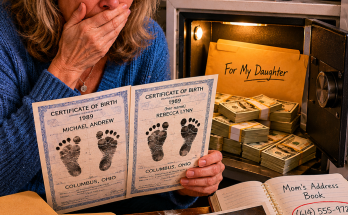
I discovered twin newborn girls abandoned inside a deserted beach changing stall, each wrapped in a faded towel embroidered with tiny blue sailboats.
I eventually adopted them and raised them as my daughters.
But on the night they turned eighteen, they placed those same towels on our kitchen table and whispered:
“Dad… there’s something we need to show you.”
Eighteen years earlier, I had lost my pregnant fiancée, Katherine.
Everyone called her Kate.
She was carrying our first child, a baby girl we had already named Claire.
Thirty-six weeks along.
The nursery was finished.
We had painted it a soft buttercup yellow.
The crib was assembled.
Tiny dresses hung in the closet.
A plush elephant sat on the shelf, exactly where Kate had placed it with her own hands.
Then, one terrible night, everything ended.
Complications during delivery.
I lost both of them.
The funeral was a blur.
I remember standing by the grave, clutching Kate’s favorite scarf.
I remember the pastor’s words, the cold wind, the hollow sound of dirt hitting the casket.
I remember going home to an empty house that smelled like her perfume.
After the funeral, I stood in that nursery alone.
The silence was louder than any scream I had ever heard.
I touched the empty crib.
I traced the carved letters spelling Claire above it.
I smelled the baby powder still in the air.
I did not eat.
I did not sleep.
I stopped answering phone calls.
Days turned into weeks.
My best friend, Mike, finally showed up at my front door.
He didn’t knock.
He just walked in, looked at me in my unwashed clothes, and shook his head.
“David,” he said quietly, “I’m not leaving you here like this.”
I didn’t argue.
I couldn’t.
He pulled a duffel bag from the closet and threw some clothes into it.
Then he grabbed my truck keys from the hook by the door.
“Come on,” he said. “We’re getting out of here.”
He drove me away from our hometown in Ohio, all the way to a small beach town in South Carolina called Palmetto Cove.
We didn’t talk much during the drive.
Mike just let the radio play.
Occasionally, he would point out the window at a pretty stretch of countryside.
He never told me to move on.
He never said time would heal.
He simply walked beside me on the sand.
Late that afternoon, as the sun began sinking over the Atlantic, I wandered toward a row of old wooden changing cubicles near the dunes.
Most of them were barely standing.
The paint was peeling.
The wood was weathered.
And then I heard something.
A faint cry.
A few seconds later, another cry.
It was coming from inside one of the stalls.
My heart lurched.
I pulled back the tattered curtain.
Two newborn baby girls lay close together directly on the sandy wooden floor.
One was wrapped in a white towel.
The other in a pale-pink towel.
Both towels had small blue sailboats stitched along their edges.
There was no adult anywhere.
No diaper bag.
No note.
Just the two of them lying there, completely alone.
“Mike!” I shouted.
He came running and immediately dialed 911.
I knelt down beside the babies, afraid to even touch them.
They were so small.
So fragile.
But one of them stretched out her tiny hand and wrapped her whole fingers around my thumb.
I froze.
I felt something I had not felt in weeks.
A heartbeat inside my own chest that was not just pain.
The police arrived and searched the entire beach, the parking lot, nearby motels, everything.
They checked hospitals and shelters.
They issued alerts.
But no one ever came forward.
No mother.
No father.
No relatives.
It was as if these two little souls had simply appeared from thin air.
At the hospital, they called them Baby A and Baby B.
But in my mind, they were already Evelyn and Charlotte.
Evelyn had a tiny dimple on her left cheek.
Charlotte had a full head of dark hair.
I visited them every single day.
I learned that Evelyn became restless whenever the room grew too quiet.
Charlotte refused to settle unless someone was holding her hand.
I spent hours just sitting beside their bassinets, humming lullabies that Kate used to sing.
The nurses grew accustomed to seeing me.
They brought me coffee.
They let me stay past visiting hours.
One afternoon, a social worker named Mrs. Patterson sat next to me in the corridor.
She had kind eyes and a gentle voice.
A soft, grandmotherly woman.
“Mr. Miller,” she began, “these little ones are medically healthy, but the state has to make decisions.”
I nodded.
She continued, “You know they may eventually be placed in the foster care system.”
My throat tightened.
I nodded again, staring at the floor.
Then she asked something that changed my entire life.
“Have you ever thought about adopting them?”
I looked through the glass window at those tiny faces.
I thought about the nursery at home, still painted yellow, still empty.
I thought about the silence that had nearly swallowed me whole.
I thought about Kate’s smile and how she would have loved them.
Fear was there.
A cold, gripping fear.
Could I do this alone?
Did I deserve this second chance?
And beneath the fear, something else.
Hope.
“Yes,” I heard myself whisper. “I want to.”
The adoption process took months.
Interviews, home inspections, background checks, court hearings.
My finances were tight.
My house needed baby-proofing.
But I fought for those girls.
I painted the nursery a soft lavender because the yellow was too painful.
I bought two cribs instead of one.
I filled the closet with tiny matching outfits.
And eventually, Evelyn and Charlotte legally became my daughters.
Those next eighteen years were the fullest years of my life.
I worked two jobs when money was tight.
I learned to bra