For twenty-two years, I hated my older brother. And God forgive me, I was proud of it.
I told everyone in Millbrook, Ohio that Walter had stolen my inheritance. That he’d pushed me out of our father’s store the moment the old man was in the ground.
I believed it. I built my whole life around believing it.
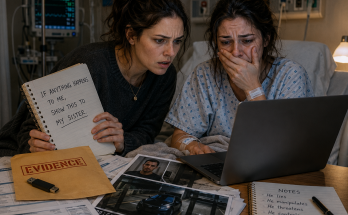
Then, on a cold Tuesday morning last November, I found a shoebox tucked under his hospital bed. And everything I thought I knew about my brother turned to ash in my hands.
Let me start at the beginning.
Our father, Raymond Whitfield, ran Whitfield Hardware on Main Street for thirty-one years. It wasn’t much. A creaky wooden floor, a little bell over the door, the smell of sawdust and machine oil that got into your clothes and never quite left.
But it was ours. Or at least, I always believed half of it was supposed to be mine.
I was the younger son. Walter was six years older. Quiet, serious, the kind of boy who never got into trouble and never let you forget it.
I was the loud one. The dreamer. The one who couldn’t wait to leave Millbrook and never look back.
When Dad’s heart gave out in the spring of 2003, I came home for the funeral expecting we’d split everything down the middle. The store. The house. The savings account.
Instead, our father’s lawyer, an old man named Harold Beckett, slid a single sheet of paper across the table.
Everything went to Walter. The store, the house, the accounts. My name wasn’t mentioned anywhere. Not once.
I remember the room going silent. I remember Walter staring down at his own hands, unable to lift his eyes to meet mine.
“There has to be a mistake,” I said. My voice cracked like a teenager’s.
Walter didn’t argue. He didn’t explain. He just said, quietly, “Dad knew what he was doing, Danny.”
That was the last real conversation I had with my brother for twenty-two years.
I left Millbrook that same week. I told my wife, Carol, that my own blood had thrown me away like trash on the curb.
We moved three hundred miles to Pittsburgh. I took a job at a warehouse, then another, then another.
Every time money got tight, and it got tight often, I’d picture Walter sitting comfortable in that store, counting the money that should have been mine, and my stomach would twist into knots.
We had a daughter, Emily. She was the light of our whole world, born the year after we left.
When Emily was four years old, she got sick. The doctors said her kidneys were failing. They said words we couldn’t understand and numbers we could never afford.
Carol and I nearly lost our minds. We had no savings. No family to lean on. And I certainly was not going to crawl back to Walter with my hat in my hand.
And then, somehow, a miracle arrived in our mailbox. A charity foundation we’d never heard of agreed to cover Emily’s treatments. Every single one of them.
The letters came typed and official, signed with a name I didn’t recognize. “The Beckett Family Trust.”
I cried the day that first letter came. I held it to my chest and told Carol that maybe, finally, God had remembered our little family.
Emily got better. She grew strong. She’s a nurse now, married, with two beautiful children of her own.
And for eighteen years, I never once asked where that money truly came from. I was too grateful. Or maybe I was too afraid to look too closely at a gift that good.
This past October, my phone rang. It was my niece. Walter’s daughter, Sarah, a grown woman now, with a voice so much like her mother’s that it made my chest ache.
“Uncle Danny,” she said. “Dad’s sick. It’s his lungs. The doctors don’t think he has much time left.”
I stood in my kitchen holding that phone, and I’ll tell you the honest, ugly truth. I felt nothing.
“Why are you calling me?” I asked.
She was quiet for a long moment. Then she said, “Because he asks for you every single day. And he has, since the day you left.”
I didn’t want to go. Carol packed my bag anyway.
“Twenty-two years is long enough, Daniel,” she said, folding my shirts with steady hands. “Go make your peace, or you’ll carry this stone in your heart for the rest of your life.”
So I drove back to Millbrook for the first time in two decades.
The town was smaller than I remembered. The hardware store was gone, replaced by a little coffee shop with string lights in the window. That sight hit me harder than I ever expected it to.
Walter was in a county hospital, in a narrow room that smelled of antiseptic and something sweeter underneath. The smell that tells you a body is quietly giving up.
He was so thin. My big brother, the strong and silent one, had become a frail old man with tubes in his nose and skin like tissue paper.
When he saw me in the doorway, his eyes filled with tears. “Danny,” he whispered. “You came. You actually came.”
I stood there with my arms crossed, all my old anger rising up like a tide. “Sarah said you were asking for me.”
“Sit,” he said. “Please. Sit with your brother.”
I sat. But I couldn’t soften. Twenty-two years doesn’t melt away in a single afternoon.
We talked about nothing at first. The weather. My grandkids. His grandkids. Two old strangers circling the thing that had broken us both.
Finally, I couldn’t hold it in any longer. “Why’d you do it, Walter?” I asked. “Why’d you take it all? Was I really such a bad son that Dad cut me out completely?”
He closed his eyes. For a second I thought he’d drifted off to sleep. Then he said, “Look under the bed, Danny. There’s a box.”
I reached down and pulled out an old shoebox, the cardboard gone soft with age, the corners held together with yellowed tape.
Inside were papers. Hundreds of them. Bank statements. Receipts. Letters.
And right on top, a photograph of the two of us as boys, sitting on the front step of the store, both grinning wide and gap-toothed at the camera.
“Dad didn’t cut you out,” Walter said, his voice barely more than a breath. “He left everything to me because he was drowning in debt he never told a single soul about.”
I stared at him.
“The store was mortgaged three times over. He’d borrowed against the house. There were medical bills from Mom’s cancer that he hid from both of us.”
“If we’d split it evenly, the creditors would have come after you too, Danny. After your credit. After anything you ever tried to build.”
“So Dad put it all in my name. All the debt. All the burden. So it would land on me, and only me.”
My hands were shaking now. “That’s not possible. You had the store. You had the house.”
“I sold the house within the year to pay off the first loan,” Walter said. “I lived in the back room of that store for eleven years, Danny. On an army cot.”
He coughed, a wet and terrible sound. “I worked that place alone, sixteen hours a day, for two decades, just to keep our father’s name from being dragged through the mud in this town.”
Then he lifted a trembling finger and pointed at the box. “Now look at the letters. The ones near the bottom.”
I dug down through the stacks of paper. And that is when I found them.
Copies of letters. Dozens of them. Every single one on the letterhead of “The Beckett Family Trust.”
Every one addressed to a hospital in Pittsburgh. For the account of one patient. Emily Whitfield.
My whole body went cold.
“There was no foundation, Danny,” Walter whispered. “There was no charity. There was just me.”
“When Sarah heard your little girl was sick, we learned about it through an old friend of the family. And I knew you’d never take a dime from me. I knew you hated me far too much for that.”
“So I set up a trust through Harold Beckett’s law office. I sold the store’s delivery trucks. I took out yet another loan against the business.”
“I paid for every treatment your Emily ever had. And I made absolutely certain that you would never, ever know it was me.”
I couldn’t breathe. The whole room seemed to tilt beneath my feet.
Eighteen years. For eighteen years I had thanked God, thanked a foundation, thanked a faceless stranger, for saving my daughter’s life.
And the whole time, it had been the brother I cursed at every holiday. The brother I had taught my own children to resent.
“Why?” I choked out. “Why would you let me hate you all these years? One phone call. One letter. You could have told me the truth and I would have”
“You would have what?” he said gently. “Felt like you owed me? Spent the rest of your life trying to pay me back?”
“No. You had a daughter to raise. A family to love. You didn’t need my debts weighing down your shoulders. You just needed to be free of all of it.”
“So I let you go. I let you hate me. It was the only gift I had left in me to give.”
I fell to my knees beside that hospital bed like a small boy. I took my brother’s frail hand in mine, and I wept in a way I hadn’t wept since I was a child.
“I’m sorry,” I kept saying, over and over. “I’m so sorry, Walter. Forgive me. Please, God, forgive me.”
He rested his thin hand on top of my head, the way our father used to when we were small. “There’s nothing to forgive, Danny. You’re my little brother. You always have been.”
“I watched you from far away for twenty-two years. I saw Emily’s wedding photo in the paper. I cut it out and kept it in my wallet.”
“You built yourself a beautiful life. That’s all I ever wanted for you. That’s all any of it was ever for.”
I stayed in Millbrook for three weeks. I never once left his side.
I brought Carol and Emily down to meet the uncle they’d been told had abandoned us. Emily held the hand of the man who had secretly saved her life, and not one of us could speak a word through the tears.
My brother finally got to meet his great-nieces. He held them on his lap and told them stories about a hardware store with a creaky wooden floor and a little bell over the door.
For three weeks, I had my brother back. Twenty-two years stolen from us, and only three short weeks returned. But I thank the good Lord for every single one of those days.
Walter passed away peacefully on a Sunday morning, with my hand wrapped around his and Emily reading his favorite scripture softly aloud.
His very last words to me were, “See? I told you Dad knew what he was doing.”
And then he smiled. My serious, silent brother actually smiled.
I buried him beside our mother and father, under the old maple tree at the Millbrook cemetery.
On his headstone, I had them carve four words. Not his dates. Not “beloved father.” Just the simple truth I had been too blind to see for most of my life.
“He carried it all.”
I’m an old man myself now. And I have to live with knowing that I spent the best years I could have had with my brother hating a lie I invented in my own wounded pride.
If there is someone in your family you’ve written off, someone you are absolutely certain wronged you, I am begging you with everything I have left. Pick up the phone.
You may not know the whole story. You may have no idea what they quietly carried for you, in silence, all these long years.
Don’t wait until you’re kneeling beside a hospital bed to finally find out the truth.