The Winter Ledger
Chapter 1: The Fifteen-Year Freeze
For fifteen consecutive years, my family simply forgot I existed every December.
It wasn’t a dramatic excommunication. There were no screaming matches, no slammed doors, no formal severing of ties. It was far more insidious than that. It was a quiet, suffocating erasure, executed with the casual precision of a surgeon removing an appendix they deemed unnecessary.
Not once. Not twice. Fifteen times.
Every Christmas Eve, I would sit in whatever cramped, drafty apartment I was renting at the time, nursing a lukewarm mug of tea, and wait for the digital proof of my exclusion. It always arrived around midnight. The glowing screen of my phone would illuminate the dark as I opened Instagram, my thumb swiping upward like a masochist seeking a familiar sting.
There they were. My cousins in matching plaid pajamas. My aunts, their cheeks flushed from expensive Merlot, holding crystal glasses up to the camera. My parents, David and Helen, smiling beatifically beside a Douglas fir that scraped the vaulted ceiling of my aunt’s suburban mansion.
Someone—usually my sister, Lauren—would caption it: Nothing better than having the whole family together. So blessed.
The whole family.
Except me.
In the beginning, when I was still young enough to hope it was a genuine oversight, I would ask about it. I’d call my mother in early January, my voice tight. “Mom, why wasn’t I told about the Christmas trip to Tahoe?”
My mother would exhale a long, practiced sigh that managed to sound both victimized and condescending. “Oh, Nora, honey. We just thought you were so busy with your nursing shifts. You always complain about being tired. We didn’t want to pressure you.”
If I pressed my father, he would adjust his glasses, look anywhere but at me, and mutter, “Don’t make Christmas about your hurt feelings, Nora. It’s supposed to be a season of joy.”
And Lauren, the golden child who had never worked a holiday shift in her life, would simply roll her eyes. “You always bring this weird, heavy energy anyway, Nora. You’d just sit in the corner and judge us.”
So, eventually, I learned the hardest lesson of all: I stopped asking.
I learned to survive the holidays in the shadows. I spent one Christmas sleeping in my freezing car outside a closed diner because my apartment’s heating system had failed, and I refused to give them the satisfaction of calling for help. I spent others working triple shifts in the ER, surrounded by the beeping of heart monitors and the smell of antiseptic, pretending that the hospital was my real family.
But there was one exception. One anchor that kept me tethered to the earth. Grandma Ruth.
Every Christmas morning, at exactly 9:00 AM, my phone would ring. It would be Grandma Ruth, calling from her sprawling, cedar-shingled beach house on the gray, biting coastline of Maine.
“Nora, my brave girl,” she would say, her voice as crisp and bracing as the ocean wind. “I saved you a slice of the cherry pie. The tart one. Just how you like it.”
She was the only one who never forgot. She saw through their carefully curated holiday photos. She knew the truth.
When Grandma Ruth passed away suddenly in late October, my world tilted on its axis. The grief was a physical weight, a crushing pressure in my chest that made it hard to draw a full breath. But amidst my mourning, a miraculous event occurred: my family suddenly remembered my phone number.
They didn’t call to ask how I was doing. They didn’t call to share memories of the woman who had baked us pies and told us stories of the sea. They called to ask about The Beach House.
Grandma’s house was a masterpiece of coastal architecture, perched on a rocky bluff with blue shutters and a wrap-around porch facing the restless Atlantic. For decades, my relatives had treated it like a free, all-inclusive luxury resort. Every summer, they descended upon it like a plague of well-dressed locusts. They left sand ground into the Persian rugs, red wine stains on the antique linen, and towering stacks of grocery and liquor receipts for Grandma to pay.
They never noticed that the porch railing was loose. I was the one who drove up on weekends with a toolbox to fix it. They never noticed her hands trembling. I was the one who took her to the neurologist. I was the one who sat by her bed in her final days, holding her fragile, paper-thin hand when she was too tired to speak, but still had the strength to squeeze my fingers.
At the formal reading of the will in November, the atmosphere in the lawyer’s mahogany-paneled office was suffocating. Aunt Patricia, draped in black lace that looked more suited for a gothic gala than a funeral, dabbed her dry eyes with a tissue.
“Ruth would have wanted us to share the house, of course,” Patricia announced to the room, not a question, but a royal decree. “It’s the anchor of our family.”
The estate attorney, Mr. Vance, a man with sharp eyes and a face carved from granite, slowly adjusted his glasses. He looked down at the document, then up at the twenty-three expectant faces gathered in the room.
“I’m afraid that is incorrect,” Mr. Vance said, his voice completely devoid of emotion. “Ruth left the property, the land, and all its contents solely to Nora.”
The silence that followed was absolute. Twenty-three heads snapped on their swivels to stare at me. For the first time in fifteen years, they all seemed to remember I existed. And in their eyes, I didn’t see familial love. I saw pure, unadulterated venom.
By early December, the onslaught began. The text messages and emails poured in, practically vibrating with entitlement.
Hey Nora! Can’t wait for Christmas at the beach house. We’ll need the three upstairs master bedrooms, just so you know. — Aunt Patricia.
Tell the cleaning lady to double scrub the guest tubs. Blake has sensitive skin. — Mom.
Not a single one of them asked for permission. They simply assumed the house was theirs, and I was merely the temporary, inconvenient custodian of the keys.
But it was a text from Lauren, arriving just three days before Christmas, that made the hairs on the back of my neck stand up.
Nora, sweetie! So sorry about how crazy things have been. I’ve been thinking a lot about Grandma. Hey, did Mr. Vance mention anything about that old iron safe in her study? Or any, like, old financial documents she might have kept? Just want to make sure her paperwork is sorted before we all get up there and celebrate! Love you!
Love you. She hadn’t typed those words to me since we were children.
A cold dread coiled in my gut. They weren’t just coming to drink wine and take Instagram photos. They were coming to scrub the house of any secrets Grandma might have left behind. They were coming to take everything.
I replied with a simple: See you at Christmas.
Then, I packed my bags, called Mr. Vance, and began to prepare a holiday feast they would never, ever forget.
I just hoped they were hungry for the truth.
Chapter 2: The Sound of Brass
On December 23rd, the Maine coastline was a portrait of hostile beauty. The sky was the color of bruised iron, and the ocean hurled itself against the rocky cliffs below the beach house with a violent, rhythmic booming. Inside, the house was dark, save for the flickering amber glow of the massive stone fireplace in the central living room.
I sat in Grandma Ruth’s worn leather armchair, a thick wool blanket draped over my knees. Next to me, sipping black coffee from a thermos, sat Sheriff Callahan. He was a bear of a man, an old friend of my grandmother’s, with a thick silver mustache and eyes that had seen every petty squabble and brutal tragedy this coastal town had to offer.
“You sure about this, Nora?” Callahan asked, his voice a low rumble over the sound of the wind.
“I’ve never been more sure of anything in my life, Sheriff,” I replied, my fingers tracing the edges of a thick, manila envelope resting in my lap.
By noon, the crunch of heavy tires on the gravel driveway announced their arrival. I stood up, moving to the edge of the window, staying hidden behind the heavy velvet curtains.
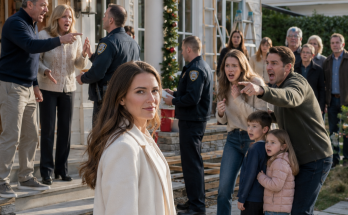
Four pristine, luxury rental vans rolled into the driveway. The doors slid open, and the circus began. Out poured twenty-three relatives, decked in matching crimson cashmere sweaters, dragging designer suitcases, oversized coolers, and mountains of perfectly wrapped gifts. They moved with the swagger of conquering royalty returning to their winter palace.
Aunt Patricia stepped out first, adjusting a fur-lined collar. She marched up the wooden steps to the expansive wrap-around porch.
“Nora!” she sang out, her voice sharp and bright, attempting to pierce the heavy oak front door. “Open up, darling! It’s freezing out here, and the caterers will be arriving with the tenderloin soon!”
I didn’t move. I didn’t make a sound.
Beside me, Sheriff Callahan stood tall, his hand resting casually on his utility belt.
Outside, the fake cheer began to curdle. “Nora!” my father barked, pounding a gloved fist against the wood. “Stop playing games. Open the door right now!”
Still, I waited. I wanted to see how far they would go. I didn’t have to wait long.
Through the frosted glass of the door, I saw my cousin Blake—a thirty-something real estate broker with slicked-back hair and a notorious temper—push his way to the front. He was carrying a heavy canvas bag.
“She’s probably asleep, the lazy cow,” I heard Blake mutter, loud enough for the wood to barely muffle it. “Move aside, Mom. I called a guy in town.”
From the driveway, a smaller, unmarked truck pulled up. A man in Carhartt overalls stepped out, carrying a heavy-duty Makita drill.
They hired a locksmith.
My breath caught in my throat. They hadn’t even waited five minutes. They hadn’t tried to call my phone. They had preemptively hired a man to break into my home, assuming their sheer numbers and familial title gave them the divine right to shatter my locks.
Sheriff Callahan’s jaw tightened. “Well,” he whispered, a dangerous edge to his tone. “That changes things.”
I listened to the metallic clack of the locksmith setting his drill bit against the antique brass lock of Grandma’s door. The high-pitched whine of the motor spun up.
It was time.
I stepped forward, gripped the heavy iron handle, and threw the door open just as the drill bit touched the metal.
The locksmith jumped back in shock, dropping his tool. The entire family, gathered on the porch like a flock of expectant vultures, froze.
“Good afternoon,” I said, my voice eerily calm, carrying over the howling wind.
Aunt Patricia’s shocked expression instantly morphed back into a plastic smile. “Nora! Finally. We thought you were—”
“I know what you thought,” I cut her off. I stepped out onto the threshold. The freezing wind whipped my hair across my face, but I didn’t flinch. “You thought you could drill through my front door because waiting in the cold was too inconvenient.”
Blake sneered, stepping forward to shield the locksmith. “Come on, Nora. Don’t be dramatic. You weren’t answering. We have perishables in the van. It’s tradition.”
I looked at the mountain of luggage, the expensive coolers, the children already running toward the fragile sand dunes, crushing the protected sea grass beneath their boots.
“Tradition,” I echoed, the word tasting like ash in my mouth. “Tradition is just a ghost story you tell yourselves to justify taking something long enough to mistake it for ownership.”
Mom pushed her way to the front, her face pale beneath her heavy makeup. “Nora, sweetie, what is wrong with you? Let us in. We’re your parents.”
“You were my parents every Christmas you forgot to invite me, too,” I said evenly. “But you didn’t seem to need a locksmith to find me then.”
My father’s face flushed a deep, angry purple. “I will not stand on this porch and be lectured by an ungrateful child! Move out of the doorway.” He took a menacing step forward, attempting to physically intimidate me into stepping aside.
That was when Sheriff Callahan stepped out from the shadows of the hallway, towering over me, his badge catching the dull gray light of the winter sun.
“I’d suggest you hold your ground right there, David,” Callahan rumbled.
The sight of the uniform acted like a physical blow. The family physically recoiled.
“You called the cops on your own family?” Lauren shrieked, clutching her designer handbag to her chest like a shield. “Are you insane?”
“No,” Callahan answered for me. “Ruth did.”
The wind seemed to hold its breath as twenty-three pairs of eyes widened in terror.
Chapter 3: The Forgery and the Fury
The silence on the porch was so profound I could hear the rhythmic thud-thud of the waves crashing a hundred yards away.
“Ruth?” Aunt Patricia choked out, her perfectly manicured hand flying to her throat. “What are you talking about? Ruth is dead.”
“Her physical body, yes,” I said, my voice steady. “But her memory is entirely intact. And she made preparations.”
I lifted the manila envelope and pulled out the first document. It was a formal, notarized cease-and-desist letter.
“The beach house has been transferred into a private, irrevocable trust,” I read aloud, my voice carrying no malice, only the cold, hard weight of the law. “No family member—specifically David, Helen, Patricia, Lauren, and Blake—has occupancy rights without a formal, written invitation from the trustee. Any attempt to enter the property, or damage its fixtures…” I looked pointedly at the locksmith, who was hastily packing his drill and backing toward his truck, “…will be prosecuted as criminal trespassing and breaking and entering.”
My father laughed, but it was a thin, reedy sound devoid of humor. “A trust? That’s absurd. Mom wouldn’t do that. She loved us. She loved having the family here.”
“She loved you,” I corrected him. “You loved her house.”
“This is ridiculous!” Blake exploded, his face twisting with rage. He shoved past his mother, stepping dangerously close to Sheriff Callahan. “This is a power trip! You’ve always been jealous of us, Nora. You manipulated a dying old woman into signing everything over to you because you’re a lonely, bitter spinster!”
I didn’t blink. I didn’t raise my voice. I simply looked at him with a pity that I knew would infuriate him more than anger ever could. “Are you finished, Blake?”
Aunt Patricia suddenly stepped forward, her eyes darting frantically. “Wait. Wait just a minute.” She reached into her oversized designer tote bag and pulled out a folded piece of thick stationary. Her hands were trembling slightly, but her chin was thrust outward in defiance.
“I didn’t want to bring this out,” Patricia announced, projecting her voice so the whole family could hear. “I wanted to keep this amicable. But I found this in Ruth’s desk during Thanksgiving last year. It’s a handwritten codicil. A holographic will.”
She waved the paper. “In her own handwriting, Ruth states that the house is to be divided equally among her children, and that Nora is only to receive a small cash stipend for her… nursing services.”
A murmur rippled through the family. Hope flickered in their greedy eyes. Lauren smirked at me, a nasty, triumphant curve of her lips.
“A handwritten will?” I asked, raising an eyebrow.
“Yes,” Patricia said, gaining confidence. “And in the state of Maine, if it’s entirely in the testator’s handwriting, it’s perfectly legal. So you can take your little trust and shove it, Nora.”
“May I see that, Patricia?”
The voice didn’t come from me. It came from the driveway.
Stepping out of a sleek black sedan that had pulled up silently behind the rented vans was Mr. Vance, the estate attorney. He was dressed in a razor-sharp charcoal overcoat, carrying a sleek leather briefcase. He walked up the steps, the crowd parting for him as if he were parting the Red Sea.
Patricia hesitated, clutching the paper. “It’s a private family matter, Mr. Vance.”
“Nothing regarding the estate of Ruth Hastings is private from me, madam. I am the executor,” Vance said, holding out a black-gloved hand. “Hand it over. Or I will ask the Sheriff to confiscate it as evidence.”
Reluctantly, Patricia handed him the paper.
Vance didn’t even need to put on his glasses. He stared at the document for exactly four seconds. Then, he looked up at Patricia, his expression one of utter, chilling disgust.
“The ink is blue,” Vance stated flatly.
“So?” Patricia snapped. “Mom liked blue pens.”
“Ruth suffered from severe arthritis in her right hand for the last three years of her life,” Vance explained, his voice echoing off the porch roof. “She couldn’t grip a standard ballpoint pen. She only used heavy, felt-tipped markers. Furthermore, she was right-handed. The slant of this cursive is distinctly left-handed. Like yours, Patricia.”
Patricia’s face drained of all color, leaving her looking like a wax mannequin.
Vance folded the paper and slipped it into his breast pocket. “What you have just handed me is a forged legal document. Presenting it in an attempt to subvert a legal trust crosses the line from a family dispute into federal fraud.”
“Fraud?” Blake shouted, his veins bulging in his neck. “You’re calling my mother a criminal? Give me that paper!”
With a roar of primal anger, Blake lunged forward, throwing his full weight toward the elderly lawyer, his hands grasping for Vance’s coat.
But Blake never made it.
Chapter 4: The Voice from the Grave
Before Blake’s hands could touch the lawyer, Sheriff Callahan moved with a speed that defied his massive frame. He stepped between them, his left forearm slamming into Blake’s chest like a steel beam, halting his momentum instantly.
At the same time, Callahan’s right hand dropped flawlessly to the holster at his hip, unclicking the safety strap with a loud, sharp snap. He didn’t draw the weapon, but the implication was louder than a gunshot.
“Take one more step toward this man,” Callahan growled, his face inches from Blake’s, “and you will spend Christmas Eve in a county cell drinking tap water out of a metal toilet. Back. Up.”
Blake froze, his eyes locked on the sheriff’s hand resting on the black grip of his service weapon. The fire in the young man’s eyes extinguished instantly, replaced by a raw, pathetic terror. He stumbled backward, tripping over a cooler and landing hard on the wooden deck.
Nobody moved to help him up.
“Thank you, Sheriff,” Mr. Vance said, completely unruffled, adjusting his lapels. He turned back to the trembling family. “Now that we have established the rules of engagement, Miss Nora has something else to share with you.”
I stepped out onto the porch, leaving the door wide open behind me.
“You all thought Grandma was just a sweet, forgetful old woman who baked pies and let you use her home,” I said, my voice trembling for the first time, not from fear, but from the sheer weight of the heartbreak I carried for her. “You thought she didn’t notice the money missing from her purse. You thought she didn’t realize you only visited when you needed a free vacation.”
I reached into the pocket of my coat and pulled out a small black remote control. I pointed it at the massive 75-inch television mounted above the fireplace inside the living room—the one they could all see perfectly through the wide double doors.
I pressed play.
The screen flickered to life. The audio, wired to the outdoor patio speakers Grandma had installed for summer parties, crackled.
And then, Grandma Ruth’s face filled the screen.
A collective gasp rippled through the crowd on the porch. My mother clapped a hand over her mouth, stifling a sob.
In the video, Grandma looked frail, sitting in the very leather chair I had just vacated. But her eyes—those sharp, intelligent, piercing gray eyes—were full of fire.
“If you are watching this,” Grandma Ruth’s voice echoed out of the speakers, filling the freezing air, “it means Nora has locked you out. And it means you are likely standing on my porch, throwing a tantrum, demanding what you believe is your rightful inheritance.”
Lauren burst into tears. “Grandma…” she whimpered.
“Do not cry for me, Lauren,” the digital ghost of my grandmother snapped, as if she could hear her. “Save your tears for your own conscience.”
The recording continued. “Over the last ten years, I have kept a ledger. A very detailed ledger. I recorded every time Patricia ‘borrowed’ money to fix her roof and never paid it back. I recorded every time David and Helen charged their flights to Europe on my credit card without asking.”
My parents looked at each other, sheer panic setting in.
“But the money wasn’t the worst part,” Grandma’s voice cracked, a deep sorrow leaking into her tone. “Two years ago, I was diagnosed with a valve blockage in my heart. The doctors recommended a specialized, experimental surgery in Boston. It wasn’t covered by Medicare. I needed eighty thousand dollars out of pocket.”
I closed my eyes. Even having watched this video a dozen times, this part still felt like a knife twisting in my ribs.
“I called you, David. I called you, Patricia,” Grandma said, looking directly into the camera lens. “I asked for my money back. The money you took. Do you remember what you told me?”
Silence on the porch. Only the wind howled.
“You told me it wasn’t a good time,” Grandma said softly. “You told me that at my age, surgery was a risk, and I should just enjoy the time I had left. And then, three weeks later, I saw photos of you all on a luxury cruise in the Mediterranean. A cruise you paid for using the equity line of credit you convinced me to take out on this house.”
Aunt Patricia collapsed against the porch railing, burying her face in her hands.
“You traded my heart for a vacation,” Grandma said, her voice turning to ice. “You drained my medical fund. The only reason I survived this long was because Nora worked triple shifts at the hospital to pay for my medication out of her own pocket. Nora gave me life. You gave me an expiration date.”
The video paused, the image freezing on Grandma’s stern, unforgiving face.
I looked at my family. The arrogance was gone. The matching Christmas sweaters suddenly looked like prison uniforms. They were stripped bare, their darkest, most shameful secret dragged out into the harsh daylight.
“You didn’t just neglect her,” I whispered, the anger bubbling up from my soul. “You bled her dry.”
And just when they thought the nightmare was over, Mr. Vance opened his briefcase, revealing the true cost of their betrayal.
Chapter 5: The Long Walk in the Snow
Mr. Vance pulled out a thick stack of manila folders, distributing them with the cold efficiency of a blackjack dealer. He handed one to my father, one to Patricia, and threw one onto the deck beside Blake, who was still sitting in the freezing wood, shell-shocked.
“What is this?” my father asked, his hands shaking so badly he could barely open the flap.
“That,” Mr. Vance said, “is a detailed forensic accounting report of the Ruth Hastings Estate. Included are copies of bank transfers, forged signatures on equity loans, and documented evidence of elder financial abuse.”
“Elder abuse?” my mother shrieked. “We didn’t abuse her! We’re her family!”
“The law does not recognize ‘family’ as a defense for embezzlement, Helen,” Vance replied smoothly. “The total amount extracted from Ruth’s accounts over the last decade, adjusted for interest and penalties, is two hundred and forty-two thousand dollars.”
Patricia gasped, clutching her chest as if she were having a heart attack.
“The private trust, of which Nora is the sole beneficiary and trustee, is now formally demanding restitution,” Vance continued, his voice like the strike of a gavel. “You have exactly thirty days to repay the stolen funds in full.”
“Thirty days?” Blake scoffed, rubbing his chest where the sheriff had struck him. “Or what? You’ll sue us? It’ll take years in civil court. We’ll bankrupt you with legal fees.”
Vance smiled. It was a terrifying expression.
“Oh, no, Mr. Blake. This isn’t a civil matter. Because Patricia utilized a forged power of attorney to secure the equity loan across state lines, it falls under the purview of federal wire fraud and felony elder exploitation.” Vance pointed a gloved finger at them. “If the funds are not deposited into the trust’s account by 5:00 PM on January 23rd, I will hand these files over to the District Attorney and the FBI. Criminal charges will be filed. Your assets—including your homes, your cars, and your retirement accounts—will be seized and frozen pending trial. You will be facing mandatory minimum prison sentences.”
The air went dead. The threat wasn’t a bluff. It was a loaded gun pressed directly against their luxurious, comfortable lives.
My father, the man who had always told me not to make things about my feelings, looked at me with tears streaming down his face.
“Nora,” he begged, his voice breaking. “Please. We don’t have that kind of liquid cash. If they take the house… we have nowhere to go. Please, you can’t do this to us on Christmas.”
Nowhere to go.
That sentence hung in the air. For a fleeting microsecond, a phantom pang of guilt tugged at my heart. But then, a montage of memories washed over it, burying it forever.
I remembered the fifteen years of empty chairs I was never offered. I remembered the freezing car I slept in. I remembered Grandma Ruth coughing in pain, unable to afford her premium medication because her children were sipping champagne on a yacht.
I looked at my father, feeling nothing but a profound, hollow pity.
“There’s a Motel 6 out on Route 1,” I said softly, my voice perfectly steady. “They usually have vacancies on the holidays. I suggest you start driving.”
Defeated, crushed, and facing total ruin, the family turned around. There was no dramatic shouting left. No grand collapse. Just the pathetic, shuffling sound of twenty-three people dragging their designer suitcases back down the stairs.
But the universe, it seemed, wasn’t quite done with them.
As they reached the gravel driveway, a flashing yellow light cut through the gloom. A heavy-duty tow truck was backing down the narrow coastal road.
The driver hopped out, hooking a thick steel chain to the front axle of the largest rental van—the one Blake had haphazardly parked diagonally across the driveway, its rear wheels crushing the protected coastal dune grass and blocking the marked fire lane.
“Hey! Hey, what are you doing?” Blake yelled, running toward the truck.
“Vehicle’s parked illegally on a protected state nature reserve and blocking an emergency access route,” the tow truck driver drawled, chewing on a toothpick. “Sheriff’s department called it in twenty minutes ago.”
Sheriff Callahan tipped his hat from the porch. “Public safety hazard, son. Can’t be too careful in a winter storm.”
“You can’t tow it! All our kids’ presents are in there!” Lauren screamed.
“You can claim the vehicle and its contents at the municipal impound lot in Bangor on Monday,” the driver said, climbing back into his cab. “Lot’s closed for the holiday weekend. Merry Christmas.”
With a grinding of gears, the tow truck pulled away, dragging the massive van into the gray afternoon.
Because one van was gone, they no longer had enough seats for twenty-three people.
I stood on the porch, leaning against the wooden railing, and watched as my aunts, uncles, parents, and cousins were forced to make a choice. They crammed the children and the elderly into the remaining three vans.
That left five adults—including Blake, Lauren, and Patricia—without a seat.
As the first flakes of a brutal Maine snowstorm began to fall, swirling like white ashes from the sky, they zipped up their expensive cashmere coats. Without a word, they began to walk down the long, winding, two-mile gravel road toward the highway.
They looked small. Pathetic. Stripped of their entitlement, they were just people walking in the cold, while the ocean wind did what shame could never do: it made them bow their heads.
I turned around, walked inside, and closed the heavy oak door. The lock clicked shut with a satisfying, permanent finality.
That night, the storm raged outside, but inside, the beach house was a sanctuary of warmth. I built a roaring fire in the stone hearth. I went into the kitchen, opened the fridge, and took out the cherry pie I had baked that morning.
I cut a generous slice, placing it on Grandma’s favorite blue ceramic plate, and set it on the small table beside her leather armchair.
I sat on the rug, watching the flames dance, and for the first time in fifteen years, I cried on Christmas Eve. But I didn’t cry because I was lonely. I cried because the house was finally peaceful. The ghosts had been exorcised. The ledger was balanced.
Over the following months, Mr. Vance executed the legal trap perfectly. Terrified of federal prison, my parents and aunts liquidated their vacation funds, sold their luxury cars, and mortgaged their homes to repay the trust.
I didn’t keep a single penny of it for myself.
Instead, I used the recovered $242,000 to fully fund a new pediatric cardiac wing at the local hospital, and to endow Grandma Ruth’s favorite coastal library program in perpetuity.
I kept the beach house exactly as it was. But now, its doors were only open to the people who had loved her quietly, without condition: her hospice nurse, her elderly neighbor who brought her crossword puzzles, the members of her Thursday book club, and the young grocery cashier she used to tip every Friday.
My family sent a flurry of Christmas cards the following year, desperate attempts to bridge the chasm they had dug. I threw them straight into the fireplace unopened, watching the glossy paper curl and turn to ash.
For fifteen years, they forgot to invite me and called it an accident.
Grandma remembered everything.
And when they finally showed up at my door expecting a feast, I served them the only gift they had truly earned: the cold, hard, devastating truth, wrapped in legal paper.
If you want more stories like this, or if you’d like to share your thoughts about what you would have done in my situation, I’d love to hear from you. Your perspective helps these stories reach more people, so don’t be shy about commenting or sharing.