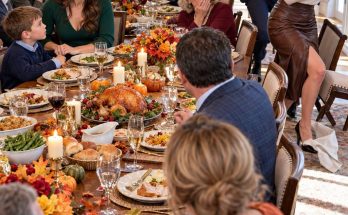
For Five Thanksgivings, My Sister Introduced My Son As “The Bastard.” Last Year, With 17 Relatives Listening And His Hand In Mine, She Added, “He’s Not A Cousin. He’s A Mistake We Feed.” I Said, “Say It Again. Slowly.” She Did. My Seven-Year-Old Put His Fork Down And Asked Her One Question. Her Chair Hit The Floor, And My Father Followed Her Out To The…
My sister spent five Thanksgivings turning my son into the family punch line while everyone else asked me to keep the peace. I thought the worst thing she had done was teach a little boy that his place at our table could disappear whenever she wanted. Then, at seven years old, he asked one question in front of the entire family, and my father went pale. What I uncovered afterward was buried in my grandmother’s trust records: they had not only treated my son like a burden. They had quietly made him pay for the privilege.
### Part 1
My name is Rachel Mercer, I’m thirty-four years old, and until last Thanksgiving I believed there were some kinds of cruelty families tolerated because admitting what they were would require too much courage. My older sister, Monica, had spent five years calling my son Noah “the bastard” at Thanksgiving, and every year somebody found a different excuse for why I should not make a scene. The first time she did it, Noah was two, sitting in a booster seat with mashed potatoes on his cheek while Monica walked around my parents’ dining room introducing relatives who had come in from three states away. She reached us, rested one hand dramatically on the back of my chair, and said, “And here’s Rachel with our little bastard.”
I remember the smell of sage stuffing, the clink of a serving spoon against Grandma Evelyn’s old china, and the strange silence that fell before two relatives gave embarrassed laughs because they did not know what else to do. I stared at Monica and said, “Don’t ever call him that again.” She rolled her eyes and reached for her wine. “He’s two. He doesn’t even know what it means.” My father, Howard, frowned at me rather than her and said, “Rachel, don’t ruin Thanksgiving over one stupid word,” while my mother, Linda, whispered, “Ignore her. You know how Monica gets.”
So I ignored her, and that became the first mistake in a chain of mistakes I would spend years regretting. The next Thanksgiving, Monica did it again, only this time she said it after Noah had already learned to recognize his own name. The year after that, she said it while her daughter, Sophie, was sitting beside him making a paper turkey out of construction paper, and Noah looked at me because he noticed the adults suddenly becoming uncomfortable. By the fourth year, he was six, old enough to understand that when Aunt Monica used that word, Grandma Linda looked down at her plate, Grandpa Howard rubbed his forehead, and I became stiff in a way he could feel even if he did not understand why.
I should have stopped bringing him. Instead, I convinced myself that leaving would mean Monica got to decide whether my son belonged in his own family, and that idea made me stubborn. Grandma Evelyn had encouraged that stubbornness before she died. “Never let your sister chase you away from your own table,” she once told me while we washed dishes together after a Sunday dinner. “That boy is family whether Monica likes the shape of your life or not.”
I had Noah when I was twenty-seven. His father had been charming when things were easy and unreliable when they became real, disappearing in and out of our lives until I finally stopped designing my son’s childhood around promises that rarely survived the weekend. I worked as a commercial insurance account manager, paid our rent, handled school forms, doctor appointments, groceries, soccer registration, birthday presents, and every other ordinary expense that comes with raising a child. Monica still liked to talk about me as though I had failed some test she had passed because she was married before having Sophie and owned a four-bedroom house with her husband, Kevin.
She loved the phrase “the right order.” She had married at thirty, bought a house at thirty-one, and had Sophie at thirty. I had gotten pregnant before marriage and ended up raising my child mostly alone, which in Monica’s mind permanently established our rankings. She never said she was better than me in those exact words because people like Monica rarely do. Instead, she said things like, “Some of us thought ahead,” or, “Sophie shouldn’t lose opportunities because other people made different choices.”
The only reason I kept returning was that Noah loved Sophie, and Sophie loved him. They built blanket forts, traded Halloween candy, made ridiculous obstacle courses in my parents’ basement, and disappeared upstairs with board games while the adults argued about politics and football downstairs. Sophie never once treated Noah as anything except her cousin, and watching them together made it easy to tell myself that Monica was the problem, not the family.
Then Grandma Evelyn died.
She was eighty-two, stubborn enough to keep driving long after everyone begged her to stop, careful enough with money that she still reused wrapping paper, and wealthy only in the quiet way some older people become wealthy by never wasting anything. Her house had been paid off for years, she had investments nobody talked much about, and she had lived below her means for four decades. Eighteen months before that final Thanksgiving, we buried her beneath an oak tree in a cemetery twenty minutes from the house where she had hosted Christmas for most of my childhood.
After the funeral, Dad pulled me aside near the church parking lot while people were still carrying foil-covered casseroles toward their cars. “Mom left something for both kids,” he said. I assumed he meant a few thousand dollars for college. Then he added, “Sophie and Noah. Equal shares.”
I remember smiling because it sounded exactly like Grandma Evelyn. Equal meant equal to her. She did not care who had been born first, whose parents were married, or who visited one extra weekend in July.
What I did not understand was that those two words—equal shares—had already started a quiet war inside my family.
### Part 2
Grandma Evelyn’s estate plan created a trust worth a little more than one hundred twenty thousand dollars for Sophie and Noah, with each child receiving an equal beneficial share. My father became trustee, while Grandma’s longtime accountant, Margaret Ellis, was named successor trustee if Dad resigned, became unable to serve, or had to be removed. The trust allowed distributions for education, medical needs, certain activities, and reasonable support expenses while the children were minors, with anything left remaining invested for their future. I understood that much when Dad explained it to me, but I never asked to see the actual documents.
That decision seemed harmless at the time. Dad had spent his career managing inventory and payroll for a regional construction company, had never bounced a check in his life, and still balanced his personal account with a paper register even though his bank did everything online. Asking for statements felt like accusing him of something before there was anything to accuse. Grandma had trusted him, and I trusted Grandma’s judgment.
Monica reacted differently. At first, her comments were small enough to pass as grief. “Sophie actually remembers Grandma,” she said once while we were sorting photographs after the funeral. Another time she pointed out that Noah had been much younger during Grandma’s last healthy years. Dad shut her down both times. “Mom made them equal because she wanted them equal. We are not revisiting it.”
I thought that ended the subject. It did not.
That summer, Monica volunteered to take both children to a weeklong day program while school was out. I had a heavy month at work, so I was grateful, and when she told me the program cost one hundred eighty dollars for Noah, I offered to reimburse her. She said, “Don’t worry about it. Dad said Grandma’s trust can cover his fee.” When I asked Dad later, he explained that the payment qualified as an activity expense for Noah and that he had reimbursed Monica from Noah’s share.
That made complete sense.
Then there was a museum trip. A movie. A science workshop. Occasionally Monica watched Noah on a Saturday while I handled work, and Dad reimbursed something she had paid for him. Every expense was small enough to sound reasonable when described individually, and I had no reason to believe anyone was taking advantage of him. What I did not know was that the category of “support” was quietly expanding.
Family outing meals became support. A portion of holiday groceries became support. Weekend care Monica had volunteered to provide became support. Tickets for events where both children attended became support for Noah, while Sophie’s parents simply paid Sophie’s cost themselves. No single reimbursement looked dramatic enough to trigger an alarm.
That was precisely why the pattern survived.
The Thanksgiving everything exploded began normally. My parents’ house smelled like coffee and roasted turkey before noon, Mom had three timers going in the kitchen, and Dad was already complaining that relatives were arriving too early. There would be seventeen extended family members at dinner, not counting Mom, Dad, Monica, Kevin, Sophie, Noah, and me. Noah disappeared upstairs almost immediately looking for Sophie.
What I learned later was that he first wandered past Dad’s study.
The door was partly open. Monica was inside with my father, holding an envelope filled with receipts and a printed sheet. Noah was not trying to spy; he was seven, bored, and looking for his cousin. He stopped because he heard his own name.
“Put Thanksgiving under Noah again,” Monica said.
Dad apparently lowered his voice. “Not now, Monica.”
“Why not? Mom’s trust specifically allows support.”
“I said not now.”
Then Dad looked toward the doorway and saw Noah standing there.
“Buddy,” he said quickly, “go find Sophie.”
Noah did exactly what adults had trained him to do. He went upstairs without asking questions. Nobody knew he had understood enough to remember the conversation.
By four that afternoon, the house had become loud enough that I forgot almost everything except keeping track of Noah. People were carrying dishes through the dining room, my uncle was arguing about football with Kevin, and somebody had brought a pecan pie large enough to serve a restaurant. Noah and Sophie came downstairs wearing paper crowns they had made from printer paper and tape.
Dinner started late. It always did.
Monica eventually stood near the far end of the table and began introducing people for two cousins who had brought new partners. She worked her way around the table, enjoying the attention, until she reached me.
“And here’s Rachel,” she said.
I felt Noah’s small hand slide into mine beneath the table.
Monica glanced at him.
“And, of course, the bastard.”
Nobody laughed.
That silence should have warned her.
I looked straight at her. “Don’t.”
Her smile sharpened. “What? Everybody knows.”
“Stop.”
Instead, she turned slightly toward the table as though delivering a punch line. “He’s not really a cousin. He’s a mistake we feed.”
Noah’s fingers tightened around mine.
Five years of swallowing my anger rose at once. Five years of my parents telling me not to ruin holidays. Five years of watching my child slowly become old enough to understand a cruelty everybody insisted was harmless.
I said, “Say it again.”
Dad looked at me. “Rachel.”
I ignored him.
“Say it again,” I told Monica. “Slowly.”
She could have stopped.
Instead, pride took over.
### Part 3
Monica looked directly at me with seventeen relatives watching and repeated every word as though she were proving I could not embarrass her. “He is not a cousin,” she said carefully. “He is a mistake we feed.” I wanted the adults in that room to hear the sentence without laughter, without pretending they had misunderstood, without giving her the shelter of calling it a joke afterward. What I forgot in my anger was that Noah would have to hear it twice too.
His hand slipped out of mine. He placed his fork carefully beside his plate, looked at Monica, and asked, “Then why does Grandpa pay you from Grandma Evelyn’s school money when I eat here?” The sound of Monica’s chair crashing backward onto the hardwood floor seemed impossibly loud. Dad went pale.
Nobody spoke for several seconds.
I turned to Noah. “What did you say?”
Monica snatched her phone from beside her plate. “This is ridiculous.”
She headed for the back door.
Dad followed her.
Not me.
Not Noah.
Her.
That choice settled in my stomach before I had enough information to understand why.
“Noah,” I said, keeping my voice as calm as I could, “what did you hear?”
He pointed toward the hallway leading to Dad’s study. “Aunt Monica told Grandpa to put Thanksgiving under me again.”
“Again?”
He nodded. “She said Grandma Evelyn left money for my support.”
His face changed then, uncertainty replacing the strange confidence that had made him ask the question in the first place. “Was I not supposed to hear?”
Before I could answer, Sophie spoke from across the table.
“He is my cousin.”
She was nine years old. Four words.
More courage than nearly every adult in that room had shown in five years.
Mom stood and started toward us. “Rachel, please don’t leave like this.”
I was already helping Noah into his coat. “I should have left four Thanksgivings ago.”
“Your father will explain.”
“He had five years to explain why he let Monica call my child that.”
“This is complicated.”
I looked at her. “No. The trust may be complicated. What Monica said is not.”
We left before Dad returned.
Noah was silent as I drove through streets already dark with the early November sunset. Holiday lights had started appearing on houses, and somebody two blocks from my parents had an inflatable snowman leaning sideways in the wind. I kept glancing at Noah in the rearview mirror, trying to decide what to say without frightening him with things I did not yet understand.
About ten minutes from home, he finally spoke.
“Mom?”
“Yeah?”
“Do I have to pay when I eat at Grandpa’s?”
My throat closed so quickly I had to pull into a pharmacy parking lot.
I turned around in my seat. “No.”
“But Aunt Monica said—”
“Noah, listen to me. Grandma Evelyn left money for you. Grown-ups have been making decisions about that money. I don’t know yet whether those decisions were right or wrong, but whatever happened is my problem to fix. It is not your job.”
He studied my face. “So I don’t owe them dinner money?”
“No.”
“What about Christmas?”
“No.”
“Sophie doesn’t pay?”
“I don’t think so.”
He looked down at his shoes.
That hurt more than anything Monica had said.
“Did I cost too much?” he asked.
I reached into the back seat and took his hand. “You are a child. You do not owe your family money for loving you, feeding you dinner, or letting you sit at a table. Ever.”
He nodded, but I knew a sentence could not erase what five years of watching adults tolerate Monica had taught him.
That night, after Noah finally fell asleep, I sat at my kitchen table with my laptop open and searched for attorneys who handled trusts and estates. I was not looking for revenge. I still did not know whether Dad had violated any law, and I refused to turn suspicion into accusation simply because I was furious.
What I wanted was an answer to one question.
Why was my family apparently charging my seven-year-old son for things they called family?
The following Monday, I met with an attorney named Amelia Brooks. Her office was on the fourth floor of a plain brick building downtown, and she listened without interrupting while I explained the trust, Monica’s comment, what Noah had overheard, and the fact that I had never seen an accounting. I expected outrage.
Instead, Amelia remained calm.
“A support trust can legitimately pay expenses for a minor beneficiary,” she said. “Nothing you’ve told me proves anyone stole from your son.”
Strangely, that made me trust her immediately.
“So what do we do?”
“We read the trust. Then we follow the money.”
She sent a formal request for the governing documents, account statements, distribution history, receipts, reimbursement requests, and anything else Dad had used to authorize distributions from Noah’s share.
Dad called me the next evening.
“You hired a lawyer against your own father?”
“I hired a lawyer for Noah.”
“I never stole from that boy.”
“Then the records will show that.”
Silence.
When Dad finally spoke again, his voice sounded smaller.
“You’re going to tear this family apart over five thousand dollars.”
I had never mentioned a number.
And that was how I learned he already knew exactly what I was going to find.
### Part 4
Dad hired his own attorney within a week, which Mom described as proof that I had “forced everyone into defensive positions.” I refused to argue with her. If Dad believed every distribution was appropriate, then having a lawyer organize the records would protect him as much as it protected Noah. To his credit, he preserved everything.
There were no mysteriously missing receipts. No deleted spreadsheets. No bank statements that had suddenly disappeared. Dad’s attorney turned over the trust agreement, investment statements, distribution logs, emails, receipts, handwritten notes, and several reimbursement worksheets Monica had created over the previous eighteen months.
It took weeks.
During that time, Monica sent me exactly one message.
You are humiliating Dad over normal support expenses.
I did not respond.
Christmas invitations arrived through Mom rather than directly from my sister. I declined them. Noah asked once whether Sophie could come to our apartment during winter break, and I arranged it through Kevin instead of Monica because whatever happened between the adults, I was not willing to punish two children for loving each other.
The accounting arrived in January.
I had built the number into something enormous in my mind, perhaps because Dad’s Thanksgiving phone call had made five thousand dollars sound like a confession. The actual disputed total was smaller than the betrayal felt. Roughly five thousand dollars had been distributed from Noah’s share across eleven reimbursement requests, but Amelia immediately separated the expenses into categories.
Some were perfectly reasonable.
A summer program Monica had paid for.
A science activity fee.
An admission ticket for an outing Noah had attended.
A registration cost connected directly to him.
“If the records contained only these,” Amelia told me, “I would probably advise you there’s very little worth challenging.”
I nodded.
Then she turned the page.
Holiday groceries.
A portion of Christmas hosting.
Weekend childcare.
Meals during family outings.
A Thanksgiving allocation from the previous year.
I stared at that entry until the words blurred.
“They actually charged him for Thanksgiving?”
Amelia did not answer emotionally. That was not her job.
“Potentially. But I want you to look at something else.”
She slid Monica’s spreadsheet toward me.
It was almost insultingly simple.
Rows showed events and expenses. Columns identified Sophie and Noah. Beside one zoo trip, Sophie’s expense was marked “parent paid.” Noah’s was marked “trust.” A holiday outing showed the same distinction. At another family event, Sophie’s column said “family,” while Noah’s said “support allocation.”
I read the words three times.
“Why?”
“That,” Amelia said, “is the important question.”
“Is this illegal?”
“Some expenses could arguably fall within broad support language. Others are poorly documented. I’m not going to tell you a court would automatically find misconduct.”
That disappointed me for approximately two seconds, until I realized I had not hired her to validate my anger.
She tapped the spreadsheet.
“But administration appears inconsistent. Two beneficiaries have equal interests under the same trust, yet similar expenses are being treated differently depending on which child incurred them.”
I leaned back.
Monica had not emptied Noah’s account. She had not bought a car with his inheritance or taken tens of thousands of dollars.
What she had done was quieter.
The family invited both children to the same places, fed them at the same table, took them to the same events, and then afterward somebody looked at Sophie and decided her presence was simply part of having family.
Noah’s presence became reimbursable.
I could replace five thousand dollars myself if necessary. I could work extra hours for six months and erase the financial damage.
What I could not erase was what the paperwork meant.
Monica had spent years acting as though the family was generous for “including” my son, and somewhere behind the scenes she had been submitting requests so his own inheritance would reimburse her for that generosity.
I thought about every Thanksgiving insult again.
A mistake we feed.
Suddenly, the phrase sounded less like random cruelty.
It sounded like a philosophy.
I looked at Amelia. “Why didn’t Sophie’s trust pay for any of this?”
She closed the folder.
“That is the question I would ask your father.”
We scheduled a family meeting at my parents’ house for the following Sunday. No extended relatives. No spouses. No children. Just Mom, Dad, Monica, and me.
I brought copies of the spreadsheet.
Monica arrived seven minutes late, dropped her purse onto the kitchen counter, and looked at the folder in front of me.
“You’re really doing this?”
“Yes.”
She sat across from me.
I opened to the distribution summary.
Before I could speak, she said, “You are making it sound like I emptied his trust.”
“You didn’t.”
That stopped her.
She had prepared to defend herself against an accusation I was not making.
I continued, “Some expenses were legitimate.”
Dad looked surprised.
“The summer program was legitimate. The science activity was legitimate. If you paid for something specifically for Noah, I have no issue with reimbursement.”
Monica crossed her arms. “Then why are we here?”
I turned to the holiday entries.
“Because you charged my son for Thanksgiving.”
And for the first time since this began, Monica did not have a quick answer.
### Part 5
Monica recovered after only a few seconds. “He ate the food.”
I looked at her, almost certain I had misunderstood because the answer was too perfect. “What?”
“You keep saying ‘charged him for Thanksgiving’ like I sent him an invoice. We bought groceries. There were extra people. Grandma’s trust allows support expenses.”
“So did Sophie eat.”
“She’s my daughter.”
“Exactly.”
I pushed the spreadsheet across the table until it stopped in front of her.
“Why did Sophie’s trust never pay for Sophie’s dinner?”
Monica glanced at Dad.
I saw the movement.
“Don’t look at him,” I said. “You organized these requests. Answer me.”
“Because Sophie is our responsibility.”
The room went silent.
Mom actually closed her eyes.
I nodded slowly. “Noah is mine.”
“That’s not what I meant.”
“It is exactly what you meant.”
“You’re twisting it.”
“Then untwist it.”
She opened her mouth and stopped.
For five years, Monica had disguised contempt as humor. Now her own bookkeeping had translated it into numbers.
Dad finally spoke. “I approved the reimbursements.”
I turned toward him. “I know.”
“I thought they were permitted.”
“Some probably were.”
Again, he looked surprised that I was not trying to make every expense sound criminal.
I pointed to the worksheet.
“This stopped being only a question about what the trust technically allowed. You treated identical expenses differently depending on which child created them.”
Dad rubbed both hands over his face.
“I was trying to keep things fair.”
“Fair to whom?”
He did not answer.
Monica stepped in. “Lucy—”
“Sophie,” I corrected automatically, irritated that in my anger I had almost used Grandma’s old nickname for her.
“Sophie shouldn’t end up with less because of the choices you made.”
There it was.
No joke.
No sarcasm.
No holiday audience.
Just the belief underneath everything.
“She didn’t have less,” I said. “Grandma Evelyn made the shares equal.”
“She was closer to Sophie.”
“That was Grandma’s decision to make.”
“You barely brought Noah around when he was little.”
“I was working full-time and raising a baby.”
“You always have an excuse.”
Mom said, “Monica.”
But for once, I did not need Mom to defend me.
“I’m not asking why you resent me,” I said. “I already know. I’m asking why you made a seven-year-old pay for it.”
“I did not.”
“You looked at two children eating the same meal and decided one belonged automatically while the other should reimburse the family.”
She pushed the spreadsheet away.
“That’s dramatic.”
“It’s accurate.”
Dad stood and walked toward the kitchen window. For a while, all I heard was the refrigerator humming and a dog barking somewhere down the street.
Then he said, “After Mom died, Monica complained about the trust constantly.”
Monica turned toward him. “Dad.”
He kept talking.
“She said Sophie had been closer to Grandma. She said it was unfair that both children got the same amount. She said Rachel’s household shouldn’t benefit the same way hers did.”
“I never said it like that.”
“Yes, you did.”
Monica stared at him.
Dad looked older than he had before Thanksgiving.
“Every time Monica paid for something involving Noah, she’d bring it up. If I reimbursed her, she stopped complaining for a while.”
Something cold moved through me.
“You knew.”
“I knew she was upset.”
“No. You knew why she wanted the reimbursements.”
“I thought the trust allowed them.”
“You used my son’s money to make his presence cheaper for her.”
“That wasn’t how I saw it.”
“Then how did you see it?”
He struggled for an answer.
“I thought I was keeping peace in the family.”
I almost laughed.
The sentence was so familiar.
Ignore Monica.
Don’t ruin Thanksgiving.
You know how she is.
Keep the peace.
Five years of adults asking the easiest person to absorb the cost.
“Whose peace?” I asked.
Dad looked at the floor.
I finally understood that the trust problem and the Thanksgiving problem were the same problem. Whenever Monica became uncomfortable, somebody else was expected to pay. Sometimes I paid with silence.
Sometimes Noah paid with dignity.
And sometimes his trust literally paid with money.
I closed the folder.
“This is what happens next. Every disputed reimbursement gets reviewed. Anything that should not have come from Noah’s share goes back. Dad, you resign as trustee.”
His head came up. “Rachel—”
“You resign.”
“You can’t just decide that.”
“Your attorney already knows I’m prepared to petition the court if necessary.”
Mom whispered my name.
I continued.
“Margaret Ellis takes over, exactly as Grandma Evelyn planned. Monica never handles another piece of Noah’s financial paperwork.”
Monica laughed bitterly. “Fine.”
“And you will have no direct contact with Noah for now.”
Her expression changed instantly.
“You can’t keep my nephew from me.”
For the first time in years, I answered without hesitation.
“You spent five Thanksgivings telling him he wasn’t your nephew.”
### Part 6
The money issue ended more quietly than the family issue because numbers are easier to correct than beliefs. Dad’s attorney and Amelia reviewed each disputed reimbursement rather than turning a few thousand dollars into a year of litigation, and several expenses were allowed to remain because they were clearly tied to legitimate activities for Noah. Others were reversed because the documentation was weak, the allocation was inconsistent, or they should never have been treated as individual support expenses in the first place. In the end, a little under six hundred dollars was restored to Noah’s share.
That number surprised people when they eventually heard it.
Some relatives assumed I had uncovered tens of thousands of dollars. One cousin even called Mom to ask whether Monica had “drained the whole trust,” which was exactly the kind of dramatic version I refused to spread. She had not.
The point was never that Monica stole Noah’s future.
The point was that my family had created a system where her resentment became an accounting practice.
Monica repaid most of the restored amount because she had received the reimbursements. Dad covered the remainder because he had authorized them. There were no damages, no settlement check, and no triumphant courtroom scene.
There was simply money returned to where it should have stayed.
Dad also resigned as trustee.
That was harder for him than repaying anything.
Grandma Evelyn had trusted him with something important, and admitting he had mishandled that responsibility embarrassed him deeply. Margaret Ellis, Grandma’s longtime accountant, took over without drama. She already understood the trust, had known Grandma for nearly twenty years, and treated every distribution like what it was: a fiduciary decision rather than a family negotiation.
Sophie’s share remained untouched.
I insisted on that.
Amelia had never suggested taking money from Sophie, but I told Dad and Mom anyway because I wanted there to be no misunderstanding. “Nothing that happened is Sophie’s fault. Grandma made her share hers. It stays hers.”
Mom nodded.
Dad said quietly, “I know.”
Monica’s consequence had nothing to do with her daughter’s inheritance.
For the time being, she had no direct contact with Noah.
No holiday dinners.
No unsupervised visits.
No messages delivered through Sophie.
Her first apology confirmed I had made the right decision.
She came to my apartment one evening without warning, and I spoke to her in the hallway rather than letting her inside.
“I never meant for him to feel unwanted,” she said.
I stared at her.
“You called him unwanted every Thanksgiving.”
“I was joking.”
“He stopped laughing before you did.”
“I didn’t realize he understood.”
“You repeated it slowly because I asked you to.”
She flinched.
“That was a bad moment.”
“It was five years.”
She shifted her purse on her shoulder. “So what? I never get to see him again?”
“I didn’t say never.”
“You’re punishing me.”
“I’m protecting him.”
“From words?”
“Yes.”
The answer seemed to offend her more than anything else.
People like Monica understood protection from physical danger. They struggled with the idea that a child could also need protection from adults who repeatedly taught him he was less valuable.
Mom apologized differently.
She came over one Sunday carrying a grocery-store apple pie neither of us wanted, sat at my kitchen table, and spent several minutes turning her coffee mug between her palms.
“I kept asking you to ignore Monica,” she finally said, “because asking you was easier than confronting her.”
I said nothing.
“I told myself I was keeping holidays together.”
“You were.”
She looked up hopefully.
“For Monica.”
Her eyes filled.
“I’m sorry.”
No explanation followed.
No “but.”
That mattered.
Dad took longer.
He called twice, and I let both calls go to voicemail. Then he sent a message asking whether he could meet me at a coffee shop rather than my apartment. I agreed because for all my anger, I still loved him.
He looked tired.
“I love that boy,” he said almost immediately.
“I know.”
“Do you?”
“Yes.”
He seemed confused.
“If you know I love him, then what am I supposed to do?”
“Show me you can love him without asking him to absorb the cost of keeping everybody else comfortable.”
Dad stared into his coffee.
“I never thought of it like that.”
“That’s the problem.”
He nodded.
After a long silence, he said, “I should have stopped Monica the first time she called him that.”
“Yes.”
“I should have stopped the reimbursements once I saw the difference.”
“Yes.”
“I thought if I could keep Monica from complaining, everyone could stay together.”
“And what did Noah get for everyone staying together?”
Dad closed his eyes.
That was the first moment I believed he truly understood.
Before we left, I told him one more thing.
“I may trust you to love Noah again before I ever trust you to make decisions for him.”
He nodded.
He did not argue.
And for Dad, not defending himself was the beginning of something I had stopped expecting.
### Part 7
The hardest conversation was not with Dad, Mom, or Monica. It was with Noah.
Children do not process betrayal in the neat order adults prefer. Noah could spend an entire Saturday laughing with Sophie over a board game and then suddenly ask while brushing his teeth, “Did Aunt Monica use my money when we went to the zoo?” He wanted rules because rules made the world predictable, and what my family had done made no sense under any rule I wanted him to learn.
One night, I sat beside him on the edge of his bed while rain tapped against the bedroom window.
“I need to tell you something I should have told you before,” I said.
He waited.
“I should have taken you away from those Thanksgiving dinners sooner.”
He looked surprised. “Why?”
“Because when Aunt Monica called you names, I kept thinking that if we stayed, we were proving you belonged.”
“Did we?”
The question hurt.
“No.”
He picked at a loose thread on his blanket.
“What did it prove?”
“That I was worried about the wrong thing.”
He thought about that.
Then he asked, “Are we going there this Thanksgiving?”
“No.”
His shoulders dropped in relief so visibly that I almost cried.
“Okay.”
That was all.
No speech.
No demand to punish Monica forever.
Just okay.
I had spent years believing leaving meant Monica won.
My seven-year-old had been waiting for me to realize that he did not care who won. He wanted to feel safe while eating dinner.
Spring passed.
Then summer.
Dad slowly rebuilt contact with Noah in small ways. He came to one soccer game and sat on the opposite side of the field from me because I had not invited him to join us. He mailed Noah a birthday card without enclosing money or using it as an excuse to request a visit. When Noah eventually asked whether Grandpa could come to his school science fair, I said yes.
Dad arrived early.
He did not bring Monica.
That mattered.
Mom had more contact with us because she accepted boundaries without negotiating every one of them. If I said we were leaving at six, she did not ask why six-thirty would hurt. If Noah did not want to attend a family gathering, she did not tell him people would be disappointed. She seemed to be learning that disappointment was survivable.
Monica remained angry.
I heard about it through relatives, although I repeatedly asked them not to carry messages. She told one aunt I had “weaponized Noah.” She told a cousin I was exaggerating an accounting technicality to justify cutting her off. She told Mom I was destroying Sophie’s relationship with her cousin, which was especially dishonest because I continued arranging time for the children to see each other.
Sophie came to our apartment several times that summer.
One afternoon, I found her and Noah sitting on the living-room floor building a cardboard city out of shipping boxes. Sophie had drawn little houses while Noah was constructing what looked like an unnecessarily complicated bridge.
Sophie looked up at me.
“Is Mom still mad at you?”
I crouched beside them. “That’s between your mom and me.”
“Did Noah do something?”
“No.”
“Did I?”
“Absolutely not.”
She nodded and returned to coloring.
I understood then why keeping her share untouched had mattered so much.
Adults in my family had spent years turning children into symbols of adult choices. Sophie was the “right” child because Monica had done things in the “right order.” Noah was the “mistake” because my life did not match Monica’s rules.
I refused to continue that pattern by turning Sophie into the daughter of the villain.
She was a child.
So was Noah.
They both deserved to stay children.
By October, Thanksgiving invitations began circulating.
Mom called me.
“I’m not asking you to come to the big dinner,” she said quickly.
That sentence alone showed progress.
“What are you asking?”
“I was wondering if I could spend part of Thanksgiving with you and Noah instead.”
“Dad?”
“He said he’ll respect whatever you decide.”
“Monica?”
“She and Kevin are doing dinner at their house.”
I sat at my desk, looking out at the parking lot behind my office.
“What about Sophie?”
“Monica said she could spend a few hours with you if you’re comfortable.”
That surprised me.
I did not mistake it for an apology, but it was something.
“Okay,” I said.
Our Thanksgiving would be four people.
Me.
Noah.
Mom.
Sophie.
Dad asked whether he could drop off the rolls Grandma Evelyn used to make.
I said yes.
He did not ask to stay.
The morning of Thanksgiving, he arrived holding a foil-covered pan, hugged Noah only after Noah stepped toward him first, and left after less than five minutes.
No guilt.
No performance.
No demand for forgiveness because he had brought bread.
After he drove away, Noah carried the rolls to the kitchen.
“Grandpa didn’t come in.”
“No.”
“Did you tell him not to?”
“I told him we were having a small dinner.”
Noah nodded.
Then he said, “He listened.”
“Yes.”
That might have been the most important thing Dad had done all year.
### Part 8
Our Thanksgiving table looked almost comically small compared with the crowded dinners at my parents’ house. I had made too much mashed potato out of habit, Mom brought cranberry sauce, Sophie helped Noah arrange place settings, and Dad’s rolls warmed in the oven until the apartment smelled faintly like Grandma Evelyn’s kitchen. There were no seventeen relatives, no awkward introductions, no one scanning the room to see whether Monica was about to say something cruel.
Margaret Ellis now handled the trust.
Any distribution for Noah had to be documented, connected to an actual trust purpose, and reviewed without considering Monica’s opinions about my life. Sophie kept every dollar Grandma had intended for her. Noah kept every dollar intended for him.
Nobody was punished because somebody else was resentful.
Before dinner, Noah stood beside his chair and looked around the table.
“Do we have to introduce everybody?”
I smiled.
“No.”
“Good.”
He climbed into his seat.
“They know who they are.”
Mom laughed, then covered her mouth as though she worried laughter might somehow be inappropriate.
I laughed too.
For the first time in years, Thanksgiving felt ordinary.
That was what I had been missing.
Not triumph.
Not revenge.
Ordinary.
A child reaching for a second roll without wondering whether somebody would put it on a spreadsheet.
Sophie asking for more gravy.
Mom complaining that I had made enough potatoes for twenty people.
Nobody watching Monica.
Nobody asking me to keep the peace.
After dinner, the kids carried their plates into the kitchen and disappeared into Noah’s room with a board game. Mom and I remained at the table.
“Your grandmother would have hated what happened,” she said.
“I know.”
“She would have blamed your father.”
“Probably.”
“And Monica.”
“Definitely.”
Mom gave a small smile.
“Then she would have blamed herself for choosing your father as trustee.”
I shook my head.
“No. I’m done making women responsible for predicting every bad decision other adults might make.”
Mom looked at me for a moment.
“That sounds like something Evelyn would have said.”
Maybe it was.
The truth was that Grandma’s trust had not created the problem.
Money had only documented it.
For five years, Monica had called my son a mistake, and everyone had focused on the word. We argued about whether it was a joke, whether Noah understood it, whether Thanksgiving was the right time to confront her, whether I was too sensitive.
The accounting showed me the belief underneath the insult.
My family had quietly divided the children into two categories.
Sophie belonged automatically.
Noah required justification.
Sophie’s dinner was family.
Noah’s dinner was support.
Sophie’s outings were her parents’ responsibility.
Noah’s outings were something his trust could reimburse.
The difference had never been about money.
It was about belonging.
That was why Dad’s betrayal hurt almost as much as Monica’s.
Monica had been cruel openly.
Dad had tried to make her cruelty easier for everyone else to live with.
He thought he was preventing conflict.
Instead, he had made Noah subsidize it.
That realization changed the way I understood nearly every family gathering from the previous five years. Each time somebody told me to ignore Monica, they were asking me to absorb a little discomfort so they would not have to confront her. Each time Dad reimbursed one of her questionable expenses, he was doing the financial version of the same thing.
Keep Monica quiet.
Keep the family together.
Charge the easiest person.
Noah had been the easiest person because he was a child.
Not anymore.
Monica contacted me again shortly before Christmas.
This time, the message was different.
I have spent months being angry at you because it was easier than admitting what I did. I treated Noah differently because I resented that Grandma made the shares equal. I told myself reimbursements were fair because the trust allowed support, but I can see why the difference between how I treated Sophie’s expenses and Noah’s was wrong. The Thanksgiving comments were cruel. I don’t expect access to him because I apologized. I am sorry.
I read it twice.
Then I showed it to Amelia, not because it had legal importance but because after everything, I still distrusted my own reaction to Monica.
“You don’t owe her a response,” Amelia said.
“I know.”
“Do you want to respond?”
Eventually, I did.
Thank you for saying that. I hope you mean it. I am not ready to change the boundaries around Noah.
Monica replied with one sentence.
I understand.
I did not forgive her that day.
I still have not forgiven everything.
Maybe someday I will.
Maybe I will simply stop carrying anger without reopening the relationship we had.
Those are not the same thing.
I no longer believe forgiveness is a door someone gets to walk through just because they finally learned to knock politely.
Dad is different.
His relationship with Noah is slowly returning because he stopped demanding that trust recover faster than his behavior earned it. He attends occasional games. He asks before making plans. He never discusses the trust.
Most importantly, when somebody in the family complains about Monica being excluded from something involving Noah, Dad does not call me and ask me to reconsider.
He tells them the decision is mine.
Mom still visits often.
Sophie and Noah are still cousins, still friends, still capable of arguing for twenty minutes about board-game rules and forgetting the argument five minutes later.
That is exactly how I want it.
A year ago, I thought the fight was about whether my son had a seat at my family’s table.
I was wrong.
The real question was what he had to endure to keep that seat.
For five Thanksgivings, Monica called him a mistake they fed.
Then a spreadsheet showed me something uglier.
They had quietly made his own inheritance reimburse them for treating him like family.
The final amount returned to his account was not life-changing.
The lesson was.
Belonging that must be purchased with silence is not belonging.
Love that depends on one person absorbing everybody else’s discomfort is not peace.
And a family table is not sacred merely because everyone shares the same last names around it.
This Thanksgiving, Noah ate two helpings of turkey and three rolls.
Nobody calculated his portion.
Nobody called him a burden.
Nobody asked him to prove he belonged.
He simply ate dinner, laughed with his cousin, left crumbs all over my table, and complained that I had put too many vegetables on his plate.
For years, I thought protecting him meant making sure nobody could chase us away.
Now I understand something much simpler.
Sometimes protecting your child means being the one who finally stands up, takes his hand, and walks away first.
THE END!