My Sister “Borrowed” My 16-Year-Old Daughter’s Restored Truck, Crashed It, And Then Told The Cops It Was Her. My Parents Signed The Statement To Protect Her Brand Deals. I Stayed Quiet And Played The Recording. Three Days Later, Their Faces Went White When…
My parents had spent my entire life calling me “the strong one,” and for years I mistook that label for love. Then my younger sister took the restored vintage truck I had spent four years rebuilding, crashed it after a glamorous event, and my parents gave police the name of my sixteen-year-old daughter to protect her career. They expected me to sacrifice my child the same way I had always sacrificed myself. What they did not know was that my truck had been listening to everything.
### Part 1
The knock came at 1:47 in the morning, heavy enough to pull me from sleep before I was fully conscious. It was not the hesitant tap of a neighbor with the wrong house or the quick knock of a delivery driver who had lost track of time; it was deliberate, official, the kind of knock your body understands before your mind catches up. A moment later, red and blue light moved slowly across my bedroom ceiling, painting the walls in alternating color.
I lived in a quiet part of Austin where October nights were cool enough for me to leave the bedroom window cracked, and the first thing I noticed when I sat up was the smell of cedar coming through the screen. The second thing I noticed was how silent the house was beyond my room, which immediately made me think of my sixteen-year-old daughter, Leah. I had checked on her before bed and found her asleep beneath two library books, her reading glasses still crooked on her face and a bowl of cereal going soft on the nightstand.
The knock came again, harder this time. I pulled on my robe, crossed the dark hallway, and looked through the peephole to find two uniformed police officers standing under my porch light. Both wore the careful expressions people use when they know whatever they say next is going to rearrange someone else’s night.
I opened the door with the security chain still attached. “Can I help you?”
“Are you Mara Collins?” the taller officer asked.
“Yes.”
“We need to speak with you about a vehicle registered at this address. A 1969 Ford Bronco, red and white two-tone.”
For a second, I simply stared at him. “The Bronco is in my garage.”
The officers exchanged a glance, and that was when the first real warning moved through me. The younger officer looked toward the driveway before turning back. “Ma’am, the vehicle was located roughly forty minutes ago near Fifth Street. It appears to have struck a stone pillar outside the Bellmont Event Hall.”
I actually laughed. It was not amusement; it was the strange reflex your brain sometimes produces when reality presents information so impossible that disbelief has nowhere else to go. “No, it didn’t.”
The taller officer did not smile. “The driver left the scene.”
“My truck is in my garage,” I repeated. “Both sets of keys are in my kitchen.”
His expression shifted slightly. “We also have witness statements.”
Something in his voice made me stop arguing.
“Several witnesses described the driver as a young female, roughly five-four, dark hair, teenage or possibly early twenties.” He hesitated just long enough for me to notice. “Three individuals gave statements identifying the possible driver as your daughter.”
The cold that went through me had nothing to do with the open door.
“My daughter?”
“Your parents, Thomas and Elaine Collins, and your sister, Sienna Collins.”
For several seconds I heard nothing except the low hum of a patrol car somewhere behind them. My daughter Leah was sixteen years old, terrified of driving, and had postponed applying for her learner’s permit twice because she said the idea of controlling two tons of moving metal made her palms sweat. The idea that she would steal my Bronco, drive downtown in the middle of the night, crash it, and run away was so absurd it would have been funny if three members of my own family had not apparently signed their names beneath it.
“Come inside,” I said.
The officers followed me down the hallway. I stopped at Leah’s door, knocked once, and pushed it open.
She was exactly where I had left her.
She lay curled toward the wall with a paperback spread open beside her pillow and her reading glasses pushed halfway into her hair. When the hallway light reached her face, she blinked awake, squinting at the officers behind me. “Mom?”
I looked at the taller officer. “There’s your hit-and-run driver.”
He cleared his throat. “I’m sorry to wake you, ma’am.”
Leah sat up slowly. “What’s happening?”
“Nothing you need to worry about tonight,” I told her, though my heart had started beating hard enough to hurt. “Go back to sleep.”
The officers asked a few preliminary questions before leaving shortly after two. They told me a detective would call in the morning and that I would need to make a formal statement about Leah’s whereabouts. I locked the door behind them, walked to the bottom step of the staircase, and sat there in the dark.
That was when I remembered the event.
My mother had mentioned the Bellmont Gala at least four times that week because Sienna was attending as a featured guest for a wellness company she had spent months courting. My twenty-nine-year-old sister had built an online following large enough that companies paid her to smile beside products most people forgot five minutes after scrolling past them. According to our mother, the new partnership was supposed to be the biggest deal of Sienna’s career.
My sister had been downtown tonight.
My parents had been downtown tonight.
And somehow my Bronco had also been downtown tonight.
I went outside barefoot and opened my garage.
The bay where the Bronco should have been was empty.
For nearly a minute I simply stood there staring at the concrete floor.
I had bought that truck six years earlier from a retired mechanic outside Wimberley. Calling it a truck when I first saw it had been generous; it was a rusted shell sitting in weeds, with no engine, torn upholstery, a cracked dashboard, and wheel wells so corroded I could push metal flakes loose with my thumb. The owner wanted five hundred dollars, and I paid him six because he told me he had driven it to his wedding in the seventies.
Then I spent four years rebuilding it.
Every spare Saturday went into that garage. I learned welding because of that Bronco, rebuilt brake lines because of that Bronco, drove halfway across Texas for original trim because of that Bronco, and spent Thanksgiving weekends stitching upholstery while everyone else in my family complained that I was “obsessed with an old truck.” By the time it was finished, I had spent almost sixty thousand dollars and more hours than I could calculate.
It was the first thing I had ever made entirely for myself.
Maybe that was why standing in the empty garage hurt so badly.
Or maybe it was because, somewhere beneath the shock, I already knew exactly who had taken it.
Sienna had wanted to borrow the Bronco twice in the previous month for photographs. Both times I had refused. The second time, she had laughed and told me I was being ridiculous because she only needed it for “content.”
At 2:38 a.m., I checked the kitchen.
One key was still hanging where it belonged.
The spare was missing.
I closed my hand around the empty hook and remembered something else.
Three days earlier, my mother had been standing in this kitchen while I carried groceries inside.
And for nearly ten minutes, I had left her alone beside those keys.
### Part 2
I did not sleep after the police left. I made coffee at three in the morning and sat at my kitchen island while the house settled around me, listening to the refrigerator cycle on and off and watching the minute hand crawl around the clock. Leah came downstairs shortly before seven wearing pajama pants and an oversized sweatshirt, her face pale with the particular fear teenagers try to disguise because they think adulthood means pretending not to be scared.
“Were the police really here because of me?” she asked.
I hated that she even had to say those words.
I pushed a mug of hot chocolate toward her. “They were here because somebody lied.”
“Grandma and Grandpa?”
I hesitated.
That was answer enough.
Leah looked down at the steam rising from her cup. “Why would they tell the police it was me?”
“I don’t know everything yet.”
That was technically true.
What I did know was worse than anything I wanted to say aloud before I understood the full picture.
My relationship with Sienna had never been normal, though it took me years to recognize that. She had been born nine years after me, when my parents were financially comfortable enough to become the kind of people who photographed every milestone and believed encouragement was something children needed in unlimited quantities. By the time Sienna was ten, family life revolved around piano recitals, dance competitions, photo shoots, school projects, and whatever new dream she had announced over breakfast.
I became useful.
When I was nineteen, Sienna was caught leaving an expensive department store with a sweater she had not paid for. My mother called me because Dad was traveling, and I drove forty-five minutes to help straighten it out before the situation became more serious. Years later, when Sienna hit a parked car and drove away because she “panicked,” I spent days helping locate the owner and dealing with insurance while my parents explained that Sienna was going through a stressful phase.
There was always an explanation.
There was always a reason.
And there was always me.
My mother called me “the strong one.” My father called me “the practical one.” Whenever Sienna created chaos, they said I could handle it better than she could.
For almost thirty years, I thought that was admiration.
At 8:22 that morning, my phone rang.
Mom.
I looked at Leah, who was sitting across from me pretending to read a text message, and carried the phone into my office before answering.
“Mara,” my mother said immediately. Her voice was smooth and prepared. “We’ve been awake all night trying to get ahead of this.”
Get ahead of this.
Not find out what happened.
Not make sure Leah was okay.
Get ahead of this.
“What happened to my truck?”
A pause.
“We’ll deal with the vehicle separately.”
“Sienna took it.”
Another pause, slightly longer.
“Mara, listen to me before you become emotional.”
That sentence almost made me laugh again.
My father came onto the line in the background. “Your mother is trying to explain the practical situation.”
“What practical situation?”
Mom exhaled. “The police have already been given a version of events. At this stage, creating unnecessary contradictions will only make everything more complicated.”
I gripped the edge of my desk.
“What version?”
She lowered her voice. “If Leah accepts responsibility as a juvenile, the long-term consequences could be limited. There would be attorneys, obviously, but we would cover those expenses.”
For a moment, I genuinely thought I had misunderstood.
“You want Leah to say she was driving.”
“Mara—”
“My daughter was asleep.”
“We know.”
“She doesn’t even have a permit.”
“That could actually support the explanation that she lost control.”
The room seemed to narrow around me.
“You signed a statement saying you saw her.”
My mother did not answer immediately.
My father did.
“We identified someone matching her general description.”
“You identified your granddaughter.”
“We were trying to contain the situation.”
I stood slowly because sitting had become impossible.
“Contain whose situation?”
My mother’s voice became sharper. “Sienna has a major brand launch next week. Eight months of negotiations, Mara. If she gets tied to something like this, the contract disappears.”
I stared through the office window at my quiet backyard.
“And?”
“And that affects everything she has built.”
“What exactly are you asking me to do?”
“We’re asking you not to destroy your sister’s career when Leah’s exposure could be temporary.”
There it was.
Not hidden.
Not softened.
My sixteen-year-old daughter’s future was being placed on one side of a scale, and Sienna’s sponsorship money was being placed on the other.
My parents had already decided which weighed more.
I pressed the phone harder to my ear. “You want an innocent child to confess to stealing a vehicle, crashing it, and leaving the scene so Sienna doesn’t lose an advertising contract.”
“Don’t reduce it to something ugly,” Mom snapped.
“I don’t have to. You already did that.”
Dad’s voice became stern. “You need to think like an adult. Families protect each other.”
I looked toward the hallway where Leah was sitting alone.
“You didn’t protect Leah.”
Silence.
Then my father said something I will remember for the rest of my life.
“Sienna has more to lose.”
I stopped breathing for a second.
My mother continued, as though he had merely stated a financial fact. “Leah is young. She can recover. Sienna’s reputation is the foundation of her livelihood.”
“My daughter is not a shield for your favorite child.”
“Mara—”
“No.”
“You need to think carefully before you make a decision you cannot undo.”
I heard my father’s voice in the background, then my mother returned with a colder tone.
“And don’t expect us to help with the expansion of your design studio this spring if you decide to turn this into a family war.”
That finally clarified everything.
They were not asking.
They were negotiating.
And somewhere in their heads, they still believed I was nineteen years old, standing outside a department store agreeing to clean up Sienna’s mess because my mother had told me family came first.
I ended the call without saying goodbye.
For nearly a minute, I stood motionless beside my desk.
Then I remembered something.
During the final stage of the Bronco restoration, I had installed a collector-vehicle security system beneath the dashboard. I had almost forgotten about it because I had never needed it beyond checking battery status and location alerts.
GPS.
Impact sensors.
Ignition monitoring.
And a cabin camera that activated whenever the engine started.
I sat down.
Opened my laptop.
Logged into the security portal.
Three alerts were waiting.
1:12 a.m. — Unauthorized ignition.
1:34 a.m. — Severe impact detected.
1:35 a.m. — Recording archived.
And beneath them was a file.
Forty-seven minutes and eleven seconds long.
I stared at the play button.
Then I reached for my headphones.
### Part 3
I did not press play immediately. That surprised me, because after hours of wanting answers, I suddenly found myself afraid of getting them. There are moments when uncertainty feels unbearable until certainty becomes available, and then you realize certainty can hurt in ways imagination cannot.
I closed my office door.
Leah was upstairs showering before school, though I had already decided she would stay home that day. I wanted her somewhere safe, away from whispers, phones, and adults who might decide that protecting themselves mattered more than protecting her.
Then I put on the headphones.
The recording began with the Bronco’s engine turning over.
I knew that sound better than most people know another human voice. I had rebuilt enough of that engine with my own hands that every vibration felt familiar, and hearing it start inside a parking structure miles away made something inside my chest tighten.
Then music filled the cabin.
A woman’s laugh followed.
Sienna.
“Oh my God,” she said, close to the microphone. “Okay, this is actually insane.”
More laughter.
Someone else was with her, though the voice was too distant to identify.
Sienna continued talking in the polished, exaggerated cadence she used whenever she recorded herself for social media. She admired the seats, the dashboard, the old steering wheel, the shine of the paint visible under the parking garage lights.
Then she said, “Nobody tell Mara.”
I took off the headphones.
For several seconds I stared at my desk.
It was one thing to believe my sister had taken the Bronco.
It was another to hear her laughing about it.
I put the headphones back on.
The truck left the garage.
Sienna kept talking while she drove, describing downtown Austin as though she were filming a travel commercial. Her words grew looser as the minutes passed, and there was a confidence in her voice that made my hands curl into fists.
The passenger told her to slow down.
Sienna laughed.
The passenger repeated it.
Sienna dismissed them.
I heard traffic.
A turn.
The Bronco accelerating.
Then tires scraping hard enough that I instinctively flinched.
The impact came seconds later.
I will not describe the sound beyond saying that it hurt in a way I had not expected. Four years of weekends, four years of scraped knuckles and parts orders and late nights, compressed into one brutal mechanical noise.
Then silence.
Sienna began crying.
“Oh my God. Oh my God. My phone. Where’s my phone?”
The passenger told her they needed to leave.
Footsteps moved outside the vehicle.
Voices approached.
My father’s voice came first.
“Is the stream off?”
My mother’s followed.
“Sienna, look at me.”
I stopped breathing.
Their voices were not frightened in the way I expected.
They were organized.
Mom asked whether anyone had seen her leave the venue. Dad asked about cameras. Sienna kept repeating that she was sorry about the Bronco.
Then my mother said, “It’s a vehicle. It’s insured.”
I paused the recording.
The clock on my computer said 9:41 a.m.
The office seemed unnaturally bright.
I pressed play again.
Mom’s voice returned.
“Your reputation is not insured.”
I closed my eyes.
“You were inside all night,” she continued. “That’s what you remember.”
Sienna asked what they were going to do.
Dad spoke next.
“We say somebody took the vehicle.”
My mother’s breathing was audible near the microphone.
“We saw someone running.”
Sienna said, “Who?”
There was a brief silence.
Then Dad said, “Leah’s about the right height.”
I felt something change inside me.
Not break.
Change.
Until that second, some small part of me had still been searching for an explanation that made my parents less monstrous. Maybe panic had confused them. Maybe police misunderstood their statements. Maybe they thought Leah had borrowed the Bronco.
All of those possibilities died with one sentence.
Leah’s about the right height.
They had chosen her.
Not by mistake.
By calculation.
My mother responded quietly. “Dark hair too.”
Sienna whispered, “You can’t say Leah did it.”
For the first time all night, my sister sounded more shocked than my parents.
Dad answered, “Nobody is saying anything yet. We say what we saw.”
“What did you see?” Sienna asked.
Mom’s reply was immediate.
“What we need to have seen.”
I leaned back in my chair.
My stomach turned.
The recording continued, and the plan became clearer with every minute. My parents discussed witnesses, timelines, how quickly people became uncertain when questioned after a chaotic event. They told Sienna to return through a side entrance and stay near people who could remember seeing her later.
Then came the sentence that finally made me stop the recording.
My mother said, “We do this because you matter.”
A second later, she added, “You are worth protecting.”
I rewound it.
Listened again.
“We do this because you matter. You are worth protecting.”
Thirty-eight years.
That was how long I had been alive.
Thirty-eight years of solving problems, carrying bags, driving across town, lending money, leaving work early, changing plans, apologizing for things I had not done, and absorbing consequences that belonged to other people. In all those years, neither parent had ever looked at me and said I was worth protecting.
Because I had never been the one they protected.
I was the protection.
I was the extra layer between Sienna and reality.
I removed the headphones and stared at the black screen of my phone.
Then I started thinking differently.
My mother’s threat about the studio suddenly did not matter.
The money did not matter.
The Bronco did not even matter in the way it had an hour earlier.
There was only Leah.
And evidence.
I saved the file in three locations.
I downloaded the telematics log.
I photographed the missing key hook.
I copied the vehicle registration and the installation invoice for the security system.
Then I searched my contacts for a name I had not used in nearly two years.
Catherine Monroe.
Attorney.
I had once referred one of my interior-design clients to Catherine after a contractor vanished with tens of thousands of dollars in prepaid materials. Catherine recovered the money so quickly that my client joked she should send the woman flowers every Christmas.
I had kept her number.
Now I called it.
She answered on the second ring.
“Catherine Monroe.”
“This is Mara Collins. I referred Julian Mercer to you a couple years ago.”
“I remember you.”
“I need help.”
Her tone changed immediately. “Tell me what happened.”
I spent the next fifteen minutes explaining the police visit, the missing Bronco, my parents’ statements, Sienna’s event, the call that morning, and finally the recording.
Catherine did not interrupt except to ask short, precise questions.
When I finished, she said, “Do you still have the original file stored on the system?”
“Yes.”
“Do not edit it.”
“I haven’t.”
“Do not send it to relatives.”
“I won’t.”
“Do not post anything online.”
“That wasn’t my plan.”
“Good.”
She paused.
“Are you ready to act today?”
I looked through the office window toward the staircase.
Leah had come downstairs and was standing in the hallway.
She looked sixteen.
Not strong.
Not disposable.
Not built to absorb anybody else’s damage.
“Yes,” I said.
Catherine’s answer was simple.
“Then come to my office at noon.”
### Part 4
Catherine Monroe’s office occupied the second floor of a converted brick building on Austin’s east side, with tall windows, exposed beams, and none of the dramatic legal decorations I had expected. There were no mahogany walls or towering shelves meant to intimidate clients, just clean desks, neatly labeled files, and a quiet receptionist who brought me water while Catherine examined the evidence.
She listened to the entire recording without changing expression.
When it ended, she removed her headphones and folded her hands on the desk.
“They gave police your daughter’s name after discussing the fact that she wasn’t there?”
“Yes.”
“And your parents are still expecting you to support that statement?”
“They called me this morning to make sure I understood the plan.”
“Did you record the call?”
“No.”
“That would have helped, but it isn’t necessary.”
She turned toward her computer.
“The vehicle system is more important.”
Catherine spent nearly an hour verifying the installation paperwork, timestamps, cloud archive information, and account ownership. She was methodical about everything, the kind of person who made you realize that anger felt powerful but documentation was what actually moved the world.
At one point she looked up and asked, “Does your sister have access to your security credentials?”
“No.”
“Your parents?”
“No.”
“Anyone else?”
“Only me.”
She nodded.
“Good.”
I asked what would happen next.
“That depends on what the detective already has and whether your parents have formalized their statements yet.”
“They were supposed to go back today.”
Catherine glanced at the clock.
“Then we should move.”
We arrived at the precinct shortly after two.
My stomach dropped the moment I saw my parents sitting in the lobby.
Sienna was between them.
She wore a black dress, large sunglasses pushed onto her head, and makeup so perfect she looked as though she had stepped out of a photo shoot rather than spent the night dealing with a crash. Mom sat beside her holding a leather folder, while Dad leaned forward with both hands resting on his knees.
All three looked up when I entered with Catherine.
Mom’s face changed first.
Not fear.
Annoyance.
“Mara,” she said sharply. “What are you doing here?”
Catherine handed her business card to the desk officer before answering. “Representing Ms. Collins.”
My father’s eyes narrowed.
“You brought an attorney?”
I stopped several feet away.
“Yes.”
Mom stood.
“Can we talk privately?”
“No.”
Her mouth tightened.
“This doesn’t need to become hostile.”
“It became hostile when you gave the police my daughter’s name.”
Sienna looked between us.
“Mara, I told them this was going too far.”
Dad turned toward her immediately.
“Stop talking.”
That tiny moment stayed with me.
Sienna had spent her whole life being protected, but even she looked frightened by the machinery my parents had built around her.
A detective came through the secured door a few minutes later and introduced himself as Detective Alvarez. He was in his fifties, with tired eyes and the patient manner of someone who had listened to thousands of people explain why the truth was inconvenient.
He brought us into a plain conference room.
My parents sat on one side.
Sienna sat beside them.
Catherine and I sat across.
Detective Alvarez opened a folder.
“I’d like to go through last night’s events one more time.”
My mother began immediately.
She said she and my father had been leaving the Bellmont Event Hall when they heard a crash. She said they saw someone moving quickly away from the Bronco.
“How close were you?” the detective asked.
“Close enough.”
“And you recognized the person?”
Mom hesitated.
“I recognized the build and hair.”
“As your granddaughter?”
“I believed it could be Leah.”
Dad added, “Everything happened fast.”
Detective Alvarez looked at him.
“But you both provided her name.”
“We were trying to be helpful.”
I watched them.
They were good.
That was the disturbing part.
My mother’s voice remained calm, and my father’s expression communicated reluctant concern. If I had not heard the recording myself, I might have believed they were confused grandparents doing their best to help.
The detective turned toward Sienna.
“And where were you at the time of the collision?”
“Inside.”
“Anyone with you?”
“Lots of people.”
“Anyone specific?”
She shifted in her chair.
“My friends.”
Mom glanced at her.
Sienna immediately stopped talking.
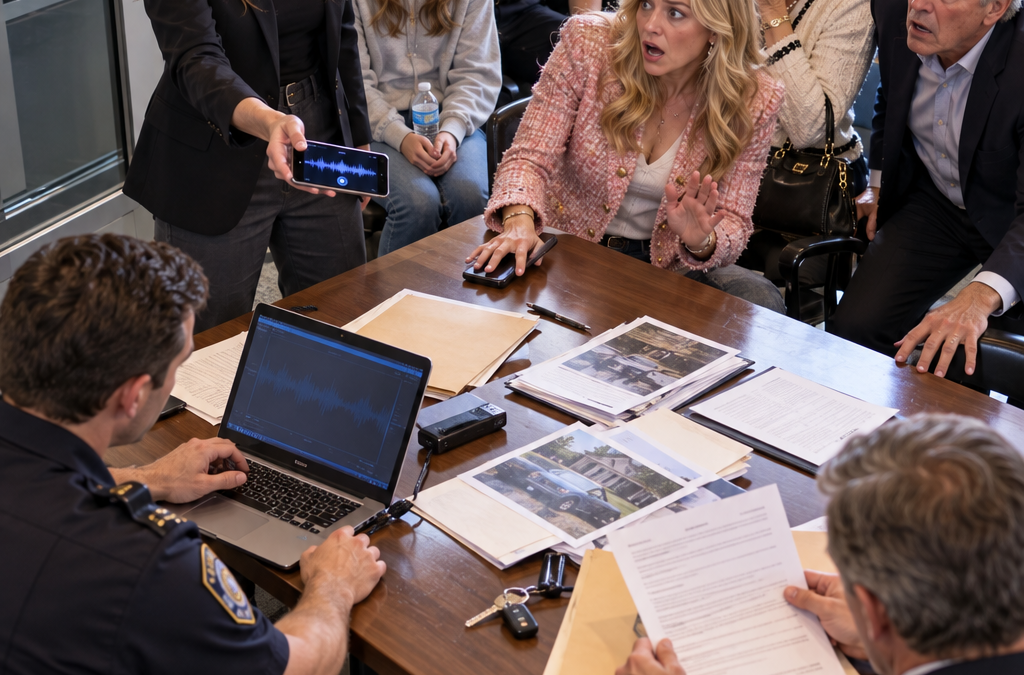
Catherine placed her laptop on the table.
“Detective, before these statements go any further, my client needs to submit evidence directly related to the vehicle and the identity of the driver.”
Mom’s head turned toward me.
For the first time, I saw uncertainty.
“What evidence?” Dad asked.
Catherine did not answer him.
She looked at Detective Alvarez.
“The Bronco contains a professionally installed telematics and security system that automatically activates when the ignition is engaged. It logs GPS movement, impact events, and cabin recording.”
Sienna went completely still.
My mother’s face lost color.
Dad looked at me.
“You recorded people without telling them?”
Catherine’s voice stayed calm.
“We can discuss admissibility questions separately. Right now, the detective needs to know the file exists.”
Detective Alvarez looked from Catherine to me.
“You have the recording from last night?”
“Yes.”
“How much?”
“Forty-seven minutes.”
My sister’s lips parted.
Mom whispered, “Mara.”
There was something almost pleading in her voice now.
It was the first time all day she had said my name as though I were a person rather than a problem she needed to manage.
Catherine turned the laptop toward the detective.
Then she pressed play.
Sienna’s voice filled the conference room.
“Oh my God. Okay, this is actually insane.”
Nobody moved.
I watched my father instead of the screen.
His jaw tightened when his own voice appeared.
I watched my mother’s hand flatten against the table when she heard herself discussing Leah’s height and hair.
Sienna covered her mouth.
Then the sentence came.
“We do this because you matter.”
My mother’s recorded voice sounded colder through laptop speakers.
“You are worth protecting.”
The file continued for another minute.
Then Catherine stopped it.
Silence filled the room.
Detective Alvarez looked at my parents.
Then at Sienna.
Then back at my parents.
He closed the folder in front of him.
“I think,” he said slowly, “we need to restart this conversation from the beginning.”
### Part 5
My mother tried to speak first.
“Detective, that recording is missing context.”
Catherine leaned back in her chair but said nothing.
Detective Alvarez looked at Mom with an expression that was neither angry nor sympathetic. “Then you’ll have an opportunity to provide whatever context you believe is missing.”
Dad turned toward me.
“Mara, think carefully about what you’re doing.”
I almost admired his consistency.
Even after hearing himself participate in a plan to accuse my daughter of something she had not done, he still believed the central issue was my reaction.
“I did,” I said.
Sienna began crying quietly.
Not the polished tears she had used online when sponsors dropped campaigns or followers criticized her. These were smaller and uglier, the tears of someone discovering that consequences were not always negotiable.
“I shouldn’t have taken the truck,” she whispered.
Dad looked at her sharply.
“Sienna.”
“No,” she said. “It’s already recorded.”
Her voice shook.
“I took the spare key from Mom’s purse.”
That answer hit me harder than I expected.
I looked at my mother.
She did not deny it.
“You took my key?”
Mom’s face hardened.
“You had already refused to help your sister.”
“So you stole it for her.”
“We intended to return the vehicle.”
Catherine finally spoke.
“That distinction may not help you as much as you think.”
Dad glared at her.
“This is a family matter.”
“Not once false statements are provided to police.”
Detective Alvarez raised a hand.
“Everyone needs to stop talking over each other.”
The rest of that afternoon became a blur of separate rooms, questions, timestamps, signatures, and requests for copies of evidence. Catherine stayed beside me through all of it, periodically reminding me to answer only what I actually knew and not what I assumed.
At one point, I saw my mother being led down another hallway.
She looked at me.
I had expected fury.
Instead, I saw disbelief.
She genuinely could not understand how the daughter who had always absorbed the damage had suddenly stepped aside.
That realization freed me more than anger would have.
For the next three days, developments came quickly.
Investigators verified the truck’s location data, reviewed exterior cameras near the event hall, and interviewed people who had been at the gala. Several witnesses remembered Sienna leaving the parking structure, and one person had apparently seen my parents arrive moments after the collision.
The story my parents had constructed collapsed almost immediately.
Catherine warned me not to obsess over specific charges while the investigation continued because those decisions belonged to prosecutors. What mattered to me was simpler: Leah’s name was cleared from the active suspicion surrounding the crash.
When I told her, she did not celebrate.
She sat at the kitchen table with both hands around a mug and stared down.
“So Grandma really knew I wasn’t there?”
“Yes.”
“And Grandpa too?”
“Yes.”
She nodded slowly.
“What about Aunt Sienna?”
I considered the question.
“She knew they were going to blame you.”
Leah swallowed.
“And she let them.”
“Yes.”
That was the part I could not soften.
My daughter deserved the truth even when the truth hurt.
For several weeks, our house felt quieter than usual. Leah went to school, came home, did homework, and disappeared into her room with music playing softly through the door.
I worried constantly.
Then one Saturday morning she joined me in the garage while I was looking over the damage to the Bronco.
The front corner was crushed badly enough that I could not open one panel correctly. The bumper had twisted, paint was gone across part of the body, and several components I had restored years earlier would need replacement.
Leah stood beside me.
“Can it be fixed?”
“Yes.”
“You sure?”
I ran my hand along the damaged metal.
“Anything can be rebuilt if the structure underneath is still good.”
She gave me a strange look.
I heard what I had said a second after I said it.
Neither of us commented.
She handed me a wrench.
That afternoon we worked together for nearly four hours.
We did not talk about my parents.
We did not talk about Sienna.
We talked about music, school, whether Leah should take ceramics the following semester, and why every ten-millimeter socket in the universe seemed to disappear the moment you needed it.
It was the most normal afternoon we had experienced since the police knocked on our door.
Outside our house, however, nothing was normal.
The investigation had become public.
I do not know who first connected Sienna’s name to the incident. Catherine insisted it had not come from her office, and I believed her.
But court filings exist.
Police records exist.
People talk.
Within days, online accounts began discussing the crash.
A week later, one of Sienna’s brand partners issued a brief statement announcing that its campaign with her would not move forward. Another suspended its agreement pending review.
My mother called fourteen times in one afternoon.
I did not answer.
Dad sent a message.
You have made your point. Call your mother.
I deleted it.
Then Sienna emailed me.
The subject line contained only my name.
I stared at it for ten minutes before opening it.
She wrote that she was sorry.
She wrote that she had been scared.
She wrote that everything happened quickly and that once Mom and Dad began talking, she felt trapped.
Then she wrote something that confirmed she still understood nothing.
I never wanted Leah to actually get hurt.
I read that sentence three times.
She believed harm only counted if the outcome became catastrophic.
Not the lie.
Not the accusation.
Not allowing police to come to my house in the middle of the night looking for my child.
She was sorry because the plan had failed.
Not because she had participated.
I closed the email.
Then I blocked her address.
### Part 6
The civil case over the Bronco moved more quietly than the criminal investigation but affected me in a more personal way. Catherine arranged for specialists to inspect the vehicle, document the damage, calculate restoration costs, and assess the loss in value associated with a collector vehicle that had now been in a significant collision.
The numbers became substantial.
My parents’ attorney requested mediation.
I agreed because Catherine advised me that a civil settlement could save months of unnecessary conflict.
The mediation took place in a downtown office overlooking the river.
My parents sat across the table from me for the first time since the police station.
Sienna was not there.
Mom looked smaller than I remembered.
Dad looked older.
That did not make me feel satisfaction.
It simply made them look human, which was somehow worse.
Their attorney spoke for nearly twenty minutes about proportionality, family relationships, financial hardship, and the potential benefit of resolving the dispute privately.
Then Mom interrupted him.
“Mara, can we please stop this?”
The mediator looked uncomfortable.
Catherine remained still beside me.
“What do you mean?” I asked.
“This.”
Mom gestured vaguely toward the papers between us.
“Attorneys. Claims. Numbers. You are treating us like strangers.”
I looked at her.
“You treated Leah worse than a stranger.”
Her eyes closed briefly.
“We panicked.”
“No. You planned.”
“We were trying to protect Sienna.”
“I know.”
“You don’t understand the pressure she was under.”
I almost laughed.
“What pressure?”
“Her career.”
“And that justified giving police my daughter’s name?”
Mom’s voice cracked.
“No.”
It was the first direct admission I had heard from her.
But it came months too late.
Dad leaned forward.
“We made a bad decision.”
“A bad decision is forgetting someone’s birthday.”
His mouth tightened.
“We made a serious mistake.”
“You discussed my daughter’s height, her hair, her age, and whether people would believe she was the driver. Then you signed statements.”
Neither answered.
I continued.
“You threatened my business funding because you thought I might refuse to cooperate.”
Dad looked down.
“You were not confused.”
I could hear my own heartbeat.
“You were not panicking.”
My voice stayed calm.
“You made a calculation. You decided Leah could absorb the consequences better than Sienna.”
Mom’s eyes filled with tears.
“I am sorry.”
I believed she was.
That did not mean I owed her anything.
There is a strange idea people have about apologies, as though remorse creates an invoice the injured person must pay with forgiveness. I had spent most of my life accepting that arrangement.
I was done.
The settlement was reached that afternoon.
My parents agreed to pay enough to cover the Bronco’s restoration, diminished value, legal expenses, and additional damages associated with the vehicle. The final figure was substantial but not life-changing for them.
Their attorney asked whether settlement could include confidentiality about “family communications.”
Catherine looked at me.
“No,” I said.
Mom stared at me.
“You want this public?”
“I don’t want anything.”
That was the truth.
“I am simply not signing another agreement designed to protect Sienna’s image.”
The settlement proceeded without it.
A few weeks later, the payment arrived through Catherine’s firm.
No note.
No call.
Nothing.
I was relieved.
By then, Sienna’s carefully constructed professional life had begun shrinking. Several brands ended agreements, her management company reportedly stopped representing her, and invitations that had once appeared weekly became rare.
I did not celebrate any of it.
Consequences had never been my objective.
Leah had been my objective.
That distinction mattered.
My parents seemed unable to understand it.
Dad sent one final email.
Your mother hasn’t slept properly in weeks. Whatever anger you feel, she is still your mother.
I stared at the message for a long time.
Then I typed a response.
Leah was still your granddaughter.
I did not send it.
I deleted the draft.
Silence was clearer.
Meanwhile, the Bronco restoration became part of my weekends again.
The damage was not easy to repair, but much of the deeper structural work I had completed years earlier had survived. Every time a mechanic or body specialist complimented the original restoration, I felt an unexpected pulse of pride.
I had built something solid.
It had been damaged.
It had not been destroyed.
Leah started helping regularly.
She still did not want to drive, which was fine with me.
But she liked sanding.
She liked organizing tools.
She liked choosing music for the garage.
One Sunday afternoon she stood beside the Bronco with dust on her sweatshirt and said, “Mom?”
“Yeah?”
“Were you always the one who fixed things in your family?”
I looked at her.
“I guess so.”
“Why?”
I thought about it.
“Because everyone told me I was good at it.”
She frowned.
“That doesn’t mean you had to.”
Sixteen years old.
And she understood in one sentence what had taken me almost four decades to learn.
“No,” I said. “It didn’t.”
She smiled faintly.
Then she returned to sanding the panel.
That night, alone in the kitchen, I thought about the phrase my parents had used for most of my life.
Strong one.
They had made it sound like a compliment.
Maybe sometimes it had been.
But strength without choice was simply another kind of obligation.
I had not been strong because I never broke.
I had been convenient because I broke quietly.
That difference changed everything.
### Part 7
Seven months after the crash, Leah turned seventeen.
She chose a small birthday dinner with three friends instead of the large family gathering we used to host every year. We ordered barbecue, bought a ridiculous chocolate cake, and let the girls take over the living room while I retreated upstairs with a glass of iced tea.
At some point I heard Leah laughing.
Not politely.
Not carefully.
Really laughing.
I sat on the edge of my bed and listened.
I had not realized how much I missed that sound.
The months after the crash had changed her in ways I worried I would never fully understand. She had become more skeptical when relatives texted, more hesitant when adults asked personal questions, and much less willing to assume that family relationships were automatically safe.
But she was also becoming herself again.
She joined the ceramics program at school and discovered she loved working with clay. Most Thursdays she came home with dried gray dust under her fingernails and some lopsided bowl or cup wrapped in newspaper.
One afternoon she placed a crooked blue mug on my desk.
“For you.”
I turned it in my hands.
“It leans.”
“It’s artistic.”
“It looks drunk.”
“Then it’s realistic.”
I laughed so hard I nearly spilled coffee.
Those small moments rebuilt us.
My parents did not attend her birthday.
They were not invited.
Mom mailed a card.
I recognized her handwriting before opening the envelope.
Leah looked at it for several seconds.
“Do I have to read it?”
“No.”
“Can I throw it away?”
“Yes.”
She dropped it into the kitchen trash unopened.
I did not retrieve it.
That was harder than I expected.
Old conditioning has a long half-life.
Part of me still imagined Mom sitting somewhere waiting for an answer. Part of me still heard Dad saying families protect each other.
Then I remembered two police officers on my porch.
I left the card in the trash.
Sienna attempted to contact Leah directly once through social media.
Leah showed me the message.
It was long.
Sienna apologized, said she loved her, said she had been under enormous pressure, and asked whether they could someday talk.
At the bottom she wrote, I hope you know I never wanted any of this to happen.
Leah handed me the phone.
“What do you think?”
I resisted the urge to tell her what to do.
For months I had promised myself that protecting my daughter would never become controlling my daughter.
“What do you think?” I asked.
She reread the message.
“I think she keeps talking about what she wanted.”
I waited.
“She doesn’t talk about what she did.”
I felt something warm and painful move through my chest.
“No,” I said. “She doesn’t.”
Leah blocked her.
I never mentioned it again.
The Bronco returned home two weeks later.
The repair shop delivered it on a flatbed in the middle of a bright Saturday morning. I stood at the end of the driveway while the driver lowered it slowly.
The paint looked perfect.
The body lines were right again.
The chrome caught the sun.
For months, I had imagined that moment would feel triumphant.
Instead, I cried.
Not because the truck was restored.
Because I suddenly remembered the rusted shell in the field years earlier.
I remembered buying it when my marriage had recently ended and I was rebuilding my finances while raising Leah alone. I had spent years giving everyone else practical explanations for why I deserved to spend money and time on something unnecessary.
The Bronco had been the first thing I stopped explaining.
I wanted it.
That had eventually become enough.
Maybe that was why Sienna taking it had felt so personal.
It was not only theft of a vehicle.
It was my family taking something I had chosen for myself and assuming they still had the right to decide how it should be used.
Leah came outside.
She walked around the truck slowly.
“It looks brand new.”
“Better than brand new.”
She smiled.
“Are you going to drive it?”
“Tomorrow.”
“Where?”
I looked west.
“Lake Travis.”
“Can I come?”
I hesitated.
“Early.”
“How early?”
“Before sunrise.”
She made a face.
“Never mind.”
I laughed.
That evening I checked the oil, tire pressure, brake fluid, battery, and every other thing I could think of even though the shop had already done all of it. I was not checking because I doubted their work.
I needed the ritual.
Before going inside, I sat behind the wheel.
The garage was silent.
My hands rested on the steering wheel.
For the first time in months, I did not hear Sienna’s voice.
I did not hear my mother’s recording.
I did not hear my father saying Leah had the right build.
I heard only silence.
Then my phone buzzed.
An email notification.
From Mom.
I almost deleted it without opening it.
Instead, I read the first line.
I know you may never forgive us.
I stopped.
For once, she had not written asking me to call.
She did not mention family loyalty.
She did not mention Sienna.
The email was only four paragraphs.
Mom admitted that what they did had been deliberate, that they had convinced themselves Leah would face fewer consequences, and that they had placed Sienna’s future above their granddaughter’s innocence. She wrote that she now understood why I wanted no contact.
At the end, she wrote, I hope someday you will believe that I regret it.
I closed the email.
I believed her.
And that was enough.
Not enough for forgiveness.
Not enough for reconciliation.
Enough for clarity.
I did not respond.
Some apologies are meant to repair relationships.
Others simply confirm that leaving was the right choice.
### Part 8
I drove toward Lake Travis before sunrise the next morning.
Austin was still half asleep, and the highway carried only scattered headlights. I kept the radio off and lowered the windows enough to let cool October air fill the cabin.
The engine sounded exactly the way it should.
Steady.
Clean.
Familiar.
For the first twenty minutes, I waited for memories to invade.
They did not.
I followed the road west as the sky slowly changed from black to gray, then from gray to pale blue. When the first sunlight reached the hills, it spread across the water in a flat golden sheet that made the entire landscape look suspended.
I pulled into an overlook.
Turned off the engine.
And sat there.
For years, I thought healing would feel dramatic.
I thought there would be a final conversation, a perfect sentence, some moment when the people who hurt you finally understood exactly what they had done and handed you closure like a returned possession.
That never happened.
My parents understood enough.
Sienna probably understood less.
None of it mattered as much as I once believed it would.
The real ending had happened quietly.
It happened when Leah stopped asking whether her grandparents might change their minds about her.
It happened when I stopped checking my phone after every family holiday.
It happened when Saturday arrived and I realized I had nowhere I was obligated to be.
It happened when my studio expansion succeeded without my parents’ financial help.
That part surprised them.
Maybe it surprised me too.
I delayed the project six months, changed the layout, secured a smaller commercial loan, and opened the expanded space the following spring. It was not as impressive as the original plan.
It was mine.
At the opening reception, Leah stood near the front desk drinking sparkling water from a plastic cup. Catherine came by for twenty minutes and brought flowers.
My parents were not there.
Sienna was not there.
Nothing felt missing.
That realization might have been the clearest answer I ever received.
I had spent decades believing family was a structure I had to hold upright.
If I stopped solving problems, who would solve them?
If I stopped forgiving, who would keep everyone together?
If I said no, who would absorb the consequences?
Those questions kept me obedient far longer than love ever could.
The truth was embarrassingly simple.
They would carry their own weight.
Or they would not.
Either way, it was no longer mine.
Months after the studio opened, I heard through an old cousin that my parents had moved to a smaller house outside the city. Mom had returned to part-time real estate work, and Dad had become quieter.
Sienna reportedly took a regular marketing job.
Her online following still existed, but the glamorous brand partnerships were mostly gone.
I did not search for her.
I did not celebrate her losses.
I did not mourn them either.
She was an adult living with the consequences of choices she had made.
For the first time in her life, I was not standing nearby trying to soften the landing.
One Sunday morning, Leah joined me in the garage while I was checking the Bronco.
She had grown taller.
Her hair was shorter.
A college brochure stuck out of her backpack.
She watched me for a minute.
“Can you teach me?”
I looked up.
“Teach you what?”
“To drive.”
I nearly dropped the wrench.
“You?”
“Don’t make it weird.”
“You postponed your permit twice.”
“I know.”
“You said cars were two-ton weapons.”
“I was dramatic.”
“You made me promise not to bring it up again.”
“Mom.”
I smiled.
“All right.”
She looked at the Bronco.
“Not in this.”
“Absolutely not.”
She laughed.
We used my ordinary SUV instead.
I drove us to an empty school parking lot on a Sunday afternoon. Leah adjusted the seat three times, checked every mirror twice, and gripped the steering wheel so tightly her knuckles turned pale.
“Breathe,” I said.
“I am breathing.”
“You look like you’re trying to defuse something.”
“Helpful.”
I showed her how to release the brake.
The vehicle rolled forward.
She gasped.
Then laughed.
Ten minutes later she was making slow circles around the parking lot.
Twenty minutes later she was practicing turns.
When we stopped, she looked at me with an expression I had not seen since she was little.
Pride.
“I did it.”
“You did.”
She stared through the windshield.
“Grandma said I could recover because I was young.”
I froze.
Leah continued before I could respond.
“I don’t think she understood that being young doesn’t mean things don’t matter.”
“No.”
“But maybe she was accidentally right about one thing.”
“What?”
Leah looked at me.
“I did recover.”
I felt tears burn behind my eyes.
“Yes.”
She smiled.
“But not because of them.”
“No.”
“Because you believed me.”
That sentence stayed with me.
I had spent months questioning whether I had been too harsh with my family, whether cutting contact had been extreme, whether I had allowed anger to make permanent decisions for me.
But Leah simplified everything.
She had needed one adult to believe her innocence mattered more than convenience.
I had been that adult.
Nothing else needed justification.
Later that year, I drove the Bronco back toward Wimberley, close to the field where I had originally found it. The old property had been sold and the weeds were gone, replaced by a new fence.
I pulled over anyway.
I looked across the road and remembered that rusted shell sitting under the Texas sun.
Nobody else had seen value in it.
I had.
I had dragged it home.
Taken it apart.
Learned what I did not know.
Built it slowly.
Then, years later, someone damaged it.
And I built it again.
For most of my life, my parents called me strong because strength was useful to them.
They believed strength meant taking the hit quietly.
Cleaning up.
Forgiving quickly.
Making sure everyone else remained comfortable.
They were wrong.
Strength was telling two police officers the truth even when the lie came from your own family.
Strength was letting people face consequences without rushing in to rescue them.
Strength was believing your child when everyone else had already decided she was expendable.
Strength was walking away from people you still loved because love did not make them safe.
And strength was understanding that forgiveness was not always the final chapter.
Sometimes clarity was.
I no longer hated my parents.
I no longer hated Sienna.
Hatred would have required me to keep them present in my life.
I simply stopped carrying them.
On quiet mornings, I still drive the Bronco west before the traffic gets heavy.
The windows stay down.
The radio stays off.
I listen to the engine.
Sometimes Leah comes with me now.
She has her learner’s permit, though she knows better than to ask for the Bronco keys.
At least for now.
When the road opens beside the lake and sunlight spreads across the water, I occasionally think about the woman I used to be.
The woman who answered every midnight phone call.
The woman who apologized for saying no.
The woman who believed being needed was the same as being loved.
I do not judge her.
She was doing what she had been trained to do.
But she is not driving anymore.
I am.
And if there is one thing I learned from the night my sister stole my truck and my parents offered my daughter’s future in exchange for her reputation, it is this:
A family does not fall apart because the strongest person finally stops holding it together.
The people who were leaning on her simply have to stand on their own.
And sometimes stepping away from the weight is not the end of your family.
It is the beginning of your life.
THE END!