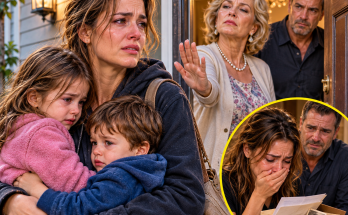
MY HUSBAND DIVORCED ME AFTER 37 YEARS OF MARRIAGE AND LEFT ME WITH A BANK CARD HE SAID HAD $300 — FIVE YEARS LATER, I CHECKED THE BALANCE AND FOUND $987,000 DEPOSITED BY HIM
PART 1 — THE GOODBYE
I was sixty-five years old when I finally understood that a person could leave your life without raising their voice.
My husband, Daniel, didn’t slam doors.
He didn’t scream.
He didn’t accuse me of anything.
He simply placed a folder on our kitchen table and said:
“I’m sorry.”
That was it.
Thirty-seven years of marriage reduced to two words.
I stared at him across the table.
“Sorry for what?”
He looked down.
“For all of it.”
I remember almost laughing.
Not because anything was funny.
Because I couldn’t understand how someone could say that after thirty-seven years as if he were canceling a magazine subscription.
We had met when I was twenty-seven.
We were married a year later.
We had raised two children.
We bought a small house.
We survived layoffs, illnesses, broken appliances, funerals, school bills, mortgage payments, and all the ordinary disasters that make up a lifetime.
Daniel had held my hand during my mother’s funeral.
I had sat beside him through his father’s cancer treatments.
We had celebrated anniversaries with cheap restaurant dinners because money was tight.
And now he was leaving.
No affair.
No fight.
No explanation that made sense.
Just papers.
And a cold goodbye.
Before he walked out, he reached into his wallet.
He handed me a bank card.
“There should be about three hundred dollars on it.”
I stared at the card.
“What is this?”
“Just something to help you.”
“Help me with what?”
He didn’t answer.
I pushed the card back toward him.
“I don’t want your charity.”
“It’s not charity.”
“Then what is it?”
He looked at me for several seconds.
Then he said something I didn’t understand.
“You’ll know when you need it.”
And he left.
I watched his car disappear down the street.
I didn’t cry.
Not that day.
I was too angry.
For the first six months after the divorce, I refused to touch the card.
I found work wherever I could.
I cut expenses.
I sold jewelry.
I stopped eating out.
I learned which grocery stores marked food down late in the evening.
Eventually, my savings disappeared.
But I still wouldn’t use Daniel’s card.
I couldn’t.
Every time I looked at it, I remembered the man who had given it to me like a farewell gift.
Three hundred dollars.
That’s what he had said.
Three hundred.
So I put it in an envelope.
And forgot about it.
Or at least I tried to.
PART 2 — FIVE YEARS LATER
Five years passed.
I was sixty-five.
The house felt enormous.
Too enormous.
The children had their own lives.
My daughter lived three states away.
My son had his own family.
I didn’t blame them.
Life moves forward.
That’s what people tell you.
But sometimes “moving forward” simply means learning how to be lonely without showing it.
My health had also become worse.
I didn’t have much money left.
Some mornings, I drank coffee for breakfast because it was cheaper than food.
I told myself I wasn’t hungry.
Eventually, my body stopped believing the lie.
One afternoon, I was standing in my kitchen when everything became blurry.
I grabbed the counter.
My knees weakened.
The next thing I remember was waking up on the floor.
My head hurt.
My hands were shaking.
There was nothing in the refrigerator except half a carton of milk and some mustard.
That was when I finally admitted something to myself.
I needed help.
I remembered the bank card.
Daniel’s card.
The one he’d said contained about $300.
I found it inside the old envelope.
For several minutes, I just stared at it.
Then I whispered:
“Fine.”
I put it in my purse.
The next morning, I went to the bank.
There was a young woman behind the counter.
She smiled politely.
“How can I help you?”
I handed her the card.
“I’d like to withdraw the balance.”
She inserted the card.
Typed something.
Then stopped.
She frowned.
Typed again.
Then she looked at me.
“Ma’am…”
“Yes?”
“Are you sure this is your account?”
I almost laughed.
“Yes. My ex-husband gave me the card five years ago.”
She looked at the screen again.
Then her expression changed.
She turned the monitor slightly toward me.
“I don’t think you understand.”
I leaned forward.
“What?”
She swallowed.
“This isn’t three hundred dollars.”
I stared at the number.
At first, my mind refused to process it.
Then I read it again.
$987,214.63
I blinked.
“No.”
She nodded slowly.
“That’s the current balance.”
My hands began shaking.
“That’s impossible.”
She printed something.
Then she said:
“There’s more.”
I looked at her.
“What do you mean?”
She lowered her voice.
“The deposits.”
She turned the paper toward me.
There were dozens of them.
Month after month.
Year after year.
Money deposited into the account.
And every deposit came from the same name.
Daniel Carter.
My ex-husband.
I stared at the page.
Five years.
He had been depositing money into that account the entire time.
While I struggled to buy groceries.
While I sold my jewelry.
While I wondered whether I could afford my electricity bill.
Daniel had been putting money into a bank account in my name.
Nearly one million dollars.
The teller looked at me.
“Ma’am, are you all right?”
I couldn’t answer.
Because suddenly I remembered his final words.
“You’ll know when you need it.”
PART 3 — THE FIRST QUESTION
I sat in the bank office for nearly an hour.
The manager came in.
His name was Mr. Harris.
He closed the door behind him.
“I’ve reviewed the account,” he said.
“Is it real?”
“Yes.”
“Can I access it?”
He nodded.
“You are the sole account holder.”
I couldn’t breathe.
“Then why did my husband tell me there was only three hundred dollars?”
Mr. Harris paused.
“I can’t speak to his intentions.”
“Who opened this account?”
“Your former husband.”
“But it’s in my name.”
“Yes.”
“Why?”
“We don’t know.”
I looked at the statement.
There was one thing that stood out.
The deposits weren’t random.
They came every month.
Exactly.
Sometimes $12,000.
Sometimes $15,000.
Sometimes $20,000.
Over time, they had accumulated.
And because I hadn’t touched the account, the money had continued earning interest.
I asked the manager:
“Where did this money come from?”
He hesitated.
“Most of the deposits were transfers from a business account.”
“His business?”
“Yes.”
I felt a chill.
Daniel had owned a small construction company.
When we were married, it had been barely surviving.
Or so I thought.
After the divorce, I’d assumed he’d sold it.
Apparently, I had been wrong.
Very wrong.
“Can you tell me what happened to his company?”
Mr. Harris looked at the documents.
“He sold his ownership stake five years ago.”
My heart stopped.
“When?”
“The month before your divorce.”
I stared at him.
“How much did he receive?”
Mr. Harris checked.
Then he said:
“Just over four million dollars.”
I sat completely still.
Four million.
My husband had walked away from our thirty-seven-year marriage with millions.
And he had left me believing he was giving me three hundred dollars.
But why?
I left the bank that afternoon with only one thought.
I needed to find Daniel.
PART 4 — THE HOUSE THAT WASN’T HIS
I hadn’t spoken to Daniel in almost five years.
I had his old phone number.
It was disconnected.
His old address belonged to someone else.
I called our son.
“Michael,” I said, “I need to ask you something.”
“What happened?”
“Have you talked to your father recently?”
Silence.
Then:
“Mom… why?”
“Please.”
He sighed.
“Not much.”
“Where is he?”
“I don’t know exactly.”
“What does that mean?”
“He moved.”
“Where?”
Michael hesitated.
“Arizona, I think.”
I felt something inside me crack.
“Did you know he had nearly a million dollars in an account for me?”
Silence.
“What?”
I repeated it.
Michael didn’t answer.
“Mom, are you sure?”
“I’m looking at the statement.”
He breathed out.
“That’s… that’s a lot.”
“Did your father ever tell you anything?”
“No.”
But his voice sounded strange.
I knew my son.
“Michael.”
“What?”
“You’re hiding something.”
Another silence.
Finally he said:
“Dad told me once that if you ever contacted me about money, I shouldn’t interfere.”
My stomach tightened.
“Why would he say that?”
“I don’t know.”
“Michael.”
“I swear.”
I believed him.
Mostly.
That evening, I searched through the boxes in my attic.
I found old tax documents.
Insurance papers.
Our marriage certificate.
And eventually, I found something else.
A photograph.
Daniel and me standing outside our house on our twentieth anniversary.
We were smiling.
Behind us was the old garden.
I stared at his face.
How could the man in that photograph have become a stranger?
Then I noticed something in the background.
A wooden sign.
Our garden had a small sign Daniel had made himself.
It said:
“Home is where we choose to stay.”
I sat down and cried for the first time since the divorce.
Not because I missed him.
Because I finally understood that I had been grieving a marriage that Daniel had already mourned years before I knew it was dying.
But there was still one question.
Why nearly one million dollars?
PART 5 — THE LETTER
Three days later, a letter arrived.
No return address.
My hands trembled before I even opened it.
Inside was a single sheet of paper.
I recognized the handwriting immediately.
Daniel’s.
It said:
“Dear Margaret,
If you’re reading this, then you’ve finally used the card.
I’m sorry you had to wait this long.
I know you probably hate me.
You have every right to.
But please don’t return the money.
It was never meant to buy your forgiveness.
It was meant to give you something I should have given you thirty years ago.
Freedom.”
I read the letter twice.
Then again.
There was more.
“When we were first married, I made a promise to myself that you would never have to worry about money.
I failed.
I spent years pretending the business was doing worse than it was because I was afraid.
Afraid of losing everything.
Afraid of becoming my father.
Afraid that if you knew how much money I was making, you’d ask me to leave the business.
I became obsessed with protecting what we had.
And eventually, I destroyed what we had.”
My eyes filled with tears.
Daniel continued:
“The divorce wasn’t because I stopped loving you.
It was because I had become someone I couldn’t recognize.
I lied.
I hid money.
I worked constantly.
And I watched you become lonely beside me.
You deserved better.”
I stopped reading.
I couldn’t continue.
But eventually I did.
“The money is from the sale of my company.
Half belonged to me.
The other portion was money I had set aside over the years.
I divided it into monthly deposits because I didn’t want you to know where it came from.
If I had handed you a million dollars during the divorce, you would have refused it.
I knew you.
So I gave you the card and told you there was $300.”
I laughed through my tears.
He knew me.
After thirty-seven years, he still knew exactly what I would do.
Then I reached the final paragraph.
And it changed everything.
PART 6 — THE REAL REASON
“Margaret,
There’s something I didn’t tell you.
The doctors found something two years before our divorce.
I was diagnosed with a heart condition.
It wasn’t immediately life-threatening.
But it changed the way I looked at time.
I realized I had spent thirty-seven years preparing for a future I might never see.
I wanted you to have something when I was gone.
But I couldn’t give it to you while we were married.
Because you would have asked why.
And I couldn’t tell you.
I wasn’t brave enough.
So I chose the coward’s way.
I left.
I’m sorry.
I know that’s unforgivable.
But if you use the money, please use it for yourself.
Don’t save it.
Don’t give it to anyone because you think you owe them.
Travel.
Eat good food.
Buy the house you wanted.
Help someone if you want.
But live.
Please.
Daniel.”
I sat at the kitchen table until midnight.
My ex-husband had left me.
But he hadn’t abandoned me.
Not financially.
Not entirely.
There was another envelope inside the letter.
I opened it.
Inside was an address.
And a date.
Five years earlier.
The date of our divorce.
I didn’t understand.
Then I saw the final line.
“If you ever want to know the truth about why I really left, come here.”
PART 7 — THE LITTLE HOUSE IN ARIZONA
I booked a flight.
I didn’t tell my children.
I didn’t tell anyone.
I went alone.
The address led me to a small house outside a quiet Arizona town.
I knocked.
An elderly woman opened the door.
She looked at me.
Then she began crying.
“You must be Margaret.”
I froze.
“Who are you?”
She opened the door wider.
“My name is Evelyn.”
“How do you know my name?”
She looked toward the hallway.
“Because Daniel talked about you every week.”
My heart began pounding.
“Where is he?”
Evelyn looked down.
“He’s gone.”
I gripped the doorframe.
“What do you mean?”
“He died two years ago.”
The world seemed to stop.
I had spent five years thinking my husband had simply moved on.
He had been dead for two years.
I sat in Evelyn’s living room.
She brought me tea.
Then she told me the truth.
Daniel had been sick.
Very sick.
After the divorce, he moved to Arizona for treatment.
He had met Evelyn through a cardiac rehabilitation program.
They became friends.
Nothing more.
“He loved you,” she said.
I looked away.
“If he loved me, why did he leave?”
“Because he believed you would spend the rest of your life taking care of him.”
I shook my head.
“He didn’t give me a choice.”
“I know.”
“Then why?”
Evelyn reached into a drawer.
She pulled out a box.
Inside were dozens of letters.
All addressed to me.
Never mailed.
“I found these after he died.”
I opened the first one.
The date was six months after our divorce.
The second was dated a year later.
Then another.
And another.
He had written to me constantly.
He had simply never sent them.
One letter said:
“Today I drove past a restaurant where we used to eat.
I almost called you.
Then I remembered that you deserve a life without a man who needs you to be his nurse.
So I kept driving.”
Another said:
“Margaret, I hope you’re happy.
I hope you hate me less.
I hope you never need the money.
But if you do, I hope it helps.”
I couldn’t stop crying.
Then Evelyn said:
“There’s one more thing.”
PART 8 — THE SECRET HE NEVER TOLD ME
Evelyn handed me a medical envelope.
Inside were copies of Daniel’s medical records.
His condition had been far worse than I imagined.
He had been told he might only have several years.
He didn’t want me to spend those years caring for him.
But there was something else.
A note from his doctor.
It explained that Daniel had insisted on keeping his diagnosis private.
Why?
Because he believed his illness would destroy my future.
I read that sentence several times.
It made me angry.
It made me sad.
It made me furious.
“You know what the worst part is?” I said.
Evelyn nodded.
“He made the decision for me.”
She didn’t argue.
“He thought he was protecting me.”
“I know.”
“He didn’t let me decide whether I wanted to stay.”
“I know.”
“He took thirty-seven years of marriage and decided alone that I was better off without him.”
Evelyn’s eyes filled with tears.
“Yes.”
For the first time, I understood something important.
Love isn’t always enough.
Sometimes people make terrible decisions while believing they’re doing something noble.
Daniel had loved me.
And he had hurt me.
Both things could be true.
Before I left Arizona, Evelyn gave me one final envelope.
“This was supposed to be given to you after he died.”
Inside was a photograph.
Daniel sitting at a small desk.
Behind him was a framed photograph of our wedding.
On the back of the photograph he had written:
“She was the best thing that ever happened to me.”
I held it against my chest.
And cried.
PART 9 — WHAT I DID WITH THE MONEY
When I returned home, I didn’t become a different person.
I didn’t buy a mansion.
I didn’t purchase a sports car.
I didn’t go on some extravagant shopping spree.
Instead, I did something Daniel never expected.
I bought back my life.
I paid off the house.
I repaired the roof.
I replaced the old furnace.
I bought a reliable car.
Then I opened a small savings account for my grandchildren.
But most importantly, I created something called the Margaret Carter Foundation.
Its purpose was simple.
To help older women who suddenly found themselves alone after divorce, widowhood, or abandonment.
Women who had spent decades taking care of everyone else.
Women who didn’t know how to start again.
I understood them.
Because I had been one of them.
The first woman we helped was seventy-one.
Her husband had left after forty-three years.
She had no savings.
She was embarrassed to ask for help.
I gave her enough money to pay her rent for six months.
She cried.
Then she hugged me.
And I realized something.
Daniel’s money had finally become what he intended it to be.
Not a payment.
Not an apology.
A second chance.
Six months later, I received another letter.
This one came from a lawyer.
Daniel had left instructions in his will.
There was one final account.
The amount was $112,000.
The lawyer told me it had been designated specifically for one purpose.
“Your husband’s instructions were very clear,” he said.
“What did he want?”
The lawyer handed me a note.
It said:
“Give this to Margaret when she has helped her first ten women.
She’ll understand why.”
I stared at the words.
Then I laughed.
Daniel.
Even after death, he was still leaving me puzzles.
PART 10 — THE LAST SURPRISE
I helped the tenth woman six months later.
Then I called the lawyer.
He invited me to his office.
He opened a safe.
Inside was a small wooden box.
I recognized it immediately.
Daniel had made it thirty years earlier.
Inside was our wedding ring.
Not mine.
His.
He had kept it.
Beneath it was another letter.
I opened it.
“Margaret,
If you’ve reached this point, then I know something.
You didn’t spend the money trying to replace the life we lost.
You used it to help people.
That’s exactly why I left it to you.
You always had a bigger heart than mine.
I spent too much of my life believing money could protect people.
You taught me that sometimes what people need isn’t protection.
It’s a chance.
So here’s the final truth.
The $987,000 wasn’t everything.
There is another $2.4 million in a trust.
It’s yours.
Not because you’re my ex-wife.
Not because I owe you.
Because you’re the woman who stood beside me for thirty-seven years.
And because I should have trusted you enough to let you choose your own future.”
I couldn’t breathe.
Then I reached the final line.
“Please don’t spend your remaining years asking why I left.
Spend them asking where you want to go next.”
I closed my eyes.
For the first time in five years, I didn’t feel abandoned.
I felt free.
THE END — FIVE YEARS AFTER THE DISCOVERY
I’m seventy now.
People sometimes ask me if I regret marrying Daniel.
I always give the same answer.
“No.”
I regret the lies.
I regret the silence.
I regret the years we wasted being afraid to tell each other the truth.
But I don’t regret the thirty-seven years.
Because those years gave me my children.
My grandchildren.
My memories.
And eventually, the courage to begin again.
Today, I still have Daniel’s bank card.
The same card he told me had $300 on it.
I keep it in a small wooden box beside his wedding ring.
Sometimes I take it out.
Not because of the money.
Because of what it taught me.
That people can love you and still hurt you.
That someone can leave and still care.
That an ending doesn’t always mean the story was meaningless.
And most importantly…
That it’s never too late to start living for yourself.
I spent thirty-seven years being a wife.
Five years wondering why my husband left.
And the rest of my life learning who Margaret was without him.
The strange thing is…
The day I went to the bank because I was hungry,
I thought I was going there to withdraw $300.
I didn’t know I was walking in to discover the truth about my entire marriage.
I thought Daniel had left me with nothing.
Instead, he left me something far more complicated.
A second chance.
And sometimes…
The greatest inheritance isn’t money.
It’s the permission to finally live the life you were too afraid to choose.
THE END.