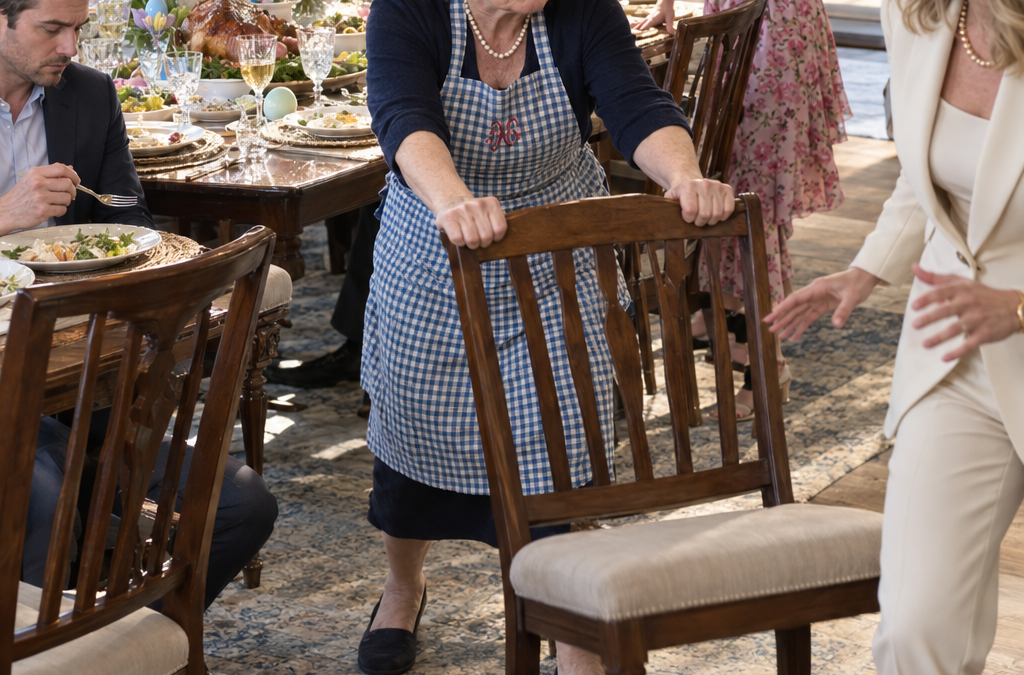
I spent twelve hours cooking Easter dinner in my own home, only for my daughter-in-law to arrive with nine uninvited relatives, give my chair to her mother, and tell me to eat in the kitchen. My son stared at his plate and let it happen. So I folded my apron and walked out. They thought I was being dramatic. Nine days later, a stranger showed up carrying a catering flyer with my address on it—and I finally understood why they had needed me hidden.
### Part 1
My name is Eleanor Mercer, I am sixty-eight years old, and until that Easter Sunday I believed there were certain humiliations a family simply would not ask an older woman to swallow. I was wrong. I started cooking before sunrise, the way I had for almost every holiday since my son was small, while the sky outside my kitchen window was still gray and the coffee maker sounded louder than anything else in the house.
The centerpiece was a sixteen-pound bone-in ham glazed with honey, cloves, brown sugar, and one ingredient I never bothered writing down because I had learned the mixture by smell long before I learned to measure it. I scored the fat in diamonds, pressed a clove into every intersection, then lowered the ham into a blue enamel roasting pan whose chipped rim and dented corner had been part of my kitchen longer than most people had been part of my life. My mother, June, had dropped that pan outside the diner where we both worked when I was sixteen.
She had stared at the dent and said, “Well, now nobody can mistake it for anyone else’s.”
That same year she made me a blue-checkered apron and stitched my initials, EM, into the chest with red thread. I still wore it on holidays.
By noon I had potatoes sliced for scalloping, eggs cooling for deviling, yeast dough rising beneath a towel, green beans trimmed, and a coconut cake assembled on the counter. My daughter-in-law, Mallory, had texted the night before to say her mother and “a few others” were coming. I planned for ten because any cook who prepares exactly enough food for the announced number of relatives has never hosted a family holiday.
My husband, Raymond, had been gone for five years. Since his death, holidays at my house had become less about tradition and more about proof that the family still had a center. I knew that sounded sentimental, but when you wake up alone most mornings, the sight of extra shoes by the door starts to matter.
My son, Caleb, was thirty-seven and sold commercial heating systems. He was talented because he could make people feel they had reached a decision on their own even when he had been guiding them there for twenty minutes. He married Mallory seven years earlier, and they had a five-year-old daughter named Lucy, who believed paprika belonged on food for the same reason glitter belonged on construction paper.
Mallory’s mother, Denise Halbrook, had never openly disliked me. Dislike would have required acknowledging me as someone worth the trouble. At Caleb and Mallory’s engagement party, she asked what I had done before retirement, and I said, “I cooked for a living.”
She looked at the people beside her and smiled. “Like school cafeterias?”
“Something like that.”
A few people laughed. Caleb smiled weakly and stared at his drink.
I remembered that moment more often than I admitted.
At five forty-five on Easter afternoon, Caleb arrived with Lucy and three folding chairs. I was carrying a bowl of boiled eggs when I saw him extending the dining table with both leaves.
“What are those for?”
“Mallory invited a couple more people.”
“How many is a couple?”
He stopped moving for half a second. “Nine, maybe.”
“Nine extra?”
He kept adjusting the table.
I set down the bowl. “Caleb.”
“It’s Easter, Mom.”
He said it to the table instead of to me.
Through the rear window of his SUV, I noticed a boxed ring light and a phone stabilizer. Caleb told me they belonged to Mallory’s brother, Shane. I asked why Shane needed professional filming equipment at my Easter dinner, and Caleb shrugged.
“He does social media stuff now.”
Lucy climbed onto a stool and helped me finish the deviled eggs. She covered them with enough paprika to qualify as weather.
“They’re beautiful,” she announced.
“They’re unforgettable.”
At least she laughed.
Forty minutes later, I heard three cars pull into the driveway almost at once. Mallory came through the front door first, smiling broadly and holding it open as if she were welcoming people into a rented event space. Denise came behind her, followed by Mallory’s brother Shane, her younger sister Paige and Paige’s fiancé Owen, Owen’s parents, Denise’s sister, and Denise’s brother-in-law.
Nine guests.
Not one had called me.
Denise removed her coat and dropped it into my arms without turning fully toward me.
“Thank you, Eleanor.”
She walked past.
Owen’s mother handed me a bottle of wine. “Sweetheart, could you put that somewhere?”
For a moment I stood in the entryway wearing my mother’s apron, carrying someone else’s coat and someone else’s wine while strangers entered my dining room.
“Everybody find a seat,” Mallory called.
Then she added, “Mom, you’re at the head.”
She meant Denise.
Shane set up his ring light beside the table.
I carried out the ham on my mother’s platter. Shane walked backward filming it, close enough that I had to tell him twice not to trip over the rug. Owen’s mother admired the glaze.
“Denise, how big is that?”
“Sixteen pounds,” Denise answered.
I stopped.
She had never seen the ham before that evening.
I told myself it was nothing.
I brought out the potatoes, beans, rolls, eggs, and gravy. Everyone talked loudly enough that I became part of the background noise, which is a familiar condition for cooks. Once every dish was down, I walked toward the chair nearest the kitchen door.
It had been my seat for forty years. The cook sits near the kitchen because the cook gets up twenty times before anyone else gets up once.
I pulled it back.
Mallory’s voice cut across the room.
“Don’t sit there.”
I looked at her.
“That’s my mother’s seat,” she said. “You can eat in the kitchen.”
Silence did not fall.
That was the worst part.
People kept moving. Shane adjusted his camera. Denise smoothed the front of her cream-colored pantsuit and began walking toward me.
I looked at Caleb.
My son lowered his eyes to his plate.
He picked up his fork.
Set it back down.
Said nothing.
Then Lucy spoke from halfway down the table.
“Grandma, I can eat in the kitchen with you.”
Mallory turned sharply. “No, honey. Sit down.”
I had been standing since before sunrise.
My feet hurt. My back hurt. My hands smelled like cloves and onions. I looked at the dented blue pan through the kitchen doorway and remembered my mother saying nobody could ever mistake it for someone else’s.
Something inside me became very quiet.
I pushed the chair toward Denise.
Then I returned to the kitchen, turned off the burner beneath the gravy, folded my mother’s apron carefully into thirds, and set it beside the blue pan.
I picked up my purse.
Nobody stopped me as I crossed the living room.
Nobody stopped me at the door.
I made it across the street before the first person screamed.
### Part 2
My neighbor Ruth Bell had lived across from me for thirty years and worked as an emergency-room nurse until retirement. She had seen enough human chaos that very little surprised her anymore. When I walked onto her porch without a coat, she took one look at me and disappeared inside.
She returned carrying a plate.
“Ham, sweet potatoes, and rolls,” she said. “Eat here or in my kitchen. Your choice.”
I laughed once, although nothing was funny.
I had eaten nothing since toast that morning, so I sat on her porch swing and took three bites before the smoke detector inside my house started shrieking. I had opened my kitchen window earlier because of the heat, and the alarm carried clearly across the street.
Then came the smell.
Burned fat.
Scorched gravy.
Cloves turned bitter.
Voices rose inside the house.
“What do I do?”
That was Denise.
“Turn it down!”
Mallory.
“Go get her!”
Someone else.
Lucy started crying.
Then a man laughed so hard I could hear him from Ruth’s porch.
A minute later, my front door opened and Caleb stepped onto the lawn. He looked up and down the street, but Ruth had switched off her porch light. He never noticed us sitting in the shadow.
He went back inside.
My phone vibrated repeatedly in my purse. I eventually counted six calls from Caleb and four from Mallory.
Ruth glanced toward my house. “Sounds like somebody who claimed she could cook has met a saucepan.”
I looked at her.
“What makes you say claimed?”
She shrugged. “Just guessing.”
At nine twenty, the final car left.
When I returned home, the kitchen looked as if twelve people had attempted to extinguish a grease fire using dinner.
The smoke detector battery lay on the floor. My gravy saucepan contained a pale, glue-like paste. Someone had placed my blue roasting pan directly over a high burner and burned the drippings into a black crust.
There was a new scorch mark beside the old dent.
My mother’s apron was missing from the counter.
I found it crumpled beside the trash can with gravy smeared across my initials.
The coconut cake was gone completely.
My phone showed a message from Caleb.
Mom, tonight was humiliating. Denise cried. Call me.
Mallory had written:
Owen’s parents had to watch Mom fix your gravy. Thanks for making everything awkward.
I read the message twice.
Why would Owen’s parents care whether Denise could make gravy?
I washed dishes until nearly midnight, but the question stayed with me.
Caleb appeared on my porch the next afternoon wearing his work shirt.
He remained outside.
“You embarrassed Mallory.”
“How?”
“Her family was there.”
“I noticed.”
“You walked out.”
“Yes.”
“They’re important people, Mom.”
That sentence interested me.
“Why?”
His jaw tightened.
“Paige is marrying into their family.”
“I already knew that.”
“It was supposed to be a good impression.”
“Of whom?”
Caleb looked past me into my hallway.
“Just apologize to Denise.”
“For what?”
“Leaving.”
“I left after being told to eat in my kitchen.”
“You made it about a chair.”
“No. Mallory made it about a chair. I simply believed her.”
His face hardened.
Then he said something I had heard in smaller versions for years.
“You always care more about cooking than family anyway.”
I knew immediately what memory he meant.
His tenth birthday.
I had been catering a wedding forty miles away when a thunderstorm destroyed part of the reception tent. Raymond took Caleb bowling with six boys while I stayed at the venue until after midnight helping save a wedding cake and feeding hundreds of wet guests.
I apologized the next morning.
I apologized again every year his birthday came up.
But I did not apologize that afternoon.
“I’ll apologize when someone explains exactly what I did wrong.”
He had no answer.
Before leaving, he checked his watch.
He never apologized for remaining silent at the table.
That mattered.
Two mornings later, Ruth crossed the street holding her tablet.
“You should see this.”
Mallory had posted a photograph of my Easter ham online.
My ham.
My blue pan.
My white tile counter.
The caption praised Denise for “working all day” to make Easter special for everyone.
Comments underneath complimented Denise’s cooking.
One relative wrote, Denise’s gravy was my favorite.
I stared at the screen.
There had barely been edible gravy after I left.
Ruth looked at me carefully. “Are you going to answer?”
“No.”
“Why not?”
“Because I don’t argue with people who need applause.”
But I kept thinking about that photograph.
Denise had walked into my house minutes before seven.
Why were they pretending she had cooked?
Three evenings later, Mallory called.
She skipped hello.
“Mom is still upset.”
“I assume you mean Denise.”
“You need to apologize.”
“I’ll discuss Easter with her anytime.”
“You’re impossible.”
I waited.
Mallory hated silence.
Eventually she said, “Do you understand what my mother’s life is like?”
Denise had recently had her hours cut at the dental office where she answered phones. I knew because Mallory had asked me for help with her rent two months earlier.
I had quietly sent twelve hundred dollars.
Mallory continued. “You have your house paid off. Dad left you a pension. Mom has nothing. She deserved one evening when people looked at her like she mattered.”
It was the first honest thing she had said.
“I don’t object to people looking at your mother.”
“You sure acted like it.”
“I object to disappearing so they can do it.”
Mallory exhaled sharply.
Then her voice became bright and practical.
“And you’ll help Mom with Paige’s wedding food.”
I straightened.
“What wedding food?”
“Nothing huge. Some trays.”
“Mallory.”
“She’s handling it.”
The call ended.
That Friday, Denise appeared holding my cake stand. Dried coconut frosting still marked the rim.
“I came to make peace,” she said.
She did not enter, although she spent most of the conversation staring past me toward the kitchen.
Then she asked if I had ever considered writing down my recipes.
“For the family.”
“My recipes are mostly in my head.”
“What about the ham glaze? Coconut cake?”
“Why?”
She smiled.
“So they aren’t lost.”
Something about the way she said it made my shoulders tighten.
Then Denise surprised me.
“My ex-husband left me eight years ago,” she said. “I had a four-bedroom house, a dining table for eighteen people, nice things. Now I answer phones part-time and live in an apartment.”
“I’m sorry.”
“And you have Raymond’s pension.”
I said nothing.
She looked toward my kitchen again.
“You were always modest about your little cooking job.”
“Was I?”
“Lunch lady sort of thing.”
“Something like that.”
She left.
On Sunday, Caleb brought Lucy over.
While we made deviled eggs, Lucy casually told me that Nana Denise was going to cook Aunt Paige’s wedding.
“With your big blue pan,” she added.
I set down the spoon.
“Who said that?”
“Mommy.”
I wiped paprika from Lucy’s cheek.
“My pan doesn’t leave this kitchen.”
The next evening, Mallory and Shane came to my house without calling.
Mallory stood in the entryway.
“We need your roasting pan and stand mixer.”
“No.”
She blinked.
“What?”
“No.”
“It’s a pan.”
“Then buy one.”
Behind her, Shane had already walked into my kitchen.
He raised his phone.
Click.
My stove.
Click.
My backsplash.
Click.
My window.
“What are you doing?”
“Getting content.”
“For what?”
“Relax.”
He took another photograph.
I stepped between him and the counter.
“Put the phone away.”
He finally did.
They left angry and empty-handed.
Mallory paused on the porch.
“You’re making this much harder than it has to be.”
Twenty-four hours later, I finally learned what “this” was.
At ten in the morning, a stranger rang my bell carrying a printed price list.
At the bottom, beneath photographs of my food, my kitchen, and my mother’s dented blue pan, was an address for customer pickup.
My address.
### Part 3
The woman on my porch introduced herself as Susan Merritt. She was around sixty and wore reading glasses on a beaded chain.
“I hope I’m not bothering you,” she said. “My grandson has a nut allergy, and I wanted to ask about the Mother’s Day brunch boxes before I ordered.”
“What boxes?”
She looked confused.
“Denise’s Sunday Kitchen.”
Susan handed me the flyer.
Mother’s Day brunch box: eighty-five dollars.
Glazed ham tray: ninety-five.
Three-layer coconut cake: forty-five.
Pickup at our kitchen.
My address followed.
At the bottom was another line:
Now booking summer weddings, showers, graduations, and reunions.
The flyer included three photographs. One showed my Easter ham inside my blue pan. Another showed the backsplash behind my stove.
The third had been cropped badly enough that part of my blue-checkered sleeve remained visible.
My mother’s apron.
Susan studied my face.
“Is Denise here?”
“No.”
“Does she rent the kitchen?”
“No.”
“But the flyer says—”
“No food is being sold from this property.”
Her expression changed.
“Then who made the food?”
“That is an excellent question.”
After she left, I carried the flyer across the street.
Ruth already had her tablet open.
We found Denise’s business page within minutes.
It had nearly four thousand followers.
The account had been created shortly after Denise’s work hours were reduced.
We scrolled.
My Thanksgiving pecan pie.
My Christmas rib roast.
My dinner rolls.
My coconut cake.
Family photographs had been cropped until only platters remained.
One post from Christmas showed my dining room table with the caption, Another holiday feeding the people I love.
Another showed Easter’s ham.
Twelve hours in my kitchen today, it said.
Those were my twelve hours.
Near the top was a pinned announcement.
PAIGE AND OWEN — JUNE 13 — 140 GUESTS.
Our first full-service wedding.
Thank you to the Harper family for trusting Denise’s Sunday Kitchen.
I recognized Owen’s parents.
The supposedly “important people” Caleb had mentioned.
Then everything became obvious.
They had not come to Easter as ordinary guests.
They had come for a tasting.
Denise had presented herself as a caterer.
Mallory needed her mother seated at the head of the table.
Shane needed photographs.
I needed to remain invisible.
Eat in the kitchen.
Of course.
I sat back.
“They sold your dinner,” Ruth whispered.
“No.”
I looked at my hands.
“They sold my hands.”
I called Susan and warned her not to order anything from my address.
The next morning, I visited my attorney, Margaret Sloan.
Margaret had reviewed my business contracts for more than twenty-five years. She read the flyer, studied screenshots of the social-media page, and asked one question.
“Did you authorize any of this?”
“No.”
She drafted a formal notice stating that Denise, Mallory, and anyone associated with their venture had no permission to use my property, address, kitchen images, recipes, or personal photographs in commercial advertising.
Seven days to remove everything.
I changed my locks the following morning.
Caleb still technically had an old key, although it had lived on Mallory’s ring for years.
That evening, I called him.
“Did you know they were using my address?”
He became quiet.
“Mallory said you wouldn’t care.”
“You knew.”
“It was only for pickup.”
“That is not an answer.”
He sighed.
“Mom, it’s not like they were moving in.”
“Did you know Easter was a tasting?”
Another silence.
This one told me more than words.
“I’m changing the locks.”
“Come on.”
“The letter from my attorney should arrive Saturday.”
His voice sharpened. “Attorney?”
“Yes.”
“Mom, you don’t need a lawyer for family.”
“They stopped treating it like family when they printed prices.”
Saturday morning, Mallory called screaming.
“You sent my mother a legal letter?”
“You advertised my home as a business.”
“Paige’s wedding is eight weeks away!”
“Then Denise should hire a caterer.”
“She is the caterer.”
“Then there shouldn’t be a problem.”
Mallory went silent.
Finally she said, “She can’t do a hundred and forty people by herself.”
There it was.
The truth.
They had never expected Denise to cook the wedding.
They had expected me to.
“You love cooking,” Mallory continued. “You would be in the kitchen anyway. What difference does it make whose name is on it?”
I almost laughed.
“All the difference in the world.”
Her voice changed.
“If you keep doing this, don’t expect to see Lucy.”
That hurt.
Of everything they had said, that was the first sentence that truly landed.
I thought about my granddaughter standing on a stool, sprinkling paprika over eggs.
I closed my eyes.
“You don’t use a child to rent a grandmother.”
Mallory said nothing.
“I’ll eat in my kitchen,” I continued. “I won’t work in your mother’s imaginary one.”
“You are bitter.”
“Goodbye, Mallory.”
I ended the call gently.
Two days later, Shane arrived with a folder.
He called it a business proposal.
“You cook the wedding and the Mother’s Day orders,” he said. “We give you ten percent.”
“Ten percent?”
“Of revenue.”
“For cooking all the food?”
“Well, you’re basically kitchen staff.”
I leaned back.
“How much did Owen’s parents pay?”
He hesitated.
Then pride defeated caution.
“Forty-eight hundred deposit.”
“How much did you get?”
“I manage marketing.”
“That wasn’t my question.”
“Twenty-five percent.”
Shane had recently lost his advertising job and was carrying thousands of dollars in credit-card debt. Denise’s business page had become his plan for staying afloat.
For one second, he looked tired enough that I almost pitied him.
Then he leaned forward.
“I filmed Easter.”
“I know.”
“If I post it, everyone will see you walk out because you didn’t get the best chair.”
“Post whatever you like.”
His expression changed.
He had expected fear.
That evening, the video appeared.
It began seconds after Mallory ordered me into the kitchen. Conveniently, the beginning was missing.
The clip showed only a sixty-eight-year-old woman taking off her apron and leaving while everyone else sat around the table.
The caption called me an entitled mother-in-law.
Within two days, tens of thousands of people had watched it.
Some called me selfish.
Some called me controlling.
A woman wrote that her mother-in-law behaved exactly the same way.
But several comments asked something more interesting.
Why did nobody at the table stop her?
Why did her son stare at his plate?
Why is the host wearing an apron if the other woman supposedly cooked?
Shane deleted several of those comments.
Then Ruth called me late one night.
“Look at the newest comment.”
Someone had written:
Wait. I know that blue pan.
The comment disappeared within an hour.
But I saw it first.
The next morning at seven, my phone rang.
The name on the screen was Mateo.
I had not heard his voice since Christmas.
“Eleanor,” he said immediately, “I saw that Easter video.”
I sat up in bed.
“And?”
“I recognized your apron.”
My hand tightened around the phone.
“More importantly, Denise Halbrook emailed me.”
“When?”
“Two days ago.”
“Why?”
“She wants Blue Hearth Catering to cook a hundred-and-forty-person wedding.”
I said nothing.
“Food only,” Mateo continued. “Delivered in plain disposable pans. No company stickers. No staff. She specifically wrote, ‘The clients believe I’m preparing everything.’”
My feet touched the floor.
He kept talking.
“She attached a menu.”
I already knew what he was about to say.
“Honey-clove ham. Scalloped potatoes. Bacon green beans. Deviled eggs. Yeast rolls. Coconut cake.”
My menu.
My mother’s recipes.
Then Mateo said the sentence that changed the entire situation.
“She also asked to rent our tasting room.”
For the first time since Easter, I smiled.
Denise had unknowingly booked a tasting inside the company I had founded.
### Part 4
Thirty-five years earlier, I opened Blue Hearth Catering with six thousand dollars, two borrowed refrigerators, and my mother’s dented roasting pan.
I never deliberately hid that history from Mallory’s family. Caleb did most of the hiding for me.
When Caleb was young, Blue Hearth grew faster than I expected. I started in a rented bakery and eventually built a full commercial kitchen, employed more than forty people, and handled weddings across three counties.
That success came with a cost.
I missed school programs.
I missed dinners.
I once missed Caleb’s birthday during the thunderstorm wedding he later turned into evidence that I loved strangers more than my own son.
There was enough truth inside his resentment that I never defended myself very well.
When I sold the business seven years earlier, Mateo Alvarez bought it from me. He had started as a dishwasher at nineteen, moved through prep, purchasing, logistics, and eventually operations.
The sale made me financially comfortable.
It did not change the house I lived in.
It did not change the dented pan.
And apparently, according to Denise, it did not change my status from lunch lady.
When I visited Blue Hearth after Mateo’s call, the brick building looked almost exactly the same.
The painted blue roasting pan beside the entrance had faded.
The dent in the painted corner was still there.
Two employees I remembered came out of the kitchen to hug me.
Mateo printed Denise’s email.
Her words looked worse on paper.
No Blue Hearth branding, please. Clients believe Denise’s Sunday Kitchen is preparing the wedding meal.
Mateo tapped the page.
“We already declined.”
“Good.”
“Our permits and insurance follow our food. We don’t cook under someone else’s name.”
“Good.”
“She still wants the tasting.”
I looked up.
“When?”
“May ninth.”
“Where?”
“Here.”
I smiled.
Mateo narrowed his eyes.
“I know that expression.”
“No, you don’t.”
“I worked for you twenty-three years.”
“Then you should know better than to interrupt.”
He laughed.
There was another issue.
The wedding venue required every caterer to submit liability insurance and health permits thirty days before the event. Denise had neither.
The deadline was approaching.
“She can’t legally service the event,” Mateo said.
“She probably doesn’t know that.”
“She does now. I mentioned it in our email.”
“Did she cancel?”
“No.”
That told me Denise still believed she could somehow use Blue Hearth’s kitchen, Blue Hearth’s food, and my recipes while keeping Blue Hearth invisible.
“How much is the tasting?”
“Standard fee.”
“Take it.”
Mateo stared at me.
“You want me to accept her?”
“For the tasting only.”
“What are you thinking?”
“Treat her exactly like any other customer.”
His smile slowly appeared.
“That sounds dangerous.”
“I want your standard tasting cards on every plate.”
“Always.”
“I’ll cook.”
Mateo stopped smiling.
“Eleanor.”
“I mean it.”
“You haven’t worked a full prep shift in years.”
“So?”
“You’ll complain about your knees for a week.”
“I already complain about my knees.”
He laughed again.
Then he reached across the desk.
“Welcome home.”
Four days later, Denise called.
Her voice was warm enough to spread on toast.
“Eleanor, we are family.”
“That is what people keep telling me.”
“We should stop fighting.”
“I’m not fighting.”
“Help me with Paige’s wedding. I’m willing to put you in the program.”
I nearly asked her to repeat herself.
“How?”
“With help from Eleanor Mercer.”
“With help?”
“Yes.”
“Fifty years of cooking and I get a footnote?”
Her sweetness disappeared.
“You always have to make everything about yourself.”
I leaned against the kitchen counter.
“Denise, you put my address on a price list.”
“I said I’d remove it.”
“After my lawyer asked you.”
“You’re enjoying this.”
“No.”
That part was true.
I was not enjoying the damage.
I was enjoying clarity.
Denise became dismissive.
“It doesn’t matter. I have a professional partner now.”
“I’m glad.”
“A commercial kitchen.”
“Even better.”
“The best operation in the county.”
“I’ve heard good things.”
Something about my voice made her pause.
Then she continued.
“Owen’s parents are coming for my tasting on the ninth. After that, this silly Easter issue will be forgotten.”
“I hope the tasting clears everything up.”
Again, I meant it.
After hanging up, I wrote a prep list for the first time in years.
Two bone-in hams.
Yukon Gold potatoes.
Fresh green beans.
Heavy cream.
Three fresh coconuts.
Yeast.
Eggs.
Honey.
Cloves.
Sorghum.
My mother used to say a cook was the only person at a party who knew what would happen next because everyone else arrived after the work was done.
For the first time since Easter, I felt like myself.
Then Caleb came to my house alone.
He knocked because his old key no longer worked.
He sat at my kitchen table and stared at his hands.
“I want to tell you what happened after you left Easter.”
I poured coffee.
He told me Owen’s mother had followed Denise into the kitchen because she wanted to watch the “famous gravy” being finished.
Denise had turned the burner under my blue pan too high.
The drippings smoked.
She panicked.
She ruined the gravy.
The alarm sounded.
Owen’s father laughed because Denise had spent the evening describing techniques she clearly did not know.
“Did Mallory tell them Denise cooked everything?”
Caleb nodded.
“And you knew?”
“Yes.”
“Did you know they expected me to cook the wedding?”
He looked away.
“I knew Mallory thought you would.”
“Why?”
“She said you’d never say no if she called it family.”
I sat across from him.
“That was never a family dinner, Caleb. It was a sales presentation.”
He nodded again.
Then he asked whether he could bring Lucy to see me on Mother’s Day.
“Mallory said no,” he added immediately.
I understood.
He was still asking permission from his wife to behave like my son.
That realization was almost sadder than his silence at Easter.
When he left, I did not tell him about the tasting.
Eight days later, at five in the morning, I walked into Blue Hearth carrying my mother’s pan.
A young prep cook noticed the dent.
“Is that actually the pan from the logo?”
I set it on the stainless-steel counter.
“It’s the pan that came before the logo.”
Then I tied on my mother’s stained apron and went back to work.
### Part 5
A commercial kitchen wakes differently from a house.
At home, morning cooking begins with the refrigerator humming and one coffee cup on the counter. At Blue Hearth, it began with ventilation fans, delivery carts, ovens preheating, sheet pans striking steel racks, and cooks calling temperatures across the room.
I had forgotten how much I loved the noise.
By six, the hams were scored.
By seven, the coconut layers were cooling.
By eight, the potatoes were portioned.
Mateo’s sous-chef, Daniel, watched me chop onions and said, “You still hold a knife like you’re mad at vegetables.”
“I trained you better than that.”
“You never trained me. I was terrified of you.”
“Good.”
He laughed.
My mother’s apron still carried the faint gravy stain from Easter. I had washed it repeatedly, but a pale brown shadow remained across the red initials.
I considered replacing it.
Then I decided against it.
Scars were records too.
Late that afternoon, Mateo showed me another email from Denise.
Please keep kitchen employees out of sight during the tasting. I will present each course myself.
Mateo looked offended.
“You want me to answer?”
“No.”
“Eleanor.”
“She rented a tasting.”
“She rented the room. She didn’t rent reality.”
“Then reality can stay behind the kitchen door until someone asks for it.”
The following day, guests began arriving shortly before two.
The tasting room had a walnut table that seated twelve. A serving window connected it to the kitchen, though a wooden screen prevented guests from seeing directly inside.
I positioned myself at the stove.
Through a narrow gap, I watched Denise enter wearing a brand-new white chef’s jacket embroidered with Denise’s Sunday Kitchen.
I nearly admired the commitment.
Mallory followed.
Then Caleb.
Shane carried his stabilizer and phone.
Paige and Owen came together.
Owen’s parents, Patricia and Martin Harper, entered behind them.
Denise’s sister and brother-in-law completed the group.
Caleb stopped near the entrance.
From where I stood, I could not hear him clearly, but I saw him looking through the front windows toward the painted roasting pan on the brick exterior.
His face changed.
Mallory pulled him toward the table.
Denise stood at the head.
“Thank you all for coming,” she began.
Her voice carried easily.
“After Easter, I wanted Patricia and Martin to have a chance to see what I can really do under professional conditions.”
She rested one hand over the embroidered name on her jacket.
“Everything you’re eating today was prepared fresh by me in this kitchen.”
Beside me, Daniel looked at me.
I held one finger to my lips.
The first plates went out.
Ham sliced thin.
Scalloped potatoes.
Green beans.
Gravy.
Every plate carried Blue Hearth’s standard cream-colored tasting card.
Denise described the ham.
“This glaze comes from my grandmother.”
Interesting.
Her grandmother had apparently cooked exactly like my mother.
Patricia tasted slowly.
“There’s something behind the honey,” she said.
Denise answered immediately.
“Sorghum.”
My hand stopped above the gravy pan.
She had learned more than I realized.
Probably from Mallory watching me over the years.
The meal continued.
Paige looked relieved.
Owen ate three rolls.
Martin said little.
Then Denise noticed the tasting card.
Her expression flickered.
She quietly turned hers facedown.
Patricia picked up her own.
“Blue Hearth Catering,” she read.
Denise smiled.
“They’re my kitchen partner.”
“Partner?”
“I rent the space.”
Patricia nodded.
Then she tasted the gravy again.
“This is excellent.”
“Thank you.”
Patricia tilted her head.
“It’s completely different from Easter.”
Denise’s face tightened.
“Well, Easter was chaotic.”
“I’d like to meet whoever is working your stove.”
Denise’s eyes widened.
“There’s no need.”
“I always meet the chef before hiring a caterer.”
“I’m the chef.”
“Then who is currently cooking?”
Denise laughed too quickly.
“Just support staff.”
Patricia pushed back her chair.
“I’d still like to thank them.”
She started toward the kitchen.
Shane swung his camera in her direction.
Denise moved after her.
“Patricia, honestly, the cake is coming.”
Mateo reached the kitchen door first.
He opened it.
I stood at the stove whisking gravy in my dented blue pan.
My mother’s apron covered an emerald-green dress because I had learned long ago that chefs occasionally needed to become businesswomen without time to change.
I finished stirring before turning.
Nine faces crowded behind Patricia.
Caleb.
Mallory.
Paige.
Owen.
Martin.
Shane.
And Denise.
Patricia looked from me to the pan.
Then to the painted company emblem on a rack beside the door.
Her mouth opened slightly.
“You.”
I placed the whisk down.
“Yes?”
“You’re the woman from Easter.”
“I am.”
“The woman who left.”
“Yes.”
Patricia stared at my apron.
“You cooked that dinner.”
I smiled faintly.
“I cooked this one too.”
Behind her, Mallory whispered something I could not hear.
Denise found her voice.
“What is she doing here?”
I looked at my blue pan.
“Cooking.”
Her face lost color.
Mateo stepped beside me.
“My name is Mateo Alvarez. I own Blue Hearth Catering.”
He gestured toward me.
“Eleanor Mercer founded this company in 1991. I purchased it from her seven years ago.”
Nobody spoke.
Mateo continued.
“Every primary recipe served today belongs to Blue Hearth’s original menu developed by Eleanor and her mother.”
Paige slowly turned toward Denise.
“Mom?”
Mateo picked up a printed email.
“Mrs. Halbrook contacted us asking Blue Hearth to prepare your wedding meal and deliver it without branding.”
Denise moved quickly.
“That was a misunderstanding.”
Mateo kept reading.
“Her exact instruction was, ‘No Blue Hearth labels, please. The clients believe I’m preparing everything.’”
Martin stood.
Owen stopped chewing.
Mallory backed against the stainless-steel wall.
Shane’s phone remained raised.
Mateo looked directly at him.
“You’re recording?”
Shane hesitated.
“Yes.”
“Good.”
Denise stared at me.
“You planned this.”
“No.”
“You set me up.”
“You booked the tasting.”
“You knew!”
“I knew you were coming.”
“You wanted to humiliate me.”
I lowered my voice.
“Denise, I stayed in the kitchen. Exactly where your daughter told me to stay.”
The room became completely still.
Then Mallory snapped.
“You made my mother look ridiculous.”
I looked at her.
“No. I made gravy.”
### Part 6
There are moments when a lie collapses dramatically.
This was not one of them.
No plates shattered.
Nobody fainted.
Nobody shouted at first.
The truth simply sat in the middle of the kitchen while everyone slowly realized they would have to reorganize themselves around it.
Denise recovered first.
“You told me you were a lunch lady.”
“I told you I cooked for a living.”
“You let me believe—”
“I let you finish your own sentence.”
Her eyes filled with fury.
“For seven years?”
“For seven years, my employment history was never relevant to dinner.”
Shane lifted his phone higher.
“This whole thing is going online.”
Martin Harper turned toward him.
“Please do.”
Shane hesitated.
Martin pointed toward Mateo’s printed email.
“Start there.”
The phone lowered slightly.
I looked at Shane.
“Relax. It’s content.”
Daniel made a choking sound that might have been laughter.
Then Patricia opened her handbag.
She removed a folded contract.
“I brought this because I wanted to review serving times.”
She laid the pages on the prep table.
“Denise’s Sunday Kitchen. One hundred forty guests. Sixty-eight dollars per person. Deposit: four thousand seven hundred sixty dollars.”
Denise stared at the document.
Patricia continued.
“I paid you for food you apparently cannot prepare from a kitchen you do not own.”
“I can explain.”
“I’m listening.”
Denise opened her mouth.
Nothing came.
Patricia tapped the contract.
“The venue requires proof of health permitting and liability coverage by Thursday.”
Denise looked toward Mallory.
Mallory looked toward Shane.
Patricia understood immediately.
“You don’t have either.”
“We were arranging them.”
“How?”
No answer.
“I want my deposit returned Monday.”
“Patricia—”
“All of it.”
“I already used part of it.”
Patricia’s voice remained perfectly calm.
“That sounds like a separate problem.”
Denise’s shoulders sagged.
For the first time since I had known her, she looked her age.
Then the blame began moving.
“This was Mallory’s idea,” she said.
Mallory stepped forward.
“Excuse me?”
“You said Eleanor would cook.”
“I said she always cooks!”
“You promised.”
“I didn’t tell you to take deposits.”
“Shane built the page.”
Shane threw up a hand.
“I handled marketing. You agreed to the numbers.”
Paige stared at all three of them.
“You used Aunt Eleanor’s food to sell my wedding?”
Mallory turned on her.
“We were trying to help Mom.”
“With my wedding?”
“You were getting a cheaper caterer!”
“I wasn’t asking for cheap!”
Owen stepped beside Paige.
“Everybody stop.”
Denise sat heavily on a stool.
The embroidered chef’s jacket suddenly looked less like a uniform and more like a costume.
“I’m sixty-three years old,” she said quietly. “I work twenty hours a week answering phones. I lost my house. I lost my marriage. I just wanted one thing that belonged to me.”
The anger in the room softened slightly.
I believed her.
Wanting dignity was not a crime.
Wanting ownership was not a crime.
Wanting someone else’s accomplishments to become yours because you believed life had treated you unfairly was another matter.
“Then build something,” I said.
Denise looked at me.
“But don’t borrow mine.”
Her eyes filled.
“You have everything.”
“No.”
“You sold this place for millions.”
Several people turned toward me.
Mallory looked stunned.
Apparently somebody had finally searched public records or asked a question.
I nodded.
“I did well.”
“And you let me struggle.”
“I paid twelve hundred dollars toward your rent in January.”
Denise froze.
Mallory’s face drained.
I continued.
“I did it because Mallory asked. Quietly.”
Denise looked at her daughter.
“You said that was from you.”
Mallory swallowed.
“I was going to pay her back.”
“When?”
Mallory had no answer.
I felt a strange sadness.
Their entire system operated through borrowed things.
Borrowed credit.
Borrowed recipes.
Borrowed generosity.
Borrowed authority.
Then Paige spoke to Mateo.
“Is it too late for Blue Hearth to cater our wedding?”
Mateo glanced at me.
“I held June thirteenth after Patricia requested a quote earlier this year.”
Patricia turned toward him.
“You kept the date?”
“I never released it.”
Paige covered her mouth.
Tears appeared immediately.
“I thought we were going to lose the venue.”
“You won’t,” Mateo said.
I stepped closer.
“And I’ll make the coconut cake.”
Paige looked at me.
“For the wedding?”
“For you.”
Not Denise’s page.
Not Mallory’s plan.
Not an online brand.
For the bride.
Paige began crying.
Owen wrapped one arm around her.
Denise stood.
She removed the white chef’s jacket and folded it once over her arm.
She walked out without saying goodbye.
Shane followed.
Denise’s sister and brother-in-law slipped out behind them.
Mallory remained.
She looked at Caleb.
“You’re coming.”
It was not a question.
Caleb stared at her.
For the first time, he did not look away.
“I sat at Mom’s table on Easter and watched you send her to the kitchen.”
Mallory’s face hardened.
“Now is not the time.”
“I said nothing.”
“She walked out because she wanted attention.”
“I knew why your parents were there.”
“They aren’t my parents.”
“You know what I mean.”
He swallowed.
“I knew it was a tasting. I knew you were using Mom’s cooking.”
Mallory crossed her arms.
“And?”
“And I let you do it because arguing with you was harder than disappointing her.”
Nobody spoke.
Caleb looked at me.
“That doesn’t make me innocent.”
No, it did not.
But it was the first honest sentence I had heard from him in a long time.
Mallory stared at her husband.
“Are you really choosing her?”
Caleb shook his head.
“That’s the problem. I kept acting like I had to choose.”
Mallory turned and walked out.
Caleb remained beside the prep table.
He looked at the dented blue pan.
Then at me.
“Mom?”
“Yes?”
His voice broke slightly.
“Can I eat in the kitchen with you?”
I handed him a plate.
He stood beside me at the counter and ate ham, potatoes, and gravy like he had when he was nine years old.
For a few minutes, neither of us mentioned Easter.
Then he looked down at his plate.
“I was angry about my tenth birthday for twenty-seven years.”
“I know.”
“You apologized.”
“Many times.”
“I liked keeping it.”
“What?”
“The anger.”
I waited.
“If I stayed angry about that one birthday, I didn’t have to admit I was proud of you.”
That surprised me.
He rubbed his forehead.
“I thought if I told Mallory what Blue Hearth was, she’d think I came from money.”
“You did not.”
“I know.”
“I started with borrowed ovens.”
“I know that too.”
He nodded.
“I think I wanted your success to stay invisible because I spent so long treating it like something you did to me.”
I put my hand on his shoulder.
I did not tell him everything was forgiven.
That would have been dishonest.
But I stayed beside him while he finished eating.
Sometimes reconciliation begins before forgiveness.
Sometimes it never becomes forgiveness at all.
### Part 7
The consequences arrived quietly.
By Mother’s Day, Denise’s business page disappeared.
Shane’s edited Easter video vanished the same afternoon.
Patricia received most of her deposit back on Monday. Denise had spent some of it, and Shane had already taken his marketing percentage, but both agreed to repay the remainder after Patricia mentioned small claims court.
She never had to file.
Susan Merritt, the woman who first brought the flyer to my door, called me when she heard the story.
“I almost bought four brunch boxes.”
“Then I’m glad you asked about the allergy.”
She laughed.
“No offense, but after meeting you, I don’t think I would ever buy ham from somebody who isn’t you.”
“That is an unreasonable amount of trust.”
“Fine. Two hams.”
No food was ever sold from my house.
My attorney confirmed that the advertising photographs and my address had been removed.
The locks remained changed.
On Mother’s Day morning, Caleb came alone.
He carried a ladder.
Without asking, he replaced the battery in my smoke detector.
Then he came into the kitchen.
“Mallory says I’m undermining her.”
“Are you?”
“I don’t know anymore.”
“That usually means yes.”
He smiled despite himself.
Then his expression became serious.
“I’m sorry, Mom.”
“For what?”
He looked confused.
“Easter.”
“That’s one thing.”
“For knowing about the tasting.”
“Two.”
“For letting Mallory threaten you with Lucy.”
“Three.”
“For pretending Blue Hearth was something shameful.”
I nodded.
“Four.”
He laughed once.
“There are probably more.”
“There usually are.”
Then I poured coffee.
I did not say the apology fixed everything.
Caleb did not ask me to.
That mattered.
Mallory sent a message two weeks later.
I’m sorry you felt humiliated.
I read it twice.
The sentence contained no admission that she had humiliated me.
I did not respond.
Caleb later told me they had begun marriage counseling.
I wished them well privately.
I did not involve myself.
My relationship with Lucy resumed gradually.
At first, Caleb brought her every other Sunday.
Mallory allowed it, although “allowed” was Caleb’s word, and I told him they would eventually have to address that language if they wanted their marriage to improve.
I never asked Lucy about the conflict.
Children should not become investigators for adults.
We made biscuits.
We planted tomatoes.
She continued using paprika irresponsibly.
Meanwhile, I returned to Blue Hearth several times to help prepare for Paige and Owen’s wedding.
I discovered my body remembered kitchen work faster than my knees forgave it.
Young cooks asked questions about older recipes.
Mateo pretended he was still my employee whenever I criticized his storage system.
“You sold the company,” he reminded me.
“I sold the assets. Apparently I retained the right to complain.”
“That wasn’t in the contract.”
“Call Margaret.”
He laughed.
Paige visited one afternoon to taste the coconut cake.
She came alone.
After finishing half a slice, she placed her fork down.
“I’m sorry.”
“For what?”
“For Easter.”
“You did not tell me to eat in the kitchen.”
“I still sat there.”
“So did ten people.”
“I should have gotten up.”
“Yes.”
Her eyes widened slightly.
Perhaps she expected me to rescue her from the discomfort.
I had stopped doing that.
“But you’re here now,” I added.
She nodded.
“Mom says you destroyed her.”
“No.”
“I know.”
I waited.
“She says she could have made the business work.”
“Maybe.”
Paige looked surprised.
“You think so?”
“If she had started by learning to cook, getting permits, using her own photographs, building her own menu, and charging people for something she could actually provide, yes.”
Paige stared at the cake.
“She wanted things quickly.”
“Most people do.”
“Do you hate her?”
“No.”
That answer surprised even me.
“I don’t trust her.”
“That’s different.”
“Very.”
Paige asked whether Denise could still attend the wedding.
“That is your decision.”
“I didn’t want you uncomfortable.”
“It isn’t my wedding.”
She studied me.
“You really don’t want revenge, do you?”
“I wanted my name back.”
“That’s it?”
“And my kitchen.”
She smiled.
“And your chair.”
“That too.”
On June thirteenth, Blue Hearth catered one hundred forty guests at the renovated railroad hall where Paige and Owen married.
I arrived before sunrise.
The kitchen smelled like yeast, coffee, ham glaze, and floor cleaner.
Exactly like work.
I baked the coconut cake myself.
Three layers.
Fresh coconut.
My mother’s recipe.
Beside it, Mateo placed a small card:
June Mercer’s Coconut Cake — Blue Hearth Original Recipe.
I stared at it longer than necessary.
“You okay?” he asked.
“Yes.”
“You’re crying.”
“I have onions nearby.”
“There are no onions on the dessert station.”
“Then someone should fix that.”
He walked away laughing.
Denise attended the wedding.
She sat with her sister near the middle of the room.
She wore a navy dress and no embroidered jacket.
We did not speak.
I saw her eat one slice of coconut cake.
Then another.
For some reason, that pleased me.
Shane attended too.
He kept his phone in his pocket during dinner.
Around eight, Caleb found me beside the service door.
“You haven’t sat down.”
“I’m working.”
“You don’t work here anymore.”
“Tell Mateo.”
“I did. He said you don’t listen.”
“Smart man.”
Caleb smiled.
Then he pulled a chair from the wall.
“Sit five minutes.”
I did.
My son sat beside me.
Across the ballroom, Mallory stood near Denise.
She saw us.
Our eyes met.
She looked away first.
I felt no triumph.
I felt tired.
And strangely free.
Because for the first time, I understood that closure was not the moment another person apologized correctly.
Sometimes they never did.
Closure could simply be the moment their refusal to understand stopped controlling your next decision.
### Part 8
That summer, I made several changes.
The first was small.
I stopped automatically agreeing to host every holiday.
For decades, my house had been considered the family gathering place because I cooked, cleaned, owned enough chairs, and rarely complained.
Now invitations came from me.
Not assumptions.
At Thanksgiving, I invited Caleb, Lucy, Ruth, Mateo, Paige, Owen, and several old friends.
Mallory came with Caleb.
Denise did not.
Nobody asked why.
My chair remained the one nearest the kitchen.
This time, when I sat down, nobody told me where I belonged.
The second change involved money.
For years, I had been careful about discussing what I earned from selling Blue Hearth because I did not want money changing the way relatives behaved around me.
I eventually realized secrecy had not prevented people from forming opinions.
It had simply allowed them to invent whatever version of my life suited them.
I did not start announcing my bank balance.
I did something better.
I donated fifty thousand dollars to the culinary program at a community college thirty miles away.
The scholarship honored my mother.
The June Mercer Scholarship went to students who worked food-service jobs while attending classes.
The first recipient was a nineteen-year-old dishwasher taking evening courses in hospitality management.
When Mateo heard, he cried.
I told him that was embarrassing.
He told everyone anyway.
Ruth demanded the first slice of the next coconut cake I made.
I gave her two.
Caleb and Mallory remained in counseling.
They did not magically become happy.
Real marriages rarely transform on schedule.
Some weeks Caleb looked hopeful.
Other weeks he looked exhausted.
I stopped asking for reports.
Lucy mattered to me.
Their marriage belonged to them.
Mallory eventually came to my house alone one afternoon in September.
I almost did not let her inside.
But I opened the door.
She stood in the hallway for several seconds.
“I owe you a better apology.”
“Yes.”
She looked startled by the answer.
I waited.
“I used your work.”
“Yes.”
“I knew Mom couldn’t cook the wedding.”
“Yes.”
“I thought if we got far enough, you’d step in.”
“Yes.”
“I knew you would hate it.”
“That one I didn’t know you understood.”
Her eyes filled.
“I told myself you’d complain, then do it because you always do things for everyone.”
I said nothing.
“I also knew Dad’s parents respected you, and that bothered me.”
“You mean Owen’s parents.”
“Yes.”
She rubbed her palms together.
“I wanted them to think Mom was impressive.”
“There are ways to help your mother become impressive without making someone else disappear.”
“I know.”
“Do you?”
“I’m learning.”
That was more honest than I expected.
Then she said, “I’m sorry I used Lucy.”
My throat tightened.
“That was the worst part.”
“I know.”
“No, Mallory. I need you to understand this. You can be angry with me. You can dislike me. You can refuse my invitations. But you do not turn a child into punishment.”
She nodded.
“I won’t again.”
I believed she understood the words.
Trust would require time.
Mallory looked toward the kitchen.
“Can I ask something?”
“Yes.”
“How much of the Blue Hearth sale did Caleb know about?”
“All of it.”
Her mouth opened.
“He never told me.”
“That is between you and your husband.”
“He said he was ashamed.”
“Not of the money.”
“Of what?”
I looked at her.
“Of what he believed it cost him.”
She became quiet.
Then she left.
I did not hug her.
I did not tell her everything was fine.
But I did not hate her either.
There are relationships that survive because people forgive everything.
There are others that survive because everyone finally accepts the boundaries around what will never be forgotten.
Caleb has a new key to my house.
Mallory does not.
That is not revenge.
It is information translated into hardware.
The blue roasting pan still sits in my kitchen.
The corner carries the dent from my mother’s mistake when I was sixteen.
Inside it is the black scorch mark from Easter.
I considered restoring it once.
A cookware specialist told me he could probably improve the stain.
I declined.
The dent reminds me where I began.
The scar reminds me where I finally stopped.
I sometimes think about Denise.
From what Paige tells me, she took another full-time receptionist position and began baking simple cakes for friends.
Not selling them.
Just learning.
I hope she eventually creates something that belongs entirely to her.
I mean that.
I also hope she never puts my address on another piece of paper.
On Easter the following year, I woke before sunrise out of habit.
For a moment, I almost began cooking automatically.
Then I remembered the new rule.
Nobody had been invited until noon.
I made coffee.
I sat at my kitchen table.
Sunlight moved across the blue pan drying beside the sink.
At eleven, Caleb arrived carrying folding chairs.
I raised one eyebrow.
“Relax,” he said. “I called first.”
Lucy ran in behind him carrying a paper bag.
“I brought paprika!”
“Why?”
“For the eggs.”
“How much?”
She opened the bag.
Far too much.
By noon, Paige and Owen arrived.
Ruth crossed the street carrying sweet potatoes.
Mallory came twenty minutes later with a pie she had made herself.
It was slightly overbaked.
I ate it anyway.
Nobody brought a ring light.
Nobody photographed the ham before I served it.
Nobody called the food someone else’s.
Denise did not attend.
I was comfortable with that.
When dinner was ready, I placed everything on the table.
Then I pulled out the chair nearest the kitchen.
My chair.
Lucy climbed into the seat beside me.
Caleb looked across the table.
“You sitting down this year?”
“I thought I might.”
He smiled.
“Good.”
I sat.
For the first time in decades, I stayed seated through almost the entire meal.
Someone else refilled the rolls.
Someone else carried dishes.
Someone else checked the coffee.
The kitchen survived without me for twenty minutes.
That might have been the biggest surprise of all.
People sometimes ask whether I regret walking out that first Easter.
I do not.
I regret only how long I believed keeping peace required remaining quiet while other people made decisions about my labor, my home, my money, and eventually my dignity.
I had confused generosity with availability.
They are not the same.
I had confused forgiveness with access.
Those are not the same either.
And for years, I thought love meant making sure everyone else had a place at my table even if I had to surrender mine.
That was the mistake.
A family table should have room for everyone.
Including the woman who cooked the meal.
So if someone ever points toward the kitchen and tells you that is where you belong, you are free to go.
Just remember to take your name, your work, and your recipes with you.
The kitchen was never the insult.
Being erased was.
And once I understood that, nobody ever got to assign my seat again.
THE END!