Richard Halston’s hand remained suspended over the board for one second too long.
In any other game, against any other opponent, no one would have noticed.
But now, in the thick silence that had swallowed the room, everyone noticed everything.
The billionaire who had laughed first…
The man who had offered one hundred million dollars like it was pocket change…
The same man who had spoken to a child as though humiliation were entertainment…
Was hesitating.
Across from him, Emily sat exactly as she had from the beginning—small hands folded briefly in her lap after every move, shoulders relaxed, eyes fixed on the board with a focus that seemed almost unnatural for someone her age.
She did not smile.
She did not taunt him.
She simply waited.
That made it worse.
Richard finally moved a bishop with controlled force, setting it down harder than necessary.
“There,” he said, though his voice had lost some of its earlier ease. “Let’s see how you answer that.”
Emily looked at the piece.
Then at the entire board.
Not nervously.
Not hurriedly.
As if she were listening to something only she could hear.
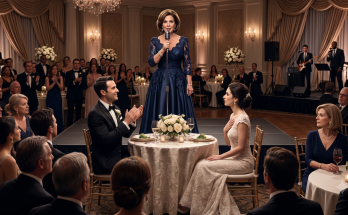
The guests leaned in.
Phones stayed raised.
No one laughed now.
Because what had begun as a rich man’s little spectacle had become something else entirely.
Emily reached forward and slid her knight into place.
Soft click.
Nothing dramatic.
And yet the effect was immediate.
A murmur moved through the room like a sudden draft.
Richard froze.
His eyes narrowed.
Then widened.
Not much.
Just enough.
Because with that one quiet move, she had cut off his escape on two sides without sacrificing a single major piece.
One of the men near the bar let out a low whistle.
Another whispered, “That wasn’t luck.”
Maria, standing behind her daughter, pressed one trembling hand to her mouth.
Richard leaned closer, elbows on the table now, no longer pretending this was amusing.
He studied the board.
Studied Emily.
Then gave a short, dry laugh.
“Well,” he said, “somebody’s been practicing.”
Emily looked up for the first time in several minutes.
“Yes,” she said softly. “A lot.”
There was something in the way she answered that made Richard’s face shift.
Not much.
But enough.
Something about her calm had begun to unsettle him more deeply than the game itself.
He made another move.
Faster this time.
Less elegant.
He was trying to regain momentum.
Trying to force the board back into familiar territory.
Emily responded in less than three seconds.
Then he moved again.
She answered.
Again.
Again.
Each one of her moves felt less like a reaction and more like a confirmation of something she had already decided long before he touched the piece.
A woman near the staircase lowered her phone and whispered, “She’s leading him.”
And she was.
Not by much.
Not obviously enough for amateurs to see at first glance.
But the people in the room who knew chess—really knew it—had gone completely still.
Because Emily wasn’t just surviving.
She was guiding him somewhere.
Richard felt it too.
That was the worst part.
Not the danger on the board.
The sensation that he had entered a path she understood better than he did.
He sat back, exhaled once through his nose, then leaned forward again and captured one of her rooks.
A few people reacted immediately.
“There it is.”
“Now he’s got her.”
Richard smiled again, but the smile looked forced now, stretched over tension.
“You see?” he said, glancing briefly toward the crowd. “Talent only gets you so far.”
Emily’s gaze never left the board.
“I know,” she replied. “That’s why I don’t rely on talent.”
He frowned.
Before he could answer, she moved her queen.
The room went silent again.
One move.
That was all.
One move, and everything Richard had built over the last twelve turns was suddenly exposed for what it had become:
A trap he had walked into willingly.
He stared at the board.
Then stared harder.
Someone near the back whispered, “No…”
Another man stepped closer, forgetting all pretense. “That’s… that’s not possible.”
But it was.
Richard’s king was boxed in.
His strongest pieces were still standing, but useless.
Decorative.
Power without freedom.
He looked up at Emily sharply.
“Who taught you that line?”
The question came too fast.
Too personally.
Maria’s head lifted.
Emily’s face stayed calm, but now something flickered there.
Not fear.
Not pride.
Memory.
“My father did,” she said quietly.
Richard’s expression changed at once.
Not confusion.
Not just surprise.
Something deeper.
Something that made the air in the room feel suddenly colder.
He looked at Maria.
She had gone pale.
“Maria,” he said slowly, “what is this?”
Maria swallowed, her hands clasping tighter.
“Richard…”
He stood so abruptly that the chair legs scraped hard across the marble floor.
“What is this?”
Emily finally looked away from the board and up at him fully.
Her eyes were dark, steady, and far older than they should have been.
“You said we were playing for the truth,” she said.
A pulse jumped visibly in Richard’s jaw.
“I said we were playing for money.”
Emily shook her head once.
“No,” she said softly. “You offered money because you thought this was a joke.”
Every person in the room felt the shift.
The chess match was no longer the center of the evening.
It had become a door.
And something long buried had just stepped through it.
Richard looked at Maria again, and this time there was no amusement left in him at all.
“Take her home,” he said sharply.
But Emily spoke before Maria could move.
“You should hear the rest.”
Richard turned.
“No.”
It was the first honest thing he had said in several minutes.
Emily reached into the pocket of her cardigan and pulled out something folded and worn with age.
Paper.
A single yellowed sheet, creased many times.
She placed it gently beside the chessboard.
The room held its breath.
Richard stared at it without touching it.
Because he already knew what it was.
Or feared he did.
Maria closed her eyes.
“I told you not to bring that,” she whispered.
Emily’s voice remained soft.
“I know.”
Richard’s hand moved toward the paper.
Then stopped.
He looked at Maria.
“Where did she get this?”
Maria’s lips trembled.
“I kept it.”
The answer landed like a blow.
Richard stared at her, disbelief mixing with something much uglier.
“You told me you burned everything.”
Maria looked at him with the exhausted grief of someone who had carried a lie until it became heavier than the truth.
“I lied.”
The room seemed to tilt around them.
Richard picked up the letter with shaking fingers.
Unfolded it.
And the instant his eyes found the handwriting, all color left his face.
“Dear Richard,” he read silently at first.
Then stopped.
His hand trembled harder.
That handwriting belonged to only one person.
Eleanor Vale.
The woman he had loved twenty years earlier.
The woman who had vanished from his life so suddenly and completely that he had told himself for years it was easier not to know why.
The woman Maria had once told him ran off with someone else after taking money to disappear.
The woman he had buried in his mind because anger was easier to live with than grief.
Now her words were in his hand.
Real.
Fragile.
Surviving.
Richard read another line.
Then another.
His breathing changed.
“No,” he whispered.
A guest near the front stepped forward. “Richard?”
But he didn’t hear him.
He was reading.
And with every line, the lie inside him cracked wider.
Eleanor had not abandoned him.
She had not taken money.
She had not chosen someone else.
She had written that she was pregnant.
That she had tried to come see him.
That she had been turned away from the estate gate by someone in the house.
That she had been told Richard wanted nothing to do with “a servant girl trying to trap him.”
Richard’s eyes lifted slowly from the page.
To Maria.
Maria was crying now.
Not dramatically.
Quietly.
Like someone who had rehearsed this moment in nightmares and still wasn’t ready for it.
“My mother worked in this house too,” she whispered. “Back then. She heard everything.”
Richard stared at her.
“My mother,” Maria continued shakily, “was the one ordered to carry the message to Eleanor. But she couldn’t do it. She couldn’t tell a pregnant woman that lie to her face. So she kept the letter instead.” Tears slid down her cheeks. “By the time I found it years later… Eleanor was already gone.”
Richard’s voice came out raw.
“Who turned her away?”
Maria didn’t answer.
She didn’t need to.
Because footsteps sounded at the top of the staircase.
Slow.
Measured.
And every head in the room turned.
An older woman stood there in a silk robe, one hand resting lightly on the railing, her face drained of composure.
Vivian Halston.
Richard’s mother.
Elegant.
Controlled.
Untouchable for decades.
Until now.
Richard looked up at her with a face transformed by horror.
“You knew.”
Vivian said nothing.
That silence was answer enough.
“You told me she left,” Richard said, louder now. “You said she was after money. You said she was carrying another man’s child.”
Vivian descended one step.
“I protected this family.”
Emily’s expression did not change.
Maria let out a broken sound.
And Richard… Richard laughed.
But there was nothing sane in it.
“Protected?” he repeated. “From what? Love? Shame? Your own disgust?”
Vivian’s voice sharpened.
“From weakness.”
The word hit the room like ice.
Richard looked down at Emily.
At the child who had outplayed him in front of everyone.
At the child with Eleanor’s eyes.
At the child who had walked into his house not asking for money, not begging for recognition, but bringing proof.
His lips parted.
His voice, when it came, was barely there.
“Emily…”
She met his gaze.
“You’re my daughter.”
It wasn’t a question.
He said it like a man falling from a great height and only then realizing how far there was to drop.
Emily nodded once.
A single tear slipped down her cheek, but she did not wipe it away.
“Yes.”
The room broke into whispers.
Gasps.
Stunned half-sentences.
Phones lowered now, forgotten.
Because wealth had stopped being entertaining the moment it became exposed.
Richard took one slow step toward her.
Then stopped.
Because what right did he have?
All this time.
All these years.
And he had laughed at her.
Mocked her.
Offered her a hundred million dollars like he was buying dignity from a child who should never have needed to prove her mind to him in the first place.
“I didn’t know,” he said.
Emily’s face trembled for the first time.
“I know,” she whispered.
That hurt more than anger would have.
Because forgiveness offered too soon can feel like judgment.
Richard looked at Maria.
“Eleanor?”
Maria shook her head, crying harder now.
“She died last winter.”
The words hollowed him out.
He stood there in the center of the room, the chessboard still between them, the check he had promised still unwritten, and understood with brutal clarity that the greatest humiliation of the evening had never been the possibility of losing to a child.
It was this:
He had already lost the life he should have been living long before she ever sat down at the board.
Emily reached toward the chess pieces and gently turned his king onto its side.
Checkmate.
The soft click echoed through the room like a verdict.
No one spoke.
Then Richard did something no one in that house had ever seen him do.
He sank to one knee in front of her.
Not performative.
Not graceful.
Not for the crowd.
For her.
His voice broke completely.
“I can’t give you back the years I didn’t know,” he said. “And I can’t ask you to fix what I failed to protect. But if there is anything left that I can do…”
Emily looked at him with those same dark, steady eyes.
Then at the board.
Then at the letter in his hand.
Finally she asked the question that mattered more than the money, the mansion, the audience, or the check he had boasted about at the start.
“Will you tell the truth tomorrow too?”
Richard closed his eyes briefly.
Because she understood something adults often spend entire lives avoiding:
A public moment means nothing if the truth is hidden again by morning.
When he opened his eyes, there was no arrogance left in them.
“Yes,” he said.
And somehow, that simple answer silenced the room more completely than any display of power ever had.
But before anyone could move, before the first stunned guest could decide whether to leave or stay, before Vivian could retreat upstairs and pretend control still belonged to her—
the front doors opened.
Hard.
A man in a dark suit entered with two others behind him, rain still clinging to his shoulders, a leather folder in one hand.
He did not look like a guest.
He looked like consequence.
His eyes moved from Richard… to Vivian… to the chessboard… to Emily.
Then he said the words that turned the entire night toward an even darker edge.
“Mr. Halston,” he said, voice flat, official, final. “I’m here regarding Eleanor Vale’s sealed estate file.”
Richard stared.
“What?”
The man lifted the folder.
“There’s been a challenge to the inheritance.” He glanced at Emily. “And according to the newly released documents… your daughter is not the only child Eleanor left behind.”
No one breathed.
No one moved.
Because in that instant, the checkmate on the board stopped being the end of the story.
It became the first move in a much larger game.