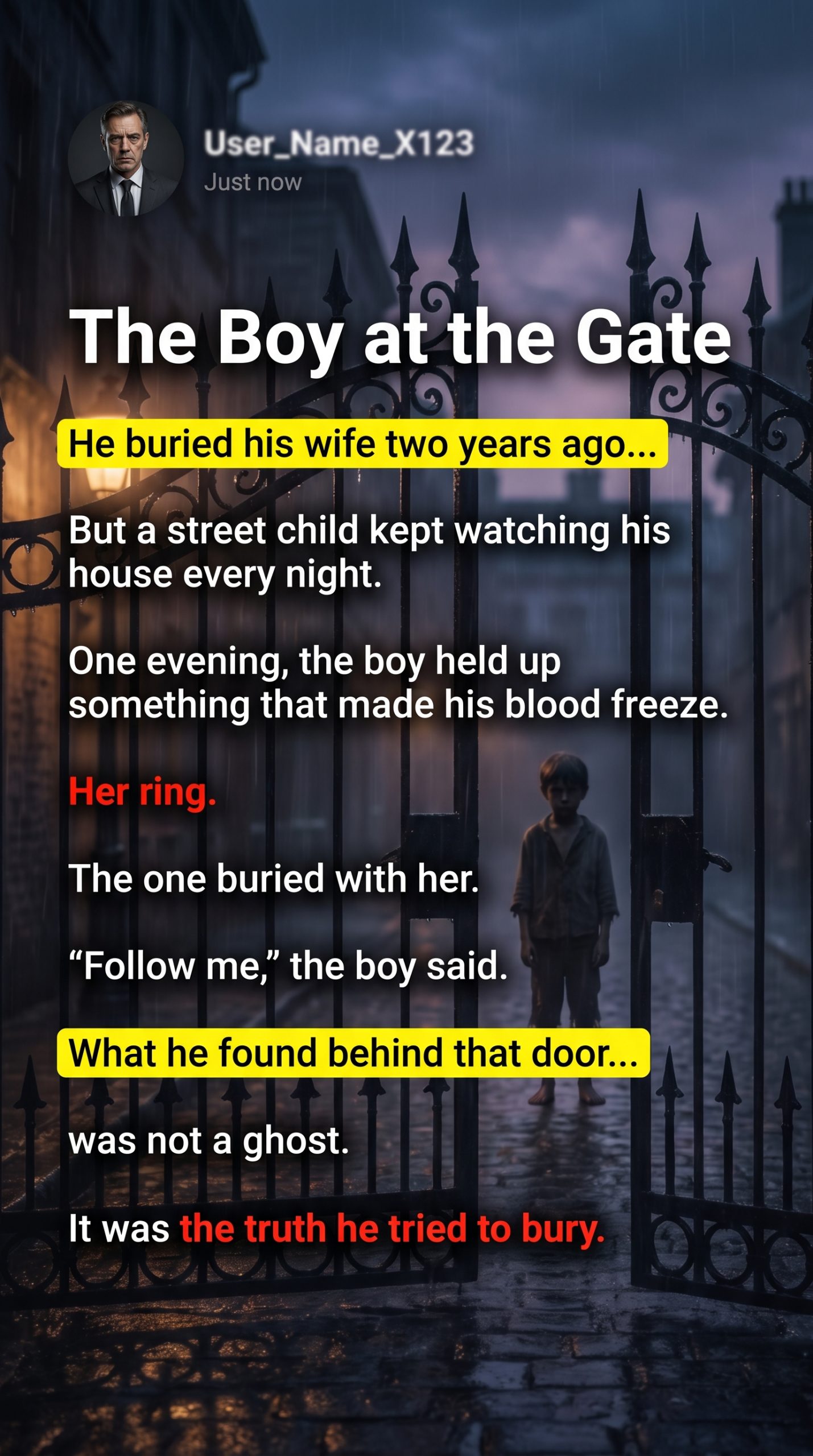
For one long, unbearable moment after the boy spoke, Alexander Vaughn forgot how to breathe.
The room did not change.
The curtains still hung heavy and unmoving.
The fire still crackled faintly beneath Isabella’s portrait.
The security guards were still standing at the doorway, tense and uncertain.
And yet everything inside him had shifted.
Because “Shadow” was not just a word.
It was the name of the black stray kitten Isabella had rescued during the first winter of their marriage. The kitten had lived only three months, but she had loved it with ridiculous tenderness, wrapping it in cashmere scarves and whispering to it like it was royalty. No one else knew that name. Not the press. Not the police. Not even most of their friends.
It had belonged to them.
To their life before the cliff.
Before the funeral.
Before the closed curtains and the whiskey and the silence that had become a second skin.
Alexander set the glass down too hard on the mantel.
His hand was shaking.
The boy saw it.
So did the guards.
“What else did she say?” Alexander asked, and his voice no longer sounded cold. It sounded dangerous in a different way—like a man standing at the edge of something he did not want to hope for.
The boy swallowed.
“She said if you didn’t believe me, I should tell you…” He squeezed the cap tighter in both hands. “Tell you the blue letter was never burned.”
Alexander went still.
Completely still.
The blue letter.
The letter Isabella had written him on their first anniversary and hidden beneath his pillow because she thought spoken love was too easy to deny later. It was written on pale blue stationery, folded into thirds, and ended with a ridiculous sketch of Shadow wearing a crown.
He had thought it was burned with the rest of the bedroom things after the fire in the east wing three years ago.
No one knew about that letter.
No one.
The room felt suddenly airless.
The guards looked at each other.
Alexander stepped away from the fireplace.
“Leave us,” he said.
The guards hesitated.
“Sir—”
“Now.”
They obeyed instantly.
The door shut behind them.
Now only Alexander and the boy remained, facing one another across a room filled with too much memory and not enough truth.
Alexander walked closer.
The boy did not retreat, though fear was written across every line of his body.
“What’s your name?” Alexander asked.
“Eli.”
“How old are you, Eli?”
“I think ten.”
Alexander stared at him.
A child should know.
But then, a child on the street often lost dates before he lost hunger.
“Start from the beginning,” Alexander said. “Every word. Every detail. Where exactly did you see her?”
Eli glanced once toward the food cart near the far wall, as if only now remembering how badly he was starving.
Alexander noticed.
He pressed a button on the intercom.
“Bring food,” he said sharply. “Now.”
Then he looked back at the boy.
“If you’re lying to me, I’ll know.”
Eli’s eyes filled, but he held Alexander’s gaze.
“I’m not.”
Ten minutes later, the boy was sitting stiffly at the edge of a leather chair, devouring soup and bread with the frantic, ashamed speed of someone not used to being fed indoors. Alexander sat opposite him, untouched whiskey forgotten, asking questions with the precision of an interrogator and the desperation of a widower whose dead had just been dragged back into possibility.
“She was near the old train yard,” Eli said between smaller bites now. “By the broken freight building where people sleep when it rains. I go there sometimes because the security trucks don’t check behind the east wall.”
Alexander knew the place.
Abandoned industrial property on the edge of the city. Half-collapsed warehouses. Rusted tracks. A dead zone of old money and newer crime.
“When did you see her?”
“Yesterday. Late. Right before dark.”
“Alone?”
Eli hesitated.
“No.”
Alexander’s pulse jumped.
“Who was with her?”
“A man.” The boy’s fingers tightened around the spoon. “Big. He kept her close. Not like helping. More like… not letting.”
A slow, cold rage started to rise inside Alexander.
“She was hurt?”
Eli nodded.
“Her lip was split. And one arm…” He touched his own wrist. “It looked bad.”
Alexander looked down, jaw clenched so hard it hurt.
Dead women do not split their lips.
Dead women do not whisper secrets to street children.
Dead women do not wait in ruined freight buildings with strange men holding them too tightly.
Unless—
Unless the body in the wreck had never been hers.
His mind recoiled from the possibility.
But it had already entered.
And once it had entered, it would not leave.
“What exactly did she ask you?” he said.
Eli drew a shaky breath.
“I asked if she had food. She looked at me for a long time first, like she couldn’t believe I was real. Then she asked if I knew this house.” He looked around uneasily. “I didn’t. So she asked if I knew who Alexander Vaughn was.”
“And you did?”
The boy shrugged. “Everybody knows who rich people are.”
That almost made Alexander laugh, but the sound died before it formed.
“She said if I could find you, you had to come alone. Then she said the thing about Shadow. And the blue letter.”
Alone.
Alexander leaned back slowly.
That detail mattered.
Deeply.
Because Isabella would only say alone if she believed someone close to him was unsafe.
Someone inside his world.
Someone she did not trust.
The thought came fast.
Too fast.
Marcus Reed.
His chief of security.
The man who had overseen the crash-site recovery.
The man who had insisted there was nothing left to identify beyond jewelry fragments and burned remains.
The man who had controlled access to everything.
Alexander stood abruptly.
Eli flinched.
Alexander softened his tone at once.
“You did the right thing coming here.”
The boy nodded uncertainly.
Alexander hit the intercom again.
“Get the car ready. No driver. And send Collins.”
Collins had been his groundskeeper for nineteen years, and before that a Marine. Quiet, loyal, and importantly—not part of the polished inner circle Marcus Reed had assembled around him over the last two years.
If Isabella had said alone, he could not risk bringing anyone who might belong more to his fortune than to him.
Twenty minutes later, the mansion’s front gates opened without announcement.
Alexander sat behind the wheel of a black Range Rover, Eli in the passenger seat wrapped in one of Alexander’s old wool coats, Collins in the back with a flashlight, medical kit, and a pistol he hoped to God they would not need.
The city changed as they drove.
The clean lines of wealth gave way to industrial shadows, graffitied walls, chain-link fences, and blocks where the streetlights seemed too tired to fully work.
Eli pointed through the windshield.
“There. Past the cranes.”
The old train yard spread before them like the remains of something once proud and now forgotten. Rusted tracks split the ground in crooked directions. Freight cars sat gutted and tagged with spray paint. Wind moved loose sheets of metal with a hollow clatter that sounded almost human.
Alexander killed the engine.
“Stay in the car,” he told Eli.
The boy shook his head quickly.
“I know where.”
Collins leaned forward. “Sir, let me go first.”
Alexander nodded once.
They moved through the dark with flashlights low.
Eli led them behind the eastern freight building, past a collapsed loading ramp and a gap in the corrugated wall barely wide enough to enter one at a time.
Inside, it smelled of rain, rust, and old soot.
Eli whispered, “She was back there.”
They crossed the warehouse slowly.
Then Collins held up one hand.
On the floor near a support beam lay a torn strip of pale fabric.
Alexander picked it up.
Silk.
Cream-colored.
His stomach dropped.
He knew this fabric.
It was from Isabella’s favorite winter dress—the one she had been wearing the night of the cliff crash.
The world narrowed.
“She was here,” he said.
Then they heard it.
A sound from deeper in the warehouse.
Not footsteps.
Not voices.
A faint metallic rattle.
As if someone had shifted a chain.
They moved toward it.
Collins went first around the corner.
Then stopped dead.
Alexander stepped beside him.
And there—
In a narrow room hidden behind old shipping crates—
Sat a woman tied to a steel chair.
Head bowed.
Hair fallen across her face.
One wrist bruised raw against the restraints.
For one suspended second, Alexander could not make sense of the sight.
The world seemed to lag behind what his eyes already knew.
Then she lifted her head.
And Isabella looked at him.
Not as a ghost.
Not as a memory.
Not as a dream conjured by grief and desperation.
Alive.
Her face was thinner, sharper, marked by exhaustion and pain. Her mouth was split at one corner. There was fear in her eyes—but beneath it, unmistakable, blazing, impossible relief.
“Alexander,” she whispered.
He dropped to his knees in front of her so fast it hurt.
For a moment he could not touch her.
He was afraid she would vanish.
Afraid his mind had finally broken under the strain of wanting her back.
Then she let out a tiny sob and leaned toward him as far as the restraints allowed, and he caught her face in both hands.
Warm.
Real.
Alive.
His entire body shook.
“My God,” he breathed. “My God…”
Collins was already cutting the restraints.
Eli stood frozen in the doorway, wide-eyed and silent, staring as though he had just watched the dead step out of a story.
When the restraints finally fell away, Isabella collapsed forward into Alexander’s arms.
He held her like a drowning man holds the surface.
For several seconds neither of them spoke.
They just shook against each other in the dust and darkness of the warehouse while thirty feet of rusted steel and two years of mourning collapsed into one terrible, miraculous truth.
Then Isabella gripped his jacket with surprising force.
“You shouldn’t have come with anyone,” she whispered urgently.
Alexander pulled back just enough to look at her.
“What?”
She looked toward Collins and Eli, then back at him.
“I told the boy alone.”
“It’s Collins. He’s safe.”
Her face changed.
Not relieved.
Alarmed.
“No one is safe,” she said. “Not if Marcus knows.”
Alexander went cold.
Of course.
Of course it was Marcus.
The name had lived in the back of his mind from the moment the possibility of her being alive became real. Now hearing it from her made the whole structure of betrayal lock into place.
“What happened?” he asked.
Isabella’s breathing was ragged, but her mind was clear.
“The crash wasn’t an accident,” she said. “Marcus drove me out there himself. He said you’d signed papers. Said you were done with me. Said there were debts I never knew about, and if I fought, you’d lose everything.”
Alexander’s face twisted.
“That’s insane.”
“I know that now.” Her voice broke. “But that night—Alexander, I believed he worked for you. Then the car went over, but not the way they told it. He pushed it after pulling me out. There was already another body inside.”
The warehouse seemed to tilt.
Alexander stared.
Another body.
Someone had died in that car.
Someone buried as Isabella so that Isabella could disappear cleanly.
His stomach turned.
“Who was it?”
Tears filled her eyes.
“I don’t know. I never saw her face.”
Collins swore under his breath.
Alexander felt something savage rise inside him.
Marcus had orchestrated the crash.
Falsified the death.
Hidden Isabella for two years.
But why?
Why keep her alive?
As if hearing the question forming, Isabella answered it.
“He wanted access,” she whispered. “Your signatures. Your accounts. The offshore authorizations you never let anyone touch without both our clearance.”
Alexander went still.
His financial empire included joint trust layers and legacy accounts only he and Isabella had direct authority over—protections built after his father had once tried to manipulate their early marriage contract. If Marcus had needed Isabella alive, it meant he had been trying to extract access he could not fully fake.
“How long have you been here?”
“Not always here,” she said. “Different places. Houses. Storage rooms. Motels. He moved me every few months. Said if I behaved, he’d let me send for you.” Her eyes hardened suddenly through the exhaustion. “He was never going to.”
The air behind them shifted.
Collins turned.
Fast.
Too late.
A voice came from the warehouse entrance.
Cold.
Smooth.
Amused.
“I was hoping the boy would bring you.”
Alexander rose instantly and turned.
Marcus Reed stood in the doorway with two armed men.
Neatly dressed, as always.
Calm, as always.
As if catching a billionaire kneeling in the dirt beside his resurrected wife was simply one more logistical inconvenience in a busy week.
Marcus smiled faintly.
“Touching reunion,” he said.
Eli gasped softly behind the crates.
Collins moved one step to shield him.
Alexander stepped in front of Isabella.
“You’re dead,” Marcus said mildly. “Both of you should be, really. But here we are.”
Isabella grabbed Alexander’s sleeve.
“He has the blue letter,” she whispered. “I hid it before. He found it.”
That tiny detail, absurdly intimate in the middle of danger, made everything even worse. Marcus had not only controlled her body and the narrative of her death.
He had invaded their private life down to its smallest sacred fragments.
Marcus lifted a gun.
Not hurriedly.
Not shakily.
Like a man who had rehearsed this moment too many times.
“You built such a beautiful cage around yourself, Alexander,” he said. “Money, grief, power, loneliness. All I had to do was convince you to stop looking.”
Alexander’s face went utterly still.
That was when he became most dangerous.
“You made one mistake,” he said.
Marcus’s smile thinned. “Only one?”
Alexander’s gaze flicked toward Eli.
“No. Two. You let her live.” Then toward the boy. “And you let him through my front gate.”
Marcus laughed softly.
Then the warehouse lights exploded.
Not all of them—just three overhead industrial lamps flaring on at once, flooding the room in sudden brutal brightness.
Marcus flinched.
So did his men.
And from the catwalk above came a new voice.
A woman’s voice.
Clear.
Amplified.
“Drop the weapon, Marcus.”
Every head snapped upward.
A figure stood on the metal walkway with two armed officers behind her.
Dark coat.
Phone in hand.
Expression like cut glass.
It took Alexander one stunned second to recognize her.
Lena Moreau.
His chief financial officer.
The woman Marcus had repeatedly insisted could not be trusted with sensitive security matters.
The woman he had almost left behind tonight because Isabella had said alone.
Lena looked down at him only briefly.
Then back at Marcus.
“You really should have checked whose server you used for the forged offshore approvals,” she said coolly. “I traced your access attempts six months ago.”
Marcus’s expression changed for the first time.
Not fear yet.
But surprise.
Lena continued, “And when a starving child walked through the front gate tonight claiming to see a dead woman, I decided to stop trusting coincidence.”
Police flooded the rear entrance.
Marcus’s men panicked.
One ran.
One dropped his gun.
Marcus did neither.
He looked at Alexander almost sadly.
“You always did choose sentiment at the worst possible moment.”
Then he fired.
The shot shattered through the warehouse.
Alexander moved without thinking.
So did Isabella.
So did Collins.
The bullet struck metal, ricocheted, and chaos detonated around them—shouting, footsteps, commands, a second shot, Eli screaming, Isabella falling, Alexander catching her—
“Bella!”
For one horrifying instant he thought she had been hit.
Then she grabbed his face with both hands, breathless but alive.
“Not me,” she gasped.
Alexander turned.
Collins was on one knee, blood spreading darkly through his shoulder, still holding his own weapon steady.
Police tackled Marcus to the ground.
The warehouse rang with orders.
Eli was crying openly now, huddled behind the crate stack with one officer shielding him.
Lena came down the stairs at a run.
“You okay?” she shouted.
Alexander barely heard her.
Because Isabella was clutching his jacket, trembling, staring not at Marcus, not at the officers—
but at the floor near the overturned crate beside the chair where she had been tied.
Following her gaze, Alexander saw it.
A small photograph.
Bent.
Old.
Face down in the dust.
It must have fallen from Marcus’s coat during the struggle.
Isabella pointed at it with shaking fingers.
“That’s why,” she whispered.
Alexander picked it up and turned it over.
Then went completely still.
The photograph showed a little girl.
No older than six.
Dark curls.
Wide eyes.
A silver bracelet on one wrist.
And written on the back, in Marcus’s handwriting, were six words:
Second transfer. Vaughn child. Age 3.
Alexander’s blood turned to ice.
They had no child.
He and Isabella had lost their baby before term—years ago, long before the crash, long before this nightmare.
There had never been a three-year-old daughter.
Unless—
Unless Marcus had not just been stealing accounts and identities.
Unless this had begun before the crash.
Before the mourning.
Before everything they thought was the original crime.
Isabella’s face had gone white.
Because she understood at the same moment he did.
And when she spoke, her voice was barely more than air.
“Alexander… who is that child?”
He had no answer.
Not yet.
But standing in the ruined warehouse with his dead wife alive in his arms and a photograph of a child labeled with his name, Alexander understood one terrible thing with absolute clarity:
Marcus had not only hidden the woman he loved.
He had hidden something else from them too.
Something smaller.
Older.
And possibly still alive.