When My Son And I Returned From Our Trip, His Room Was Empty. “Where Are My Son’s Things?” I Asked. My Sister Laughed. “I Took The Room! I Sold Everything, Got A Good Price!” My Mom Chuckled. “Your Sister Is Pregnant. It’s Only Fair, Right?” My Son Clung To My Clothes, Crying… I Said Nothing And Walked Away.
My sister sold my 7-year-old son’s entire bedroom while we were away for 6 days. His bed, books, bike, clothes, and the unfinished wooden sailboat his dead father had started building with him were gone. In their place sat a brand-new crib. When I demanded an explanation, my pregnant sister laughed and said, “I sold everything. Got a good price.” My mother smiled beside her. “She needs the room more.” I didn’t argue. I took my crying son’s hand and walked out, because I had just noticed something they hadn’t meant for me to see.
### Part 1
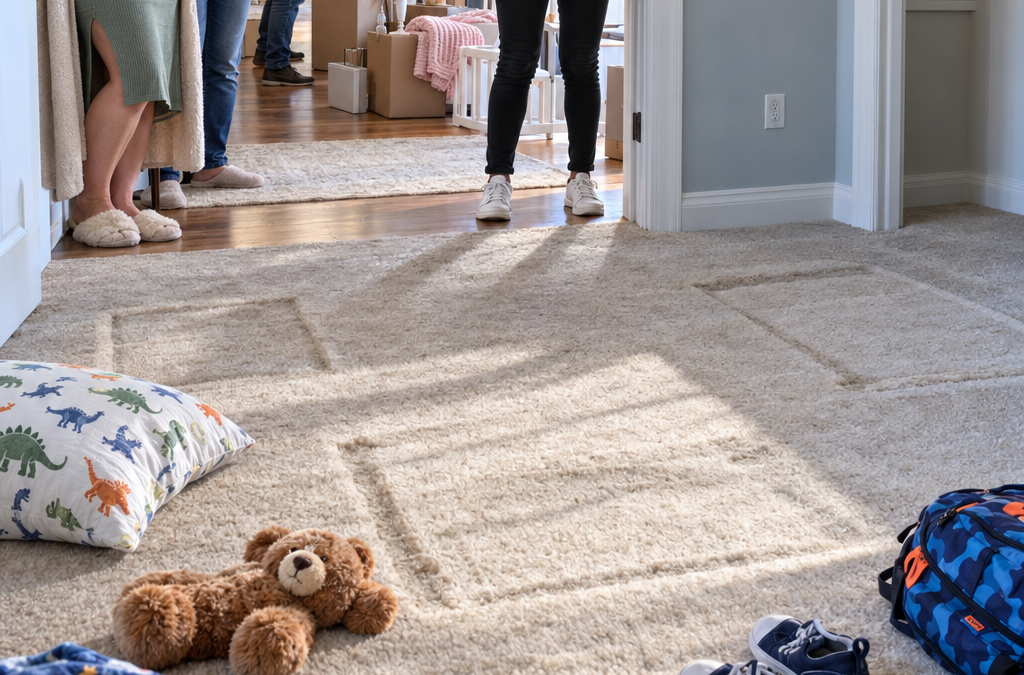
Noah stopped so suddenly in the hallway that I nearly walked into the back of him. His little rolling suitcase tipped sideways behind his sneakers, and for a few seconds neither of us moved. Sunlight from the bedroom window fell across a stretch of bare carpet marked by pale rectangles where furniture had stood only 6 days earlier. His bunk bed was gone, his blue desk was gone, the narrow bookshelf Daniel and I had painted together was gone, and beneath the window where an unfinished wooden sailboat had rested for nearly 3 years sat a new white crib with a yellow blanket folded neatly over one rail.
“Mom?” Noah whispered.
I set down the paper bag of road-trip snacks I was carrying. “Stay right here.”
I stepped into the room, still waiting for my brain to catch up with what my eyes were seeing. There were no model airplanes hanging from the ceiling, no baseball glove on the desk, no dinosaur rug, no ridiculous helicopter lamp Daniel had bought because he said every boy deserved at least one object in his bedroom that annoyed his mother. Even the small corkboard filled with Noah’s drawings was gone. The walls looked brighter where his belongings had blocked the afternoon sun, as though somebody had erased my son and tried to paint over the outline.
Then I opened the closet.
Daniel’s brown flight jacket was missing.
So was his watch.
So was the old metal toolbox I had kept on the upper shelf.
I turned toward the window again, already knowing what I would not see. The sailboat was gone too.
Three years earlier, Daniel had been sitting cross-legged on that same carpet with Noah between his knees, guiding our son’s tiny hands over a piece of sandpaper. The boat was only half finished then, no longer than Noah’s forearm, its ribs exposed and pencil measurements still visible along the wood. Daniel had promised him, “We’ll put her in the water when you turn 8.” Noah had laughed and asked whether boats had birthdays too.
Daniel died 4 months later.
After that, I finished pieces of the boat with Noah one Saturday at a time. I never rushed him. Sometimes we worked for an hour; sometimes he only held one of Daniel’s tools and asked questions about his father. The boat stopped being a project and became a conversation we were still having with someone we loved.
Behind me, footsteps approached.
My younger sister Brooke leaned against the doorframe holding three paint cards in one hand. She was 29, 7 months pregnant, and wearing the satisfied smile of someone waiting to be complimented.
“Oh,” she said. “You’re back early.”
“We’re back exactly when I told everyone we’d be back.”
Her eyes shifted toward Noah. “Well, surprise.”
I stared at her. “Where are my son’s things?”
She laughed.
Not nervously. Not apologetically. She actually laughed.
“I took the room,” she said. “I sold most of the stuff. Got a pretty good price, actually.”
Behind her, my mother appeared from the kitchen, wiping her hands on a dish towel. Linda Bennett had been living with me for almost 2 years after a combination of medical bills, rent increases, and poor financial decisions made her apartment unaffordable. I had never charged her rent. I covered groceries, utilities, and most of the expenses she pretended not to notice.
“Rachel,” she said, “don’t start.”
I looked at her. “Don’t start what?”
“Brooke is having a baby.”
“I’m aware.”
“She needs family right now.”
“So does Noah.”
My mother sighed like I was deliberately making a simple situation difficult. “He’s a child. Children adjust.”
Behind me, Noah grabbed the back of my sweater. His fingers twisted tightly into the fabric.
“Where’s Dad’s boat?”
Brooke’s shoulders lifted in a shrug. “That old thing? I sold it.”
For one dangerous second, the room became strangely quiet. I could hear the refrigerator humming in the kitchen, a lawn mower somewhere down the street, and Noah breathing through his nose as if he was afraid making too much noise might cause something else to disappear.
“The jacket?” I asked.
“Sold.”
“The watch?”
“I think so.”
“The toolbox?”
Brooke rolled her eyes. “Rachel, it was all old stuff. Nobody was using it.”
My mother gave me the look she had used since I was 12 whenever she wanted me to swallow a reaction for everyone else’s convenience. “Your sister is under a lot of pressure. Her boyfriend left, she’s pregnant, and she can’t afford something bigger. You have 3 bedrooms.”
“She has a studio apartment.”
“With a baby coming.”
“I paid the deposit on that apartment.”
“And that was generous,” Mom said. “But this is family.”
That sentence had ruled most of my life.
Family meant I drove Mom to appointments even after working 12-hour shifts. Family meant I covered Brooke’s phone bill one month because she had spent her rent money on a weekend in Las Vegas. Family meant I was the reliable one, the reasonable one, the one who understood. Every compliment I had ever received from them seemed to end with another responsibility.
Rachel can handle it.
Rachel won’t mind.
Rachel is strong.
I had believed strength meant carrying whatever they handed me without letting anyone see my knees buckle.
Then Noah stepped around me.
He walked to the place where his bed had stood, stared at the rectangular dents in the carpet, and started crying without making a sound.
Something in me changed.
Not loudly.
Not dramatically.
I turned toward him. “Get your backpack, sweetheart.”
Brooke straightened. “What?”
I ignored her.
Mom followed me into the hallway. “Where are you going?”
“Claire’s.”
“Our neighbor?”
“Yes.”
“You’re being ridiculous.”
I crouched beside Noah and zipped his backpack because his hands were shaking too badly to do it himself. “Do you have your tablet?”
He nodded.
“Your charger?”
Another nod.
“Good. Let’s go.”
Brooke laughed again, but this one sounded thinner. “Seriously? You’re storming out because I cleaned out one bedroom?”
I stood.
That was when I noticed it.
The small closet beside the laundry room was open.
It was where I had kept Daniel’s personal belongings after his death, things I was not ready for Noah to handle alone. The closet normally stayed locked with a brass padlock. I had carried my key to San Diego with me.
Now the lock was hanging from the latch, open.
There was only one spare key.
I knew exactly where I had hidden it.
And Brooke had never known.
At Claire’s house, Noah sat curled into the corner of her sofa with an untouched grilled-cheese sandwich cooling on a plate beside him. Claire had lived next door for 6 years and had known Daniel before his accident. She asked no questions until Noah finally fell asleep under a blanket with his backpack resting against his chest.
Then she looked at me. “What happened?”
“My sister sold his room.”
Claire blinked.
“She sold Daniel’s things too.”
Her face changed. “Rachel…”
“And somebody helped her find the spare key.”
I looked through Claire’s kitchen window toward my house. Mom’s bedroom light was on. Brooke’s car still sat in the driveway.
I had spent years thinking my family crossed my boundaries because they did not understand where those boundaries were.
For the first time, I considered a different possibility.
Maybe they understood perfectly.
Maybe they simply believed I would never make them pay a price for crossing them.
I returned home after Noah was asleep.
Brooke had left. Mom was watching television like it was an ordinary Sunday evening.
I went directly to the kitchen junk drawer.
Batteries, rubber bands, old takeout menus, tape, two flashlights.
No spare key.
I closed the drawer.
Mom watched me from the doorway.
“What are you looking for?”
I met her eyes.
“Nothing.”
For once, I decided not to tell my family what I knew.
### Part 2
By midnight, the coffee beside my laptop had gone cold. I was sitting at Claire’s dining room table with two columns written across a legal pad: WHAT THEY SAID and WHAT I CAN PROVE. It was the kind of system I used at work whenever a frightened parent gave me 5 versions of the same story because fear had scrambled the timeline. I was a pediatric critical care nurse, and I had spent 11 years learning that emotions mattered, but facts kept people alive.
Under WHAT THEY SAID, I wrote: Brooke needed a room. Old furniture. Nobody used Daniel’s things. Family decision. Harmless.
Under WHAT I CAN PROVE, I had almost nothing.
Then I remembered Brooke’s social media marketplace account.
Her profile was public.
The first listing had been posted the morning after Noah and I left for San Diego.
Twin-over-full bunk bed, excellent condition.
The photographs were unmistakably Noah’s room. I could see his dinosaur curtains in the background and part of Daniel’s sailboat beneath the window. The bed had sold for $180.
The next listing was Noah’s desk.
Then the bookshelf.
Then the bike Daniel’s parents had bought for his seventh birthday.
Then the helicopter lamp.
I saved every screenshot before I opened the next one.
By 1:17 a.m., my hands were shaking.
Brown vintage flight jacket. Men’s medium. $75.
Steel toolbox with assorted hand tools. $120.
Old mechanical watch. Needs cleaning. $90.
Unfinished decorative wooden boat. Could make a cute nautical shelf piece. $30.
Thirty dollars.
Three years of Saturdays with my son had been reduced to thirty dollars.
I stared at the photograph until the screen blurred.
Claire quietly set a fresh cup of coffee beside me. “How much?”
“About $900 altogether.”
“That’s all?”
“The replacement value is probably closer to $2,500 or $2,600, depending on the watch and tools.”
“I don’t mean how much the things were worth.”
I knew what she meant.
There was no number for the way Noah had looked at his empty room.
By morning, Brooke had already started rewriting the story.
A cousin texted me: Your mom said you’re freaking out because Brooke got rid of some old furniture.
Another message arrived 20 minutes later: Pregnancy is stressful, Rach. Maybe don’t pile this on her.
Then my aunt Janet called while I was packing Noah’s lunch.
“You really left the house?”
“Yes.”
“Because of furniture?”
“No.”
“Well, your mother says—”
“I don’t care what my mother says.”
There was a pause. I rarely interrupted Aunt Janet.
“You know Brooke is scared,” she said.
“Then she should have called me.”
“She thought you’d say no.”
“I had already said no.”
“That’s probably why she felt like she didn’t have options.”
I put the peanut-butter knife down.
“She had an option. Her own apartment.”
“That little studio?”
“The studio I paid the security deposit for.”
Janet became quiet.
I continued. “She didn’t need my son’s room. She wanted it.”
“Rachel, I’m not defending what she did.”
“You’re explaining why I should absorb it.”
“That’s not fair.”
“No. What happened to Noah wasn’t fair.”
I ended the call before she could answer.
Noah barely spoke on the drive to school. At a red light, I glanced in the mirror and saw him looking down at his backpack.
“Mom?”
“Yeah?”
“Can I take this inside?”
“You always take it inside.”
“No. I mean all of it.”
I looked at him again.
His tablet, sweatshirt, two books, charger, baseball cards, and stuffed dog were packed inside.
He did not want to leave anything in the car.
“Of course,” I said.
He nodded and hugged the backpack against his chest.
That was when my anger changed shape.
Until then, I had been furious about what Brooke had taken.
Now I was afraid of what she had taught him.
After dropping him off, I called a non-emergency county number and explained the situation without using words like insane, betrayal, or cruel. I told them property had been removed from my home and sold without my permission. Some belonged to my minor child. Some belonged to my deceased husband’s estate and had been retained by me. I had screenshots, photographs, receipts, and evidence that my sister had her own residence.
The woman on the phone asked, “Did your sister have permission to enter the home?”
“She was not living there.”
“Did anyone with access let her in?”
“My mother lives with me.”
“Did your mother own the property?”
“No.”
“Did she have authority to dispose of your belongings?”
“No.”
The answer did not magically solve anything. There would be questions about ownership, permission, household access, and value. But when she told me what kinds of documentation would matter, I felt something loosen inside my chest.
Proof.
That was a language I understood.
I spent the next 2 days gathering it.
Old photographs showed Noah’s room exactly as it had been before the trip. Credit-card statements showed when I purchased the bunk bed and desk. Daniel’s father still had the receipt for the watch. I found pictures of Daniel wearing the flight jacket, then later of Noah standing in it with the sleeves hanging past his hands. I found messages between Brooke and me from 3 weeks earlier.
Brooke: The baby can use Noah’s room until I figure things out.
Me: No. Noah keeps his room.
Brooke: You have space.
Me: I’m helping you with your apartment. I’m not displacing my child.
Brooke: God, Rachel. Everything has to be about your rules.
There it was.
No misunderstanding.
No confused conversation.
No permission.
I started contacting buyers.
I kept every message short.
Hello. I believe you recently purchased an item from my sister, Brooke Bennett. It was sold without my permission from my home while I was away. I’m trying to recover the property if possible. I can reimburse what you paid.
Most people did not answer.
One woman wrote back within 10 minutes. She had Noah’s bike.
“I bought this for my grandson,” she said when we spoke. “Are you telling me somebody sold a kid’s bike while he was on vacation?”
“Yes.”
“Oh, honey.”
She brought it back that afternoon.
Noah ran his hand over the handlebars without smiling.
“Is it mine again?” he asked.
“It was always yours.”
He looked at me for a long moment.
Then he wheeled it into Claire’s garage instead of our own.
The next person to respond was a man named Martin Harris.
He had Daniel’s toolbox.
“I can come by after work,” he said.
He arrived in an old pickup just before 6, carried the toolbox onto Claire’s porch, and set it down carefully between us.
“I didn’t know,” he said.
“I know.”
I held out the $120 he had paid.
Martin looked at the cash, then at the toolbox. “This belonged to your husband?”
“Yes.”
“And now your boy?”
“Yes.”
He pushed my hand back gently.
“Then keep your money.”
“I can’t let you lose—”
“You didn’t make me lose anything. Your sister did.”
That sentence hit harder than I expected.
I had spent most of my life refunding other people for damage I had not caused.
That evening, Noah sat cross-legged on the guest-room carpet opening each toolbox drawer. He ran his fingers over the worn wooden handle of Daniel’s hammer.
Then he looked up.
“Dad touched this.”
“He did.”
His mouth trembled, but he did not cry.
An email from his teacher arrived after bedtime.
Mrs. Park wrote that Noah had been unusually quiet. During independent drawing time, the class had been asked to draw a place where they felt comfortable.
Noah drew a bedroom.
Four walls.
One door.
Nothing inside.
Later, while I folded laundry, he stood beside me holding one of his T-shirts.
“Mom?”
“Yeah, baby?”
“If we go somewhere again, will my new stuff still be there when we come back?”
I stopped folding.
I had received angry texts from relatives all week. None of them hurt like that question.
A 7-year-old had learned that home might only belong to him until an adult decided somebody else deserved it more.
I knelt in front of him.
“Yes,” I said. “And I’m going to make sure you know that.”
He studied my face.
“Promise?”
“I promise.”
After he went to sleep, I checked my phone.
There were 6 missed calls from Mom.
The seventh came while I was looking at the screen.
I answered.
Her first words were, “You need to stop contacting the buyers.”
“Why?”
“You’re humiliating your sister.”
“No. I’m recovering what she sold.”
“She made a mistake.”
“Mom, where did Brooke get the spare key?”
Silence.
It lasted only 2 seconds.
But it was enough.
### Part 3
Mom did not answer my question.
Instead, she said, “I don’t know what you think you’re proving.”
“That wasn’t what I asked.”
“You always do this.”
“Do what?”
“Turn everything into an interrogation.”
I nearly laughed. “Where did Brooke get the key?”
Another pause.
Then Mom said, “You should be more worried about whether your relationship with your sister can survive this.”
That was the closest thing to an answer I needed.
I hung up.
For the next 48 hours, my family behaved as though I had declared war. Brooke posted vague messages online about toxic relatives who cared more about possessions than people. Aunt Janet called Claire, apparently hoping another adult could convince me to calm down. My cousin Stephanie sent a 4-minute voice message explaining that pregnancy hormones could make people act irrationally and that I should consider the stress Brooke was under before “taking things too far.”
Nobody asked about Noah.
That detail became impossible not to notice.
At work, I moved through my shifts with the practiced efficiency that had earned me my reputation as the calm nurse. I adjusted lines, answered questions, called physicians, explained procedures to frightened parents, and charted everything carefully. But every time I saw a child clutching something familiar—a blanket, a stuffed animal, a worn plastic dinosaur—I thought about Noah’s empty room.
On Thursday afternoon, I met with an investigator named Elena Ruiz.
She was in her early 40s, wore thin-framed glasses, and did not react dramatically when I spread the documents across the conference table. She simply asked questions.
“Who owns the house?”
“I do.”
“Is your mother on the deed?”
“No.”
“Lease?”
“No. She was staying with me.”
“Did your sister live there?”
“No.”
“Did your sister have permission to enter Noah’s room?”
“No.”
“Permission to remove items?”
“No.”
“Permission to sell anything?”
“No.”
She read the screenshots of my earlier messages to Brooke.
Her finger stopped beside the line where I had written, I’m not displacing my child.
“This helps,” she said.
“What happens now?”
“I can’t promise an outcome.”
“I understand.”
“We document, verify ownership where possible, speak with the people involved, and determine what can be addressed formally. Recovery of the items may be partly separate.”
I nodded.
Elena looked at me over her glasses. “You’ve done a good job preserving records.”
It was a strange compliment, but I almost cried.
Not because I wanted Brooke punished.
Because for the first time since coming home, someone looked at what happened and did not immediately ask me to make it smaller.
When I returned to Claire’s that evening, Noah was doing homework at the kitchen table.
Claire pulled me aside.
“Your mom came by.”
My stomach tightened. “Here?”
“She wanted Noah.”
“What do you mean?”
“She said she was supposed to watch him tomorrow because you work.”
I had forgotten.
Mom had watched Noah during some of my longer shifts for years. She loved him, or at least I had always believed she did. She baked pancakes shaped like animals and let him stay up 30 minutes too late watching nature documentaries. Whatever anger I felt toward her, I did not want to pretend those things had never been real.
“What did you tell her?”
“That she needed to speak to you.”
My phone buzzed.
Mom: I assume you’re finding another babysitter since you’ve decided I’m a criminal now.
I stared at the message.
This was how she did it.
She turned every boundary into an accusation against her character, then waited for me to comfort her.
I typed: Yes. I’ve arranged childcare.
Three dots appeared.
Then disappeared.
A minute later: Fine. Since apparently family means nothing anymore.
I did not respond.
The next morning, I rearranged shifts, called in favors, and paid for childcare I had not budgeted for. It was inconvenient. It was expensive. It was also clarifying.
Every time someone told me I could not afford to set a boundary, I began asking what the absence of that boundary had already cost me.
Saturday afternoon, I stopped at my house to pick up more clothes.
Brooke’s car was in the driveway.
For a moment, I simply sat behind the wheel.
I had told her in writing not to enter the house without my permission.
I took out my phone, photographed the car, and went inside.
She was standing in the kitchen with Mom, sorting baby clothes across my counter.
Brooke looked annoyed rather than surprised.
“What are you doing here?”
“Visiting Mom.”
“I told you not to come into my house.”
“Mom lives here.”
“Mom does not own this house.”
Mom crossed her arms. “This is getting absurd.”
I looked at Brooke. “Leave.”
She gave a short laugh. “You can’t be serious.”
“I am.”
“This is Mom’s home too.”
“No. It’s the place I allowed Mom to live.”
Mom flinched.
I hated saying it.
I also knew it was true.
Brooke gathered the baby clothes slowly, making a performance out of stuffing them into a tote bag. At the doorway, she turned.
“You know what your problem is?”
I waited.
“You think because you make more money, you own everyone.”
I looked around the kitchen I had paid for, inside the house whose mortgage I paid, after she had sold my child’s belongings from a room she had no right to enter.
“No,” I said. “I think owning my house means I own my house.”
Her face reddened.
“You’ve always thought you were better than me.”
“That isn’t what this is about.”
“It’s always been about that.”
She left.
Mom stared at me with tears already shining in her eyes.
“I raised you better than this.”
I almost answered the way I always had.
I almost apologized.
Instead, I said, “You raised me to give until people stopped asking whether they had the right to take.”
Her expression hardened.
“I let Brooke into the room.”
There it was.
No denial.
No excuse.
Just a sentence placed between us.
I waited.
Mom continued, “She needed help. You were being unreasonable. I told her we could clear out some things.”
“Did you give her the spare key?”
Mom looked away.
“Did you?”
“Yes.”
My hands felt cold.
“You searched my kitchen drawer for the key to a locked closet containing Daniel’s things?”
“I knew where it was.”
“That doesn’t answer the question.”
“You weren’t using those things.”
I stared at her.
“Daniel was my husband.”
“And Brooke is alive,” Mom snapped. “She’s here. She needs us now.”
The cruelty of the comparison landed slowly.
I did not raise my voice.
I did not cry.
I walked to the drawer beside the refrigerator, took out the envelope where I kept spare-house information, and removed Mom’s copy of the garage code instructions.
“What are you doing?”
“Changing the locks.”
Her mouth fell open.
“You can’t lock me out of my own home.”
I looked at her.
“Mom. This is not your home.”
That afternoon I called a locksmith.
Then I checked the proper process for ending Mom’s living arrangement legally instead of reacting emotionally.
I had not yet decided what I would do.
By evening, Aunt Janet called.
“Sunday dinner,” she said. “Everyone’s coming.”
“I’m not interested.”
“You need to settle this before it destroys the family.”
I looked through Claire’s window at Noah riding his recovered bike in slow circles around the driveway.
“The family already let something get destroyed.”
“Rachel.”
“What?”
“Please come.”
I almost refused.
Then I remembered the way Mom had said, I let Brooke into the room.
There were still things I needed to hear.
“I’ll come,” I said.
But I would not bring Noah.
Whatever happened at that table, my son had carried enough.
### Part 4
Aunt Janet’s dining room smelled like roast chicken, rosemary, and the vanilla candle she lit whenever she wanted everyone to believe we were having a pleasant evening. There were 9 adults around the table, including Mom, Brooke, two cousins, Uncle Ray, and Janet’s husband, Mark. I had barely sat down before I understood exactly why I had been invited.
Nobody wanted the truth.
They wanted closure.
More specifically, they wanted me to provide it.
Brooke sat across from me with one hand resting on her stomach. She looked tired, but not ashamed. Mom sat beside her with her shoulders stiff and her mouth drawn into the thin line she used whenever she wanted people to know she was suffering nobly.
Janet served potatoes before speaking.
“Can we all agree this has gone far enough?”
I looked around the table. “What does ‘far enough’ mean?”
She sighed. “You know what I mean.”
“No. I’d like someone to say it.”
Uncle Ray put down his fork. “The kid’s furniture can be replaced.”
I nodded slowly.
“What about his father’s watch?”
Ray looked away.
“What about the jacket?”
Nobody answered.
“The toolbox?”
Silence.
“The sailboat Daniel started building with Noah before he died?”
Brooke shifted in her chair. “I didn’t know it was that important.”
“You watched them work on it.”
“I saw an unfinished boat.”
“It was in Noah’s room for 3 years.”
“I thought you were never going to finish it.”
I stared at her.
The sentence was so revealing that she did not seem to realize what she had admitted.
“You thought about it.”
Brooke blinked. “What?”
“You didn’t accidentally toss something you didn’t recognize. You looked at it, decided I would never finish it, photographed it, listed it, negotiated with a stranger, accepted money, and let them carry it away.”
Her cheeks reddened.
“That’s not what I meant.”
“It’s exactly what you described.”
Mom put down her napkin. “There you go again.”
I turned to her. “There I go doing what?”
“Making everything bigger than it needs to be.”
For several seconds, nobody spoke.
I noticed the smallest details. The condensation sliding down Mark’s water glass. The scrape of Janet’s thumb against the serving spoon. Brooke’s chipped pink nail polish. My own heartbeat pounding behind my ears.
“What size should this be?” I asked quietly.
Mom frowned.
“How small do you need this to be before you don’t have to feel uncomfortable?”
“Rachel—”
“My 7-year-old walked into his bedroom and found it empty.”
“We know.”
“No. You know the sentence. You don’t know what it did to him.”
Janet’s expression softened. “How is Noah?”
It was the first time anyone at the table had asked.
“He packs everything important into his backpack before leaving a room.”
Brooke looked down.
“He asked whether his belongings would still exist if we took another trip.”
Mom’s face changed slightly.
“He drew an empty bedroom at school when his teacher asked him to draw somewhere safe.”
For one moment, the room became still.
Then Brooke started crying.
“I didn’t mean to hurt Noah.”
I believed that she believed it.
That was part of the problem.
She had not hated my son.
She had simply considered him less important than herself.
“I just needed help,” she said. “I’m alone. Evan left. I’m terrified. Everyone keeps acting like I planned for my life to fall apart.”
“I paid the deposit on your apartment.”
“A studio!”
“It has a kitchen, bathroom, and enough space for a crib.”
“You have 3 bedrooms.”
“One is mine. One is Noah’s. One was Mom’s.”
“You could have moved Mom.”
Mom looked offended.
Brooke wiped her eyes. “Why does everyone else get stability except me?”
I stared at her.
There it was.
The actual grievance.
Not that she had nowhere to go.
That someone else possessed something she wanted.
“So you took stability from a child.”
“That’s not what I was trying to do.”
“But it’s what you did.”
Mom leaned forward.
“That’s enough.”
“No.”
Everyone looked at me.
I had almost never said that word to my mother without adding an explanation.
“No,” I repeated. “You don’t get to decide when enough is enough.”
Mom’s eyes filled.
“If somebody has to take responsibility,” she said, “let it be me.”
Brooke turned. “Mom.”
“I gave her the key. I told her she could clear the room.”
I studied her face.
“Did you tell her she could sell Daniel’s things?”
Mom hesitated.
“I said some of it was just sitting there.”
“That isn’t what I asked.”
“She was trying to make money for the baby.”
“And you thought my dead husband’s belongings were a fundraising opportunity?”
Janet whispered, “Rachel.”
I held up one hand.
Mom’s mouth tightened.
“I was trying to help both of my daughters.”
“No. You were helping Brooke with things that belonged to me and Noah.”
“Fine.” Mom’s voice rose. “Then blame me.”
Brooke began crying harder.
Mom touched her shoulder.
“If somebody has to take the consequences, let it be me.”
I watched the two of them.
For years, I had thought Mom favored Brooke because Brooke needed more.
But sitting there, I finally saw the arrangement clearly.
Brooke created emergencies.
Mom rescued her.
I absorbed the cost.
Every person had a role.
And my role was to call the arrangement love.
“Why?” I asked Mom.
She looked confused.
“Why did you think this was acceptable?”
Mom stared at the table.
Then she said something I had not expected.
“When I was 18, my mother sold my grandmother’s jewelry.”
I frowned.
“What?”
“Your grandmother had left it to me. My brother needed money. Mom sold it and gave him everything.”
The table was silent.
“I cried for months,” Mom continued. “Do you know what my mother told me? Family sacrifices for whoever needs it most.”
I stared at her.
“And you hated it.”
“Yes.”
“But you did the same thing to Noah.”
Mom’s face went blank.
She had not expected the comparison.
“You took something painful that happened to you and turned it into a rule.”
“That isn’t fair.”
“No. It’s exactly fair.”
Brooke whispered, “Can we please stop?”
I looked at her.
“Noah doesn’t get to stop remembering his empty room just because remembering it makes you uncomfortable.”
She covered her face.
Aunt Janet took a slow breath.
“What do you want, Rachel?”
Finally.
The right question.
“I want Brooke to acknowledge what she did. I want reasonable repayment for what was sold. I want every recoverable item returned. And until I decide otherwise, she does not have unsupervised access to Noah.”
Brooke’s hands dropped from her face.
“You’re keeping my nephew from me?”
“I’m protecting my son from someone who entered his room, sold his belongings, and laughed when he cried.”
“I said I was sorry.”
“You said you didn’t mean to hurt him.”
“That’s the same thing.”
“No.”
Mom pushed back from the table.
“You are destroying this family over things.”
I looked at her.
“Then why are all of you so desperate to avoid returning them?”
Nobody answered.
I stood.
Janet frowned. “Where are you going?”
“I’ve heard enough.”
Mom looked suddenly frightened. “Rachel.”
I picked up my purse.
“Three days from now, I have a formal meeting about Brooke’s case.”
Brooke went pale.
I had not told the family the date.
Her voice cracked. “You actually went through with that?”
“Yes.”
“You’re my sister.”
“And Noah is my son.”
I pushed in my chair.
“I’m done being the person who proves she loves this family by accepting whatever it does to her.”
As I reached the hallway, Mom called after me.
“Rachel, fair is fair!”
I stopped.
For most of my life, those words had meant somebody else needed something I had.
This time, I understood them differently.
I turned around.
“You’re right.”
Brooke looked hopeful for half a second.
“That’s why Noah gets counted too.”
### Part 5
Three days later, I sat across from Brooke in a small county conference room with beige walls and a clock loud enough to measure every uncomfortable second. She had an attorney beside her. Elena sat near the end of the table with another official responsible for discussing a possible resolution. Mom and Aunt Janet waited outside.
There was no television drama.
No shouting.
No judge pounding a gavel.
Just paper.
That made it feel more serious.
The proposed agreement recognized that property had been removed and sold without my authorization. Brooke could avoid the harshest consequences if she complied with several conditions, including restitution, counseling, cooperation in recovering property, and restrictions connected to future access. The exact language was careful and dry, which was probably why I trusted it more than every emotional speech my family had made.
Brooke’s attorney slid one page toward me.
“Your support would help everyone move forward.”
There was a line for my signature.
I stared at it.
The worst part was that I wanted to sign.
I wanted Mom making pancakes in my kitchen on Sunday morning.
I wanted Brooke sending me ridiculous baby names and asking which stroller to buy.
I wanted Christmas without relatives choosing sides.
I wanted Noah to have a grandmother who picked him up from school and an aunt whose mistakes existed only in old stories nobody mentioned anymore.
I wanted to go backward.
Then I remembered Noah standing beside my laundry basket.
Will my stuff still be here when we come back?
I pushed the paper away.
Brooke looked up.
“What are you doing?”
“I’m not signing a statement that treats this as a family misunderstanding.”
Her attorney began speaking, but I raised one hand.
“I understand the proposal. I’m not asking for the maximum punishment. I’m asking for an accurate record.”
Brooke stared at me.
“You want me charged over furniture.”
“No.”
“What else do you call this?”
I opened the folder in front of me.
“The listings show what you sold. The payment records show when you sold it. The photographs show where the items were before you took them. The messages show I had already told you Noah’s room was not available to you.”
Brooke’s jaw tightened.
“I needed a room for my baby.”
“You needed help.”
“I had no one.”
“You had me.”
Her expression flickered.
“I paid your deposit. I offered to help with groceries. I offered to go with you to appointments. I helped you apply for benefits through your employer. You didn’t lack help.”
“Then why couldn’t I have one bedroom?”
“Because it belonged to my son.”
She shook her head.
“He’s 7. He could have slept anywhere.”
I sat back.
That sentence erased the last sliver of doubt I had.
Not because she was evil.
Because she still did not understand.
“No,” I said. “He should not have to prove he deserves a bedroom in his own home.”
The door opened.
Mom entered with Aunt Janet behind her.
She sat beside Brooke.
“This family has always taken care of whoever needs it most,” Mom said.
I looked at her.
There was that rule again.
A sentence passed down like an heirloom nobody had examined for cracks.
“Who decides who needs it most?”
Mom frowned.
“What?”
“Who gets to decide?”
“Well… we all do.”
“No. Brooke creates a crisis. You decide it matters more than everything else. Then you volunteer something that belongs to me.”
“That’s not what happened.”
“It has happened my entire life.”
I began counting quietly.
“When I was 16, Brooke crashed Mom’s car, so my savings from my summer job helped pay the insurance deductible. When I was 22, she dropped out of school and moved into my first apartment without paying rent because she was ‘finding herself.’ When I got married, she borrowed money for a bridesmaid dress and never repaid it. When Daniel died, Mom moved in because she needed help. I never complained about any of those things.”
Mom’s face tightened.
“Are you keeping score now?”
“No. I’m finally admitting there was a score.”
The room went silent.
I turned toward the official.
“I’m asking for three things.”
Brooke stared at me.
“First, I want the record to say clearly that Brooke took and sold property she did not own.”
I placed one finger on the table.
“Second, restitution. The documented replacement and recoverable value is approximately $2,600. I’m fine with a realistic payment schedule.”
A second finger.
“Third, Brooke does not get unsupervised access to my son unless I decide that boundary has been earned back.”
Brooke’s face changed completely.
“You’re serious.”
“Yes.”
“You would do that to your own sister?”
I looked directly at her.
“No. You did this to my son. I’m refusing to erase it.”
Mom’s voice came quietly from beside her.
“Rachel, fair is fair.”
I turned.
“You’re right.”
For a brief moment, Brooke’s shoulders relaxed.
Then I finished.
“That’s why Ethan—”
I caught myself.
The wrong name almost slipped from an old memory of Daniel’s cousin, and I stopped.
“That’s why Noah finally gets counted too.”
Nobody spoke.
Brooke eventually agreed to the resolution.
Not happily.
Not with some sudden revelation.
She signed because the alternative was worse.
There was no dramatic apology.
She looked at the paperwork and said, “You got what you wanted.”
I shook my head.
“No.”
She looked up.
“What I wanted was to come home from San Diego and find my son’s room exactly where we left it.”
For the first time, she had nothing to say.
The formal process took several more weeks, but the direction was clear. Brooke would participate in counseling, cooperate with recovery efforts, make restitution in installments, and respect the boundary involving Noah. There would be no jail. I had never wanted that.
I wanted something much simpler.
I wanted Brooke to carry what belonged to Brooke.
When I returned home, Mom was waiting in the kitchen.
A cardboard box sat on the counter.
“What’s that?”
“Mine.”
I looked at her.
She folded her arms.
“I assume you want me gone too.”
There was challenge in her voice, but fear underneath it.
For 2 years, she had depended on my house.
Part of me immediately began calculating how much an apartment would cost her, whether Aunt Janet had enough room, which prescriptions she needed monthly, whether she could manage transportation.
Then I remembered the locksmith.
The missing key.
The open closet.
“Yes,” I said.
Mom stared at me.
“You’re throwing your own mother out?”
“I’m ending the living arrangement through the proper process. I’ll give you written notice and help you find somewhere safe.”
“How generous.”
“I’m not trying to punish you.”
“That’s exactly what this is.”
“No. Punishment would be trying to make you hurt because I hurt. This is about making sure you cannot do it again.”
Her eyes filled.
“You really think I’d hurt Noah?”
“You already did.”
She looked away.
That evening, I drafted the notice.
I read it 4 times before printing it.
My hand shook when I signed my name.
Not because I thought the decision was wrong.
Because sometimes the hardest boundary is not the one you doubt.
It is the one you know is necessary.
### Part 6
The first box Mom packed was full of coffee mugs.
I wrapped them in newspaper at the kitchen table while she stood across from me pretending not to watch. There were 17 of them, including the chipped blue mug Noah had painted at a pottery studio and the Christmas cup she complained was too small but used every December anyway. Nothing about packing my mother’s things felt victorious.
That surprised some relatives.
Aunt Janet seemed to expect me either to throw Mom’s belongings onto the lawn or suddenly change my mind after enough guilt. Instead, I followed the written notice, helped organize transportation, called about 2 possible senior apartment programs, and arranged for Mom to stay with Janet while she decided what came next.
“You don’t have to do all this,” Claire told me.
“I know.”
“Then why are you?”
“Because helping her is my choice. Giving her control over my home isn’t.”
Claire smiled slightly.
“That sounds healthier than anything your family has said in a month.”
I laughed for the first time in days.
Mom remained angry.
She also remained confused.
One afternoon, while we packed winter clothes, she watched me fold a sweater into a box and said, “If you hate me this much, why are you helping?”
I stopped.
“I don’t hate you.”
“You’re making me leave.”
“Yes.”
“And you’re still paying for my pharmacy delivery.”
“Yes.”
“That doesn’t make sense.”
“It does to me.”
She waited.
“I can love you and not live with you.”
Mom looked down.
For a few seconds, she seemed smaller than I remembered.
Then the moment passed.
“You’ll regret this when I’m dead.”
There it was.
The old weapon.
I put the sweater into the box.
“I hope you live a very long time.”
She looked almost disappointed that I had not defended myself.
On moving day, Aunt Janet parked beside the curb while Mom carried out the last bag.
I checked each room once.
Nothing forgotten.
Nothing hidden.
At the front door, Mom reached into her purse and pulled out her key.
She held it between two fingers.
“You really think taking this fixes anything?”
“No.”
I held out my hand.
“I think it stops the same thing from happening again.”
Her mouth trembled.
Then she dropped the key into my palm.
It weighed almost nothing.
It felt heavier than Daniel’s entire toolbox.
After she left, I stood inside my quiet house for several minutes.
The empty bedroom waited at the end of the hall.
Noah had still not slept there since our trip.
I did not force him.
Instead, we rebuilt it slowly.
He picked a new bed, a simple oak frame with drawers underneath. We painted one wall deep blue because he said the old room looked “too erased.” He chose new shelves, another rug, and a desk that was slightly too large but that he insisted he would “grow into.”
The first restitution payment arrived that week.
It was $100.
The memo line said Property.
I stared at it for several seconds.
Then I deposited it into a separate account.
Every dollar would go toward replacing what Brooke had taken.
Not because money could restore trust.
Because accountability should build something.
Meanwhile, more belongings came home.
The woman who had bought Daniel’s watch called me herself.
“I saw Brooke’s post about the situation,” she said. “I think this is yours.”
I drove across town the next afternoon.
She handed me a small envelope.
The watch had a thin scratch across the glass that had not been there before.
I ran my thumb over it.
“I’m sorry,” she said.
“It’s okay.”
She looked worried. “I can pay to have the glass replaced.”
“No.”
I surprised myself.
“I think I’ll leave it.”
The scratch was part of the object’s story now.
Daniel had worn the watch when he proposed to me on a pier in San Diego. He had worn it when Noah was born. Brooke had sold it. A stranger had bought it. And somehow it had returned.
Not untouched.
Returned.
There was a difference.
Daniel’s flight jacket came back 2 days later.
It smelled faintly of cigarette smoke.
I hung it outside for a few hours, but Noah refused to wait until the smell disappeared completely.
He wore it to dinner with the sleeves rolled 4 times.
Claire laughed when she saw him.
“You look like you’re planning to fly somewhere.”
Noah zipped it all the way to his chin.
“My dad wore this.”
Claire’s smile softened.
“I know.”
That night, he left the jacket hanging over the back of his new desk chair.
The next morning, it was still there.
He touched it before breakfast.
I pretended not to notice.
Then Martin called.
“Found something you might want to see.”
He had been asking around among people who visited local swap meets and garage sales, trying to trace the sailboat. I told him he had already done more than enough.
“Maybe,” he said. “But I hate unfinished business.”
He came over carrying Daniel’s toolbox.
“I thought we already checked this,” I said.
“Check underneath the removable tray.”
I lifted it.
A folded piece of paper had been pressed flat beneath the metal.
Then another.
Then six more.
Daniel’s handwriting.
Measurements.
Sketches.
Numbered steps.
Notes about the keel, mast, and ribs.
At the bottom of one page, he had written: Noah sands. Dad fixes Noah’s sanding when Noah isn’t looking.
I covered my mouth.
Martin turned away slightly, giving me privacy without leaving.
Noah came running when he heard me call.
He climbed onto the chair beside me and studied the pages.
“Dad wrote that?”
“He did.”
“He made instructions?”
“For the whole boat.”
Noah traced a pencil line with one finger.
“Then we can still finish it.”
I looked at him.
“We have to find it first.”
He nodded as if that were merely one more step in the instructions.
Three days later, Martin called again.
“Rachel.”
Something in his voice made me stand up.
“I think I found your boat.”
### Part 7
The sailboat was in a garage 42 miles away.
A man named Carl had bought it at a weekend swap meet from someone who matched the description of the buyer in Brooke’s marketplace messages. By the time we tracked him down, he had almost thrown it away twice.
When he pulled open the garage door, I understood why.
Summer heat and moisture had warped the keel. Two ribs had separated. One side had split from bow to stern. A piece of trim was missing, and the wood had faded to a dull gray-brown.
For one awful second, I wished Noah had stayed home.
He stood beside me holding Daniel’s folded plans.
Carl rubbed the back of his neck. “I’m sorry. I thought it was some decorative project somebody abandoned.”
“It’s okay,” I said automatically.
Noah walked forward.
I waited for him to cry.
Instead, he crouched beside the boat.
He touched one damaged rib.
Then he opened Daniel’s plans.
“Can we fix it?”
I swallowed.
“Not exactly the way it was.”
He nodded.
“That’s okay.”
I stared at him.
He said it again.
“That’s okay, Mom.”
There are moments when your child says something simple and you realize he understands more about life than you wanted him to learn.
We loaded the boat into my SUV.
Carl refused money.
Everyone seemed to be refusing money lately.
Perhaps because once people understood what the objects meant, the transaction stopped looking ordinary.
At home, we set the boat on two sawhorses in the garage.
Martin came over the following Saturday.
Then again the Saturday after that.
He had been a cabinetmaker before retiring and knew more about wood than Daniel or I ever had. He showed Noah how to tell which pieces could be saved and which ones would eventually fail if we kept them for sentimental reasons.
That lesson felt bigger than the boat.
“Old doesn’t always mean good,” Martin said, holding up a cracked rib.
Noah frowned. “But Dad put that one in.”
“Yep.”
“So shouldn’t we keep it?”
Martin looked at me before answering.
“You can remember who put something there without letting a broken piece sink the whole boat.”
I looked away.
Sometimes strangers arrive in your life and say the exact sentence your family spent decades avoiding.
We saved as much original wood as we could.
We replaced what we had to.
Noah sanded every new piece himself.
At night, the garage smelled like cedar dust and varnish. A little radio played quietly from the shelf, usually one of Daniel’s old playlists. Sometimes I caught Noah humming songs he had been too young to remember hearing with his father.
Meanwhile, Brooke had her baby.
A girl.
Her name was Lily.
I found out through Aunt Janet, who sent a photograph and then immediately added, You don’t have to respond.
I stared at the baby’s wrinkled little face.
For a moment, I felt nothing connected to the conflict.
No anger.
No vindication.
Just the basic human understanding that a newborn had entered the world carrying no responsibility for anything the adults around her had done.
I ordered diapers and had them delivered.
No note.
Brooke texted that evening.
Did you send these?
I answered: Yes.
Three dots appeared.
Thank you.
I placed the phone facedown.
Five minutes later another message arrived.
Can we talk?
I waited almost an hour before answering.
About what?
She called instead of texting.
I nearly let it ring out.
Then I answered.
Brooke sounded exhausted.
“I don’t want to fight.”
“Neither do I.”
“Mom says you’re rebuilding the boat.”
“Yes.”
A pause.
“I’m glad you found it.”
“Okay.”
“Rachel, can you stop doing that?”
“Doing what?”
“Talking to me like I’m a stranger.”
I sat at the kitchen table.
“I don’t know how to talk to you right now.”
“I said I was sorry.”
“No. You said you didn’t mean to hurt Noah.”
She exhaled sharply.
“What do you want me to say?”
“The truth would be a start.”
“What truth?”
“Why you did it.”
“I told you. I needed space.”
“No.”
Silence.
“You had an apartment. You had help. You knew I said no. You waited until I was hundreds of miles away.”
Brooke began crying quietly.
For once, I did not rush to stop it.
Finally, she said, “I was angry.”
I waited.
“You always had everything figured out.”
I almost laughed.
“My husband died when my son was 4.”
“I know.”
“No, Brooke. You don’t get to say I had everything figured out.”
“That isn’t what I mean.”
“Then explain.”
She sniffed.
“You bought a house. You have a career. Noah is a good kid. Daniel loved you. Even after he died, everyone talks about your marriage like it was perfect.”
“It wasn’t perfect.”
“It was better than anything I ever had.”
There it was.
Not need.
Resentment.
She continued.
“When Evan left, I came home from another appointment alone and Mom was talking about how strong you were after Daniel died. And I just… hated hearing your name.”
I closed my eyes.
“So you took Noah’s room.”
“I wanted one thing to be mine.”
“You made something his into yours.”
“I know.”
“No. I don’t think you did then.”
She began crying harder.
“I know now.”
Maybe she did.
Maybe she was beginning to.
But understanding after consequences is not the same as undoing harm.
“Does this mean I can see Noah?”
“No.”
Her breathing changed.
“Seriously?”
“Yes.”
“I just told you everything.”
“I appreciate that.”
“But you’re still punishing me.”
“This isn’t punishment.”
“It feels like it.”
“I believe you.”
She went quiet.
I continued.
“Noah decides when he feels safe around you again. Not you. Not Mom. Not me.”
“You’re putting that on a child?”
“No. I’m taking the decision away from adults who already ignored him.”
Brooke said nothing.
Before hanging up, she whispered, “I miss him.”
“I hope someday he wants to see you too.”
It was the kindest answer I had.
After the call, I went upstairs.
Noah was asleep in his new room.
His backpack was hanging from a hook beside the door.
Empty.
For weeks, he had carried everything important from room to room.
Now Daniel’s watch sat in the top desk drawer.
The flight jacket hung in the closet.
The toolbox was in the garage.
And Noah had finally stopped checking whether his life would disappear overnight.
I stood in the doorway listening to the soft hum of his fan.
For the first time since San Diego, the quiet in my house did not feel empty.
It belonged to us.
### Part 8
On Noah’s 8th birthday, we carried the sailboat down to the lake together.
The morning was bright and cool, the kind of Northern California day when the sky looks scrubbed clean. Claire brought donuts. Martin brought a thermos of coffee and pretended the entire event was no big deal, although he had polished the brass fitting on the mast until it shone.
The boat looked different.
Some pieces were Daniel’s.
Some were ours.
There was a narrow line along the repaired side where old wood met new, and Noah had asked me not to hide it beneath paint.
“I want to see where we fixed it,” he said.
So we left it visible.
He carried the boat to the edge of the water.
For a second, I saw him at 4 years old again, sitting between Daniel’s knees with sandpaper in his hands.
Then the image disappeared.
Noah was 8.
Daniel was still gone.
Brooke had still sold the boat.
Mom had still helped her.
Nothing we had done changed those facts.
Healing, I had learned, was not editing the past until it looked kinder.
It was building something that could survive knowing exactly what happened.
“You ready?” I asked.
Noah nodded.
He lowered the boat into the water.
It tipped once.
My heart jumped.
Then it steadied.
A breeze filled the little sail.
The boat moved away from shore.
Not fast.
Not perfectly straight.
But it moved.
Noah laughed so loudly that two people fishing farther down the bank turned to look.
“It works!”
Martin grinned. “Of course it works.”
Noah ran along the shoreline following it.
I stood beside Claire with my hands in my jacket pockets.
“You okay?” she asked.
I nodded.
Then shook my head.
Then laughed.
“I don’t know.”
“That sounds about right.”
My phone vibrated.
A message from Mom.
Happy birthday to Noah. Tell him Grandma loves him.
I showed him later.
He read it.
“Do I have to answer?”
“No.”
He thought about it.
“Can I just say thank you?”
“If you want.”
He typed it himself.
Thank you Grandma.
Nothing more.
That became the shape of our relationship with Mom.
Not nothing.
Not what it had been.
We met her occasionally for lunch. She came to Noah’s school concert after asking first. She did not have a key to my house. She did not watch him alone.
For months, she kept trying to turn those boundaries into temporary punishments.
“How long are you going to keep this up?”
“As long as I think it’s necessary.”
“So forever?”
“I didn’t say that.”
“You haven’t forgiven me.”
“Forgiveness and access are different things.”
She hated that answer.
Eventually, she stopped asking as often.
Brooke made every restitution payment.
Sometimes late.
Never skipped.
The money replaced the final things from Noah’s room and paid for materials used on the sailboat. I kept the records because accountability felt different when it was visible.
Almost a year after the room was emptied, Brooke asked to meet me for coffee.
I agreed.
Lily sat in a stroller beside her, chewing on a silicone toy.
Brooke looked older.
Motherhood had changed her face in ways pregnancy had not.
For several minutes, we talked about ordinary things.
Lily’s sleep.
My work.
Noah’s school.
Then Brooke wrapped both hands around her coffee.
“I was cruel.”
I looked at her.
She did not add but.
She did not mention hormones.
She did not mention Evan.
She did not mention Mom.
“I knew you said no,” she continued. “I waited until you left. I knew some of those things mattered. I told myself they shouldn’t matter because that made what I wanted easier.”
I remained quiet.
“The worst part is that I laughed.”
Her eyes filled.
“When Noah cried, I laughed because I was embarrassed and defensive and I wanted you to feel like you were the ridiculous one.”
I looked out the café window.
Cars moved through the parking lot.
A woman carried groceries toward an SUV.
Somebody pushed a shopping cart back into the rack.
Nothing dramatic happened.
That was appropriate.
Real accountability rarely arrived with dramatic music.
“I believe you’re sorry,” I said.
Brooke swallowed.
“Does that mean you forgive me?”
“No.”
Her face fell.
I continued.
“It means I believe you’re sorry.”
She stared down at her coffee.
“I thought maybe if I did everything they asked…”
“This isn’t a checklist.”
“I know.”
“Do you?”
She nodded slowly.
For once, I believed her.
“I don’t hate you,” I said. “But I’m not going back to the relationship we had.”
She wiped her cheek.
“What relationship do we have?”
“I don’t know yet.”
That answer hurt her.
It was also true.
Two months later, Noah agreed to see Brooke at a family barbecue.
I asked him 3 times if he was sure.
“Mom.”
“What?”
“You said I get to decide.”
I smiled.
“You’re right.”
Brooke arrived carrying nothing.
No toys.
No gifts.
No attempt to buy her way back into his affection.
She walked over and stopped several feet away.
“Hey, Noah.”
He looked at her.
“Hi.”
She swallowed.
“I’m sorry I sold your things.”
Noah looked toward me.
I did nothing.
He turned back to her.
“You shouldn’t have.”
“I know.”
He thought about that.
Then he said, “We fixed the boat.”
“I heard.”
“It still has some of Dad’s wood.”
“That’s good.”
“And some new wood.”
Brooke nodded.
“That sounds good too.”
Noah walked away to join his cousins.
Brooke remained standing there for a few seconds.
She looked at me.
I did not hug her.
I did not tell her everything was fine.
Because everything was not fine.
Some damage becomes part of the structure.
The goal is not pretending it never cracked.
The goal is making sure it can hold weight again.
Mom still believes I went too far.
Aunt Janet mostly stopped taking sides.
Several relatives still tell the story as though I “broke up the family over furniture.”
I stopped correcting them.
People committed to misunderstanding your boundary rarely become reasonable because you provide a better explanation.
What matters is that Noah sleeps safely.
His room is his.
Daniel’s watch sits in the top drawer of his desk.
The flight jacket hangs in his closet.
The toolbox stays in our garage.
The sailboat rests on a shelf during winter and returns to the lake when the weather warms.
And nobody except Noah and me has a key to our house.
Sometimes I think about the version of myself who came home from San Diego and stood in that empty bedroom.
She was 36 years old and still believed being strong meant carrying whatever her family handed her.
She did not yet understand that strength could look like saying no.
It could look like changing a lock.
It could look like handing your mother a moving box while still paying for her medication.
It could look like sending diapers to an innocent baby without reopening the door to the baby’s mother.
It could look like refusing to forgive on somebody else’s deadline.
Most of all, it could look like teaching a child that love does not require surrendering what is his simply because someone else wants it.
Daniel started the boat with our son.
Noah and I finished it.
Some of the original wood survived.
Some had to be replaced.
The repaired places remained visible.
And this time, nobody else got to decide what belonged to us.
THE END!