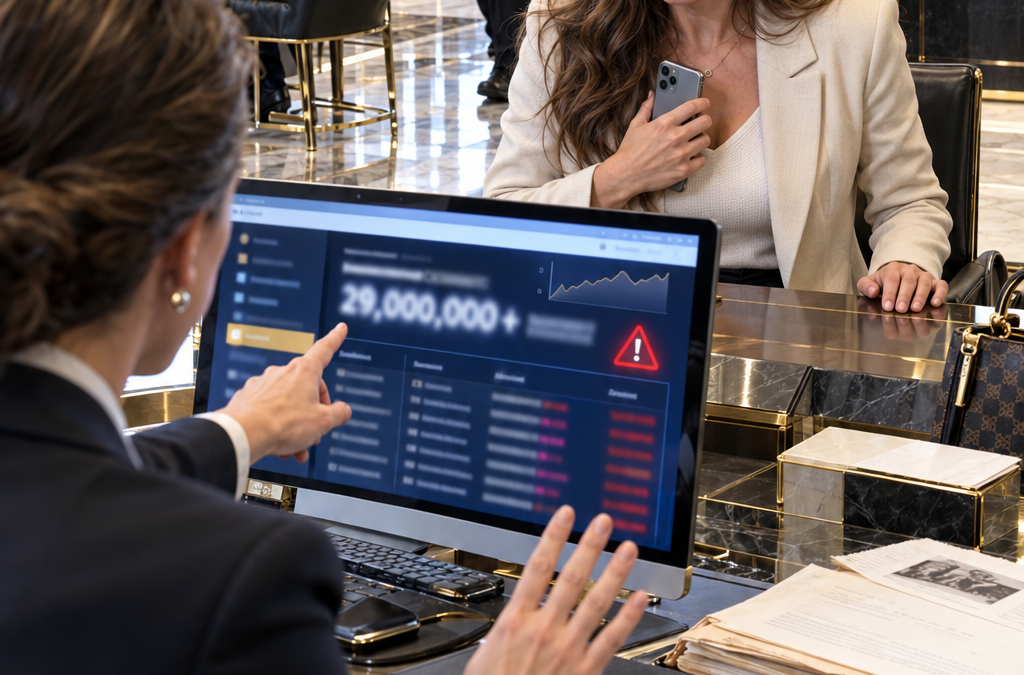
The Bank Called, “Ma’am, Someone Is Trying To Withdraw All The Money From Your Account.” I Never Knew About This Account. When I Arrived, There Was $29 Million In It. What Happened The Next Day…
The bank called while I was standing in a hospital break room eating yogurt between patients. “Ma’am, someone is trying to withdraw nearly everything from your account.” I laughed because I didn’t have an account with them. Then the banker read my Social Security digits, my birthday, and my late father’s address. The next morning, I drove to Columbus expecting a clerical mistake. Instead, a banker turned his screen toward me and showed me $29 million under my name—and a document granting someone in my family permission to take it.
### Part 1
Before that phone call, my life was ordinary enough that nobody would have mistaken me for a woman with secrets worth stealing.
My name is Maren Whitaker. I was thirty-nine, divorced, raising my eleven-year-old son Noah in a rented duplex outside Dayton, Ohio, and working three twelve-hour shifts a week as a pediatric nurse. When money got tight, I picked up a fourth shift. My Honda had nearly two hundred thousand miles on it, the passenger window made a grinding sound in cold weather, and I had learned which warning lights on the dashboard could be safely ignored for another paycheck. Noah knew the batting average of every player on the Cincinnati Reds and believed, with the unshakable confidence only an eleven-year-old possesses, that he would someday play shortstop for them.
I wasn’t wealthy. I wasn’t miserable either. I paid my bills, bought decent groceries, and occasionally had twenty dollars left on Friday night for takeout. After my divorce, that stability had felt like an achievement.
My father, Gordon Mercer, died fourteen months before the bank called me. He collapsed in the kitchen of his Oakwood home before paramedics could do anything. He was sixty-eight. At the reading of his will, nearly everything visible went to my stepmother, Elaine: the house, his cars, his personal accounts, his furniture, his collection of expensive watches. I received his old stainless-steel wristwatch and twenty thousand dollars.
I told myself it was reasonable. Elaine had been married to Dad for twenty-two years. She had lived with him, traveled with him, cared for him after a heart procedure, and listened to him complain about cholesterol and taxes. I was an adult with a career and a child of my own.
Still, there were nights when I folded Noah’s T-shirts at the kitchen table and wondered if twenty thousand dollars and a watch were really all my father had wanted to leave me.
The first strange thing happened five months after Dad died. Elaine called and asked for my Social Security number.
“The accountant needs it for estate paperwork,” she said.
Her voice was cheerful in a way that sounded practiced.
“Have the accountant call me,” I said. “I’ll give it directly to him.”
There was a pause.
Then she laughed. “Maren, don’t be dramatic. I’m your stepmother, not some stranger on the internet.”
“I know. I’d still rather give it to the accountant.”
She said it didn’t matter and ended the call.
No accountant ever contacted me.
In July, an email arrived from an institution called Heritage Lakes Private Trust informing me that my online security preferences had been changed. I didn’t recognize the bank. The message looked professional, which made me more suspicious, not less. I deleted it, congratulating myself for avoiding a phishing scam.
In September, my stepsister Brooke invited me to lunch.
Brooke was Elaine’s daughter from her first marriage. She was three years younger than me and worked as a notary and closing specialist for a title company in Centerville. We had known each other since our teens, but we had never been close enough to meet for lunch alone.
She ordered a chicken salad and barely touched it.
“Did Gordon ever talk to you about investments?” she asked.
“Dad?”
“Yeah. Company stock, retirement accounts, things like that.”
“Not really.”
She nodded, took a sip of tea, then asked whether I still used the same phone number.
“Yes.”
“And you’re still at the apartment in Kettering?”
“Duplex.”
“Right.”
I put down my fork. “Why are you asking me all this?”
Her smile came too quickly. “Mom’s updating family information.”
“What family information?”
“You know. Addresses. Numbers.”
“Since when does Elaine keep a family database?”
Brooke laughed, but she looked toward the window instead of at me.
I drove home feeling uneasy, though I couldn’t have explained why.
That was the problem with warnings. They rarely arrive as warnings. They arrive as ordinary things: a phone call, an email, a strange lunch. Each detail is easy to dismiss until somebody puts them together for you.
For me, that somebody was a private banker named Daniel Ross.
He called on a Tuesday afternoon in October at 2:38. I was standing in the fourth-floor break room eating strawberry yogurt because I had missed lunch.
“Is this Maren Whitaker, formerly Maren Mercer?”
“Yes.”
“My name is Daniel Ross. I’m calling from Heritage Lakes Private Trust in Columbus.”
My spoon stopped halfway to my mouth.
“We’re attempting to verify a wire transfer request from an account in your name.”
“I think you have the wrong person.”
“May I verify your date of birth?”
He read it.
Then the last four digits of my Social Security number.
Then Dad’s Oakwood address.
The room suddenly felt too warm.
“I don’t have an account with your bank.”
There was silence on his end.
When Daniel spoke again, his voice had changed. “Ms. Whitaker, someone submitted instructions this morning requesting a transfer of nearly the entire account balance. The request is supported by a power of attorney carrying your signature. Our policy requires verbal verification for transfers of this size.”
“What size?”
Another pause.
“Twenty-eight million dollars.”
I laughed again, but it came out like a cough.
“You’ve definitely got the wrong Maren Whitaker.”
“I don’t believe we do.”
He asked whether I had ever authorized anyone to act financially on my behalf.
“No.”
“Have you signed a power of attorney recently?”
“No.”
“Then I’m placing an immediate hold on the transaction.”
I gripped the edge of the counter.
“How much money is in this account?”
“I’d rather discuss that in person after verifying your identification.”
I finished my shift badly. I entered the wrong room with a medication cup, caught myself before anything happened, apologized to the family, and spent the rest of the evening operating on muscle memory. At home, I made Noah spaghetti, listened to him complain about a math worksheet, and pretended my hands weren’t shaking.
After he went to bed, I sat alone in the kitchen.
A bank account in my name.
A power of attorney I hadn’t signed.
Twenty-eight million dollars.
I drove to Columbus the next morning with my passport and driver’s license in my purse. Heritage Lakes occupied several floors of a glass office tower downtown. Daniel Ross was a gray-haired man in his fifties with careful eyes and reading glasses resting low on his nose.
He verified my identification twice.
Then he rotated his monitor toward me.
My name appeared at the top.
Under it was an account number.
Under that was the balance.
$29,146,882.17.
For several seconds, I couldn’t understand what I was seeing.
I counted the commas.
Then I whispered, “This has to be a mistake.”
Daniel removed his glasses.
“No, Ms. Whitaker,” he said. “Your father opened this account for you.”
And suddenly every harmless little warning from the previous seven months felt like a door locking behind me.
### Part 2
Daniel explained the account slowly, as though he were describing a diagnosis to someone whose brain had stopped processing ordinary language.
Ten years earlier, after my marriage ended, Noah and I had lived with Dad for eight months while I rebuilt my finances. During that period Dad had still owned Mercer Route Systems, a regional software company he had founded with a college friend. One evening, he had pushed several papers across the kitchen table and told me they involved company shares.
“Sign here, kiddo. It’s something for later.”
I remembered the moment, but only faintly. I had been working nights, going through custody mediation, and trying to keep a toddler from drawing on Dad’s walls. I had signed wherever he pointed.
Those signatures transferred a block of privately held shares into my name.
At the time, they were valuable but hardly life-changing.
Dad completed the required filings. Because I lived with him, he used his house as my mailing address. Heritage Lakes opened a custodial investment account containing the shares.
Years passed.
I moved out.
Nobody changed the address.
Then, three months after Dad died, a national transportation technology company acquired Mercer Route Systems. My shares converted to cash.
More than thirty million dollars.
Every statement went to the Oakwood house.
To Elaine.
“So she knew,” I said.
Daniel didn’t answer directly.
Instead, he opened the transaction history.
A wire for $180,000 had left the account in June.
Another for $240,000 had left in August.
Both had gone to Mercer Family Ventures LLC, an entity I had never heard of.
“How?”
Daniel opened another screen.
A power of attorney had been submitted in May granting Elaine Mercer authority over my financial affairs. It appeared to bear my signature.
I stared at the digital copy.
The handwriting was close enough to fool somebody who did not know me.
It wasn’t mine.
“I didn’t sign that.”
“We’ll obtain the original scanned document.”
“Who notarized it?”
He hesitated.
That hesitation told me the answer would matter.
“I can’t confirm anything until our fraud department reviews the file.”
A woman named Priya Shah joined us twenty minutes later. She was the bank’s fraud investigator, sharp-eyed and calm, with a legal pad already full of notes.
She explained that yesterday’s transfer request had been for $28.6 million.
Nearly everything remaining in the account.
The earlier transfers had not triggered personal verification because they fell below the institution’s special callback threshold. The latest request had.
The room became very quiet.
If Daniel had not called me, I would have lost almost thirty million dollars without knowing I had ever owned it.
Then Priya asked, “Do you recognize anyone who might have had access to your personal information?”
Elaine asking for my Social Security number.
Brooke asking about my phone and address.
Brooke, the notary.
“I have suspicions.”
“Don’t confront anyone,” Priya said. “Not yet.”
I looked at her.
She tapped her pen against the folder. “If somebody fabricated legal authority to access this account, you don’t want to give them time to destroy evidence.”
There was another problem.
Taxes.
The sale of my shares had created substantial taxable income. I had filed my ordinary return the previous spring: nursing salary, mortgage interest from my old marital property, child credit, nothing unusual.
I hadn’t reported millions of dollars because I hadn’t known the transaction existed.
By the time I reached the parking garage, I had convinced myself I was about to lose my job, my home, and possibly my freedom because of money I had never touched.
I sat inside my Honda with the doors locked and cried so hard my chest hurt.
Then my phone buzzed.
Elaine.
I watched it ring.
She had stood beside me at Dad’s funeral. She had held my arm at the cemetery and told me, “We’re all we have now.”
Had she already been receiving my bank statements then?
I didn’t answer.
By the time I reached home, fear had become something more useful.
A plan.
First, I would tell Elaine and Brooke nothing.
Second, I would hire an attorney.
Third, I would fix the tax problem before anybody could use it to frighten me.
My friend Jasmine recommended David Crane, a litigation attorney whose office occupied the upper floor of an old building near the Great Miami River. She described him as “expensive, humorless, and exactly who you want when somebody thinks they can bully you.”
David listened for nearly half an hour without interrupting.
When I finished, he said, “You’ve already done the most important thing.”
“What?”
“You didn’t call them.”
His retainer was fifteen thousand dollars. I paid it from the twenty thousand Dad had left me in his will.
That felt appropriate.
Within forty-eight hours, David demanded certified copies of the power of attorney, transfer requests, security changes, correspondence, telephone logs, and account-opening records. He sent preservation notices to the receiving bank and to Mercer Family Ventures LLC.
He also referred me to a CPA named Sheila Porter.
Sheila looked at my records and said, “You owe tax. That part doesn’t disappear. But accidental nonreporting is very different from intentional concealment. We amend the return immediately, pay what is due from the account, document why you didn’t know about the income, and ask for penalty relief.”
“So I’m not going to prison?”
She looked over her glasses.
“Not for failing to report income you can prove you didn’t know existed.”
I almost hugged her.
The criminal side frightened me more.
David and I met with Detective Lena Morales from the county financial crimes unit. She listened, requested the bank documentation, and told me exactly what I needed to understand.
“If someone forged your signature and used it to obtain millions of dollars, this is not a family disagreement.”
“What happens if I decide later that I don’t want to pursue it?”
“That may affect some decisions, but once the state has evidence of serious crimes, it isn’t completely yours to turn off.”
Two days later, the calls started.
Elaine called three times.
Brooke texted twice.
“Mom’s trying to reach you. Everything okay?”
I ignored both.
Then a sedan I didn’t recognize passed my duplex slowly one evening and returned ten minutes later.
I moved Noah’s bicycle inside.
A week later, David called me to his office.
The bank had produced the power of attorney.
It was four pages long.
At the bottom was my forged signature.
Under it was the notary certification.
Brooke Mercer Lane.
My stepsister.
For a moment, I simply stared.
Then I checked the date.
May 14.
I pulled up my hospital scheduling app.
On May 14, I had worked from 7:00 a.m. until after 7:30 p.m.
My badge entries proved it. Medication scans proved it. Patient records proved it.
Brooke had notarized a document saying I personally appeared before her on a day when I had been inside a hospital caring for patients nearly continuously.
David leaned back in his chair.
“That date may be the best witness you have.”
That night Elaine left me a voicemail.
Her voice no longer sounded sweet.
“Maren, I know you went to Columbus. Call me.”
I listened twice.
I had told nobody in the family where I had gone.
The pretending was over.
### Part 3
David filed the civil lawsuit that Friday.
Maren Whitaker v. Elaine Mercer, Brooke Mercer Lane, and Mercer Family Ventures LLC.
Fraud. Conversion. Civil conspiracy. Theft.
He also obtained an emergency order preventing the defendants from moving money or selling property connected to the disputed funds.
Detective Morales began pursuing Brooke’s notary records.
Then Elaine came to my hospital.
I saw her standing near the huge aquarium in the main lobby while I was walking toward the cafeteria. She wore a tailored tan coat and pearl earrings Dad had given her on an anniversary. Around her, parents pushed children in wheelchairs and nurses hurried toward elevators.
Elaine stood completely still.
“We need to talk,” she said.
“We can talk here.”
“Privately.”
“No.”
Her mouth tightened.
“Do you understand what you’ve done?”
I said nothing.
“Brooke has been put on leave. Her employer thinks she committed fraud because of you.”
“Brooke notarized a document I never signed.”
“You are destroying this family over money.”
That sentence almost made me laugh.
Elaine stepped closer.
“Your father didn’t tell you about that account for a reason.”
“Then how did you know about it?”
Her eyes flickered.
I knew immediately I had hit something important.
She changed direction.
“You didn’t report the money on your taxes.”
There it was.
The weapon she had prepared.
“Thirty million dollars, Maren. Do you have any idea how bad that looks? If investigators think you hid income, you could face serious consequences.”
My heartbeat accelerated, but I didn’t let her see it.
She lowered her voice.
“And what happens to Noah if his mother gets investigated for financial crimes? His father might decide he wants custody.”
Everything inside me went still.
I could tolerate threats aimed at me.
Not Noah.
“My amended return was filed last week,” I said.
Elaine blinked.
“My accountant included the bank records showing every notice went to your address. The tax is being paid.”
Her expression changed.
“And May 14?” I continued. “I worked twelve hours here. My badge, medication records, computer logins, and patient charts prove where I was every hour. So if Brooke claims I appeared before her, she can explain that to Detective Morales.”
Elaine’s face drained.
“Detective?”
“Yes.”
A security officer I knew named Ron had begun moving toward us.
Elaine picked up her handbag.
“You’ll regret humiliating us.”
“If you mention my son again,” I said, “I’ll make sure my lawyer documents that too.”
She walked out.
I made it to a staff bathroom before my knees started shaking.
That night, Brooke called from an unfamiliar number.
She was crying.
“Mom said you agreed.”
I said nothing.
“She told me you signed it at the house and that I was only confirming something you had already done.”
“Brooke—”
“She said it was just paperwork.”
Then she hung up.
I wrote down the conversation immediately and sent it to David.
Afterward, I took Noah out of school for a Friday and drove north to Lake Erie. We rented a small cabin where the wind rattled the windows at night and spent two days eating fried fish, walking near the lighthouse, and discussing baseball.
On the last evening, Noah asked, “Are you in trouble?”
Children always know.
I stared into the little iron stove.
“No.”
“Then why do you keep checking your phone?”
I thought about lying.
Instead I said, “Someone tried to take something Grandpa left for us. I’m making sure they can’t.”
“Money?”
“Yes.”
“A lot?”
“Enough.”
He nodded seriously.
“Can I still get new cleats?”
I laughed for the first time in weeks.
“Yes.”
When we returned home, David called.
Elaine’s new attorney had sent a settlement proposal.
I could keep twenty million dollars.
Elaine would receive nine million “in recognition of her contributions to my father’s life and business.”
The stolen $420,000 would be treated as a forgiven family loan.
Everyone would dismiss civil claims and sign confidentiality agreements.
I would also provide a statement saying the disputed power of attorney resulted from a misunderstanding.
David finished reading.
Then he said, “Twenty million is real money. I’m obligated to tell you that.”
“It isn’t twenty million.”
“What do you mean?”
“That money is already mine.”
Silence.
“They aren’t offering me twenty million. They’re asking me to give them nine million dollars so we can pretend forging my name was a misunderstanding.”
“That is one way to describe it.”
“Can I stop the criminal investigation?”
“No. You can communicate your wishes, but prosecutors make criminal charging decisions.”
“Then reject it.”
Two days later, Brooke mailed me a card.
Inside, she wrote that her marriage was struggling, that she would lose her job and notary commission, and that her sons needed her. She asked me to meet without lawyers so we could “handle this as sisters.”
I read the letter twice.
What struck me was not what she admitted.
It was what she avoided.
She never wrote, “I falsely notarized your signature.”
She never wrote, “Mom asked me to help steal your money.”
She never wrote, “I’m telling the truth.”
She wrote around the truth because she still wanted me to rescue her from its consequences.
I gave the card to David.
The next unexpected development came from a man named Walter Greene, who had founded Mercer Route Systems with my father.
Walter called me in early November.
“I have something Gordon left for you.”
I drove to his farmhouse near Yellow Springs.
Walter brought out a thick envelope.
My name was written across it in Dad’s handwriting.
“He gave this to me about a year before he died,” Walter said. “He told me that if the company sale went through after he was gone, I should make sure you received it.”
My fingers shook as I opened the envelope.
Dad’s letter explained everything.
He had transferred the shares to me deliberately. He knew Elaine would resent it, so he had kept the arrangement quiet. He believed the house, retirement accounts, and personal assets he intended to leave Elaine would provide for her comfortably.
The shares were for me.
He wrote that he was proud of the life I had rebuilt after my divorce.
Proud of my work.
Proud of the mother I had become.
At the end, one sentence broke me.
“I know I wasn’t always good at showing you I was there, but I was always reaching for you.”
I cried at Walter’s kitchen table.
For fourteen months, I had wondered whether Dad had forgotten me.
He hadn’t.
Someone else had simply tried to steal the proof.
### Part 4
Elaine and Brooke came to my house on a Sunday afternoon two weeks before Thanksgiving.
Noah was with his father.
I was sorting laundry when the doorbell rang.
Through the window, I saw Elaine holding a pie and Brooke carrying an old leather photo album.
They looked harmless.
That frightened me more than anger would have.
Before opening the door, I put Dad’s letter inside a kitchen drawer. Then I activated the voice recorder on my phone and slipped it into my cardigan pocket.
David had mentioned weeks earlier that Ohio generally allowed a participant in a conversation to record it.
I remembered.
“We just want to talk,” Elaine said.
“No lawyers.”
I let them inside.
Elaine placed the pie on my coffee table.
“Apple. Your father’s favorite.”
Dad hated apple pie.
His favorite had been cherry.
It was such a pointless lie that something in me relaxed. She couldn’t even manipulate me accurately anymore.
Brooke opened the photo album.
Dad fishing.
Dad holding baby Noah.
Dad beside me at nursing school graduation.
Elaine let several seconds of silence pass.
“He loved all of us.”
I waited.
“He would hate what you’re doing.”
There it was.
She spoke about Brooke’s children.
About prison.
About family loyalty.
About forgiveness.
Brooke cried quietly.
Some of the tears were probably genuine.
That was what made the scene dangerous.
People imagine manipulation always looks sinister. Sometimes it looks like a frightened mother holding photographs of your dead father while another woman sobs into a tissue.
“We can still fix this,” Elaine said.
“How?”
“Accept the settlement.”
I looked at Brooke.
“Did I sign the power of attorney in front of you?”
Her crying stopped.
She looked at Elaine.
“Brooke?”
“Don’t answer,” Elaine snapped.
Her entire posture changed.
I saw the real version of her then.
She stood.
“You want honesty? Fine. I gave Gordon twenty-two years. I cooked for him, traveled with him, cared for him, listened to every complaint he ever had. You visited when it was convenient.”
I stayed seated.
“He leaves me a house and then secretly gives you thirty million dollars?”
Her voice rose.
“That money should have belonged to me.”
Brooke whispered, “Mom.”
Elaine ignored her.
“He owed me.”
I said, “So you took it.”
“We took what was fair.”
Brooke went pale.
I felt my phone against my ribs.
Recording.
Elaine pointed at me.
“You drop the case. If you don’t, I’ll contact your ex-husband. I’ll contact the hospital. I’ll tell people you’re unstable. I’ll call child services if I have to.”
I stood.
“Leave.”
“Maren—”
“Leave my house.”
Brooke picked up the photo album.
Elaine grabbed the pie dish.
At the door, she turned.
The expression on her face wasn’t sadness.
It was hatred.
I locked the door behind them.
Then I sat on the floor.
My hands shook so violently that I had trouble unlocking my phone.
The recording was twenty-seven minutes long.
I uploaded copies to my email and cloud storage.
Then I called David.
He listened to the most important section.
“We took what was fair.”
There was silence.
Finally he said, “Did she know you were recording?”
“No.”
“Good.”
I told him about the threat involving child services.
“Write down exactly what time she said it.”
“David, I’m scared.”
“I know.”
“What if she actually does it?”
“Then we deal with facts.”
I walked through the house checking doors.
“Being afraid doesn’t mean you’re losing,” he said. “It means you understand the stakes.”
January brought depositions.
By then, the evidence had multiplied.
Detective Morales obtained Brooke’s notary journal.
On May 14, Brooke had written that I appeared with an Ohio driver’s license.
The license number was mine.
But it belonged to my old license, replaced two years earlier.
I suddenly remembered leaving the old card in a bedroom drawer at Dad’s house.
The receiving bank produced records for Mercer Family Ventures LLC.
Brooke had formed the company in April.
Its mailing address was Elaine’s Oakwood home.
More than $300,000 of the stolen money had been used to eliminate the remaining mortgage on the house.
Another portion went toward a luxury SUV and a deposit on a Florida condo.
Heritage Lakes discovered that the online profile changes had been made from the Oakwood home internet connection.
David placed each document in front of me.
“No single fact wins this case,” he said. “The pattern does.”
At Elaine’s deposition, David started with harmless questions.
Her marriage.
The household mail.
Dad’s business.
Then he asked about Heritage Lakes.
Elaine claimed Dad had told her about the account before he died.
David waited.
“The cash from the company sale entered the account months after his death. What exactly did he tell you?”
She corrected herself.
Then contradicted herself.
Then claimed I had asked her to manage the money.
“When?”
“In May.”
“Where?”
“At my house.”
David produced my hospital records.
I watched Elaine realize the room had closed around her.
He showed my badge entrance at 6:51 a.m.
My exit at 7:39 p.m.
My medication activity throughout the day.
“If Ms. Whitaker personally appeared before Brooke Lane that afternoon, when did she leave the hospital?”
Elaine looked toward her lawyer.
“Maybe Brooke wrote the wrong date.”
David slid the notary journal across the table.
“The same date appears in three places.”
Elaine said nothing.
Then David played my recording.
Her own voice filled the conference room.
“That money should have belonged to me.”
Then:
“We took what was fair.”
Elaine’s attorney closed his eyes briefly.
When the recording ended, Elaine whispered, “That’s out of context.”
David leaned forward.
“What context changes the meaning of ‘we took what was fair’?”
She had no answer.
Then Elaine turned toward Brooke.
“Tell them.”
Brooke stared at the table.
Her attorney touched her arm.
“My client is invoking her Fifth Amendment rights.”
“Brooke.”
Elaine’s voice cracked.
“Tell them she signed it.”
Brooke finally looked up.
“No, Mom.”
The room went silent.
“You did this,” Brooke whispered. “You started all of it.”
For the first time since the bank called me, I watched Elaine lose control of the room.
And I understood something important.
The person who had terrified me for months was finally more afraid than I was.
### Part 5
Three weeks after the deposition, Brooke decided to cooperate with prosecutors.
I learned through David before I heard anything from the family.
“Her attorney contacted the prosecutor,” he told me.
“What does that mean?”
“It means Brooke has decided she doesn’t want to go down with Elaine.”
I should have felt vindicated.
Instead, I sat at my kitchen table staring at the old watch Dad had left me.
Families can survive disagreements.
They can survive jealousy.
They can sometimes survive betrayal.
What I was watching now wasn’t survival.
It was disintegration.
Brooke’s official statement filled in the pieces we had only guessed.
After the company sale, statements began arriving at the Oakwood house showing the enormous balance in my account.
Elaine opened them.
At first, according to Brooke, she complained that Dad had humiliated her. She believed a wife of twenty-two years deserved more than a daughter who “barely came around.”
Then complaining became planning.
Elaine found my old driver’s license in my former bedroom.
She searched online for a power-of-attorney template.
She practiced my signature.
Brooke claimed she refused the first time Elaine asked her to notarize the document.
Then Elaine pressured her.
She said no one would be harmed.
She said I had more money than I could ever spend.
She said the shares should have been marital property morally, even if they were legally mine.
Finally Brooke stamped the document after business hours.
Nobody was present except the two of them.
They opened Mercer Family Ventures.
Elaine used the forged power of attorney to access the account.
The first transfer succeeded.
So did the second.
Nothing happened.
No police appeared.
No alarms went off.
According to Brooke, that success changed Elaine.
She stopped thinking in hundreds of thousands.
She started thinking about all of it.
The plan was to transfer nearly everything, move portions through multiple accounts, then claim I had willingly authorized Elaine to manage my inheritance.
If I eventually discovered the account, they believed I would be too embarrassed by the tax problem and too afraid of family scandal to challenge them.
They had calculated my personality.
Quiet.
Responsible.
Conflict-avoidant.
A single mother.
A nurse who spent her life solving other people’s crises.
They expected me to accept whatever explanation I was given.
Detective Morales later obtained a warrant to search the Oakwood house.
Inside Dad’s former study, investigators found a yellow legal pad.
My name appeared repeatedly across the pages.
Maren Whitaker.
Maren Whitaker.
Maren Whitaker.
The first attempts were clumsy.
Later ones looked closer.
I saw photographs of the pages.
That was one of the few moments during the entire case when I became physically sick.
I had imagined Elaine forging my name once.
I had not imagined her sitting at Dad’s desk practicing it.
Brooke pleaded guilty to forgery and tampering with records.
Because she cooperated early and provided evidence against Elaine, prosecutors recommended probation rather than prison, along with restitution and permanent loss of her notary commission.
Her employer fired her.
Her commission was revoked.
Elaine refused every plea offer.
Her first criminal attorney withdrew.
She hired another.
Then another.
Each time, according to David, she insisted she had simply recovered property that should have belonged to her.
“She thinks fairness is a legal defense,” David said.
The civil case moved faster.
We sought summary judgment based on the bank records, hospital evidence, Brooke’s plea, Dad’s letter, the LLC transactions, and my recording.
The judge ruled in my favor.
Elaine and the LLC were ordered to repay the stolen funds, additional statutory damages, and attorney fees.
The total civil judgment exceeded one million dollars.
Elaine didn’t have that kind of money.
The condo purchase collapsed.
The SUV was sold.
And eventually, the Oakwood house—the same house where my bank statements had been opened and my signature practiced—was placed under a judgment lien.
When David told me it might have to be sold, I expected satisfaction.
Instead, I pictured Dad standing in the kitchen drinking coffee.
Noah running down the hallway when he was three.
Christmas mornings.
My old bedroom.
“I don’t want the house,” I said.
“This isn’t about wanting it.”
“I know.”
Elaine called me once after the civil ruling.
By then, lawyers had told us not to communicate directly, so I let it go to voicemail.
Her message was twenty seconds long.
“You’ve taken my home. I hope someday Noah understands what kind of person you are.”
I listened once.
Then I forwarded it to David and deleted it from my phone.
I had spent months wondering whether I was being cruel.
That voicemail ended the question.
She still believed my refusal to surrender my money was equivalent to stealing hers.
The criminal trial was scheduled for May.
As the date approached, my anxiety returned.
I had testified in administrative hearings before. Nurses deal with documentation, complaints, sometimes lawyers.
A criminal jury was different.
This was Dad.
This was money.
This was my family.
The night before my testimony, Noah sat at the kitchen counter doing homework while I practiced answers with David over speakerphone.
When the call ended, Noah looked up.
“You nervous?”
“A little.”
“You always tell me being nervous means you care.”
I smiled.
“I hate when you use my own advice against me.”
The courthouse was smaller than it looked on television.
The courtroom smelled faintly of old wood and copier paper.
Jasmine came.
Walter and his wife came.
David sat behind the prosecutor during portions of the trial as my civil attorney and victim representative.
Elaine entered wearing black.
She looked older than she had six months earlier.
When I took the stand, the prosecutor asked me to begin with the bank call.
So I did.
I described the yogurt.
The unfamiliar number.
Daniel reading my birthday.
Driving to Columbus.
Counting the commas on the screen.
Then we reached Dad’s letter.
The prosecutor asked me to read the final paragraph.
I managed most of it.
Then I reached the sentence about him always reaching for me.
My voice broke.
I stopped.
Took a drink of water.
Continued.
Elaine’s attorney tried to suggest I knew about the account earlier.
Then Daniel Ross testified.
“In all the years the account existed,” the prosecutor asked, “how many times did Ms. Whitaker contact your institution before October?”
“Zero.”
“Online logins?”
“None.”
“Telephone inquiries?”
“None.”
“Where were statements mailed?”
“To the Oakwood address.”
Detective Morales introduced the legal pad.
Then Brooke testified.
She cried from the moment she took the oath.
Elaine’s attorney attacked her plea deal.
“You’re blaming your mother to save yourself.”
Brooke wiped her face.
“No.”
“Then why should anyone believe you?”
She looked toward Elaine.
“Because I spent months lying for her.”
A pause.
“And now I’m finally not.”
The jury deliberated less than four hours.
When they returned, I held Dad’s watch inside my closed fist.
Forgery.
Guilty.
Identity fraud.
Guilty.
Theft.
Guilty.
Fraud involving electronic communications.
Guilty.
Elaine stared straight ahead.
I had imagined that moment many times.
I thought I would feel victorious.
I didn’t.
I felt tired.
And, for the first time in months, safe.
### Part 6
Sentencing happened in July.
Ohio summer heat pressed against the courthouse windows, and the air-conditioning inside made the courtroom almost cold.
The prosecutor spoke about planning.
Not desperation.
Not one impulsive mistake.
Planning.
Elaine had intercepted information, obtained identification, practiced my signature, recruited Brooke, established an LLC, transferred money twice, modified account settings, then attempted to take nearly the entire balance.
The judge asked whether Elaine wanted to speak.
She stood.
“I was a good wife.”
Her lawyer looked down.
“I cared for Gordon for twenty-two years. I was there when he was sick. I was there every day. Then I learned that he secretly gave his daughter a fortune.”
She looked toward me.
“I made mistakes. But nobody has ever considered what he did to me.”
The judge listened patiently.
Then he said, “This court is not sentencing Gordon Mercer.”
Elaine’s face tightened.
“We are sentencing you.”
He imposed four years in state custody followed by post-release supervision and restitution obligations.
When deputies approached her, she finally looked at me.
There were no tears.
Only accusation.
As if I had created the consequences rather than refused to erase them.
Outside the courthouse, David loosened his tie.
“How do you feel?”
I thought about it.
“Like the room finally stopped spinning.”
“That’s probably healthier than celebrating.”
“I wasn’t planning a parade.”
He almost smiled.
It was only the second time I had seen him do it.
The strange thing about suddenly becoming wealthy is that the money does not immediately feel real.
The morning after Elaine’s sentencing, I still woke at 5:15 because my body believed I had to be at the hospital before seven.
I still compared grocery prices.
I still moved money from checking to savings before the electric bill came out.
Sheila, my CPA, gave me one rule.
“Do nothing dramatic for six months.”
“That’s your professional financial advice?”
“Yes. Sudden wealth makes otherwise intelligent people behave like teenagers in a casino.”
So I did almost nothing.
The tax liability was paid.
It was several million dollars, and seeing the transfer leave the account made my stomach hurt even though I still had more money than I had ever imagined.
The tax authorities accepted our documentation and granted substantial penalty relief because the evidence showed I had not known about the account.
Heritage Lakes also admitted weaknesses in its handling of the fraudulent authorization. After negotiation, the bank reimbursed the original $420,000 transferred from my account and assumed its own collection rights against the responsible parties.
For months, the money remained mostly untouched.
I kept working.
Not four shifts.
Two.
Some colleagues assumed I was cutting back because of stress.
A few knew about the case because it had appeared briefly in local news, but I refused interviews.
I had no interest in becoming “the $29 million nurse.”
I was still the woman who knew which cartoon character could calm a frightened five-year-old before a blood draw.
I still loved that part of my life.
Noah adapted to our changed finances with surprisingly little drama.
When I told him I could replace my Honda, he asked whether we could get a truck.
“No.”
“A sports car?”
“No.”
“A motorcycle?”
“Absolutely not.”
“So what’s the point of being rich?”
I bought a reliable SUV.
He declared it boring.
In the spring, after nearly six months of looking quietly, I bought a brick house in Oakwood.
Not Elaine’s house.
I couldn’t have lived there.
Mine was four blocks away, with maple trees, a deep backyard, and an old detached garage.
On our first night, most of the furniture hadn’t arrived.
Noah and I ate pizza sitting on the living-room floor.
He looked around at the empty walls.
“This is really ours?”
“Yes.”
“You paid for it?”
“Yes.”
“All of it?”
“Yes.”
He whistled.
Then he asked whether his room could have navy walls.
I said no.
We compromised on one navy wall.
I paid off my student loans.
Created a college trust for Noah.
Set aside investments I couldn’t touch impulsively.
Walter helped me establish a scholarship in Dad’s name through my nursing school. It was intended for single parents returning to college for health-care careers.
That mattered more to me than the house.
Dad had helped me when I was a newly divorced mother struggling to finish my training.
Now his money would help someone else stand back up.
On my fortieth birthday, I invited Walter and his wife, Jasmine, Noah, and David to the steakhouse where Dad had once taken me after nursing school graduation.
Dad’s letter said he had planned to tell me about the shares there.
So I brought the letter.
After dinner, I read a paragraph aloud.
Nobody said much afterward.
David became extremely interested in the pattern of the tablecloth.
Jasmine squeezed my hand.
Noah asked if Grandpa had really planned all of this.
“The shares?”
“Yeah.”
“He planned for me to have them.”
“Even if you didn’t know?”
“Especially because I didn’t know.”
Noah frowned.
“That’s kind of weird.”
I laughed.
“Grandpa could be weird.”
The criminal case had ended, but the family consequences kept unfolding.
Elaine’s old social circle vanished.
Several women who had once sent her Christmas cards every year stopped contacting her.
Her own sister told a mutual acquaintance she wanted nothing to do with the situation.
I heard all of this secondhand.
I never asked.
Brooke’s marriage lasted only a few more months.
Her husband filed for divorce.
She received probation and restitution rather than prison, but the felony record followed her.
She couldn’t return to title work.
Banks wouldn’t hire her.
Real estate offices didn’t want somebody whose name appeared in a forgery case.
For the first time in my life, I understood that consequences can be quieter than punishment.
Sometimes losing trust is worse than losing money.
Brooke sent me a letter nearly a year after the bank call.
Unlike her first card, this one contained no excuses.
“I stamped the document. I knew you weren’t there. Mom pressured me, but I chose to do it.”
I read that sentence many times.
At the end, she wrote:
“I don’t expect forgiveness.”
That was the first truly honest thing she had sent me.
I did not respond.
Not because I hated her.
I didn’t.
I simply no longer believed every apology required access to my life.
### Part 7
Elaine wrote from prison once.
The envelope arrived in late February.
I recognized her handwriting immediately and left it unopened on the kitchen counter for three days.
Eventually, curiosity won.
The letter was four pages.
Not one sentence contained the words “I’m sorry.”
She wrote about prison food.
About losing the house.
About Brooke turning against her.
About Dad’s betrayal.
About the humiliation of being searched and counted and told when to sleep.
Then she wrote, “I hope one day you understand that your refusal to compromise destroyed what remained of Gordon’s family.”
I laughed softly when I read that.
Not because it was funny.
Because after everything, Elaine still believed boundaries were acts of aggression when they were directed at her.
I put the letter in a folder with the legal records.
I never answered.
People sometimes asked whether I regretted refusing the settlement.
Twenty million dollars was more money than I could reasonably spend.
Could I have given Elaine nine million, kept twenty, and spared everyone a trial?
The question sounded logical only if you ignored what the payment would have purchased.
Silence.
A rewritten history.
A lie stating that forgery was misunderstanding.
An agreement that theft became acceptable if the thief allowed the victim to keep most of what belonged to her.
No.
I did not regret refusing.
That didn’t mean the experience left me untouched.
For months, I checked bank notifications obsessively.
I froze my credit.
Changed passwords repeatedly.
Reviewed every tax document line by line.
I installed cameras at the new house.
The first time an unknown car stopped near my driveway, I stood behind the curtain until it moved.
Money solved bills.
It did not automatically solve fear.
Therapy helped.
So did routine.
Hospital shifts.
Baseball practices.
Laundry.
Grocery shopping.
Ordinary life rebuilt me more effectively than luxury ever could.
Noah made his school baseball team the following spring.
He did not get shortstop.
He got second base.
You would have thought the Cincinnati Reds personally rejected him.
“This is political,” he announced.
“You’re eleven.”
“Exactly.”
“What does that even mean?”
“I don’t know, but Coach has favorites.”
Two weeks later he loved second base.
Watching him play became one of the few times my mind went completely quiet.
The late-afternoon sun.
Parents folding camp chairs.
Metal bats ringing.
The smell of grass.
Children yelling from the dugout.
No lawyers.
No banks.
No recorded confessions.
No account balances.
Just life.
One evening after practice, Noah and I walked home beneath the maples.
He carried his glove in one hand.
“Would Grandpa have liked our house?”
“He would have complained about the gutters.”
Noah laughed.
“But yeah?”
“He would have loved it.”
“Do you miss him?”
“Every day.”
He was quiet for a while.
“Do you miss Elaine?”
The question surprised me.
“No.”
“You don’t feel bad?”
“Sometimes I feel sad.”
“That’s different?”
“Yes.”
He thought about that.
“Can you be sad about someone without wanting them back?”
I looked at him.
Children occasionally ask the cleanest version of questions adults spend years complicating.
“Yes,” I said. “You absolutely can.”
That became the clearest explanation of how I felt about Brooke too.
I was sad for her.
I was sad for her sons.
I was sad that she had spent so many years needing Elaine’s approval that she let it erase her judgment.
But sympathy did not mean restoration.
Her probation officer supervised her restitution.
She found work outside the financial industry.
Eventually I heard she was seeing her children regularly again and taking classes for a new career.
I hoped she succeeded.
From a distance.
Walter died two years after Dad.
He had been ill longer than he admitted.
Before he died, I visited him at the farmhouse.
He asked whether I still had Dad’s letter.
“In a fireproof safe.”
“Good.”
He smiled.
“Gordon always worried you thought he loved the company more than you.”
“He wasn’t exactly great at saying things.”
“No. He was terrible at it.”
We laughed.
Then Walter grew serious.
“You know why he gave you those shares?”
“Because he wanted me protected.”
“That was part of it.”
“What was the other part?”
Walter looked toward the window.
“Your father knew you would never ask him for anything.”
I swallowed.
“He said Elaine knew how to demand what she wanted. You didn’t.”
That sentence stayed with me.
For years, I had mistaken needing less for deserving less.
I had thought being independent meant people were allowed to overlook me.
Dad had understood something I hadn’t.
Strength doesn’t eliminate the need to be considered.
That realization changed how I used the money.
The scholarship expanded.
I funded emergency grants for nursing students who were one unexpected car repair or rent increase away from dropping out.
I donated quietly to the pediatric hospital foundation.
No naming rights.
No plaques.
I had spent enough time watching money become a performance.
I wanted mine to become useful.
Five years after the bank call, Heritage Lakes sent me an invitation to a client appreciation dinner.
I almost threw it away.
Then I noticed Daniel Ross’s name on the guest list.
I went.
He recognized me immediately.
“Maren.”
“Daniel.”
He smiled.
“You look less terrified than the first time I saw you.”
“I had just discovered twenty-nine million dollars and identity fraud before lunch.”
“Fair point.”
I thanked him again for making the call.
He shrugged.
“It was my job.”
“No,” I said. “Your job was to follow a procedure. You paid attention.”
If he had taken the easier path, the transfer might have happened.
Sometimes lives change because somebody performs a small responsibility carefully.
Daniel had made a phone call.
That was all.
That was everything.
Before leaving, he asked whether I ever wished I had known about the money earlier.
I considered it.
“Sometimes.”
“Why only sometimes?”
“Because if I had known before Dad died, I would’ve asked him a thousand questions.”
“And?”
“I might never have needed the letter.”
Daniel nodded.
I walked outside.
For once, the thought of Dad didn’t hurt.
It simply stayed beside me.
### Part 8
Six years after that Tuesday afternoon in the hospital break room, I no longer think of my life as divided into “before I had money” and “after.”
Money was never the real dividing line.
The real line was between the version of me who believed keeping peace was the same as protecting a family and the version who finally understood that sometimes protecting yourself is the only peaceful choice left.
Elaine served her sentence and was released under supervision.
I learned through David, who still handled occasional legal matters for me, that she moved into a small apartment near Columbus.
Her restitution obligation remained.
She had no house waiting.
No country-club circle.
No easy path back to the life she once considered hers by right.
She never contacted me directly again.
Brooke did.
Not immediately.
Almost three years passed after her second letter.
Then I received an email.
It began, “I’m not asking to be part of your life.”
I kept reading.
Brooke had completed probation requirements without violations. She had retrained as a medical billing specialist and was working for a small clinic. Her relationship with her sons had improved.
She wrote that therapy forced her to confront how much of her adult life had revolved around pleasing Elaine.
Then she wrote something that mattered.
“That explains why I did it. It does not excuse why I did it.”
I sat with that sentence.
For the first time, I considered responding.
Not forgiving.
Not reconciling.
Responding.
I wrote four drafts.
Deleted all of them.
Finally I sent three lines.
“I’m glad you’re rebuilding your life. I hope you continue making choices you can live with. I’m not ready for a relationship, and I may never be, but I wish you well.”
She answered, “I understand.”
No guilt.
No demand.
No photograph of Dad.
No children used as leverage.
Just understanding.
That was enough.
Sometimes people expect stories about betrayal to end with a dramatic reunion.
The person who hurt you collapses in tears.
You embrace.
Music plays somewhere in the background.
Everybody learns something.
Real life is not obligated to provide that scene.
Brooke and I did not become sisters again.
We became two women who once shared a family and later understood the same disaster from opposite sides.
That was all.
And it was more honest than pretending trust grows back because someone finally admits why they broke it.
Noah grew.
By seventeen, he was taller than me.
He never became a shortstop for the Reds.
He did become a very good second baseman for his high school, which he eventually admitted might have been the correct position all along.
He started looking at colleges.
For the first time, tuition was not the terrifying conversation I had expected to face as a single mother.
One night, while we reviewed schools at the kitchen table, he looked at me.
“Do you think Grandpa knew the company would become worth that much?”
“I don’t know.”
“What if the shares had only been worth fifty thousand dollars?”
“I would’ve loved the letter exactly the same.”
He nodded.
“That’s what I thought.”
The money changed our options.
Dad’s letter changed something deeper.
For years, I had carried quiet resentment because I believed his will proved I mattered less than Elaine.
Finding out about the shares didn’t erase every complicated part of our relationship.
Dad had been stubborn.
Private.
Sometimes emotionally clumsy.
He missed things he should have attended.
I avoided visiting when I should have gone.
We were imperfect with each other.
But love does not become unreal simply because it was expressed badly.
That was the final gift he gave me.
Not thirty million dollars.
Context.
I still work one or two hospital shifts most weeks.
People ask why.
Because I like knowing how to do something that matters when money has nothing to do with it.
A frightened child does not care about my investment portfolio.
A parent whose daughter has a fever does not care where I live.
Inside those hospital rooms, usefulness is simple.
Listen.
Explain.
Pay attention.
Do the next necessary thing.
That philosophy saved me long before wealth did.
The Richard Mercer Scholarship now supports several students each year.
Every spring, I attend a small reception where the recipients tell their stories.
Single mothers.
Single fathers.
People changing careers in their forties.
People who thought one financial crisis had ended their education.
I never tell them the entire story behind the scholarship.
They don’t need my family scandal.
I usually say my father believed people deserved a second chance to build stable lives.
That part is true.
On my forty-fifth birthday, Noah gave me a framed photograph.
It showed Dad holding him as a newborn.
I recognized the picture immediately. It had been one of the photographs in the album Brooke brought to my duplex the day Elaine confessed.
“How did you get this?”
“Brooke mailed me a copy.”
I stared at him.
“She asked first,” he added quickly. “I said I wanted it.”
I traced Dad’s face through the glass.
For a second, I remembered the pie on the table.
Elaine pointing at me.
My phone recording inside my cardigan.
My hands shaking after they left.
Then the memories moved backward.
Dad sliding papers toward me across the kitchen table.
“It’s something for later.”
I smiled.
Later had arrived in a way none of us expected.
That evening, I drove alone past the old Oakwood house.
It belonged to another family now.
A bicycle lay in the front yard.
A man was trimming bushes.
Through the front window, I saw someone carrying laundry across the hallway.
Ordinary life had filled the rooms again.
I pulled over several houses away and sat for a minute.
That house had once seemed like the center of everything.
Dad.
Elaine.
The statements.
The forged signature.
The legal pad.
The betrayal.
Now it was simply a house.
I realized the same thing was true of the money.
Twenty-nine million dollars had once seemed like the entire story.
It wasn’t.
The story was about what people reveal when they believe you will remain silent.
Elaine believed marriage entitled her to something Dad deliberately gave me.
Brooke believed loyalty to her mother mattered more than honesty to me.
I believed avoiding conflict made me safe.
We were all wrong about something.
Only some of those mistakes were crimes.
When I returned home, Noah was outside shooting baskets in the driveway.
He tossed me the ball.
I missed badly.
“That was tragic,” he said.
“I’m a nurse, not an athlete.”
“That’s your excuse for everything.”
We went inside.
Dinner was leftovers.
The dishwasher made a rattling noise.
A stack of mail waited on the counter.
Ordinary things.
Beautifully ordinary.
I still have Dad’s watch.
I wear it almost every day.
Sometimes people notice and ask whether it is valuable.
I always say yes.
They assume I mean money.
I don’t correct them.
If there is one thing the whole ordeal taught me, it is that greed rarely announces itself as greed.
It comes disguised as fairness.
As family obligation.
As “what I deserve.”
It asks you to surrender something small first: a password, a signature, a boundary, your silence.
Then it asks for more.
I also learned not every person who hurts you deserves a permanent place in your life simply because they are related to you.
I did not forgive Elaine.
I stopped needing to hate her.
Those are not the same thing.
I did not rebuild a relationship with Brooke.
I stopped wishing for her destruction.
Those are not the same thing either.
And I stopped believing that protecting myself made me cold.
Sometimes the most responsible thing you can do is refuse to participate in somebody else’s version of reality.
That Tuesday in October, I thought Daniel Ross had called to tell me someone was stealing my money.
He was.
But without knowing it, he was also calling to tell me that the life I understood was missing several important pages.
It took lawyers, tax returns, courtrooms, a recording, a criminal trial, and one letter from my father to find them.
Now, when I think back to the moment Daniel turned his monitor toward me, I no longer remember the balance first.
I remember my reflection in the dark edge of the screen.
A tired nurse in cheap shoes, staring at numbers she could not understand.
She thought the terrifying part was discovering she had twenty-nine million dollars.
She was wrong.
The terrifying part was discovering what people she called family were willing to do to take it.
The best part came later.
It was discovering they hadn’t taken me with it.
THE END!