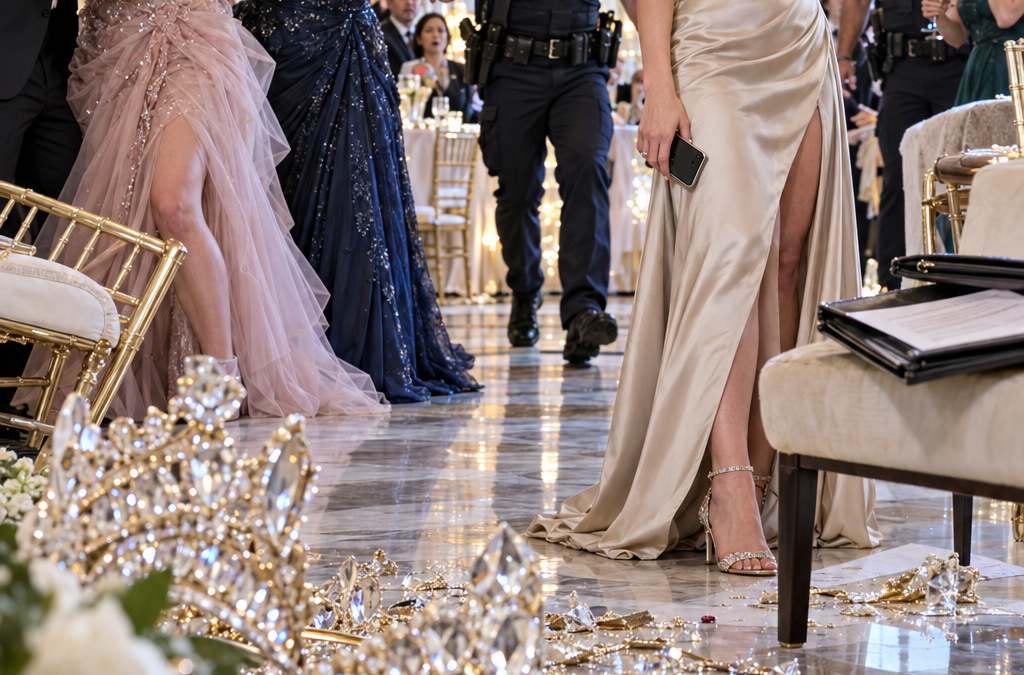
At The Engagement, My Sister Smashed A Glass Crown On My Head—What The ER Found Brought Police. My Sister Smashed A Glass Crown On Me — After I Paid $40k For Her Engagement Venue. My Mom Texted, “Stop Bleeding And Go Home.” So I Called The Police To The Party. You Won’t Believe What Happened When They Arrived… They Panicked..
I paid forty thousand dollars for my younger sister’s engagement party, then stood beneath two hundred witnesses while she drove a glass crown into my head and my mother told me to stop embarrassing the family. I didn’t scream, threaten anyone, or give them the breakdown their cameras seemed to be waiting for. I preserved the footage, went straight to the hospital, and called a lawyer. By sunrise, a doctor had removed something from my scalp that proved the “joke” had never been a joke at all—and one strange message from my sixteen-year-old niece suggested I wasn’t the only person they had been using.
Part 1
The sound I remember most clearly was not the glass breaking. It was the tiny click of a camera changing focus while blood ran down the side of my face. One second I was standing beneath the vaulted glass ceiling of Hawthorne Conservatory in Westchester County, smiling because my younger sister, Brooke Mercer, had just called me to the front of the room during her engagement toast; the next, a blinding white flash burst behind my eyes as something heavy slammed down on top of my skull. My knees buckled, my hands flew upward, and when I looked through watering eyes I saw Brooke gripping both sides of a decorative crystal crown and pressing down as if she were trying to force it through my hair.
I shoved her wrists away and stumbled backward on the marble floor. Two hundred guests went quiet so quickly that I could hear champagne bubbling in the flute someone had left on the table beside me, and somewhere near the catering station a plate hit the floor and shattered. Brooke’s fiancé, Grant, stood three feet away with his mouth open, while my mother, Camille, remained beside the floral arch in a silver evening gown that probably cost more than my first car. Camille looked at me, looked at the blood appearing between my fingers, and then—before doing anything else—turned her eyes toward the nearest camera operator and checked whether his red recording light was still on.
“Claire, please don’t make a scene,” she said.
That sentence hurt more than the first shock of pain. I was thirty-three years old, a commercial real estate appraiser who spent most of my life examining buildings for hidden damage, and yet some stupid part of me had spent decades believing there was a version of my family I could finally earn if I worked hard enough, paid enough, stayed calm enough, and asked for little enough. I had paid the forty-thousand-dollar nonrefundable venue deposit because Camille claimed the family business was temporarily short on cash, and I had even worn the ivory silk dress she chose because she said the photographs would look “cohesive.” Standing there with blood spreading across that carefully selected fabric, I understood for the first time that I had not been invited to Brooke’s perfect night as a sister; I had been positioned.
Brooke stepped back and immediately rearranged her face into something soft and wounded. “Oh my God, Claire, I barely touched you,” she said, loud enough for the microphones. “It was supposed to be a cute blessing thing. Why do you always react like this?” Her lower lip trembled with perfect timing, and several guests looked from her to me as if they had arrived halfway through an argument and were trying to decide who had started it.
A venue manager named Peter rushed over with white cocktail napkins, but I raised one bloody hand before he touched my head. “Please call medical assistance and your security supervisor,” I said. “And preserve all video from this room and the preparation hallway. Nothing gets deleted.” Peter froze, then nodded. Camille immediately grabbed my elbow and tried to steer me toward a private bridal suite, whispering that we could clean me up before people started posting pictures, but I pulled away and told her not to touch me again.
Her expression changed. The concerned mother vanished, leaving the woman I had known since childhood whenever I refused to play my assigned part. “You are turning a family joke into a legal incident,” she hissed.
“No,” I said. “Someone else did that.”
I left before an ambulance arrived because my best friend, Natalie, had already pulled her car around to the entrance. She had been standing near the back of the room during the toast and had seen everything, including the fact that Brooke did not simply drop the crown. Natalie helped me into the passenger seat without asking whether I had somehow caused it, which was such a basic act of loyalty that I nearly cried from the unfamiliarity of it. Every pothole on the twenty-minute drive to the hospital sent a hot pulse through the top of my head, and halfway there I realized something beneath my hair felt wrong—not like a clean cut from broken glass, but like several sharp points had gone into my scalp and stayed there.
At the emergency department, a physician named Dr. Russell separated my blood-matted hair beneath a bright examination lamp. “Two deep lacerations,” he said, “and at least one puncture track.” He numbed the area, cleaned around the wound, then frowned in a way that made Natalie stop pacing. “There’s foreign material in here.”
I gripped the edge of the bed while he worked with forceps. I heard a metallic click as the first object landed in the stainless-steel tray, then another, then a third. When Dr. Russell finally stepped aside, three short pieces of thick, sharply cut wire lay under the examination light, stained dark red and coated with silver paint.
“That didn’t come from the glass breaking,” he said.
Natalie stared at the tray. “What is it?”
Dr. Russell picked up one piece with forceps and examined its hooked edge. “It looks like industrial barbed wire that was cut into sections and painted.”
For several seconds I could only hear the ventilation system humming above me. Brooke had not hit me with a badly designed party prop; someone had altered the crown so sharp metal would be hidden beneath the glass and rhinestones. Someone had cut those pieces, painted them, fixed them into place, put the crown on a table under professional lights, and waited for me to bow my head.
“Please preserve those,” I said.
Dr. Russell nodded. “Given what you reported and what we removed, everything will be documented.”
Seven stitches later, Natalie drove me home shortly before three in the morning. I sat in my apartment with an ice pack against the bandage and tried to understand why anyone would do something so elaborate merely to humiliate me at an engagement party. I remembered the cameras, the microphones, Camille watching the recording light instead of my face, and Brooke’s strangely polished response seconds after she injured me.
For the first time, the question was no longer whether my family had meant to hurt me.
The question was what they had expected to gain from filming it.
Part 2
I woke four hours later because my phone was vibrating continuously against the coffee table. Brooke had already posted a forty-three-second video titled FAMILY SHOULD BE SAFE, and it had accumulated hundreds of thousands of views before I even found my glasses. The clip began after the crown struck me; viewers saw me shove Brooke’s hands away, heard me say, “Do not touch me again,” and watched her recoil with wide, tearful eyes. The blood had been softened by a warm filter, the impact itself had been removed, and melancholy piano music played beneath a caption describing me as a jealous older sister who had “turned a moment of love into violence.”
My first instinct was to defend myself publicly. My second, stronger instinct came from fifteen years of writing appraisal reports that could be challenged by attorneys, banks, insurers, and government agencies: never answer manipulated evidence with emotion when better evidence exists. I saved copies of the post, screenshots of the timestamp, the comments, the view count, and the companies whose sponsored tags appeared beneath Brooke’s name. Then I called Peter at Hawthorne Conservatory and confirmed that he had locked the venue’s security footage from deletion pending formal requests.
At eight thirty my boss called. Andrew Kellerman was managing partner of my firm and normally communicated by email unless a multimillion-dollar deal was in trouble. “Claire, I need you to tell me whether you’re physically all right first,” he said, then explained that hundreds of strangers had found our company online, flooded review pages, emailed clients, and accused the firm of employing a violent woman who attacked her sister at a family event. Several corporate clients had asked that my assignments be reassigned until the situation was clarified.
“I was the person assaulted,” I said.
“I believe that may be true,” Andrew replied carefully. “But we have one viral video and no verified context yet. I’m putting you on temporary administrative leave while counsel reviews it.”
The call lasted less than five minutes, but by the end of it my active portfolio had disappeared from the company system. I opened a spreadsheet because numbers had always been easier for me than panic and calculated the likely income loss from reassigned inspections and performance fees. Twelve thousand dollars in the first month if everything went well; much more if clients decided my name itself had become a risk.
Someone knocked hard on my door before I finished the second column. I looked through the peephole and saw Camille standing in the hallway carrying a paper bag from Bellini’s Market and a thick manila envelope. She wore a camel coat, pearl earrings, and the expression of a mother arriving to care for a sick daughter, an image so convincing that anyone passing us would have believed it.
“I brought the mushroom soup you always loved,” she said when I opened the door.
“I haven’t eaten dairy in five years.”
Her hand stopped inside the bag. “You used to like it.”
That was Camille in one sentence. She preferred old versions of people because old versions were easier to control. She set the soup aside, placed the manila envelope on my kitchen island, and told me Brooke was devastated by the “ugly public situation” surrounding her engagement.
“My head has seven stitches.”
“And Brooke’s sponsorships are being frozen.”
I looked at her for a long moment. “You said that like those things belong in the same sentence.”
Camille opened the envelope. Inside was a settlement agreement offering payment of my medical expenses, reimbursement for documented lost income, and seventy-five thousand dollars beyond that. In return I would release Brooke, Grant, Camille, my father, and Brooke’s media company from all civil claims; attached to it was a sweeping nondisclosure agreement covering the engagement party, family finances, recordings, production materials, and, oddly, “audio-visual depictions involving relatives or minors.”
I read that paragraph twice. “Why does an agreement about Brooke injuring me mention minors?”
“It’s standard language.”
“No, it isn’t.”
“You’re an appraiser, Claire. You are not an attorney.”
“I read liability provisions for a living.” I photographed every page with my phone. “Who drafted this overnight?”
“Brooke’s corporate counsel.”
That answer bothered me almost as much as the clause. Corporate counsel did not spend Sunday mornings preparing six-figure resolutions over harmless family jokes unless something commercial was threatened. I slid the documents back toward Camille and asked the question I had been saving since the conservatory.
“Why did you check the camera before you checked my wound?”
She became perfectly still.
“You were standing close enough to touch me,” I continued. “You saw blood, and you looked at the recording light first.”
“You were behaving hysterically.”
“I hadn’t said anything yet.”
Camille’s jaw tightened. “Your sister has finally built something meaningful, and once again you’ve found a way to punish her for being happy.”
“It was painted barbed wire.”
For the first time, genuine fear moved through her face. It lasted perhaps half a second, but my career had trained me to notice hairline fractures.
I tapped the NDA. “What recordings involving minors are you afraid I might discuss?”
She gathered the papers, shoved them into her bag, and left without answering. Thirty seconds after the door closed, my phone vibrated with an Instagram message from an account with no photograph and no followers.
Aunt Claire, it’s Emma. Please don’t tell Grandma I contacted you.
Emma was sixteen, the only child of my older brother, Daniel. Her mother had died three years earlier after a long illness, and Daniel worked heavy-equipment jobs that kept him away from home for weeks at a time. Camille had stepped into the empty space immediately, managing school forms, appointments, meals, and almost every detail of Emma’s life while Daniel worked.
Are you safe? I typed.
Yes. I need to show you something.
Three photographs arrived. They had been taken of a laptop screen in a dark room, and I recognized Brooke’s pink protective case around the display. The editing software showed Emma sitting on the floor of my parents’ guest bedroom with her knees against her chest and her arms covering her face; beneath the image, an audio track had been isolated and labeled PANIC BREATHING—CLEAN.
The project title at the top of the screen read: Episode 6 — Emma Breakdown — Hero Sequence.
My fingers went cold.
Emma explained that she had experienced a severe panic attack several months earlier while staying with my parents. Brooke began filming, promising afterward that the footage would be deleted, but Emma later found the project open on Brooke’s computer. “I told her to stop,” she wrote. “Grandma told me to stay where I was because Brooke said the video might help other girls who lost their moms.”
I looked again at the NDA Camille had wanted me to sign.
The engagement party was not the entire secret.
It was one episode.
Part 3
My attorney, Rebecca Sloan, listened without interrupting as I explained everything from the crown to Emma’s photographs. Rebecca handled commercial litigation, and we knew each other because I had once provided expert valuation work in a complicated property dispute she won; she had the unnerving habit of becoming quieter as a situation became more serious. When I finished, she said, “We separate the issues. Your assault, the manipulated publication, your employment loss, and any possible misuse of Emma’s image are different legal problems, even if the same people connect them.”
“She’s sixteen.”
“Which means Daniel matters. If Brooke commercially used Emma without valid parental authorization, we need to know what Daniel signed.”
Getting my brother into Rebecca’s office without Camille knowing why was harder than persuading CEOs to disclose problems in failing buildings. Daniel had spent years surviving rather than examining anything closely: his wife’s death had hollowed him out, work exhausted whatever remained, and Camille made his life easier by offering to manage every unpleasant detail. I finally told him I needed his help reviewing paperwork connected to a trust issue, which was not entirely false because by then Rebecca suspected there might be money flowing through accounts established for Emma.
Daniel arrived fifteen minutes late in steel-toed boots dusted with pale concrete powder. “I have an hour,” he said, dropping his work gloves onto the conference table. “Mom says you’re trying to destroy Brooke over an accident.”
I did not respond to the accusation. Rebecca connected a laptop to the wall monitor and displayed Emma’s photographs.
Daniel leaned forward. “That’s Brooke’s computer.”
“That’s your daughter on the screen.”
His face changed before I explained anything else. I told him about the panic attack, Emma asking not to be filmed, Camille encouraging Brooke to continue, and the project file Brooke had created afterward. Daniel shook his head repeatedly, not because he thought I was lying but because his mind was fighting the shape of what he already recognized.
“Mom said Brooke sometimes included Emma in positive family content,” he said. “She said there was money going into a college account.”
“Did you authorize medical or psychological episodes to be recorded?”
“No.”
“Did you authorize a commercial documentary or reality project?”
“No.”
Rebecca placed a printed release on the table. Brooke’s company had submitted it to a production partner months earlier. It granted sweeping permission to use Emma’s image, voice, personal history, grief counseling references, and “spontaneous emotional events” in a proposed unscripted series.
Daniel stared at his electronic signature at the bottom. “I never saw this.”
“The audit log shows it was executed at ten fourteen on a Tuesday morning,” Rebecca said. “Do you remember where you were?”
“I can tell you exactly. I was operating a loader at a quarry in Pennsylvania.”
The verification code for the signature had been sent to Camille’s phone. The IP address used to open the document traced to my parents’ house. Daniel read those details three times, then leaned back as though someone had removed a support beam behind him.
“She signs things for me sometimes,” he whispered.
“School forms?”
“Insurance renewals. Camp paperwork. Anything I leave on the kitchen counter.”
“Did you give her permission to sign this?”
His answer came immediately. “No.”
Rebecca had also reviewed bank documents Daniel brought at her request. The supposed “college account” contained several transfers from Brooke’s company, but money had repeatedly moved back out through payments marked household reimbursement, production expense, transportation, and family consulting. It was not simply a savings account for Emma. It had been treated like a flexible production ledger.
Daniel’s hands tightened around the edge of the table. “I trusted Mom because I couldn’t keep up after Melissa died.”
Nobody criticized him. He already understood the cost better than anything I could say.
I played him an audio clip Emma had recorded on her own phone from outside Brooke’s editing room weeks earlier. Emma’s breathing was ragged and frightened. “Please stop filming me. I can’t breathe,” her recorded voice said; then Brooke, calm and coaxing, told her to describe missing her mother for thirty more seconds because it might “help people understand.” Camille’s voice followed from farther away, telling Emma to cooperate because the footage could help pay for college.
Daniel removed the headphones before the clip ended.
For a long time he stared at the blank tabletop. My brother had spent our entire adult lives telling me to ignore Camille’s comments, forgive Brooke’s selfishness, and stop turning everything into conflict. I had resented him for it, but watching his face collapse, I understood that he had not been defending them because he knew them better than I did; he had been defending the structure holding up his exhausted life.
“They used her mother dying,” he said.
“Yes.”
“And Mom signed my name.”
“It appears that way.”
Daniel looked at Rebecca. “Tell me what I have to do.”
That afternoon he removed Emma from my parents’ house, changed the passwords on every account connected to her, revoked all media permissions in writing, and notified her school that Camille and Brooke were no longer authorized contacts. Emma did not celebrate when he arrived to pick her up. She simply carried one suitcase to his truck, climbed into the passenger seat, and slept most of the drive home.
For the first time in years, Daniel called me that night without Camille knowing.
“I owe you an apology,” he said.
“Protect Emma first.”
“I’m doing both.”
We still lacked direct proof that Brooke had altered the crown intentionally. Hospital evidence established what injured me, but it did not establish who inserted the wire or whether Brooke knew it was there. Rebecca warned me not to confuse what was obvious morally with what could be proved.
The next morning, the missing proof called me.
Her name was Paige Warren, Brooke’s maid of honor.
And the first thing she said was, “I recorded what happened in the preparation room.”
Part 4
Paige refused to meet at Rebecca’s office because Brooke’s followers had begun identifying members of the engagement party and sending messages to anyone visible in the viral clip. We chose a coffee shop twenty miles away where the booths were separated by tall wooden dividers and nobody looked twice at a woman wearing a sweatshirt and sunglasses indoors. When Paige arrived, she looked as though she had not slept since the party.
“I didn’t know she was going to hurt you like that,” she said before sitting down.
“You helped put me in front of the cameras.”
“I was told it was a prank.”
I let the silence remain between us until she explained. Brooke had been pitching an unscripted family series built around her public image as the emotionally intelligent daughter of a complicated family. The engagement party was supposed to provide the pilot’s dramatic climax: Brooke would ceremonially place a breakaway crown on her “chronically bitter” older sister, I would become angry at the joke, and Brooke would remain gracious while cameras captured the contrast.
“Everyone expected you to yell,” Paige said. “That was the whole point.”
“What did you expect the crown to do?”
“Crack. Maybe collapse. Brooke said it was made from decorative glass sections and brittle sugar pieces.”
Two days before the event, however, Brooke decided the crown looked too flimsy on camera. During final preparations she began reinforcing the base. Paige had brought a floral repair case containing cutters and several types of wire, then became alarmed when Brooke produced heavier barbed material from another bag.
“Why didn’t you stop her?”
Paige began crying. “I told her it was sharp. She said she was covering it.”
“You watched her put barbed wire into something she planned to hit against my head.”
“I know.”
She reached into her pocket and placed her phone between us. Paige had started an audio recording because she feared Brooke would later blame her if something went wrong. The file was forty-nine minutes long, automatically timestamped, and backed up to her cloud account.
Rebecca had warned me not to handle original evidence unnecessarily, so Paige played it herself.
At first there were ordinary preparation noises: garment bags moving, drawers opening, distant music from the conservatory. Then Brooke’s voice became clear. “Give me the heavy cutters. This stupid thing keeps shifting, and I need the wire to hold the base.”
Paige could be heard saying, “Those ends are sharp.”
Brooke laughed. “Good. Not hospital sharp, obviously, but if Claire sees a little blood she’ll absolutely lose it. Remember how she was when Dad cut his hand at Christmas?”
My stomach tightened.
Another voice entered the room.
Camille.
“Do not make her leave too early,” my mother said. “We need the argument after the toast.”
Brooke replied, “If she storms off, stop her near camera two.”
“What if she gets seriously hurt?”
“That’s why we’re barely doing anything. It’s enough to scare her.”
There was a metallic cutting sound.
Then Brooke said the sentence that ended every remaining doubt I had about whether the white dress had been chosen accidentally.
“A red streak down the front will read beautifully under the warm lights.”
I did not realize I had stopped breathing until Rebecca, seated beside me, touched the table with one finger and said my name. Paige continued crying, explaining that after I left the venue Camille ordered the camera crew to secure their cards and Brooke immediately asked an editor to begin preparing a short social clip before police or hospital records could “change the narrative.”
Rebecca copied nothing at the café. Instead, she instructed Paige to preserve the original device, disable automatic deletion, and accompany us to the police station with counsel present. Paige agreed after Rebecca made one point very clear: cooperation might matter, but nobody could promise her immunity from consequences.
The detective assigned to my report had initially treated the incident cautiously because family-event disputes often arrived wrapped in contradictory stories. His posture changed when he saw the hospital photographs, the sealed evidence documentation, Paige’s original audio file, the venue preservation notice, and the messages showing a professionally edited video was released within hours of my injury.
Police obtained the crown from the venue’s secured property room. Under ordinary lighting it looked absurdly innocent—a glittering decorative object designed for photographs. Once investigators removed part of the padded interior, they found clipped wire ends embedded beneath the trim and traces of silver coating matching what doctors had removed from my scalp.
The object my family had described online as a harmless prop was placed in an evidence box.
Brooke continued posting as though nothing had changed. She uploaded vague statements about protecting her peace, surviving jealousy, and refusing to be dragged into “dark energy.” Camille called Daniel repeatedly, demanding that he bring Emma back and accusing me of manipulating a grieving child against her family.
Daniel finally answered one call while I was in his kitchen helping Emma organize schoolwork she had missed. “Mom, Emma stays with me,” he said. “Do not come here without permission.”
I could hear Camille shouting through the phone from several feet away.
“No,” Daniel said. “You don’t get to tell me this is Claire’s fault. I saw the release.”
There was silence on the other end.
Daniel continued. “You signed my name.”
Camille hung up.
That small act—ending a call rather than arguing until Camille won—was the first real boundary I had ever seen my brother enforce against her. Emma sat at the kitchen table pretending to read while listening to every word, and when Daniel turned around she looked at him for several seconds before returning to her book.
Rebecca’s investigators spent the next week tracing Brooke’s production arrangements. They found a development company working with a national streaming platform, a four-hundred-thousand-dollar advance paid to Brooke’s media company, and a confidential pitch package built around a series tentatively titled Healing the Mercers.
The family was not simply being filmed.
They had already been paid.
And according to the production outline Rebecca obtained through formal legal channels, I had a character description too.
“Claire,” it read, “the accomplished but emotionally resentful older sister whose jealousy threatens the family’s happiness.”
They had written my role before I ever walked into the engagement party.
Part 5
The streaming company’s legal department agreed to an emergency compliance meeting after Rebecca provided a redacted summary of the hospital evidence, the disputed minor release, and Paige’s recording. We traveled into Manhattan on a gray Thursday morning and rode an elevator to the forty-second floor of a glass tower where every surface seemed designed to remind visitors that important decisions happened there. Brooke, Camille, Grant, three attorneys, two production representatives, and the network’s senior compliance officer were already seated when we entered.
Brooke looked different without a ring light. She wore a pale blue sweater, very little makeup, and an expression that suggested she had been coached to appear exhausted rather than frightened. Camille sat rigidly beside her holding a leather portfolio, while Grant looked as if he wanted to be anywhere else in the world.
The compliance officer introduced himself as Nathan Cole and began without pleasantries. “We are here because the network has received allegations that material developed for the Mercer family project involved nonconsensual conduct, an intentionally caused physical injury, and potentially invalid authorization involving a minor.”
Brooke’s attorney immediately called my accusations retaliatory. He described the crown incident as an unfortunate accident involving a decorative object and suggested that I had become hostile only after discovering Brooke’s production deal. Brooke lowered her eyes and said quietly, “I never wanted any of this. Claire has always believed my happiness takes something away from her.”
I did not answer.
Rebecca opened the first folder.
She passed Nathan certified copies of my medical records and photographs of the wire removed from my scalp. Then she provided images of the crown recovered from the venue, including the interior where investigators found remaining sections of altered reinforcement.
Grant leaned toward Brooke. “You told me the glass broke wrong.”
She stared ahead.
Rebecca then played Paige’s recording.
Brooke’s voice filled the conference room: “A red streak down the front will read beautifully under the warm lights.”
Nobody moved.
When Camille’s recorded instructions followed—“If she storms off, stop her near camera two”—one production executive slowly took off his glasses and placed them on the table. Brooke’s attorney stopped writing.
Grant looked physically ill. “You knew she could bleed?”
“Grant,” Brooke whispered, “you don’t understand the context.”
“I asked you that night.”
“This is not the time.”
“No, I asked if you knew there was metal in it.”
Camille leaned across him. “Do not start doing this here.”
Nathan interrupted. “There is more.”
Rebecca displayed the authorization involving Emma, the signature audit, Camille’s phone verification, Daniel’s work records establishing his location two hundred miles away, and his sworn statement denying permission. She then described the footage of Emma’s panic episode and her repeated requests that filming stop.
For the first time, Camille spoke directly to the network. “Daniel gave me broad authority to manage Emma’s affairs.”
Nathan asked, “Do you have legal guardianship?”
“No, but—”
“Power of attorney authorizing commercial exploitation of the child’s image?”
“That is not how our family functions.”
“I’m asking how the law functions.”
Camille’s face hardened.
The production executives requested a private recess. Twenty minutes later they returned with outside counsel on speakerphone, and the atmosphere had changed completely. Brooke was no longer the talent being protected from a difficult relative; she was a contractual liability.
Nathan read from a prepared note. Production was suspended immediately. No footage involving Emma could be used or distributed. All raw media, communications, editing files, release records, and financial documentation had to be preserved. The network reserved the right to seek repayment of its four-hundred-thousand-dollar development advance, along with additional damages, if contractual warranties regarding consent and lawful production had been breached.
Brooke began crying. This time there was no camera pointed at her.
“You’re destroying years of work because of one family misunderstanding.”
Nathan looked at her with the blank patience of a man who had spent his career hearing people call evidence misunderstandings. “Your own recording appears to describe intentionally creating visible injury for footage.”
“It wasn’t supposed to be serious.”
“That distinction is not helping you.”
Grant pushed his chair back. “I’m done.”
Brooke turned toward him. “What?”
“You told me Claire attacked you after some ridiculous joke went wrong. You looked me in the eye at the hospital parking lot and said you never meant to touch her hard.”
“Grant, please.”
“You put metal in the crown.”
Camille tried to intervene, but Grant removed his engagement ring, placed it on the table, and walked out.
I felt no pleasure watching him leave. The satisfaction I expected never arrived because none of this felt like winning. My head still ached, my job remained uncertain, Emma slept with her bedroom door locked, and Daniel carried the expression of a man discovering how much damage can happen while you are too exhausted to look closely.
But something important had changed.
Brooke’s plan had required footage, contracts, edited narratives, release forms, production payments, and people following instructions. Each tool she used to control the story had created a record. The cameras that were supposed to turn me into a villain had documented her preparation; the contract that was supposed to turn Emma’s grief into revenue had preserved the fraudulent signature trail; the advance that made the project possible gave a corporation a financial reason to investigate rather than protect the family mythology.
Three days after the Manhattan meeting, my employer received the unedited venue footage through counsel. Andrew called me himself.
“We owe you an apology,” he said.
The raw video showed Brooke raising the crown. It showed the strike. It showed Camille checking the camera. It showed me requesting medical assistance and evidence preservation while Brooke continued performing for the room.
My suspension ended the next morning.
A week later, detectives executed search warrants connected to the assault investigation and seized devices from Brooke’s production office.
What they found on those devices was worse than the crown.
There were planning folders.
And I had my own.
Part 6
The folder was labeled CLAIRE ARC.
Inside were months of notes about me: photographs, screenshots of social media posts, records of restaurants I visited, clips from old family videos, lists of subjects likely to upset me, and suggested “conflict beats” intended to make my reactions useful on camera. One document described me as financially stable, image-conscious, distrustful of the family, sensitive to being called selfish, and “most reactive when publicly compared with Brooke.”
The cruelty was disturbing, but the accuracy frightened me more. Someone had studied my emotional history the way I studied comparable property sales.
Investigators found similar folders for Daniel and Emma. Daniel’s notes centered on guilt over his wife’s death, money problems, and dependence on Camille for childcare. Emma’s included descriptions of her anxiety, grief triggers, counseling schedule, and a line that made me close the document after reading it once: “Strongest natural footage occurs when subject feels abandoned.”
Brooke’s project had not merely captured family conflict. It had been designed to manufacture it.
The deeper financial records explained why Camille had become so invested. My parents’ event-supply business had been deteriorating for almost two years, something they hid behind leased cars, renovated kitchens, vacations, and Brooke’s glossy online life. They had borrowed against business assets, missed several tax payments, and moved money between personal and corporate accounts to keep appearances intact.
The streaming advance had become their rescue plan.
Brooke received four hundred thousand dollars for development and early production. More than half was transferred through vaguely labeled consulting payments to companies linked to my parents. The forty thousand dollars I paid for the conservatory had therefore not been necessary because nobody could afford the venue. It had been necessary because spending my money kept more of the advance available to stabilize their collapsing finances.
I called Camille after Rebecca confirmed the records.
She answered on the second ring. “Have you finally decided to behave like an adult?”
“I know about the advance.”
Silence.
“I know about the transfers to Dad’s company.”
“You have no understanding of business finance.”
“I understand that you asked me for forty thousand dollars while Brooke’s company had already received hundreds of thousands.”
“That money was committed.”
“To your debts.”
Camille exhaled sharply. “Everything we did was for this family.”
I nearly laughed. Not because it was funny, but because I had heard that sentence every time she wanted somebody else to absorb the cost of her decisions.
“Did you ever intend to repay me?”
Another silence.
There it was.
My father, Richard, had been strangely absent from most of the public conflict, and for years I had considered that one of his better qualities. He rarely insulted me directly, rarely defended Brooke loudly, and rarely joined Camille’s confrontations. The investigation forced me to reinterpret that silence.
Richard knew about the network contract. He knew my forty thousand dollars was unnecessary. He knew Camille was transferring production money into the family business. He claimed he did not know about the wire crown or Emma’s panic footage, and evidence ultimately supported that he had not participated in preparing either one.
But he had known enough.
When he came to my apartment, he stood by the door holding his car keys and said, “Your mother gets carried away.”
I looked at him. “Brooke put wire in a crown and hit me with it.”
“I’m talking about the money.”
“Emma was filmed while begging them to stop.”
“I didn’t know that.”
“You knew they were making a show about us.”
He rubbed one hand over his face. “I thought it was Brooke’s career.”
“And what did you think my role was?”
He had no answer.
That was the moment I stopped treating passivity as neutrality. Richard had spent thirty years avoiding conflict by allowing Camille to decide who would pay for peace. Usually that person had been me.
“You let her ask me for the venue money.”
“Yes.”
“You knew she was lying.”
He lowered his eyes.
“Then you participated.”
He tried to say he wanted to fix things, but “fix” meant restoring the family to its previous shape, a shape in which Brooke remained adored, Camille remained obeyed, Richard remained comfortable, Daniel remained useful, Emma remained manageable, and I remained responsible enough to survive whatever everybody else did.
I told him I would communicate through counsel about financial matters and nowhere else.
The public story changed once portions of the unedited footage were authenticated and Brooke’s original accusation could no longer survive ordinary scrutiny. I never released Emma’s material. Rebecca insisted that protecting her privacy mattered more than winning an internet argument, and I agreed.
Brooke deleted the original engagement clip, then posted a statement claiming she had been under extraordinary production pressure and had made “a terrible creative decision.” She apologized for frightening me but still described the injury as unintended.
I read the statement once.
She never said she was sorry for hurting me.
She was sorry the plan had produced consequences.
Criminal charges followed slowly because real cases do not resolve with dramatic music. Brooke was charged in connection with the assault and evidence surrounding the altered crown; Camille faced separate scrutiny over the falsified authorization and financial documentation. Civil claims multiplied when the network sought repayment and several sponsors alleged Brooke had misrepresented the legality of footage supplied to them.
My parents’ business lost access to the production money that had been keeping it alive.
Within two months, the expensive house Camille used as the background for so many “family healing” videos was listed for sale.
She called me the afternoon the sign went into the front yard.
“I hope you’re satisfied.”
I looked out the window of my apartment at a construction crane moving slowly over the skyline.
“No,” I said. “I’m finished.”
And for the first time in my life, I ended the call before she could answer.
Part 7
The legal process lasted long enough for the drama to become boring to strangers, which was probably the healthiest thing that could have happened to us. The internet moved on. Another scandal replaced Brooke’s name in search trends, the engagement video stopped circulating, and the people who had threatened my job disappeared without apology.
My real life, meanwhile, had to be rebuilt one ordinary decision at a time.
Andrew offered to restore every account that had been reassigned from me, but I accepted only some of them. The firm had acted cautiously rather than maliciously, yet being suspended because strangers attacked a review page changed something in me. I began taking independent consulting work, then partnered with another senior appraiser to build a small advisory practice focused on complicated commercial assets where clients wanted analysis rather than corporate polish.
The first month we operated from two rented offices above a dental clinic. I liked it more than the glass tower I had spent a decade trying to impress.
Daniel changed too, although less cleanly. He had to learn how to be Emma’s father again instead of the exhausted man who outsourced parenting to Camille. He missed appointments, overcorrected, apologized badly, and sometimes asked me what to do when what he really needed was to ask Emma.
She started seeing a therapist she chose herself. Daniel stopped asking what happened in sessions.
One Saturday she came to my apartment carrying a shoebox of printed photographs. “Dad said I could keep these here,” she said. They were pictures of her mother, Melissa, taken before illness changed the shape of their household: Melissa laughing in a grocery store aisle, sleeping in a lawn chair, holding Emma after a middle-school concert.
“Why here?”
Emma shrugged. “Grandma always turned Mom into a sad story. I want these somewhere nobody is using them for anything.”
I cleared a shelf in my bedroom closet.
That was all she needed.
Paige cooperated with investigators and provided the original audio, metadata, messages, and information about production meetings. We never became friends. I meant what I told her in the coffee shop: helping after the fact did not erase the fact that she had watched the setup happen.
Grant sent me one email apologizing for believing Brooke’s version so quickly. He said he had returned gifts, ended the engagement permanently, and provided investigators with messages Brooke sent after the party. I thanked him for preserving evidence and did not continue the conversation.
Brooke tried something more personal.
Six months after the engagement party, her attorney forwarded a handwritten letter as part of settlement discussions. Brooke described childhood jealousy, pressure from Camille, fear of losing the network deal, and years of believing she needed an audience in order to matter. She admitted that she reinforced the crown, though she insisted she never expected the wire to penetrate my scalp as deeply as it did.
Then came the sentence she probably believed would reach me.
“I know you were always the sister who would survive.”
I sat at my desk for a long time after reading it.
That was the entire family system compressed into nine words.
They had taken more from me because I would survive. They gave Brooke more because she might collapse. They ignored my graduation because I would understand, took my bedroom because I would adjust, borrowed money because I could afford it, humiliated me because I was strong enough to handle a joke, and finally weaponized my expected reaction because my pain had always been considered renewable.
I did not write an emotional response.
Through Rebecca, I accepted a civil resolution requiring repayment of the venue money, medical expenses, documented income losses, and additional damages. Brooke was prohibited from using my image or voice commercially without written consent, and all footage containing Emma from the disputed project had to be surrendered or destroyed under supervised terms.
There was no reconciliation clause.
At sentencing months later, Brooke spoke about accountability. Camille spoke about family pressure and poor judgment. Their criminal cases had different outcomes because their conduct was different, but neither walked away untouched; Brooke received a sentence that included custody followed by supervision and mandatory restitution, while Camille’s falsification-related case resulted in penalties, probationary restrictions, and financial consequences that followed her into the collapse of the family business.
I attended the proceedings because I wanted to see the process finish, not because I needed to watch anyone suffer.
Camille waited for me outside the courtroom one afternoon.
“You’re really going to leave it like this?” she asked.
“There is no ‘it’ anymore.”
“I’m still your mother.”
“I know.”
“You only get one family.”
I looked down the hallway where Daniel was waiting beside Emma.
“That sentence kept me trapped for thirty years.”
Camille’s eyes filled with tears. For once I believed they were real.
But real emotion did not automatically create forgiveness.
“I hope you build a life you can live with,” I told her. “It just won’t include me.”
I walked away before she could turn her grief into an argument.
Part 8
A year after the engagement party, Hawthorne Conservatory sent me an automated marketing email offering discounts for anniversary celebrations. For several seconds I stared at a photograph of the same marble floor where I had watched my blood hit white silk. Then I laughed—not because the memory had become funny, but because for the first time the building looked ordinary again.
I deleted the email and went back to work.
My consulting firm had moved into a modest suite overlooking the Hudson, with three employees, mismatched coffee mugs, and enough clients that I finally stopped checking our bank balance every morning. I still appraised commercial properties, but I no longer believed stability meant constructing a life nobody could disturb. Stability meant knowing what I would and would not sacrifice when disturbance came.
The scar beneath my hair remained visible if I parted it in the right place. For months I hated touching it. Eventually it became simply another physical fact, like the small burn on my wrist from a college restaurant job or the crooked little toe I broke when I was eleven.
Emma turned seventeen in the spring.
She refused the elaborate birthday parties Camille used to organize and invited six friends to Daniel’s house instead. They ordered pizza, painted ridiculous landscapes from an online tutorial, and left brushes soaking in the kitchen sink overnight.
I arrived the next morning with bagels and found Daniel standing over the mess.
“Mom would have lost her mind,” he said.
“Probably.”
He looked at the paint-streaked table and smiled. “I think I’ll leave it until Emma wakes up.”
That was progress.
Daniel and I did not become magically close. Too many years existed between us for that. But he stopped asking me to forgive people to make rooms more comfortable, and I stopped assuming his past cowardice meant he was incapable of changing.
Richard moved into a small apartment after the house sold. He sent cards on birthdays and occasional short messages saying he was sorry. I answered twice during the first year, both times politely, neither time with an invitation.
Camille sent longer letters.
I stopped opening them.
There is a version of family stories people prefer because it is emotionally convenient: terrible things happen, secrets come out, everyone finally tells the truth, the guilty people apologize, and the injured person discovers that forgiveness is the highest form of healing.
That was not my story.
I did not forgive Brooke because losing her show made her remorseful. I did not forgive Camille because consequences finally frightened her. I did not reinterpret Richard’s silence as kindness because he later regretted it.
I simply stopped carrying them.
The criminal cases, civil claims, production collapse, lost sponsorships, and business failure were not punishments I invented. They grew directly from choices Brooke and Camille made because they believed other people existed as material: my reaction for a dramatic finale, Emma’s grief for an emotional subplot, Daniel’s signature for a release, my savings for a venue, Richard’s silence for cover, Paige’s loyalty for logistics.
Eventually there were too many records and too many witnesses for their version of reality to hold.
The most valuable thing I received from the settlement was not money. It was the return of the forty thousand dollars I had paid for the conservatory, because that money represented something I needed to correct in myself.
I used part of it to take Emma and Daniel on a quiet summer trip to Maine.
There were no professional cameras.
No coordinated outfits.
No speeches about healing.
On the second evening we ate lobster rolls from paper baskets near the harbor while Emma complained that seagulls were “flying extortionists.” Daniel laughed so hard he nearly knocked over his drink, and I realized nobody at the table was performing a role.
Emma took one photograph on her phone.
Before she snapped it, she asked, “Everybody okay with a picture?”
Daniel nodded.
I nodded.
She took the photo and put the phone away.
That simple question stayed with me.
Permission.
Such a small word for something my family had treated as unnecessary.
Several weeks later I received a package from the district attorney’s property unit. The criminal proceedings were complete, and certain personal items could finally be released. Inside was the white silk dress I had worn to Brooke’s engagement party, sealed for months in evidence storage.
The bloodstain had turned dark brown.
I stood in my apartment holding the dress and remembered Camille telling me how beautifully the ivory fabric would photograph beneath warm lights. I remembered Brooke laughing in the preparation-room recording about how red would look against white.
For a moment I considered throwing the dress away.
Instead I took scissors from the kitchen drawer and cut one clean square from the unstained hem.
I framed it beside the business license for my new firm.
Nobody visiting my office understood why a plain piece of ivory silk hung on the wall, and I never explained unless I wanted to.
To everyone else, it was fabric.
To me, it was evidence of the last night I ever allowed people to call my endurance permission.
The crown had been designed to make me bleed on camera.
What it finally broke was the role my family had written for me.
And that was one thing they could never edit back together.
THE END!