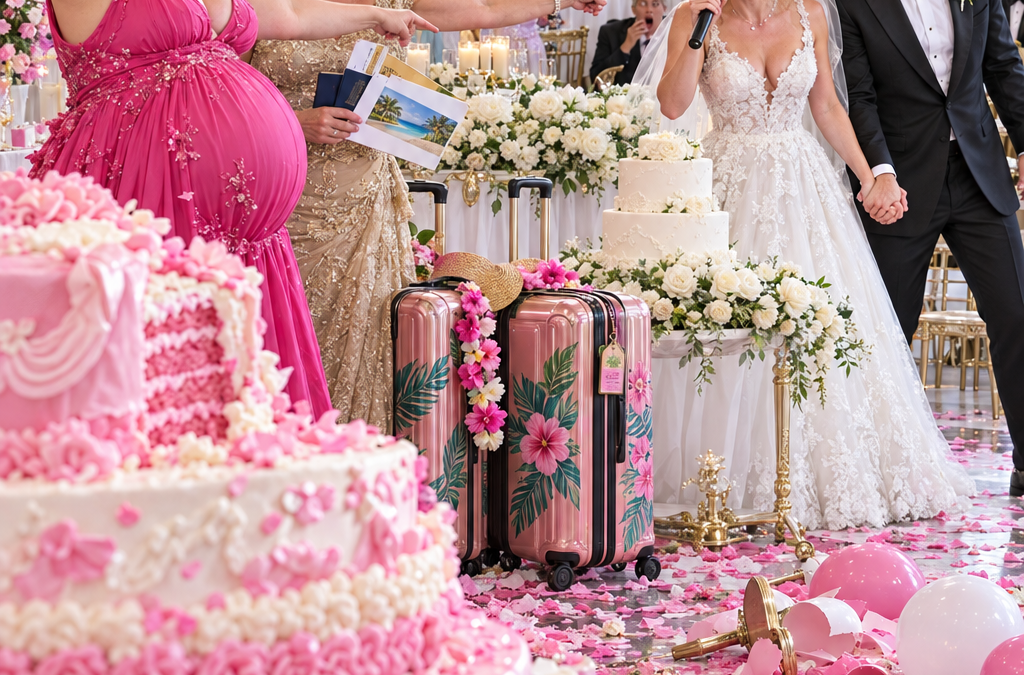
My Sister Did A Gender Reveal At MY Wedding — Then Announced: “And The Honeymoon Is Ours! Mom Already Changed The Names On The Tickets.” Guests Cheered. My Husband Squeezed My Hand. I Picked Up The Mic: “Since We’re Sharing Announcements…” 99 Guests Went Silent.
My sister hijacked my wedding with pink smoke, announced she was taking my honeymoon, and smiled while my mother admitted she had arranged it. I didn’t scream. I took the microphone, showed everyone exactly what they had done, and quietly stopped financing the family that had treated my generosity like communal property. I thought that ended it. Three weeks later, a certified envelope arrived from the management office of my coastal condo, containing a document with my signature on it—a signature I had never written.
Part 1
The first explosion happened eleven seconds before my husband and I were supposed to begin our first dance. I know because I have spent twelve years producing corporate events, and timing has become an involuntary part of how my brain works: I notice when a speaker pauses too long, when a waiter enters before applause ends, when a room loses attention. At 8:42 p.m., our DJ said, “Ladies and gentlemen, please welcome the newlyweds, Mara and Evan Cole,” and Evan took my hand while ninety-nine guests turned toward us. At 8:42 and eleven seconds, something detonated behind our wedding cake.
Half the ballroom screamed before a second blast erupted beside the DJ booth, followed by a thick cloud of pink smoke that rolled across the polished floor. My seventy-nine-year-old grandmother, Rose, jerked backward so hard her removable teeth dropped directly into her champagne glass, and Uncle Peter—who had worked security at a shopping mall for six years in the nineties and had apparently been waiting for a national emergency ever since—grabbed our cake knife and shouted, “Everybody stay where you are.” That instruction caused approximately thirty people to move at once, while a banquet server ducked behind a hydrangea arrangement and Evan stared at the smoke with the expression he normally reserved for witnesses who had just contradicted themselves under oath. Then my younger sister Sophie ran through the haze wearing a shimmering pink dress, both hands raised over her head.
“It’s a girl!” she screamed.
Her boyfriend Nate stood behind her holding the empty remains of two confetti cannons, pink metallic paper drifting off his shoulders. Sophie’s best friend Kendra shrieked loud enough to restart the applause, and within seconds my mother, Elaine, had rushed onto the dance floor crying, “My granddaughter,” while my father hugged Nate as though he had personally completed childbirth. Our first-dance song continued playing underneath all of it, soft strings floating through pink smoke while Evan and I stood motionless beneath the chandeliers. When I looked toward our photographer, Maya slowly lowered her camera and mouthed, “Are you kidding me?”
I wish I could say I was surprised.
Six weeks earlier, Sophie had announced her pregnancy, and I had genuinely been happy for her. Whatever history existed between us, the baby was innocent, Sophie had wanted children for years, and I hugged her when she told me. Forty-eight hours later, Mom called and said, “Since everyone will already be together at your wedding, I was thinking Sophie could do something small.” I knew what was coming before she finished the sentence, and I said no before she could say gender reveal.
“You didn’t even hear the idea.”
“I heard enough.”
“It would take five minutes.”
“No.”
“She’s your sister.”
“And it’s my wedding.”
Mom released the sigh she had been using on me since childhood, the one that meant I had disappointed her by possessing boundaries. “You’re being territorial.”
“Yes,” I said. “That is traditionally how weddings work.”
Sophie called three days later and accused me of being frightened that people would pay attention to her. I was sitting at my kitchen island arranging place cards when she said, “A wedding is one day, Mara. A baby is forever,” in the calm tone of somebody explaining weather to a small child. I told her that was lovely and suggested she put it on a mug, after which she called me selfish and hung up. By that evening Dad had joined the campaign, arguing that colored smoke lasted only seconds, so I sent one message to the family group chat: No gender reveal at my wedding. This is not negotiable.
Sophie responded with a thumbs-up emoji.
That should have frightened me.
My sister had never reacted to a boundary by respecting it; she treated boundaries like temporary construction signs erected by nervous people. When Sophie was eight and placed in the second row at a ballet recital, Mom called the studio to discuss “better visual positioning.” When Sophie was sixteen and wrecked Mom’s car while filming herself singing in a parking lot, Dad replaced it because her confidence was already shaken. When I was sixteen and Mom forgot to pick me up after debate practice, I walked almost four miles through rain carrying a papier-mâché model of the United Nations and was told the experience would make me more resourceful.
Being older meant being reasonable. Being reasonable meant giving way. By eighteen, I understood that Sophie could need something I owned badly enough that my ownership became negotiable, whether it was a necklace from our grandparents, concert tickets, my bedroom when cousins visited, or the attention at my own birthday dinner. Whenever I objected, Mom used the same word: jealous. Jealous became a family diagnosis assigned whenever I noticed that Sophie’s wants outranked my needs.
So I built a life outside them.
I started as an assistant at a convention center after college and worked my way through logistics, production, and live hosting until I was running national conferences and awards programs. I became good at preventing expensive people from panicking in public, which made me useful in ways my family never quite respected but frequently exploited. When Mom’s furnace failed, I paid the repair bill; when Dad needed dental work, I covered what insurance didn’t; when Sophie lost her job, I helped with rent for what was supposed to be three months and somehow became nearly a year. At first I told myself I was fortunate enough to help, but eventually helping stopped feeling like generosity and started feeling like infrastructure.
Then I met Evan.
He was a civil litigation attorney scheduled to moderate a conference panel after the original speaker came down with appendicitis. He walked backstage looking terrified and asked me how bad the situation was, and I told him, “Last month a motivational speaker accidentally lit his own vision board on fire. You are nowhere near my top ten.” He laughed, we had dinner two nights later, and what surprised me most about him was not how calm he was but how often he asked simple questions my family had trained me not to expect. “Can I borrow this?” “Do you mind?” “Are you free?” “Do you want me to help?”
Three years later, standing in pink smoke at our wedding, Evan squeezed my hand once.
We had created the signal during planning because I had warned him that my family could turn a minor issue into a congressional hearing. One squeeze meant I’m here. Two meant Do you want me to handle this? Three meant somebody should probably call security. He squeezed once as Sophie grabbed the DJ’s microphone and announced, “Wait, there’s more.”
The ballroom quieted.
Sophie wiped carefully beneath her eyes so she wouldn’t disturb her makeup. “Mara, I know you’re surprised, but Mom said you’d understand because this is such a special time for us, and traveling is going to get harder later.”
Beside me, Evan inhaled slowly.
Sophie smiled at Nate.
“And the honeymoon is ours. Mom already changed the names on the tickets.”
Fourteen people cheered.
My mother clasped her hands underneath her chin as if she had just solved world hunger. Dad nodded approvingly, Nate raised his champagne, and somebody near the bar shouted, “Babymoon!” I stood under drifting pink confetti in a wedding dress I had spent nine months choosing and looked at the people who had decided my honeymoon was transferable property.
Then Evan squeezed my hand again.
Once.
I smiled.
He immediately recognized the smile and whispered, “Oh, no.”
I walked toward Sophie, held out my hand for the microphone, and she gave it to me eagerly because she genuinely believed I was about to congratulate her.
“Wow,” I said.
The room settled.
I looked at my mother, my sister, the pink smoke, and ninety-nine people who had just become witnesses.
“Since we’re sharing announcements…”
Mom stopped smiling.
But to understand why my next sentence made Dad sit down so quickly that he almost missed his chair, you need to know what I had discovered six days before the wedding.
Part 2
Six days before I married Evan, my coordinator Tessa called while I was packing welcome bags for out-of-town guests. Tessa and I had worked together professionally for years, so I knew something was wrong when she skipped the greeting and asked, “Did you hire a special-effects company?” My hands stopped over a stack of hotel maps. “No.”
“There’s a vendor called BrightBurst asking about electrical access near the dance floor.”
I closed my eyes.
“What kind of effects?”
“Confetti cannons, cold sparks, colored smoke.”
“Pink and blue?”
A pause. “Yes.”
I laughed, but not because anything was funny. Sometimes your body needs somewhere to put disbelief, and mine had apparently chosen laughter. Tessa said the company claimed the bride’s mother had approved everything, so I told her to deny them access and not contact Mom yet. “You’re smiling right now, aren’t you?” she asked, and I admitted I was.
That afternoon I began doing something I should have done years earlier: I stopped reacting and started documenting.
First I opened the spreadsheet where I tracked household expenses and searched for every recurring payment connected to my parents or Sophie. My parents’ supplemental insurance, Mom’s car insurance, Dad’s phone bill, occasional property-tax shortages, Sophie’s rent assistance, her car payment, utilities, groceries, and subscriptions were scattered across different accounts and cards, which was why I had never looked at them together. Over the previous eighteen months, I had paid $39,684 on expenses that did not belong to me. I stared at that number long enough for the screen to dim.
Evan found me there when he came home.
“What happened?”
I turned the laptop toward him.
He read silently, then sat across from me. “Did you know it was this much?”
“No.”
“What do you want to do?”
That question nearly made me cry because he did not tell me what to do, and he did not turn my family into villains for his own convenience. He just waited.
“I think I want to stop.”
“Then stop.”
The next morning, while reviewing wedding charges, I noticed an $11,460 transaction from a travel agency on the emergency card I had given Mom. The card had exactly one purpose: vendor emergencies connected to the wedding. I called the agency and reached a woman named Celeste who sounded relieved when I identified myself.
“Oh, thank goodness,” she said. “I emailed you yesterday.”
“What happened?”
She explained that my mother had called saying there had been a change in travelers for our Greece itinerary. Our original airline tickets were nontransferable, so Celeste told her new tickets would have to be purchased. Mom responded, “Fine, use the card on file,” and bought Sophie and Nate two business-class seats to Athens, then attempted to change the names on our Santorini hotel reservation.
I pressed two fingers against my forehead. “Did she cancel our tickets?”
“No.”
“Did she change our hotel?”
“No. I held the request because something felt unusual.”
“So my mother bought an entirely separate honeymoon.”
“With your card.”
“How long do I have to cancel their flights?”
“Three hours.”
“Cancel them.”
Celeste reversed the charge while I was still on the phone. Then I froze Mom’s card, moved our departure ahead by one day, changed the first hotel, and asked Celeste to place a verbal password on every remaining reservation. By the time I finished, I expected to feel victorious.
I felt tired.
Mom had not misunderstood. She had not borrowed. She had taken a credit card intended for my wedding and spent more than eleven thousand dollars because Sophie wanted something I had. Worse, she had assumed that once the money was spent and the announcement made, I would be too embarrassed to object.
I told Evan everything that evening.
He listened without interrupting while I paced between the refrigerator and the sink, then said, “Do you want to confront them now?”
“No.”
“You’re sure?”
“I’ve spent my entire life letting their emergencies become the most important thing happening in the room. I’m getting married Saturday. That gets to be the important thing.”
So we created a plan.
If everyone behaved, I would address the travel charge privately after the wedding and end the financial support without spectacle. If anyone tried to make the honeymoon announcement publicly, I would correct the record publicly because a lie told in front of ninety-nine people deserved a correction in front of the same ninety-nine people. I prepared three slides—only three—because I knew my family and because contingency planning is the closest thing I have to a spiritual practice.
Saturday morning arrived warm and bright.
For several hours, it almost felt as though I had worried for nothing. Sophie behaved during the ceremony, Mom cried quietly, Dad walked me down the aisle without mentioning anyone else’s needs, and Grandma Rose wore a blue hat so wide that two guests had to lean sideways during the vows. When Evan said, “I promise there will never be a room where you have to earn your place with me,” I had to look down because I knew my mascara would not survive eye contact.
I married him.
That mattered more than what happened later, and I refuse to let the rest of the story steal it.
During cocktail hour Sophie disappeared twice with Kendra. Mom checked her phone constantly, and Nate looked like a man who had been given complicated instructions he had no intention of reading. I noticed all of it, but I made myself eat dinner, listen to speeches, cut the cake, and enjoy my husband.
At 8:42, the DJ announced our first dance.
At 8:42 and eleven seconds, my family detonated pink smoke inside a ballroom after being explicitly told not to.
And now I stood holding the microphone while Sophie smiled confidently beside me.
“Since we’re sharing announcements,” I said, “first, congratulations to Sophie and Nate on their baby girl.”
Scattered applause.
Sophie relaxed.
Mom exhaled.
“Second, our honeymoon has not actually been given away.”
Sophie’s expression flickered.
“The tickets Mom supposedly changed are still in Evan’s and my names.”
A murmur moved through the room.
Mom took one step forward. “Mara—”
“What Mom actually did,” I continued, “was use my wedding emergency credit card to buy Sophie and Nate an additional pair of business-class tickets for eleven thousand four hundred and sixty dollars.”
Dad turned toward her so quickly his chair scraped the floor.
“You used Mara’s card?”
Mom’s face went white.
“I was going to explain.”
“Perfect,” I said. “Because I brought visuals.”
Behind me, Evan lowered his head and rubbed his mouth to hide a smile.
I looked toward Tessa.
The projection screen descended.
And somewhere near the back of the ballroom, Grandma Rose whispered, “Oh, this is going to be good.”
Part 3
The first slide said FAMILY ANNOUNCEMENTS, with smaller text underneath: Since apparently this is what we’re doing now. Enough people laughed that Sophie’s face changed from confusion to alarm, and Mom hissed my name like she could still restore control through tone alone. I told her, “You asked for five minutes,” and clicked to the next slide.
The travel charge filled the screen.
$11,460.
Dad leaned forward as though the number might change if he approached it carefully. I explained that the new tickets had been purchased with my card, that they had been canceled within the refund window, and that our original itinerary remained intact. Sophie grabbed my forearm and whispered, “You canceled our trip?”
I looked at her hand until she released me.
“You mean my honeymoon?”
“I’m pregnant.”
“I noticed during the explosions.”
The room laughed, and for one second even Evan lost his courtroom face.
Mom stepped toward me. “We were going to pay you back.”
“With what?”
Her mouth closed.
I clicked again.
The next slide showed one number: $39,684.
This time nobody laughed.
I explained what it represented, and underneath the total appeared a short list: insurance, rent, car payments, medical bills, utilities, groceries, phone plans, home repairs, subscription services. I had removed identifying account numbers and every detail that felt too private because my goal was not to humiliate anyone; it was to make a pattern impossible to deny. At the bottom I had included one item called Sophie—Emergency Wellness Weekend, because even at my angriest I could not resist the absurdity of having paid for a resort spa after being told she was experiencing a financial crisis.
Nate looked at Sophie.
“You said your old company covered that.”
Sophie stared at the screen.
“What company?” he asked.
She did not answer.
Mom snapped, “This is humiliating.”
I lowered the microphone.
“No. Humiliating is standing in a wedding dress while your sister interrupts your first dance with unauthorized smoke cannons and your mother announces that she gave away your honeymoon after buying replacement tickets with your money.”
The laughter disappeared.
For the first time that night I stopped sounding entertaining, and I was glad. There are moments when humor protects the truth and moments when it weakens it.
“I was going to handle all of this privately tomorrow,” I said. “I helped because I love you. But somewhere along the way, helping became the price I was expected to pay for belonging to this family.”
Dad looked down.
Sophie started crying.
For a second my resolve wavered because she was still my little sister, and memory is cruel that way. I remembered teaching her to ride a bike, sitting beside her after her first breakup, driving three hours when she was twenty-two because she called me sobbing from a roadside motel. People can hurt you deeply without becoming cartoons, which makes leaving unhealthy patterns much harder.
“I’m not angry that you’re having a baby,” I told her. “I’m happy for you. I’m angry that everybody around you has spent your entire life teaching you that another person’s no is just the beginning of a negotiation.”
That one landed.
Nate looked at her.
Dad looked at Mom.
Grandma Rose said, “Exactly,” from her table with such authority that half the ballroom turned toward her.
I clicked the final slide.
Effective tomorrow: all recurring family payments end.
Mom’s emergency card: canceled.
Dad’s phone: transfer required.
Sophie’s rent assistance: ends after the current month.
Sophie’s car support: ends after the current payment.
Streaming accounts: removed tonight.
At the bottom I had written: Future financial emergencies should be handled by the adult experiencing them.
Evan laughed first.
Then his brother.
Then Maya, who had to lower her camera.
Mom stared at me. “You’re punishing a pregnant woman.”
“I’m stopping myself from paying another adult’s bills.”
“She needs stability.”
“She has a partner.”
Every head in the ballroom turned toward Nate.
He straightened. “I have a job.”
“Great,” I said. “That seems relevant.”
Dad stood. “Mara, we need to talk privately.”
“We absolutely do. Tomorrow.”
“You can’t just drop something like this in front of everybody.”
I looked at the floor around us.
Pink metallic paper covered the dance area, a confetti strip hung from the wedding cake, and Grandma’s champagne glass still contained one suspicious denture-shaped splash mark.
“Dad, they literally dropped it in front of everybody.”
His shoulders sagged.
I thought that was the end.
Then Sophie wiped her face and shouted, “Fine. Keep your stupid Greece trip. Mom said we could use your beach condo instead.”
Everything inside me stopped.
Evan’s eyebrows rose.
Mom whispered, “Sophie.”
I looked at my sister. “My what?”
“The condo in North Carolina.”
I turned slowly toward Mom.
Three years earlier I had bought a modest two-bedroom coastal condo near Wilmington as a rental investment. My parents had visited once, Sophie had never stayed there, and I used it only between tenants. It was not a vacation estate, it was not sitting empty waiting to rescue relatives, and it was definitely not something anybody else had authority to promise.
“What did you tell her?” I asked.
Mom glanced around the room. “This isn’t the place.”
“You brought special effects. I think the place argument is gone.”
Sophie crossed her arms protectively over her stomach. “She said you barely use it.”
“The property has tenants moving in next month.”
Her mouth opened.
“But Mom said—”
“Mom does not own it.”
Nate looked from Sophie to my mother. “You told us we could stay there after our lease ends.”
“How long?” I asked.
Nobody answered.
“Sophie. How long?”
She stared at Mom.
“A year.”
Ninety-nine people inhaled at once.
Evan leaned close to my ear. “This is new information for me.”
“For me too.”
“Excellent. Marriage is already educational.”
A few nervous laughs moved through the room, but I barely heard them. My mother had not merely stolen money from my wedding card; she had promised someone else the use of my property for twelve months without asking me.
“I assumed you would understand,” she said.
That sentence was our family anthem.
I would understand.
I would adjust.
I would pay.
I would move.
I would need less because I had always managed with less.
Something inside me became very calm.
“The condo is unavailable,” I said.
Sophie started crying harder. “Where are we supposed to live?”
“In a home you arrange.”
“With a newborn?”
“Yes, Sophie. Babies are allowed in apartments.”
Nate rubbed both hands over his face.
Mom wrapped an arm around Sophie and glared at me. “Look what you’ve done.”
That was the sentence that finally broke something.
“No,” I said.
Mom blinked.
“No. Do not make me responsible for Sophie’s feelings after Sophie’s choices.”
“She’s pregnant and emotional.”
I pointed at my wedding dress.
“I got married forty-seven minutes ago. I’m emotional too.”
The ballroom erupted.
Even Dad covered his mouth.
And because the whole situation had crossed beyond anger into absurdity, I started laughing with them.
“My first dance looks like a flamingo exploded,” I said, pointing toward the floor. “You fired a cannon close enough to Grandma Rose that her teeth left her body.”
Grandma Rose, delighted to be relevant, removed her dentures halfway and waved them.
The room lost control.
I turned back to Sophie. “You announced that my honeymoon belonged to you before checking whether it actually belonged to you, and you planned to move into my condo because Mom told you that was okay.”
Sophie whispered, “She did tell me.”
“I know. That is the problem.”
Then I looked directly at my mother.
“Sophie has spent thirty years hearing ‘Mom said yes’ instead of ‘I asked,’ ‘I earned,’ ‘I paid,’ or ‘I accepted no.’”
Mom looked genuinely wounded.
For once, I did not fix it.
“I love you,” I said. “But love is not authorization.”
Nobody applauded, and I was relieved.
This was not victory.
It was grief with a microphone.
Evan took my hand, asked if I was finished, then turned toward the DJ and announced that our first dance would restart after cleanup. Tessa appeared carrying three brooms and calmly informed Sophie, Nate, and Kendra that because they had created the confetti hazard, they would be helping the banquet staff remove it.
Sophie stared at her. “I’m pregnant.”
Tessa handed Nate the dustpan. “Then he can handle the bending.”
For the next ten minutes, my sister cleaned the mess she had made.
It was the first time in my memory that nobody rushed in to do it for her.
But the mess on the ballroom floor was nothing compared with the one I still didn’t know existed.
Part 4
Our second attempt at a first dance lasted three minutes and forty-one seconds, and nothing exploded. Evan held me close while the ballroom blurred at the edges, and halfway through the song he asked, “Are you okay?” I automatically nodded, then stopped lying and said, “No.”
He kissed my forehead.
“That’s allowed.”
That was when everything inside me finally caught up with what I had done. Boundaries look clean from the outside, but setting one against people you love can feel like amputating something infected and then grieving the part of you that is gone. I was relieved, furious, embarrassed, and happy all at once, dancing with the man I had chosen while accepting that my relationship with the family I came from might never recover.
Dad approached me during dessert.
He looked smaller somehow.
“I didn’t know about the tickets,” he said.
“I believe you.”
“I didn’t know about the condo either.”
“I believe that too.”
He rubbed the bridge of his nose. “Your mother told me you offered to help Sophie when the baby came.”
“Dad, when have I ever offered Sophie a house?”
He gave a weak, almost embarrassed smile. “When you say it like that…”
“How else would I say it?”
His eyes filled.
“I should have stopped this years ago.”
The old reflex rose instantly. I wanted to tell him it was okay because making other people comfortable was muscle memory.
I didn’t.
“I hope you mean that.”
Mom did not apologize that night.
She spent twenty minutes in a restroom with Sophie, left the reception early, and sent me a text at 1:14 a.m. saying, I hope embarrassing your family was worth it. I read it once, showed Evan, and blocked the family group chat for the duration of our honeymoon.
We left for Greece the next afternoon on the tickets that had always belonged to us.
The first morning in Santorini, I woke to sunlight on the water and found Evan standing outside in his boxer shorts attempting to open a yogurt cup with a spoon. “You’re an attorney,” I told him. “How are you losing to dairy?” He said, “The foil is aggressive,” and I laughed harder than the joke deserved.
Then I noticed something that felt almost unnatural.
Nobody needed me.
No payment request.
No emergency.
No family crisis disguised as a question.
For twelve days we walked, ate, swam, slept late, talked about nothing important, and learned how strange peace feels when you have been trained to interpret constant need as love.
Three weeks after we returned home, the consequences began settling into place.
Dad transferred his phone plan. My parents took over their insurance premiums. Sophie called when she realized I had removed her streaming profile and demanded to know whether I was “seriously being petty about television,” so I told her the beauty of adulthood was that she could subscribe to anything she wanted with her own debit card.
Then her lease ended.
Sophie and Nate moved into a smaller apartment across town because they could not afford their previous place without my help. She called me on move-in day and said, “The kitchen doesn’t even have an island,” as though reporting structural collapse.
I waited.
Old Mara would have offered money.
New Mara said, “That sounds inconvenient.”
Silence.
“I thought you’d care.”
“I do. I care that you’re safe. I care that the baby is healthy. I care that you have housing. I don’t care whether your kitchen has an island.”
She hung up.
For the first time in my life, nothing terrible happened because Sophie was disappointed.
Then, on a rainy Tuesday morning, I opened my mailbox and found a certified envelope from Harbor View Residential Management, the company that handled my coastal condo.
Inside was a copy of a residency authorization form.
It stated that Sophie Bennett and Nathan Cross had permission to occupy Unit 3C for up to twelve months beginning August first.
The owner authorization line was signed Mara Bennett Cole.
I stared at the signature.
It looked enough like mine to fool someone who had seen it only once.
It was not mine.
A second page contained a request for two resident parking permits and permission to receive mail at the property before move-in. Attached was an email from an address I recognized immediately.
My mother’s.
The property manager had flagged the request because tenants were already scheduled to occupy the unit, and because the signature did not match the one on my management contract. They wanted written confirmation that the authorization had been withdrawn.
I sat at my kitchen table reading the same page four times.
Evan came in carrying groceries and stopped when he saw my face.
“What?”
I handed him the packet.
He read it carefully.
His expression changed.
“This is more serious than promising somebody your condo at a wedding.”
“I know.”
“She signed your name.”
“I know.”
“Do you want me to call someone?”
I shook my head.
Not yet.
I called Harbor View myself.
The manager, a woman named Dana, told me my mother had contacted the office six weeks before the wedding. Six weeks. Before the travel charge. Before the pink smoke. Before Sophie had announced that Mom “said we could use your beach house.”
“She told us you were overwhelmed with wedding planning,” Dana explained. “She said she was coordinating the temporary family occupancy for you.”
I gripped the phone.
“Did anyone ever speak to me?”
“No. That’s why I held it when the signature looked inconsistent.”
“Did she send anything else?”
There was a pause.
“One document.”
“What document?”
“She sent a letter stating that the unit would be available rent-free to your sister because of a family medical transition.”
“What medical transition?”
“Pregnancy.”
I closed my eyes.
Dana emailed it to me while we were speaking.
The letter looked professional.
It had my full name at the top.
It referred to Sophie as my “dependent family member.”
And at the bottom was another imitation of my signature.
But that was not the line that made me cold.
Halfway down the page, the letter said: This arrangement will allow my parents to discontinue their current financial contribution toward Sophie’s housing while they address outstanding home-equity obligations.
I read that sentence twice.
Then I called Dad.
“What home-equity obligations?”
Silence.
“What are you talking about?”
I forwarded him the letter.
He called back eleven minutes later.
His voice sounded nothing like my father.
“Mara,” he said, “I need you to come over.”
“What happened?”
Another long silence.
“I think your mother has been hiding money from both of us.”
Part 5
I had seen my father angry before, but I had never seen him frightened by paperwork.
When Evan and I arrived at my parents’ house, Dad had covered the dining table with bank statements, loan disclosures, credit-card bills, and printed emails. Mom sat at the far end with her arms crossed, looking less ashamed than cornered. Sophie was not there.
Dad pointed to a chair. “Sit.”
I did.
Then he told me what he had found.
Two years earlier, Mom had opened a home-equity line of credit with his knowledge to replace the roof and repair a cracked foundation wall. The original balance was supposed to be around twenty-eight thousand dollars. Dad had assumed they were steadily paying it down.
They were not.
The balance was sixty-seven thousand.
Mom had repeatedly drawn additional money from the line to help Sophie.
Rent shortages.
Credit-card payments.
Car repairs.
Trips.
Furniture.
Medical deductibles.
A deposit for Sophie and Nate’s larger apartment after Sophie told Mom they needed more space for the baby.
Dad looked at her. “You told me that deposit was four thousand.”
“It was.”
“You took twelve.”
“I knew they would have expenses.”
“So you borrowed eight thousand more without telling me?”
Mom looked toward me as though I had somehow caused the question.
“That’s why I asked Mara to help more.”
I laughed once.
Not because it was funny.
“So my money was being used to keep you from noticing how much of your money was being used.”
Mom’s eyes hardened. “That is a disgusting way to describe helping your sister.”
“No,” Dad said quietly. “It’s accurate.”
The room went still.
Dad explained that when I stopped paying recurring expenses, their monthly budget tightened immediately. That forced him to look at accounts he had not reviewed closely in years because Mom had always handled household finances. He found transfers from the credit line into Sophie’s checking account, payments toward a card Dad didn’t recognize, and three cash advances that had never been discussed.
Mom’s plan for my condo suddenly made sense.
Sophie’s lease was ending.
My parents could no longer keep subsidizing her at the same level without Dad discovering how strained their finances had become.
So Mom decided Sophie could live in my condo rent-free.
For a year.
That would remove housing from Sophie’s budget and reduce what Mom needed to secretly send her.
“You weren’t helping Sophie,” I said. “You were moving the cost to me.”
“I knew you could afford it.”
“You did not know anything about what I could afford.”
“You own a second property.”
“A property with tenants. A mortgage. Insurance. Maintenance. Taxes.”
“It still seemed wasteful for strangers to live there while your sister needed somewhere.”
I stared at her.
That sentence told me more than the forged signature.
To Mom, ownership did not create a boundary. Need erased it.
Dad slid another paper toward me.
It was an email chain between Mom and Sophie.
Mom: Don’t worry about Mara. Once you’re moved in, she won’t throw you out while you’re pregnant.
Sophie: Are you sure?
Mom: She gets upset first, but she always does the right thing.
I read the messages without speaking.
There it was.
The entire family system compressed into two lines.
Mom had not believed I would willingly agree.
She had known I would say no.
Her plan depended on putting me in a position where enforcing that no would make me look cruel.
Evan’s hand rested lightly against my back, but he did not interrupt.
I looked at Mom.
“You forged my signature because you knew I wouldn’t agree.”
“I was trying to prevent unnecessary conflict.”
“You created a fake authorization document.”
“I knew you’d make it difficult.”
Dad pushed his chair away from the table.
“Elaine.”
“What?”
“Listen to yourself.”
Mom’s face crumpled, and for a moment I saw the exhausted woman underneath the certainty. “I was trying to keep everyone okay.”
“No,” I said. “You were trying to make sure Sophie never had to be uncomfortable.”
She started crying.
“You don’t understand what it’s like to worry about her.”
“I’ve been worrying about her with my bank account for years.”
“She’s not like you.”
There it was again.
The sentence that had shaped my childhood.
Sophie was sensitive.
Mara was capable.
Sophie needed support.
Mara would manage.
Dad looked at Mom. “What does that mean?”
“She struggles.”
“So does Mara.”
“Mara handles things.”
I leaned back.
“You know what’s strange? Everybody keeps calling me strong as though that explains why I deserved less care.”
Mom covered her face.
Nobody rushed to comfort her.
Dad asked to see the condo documents, and I handed him copies. When he saw my forged signature, his expression changed from hurt to something harder.
“Did you actually sign her name?”
Mom whispered, “I copied it.”
“From what?”
“My wedding vendor contract.”
For the first time all evening, Evan spoke.
“You understand that can have consequences.”
Mom snapped her head toward him. “Don’t threaten me.”
“He didn’t,” I said. “He described reality.”
I did not call the police.
I did not sue my mother.
But I sent Harbor View written notice that nobody except me or Evan had authority to approve occupants, changed every property password, added verbal authentication to financial accounts, and removed Mom from the small number of emergency contacts she still had.
Then I told her she was not welcome to contact vendors, property managers, insurers, or financial institutions on my behalf ever again.
“If you do,” I said, “I will treat it like I would if a stranger did it.”
She stared at me.
“That’s cruel.”
“No. That’s a boundary with consequences.”
Dad told her he was separating their finances until they understood the full debt.
That frightened her more than anything I had said.
Before we left, he walked us to the porch.
“I’m sorry,” he said.
I nodded.
“I mean it.”
“I know you do.”
“Does that help?”
“Not yet.”
He accepted that.
Two days later, another consequence arrived.
The wedding venue sent an invoice for $6,780.
BrightBurst had entered through a service corridor after being told they were unauthorized. One of the smoke devices had damaged ceiling fabric and triggered additional cleaning charges, while metallic confetti had entered floor vents and required professional removal.
The contract authorizing the vendor was attached.
Customer: Elaine Bennett.
Payment responsibility: Elaine Bennett.
Mom called me within six minutes.
“You have to help me with this.”
I looked at Evan.
Then I looked at the invoice.
“No.”
“Mara, we don’t have seven thousand dollars.”
“You spent almost twelve thousand of mine trying to buy Sophie a honeymoon.”
“That was refunded.”
“Because I caught it.”
“This could hurt us financially.”
“I know.”
Silence.
Then she said the thing that proved she still did not understand.
“After everything I’ve done for this family, I can’t believe my own daughter would let me deal with this alone.”
I closed my eyes.
For years, I had confused rescuing people from consequences with loving them.
That afternoon, for the first time, I allowed my mother’s problem to remain my mother’s problem.
And without me absorbing the impact, the entire family began to change.
Part 6
The changes were not dramatic at first.
They were practical.
Dad canceled a golf membership he barely used. Mom stopped sending Sophie grocery money every week because, as Dad later told me, “We are done borrowing money to pretend we have money.” Sophie and Nate sold the SUV I had been helping them pay for and bought a six-year-old sedan that Sophie initially described as humiliating until she realized it started every morning and belonged entirely to them.
Then she got a second job.
Not because anybody forced her.
Because the electric bill arrived.
She began doing remote customer-service work three evenings a week after her regular office job, and Nate took Saturday shifts he had previously avoided. They canceled subscriptions, cooked more often, and stayed in the apartment without the island.
Nobody died.
That was the most offensive part to my mother’s worldview.
Sophie experienced inconvenience and remained alive.
Mom, however, did not adjust gracefully.
For nearly two months she blamed me for “making the family transactional,” which was an extraordinary accusation considering I had simply stopped providing transactions. She told relatives I had embarrassed Sophie while pregnant, abandoned my parents during a financial crisis, and allowed attorneys to intimidate her over “a harmless paperwork issue.” By attorneys, she meant Evan saying one sentence at the dining table.
Several relatives called.
I stopped defending myself after the second conversation.
“If you believe Mom’s version,” I told Aunt Diane, “you are free to help financially.”
That ended the discussion surprisingly quickly.
Dad did something harder.
He started saying no.
When Sophie asked him for money toward a new crib, he told her they could contribute one hundred dollars but not the full amount. When Mom offered to secretly cover the rest, Dad reminded her that they were carrying sixty-seven thousand dollars in home-equity debt, part of which had been created by doing exactly that.
Sophie exploded.
She accused them of changing because of me.
Dad responded, “No. Mara stopped hiding the consequences from us.”
Grandma Rose reported that line to me with the excitement of someone delivering election results.
My grandmother had become the unexpected historian of the wedding.
At family gatherings she reenacted the gender-reveal explosion, sometimes dropping her dentures halfway out of her mouth for accuracy. She kept the champagne glass from the reception in a velvet box and claimed it was “an artifact.” She also called every Sunday and never asked me to repair anything.
Four months after the wedding, Mom asked to meet for coffee.
I almost said no.
Then I decided hearing her did not obligate me to forgive her.
She arrived early, wearing no makeup and carrying a folder I immediately distrusted. “There’s nothing for you to sign,” she said when she saw my face.
“That’s a promising start.”
For the first twenty minutes, the conversation went badly.
Mom cried.
She explained.
She defended.
She said Sophie had always been more fragile, Dad had been emotionally distant, she had felt responsible for keeping everybody together, and she genuinely believed that because I earned more money, asking me to contribute more was fair.
“You weren’t asking,” I said.
She stared into her coffee.
“I know.”
“You were deciding.”
A tear landed on the table.
“I know.”
“You decided my money was available. My credit was available. My property was available. My wedding was available.”
“I know.”
“And when I said no, you didn’t hear no. You heard temporary resistance.”
For once she did not argue.
I waited.
Finally she said, “I think I made Sophie afraid of being uncomfortable.”
That was the first useful sentence she had spoken.
She told me that when Sophie was little, she worried constantly because Sophie cried harder, struggled socially, took criticism badly, and seemed to feel rejection more intensely than I did. Mom stepped in again and again because she believed she was protecting her.
“And then I kept doing it,” she said. “Even when she was old enough to handle things.”
“Yes.”
“And because you handled everything…”
“You assumed I didn’t need protecting.”
Mom closed her eyes.
“Yes.”
I did not forgive her that afternoon.
I told her I loved her but did not trust her, and trust would not return because she cried or apologized once. She accepted that badly but quietly.
Two months later, Sophie went into labor.
Our relationship had barely existed since the wedding. We exchanged occasional messages about the pregnancy, mostly factual, and I made a point of never asking Mom to update me because that would have pulled her back into the middle.
Sophie texted me herself.
Lily arrived. 7 lbs 4 oz. Everyone healthy.
I stared at the message for several minutes.
Then I asked whether she wanted visitors.
She replied yes.
At the hospital, Sophie looked exhausted in a way I had never seen before. No styled hair, no careful makeup, no dramatic performance. Just my younger sister holding a tiny sleeping girl wrapped in a white blanket.
I brought flowers.
Not money.
Not a check.
Not an envelope.
Flowers.
Sophie noticed.
“I thought Mom would send you a list of things we need.”
“She did.”
Her eyes widened.
“She sent me three messages.”
“And?”
“I ignored them.”
Sophie laughed weakly.
“Wow.”
“I’m serious about not doing this through Mom anymore.”
She looked down at Lily.
“I know.”
I held my niece for several minutes. She opened one eye, made a suspicious face, and spit milk onto my blouse.
Sophie gasped.
“Oh my God, Mara, I’m sorry.”
I looked at the stain.
Then at Lily.
“At least she took something from me directly.”
Sophie laughed.
A real laugh.
Then her expression changed.
“I owe you an apology.”
I said nothing.
“I knew you said no to the gender reveal.”
“I know.”
“Mom told me you’d get over it.”
“I know.”
“I wanted to believe her.”
“That’s different from believing her.”
Sophie nodded.
“I think I knew that too.”
The room stayed quiet for a long time.
Then she said, “I was angry when you cut me off.”
“I know.”
“I’m still sometimes angry.”
“Okay.”
“But when we had to move, Nate and I started going through our accounts. I didn’t even know how much things cost.”
That sentence hurt more than I expected.
Not because I pitied her.
Because I understood the scale of what Mom’s rescuing had taken from her.
Sophie had reached thirty years old without learning how expensive her own life was.
“I’m not asking you to fix anything,” she said quickly.
“I know.”
“Actually… that might be the first time I’ve ever said that to you.”
“Probably.”
We smiled.
It did not erase the wedding.
It did not restore trust.
But it was new.
As I was leaving the hospital, my phone rang.
It was Dad.
His voice was low.
“Can you come by tomorrow?”
“What happened now?”
“It’s your mother.”
My stomach tightened.
“What did she do?”
“Nothing,” he said. “That’s the problem. She finally stopped doing something, and now we have to deal with what’s left.”
Part 7
Dad had decided to sell the house.
Not because Mom had lost it.
Not because I refused to save them.
Because after examining the mortgage, the home-equity line, their retirement accounts, and their real monthly spending, they concluded that staying would keep them financially trapped for years. The house I grew up in had become too expensive for two people approaching retirement, especially after tens of thousands of borrowed dollars had been funneled toward maintaining a family lifestyle none of them could actually afford.
Mom was devastated.
I understood.
That house contained thirty years of holidays, growth marks beside a pantry door, Dad’s workshop, and the maple tree Sophie and I climbed as children. Consequences are not painless simply because they are deserved.
But I did not offer money.
They sold in the spring.
After paying the mortgage and equity line, they had enough to make a strong down payment on a smaller townhouse fifteen minutes away. Dad said the first night there was awful because everything felt unfamiliar.
The second morning, he realized the mortgage payment was almost nine hundred dollars lower.
By the end of the month, Mom admitted she slept better.
That was the strange thing about the year after my wedding: so many disasters turned out to be adjustments nobody had wanted to make while I was available to prevent them.
The BrightBurst invoice was paid through a six-month payment plan.
Mom hated that.
Good.
Not because I enjoyed watching her struggle, but because every installment reminded her that ordering unauthorized explosives for somebody else’s wedding had a cost attached to the person who actually ordered them.
Dad and I slowly rebuilt our relationship.
He never asked me to forget his role in what happened, and that mattered. He admitted he had enjoyed being the easy parent while Mom handled conflict, which meant he had benefited from pretending not to notice the favoritism. “I wasn’t innocent,” he told me once. “I was passive, and passive can do a lot of damage.”
Mom and I remained more complicated.
We saw each other occasionally.
She stopped contacting businesses in my name.
She stopped volunteering my money.
Sometimes she still began sentences with, “Sophie needs—” then caught herself and changed them to, “Sophie asked whether…”
That difference mattered.
Trust returned in teaspoons.
Sophie and I did not become best friends.
I visited Lily, exchanged birthday gifts, and sometimes met Sophie for lunch, but I never resumed paying her bills or treating access to my life as proof of love. Nate, surprisingly, became one of the strongest defenders of the new arrangement because he had been furious when he learned how much financial information Sophie had hidden from him.
Their relationship nearly collapsed.
Then they started counseling.
They made a budget.
Nate admitted he had liked the benefits of Sophie’s family system enough not to question them too carefully.
Sophie admitted she had grown up believing that if someone loved her, they would protect her from discomfort.
Six months after Lily was born, she called me because their washing machine broke.
I braced myself.
“We found a used one for two hundred eighty dollars,” she said. “Do you think that’s too much?”
I almost laughed.
“Are you asking my opinion or asking me for money?”
“My opinion.”
“Then check the age, model number, and whether delivery is included.”
“That’s it?”
“That’s it.”
She bought it herself.
A week later she texted me a picture of Nate standing beside it with his thumbs up.
I saved the photo.
Not because buying a used washing machine was heroic.
Because ordinary responsibility was new territory for her, and I wanted to recognize the difference without turning it into another family performance.
My professional life changed too.
Maya, our wedding photographer, sent us the full album, and one photograph became legendary among our friends. It had been taken seconds after the first confetti cannon fired.
Evan and I stood in the center of pink smoke.
I looked stunned.
Evan looked like he was calculating potential legal claims.
Uncle Peter crouched near the cake holding the knife.
Kendra screamed in the background.
Nate held the cannon.
And behind everyone, Grandma Rose’s dentures were visibly suspended above her champagne glass.
It was impossible.
Perfect.
Evan framed it and hung it in our hallway.
Underneath, he attached a small brass plaque:
FIRST DANCE — ATTEMPT ONE.
Grandma demanded a copy.
She put hers beside the champagne glass artifact.
Our first anniversary fell on a Saturday.
Evan asked whether I wanted to have dinner somewhere expensive, take a weekend trip, or stay home and order Thai food. We chose Thai.
Halfway through dinner, the doorbell rang.
A delivery driver handed me a small box.
Inside was a pink baby-sized T-shirt.
Across the front were the words: I ASKED FIRST.
I stared at it.
Then I saw the card.
Happy anniversary. Lily promises not to take your honeymoon. —Sophie
I laughed until I cried.
Evan smiled. “That’s progress.”
“Maybe.”
Later that night, after we finished eating, I checked my email and found a message from Mom.
No emergency.
No request.
No guilt.
Just four sentences.
I know your anniversary probably brings up mixed memories. I am sorry my choices became part of your wedding story. I hope someday the good parts are louder. I love you.
I read it twice.
Then I closed the laptop without responding.
Evan looked at me.
“You okay?”
“Yes.”
“Are you going to answer?”
“Tomorrow.”
He nodded.
For most of my life, an unanswered message from Mom would have felt like a debt accumulating interest.
That night it was simply an email.
The next afternoon I wrote back.
Thank you. I love you too.
Nothing more.
I did not write I forgive you.
Because I had not.
I did not write everything is okay.
Because some things were not.
Love, I was finally learning, did not require false closure.
And then, almost a year after the wedding, I received one last reminder of how differently my family worked now.
Sophie called.
Not Mom.
Not Dad.
Sophie.
“I need to tell you something before Mom does.”
My body immediately tensed.
“What?”
“She wants to host Lily’s first birthday.”
“That sounds normal.”
“At your condo.”
I closed my eyes.
“Why?”
“She said the beach would be beautiful.”
“Did she tell you to ask me?”
“No.”
“Then why are you calling?”
Sophie laughed.
“Because I told her it wasn’t mine to offer.”
I opened my eyes.
“And?”
“And she got annoyed.”
“Of course.”
“And then I told her that being annoyed wasn’t an emergency.”
For several seconds, neither of us spoke.
Then I started laughing.
Sophie joined me.
It was not reconciliation.
It was something more believable.
Change.
Part 8
We did not host Lily’s birthday at my condo.
Sophie and Nate held it in a public park near their apartment, underneath a rented pavilion decorated with yellow balloons and paper daisies. It cost a fraction of what Mom had imagined, Lily spent most of the afternoon trying to eat grass, and Grandma Rose arrived wearing the same enormous blue hat from my wedding because she claimed it had “family significance.”
Mom behaved.
Mostly.
At one point she suggested we move the cake table because the light would be better for photographs, then caught Sophie’s expression and said, “Or not. It’s your party.”
I nearly applauded.
Dad brought folding chairs.
Nate grilled burgers.
Sophie handled the decorations herself.
When a gust of wind blew half the napkins across the lawn, she chased them instead of looking for someone to blame.
I noticed.
She noticed me noticing.
“Don’t say it.”
“I wasn’t going to.”
“You were thinking it.”
“I was thinking you’ve become very fast.”
She threw a napkin at me.
For the first time in years, being around my sister did not feel like waiting for an invoice.
That did not mean everything was healed.
Sophie still had moments when entitlement surfaced before she caught it. Mom occasionally tested boundaries in ways small enough to sound harmless. Dad sometimes tried too hard to make up for years of passivity, offering apologies when what I needed was simply normal conversation.
Families do not transform because somebody gives one dramatic speech.
The wedding did not fix us.
It exposed us.
The pink smoke, the stolen honeymoon announcement, the forged condo authorization, the hidden debt—they ripped open a system that had survived only because I kept cushioning every impact.
Once I stopped, everybody had to discover what belonged to them.
Their bills.
Their choices.
Their discomfort.
Their relationships.
And I had to discover what belonged to me.
My time.
My marriage.
My money.
My property.
My right to say no without submitting a legal brief explaining why.
I still work in events.
A few months ago, I was backstage at a software conference when a company executive discovered his entire presentation file had disappeared twelve minutes before his keynote. He looked ready to faint.
“What do we do?”
I checked the backup folder, found the latest version, transferred it to the presentation system, and tested the first slide.
“You’re fine.”
He stared at me.
“How are you this calm?”
I thought about ninety-nine wedding guests.
Pink smoke.
A cake knife.
Eleven thousand dollars in airline tickets.
A forged signature.
A sixty-seven-thousand-dollar home-equity line.
My grandmother’s airborne dentures.
“You wouldn’t believe me,” I said.
He laughed nervously.
I didn’t.
The greatest change was not that I became harder.
For years, that was what I feared boundaries would do to me. I thought saying no too often would turn me cold, selfish, suspicious, or ungenerous.
The opposite happened.
When I stopped helping people automatically, helping became meaningful again.
I could buy Dad lunch because I wanted to, not because he expected me to cover an insurance premium.
I could bring Sophie diapers because I saw a brand Lily liked, not because Mom called and described them as an emergency.
I could take Mom to dinner on her birthday and enjoy the evening without wondering what request would arrive before dessert.
Generosity felt generous again.
My marriage benefited too.
Evan had never demanded boundaries with my family, which made me more willing to build them myself. He did not marry me and declare war on my parents; he simply refused to participate in the system that required me to be permanently useful.
Sometimes I apologized to him for how much family chaos spilled into our first year.
He always said the same thing.
“I married you. I didn’t expect you to arrive without history.”
On our second anniversary, we finally returned to the coastal condo during a gap between tenants.
It was the first time we had stayed there since the wedding.
I stood on the balcony that first evening watching the Atlantic turn silver beneath a cloudy sky, and I remembered Sophie announcing that Mom had promised the place to her.
For a long time, I had associated the condo with betrayal.
That weekend changed it back into mine.
Not because I had defeated anyone.
Because ownership no longer felt like something I needed to defend every minute.
Evan came outside carrying two glasses of wine.
“Thinking?”
“Dangerously.”
He handed me one.
“About what?”
“How close I came to letting everybody convince me I was the problem.”
He leaned against the railing.
“You were part of the problem.”
I turned toward him.
He smiled.
“You kept fixing everything.”
I laughed.
“Rude.”
“Accurate.”
He was right.
My family had behaved badly.
Mom forged my signature.
Sophie ignored my no.
Dad looked away too often.
But my role had been real.
I had trained them to expect rescue by offering it before they experienced consequences.
That did not make their behavior my fault.
It made my participation something I could change.
And I did.
Mom and I will probably never return to the relationship we had before the wedding.
I no longer want that relationship.
It required too much silence from me.
We have something smaller now, more careful and more honest.
Dad calls every couple of weeks just to talk.
Sophie sends photos of Lily making disasters of ordinary household objects.
Sometimes we laugh together.
Sometimes we disagree.
Sometimes I say no.
The world continues turning.
The photograph from our wedding still hangs in our hallway.
Visitors always stop in front of it.
They study the pink smoke, Uncle Peter’s cake knife, Nate’s confetti cannon, Evan’s expression, my stunned face, and Grandma Rose’s airborne teeth.
Then they read the brass plaque.
FIRST DANCE — ATTEMPT ONE.
Most people assume it is simply a funny wedding story.
In some ways, it is.
Grandma certainly thinks so.
Last Christmas she brought champagne to dinner, placed the bottle on the table, then removed her dentures before anyone opened it.
“For safety,” she said.
I laughed so hard I had to sit down.
Sophie covered Lily’s ears even though nobody had said anything inappropriate.
Dad nearly spilled his drink.
Mom rolled her eyes.
Evan looked at me from across the table.
And for a moment, I saw my family as they actually were.
Not villains.
Not victims.
People who had loved each other badly for a long time and were slowly learning different habits.
Some relationships survived.
Some became smaller.
Some things were forgiven.
Others were not.
I no longer believed forgiveness was the price of peace.
Sometimes peace meant remembering exactly what happened and choosing not to live inside it anymore.
Before dessert, Grandma Rose lifted her champagne glass.
“To Mara.”
I groaned.
“Oh no.”
“To boundaries,” Dad added.
Sophie raised hers.
“To asking first.”
Mom hesitated, then lifted her glass too.
“To not volunteering other people’s property.”
“That feels unusually specific,” Evan said.
Everyone laughed.
Grandma Rose looked around proudly, pleased by the attention.
Then she shouted, “Bravo!”
Sophie clapped.
Grandma tried again.
“Bravo, señora!”
“That’s Spanish,” I said.
She frowned.
Then, with the absolute confidence of a woman who had never allowed facts to limit her performance, she raised her glass higher.
“Three languages.”
I laughed until my stomach hurt.
And the strangest thing happened.
Everyone was looking at me.
Nobody was asking me for anything.
For years, I believed love meant being the easiest person in the family to inconvenience. I thought strength meant never needing help, generosity meant saying yes quickly, and success meant having enough extra money, time, patience, and space to absorb whatever everybody else could not handle.
Eventually, the people I loved stopped seeing my generosity as a gift.
They saw it as available inventory.
My money became family money.
My condo became family housing.
My honeymoon became Sophie’s babymoon.
My wedding became a convenient location for her announcement.
And because I had spent years preventing consequences, everybody forgot consequences existed.
Until pink smoke covered my first dance.
That night, standing under falling confetti with a microphone in my hand, I understood something embarrassingly simple.
I did not need permission to stop.
I could love Sophie without financing her.
I could love Mom without trusting her.
I could forgive Dad for some things without pretending his silence had not mattered.
I could adore my niece without becoming responsible for making her mother’s life comfortable.
I could have a marriage, a house, a bank account, a vacation, a quiet Saturday, an unanswered phone, and an entire life without leaving part of every room empty in case somebody else decided they needed it.
People sometimes ask whether I regret turning that microphone against my family at my own wedding.
I don’t.
I regret that it became necessary.
There is a difference.
And whenever I doubt myself, I walk past the framed photograph in our hallway.
Pink smoke.
Confetti.
Cake knife.
Airborne dentures.
My husband beside me.
Attempt one.
Then I remember what happened next.
We cleaned the floor.
We started the music again.
And I finally learned that a ruined first dance did not mean the dance was over.
THE END!