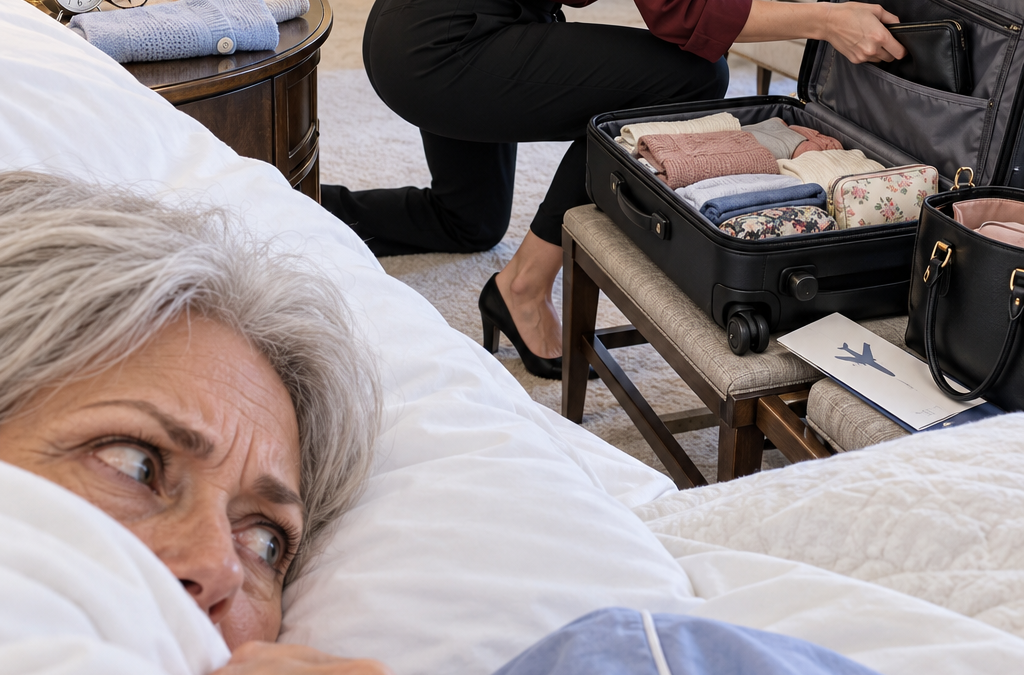
I Told My Daughter-In-Law I Had An Early Flight And Went To Bed. At Midnight, I Heard My Door Open. She Went Through My Suitcase, Zipped Something Into The Inner Pocket, Then Whispered, “It’s In Her Carry-On. Tip Off Airport Security At Six.” I Kept Pretending To Sleep. The Next Morning…
I was seventy-one when my daughter-in-law crept into my bedroom, slipped something into my carry-on, and whispered that airport security should be called after I reached the checkpoint. My son later begged me to confess to something I hadn’t done, because believing his wife was easier than believing me. I didn’t argue. I documented everything and stepped aside. Three weeks later, a photograph from an antique dealer’s account showed me that the midnight betrayal had started long before anyone touched my suitcase.
Part 1
My name is Eleanor Whitcomb, and for thirty-seven years I worked at the Rowan County Heritage Museum in Mill Creek, Ohio, where my job was to know exactly where every donated watch, military button, farm ledger, mourning brooch, child’s cup, campaign ribbon, and cracked porcelain doll belonged. I started in 1985 as a part-time typist making catalog cards on an IBM Selectric, finished my history degree at night after my husband left, and eventually became the museum’s registrar because I was the person people came to when an object disappeared from a shelf. Retirement never quite took; even at seventy-one, I still volunteered twice a week, kept cotton gloves in my purse, and could recognize half the study collection from the shape of an empty space in the foam.
My only child, Daniel, had moved into my house the previous January with his wife, Melissa, and their children, Sophie and Ben. The arrangement was supposed to last twelve months while they rebuilt their savings after Melissa’s vintage clothing shop closed, and although my 1926 Craftsman suddenly contained backpacks, cereal bowls, soccer cleats, bath toys, and somebody always asking where the charger was, I liked having the children close. Melissa worked as a collections assistant at the museum, a job she had gotten partly because I had recommended her; I had taught her how to support brittle leather, how to lift old ceramics by the body instead of the handle, and how to cut archival foam so precisely that an object settled into it without pressure.
The first thing that bothered me happened on a Thursday afternoon in September. A researcher requested photographs of an 1860s sewing case, so I went downstairs to Drawer 12, pulled it open, and saw three dark cavities where objects should have been: a curved pocket pistol, a silver watch, and a slim brass spectacle case. Nothing had been signed out, nothing was scheduled for conservation, and nothing appeared on the temporary exhibit list, which meant either someone had returned three things to the wrong location or we had a more serious problem.
I found Melissa upstairs at her desk with a paper cup of coffee beside her keyboard. “Three objects are missing from Drawer 12,” I told her, and I watched her stop with the cup halfway to her lips before asking, “Which ones?” I answered that I would send the list directly to our director, Evan Kline, because that was procedure, and although the pause in her expression bothered me, I told myself I was noticing it only because missing objects put every registrar’s nerves on edge.
Evan scheduled a full inventory for the following week and told both of us not to discuss the missing pieces outside staff. The next evening Melissa’s mother, Marlene Voss, came for dinner carrying a supermarket apple pie and wearing the same expensive camel coat she always seemed reluctant to remove in my house. Marlene had sold antiques for nearly twenty years, and she disliked me for a reason neither of us pretended to forget: five years earlier she had offered the museum what she claimed was an original Civil War cavalry saber, and I had documented that it was a 1960s reproduction worth a fraction of her asking price.
That humiliation had traveled through Mill Creek faster than weather. Marlene lost customers, blamed me, and from then on spoke to me with the careful sweetness people use when they want witnesses to believe they are being civil. During dinner she asked unusually detailed questions about my trip to Tucson for my sister Ruth’s seventy-fifth birthday—what airline, what time, whether I was checking luggage—and Melissa listened without looking up from her plate.
“Six fifty Sunday morning,” I said. “Carry-on only.”
Marlene’s fork paused. “That’s early.”
“At my age, early is easier than rushed.”
Later, while Daniel slept in the recliner after his night shift, Melissa followed me upstairs and leaned against my bedroom door. “Which suitcase are you using?”
“The navy one.”
“The little roller bag?”
“It’s the only carry-on I own.”
She smiled. “Just making sure you don’t need help.”
By Saturday evening I had packed four blouses, two pairs of slacks, comfortable shoes, a paperback mystery, Ruth’s present, and enough medication for the trip. At nine forty, I told Melissa I had an early flight and went to bed while Daniel left for the distribution center, where he supervised overnight maintenance and earned an extra differential on weekends. My house was almost a century old and made distinct sounds after dark—the furnace clicking in the basement, the settling pop over the stairwell, the faint rattle of the upstairs window when trucks passed on Fourth Street—so I noticed unfamiliar sounds quickly.
At 11:58, the brass knob on my bedroom door turned.
I lay on my side facing the window and kept my eyes mostly closed. Hallway light stretched across the rug, and through my lashes I saw Melissa move toward the luggage stand in her socks, her phone glowing face-down against her thigh. She opened the main zipper very slowly, paused, then opened the smaller inner pocket I never used.
Something went inside with a soft, dense thud.
She zipped both compartments, crossed back to the doorway, and raised her phone. “It’s in her carry-on,” she whispered. “Call airport security at six. Not before. She needs to be inside first.”
There was a pause.
“Use the shop phone,” she said. “Tell them it came from the museum.”
She closed the door.
I did not move for several minutes. I counted my breathing the way I used to count objects during inventories: slowly, methodically, without skipping when I became tired. At 12:47, I turned on the small reading lamp beside my bed, aimed it toward the carpet so no light would show beneath the door, and took my cotton museum gloves from my purse.
Inside the suitcase pocket was one of Daniel’s gray work socks.
Inside the sock was the missing nineteenth-century pocket pistol.
The painted accession number on the wooden grip had been sanded away, but whoever had done that didn’t know what I knew. In 1989, during a yearlong rehousing project, I had marked valuable collection pieces a second time in hidden locations because surface labels can be removed. Under the trigger guard, nearly invisible in the low light, were three tiny red characters in my handwriting.
I photographed the object without touching it directly, placed a sewing ruler beside it for scale, photographed the sock, the pocket, the suitcase, and the clock, then put everything back exactly as I had found it. My hands were steady, but my stomach felt hollow because the object itself was no longer the worst part.
My daughter-in-law had not merely stolen something.
She was trying to make sure authorities found it on me.
At four in the morning, I rolled my suitcase quietly past Melissa’s closed bedroom door, drove two blocks toward the interstate, and then turned north instead.
I never went to the airport.
Part 2
The Rowan County Sheriff’s Office sat twenty-two minutes from my house in a low brick building beside the courthouse annex. At 4:39 in the morning, the overnight deputy behind the glass looked from me to my navy suitcase when I said, “There is a museum firearm inside that bag, and it does not belong to me.” His name was Aaron Beck, his coffee mug said WORLD’S MOST ADEQUATE UNCLE, and the fact that he put on gloves before opening the suitcase made me trust him immediately.
He found the sock where I said he would, examined the object without manipulating it, and asked when I had discovered it. I showed him the photographs on my phone, including the first image timestamped 12:54 a.m., then explained the bedroom door, Melissa’s whispered call, and her instruction to contact airport security at six. Deputy Beck stopped writing for a moment when I repeated that last part, then asked me to provide a formal statement while another deputy photographed the bag and secured the museum piece.
At the top of my statement, I wrote the full accession number from memory. I also wrote that the surface number had been intentionally removed and that a secondary registrar’s mark remained in a concealed location. When I finished, Beck stamped the report at 4:39 and gave me a case number.
“You’re saying someone is going to call the airport around six?”
“Yes.”
“Why wait until then?”
“Because she said I needed to be past security.”
He studied me. “You understand how serious that sounds.”
“That’s why I’m here before the phone rings.”
I sat in the lobby under a bulletin board covered with lost-dog flyers and county fair notices, holding a vending-machine coffee I never drank. At 6:27, Beck came through the secured door with a different expression on his face and told me that Columbus airport police had received a call at 6:03 claiming an older woman on the early Phoenix flight was carrying a stolen antique pistol belonging to the Rowan County museum. They had searched the passenger list, found no traveler matching my name, then forwarded the information to Rowan County because the caller had specifically identified our museum.
“My report was filed at 4:39,” I said.
“Eighty-four minutes before the call.”
“I’m usually early.”
The corner of his mouth almost moved, but he caught it. “A detective wants to talk to you.”
Detective Ruth Calder arrived a little after seven wearing plain black slacks, a navy sweater, and reading glasses attached to a thin silver chain. She was in her late forties, direct without being rude, and spent nearly an hour taking me through the night in chronological order, making me repeat some details twice without telling me why. When I finished, she asked me not to contact Melissa, Daniel, Marlene, or anyone at the museum until she had spoken to the director.
I called my sister Ruth in Arizona and told her only that something serious had happened at home and I had missed the flight. She was silent for a few seconds before saying, “Ellie, are you safe?” That question reached me more deeply than I expected because nobody under my own roof had asked it.
I drove to my friend Joan Pritchard’s farmhouse outside town. Joan had taught elementary school for thirty-two years, had known me since Daniel was a toddler, and believed tea solved nothing but was worth making anyway. She took one look at me, unlocked the back door, and put water on without asking what had happened.
At 9:16, Melissa texted, Did you make it? followed by a yellow heart. At 10:02, she sent, Hope security wasn’t awful. By noon, Daniel had left two missed calls because he had come home from work, found my car gone, and been told by his wife that I should already be in Arizona.
Detective Calder called shortly before one. “Your museum director is here with me. Can we come to your friend’s house?”
Evan arrived still wearing the bow tie he used for Sunday church, carrying a leather folder. Calder asked him to explain what had happened that morning.
“She called me at eight thirty-two,” Evan said.
“Who?”
“Melissa.”
He unlocked his phone. “She said, ‘Evan, I’m so sorry. Eleanor got caught at the airport with the little pistol from Drawer 12.’”
Joan stopped slicing tomatoes.
I asked, “Did the sheriff tell you I had been caught?”
“No.”
“Did they tell you there had been an airport arrest?”
“No.”
“Did they tell you which object was recovered?”
Calder answered that one. “I told him only that a museum firearm had been voluntarily surrendered here in Rowan County.”
Nobody spoke for several seconds.
Then Calder said, “So Melissa knew three things she should not have known: that the object was the pocket pistol, that it came from Drawer 12, and that the planned location of discovery was the airport.”
Evan rubbed his thumb along the edge of his folder. “The list of missing items went only to me.”
“Exactly.”
That afternoon my phone filled with messages. Melissa asked whether I was all right, Daniel asked where I was, and at 6:11 he finally reached me while standing in our kitchen. His voice sounded exhausted.
“Mom, Christa—Melissa’s been crying all day. She says she thinks something happened at the airport.”
“Why does she think that?”
“A feeling, I guess.”
I looked across Joan’s porch at soybean fields turning bronze under the evening sun. “Daniel, feelings don’t know which drawer a pistol came from.”
“What does that mean?”
“It means I’ll explain when I’m allowed to.”
I returned home Monday evening after Calder interviewed Melissa at the museum. Daniel, Melissa, and Marlene were waiting around my kitchen table as if I were the guest arriving late to a meeting in my own house. Melissa’s face was swollen from crying, Marlene still wore her coat, and Daniel looked gray with fatigue.
Melissa spoke first. “I protected you.”
“From what?”
“You know exactly what.”
I put my purse on the counter and remained standing. “Tell Daniel.”
She said that on Saturday evening she had seen me put a wrapped object in my suitcase, had grown suspicious later, checked my bag at midnight, discovered the pistol, and called her mother in a panic. According to her, Marlene contacted the airport because they were frightened I planned to remove museum property from the state.
Daniel looked at me. “Mom, did you take it?”
“No.”
Melissa sobbed into both hands. “I saw you.”
I gave my son the sequence in four sentences: Melissa entered my bedroom; I watched her open the suitcase; she put the object inside; I delivered it to law enforcement almost two hours before the airport tip.
For three seconds Daniel said nothing.
I saw the decision happen on his face.
Then he whispered, “Mom, if you just admit it, they’ll probably go easy on you.”
The room became strangely detailed. I noticed one of Ben’s blue crayons under the refrigerator. I noticed a water ring beneath Marlene’s glass. I noticed Daniel would not look directly at me.
“I didn’t take it,” I said.
“Then we can’t stay here while this is happening.”
He meant it as leverage.
I nodded. “Then pack.”
Two hours later I carried Sophie’s backpack to Daniel’s truck while she clutched a stuffed rabbit against her chest. Ben asked whether Grandma was going to jail, and I told him no before kissing the top of his head.
At the driver’s door, I touched Daniel’s sleeve. “I love you. I will not lie to make your life easier.”
He pulled away.
The next morning, the museum suspended my volunteer access and placed Melissa on paid leave while the inventory continued. I handed in the nine keys I had carried in some form for nearly four decades, went home, and sat alone in a kitchen that had become too quiet overnight.
Then I remembered the sanded accession number.
People erase identifying marks when they expect an object to change hands.
And people who sell antiques now photograph almost everything.
Part 3
I made tea at nine that evening and forgot to drink it. Instead, I opened my laptop and searched every major online antique marketplace I could think of, using broad combinations: pocket pistol, walnut grip, two-shot, Ohio estate, nineteenth century, brass frame. Most results were reproductions, dealer inventory, collector forums, and auction archives, but shortly before midnight I found a closed listing from an account called Voss Porch Antiques.
The seller was Marlene.
The listing had been posted more than a month earlier.
The photographs showed our missing museum pistol lying on dark green velvet beneath a card that read Estate Fresh — Ohio Collection. The visible accession number had already been removed, but in one enlarged photograph the underside of the trigger guard was turned toward the camera, and there, reduced almost to three red pixels, was my hidden mark.
The listing had been ended by the seller the morning after I discovered the empty cavity in Drawer 12.
I did not call Daniel. I did not call Melissa. I saved the page as a PDF, photographed the screen, printed every image, wrote the access date and time on the first sheet, and drove the folder to Detective Calder at nine the next morning.
She examined the photographs under a desk lamp. “You’re certain?”
“I wrote that mark myself.”
“When?”
“1989.”
“Who knows where the secondary marks are?”
“Me, and a paper file in the registrar’s office.”
“Melissa?”
“I taught her the standard numbering system. I never taught anyone the hidden locations.”
Calder raised an eyebrow. “Why keep them secret?”
“Because collection work assumes people are honest while documentation prepares for the day somebody isn’t.”
Before lunch, she sent a preservation request to the marketplace so account records could not simply disappear. By three, Marlene’s shop page had been deactivated anyway.
“They’re cleaning,” Calder said over the phone.
“Then they believe there is something to clean.”
That was also the week Mill Creek decided what it thought about me. Marlene told people I had been stealing museum objects for years and that Melissa, brave and devastated, had finally exposed me. A woman I had sung beside in the church choir for a decade crossed the street rather than meet me outside the pharmacy; my hairstylist canceled my standing Friday appointment for the first time in twenty-three years, claiming she had overbooked; and somebody left an unsigned note in my mailbox that said THIEF in black marker.
I did not respond publicly. Silence was not noble or easy; it was simply useful. Every angry denial I made would become another version for people to repeat, while the police were collecting records that did not care whether anyone liked me.
Sophie messaged me Friday night from Daniel’s tablet. Grandma did you steal the museum gun?
I stared at the words long enough that the screen dimmed.
No, sweetheart. I found it in my suitcase and gave it to the police.
Three typing dots appeared, vanished, then returned.
Okay. I miss you.
I miss you too.
The museum’s complete inventory began Monday with two board members and an outside registrar from the next county so nobody could accuse Evan of protecting either Melissa or me. I was not allowed inside the building, so I spent the day washing windows that did not need washing until Evan called at 5:46.
“Nineteen,” he said.
I sat down.
“Nineteen objects missing total?”
“Counting the pistol.”
I closed my eyes. “Any documentation?”
“None.”
He emailed me the list because, as he carefully explained, he needed me to examine it not as a suspect but as the person who knew the collection best. I read it once emotionally and then forced myself to read it professionally.
All nineteen objects were small enough to fit in a purse or coat pocket. All had resale value: jewelry, watches, military curios, silver, carved bone, a powder horn, a tintype in a leather case, an engraved match safe, and an iron toy fire wagon. No documents, no textiles, nothing bulky, nothing difficult to identify for a buyer.
Every missing item came from Drawers 8 through 15.
The pattern mattered because those drawers had been rehoused between March and July.
I called Evan the next morning. “Who handled the foam project?”
He went quiet while he searched the files.
Then he said, “Melissa.”
“Only Melissa?”
“According to the work logs, yes.”
For five months, my daughter-in-law had worked alone with the exact drawers now missing nineteen saleable objects. She had removed each piece from its old cavity, cleaned the enclosure, cut new foam, photographed the object, and returned it.
Or claimed she had.
There was another pattern. Marlene had been a dealer at the Rowan County Fall Antiques Show for almost twenty years, always in Booth 38 beside the kettle-corn stand. The show opened that Saturday.
Calder listened when I told her.
“Who could identify the missing pieces if we found them mixed with similar merchandise?”
“I could.”
“Could the director?”
“Some. Not all.”
“The hidden marks?”
“I know where every one is.”
She sighed. “I was afraid you’d say that.”
On Wednesday afternoon, Daniel and Melissa returned to my house for children’s clothes and a few boxes they had left behind. Daniel carried things down from the bedrooms without meeting my eyes, while Melissa found me in the garage untangling Christmas lights I had no reason to touch in September.
“You’ll be charged before the weekend,” she said.
“Maybe.”
“My mother knows people at the courthouse.”
“So does every antique dealer who has been in business twenty years.”
Her face tightened. “You think you’re so much smarter than everybody.”
“No. I think records are smarter than everybody.”
For a moment her expression collapsed. She leaned against the garage workbench and said, “Do you know what forty-three thousand dollars is to people like us?”
I stopped moving.
The vintage shop she and Marlene had opened two years earlier had failed after fourteen months. Their landlord had sued over the remaining lease and won a judgment for a little more than forty-three thousand dollars, something Melissa had hidden from Daniel because she had signed personal guarantees and feared wage garnishment would expose everything.
“That’s why you moved here,” I said.
“We needed time.”
“Daniel thought you were saving for a house.”
Her eyes filled. “What was I supposed to tell him? That I destroyed our savings? That his wife owed more money than we had?”
For perhaps five seconds, I could see the frightened woman underneath everything—the woman who had made one terrible business decision, lied to cover it, and then kept choosing larger lies because the previous ones had become too expensive to admit.
Then she looked at me coldly.
“You’ll never prove anything. You’re retired. Nobody listens to retired women.”
She walked away before I answered.
The following morning, the marketplace responded to Calder’s court order.
Marlene’s closed account had sold eleven museum objects since spring.
And police had just watched her loading boxes marked FALL SHOW into her white van.
Part 4
Detective Calder gave me a temporary desk at the sheriff’s office and a stack of printed marketplace records nearly four inches thick. There were photographs, messages, payment histories, listing revisions, buyer addresses, shipping labels, and account logs, all the dull administrative debris people forget they create when they think clicking Delete means something is gone. The eleven completed sales had brought Marlene just under sixteen thousand dollars, with every payout deposited into the same checking account.
I went through more than three hundred photographs. Sometimes the hidden red numbers were visible, sometimes they were not, but I could still recognize our objects from damage and wear documented decades earlier: a nick in the edge of a sleigh bell, a bent hinge on a spectacle case, the missing tooth in a small comb, a dent beside the crown of a pocket watch. Wherever possible, I matched catalog photograph to marketplace photograph and marked the concealed numbering location on a separate sheet.
By midafternoon, I had identified all eleven sold objects.
Calder stood behind my chair counting the pages. “Eleven sold, one pistol recovered, seven still missing.”
“Seven would be enough for a table at the antique show.”
She nodded. “That’s what I’m thinking.”
A deputy watched Marlene’s storage unit that evening and saw her moving boxes labeled SHOW into the white van. Police did not intervene because Calder wanted a clean warrant supported by the sales records, the museum inventory, and the recovered pistol, not a rushed confrontation that gave a defense attorney ten procedural arguments before breakfast.
Daniel called me Thursday night from work. I could hear forklifts and overhead announcements behind him.
“Mom, Melissa says if you confess, the museum might ask the prosecutor not to go hard on you.”
“Daniel, what was the pistol wrapped in?”
He stopped.
“What?”
“The pistol. What was it wrapped in?”
“I don’t know.”
“A gray work sock with a D on the cuff in laundry marker.”
The warehouse noise seemed suddenly louder.
“I label your socks because you and Ben both buy the same brand,” I said. “That one was yours.”
“Anybody could take a sock.”
“Yes.”
He breathed for a few seconds. “That doesn’t prove Melissa did.”
“No. But it should make you ask why she never mentioned it.”
He hung up without saying goodbye.
I sat in the kitchen after the call and remembered something I used to tell junior staff when damaged shipments arrived: never decide what happened before you finish looking at the broken pieces. Daniel had become part of the evidence now, not because I thought he had committed a crime, but because fear was making him defend a story he had not examined.
Friday afternoon, a judge signed a search warrant for Booth 38, Marlene’s van, and several labeled containers officers had observed leaving her storage unit. Calder called me afterward and explained the problem.
“A warrant allows us to seize things we reasonably believe are stolen, but we’re going into an antique fair where half the room may contain nineteenth-century silver and military objects. Evan knows the collection records, but he hasn’t been here long enough to recognize everything.”
“You need me.”
“I need the person who can tell a museum powder horn from another powder horn without guessing.”
“I understand.”
She added, “You will not touch property unless I instruct you. You will not argue with Marlene or Melissa. You will identify only what you know.”
“That’s how I’ve worked for thirty-seven years.”
That evening Evan came to my porch carrying a formal letter from the museum board authorizing me to assist law enforcement as an identifying witness. He also brought a photocopy of a report I had written in 1989 after the secondary numbering project.
He read from it. “Six thousand three hundred eighty-nine study objects, each bearing a primary accession number and secondary concealed identification mark.”
“I’d forgotten the exact count.”
“I didn’t know this file existed.”
“That was partly the point.”
Then he pulled my old key ring from his pocket but did not hand it to me. “Not yet,” he said quietly. “But I wanted you to know I brought it.”
I appreciated that more than an apology.
At home I laid everything on the kitchen table as if preparing for an inventory: cotton gloves, magnifying glass, penlight, copies of the nineteen catalog records, and the old diagrams showing where I had placed the concealed marks. I remembered most locations without help, but memory is not documentation, especially when forty people are watching and somebody’s freedom may depend on what you say.
I called my sister in Arizona before bed.
“Tomorrow?” she asked.
“Tomorrow.”
“Are you scared?”
“Yes.”
“Good. Means you’re not stupid.”
I laughed for the first time in nearly two weeks.
Then her voice softened. “Ellie, whatever happens, don’t let Daniel’s mistake hurt more than Melissa’s.”
“It’s different.”
“I know. That’s why it hurts worse.”
I slept four hours.
At 7:40 Saturday morning, I parked behind the Merchants Pavilion at the Rowan County Fairgrounds wearing a navy blazer, cream blouse, and sensible black shoes. The long metal building smelled of coffee, furniture polish, old paper, dust, and the sugary kettle corn being stirred near the north entrance.
Show manager Warren Pike let us in through a side door. He had run the event for thirty years and wore a canvas apron stuffed with pens, badge clips, receipts, and peppermint candies.
“Hall was locked at nine last night,” he told Calder. “Only fair board keys after that.”
Booth 38 stood ready beneath fluorescent lights, two tables covered in dark green velvet.
There were price tags on everything.
Nobody touched a thing.
At 8:51, the side door opened.
Marlene entered carrying a cash bag.
Melissa followed with a cardboard box against her hip.
And behind them came Daniel, carrying two more boxes.
I had not known he would be there.
Melissa saw me first.
She stopped so abruptly that Daniel nearly walked into her.
Then she looked at Detective Calder, looked at the warrant in Calder’s hand, and whispered something I could not hear.
Marlene heard it.
Her head snapped toward me.
And before the fair had even officially opened, she shouted across the pavilion, “There she is. There’s your thief.”
Part 5
People at antique shows are not famous for ignoring public scenes. Within a minute, dealers from neighboring booths had stopped arranging merchandise, early customers lingered with paper coffee cups, and an elderly man in a VFW cap moved close enough to hear while pretending to examine fishing lures. Warren asked everyone to give the officers room, which caused nearly everyone to move only half a step backward.
Detective Calder showed Marlene the warrant and explained that officers would examine Booth 38 and her van. Marlene immediately pointed at me and said, “If she touches anything, she’ll plant something.”
I did not answer. I took my cotton gloves from my blazer pocket and put them on slowly, not because I needed them yet but because thirty-seven years of habit steadied me.
The first object Calder asked about was a powder horn lying near the front edge of the table. Its tag read Ohio, circa 1840 — $725. The painted museum number had been scraped from the side, leaving a faint rough patch in the honey-colored surface.
I studied it from where I stood.
“Inside the brass collar,” I said. “Inner rim facing the wooden plug. The secondary mark should end in seven-point-four.”
A deputy wearing nitrile gloves lifted the horn and shone his light beneath the collar. He rotated it slowly.
“There,” he said. “Red ink. Seven point four.”
A murmur moved through the people behind us.
Calder photographed the marking, the price tag, the object, and my 1989 location diagram before allowing anyone to continue. Marlene laughed too loudly.
“A number proves nothing. There are thousands of powder horns.”
“Then we should keep checking,” I said.
She turned on me. “You could have written that yesterday.”
The VFW man spoke from behind the deputy. “Lady hasn’t touched the horn.”
Marlene ignored him and shoved a black mourning brooch forward. “What about this?”
I looked at it.
“Rear pin hinge. Under the left plate.”
The deputy checked.
“Red mark.”
Another photograph.
Then came the spectacle case, a child’s pewter cup, a silver watch, a tintype of a young Union soldier, and the little cast-iron fire wagon missing one wheel. Each time I named the hidden location before anyone opened, turned, or lifted the object, and each time the mark appeared where I said it would.
Seven missing museum objects sat on Marlene’s table with seven handwritten price tags totaling several thousand dollars.
Then she held up another brooch, similar to one we had just identified. “This one too?”
I examined the enamel edge and clasp.
“No.”
She blinked.
“No what?”
“That one is not ours.”
Somebody behind me gave a small laugh.
Marlene’s mouth tightened. “How convenient.”
“It would be more convenient for me to claim everything,” I said. “I’m not here for convenient.”
That moment mattered because there are dozens of ways to accuse someone, but accuracy has a particular shape. I was not claiming Marlene’s entire business was fraudulent; I was identifying specific county property and clearing an object that looked similar but belonged to her.
Melissa had been silent until then, still holding an empty box against her stomach. Suddenly she said, “She knows where the marks are because she put them there.”
Several people turned toward her.
“Exactly,” I said.
“She could have marked those things anytime.”
Warren adjusted his reading glasses. “Not after nine last night. Building was locked.”
“Before that, then,” Melissa snapped. “She’s been inside the museum for decades.”
Calder remained quiet.
Melissa’s voice rose. “She was supposed to be at the airport. She was supposed to—”
She stopped.
The building seemed to become still around her.
I looked at Calder, and she gave me the smallest nod.
“Melissa,” I said, “on Sunday morning at eight thirty-two, you called Evan and told him I had been caught at the airport with the pistol.”
Her face lost color.
“No one was caught at an airport,” I continued. “The sheriff had not told Evan which firearm was recovered. Nobody had told you I missed my flight.”
“I saw it in your bag.”
“At midnight?”
She swallowed. “Yes.”
“You told the detective you saw me pack it earlier.”
“I saw something earlier.”
“And then you entered my bedroom while I was supposedly asleep.”
Marlene said sharply, “Stop answering her.”
Melissa stared at me.
“I was awake,” I said. “I watched you unzip my suitcase.”
Her lips parted.
I kept my voice even. “And I heard you say, ‘It’s in her carry-on. Call airport security at six.’”
The VFW man slowly lowered the fishing lure he had been pretending to inspect.
Calder stepped forward and placed a printed marketplace page on the green velvet between us. It showed the antique pistol listed by Voss Porch Antiques more than a month before the night Melissa entered my bedroom.
“Mrs. Voss,” Calder said, “your account offered this object for sale in August.”
Marlene stared down at the page.
“The listing was ended the morning after Mrs. Whitcomb reported the object missing from its drawer.”
Marlene did not look at Calder.
She looked at me.
“This is because of that sword,” she said.
I felt something settle inside me.
Five years of resentment, not forgotten at all.
“You humiliated me,” she said. “Everyone laughed.”
“I documented what the sword was.”
“You ruined my reputation.”
“It was a reproduction.”
“You always get to decide what’s real.”
“No. Evidence does.”
That was when Melissa began crying.
Marlene turned on her. “Don’t.”
Melissa shook her head. “You said she’d never look in that pocket.”
Marlene’s face changed.
“Shut up.”
“You said the pistol would guarantee they stopped her.”
“Melissa.”
“You told me a gun would make them search everything.”
Several people gasped.
Marlene stepped toward her daughter. “Calling the airport was your idea.”
“You told me to use your shop line!”
“You were the one who wanted her out of the museum!”
Their voices climbed over each other. Twenty minutes earlier, they had agreed I was a thief; now they were correcting each other’s version of the crime in front of witnesses.
I said nothing.
I did not need to.
Then Daniel spoke from the rear corner of the booth.
“Melissa.”
He was still holding one of the cardboard boxes.
She turned.
His face looked younger than forty-three.
“You wrapped it in my sock.”
Her eyes widened.
“You weren’t supposed to know about that,” she said.
The moment the words left her mouth, she closed her eyes.
Daniel lowered the box onto the concrete carefully.
He looked at me across the tables.
“I asked you to confess.”
“Yes.”
His voice broke. “I asked you to take the blame for her.”
I could have told him he had. I could have explained how much those three seconds in my kitchen had cost me.
Instead I said, “Yes.”
He nodded once and walked toward the north door.
Melissa called after him.
He never turned around.
Part 6
I wanted to follow my son more than I wanted anything else in that building. Every instinct I had as his mother told me to go after him, put a hand on his shoulder, tell him people make terrible decisions when they’re frightened, tell him I still loved him, tell him I understood why two crying children and a desperate wife had looked more urgent than an old woman’s version of events. But Daniel was forty-three, and if I ran after him at that moment, I would once again be making his pain easier before he had finished looking at what he had done.
So I stayed.
Warren closed Booth 38 under the authority of the dealer agreement and asked Marlene for her badge. She refused until he quoted the clause allowing immediate suspension when ownership of merchandise was credibly disputed.
“I’ve had this booth for nineteen years.”
“Then you know the contract.”
She tore the badge from her lanyard and threw it onto the concrete. Warren picked it up without comment and slipped it into his apron pocket.
Deputies documented every recovered museum object, photographed the van, and seized several boxes covered by the warrant. Calder told Melissa and Marlene that no one would be arrested at the fair because the prosecutor still needed to review the complete evidence package.
Marlene seemed offended by that.
“You make a spectacle out of us and then let us walk?”
Calder answered, “I’m not responsible for the spectacle.”
Evan had been standing near the coffee urn, giving law enforcement room. When the evidence work finished, he crossed the aisle and placed my key ring in my hand.
“These should not have been taken from you.”
“They had to be.”
“I know, but I hated doing it.”
“Then you probably did it correctly.”
His eyes became damp, which embarrassed him enough that he immediately straightened his bow tie. “The board reinstated you this morning pending final paperwork.”
“I’ll come Tuesday.”
“You’re sure?”
“I still have drawers to check.”
Someone nearby started clapping, and a few people joined. I raised a hand until it stopped.
I did not want applause. Public humiliation repaired by public praise is still a kind of theater, and I was tired of being the performance.
At the north door Melissa caught up to me.
“Eleanor, please.”
I kept walking until she touched my sleeve.
I looked at her hand.
She released me.
“Think about Sophie and Ben.”
“I have been thinking about them since one in the morning the night you entered my room.”
Her face crumpled. “I was desperate.”
“So was I when Daniel’s father left me with a preschooler and one income.”
“That’s different.”
“Yes. I didn’t put stolen property in anyone’s luggage.”
She flinched.
“I never wanted you arrested,” she said.
“You wanted airport security to discover stolen museum property in my bag after an anonymous tip.”
“I thought they’d question you.”
“You chose an object that would guarantee they treated it seriously.”
She began crying again. “My mother said it was the only way to make it believable.”
“You had eleven other stolen objects already sold.”
“I didn’t know how to stop.”
“There was a point before the first one.”
“You don’t understand what debt does.”
“I understand debt. I paid for night school while raising Daniel alone. I understand embarrassment. I spent years walking past people who knew my husband had left. What I don’t accept is turning fear into permission.”
She wiped her face with both palms.
“Are you going to tell Daniel everything?”
“He heard enough today.”
“What happens to me now?”
“I don’t know.”
“You’ll testify.”
“If I’m asked.”
“So you’re going to help them send me to prison.”
“No, Melissa. I’m going to tell the truth about what I personally saw and documented. What the court does with your choices is not something I’m doing to you.”
For once she had no answer.
Monday morning the museum fired her.
By Friday, the county prosecutor charged Melissa with theft-related offenses, evidence tampering, and participating in the false airport report. Marlene faced charges tied to receiving and selling stolen property, conspiracy, and the phone call placed from her antique shop.
Their attorney immediately argued that the museum’s old records were unreliable and that my hidden numbering system gave me too much power. Fortunately, I had created the system almost four decades before Melissa ever joined our family, and the 1989 report documenting it remained in the museum’s archive.
The marketplace records were even less emotional. They showed listing dates, payment deposits, item photographs, customer messages, and Marlene discussing provenance she had invented for pieces she knew came from the museum.
One buyer had asked where the silver watch originated.
Marlene had replied: Family estate outside Marietta. Been in one attic since the 1930s.
The watch had been donated to our museum in 1976 by a schoolteacher named Beatrice Haskins.
Eight online buyers returned items voluntarily once detectives contacted them. One man in Pennsylvania included a handwritten apology even though he had done nothing wrong; another woman had already given the stolen brooch to her daughter for graduation and cried on the phone while arranging its return.
Three objects remained missing.
The pistol stayed in evidence.
At the museum, empty spaces slowly filled again.
Daniel did not call me for nine days.
Sophie and Ben did not visit.
Then one rainy Thursday evening, his truck pulled into my driveway.
He came alone.
I opened the door, but he stayed on the porch.
“I should have asked you one question,” he said.
“Which one?”
“What was it wrapped in?”
I said nothing.
His eyes were red.
“If I’d asked that first, none of what I said at the table would’ve made sense.”
“Maybe.”
“I wanted her story to be true.”
“I know.”
“Because if yours was true, my wife did something I couldn’t fix.”
“Yes.”
He looked down at the wet porch boards.
“Can the kids still come here?”
“Of course.”
“Even after everything?”
“They didn’t do anything.”
His face twisted, and for a second I thought he might hug me.
He did not.
Neither did I.
He went down the steps, reached his truck, then turned.
“Night, Mom.”
“Good night, honey.”
It was not forgiveness.
It was not reconciliation.
It was simply the first conversation in which neither of us pretended the betrayal belonged to someone else.
Part 7
The legal case took months, which surprised people in town who believed truth should operate on the schedule of gossip. Marlene had managed to damage my reputation over chicken salad in a single afternoon, but prosecutors wanted bank statements, search returns, buyer interviews, museum insurance records, inventory procedures, login histories, and expert evaluations before they were willing to describe what happened in a courtroom.
I returned to volunteering on Tuesdays.
The first morning back, I stood outside the study room longer than necessary because my body remembered what my mind had already accepted. Drawer 12 opened smoothly on its rails, and most of the gray cavities were filled again, but the pistol-shaped hollow remained empty while the original sat in evidence.
Evan had changed procedures. No employee worked alone in the study collection anymore; drawers containing high-value objects required two staff members and two initials on the access sheet, and weekly exception reports automatically went to both the registrar and the director. He asked me to draft the revised policy.
“You trust me to write it?”
“I trust you because you’re the reason we know where the weaknesses were.”
“That’s not the same thing.”
“No. It’s better.”
I wrote the procedure in one afternoon.
Mill Creek slowly changed its mind about me. My hairstylist called and apologized so thoroughly I finally asked whether she intended to cut my hair or perform penance until Christmas. The church woman who had crossed the street brought banana bread to my house; I accepted the bread and told her we could talk after choir rehearsal if she wanted, but I did not tell her she had done nothing wrong.
The retired banker on the museum board mailed a card that read, Eleanor, I judged evidence by familiarity instead of facts. I am ashamed.
I kept the card.
Not because I forgave him immediately, but because specific apologies are rarer than they should be.
Daniel rented a modest two-bedroom apartment near his job. The children stayed with him most school nights while temporary family-court orders worked out the rest, and Melissa remained at Marlene’s house while the criminal case moved forward.
Sophie began coming to my house on Tuesdays after school again. The first time, she stood in my kitchen twisting the ears of her stuffed rabbit.
“Dad says Mom did something bad.”
“Your father is right.”
“Does that mean Mom is bad?”
I dried my hands on a towel.
“It means she made serious choices that hurt people.”
“Do you hate her?”
“No.”
“Are you mad?”
“Yes.”
“Can you be mad and not hate somebody?”
“That’s one of the most useful things you’ll learn.”
Ben cared less about moral complexity and more about whether museum gloves came in children’s sizes. I bought both children cotton gloves and taught them how to handle replica objects at the education table, which delighted them because they believed gloves automatically made them archaeologists.
Daniel and I rebuilt something narrower than what we had before.
He never asked me to forgive Melissa.
That helped.
One evening, while the children colored at my table, he said, “I kept thinking if I chose your version, my whole life blew up.”
“And if you chose hers?”
“Only yours did.”
The sentence hurt because it was accurate.
He stared into his coffee. “I didn’t think of it that way until afterward.”
“You weren’t trying to hurt me.”
“No. I was just willing to let you get hurt.”
“That’s different, but not as different as you’d like.”
He nodded.
I appreciated that he did not defend himself.
The deeper motive behind the thefts eventually became clearer through bank records. Melissa’s failed shop had left her with the judgment she admitted, but that was only the beginning. Marlene had encouraged her to use museum pieces as “temporary inventory,” insisting antiques from institutional collections were unlikely to be noticed quickly if they came from study drawers rather than exhibits.
The first stolen object, a small mourning pin, had sold for several hundred dollars.
That success changed everything.
Another followed.
Then a watch.
Then several more.
They told themselves they would stop after the debt was paid, but money from later sales had gone toward Marlene’s business expenses, Melissa’s credit cards, and ordinary household costs. The crime had stopped being a desperate plan and become a system.
Then I discovered the empty spaces.
The suitcase was not the beginning.
It was the cleanup.
Prosecutors believed Marlene had first suggested blaming me because my long museum history made the accusation plausible in a poisonous way. If nineteen objects were eventually found missing, people could be encouraged to wonder whether the retired registrar with decades of access had been quietly taking things for years.
Melissa’s airport plan would have supplied the dramatic centerpiece.
One stolen pistol discovered in my luggage would have made every later accusation easier to believe.
That was the part that stayed with me.
They had not only tried to escape responsibility.
They had tried to rewrite my entire working life.
Thirty-seven years of catalog cards, condition reports, donor agreements, loan forms, late evenings, water leaks, frozen pipes, grant deadlines, school tours, and underfunded storage projects would have been reinterpreted through one planted object.
I could understand debt.
I could even understand panic.
I could not understand deciding that another person’s lifetime was acceptable collateral.
Several weeks before the preliminary hearing, Melissa wrote me a letter.
I recognized her handwriting immediately.
The envelope sat unopened on my kitchen counter for three days.
When I finally read it, the first page apologized.
The second explained.
By the third, explanation had begun turning into blame.
She wrote that Marlene had pressured her, that Daniel had never understood how humiliating the shop failure felt, that I had always been “the competent woman in every room,” and that living in my house made her feel like a child who had failed at adulthood.
At the bottom she wrote, I know I did something terrible, but I need you to understand why.
I folded the letter.
Understanding was not the problem.
I understood almost everything.
What I was no longer willing to do was confuse understanding with absolution.
Part 8
The case never went to a full jury trial. The evidence from the marketplace, the airport phone records, the booth search, the recovered objects, and Melissa and Marlene’s own statements at the antique show left their attorneys very little room, especially after investigators confirmed that Melissa had accessed the relevant museum drawers during the months when the thefts occurred.
Both women eventually accepted plea agreements.
Marlene received the harsher sentence because prosecutors considered her the organizer, seller, and person who had turned an old grievance into a plan to frame me. Melissa avoided the longest possible sentence partly because she cooperated after the charges were filed and helped locate records connected to two remaining missing pieces.
I attended sentencing because I had been asked to give a victim-impact statement.
I did not tell the judge that my life had been destroyed. It hadn’t.
I did not ask for the maximum sentence.
I told the court exactly what had been taken.
“These women stole historical property belonging to the public,” I said. “They also tried to create a false story in which my professional life became evidence against me. My daughter-in-law entered my bedroom while I slept, placed museum property in my luggage, and expected law enforcement to discover it after an anonymous report. My son believed her before he believed me. The financial loss can be calculated. The rest cannot.”
Melissa cried throughout.
Marlene did not.
When court ended, Melissa tried to speak to me in the hallway.
I stopped several feet away.
“I’m sorry,” she said.
“I believe you’re sorry.”
Her face lifted with a flicker of hope.
I continued, “That doesn’t mean we return to what we were.”
“I know.”
“The children can love you without carrying messages between us. I won’t speak badly about you to them. But you will not live in my house again, work under my recommendation again, or have access to my finances, keys, belongings, or professional name.”
She swallowed.
“Ever?”
“Ever.”
She looked down.
“Daniel says he doesn’t know what will happen with us.”
“That’s between you and Daniel.”
“Would you forgive him?”
“I am working on something with my son. It is not your bargaining chip.”
That was the last private conversation we had.
Daniel eventually filed for divorce.
I never encouraged it, and I never tried to stop it.
He told me later that the suitcase had not ended the marriage by itself. What ended it was learning that Melissa had hidden the failed-shop judgment, the museum thefts, the online sales, and the plan to frame me while continuing to let him believe they were living in my house to save for a down payment.
“A person can survive one terrible truth,” he said. “I didn’t know which version of our marriage was real anymore.”
I understood that better than most.
Our relationship remained changed too.
There are betrayals you recover from by pretending nothing happened, and there are betrayals you recover from by building a smaller structure that can actually carry the weight.
Daniel no longer had a key to my house.
That was deliberate.
He still came every Sunday evening with the children, usually carrying groceries or some small repair project he insisted I had become too stubborn to handle. Sometimes we laughed easily; sometimes there were silences neither of us hurried to fill.
One night while replacing a loose porch light, he looked down from the ladder and said, “Do you think you’ll ever trust me like before?”
“No.”
He froze.
I held the ladder steady.
“That doesn’t mean I don’t love you.”
He climbed down slowly.
“I guess I deserved that.”
“It’s not punishment, Daniel. Trust isn’t a sentence somebody serves. It’s information.”
He nodded.
“Can it become different?”
“It already has.”
That answer seemed to hurt him and comfort him at the same time.
The museum recovered seventeen of the nineteen stolen objects.
One buyer had unknowingly resold a piece before detectives contacted him, and another object vanished somewhere through a cash transaction Marlene claimed not to remember.
We never recovered those two.
I dislike unfinished inventories, but age teaches you that some boxes remain unchecked.
The antique pistol came back after the court case ended.
On a Tuesday morning, Evan and I stood together beside Drawer 12 while a county property clerk transferred it to museum custody. I wore gloves, verified the accession number, checked the hidden red mark, completed the condition form, and placed it into the gray foam cavity.
It fit perfectly.
For a few seconds I simply looked at it.
Then I closed the drawer.
Evan asked, “Feel better?”
“No.”
He smiled slightly. “You always answer the question people don’t want answered.”
“The drawer is better. That’s enough.”
The museum installed additional cameras in the collections corridors, separated access privileges, and created annual inventories for high-risk material. I refused the recovery reward offered by the insurer and instead asked whether the museum could use the money for upgraded storage cabinets.
They agreed.
Warren Pike mailed me a complimentary vendor badge for the next fall antique show, even though I sell nothing.
I went anyway.
I bought kettle corn.
The man in the VFW cap recognized me and said, “Good to see your hands are empty.”
“They usually are.”
“That’s how you caused all that trouble.”
“Apparently.”
My sister finally got her birthday visit three weeks late. When I reached Tucson, Ruth had saved a slice of cake in her freezer even though the frosting had absorbed the taste of frozen peas.
We ate it anyway.
Before I flew home, I checked the inner pocket of my navy suitcase twice.
Empty.
For months afterward, the sound of a zipper in a quiet room made my shoulders tighten. That reaction faded eventually, not because I forgot, but because my house became mine again.
Nobody lived there because they needed rescuing.
Nobody opened my bedroom door without knocking.
Nobody used my silence as evidence of weakness.
Sophie still comes on Tuesdays sometimes, and she has become fascinated by preservation work. At twelve, she can already explain why metal objects should be handled carefully and why historical records matter even when they seem boring.
Ben once asked me whether I had secretly known Melissa would get caught.
“No,” I told him.
“But you had the hidden numbers.”
“I knew the objects could tell us what they were.”
“Same thing.”
“No. Knowing the truth exists is different from knowing when people will accept it.”
That may be the most important lesson I brought home from the museum.
People talk about betrayal as if the worst moment is discovering somebody lied.
It isn’t.
The worst moment is realizing the lie requires your cooperation to survive.
Melissa needed me to carry that suitcase through security.
Marlene needed me to panic.
Daniel needed me to confess so he could preserve the life he understood.
The town needed me either to defend myself loudly enough to look guilty or disappear quietly enough to become whatever story they preferred.
I did none of those things.
I drove twenty-two minutes north before sunrise and put the problem into a system larger than my family.
I documented what I knew.
I admitted what I didn’t.
I let the objects, phone calls, records, photographs, dates, and eventually the people responsible tell the rest.
I still keep the old suitcase.
The sheriff’s evidence tag remains tied around one handle, faded now and curled at the edges.
Daniel once asked why I hadn’t removed it.
“Because it reminds me of something.”
“What?”
I looked toward the hallway where Sophie and Ben were arguing over a board game.
“That somebody can put their guilt in your bag,” I said. “But they can’t make you carry it.”
Then I zipped the suitcase closed and returned it to the closet.
Empty.
THE END!