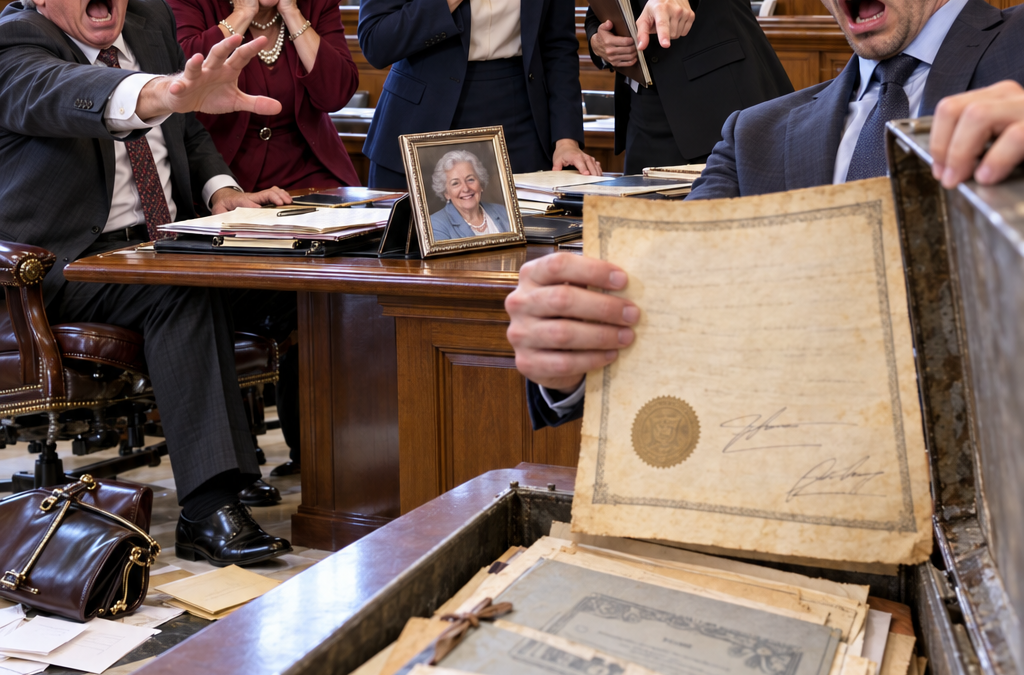
At 7, My Parents Faked My Death And Collected $134K. A Stranger Took Me In—And Only After She Died Did I Learn She Was A Hidden Millionaire Who Left Me $7.2M. My Parents Reappeared To Sue Me For It. In Court, They Smirked Until My Brother Opened The Box. They Signed My Death Certificate.
My parents left me in foster care when I was seven, then told everyone in our hometown that I had died. They held a memorial, accepted sympathy money, and collected an insurance payout while I was alive forty miles away. I didn’t learn any of that until twenty-five years later, after the woman who raised me left me $7.2 million and my biological parents sued to take it. I was ready for greed. I wasn’t ready for the person who called me nine days before trial—or what he had found hidden in their storage unit.
Part 1
The first thing I noticed when I walked into Courtroom 14 was that my biological mother had gotten highlights. Honey-blonde, carefully blended, the kind that required two hours in a salon and the reasonable expectation that something good was about to happen afterward. She leaned toward her attorney with a paper coffee cup between both hands, laughing softly at something he had whispered, while my biological father sat beside her in a navy suit with his arms folded and a grave expression that looked rehearsed. Neither of them noticed me entering because they weren’t waiting for Claire Mercer, the daughter they had abandoned twenty-five years earlier; they were waiting for Claire Ward, the woman they believed had stolen a fortune that belonged to them.
I took my seat at the defense table beside my attorney, Mara Whitfield, and placed my leather bag at my feet. Inside the front pocket was a silver compass about the size of an old pocket watch, scratched along the rim and cloudy beneath the glass, and I touched it through the leather without taking it out. I had carried it almost every day since I was eight, not because I needed help finding north, but because there are objects that stop being objects after enough years. They become proof that somebody once looked at you and decided you were worth keeping.
Before I tell you what happened in that courtroom, you need to understand that I had already had twenty-five years to decide whether I wanted revenge. What I wanted was smaller and harder than revenge: I wanted the truth put somewhere my parents could no longer edit it. I wanted every signature, every bank record, every lie, and every person they had used to tell the same story at the same time. Mostly, I wanted to know why two people who had spent decades pretending I was dead suddenly remembered I was their daughter when my name appeared beside a $7.2 million inheritance.
I was seven in the fall of 1999 when my mother, Lorraine Mercer, packed one duffel bag with my clothes and drove me from our house in Naperville to a county intake office outside Aurora. The building smelled like floor polish, old coffee, and the tomato soup somebody had served in the cafeteria downstairs. My mother told me I was staying with “some nice people for a little while,” and I remember looking at the blue duffel bag on my lap and trying to calculate how long a little while could possibly be when you only had four shirts. “Until things settle down,” she said when I asked, but she said it while looking at the social worker instead of me.
My father, Thomas, had not come with us. He had been “working late” often that year, though I would learn much later that his small contracting company was collapsing under unpaid vendors, tax liens, and loans he had personally guaranteed. At seven, all I knew was that my parents whispered behind closed doors, envelopes appeared in stacks beside the telephone, and my mother sometimes sat at the kitchen table after midnight with her forehead resting against her hands. I had also spent several weeks in and out of doctors’ offices that spring because of recurring fevers, which would matter later in a way nobody could have imagined.
The intake worker was named Mrs. Alvarez. She wore reading glasses pushed into her hair and had the exhausted kindness of somebody who knew the difference between temporary and permanent even when parents pretended not to. My mother signed several pages, crouched in front of me, and kissed the top of my head without meeting my eyes. “Be good, Claire,” she said, then stood and walked through a gray metal door. I counted the ceiling tiles while I waited for her to return—sixty-four of them, including two water-stained squares near the fluorescent lights—but the door never opened again.
Four months later, my caseworker told me there would be no reunification plan. She used phrases like parental noncompliance, relinquishment, and long-term placement while turning a yellow legal pad so the writing faced away from me. I understood none of the administrative language, but I understood what mattered: my parents were not coming back. I asked if I had done something wrong, and the woman’s expression changed so quickly that I knew adults sometimes hated questions because the honest answer would require them to admit another adult had behaved terribly.
Helen Ward entered my life the following spring. She was fifty-four, recently retired after thirty-one years teaching middle-school science, and she drove a faded green Volvo whose back seat was permanently buried beneath library books, reusable grocery bags, and a plaid blanket for emergencies. Helen did not introduce herself as someone who could save me. She showed me the bathroom, pointed out the cereal cabinet, and explained that her gray cat, Newton, would probably bite me once to establish his authority over the household. “He has an inflated understanding of his position here,” she said.
Newton bit me on my second morning. Helen inspected the tiny mark, handed me a bandage, and said, “Congratulations. You’ve been formally admitted.” That was Helen’s entire approach to affection: practical, dry, dependable, never offered with an invoice attached. On my third morning, she placed a mug of hot chocolate in front of me and set an old silver compass beside it. “Estate sale,” she said. “It’s been sitting in my junk drawer for years. Seems like something a kid ought to have.”
I opened the case and watched the needle tremble before settling. “What am I supposed to do with it?” I asked. Helen poured more coffee into her mug and shrugged. “Know which direction you’re going.” Then, after a pause, she added, “And maybe remember that being lost and being abandoned are not the same thing.” She never mentioned the sentence again. She did not need to.
Helen became my foster mother first, my legal mother four years later, and the person I called Mom long before any judge approved the paperwork. She taught me to drive in the green Volvo, sat in the front row at my college graduation, helped me study for my Illinois real estate broker’s exam, and never once asked me to be grateful for having been loved. By thirty-two, I was handling commercial property transactions around Chicago and had built a quiet life I liked. My biological parents belonged to an old section of my history I rarely opened.
Then Helen died at seventy-eight from a stroke that arrived without drama on an ordinary Tuesday morning. One week later, her estate attorney asked me to come to his office. He slid a folder across his desk, cleared his throat, and told me Helen Ward—the woman who bought generic cereal, drove the same Volvo for nearly two decades, and complained whenever restaurant coffee cost more than three dollars—had left me an estate worth approximately $7.2 million.
For several seconds I simply stared at him.
Then I reached into my bag and closed my hand around the compass.
Six days after probate became public, a short article appeared online mentioning Helen’s estate and my full legal name.
Eleven days later, my parents found a lawyer.
And on a Tuesday afternoon, twenty-five years after my mother told me to “be good” and walked away, a process server entered my office carrying forty-three pages that said Thomas and Lorraine Mercer had spent decades searching desperately for their missing daughter.
Part 2
I read their lawsuit standing behind my desk because sitting down felt too much like accepting its version of reality. According to the complaint, Helen Ward had exploited a vulnerable child, interfered with my parents’ attempts to reunify, manipulated the adoption process, and later exercised undue influence over me so I would inherit her assets. Thomas and Lorraine described themselves as grieving parents victimized by a careless foster-care bureaucracy, claiming they had “never voluntarily relinquished their parental bond.” Their attorney requested that Helen’s estate be frozen and that the entire $7.2 million be placed under court supervision pending investigation.
The final page contained their signatures. Thomas Mercer. Lorraine Mercer. I had not seen those names together since childhood, yet my body recognized them before my mind did; the room seemed to become simultaneously very quiet and very far away. I allowed myself exactly four minutes to feel whatever arrived—rage, disbelief, something unexpectedly close to embarrassment—then I went into the state my coworkers jokingly called transaction mode. Transaction mode had carried me through failed closings, fraudulent sellers, multimillion-dollar disputes, and clients who believed shouting could alter contracts.
My first call was to Mara Whitfield, a Chicago estate litigator whose reputation was based less on courtroom theater than on the fact that she prepared as if opposing counsel might lie about the existence of gravity. She listened without interrupting while I summarized the lawsuit. “Do you have records from your foster placement?” she asked. “Some.” “Do you have correspondence from your parents?” “None.” She paused. “Then before we answer emotionally, we find out what happened administratively.”
My second call was to Denise Shaw, a forensic investigator I had used during three commercial real estate disputes. Denise was sixty-one, wore sensible boots year-round, and approached buried records with the enthusiasm other people reserved for vacations. When I told her to start in 1999, she asked how far forward she should go. “Until the story stops changing,” I said. “And Denise? Don’t just find out why they abandoned me. Find out what they told people afterward.”
Eighteen days later, my dining room table had vanished beneath county records, church newsletters, insurance correspondence, photocopied checks, foster-care notes, archived newspaper clippings, and documents Denise had obtained through public-record requests. Some of it confirmed what I already understood: my parents had stopped participating in the reunification process less than two months after leaving me. They ignored caseworker calls, missed scheduled visits, changed addresses without notice, and eventually signed documents relinquishing their parental rights. The signature pages alone were enough to dismantle large sections of their lawsuit.
But Denise had circled something in red on one of the timelines. Nine months after abandoning me, Thomas and Lorraine had held a memorial service for me at Grace Community Church in Naperville. At first, I thought I was misreading the photocopy. The church bulletin carried my childhood name—Claire Ann Mercer—beneath a second-grade school photograph of me wearing a yellow cardigan and smiling through the gap where one front tooth had fallen out.
Under the photograph were the words Beloved Daughter, Gone Too Soon.
I read the page three times before calling Denise. “Is this real?” I asked. “The bulletin is authentic,” she said. “I spoke to two people who attended.” She let the silence sit for a moment. “Claire, they told everyone you died from leukemia.”
I had never had leukemia. The recurring fevers from childhood had eventually been diagnosed as a stubborn viral illness combined with anemia, uncomfortable but ordinary. Yet my parents had taken real fragments—doctor visits, blood tests, my mother’s worried conversations with neighbors—and rearranged them into a story that made my disappearance believable. The memorial drew nearly two hundred people. Former teachers attended. Parents from my elementary school organized meals. Church members created a fund supposedly meant to help my family cover medical and funeral expenses.
The contributions totaled $84,300.
I stared at that number longer than I had stared at the inheritance figure. Seven million dollars was abstract, a fortune so large my brain reduced it to accounting. Eighty-four thousand dollars was different. I could picture retired neighbors writing twenty-five-dollar checks. I could imagine women carrying casserole dishes into the Mercer kitchen, believing they were feeding parents who had buried a child. I could imagine someone standing in church holding my school picture while I was forty miles away learning multiplication tables at Helen’s dining room table.
“That’s not everything,” Denise said.
Two years before leaving me in foster care, my parents had purchased a $50,000 child life-insurance policy. The amount was not extraordinary by itself, but the timing became interesting when paired with Thomas’s business debts and a second discovery Denise made in state insurance archives. In August 2000, the insurer received a claim naming me as deceased. The file included medical documentation, a funeral statement, and a certified copy of an Illinois death record.
The insurance company paid my parents $50,000.
My parents had therefore received approximately $134,300 because I was dead.
Except I wasn’t.
Denise emailed me the scanned death record at 10:47 on a Wednesday night. I was sitting at my kitchen table with tea I had forgotten to drink when the file opened. Name: Claire Ann Mercer. Date of death: June 12, 2000. Cause: acute leukemia. The medical certification contained a physician’s name I did not recognize, and the paperwork had passed through a funeral home in another county that had closed years earlier.
On June 12, 2000, I had been eight years old and very much alive. Helen had taken me to a planetarium program that week because I had become obsessed with constellations, then taped a star chart beside my bedroom window. I remembered lying on the carpet with Newton sprawled across my stomach while Helen explained that some stars we saw had already disappeared, their light continuing toward us long afterward.
Apparently adults could do the reverse.
They could erase a living child and leave the paperwork behind.
I sat alone at the table until after midnight, reading the death certificate again and again. The strangest part was that I did not feel shattered. Something inside me became orderly. My parents’ lawsuit had transformed from an insult into evidence because, by claiming a parental right to my inheritance, they had voluntarily stepped into a courthouse and demanded that the legal system examine who I was.
The very system they had once convinced I no longer existed.
At 12:18 a.m., I called Mara’s voicemail.
“We are not settling,” I said. “I want the case heard in open court.”
The next morning Denise called again. Her voice had changed.
“There’s another problem,” she said. “The physician whose name appears on your death paperwork says he never treated you.”
Then she told me the signature looked genuine.
Part 3
Dr. Samuel Pritchard was eighty-three when Denise found him living outside Rockford. He had retired from pediatric practice years earlier but remembered my name only after Denise showed him the documents. He had treated me once during an emergency-room visit for fever in 1999, which explained how my parents knew his name and why an insurance company might have accepted it without immediate suspicion. What he denied was signing any certification saying I had leukemia or had died.
His signature, however, was close enough that a handwriting examiner would not call it a crude forgery. Denise spent another week tracing the paperwork backward until she found a connection through the defunct funeral home. In 2000, its office manager had been a woman named Cheryl Packer, who attended the same church as my parents and whose husband had occasionally subcontracted for my father’s construction business. Cheryl had died six years earlier, but old bank records showed a $7,500 payment from Thomas Mercer to her husband three weeks before my death record was registered.
Mara did not smile when Denise placed that information in front of us. “Interesting isn’t admissible,” she said. “We need proof.” Denise nodded. “I know.” Then she opened another folder. Thomas’s construction company had been in far worse condition than we had known. By the summer of 2000, he owed suppliers more than $90,000, had a federal tax lien, and was ninety days behind on the mortgage.
Within three months of the insurance payout and the church fund distributions, most of those debts had been paid down.
That discovery gave us motive, but not yet the deeper answer I kept looking for. Greed explained why someone might keep money once it appeared. It did not explain the months of preparation required to create a dead child. Someone had bought the policy in 1997, more than two years before I entered foster care. Someone had retained copies of my medical records. Someone had understood that if I disappeared through legitimate social services and later became legally adopted under another surname, people in Naperville would have little reason to ask questions.
I began revisiting memories I had spent years treating as ordinary. The life-insurance salesman who had once sat at our kitchen table. My mother telling me to smile for a school photograph because “people remember a nice picture.” My father asking strange questions after a doctor appointment about whether nurses had given us anything in writing. None of those memories proved anything, and I refused to turn childhood fragments into facts simply because I wanted an explanation. Still, I could no longer pretend my abandonment had happened in isolation.
Meanwhile, my parents’ lawyer continued sending settlement proposals. The first asked for forty percent of the estate. The second asked for $1.5 million and mutual confidentiality. The third arrived with language suggesting Thomas and Lorraine would accept $600,000 “to avoid retraumatizing all parties.” Mara read that sentence aloud in her conference room, removed her glasses, and stared at the wall for several seconds. “I have practiced law for thirty-four years,” she said. “Every so often, somebody still surprises me.”
I rejected every offer.
Then, nine days before trial, an email appeared in my personal inbox with the subject line I THINK I’M YOUR BROTHER.
I almost deleted it. My parents had never mentioned another child during the lawsuit, and I assumed someone had found my story online and wanted attention. But the email was only nine sentences long. The sender introduced himself as Ethan Mercer, thirty-one, living in Wheaton and working in network security. His final sentence read: I don’t know whether hearing from me would make your life worse, and if it would, I’ll leave you alone, but I need you to know I never knew you were alive.
I read the message twice before responding with my phone number.
Ethan called eleven minutes later.
The first thing I noticed was his voice. There was something in its cadence that sounded disturbingly familiar, not because I remembered him but because certain family resemblances survive even in sound. We switched to video after ten minutes. He had Lorraine’s eyes, my father’s long jaw, and the exhausted expression of someone who had spent several nights reconsidering his entire childhood.
He had been six when my parents held my memorial.
I remembered a little boy from before foster care only in fragments: toy trucks in the hallway, someone crying when I took the red cereal bowl, small sneakers beside mine near the back door. I had assumed for years those images belonged to a cousin because no caseworker had ever told me I had a sibling. My parents had kept Ethan and surrendered me.
“Why?” I asked.
His face tightened. “That’s one of the things I hoped you knew.”
He told me about the memorial service. Our mother dressed him in a navy sweater and told him his sister had gone to heaven. Someone gave him a white balloon during the ceremony, and he released it outside with the other children. Every June afterward, Lorraine talked about me—my missing front tooth, the time I spilled grape juice on the couch, how I supposedly loved horses even though I had been afraid of them.
“She made you real enough that I missed you,” Ethan said, “but dead enough that I never looked for you.”
A year earlier, he had helped our parents clean a storage unit after they downsized. In the back of a metal filing cabinet, he found an envelope containing an insurance policy, an original claim form, and a canceled $50,000 check payable to Thomas Mercer. Ethan had assumed the documents were ordinary proof of a tragic event and returned them to the drawer.
After seeing the article about Helen’s estate, he recognized my childhood name.
He went back to the storage unit.
The filing cabinet was still there.
So was the envelope.
But Ethan had found something underneath it that changed the shape of the story again: a handwritten notebook belonging to our mother. Most pages contained household expenses, grocery lists, mortgage figures, and calculations. One page, dated two months before I was placed in foster care, had three numbers written beside my initials.
$50,000 insurance.
$70–90K community.
No reunification after adoption window.
I stared at the photograph Ethan sent me until my phone dimmed.
“Claire,” he said quietly, “I think they knew exactly what they were doing before they ever dropped you off.”
I believed him.
But that was not the worst page in the notebook.
Three pages later, beside Ethan’s initials, Lorraine had written the name of another insurance company.
Part 4
For several minutes neither Ethan nor I spoke. I kept enlarging the photograph of the notebook as though magnification might change what the handwriting said. Beside his initials was a different insurer, a policy amount of $25,000, and a notation reading REVIEW AGE 10. Ethan was thirty-one now, alive on my screen, staring at the same page. Whatever story he had told himself about our parents’ desperation collapsed in real time.
“I was insured too,” he said finally. “Apparently.” His laugh was short and empty. “That doesn’t mean they planned anything.” “No,” I said. “It doesn’t.” I had learned from years of commercial disputes that suspicion becomes dangerous when you start treating it as proof. “We don’t invent what we can’t establish. We follow what they actually did.”
Mara agreed. The notebook could matter, but chain of custody would matter more. Ethan could not simply remove the entire filing cabinet without risking accusations that he had altered evidence. Instead, Mara arranged for him to preserve photographs, document where everything had been found, and—once the litigation rules allowed it—produce the original materials through counsel. My parents’ lawsuit had created discovery obligations they had apparently never imagined would run in both directions.
That was the remarkable thing about their mistake. For twenty-five years, my parents controlled the story because nobody with authority had reason to test it. By suing me, they changed that. They claimed Helen had wrongfully separated me from them, so their own actions during the separation became relevant. They claimed they had searched for me, so we requested evidence of every search. They claimed parental standing, so we requested documents proving what they had told government agencies about whether their daughter was alive.
Their case began consuming itself.
The records showed no missing-child reports, no private investigators, no inquiries to foster agencies, and no letters asking where I had gone. Instead, three weeks after signing their final relinquishment papers, my parents changed churches and began telling acquaintances that my condition had worsened. Four months later, Lorraine wrote to my former elementary school requesting a copy of my class photograph “for family records.” Six weeks after that, the church announced my illness during Sunday services.
They had not erased me impulsively.
They had staged my disappearance in steps.
Denise eventually located two former members of Grace Community Church who remembered troubling details. One woman, Patricia Wells, had organized the memorial fund and still possessed an old binder of correspondence in her basement. Among the documents was a letter from Lorraine thanking the congregation and explaining that medical expenses had “destroyed what little savings we had.” Another was a handwritten request asking that donations be made directly to the Mercer family rather than to a hospital because “the final bills are still being reconciled.”
There had been no final medical bills.
There had barely been medical bills at all.
The $84,300 arrived through dozens of small acts of kindness. A retired bus driver gave seventy-five dollars. My second-grade teacher contributed two hundred. A Girl Scout troop held a bake sale. An elderly couple donated a thousand dollars in memory of a granddaughter they had actually lost to cancer. Reading those records made me angrier than looking at the insurance check because each line represented somebody who had opened a wallet not because my parents were persuasive, but because a dead child bypasses ordinary suspicion.
Then Patricia gave Denise something nobody knew existed.
A VHS tape.
The memorial service had been recorded for relatives who supposedly could not attend. Denise had it professionally digitized, and I watched it once in Mara’s office. Lorraine stood at the front of the church wearing black, speaking about how courageous I had been. Thomas sat in the first pew with one hand over his face. Six-year-old Ethan sat between two relatives holding a white balloon.
My mother told the congregation I had asked her not to cry.
I had not spoken to her in nine months.
At one point the camera panned across the sanctuary, and I recognized people I had not thought about since childhood. My teacher. A neighbor who used to let me draw with sidewalk chalk in her driveway. The cashier from the grocery store who gave children stickers. They were crying for me while I was living with Helen and learning that Newton liked turkey but hated tuna.
I stopped the video halfway through.
Mara looked at me. “We don’t have to use this.” “Yes,” I said. “We do.”
Two days before trial, my parents attempted one final settlement. This time they asked for $250,000, dismissal without findings, and a confidentiality agreement prohibiting me from discussing the insurance claim or memorial fund publicly. Their attorney added that his clients were elderly, emotionally fragile, and frightened that “historic misunderstandings” might be misconstrued.
I read the proposal at my kitchen table.
Helen’s compass sat beside my laptop.
I thought about something she had told me when I was sixteen after a classmate spread a rumor about me being adopted. I had wanted Helen to call the girl’s parents and force them to make her apologize. Helen listened, then said, “An apology can be useful, but sometimes people use one to purchase your silence. Know the difference.”
I emailed Mara two words.
Reject it.
Trial began Thursday morning.
I arrived early enough to watch the bailiff test the microphone. My parents entered fifteen minutes later. Lorraine had the honey-blonde highlights. Thomas carried a leather portfolio. Their attorney arranged documents while they spoke quietly, looking almost relaxed.
Then Lorraine noticed me.
Her eyes moved over my face slowly, as though checking a photograph against memory.
She whispered something to Thomas.
He looked up.
Confusion came first. Recognition followed. Then his entire expression flattened.
Mara leaned toward me.
“They know,” she whispered.
I touched the compass through my bag.
Across the courtroom, twenty-five years after my parents had declared me dead, my father was finally looking at the living evidence.
And the first witness Mara intended to call was the son they had kept.
Part 5
Mara began without drama. That was one of the reasons I trusted her. She did not call my parents monsters, did not speculate about motives, and did not describe my childhood in language meant to make the judge emotional. She placed documents into evidence one at a time and let their dates speak to one another.
First came the foster-care records showing my parents had voluntarily stopped participating in reunification. Then the relinquishment documents carrying both signatures. Then letters proving Helen had not entered my life until after several attempted placements and had no contact whatsoever with Thomas or Lorraine before becoming my foster parent. By the time Mara finished establishing that timeline, the central allegation in my parents’ complaint—that Helen had somehow stolen me from them—was already collapsing.
Their attorney tried to argue that my parents had been confused by the system. Mara responded by producing notices mailed to three separate addresses, all signed upon receipt. He suggested financial hardship prevented them from attending hearings. Mara produced employment records showing Thomas had worked within thirty miles of the courthouse on two hearing dates. He said grief might explain inconsistencies.
That was when Mara introduced the memorial bulletin.
I watched my mother’s hand rise slowly to her throat.
The judge studied the yellow-cardigan photograph, then looked toward me. She did not say anything. Judges are trained not to perform surprise, but the room changed anyway. The air seemed to tighten as people understood that the adult woman seated at the defense table was the child described as dead on the paper in the judge’s hands.
Next came the memorial fund records.
$84,300.
Then the insurance policy.
$50,000.
Then the claim form.
Then the death record.
My parents’ attorney asked for a recess.
The judge denied it.
“Counsel,” she said, “you initiated this action.”
Mara waited until everyone was seated again before asking that the digitized memorial recording be admitted. Thomas leaned toward his attorney and began whispering rapidly. Lorraine stared at the table.
The screen at the front of the courtroom came alive.
There she was.
My mother at thirty-four.
Younger than I was now.
She stood behind a church lectern wearing a black dress and holding a tissue. “Claire was the kind of child who noticed when other people were sad,” the woman on the screen said. “Even near the end, she worried more about us than herself.”
My adult mother watched her younger self lie.
I wondered whether she remembered practicing those sentences.
The video lasted twelve minutes before Mara stopped it. She did not need more. She introduced Patricia Wells’s affidavit verifying the fundraiser, then records showing the money had been released directly to Thomas and Lorraine. Finally, she introduced bank statements tracing substantial portions into mortgage arrears, tax payments, and debts related to Thomas’s business.
My father’s jaw tightened.
Then Mara said, “The defense calls Ethan Mercer.”
Lorraine made a sound I had never heard from another human being. It was not quite a gasp and not quite a word. She turned so sharply toward the courtroom entrance that one of her earrings caught the light.
Ethan walked in carrying a document case.
He did not look at our parents.
He took the oath and sat.
Mara began with simple facts. His name. Age. Relationship to Thomas and Lorraine. His memories of having an older sister. Ethan answered quietly, keeping his hands folded in front of him.
“How old were you when you were told Claire died?”
“Six.”
“What were you told?”
“That she had cancer. That she had gotten very sick. That she died in a hospital.”
“Did you attend a memorial?”
“Yes.”
“What do you remember?”
Ethan swallowed. “They gave me a balloon.”
For the first time that morning, I had to look away.
He described releasing it outside the church. He described our mother talking about me every June. He described believing for twenty-five years that his sister had died.
Then Mara asked whether he had discovered documents in a family storage unit.
“Yes.”
“What documents?”
“An insurance policy on Claire. The claim. The canceled check. And my mother’s notebook.”
My father stood.
“That’s private family property.”
The bailiff moved before the judge had to ask.
“Mr. Mercer,” the judge said, “sit down.”
Thomas sat.
Ethan opened his case and removed the original insurance claim. The paper had yellowed along its edges. My father’s signature appeared at the bottom beneath a certification that the statements provided were true.
Mara placed it beside the certified death record.
Then she produced the notebook.
My parents’ attorney objected immediately, challenging foundation and relevance. Mara had anticipated it. Ethan testified about finding the notebook, photographing it in place, and preserving it until it could be produced according to the court’s discovery order. Denise had documented the transfer. A handwriting specialist had compared Lorraine’s writing with uncontested samples.
The judge admitted it.
Mara displayed the page.
$50,000 insurance.
$70–90K community.
No reunification after adoption window.
For the first time since entering court, Lorraine looked directly at me.
I expected shame.
What I saw was anger.
Not regret that I had been abandoned. Not horror that her lie had survived twenty-five years. Anger that I was sitting there while her private calculations were being read aloud.
That expression answered a question I had carried longer than I realized.
I had spent childhood wondering why I was not enough to make my mother return.
The truth was that returning had never been part of her plan.
My parents’ attorney stood and argued that the notebook was being misinterpreted, that the numbers could refer to anticipated expenses, that the memorial notation reflected desperate grief rather than fraud. Mara listened calmly.
Then she called Dr. Pritchard by video deposition.
He testified that he had never diagnosed me with leukemia.
He had never pronounced me dead.
He had never signed the medical certification attached to my death record.
Mara placed his verified signature beside the disputed document.
“They look similar,” she said.
“Yes.”
“Did you authorize anyone to sign your name?”
“No.”
“Did Thomas or Lorraine Mercer ever contact you regarding their daughter’s death?”
“No.”
“Was Claire Mercer dead on June 12, 2000?”
Dr. Pritchard adjusted his glasses.
“I cannot tell you where she was,” he said, “but I can tell you I did not declare her dead.”
Mara turned toward the judge.
“Your Honor, the plaintiffs are asking this court to recognize parental rights over a woman they represented to an insurer, a church, and the State of Illinois as deceased.”
She paused.
“One of those positions has to be false.”
My father’s attorney requested another recess.
This time the judge granted ten minutes.
As everyone stood, Ethan remained in the witness chair for a moment before looking at me.
I thought the worst evidence had already been presented.
Then Mara touched my arm.
“Denise just sent something,” she said.
“What?”
She turned her phone toward me.
It was a bank record from 1999.
My mother had deposited money three weeks before leaving me in foster care.
The memo line read: FINAL PAYMENT — C. PACKER.
And the account the payment came from belonged to a second life-insurance policy I had never known existed.
Part 6
The second policy was not on me.
It was on my father.
That distinction turned out to matter.
Denise had spent the morning following an old account number from Lorraine’s notebook. Twenty-five years earlier, my parents had taken a loan against the cash value of Thomas’s small permanent life-insurance policy. The amount was $8,000. Seven thousand five hundred dollars moved almost immediately to Cheryl Packer, the funeral-home office manager whose name had already surfaced in connection with my false death paperwork.
Suddenly the timeline became painfully precise. My parents had borrowed money before I entered foster care. They had paid someone connected to a funeral home. Then they abandoned me. Months later, a death record appeared supported by documentation associated with that funeral home.
This was no longer a story about desperate parents noticing an opportunity after the fact.
The machinery had begun before they left me.
During the recess, Mara spoke quietly with opposing counsel in the hallway. I could not hear everything, but I heard the phrases immediate withdrawal, referral, and potential criminal exposure. My parents sat on a bench twenty feet away. Lorraine kept glancing toward Ethan as though waiting for him to remember which side of the family he belonged to.
He never looked back.
When court resumed, my parents’ attorney asked permission to withdraw the complaint with prejudice. Mara stood and objected—not to dismissal, but to allowing the proceeding to end without preserving the record and referring the evidence to the appropriate authorities. The judge’s expression had hardened.
“I intend to address that,” she said.
Mara finished with the simplest argument of the entire case.
“My clients’ position requires no speculation. If Claire Mercer died in June 2000 as these plaintiffs represented under oath and through official documents, then they cannot now claim parental standing over a living heir. If Claire Mercer did not die—and she plainly did not—then the documents used to obtain money and create a false vital record raise issues far beyond probate.”
Nobody moved.
“There is no version of these facts,” Mara continued, “in which Thomas and Lorraine Mercer have a valid claim to Helen Ward’s estate.”
She sat down.
The judge removed her glasses and looked at my parents for several seconds.
Their lawsuit was dismissed with prejudice.
Then she ordered the record preserved for referral to the state’s attorney and relevant insurance authorities.
It should have felt triumphant.
Instead, I felt tired.
There is a difference between winning and being restored. A judge could dismiss their case, but she could not return the seven-year-old girl who had counted ceiling tiles believing her mother might walk back through a metal door. A criminal investigation could punish forged documents, but it could not make six-year-old Ethan understand that the balloon he released had been part of a lie.
I stood anyway.
Mara touched my sleeve. “You don’t have to say anything.”
“I know.”
I walked into the center aisle.
My father stared straight ahead.
My mother looked at me.
Up close, I could see fine lines beneath the makeup around her eyes. For years I had imagined that if I ever saw her again, some involuntary piece of me would become seven years old. It didn’t. I saw an aging woman who had once been responsible for a child and made a series of choices.
“You used my school picture,” I said.
Lorraine’s mouth trembled.
“You let people bring food to your house. You let Ethan release a balloon. You took money from people who thought they were helping parents bury a little girl.”
“Claire—”
I raised one hand.
“No.”
She stopped.
“I spent years thinking you left because you couldn’t handle whatever was happening in your life. I told myself that because it was easier than believing I was disposable.”
“You don’t understand what we were going through.”
“I understand the dates.”
Her expression changed.
That was the difference between us now. She wanted a story. I wanted the record.
“You borrowed money before you left me,” I said. “You paid Cheryl Packer before you left me. You bought insurance years earlier. Then you made sure no reunification happened.”
Thomas finally looked at me.
“Our business was failing,” he said.
The words landed without force.
I nodded once. “And you decided I was an asset.”
“That’s not what happened.”
“Then explain the notebook.”
He looked away.
Lorraine began crying. They were convincing tears, practiced through decades of anniversaries and sympathy. “We were drowning,” she said. “Your father could have gone to jail over taxes. We were going to lose the house. We had two children. We made terrible decisions.”
“You had two children,” I repeated.
Her eyes flicked toward Ethan.
For one second, the entire logic became visible.
They had not abandoned both children because two missing children would have attracted scrutiny. They had kept the younger one because a grieving family required somebody to witness its grief. Ethan was not merely the child they chose.
He had been part of the credibility.
I looked at him.
His face told me he had reached the same conclusion.
Lorraine saw it too.
“No,” she said quickly. “Ethan, no. Don’t think that.”
He stood.
“What am I supposed to think?”
“You were our son.”
“And she wasn’t your daughter?”
Nobody answered.
The bailiff approached and told us the courtroom needed to clear.
I turned back to my mother.
She whispered my name.
I had spent twenty-five years wondering what I would say if she ever asked me to forgive her. What came out was simpler.
“The daughter you buried grew up,” I said. “She doesn’t need anything from you.”
I picked up my bag and walked out.
In the hallway, Mara hugged me, surprising both of us.
Ethan followed several minutes later.
We rode the elevator to the parking garage without speaking.
Beside my car, he finally said, “I’m sorry about the balloon.”
I looked at him.
“You were six.”
“I still let it go.”
“You thought your sister was dead.”
He rubbed both hands over his face. “I missed you.”
That sentence hurt more than anything said in court.
Not because of what my parents had done to me.
Because they had stolen me from him too.
Ten weeks later, Thomas and Lorraine were indicted.
But the criminal investigation uncovered one final document that proved the money had never been the whole story.
Part 7
I did not attend my parents’ arraignment. I did not sit through hearings or follow every filing. Mara sent me what I needed to know, and Denise called when something materially changed, but I had no desire to build my life around watching two people lose theirs. They had already occupied enough space.
The charges included insurance fraud, charitable solicitation fraud, conspiracy to submit false vital records, forgery-related offenses, and obstruction tied to documents my father attempted to remove from storage after our civil trial began. Cheryl Packer could no longer be charged, but investigators reconstructed her role through bank records and archived funeral-home paperwork. She had apparently used legitimate forms and access credentials to create supporting documentation for a death that never occurred.
The most damaging evidence, however, came from an envelope investigators found taped beneath a drawer inside the filing cabinet.
It contained a letter Lorraine had written to Cheryl in August 1999 but apparently never mailed.
I received a copy through Mara.
Cheryl,
Tom says we cannot keep doing this another year. The school has already started asking about absences and doctors, and if Claire stays with us people will keep seeing her. Once she is placed permanently, enough time has to pass before we say anything or somebody from the county may connect it. You were right that sickness is easier because people don’t ask where a sick child is.
I stopped reading.
There are sentences that change your understanding of another human being, and then there are sentences that rearrange your own past.
This one did both.
The letter continued with references to hospital paperwork, the insurance policy, the church, and my father’s debts. But near the end, my mother wrote something that finally answered the question greed alone never had.
Ethan is too old to move without making trouble, and Tom says people know him better anyway. Claire has always been quieter and she adjusts to strangers. She’ll be okay somewhere else.
I read that sentence sitting at Helen’s old kitchen table.
She adjusts to strangers.
That was the hidden logic of my childhood.
My parents had chosen me because I seemed survivable.
I had spent decades treating my independence as evidence that abandonment had not destroyed me. They had apparently seen the same quality and used it as justification. I was the child who did not scream in grocery stores, who sat quietly at doctors’ appointments, who learned new teachers quickly. In their accounting, my resilience had made me cheaper to discard.
For several days, that knowledge hurt in ways the financial fraud never had.
Then I remembered Helen.
She had never praised me for “being strong” when I was a child. When I apologized for crying, she told me crying was not an administrative failure. When I tried to make myself invisible after spilling milk, she handed me a towel and asked why I looked like I expected to be evicted.
Helen had spent twenty-five years undoing the lesson my parents had relied on.
I did not need to be easy to deserve a home.
Thomas eventually pleaded guilty to multiple felony counts under an agreement that required restitution and cooperation. Lorraine held out longer, insisting through counsel that she had been controlled by my father, until investigators confronted her with the notebook and the unsent letter in her own handwriting. She eventually entered her own plea.
Neither received the dramatic sentence television might have written. They were in their sixties. The offenses were old. Some statutes complicated prosecution. Records had disappeared and witnesses had died. The outcome involved incarceration, probation provisions, financial penalties, and restitution orders that would follow them for years.
I did not attend sentencing.
People were surprised by that.
Even Ethan asked once.
“Don’t you want to hear them say they’re guilty?”
“They already did,” I said.
“But in court.”
I looked at him. “I don’t need another room.”
He understood.
Our relationship developed slowly. We did not attempt to manufacture twenty-five years of sibling history in a few months. There were weeks we barely spoke, then Sunday afternoons when we sat for three hours in a diner arguing over whether our shared dislike of bananas was genetic. He showed me photographs from his childhood. I showed him Helen.
One afternoon he brought over a cardboard box containing objects from the Mercer storage unit that investigators had released because they were unrelated to the case.
Inside was a red plastic cereal bowl.
I laughed when I saw it.
“What?”
“I used to fight with you over that.”
His eyebrows rose. “I remember somebody taking the red bowl.”
“That was me.”
“You were awful.”
“You were six.”
“So were you.”
For the first time, we laughed about a memory that belonged to both of us.
That was when I understood what my parents had failed to calculate. They had created a lie to solve a financial problem, but lies that large do not remain attached to money. They enter marriages, childhoods, anniversaries, family photographs, the stories people tell themselves about why somebody is missing. Thomas and Lorraine had stolen $134,300, but the larger theft had been twenty-five years of ordinary sibling life.
I could not recover that.
I could decide what happened next.
Helen’s house in Evanston remained mine. I could have sold it for more than a million dollars, but every room still carried the shape of her habits: the hook where she hung her keys, the window where Newton slept, the cabinet whose hinge she had promised to repair for fifteen years. I kept the green Volvo too, although mechanics had begun greeting me with the expression doctors reserve for families refusing to accept a terminal diagnosis.
Of the $7.2 million estate, I kept enough invested to secure my future and placed $4.8 million into an educational endowment for young adults aging out of Illinois foster care.
I named it the Ward-Mercer Fund.
Friends asked why I kept Mercer.
Because it was mine before it was theirs.
Because I wanted one thing carrying that name to do what my parents should have done.
The fund covered tuition, housing support, books, emergency expenses, and mentorship for students whose lives did not fit neatly into traditional financial-aid forms. We prioritized young people with multiple placements and no reliable family support.
The first year, we funded twelve students.
The second year, nineteen.
The thirty-second application arrived on my desk on a rainy Monday in October.
The applicant was eighteen, had experienced four foster placements, and wanted to study civil engineering.
At the bottom of her essay, she had written one sentence that kept me at my desk long after everyone else went home.
I don’t need somebody to save me. I just need one place that doesn’t disappear when things get hard.
I read it three times.
Then I reached for Helen’s compass.
Part 8
The compass no longer lived in my bag. I moved it to the corner of my desk at the Ward-Mercer Fund, where afternoon light crossed its scratched silver case. Sometimes students noticed it during meetings and asked whether it still worked. I always opened it and let them watch the needle wobble before settling north.
“That’s the whole trick,” I told one student. “It can shake and still know where it’s going.”
Helen would have rolled her eyes at me for turning her junk-drawer gift into philosophy. Then she would have secretly liked it.
The fund grew faster than I expected. Commercial clients made donations after hearing the story. Former foster youth volunteered as mentors. Patricia Wells—the woman who had organized my fake memorial fundraiser twenty-five years earlier—mailed a check with a handwritten note saying she wanted money connected to my name to finally go where it should have gone.
I called her instead of sending a thank-you card.
She cried when she heard my voice.
“I’m so sorry,” she said. “We believed them.”
“You were supposed to believe parents whose child had died.”
“We should have checked.”
“No,” I said. “They should not have lied.”
That distinction mattered to me.
I refused to transfer my parents’ guilt onto every person they had deceived.
Ethan eventually left his network-security job and applied for an operations position with the fund. He insisted on going through the same interview process as everyone else. I removed myself from the hiring panel so nobody could accuse me of giving him the position out of sentiment.
They hired him anyway.
He was excellent at the work.
People who grow up inside confusing families sometimes become very good at noticing systems that fail quietly. Ethan could look at a student’s application and spot the missing document that would become a crisis three weeks later. He remembered birthdays. He kept granola bars in his desk for students who arrived from work without eating.
We had lunch most Thursdays.
Not because siblings were supposed to.
Because we liked each other.
That surprised both of us.
Thomas wrote to me once from prison. The envelope arrived at the fund without a return name, but I recognized his handwriting from the insurance claim.
I did not open it.
For two days it sat on my desk beside the compass.
Then I gave it to Mara and asked her to place it in the case archive.
“Do you want to know what it says?” she asked.
“No.”
“What if it’s an apology?”
“Then he wrote one.”
She waited.
“That’s enough,” I said.
Lorraine tried a different route after her release. She sent Ethan messages saying she was in therapy, that she finally understood the harm she had caused, that she hoped someday we could sit together “as a family.”
Ethan asked what I wanted him to do.
“Whatever you need to do for yourself.”
“What if I keep talking to her?”
“You’re my brother, not my employee.”
He smiled faintly. “Technically I am both.”
“You know what I mean.”
He did.
I never asked him to choose.
That would have made me too much like them.
He spoke to Lorraine occasionally for several months. Eventually the conversations became less frequent. He said she still had a habit of describing what happened as “the situation,” as if twenty-five years of fraud and abandonment had been bad weather.
One Thursday he told me he had stopped answering.
I did not congratulate him.
I handed him half my sandwich.
That was enough.
My life did not transform into a victory montage after the trial. Some mornings I still woke from dreams about fluorescent lights and sixty-four ceiling tiles. Sometimes a child crying in a grocery store could transport me backward before I understood why.
But healing became less about erasing those reactions and more about refusing to let them make decisions for me.
I stayed in commercial real estate part-time because I liked the precision of contracts. I ran the fund the rest of the week. I adopted a gray shelter cat with an uneven ear and named him Newton II despite Ethan insisting that naming pets after predecessors made me “an eighty-year-old British aristocrat.”
The Volvo finally died on Lake Shore Drive one February morning.
Not dramatically.
It simply sighed, lost power, and rolled onto the shoulder.
The mechanic called later and said, “Claire, there is no financially responsible version of this conversation where I tell you to repair that car.”
I laughed so hard I cried.
Then I cried enough that it stopped being laughter.
I donated the car to a vocational training program where students could use it for automotive practice. Helen would have considered that an acceptable funeral.
A year after the civil trial, Mara invited me to speak at a continuing-education seminar about contested estates and fraudulent identity records. I declined. I had no interest in becoming professionally famous for the worst thing my parents had done.
Three years after the trial, I accepted a different invitation.
It came from a foster-youth advocacy conference in Springfield.
My talk was not about my parents.
It was about paperwork.
I told caseworkers, lawyers, educators, and foster parents that children disappear in systems long before anybody notices a crime. They disappear when files fail to follow them. When schools do not know who has custody. When siblings are separated without enough explanation. When an adult says, “She adjusts well,” and everyone treats that as evidence she does not need help.
Afterward, a woman in her fifties approached me.
She had spent fifteen years as a foster parent.
“I think I praised kids for being easy too often,” she said.
“So did a lot of people.”
“What should I have said?”
I thought about Helen.
“Maybe tell them they don’t have to be easy.”
She nodded and wrote it down.
That evening I drove back to Evanston through steady rain. Helen’s house appeared at the end of the block exactly as it always had, porch light glowing, maple branches moving above the roof.
For years I had thought home was the place someone agreed to keep you.
Helen taught me something better.
Home was the place where you did not have to earn your right to remain.
I walked inside, fed Newton II, and found an envelope from the fund on the kitchen counter. Ethan had dropped it off on his way home.
It contained a photograph.
Thirty-two young adults stood outside universities across Illinois, some in dorm rooms, some beside campus signs, some wearing graduation robes.
On the back, Ethan had written:
Thirty-two people who know where they’re going.
I carried the photograph to my desk and placed it beside the silver compass.
The needle trembled when I opened the case.
It always trembled.
Then it settled.
For most of my life, people described what happened to me as abandonment, fraud, betrayal, or survival. All of those words were accurate, but none of them was the ending.
My parents had decided I was the child who would adjust to strangers.
They were right about one thing.
I adjusted.
I learned.
I built a career, found my brother, kept the name they had tried to bury, and used the money they came back to steal from me to make sure other young people had somewhere solid to stand.
I never forgave Thomas and Lorraine.
I also stopped needing them to understand why.
Forgiveness would not change the documents, return Ethan’s childhood, or turn their choices into something less deliberate. What changed me was realizing I no longer needed any version of them—not repentant parents, not punished villains, not even explanations—to tell me what my life meant.
Helen used to say home was not necessarily the place you started.
It was the place you learned to recognize.
For twenty-five years I carried a small silver compass because I thought someday I might need help finding my way back.
I don’t carry it anymore.
It stays on my desk.
I already know where home is.
THE END!