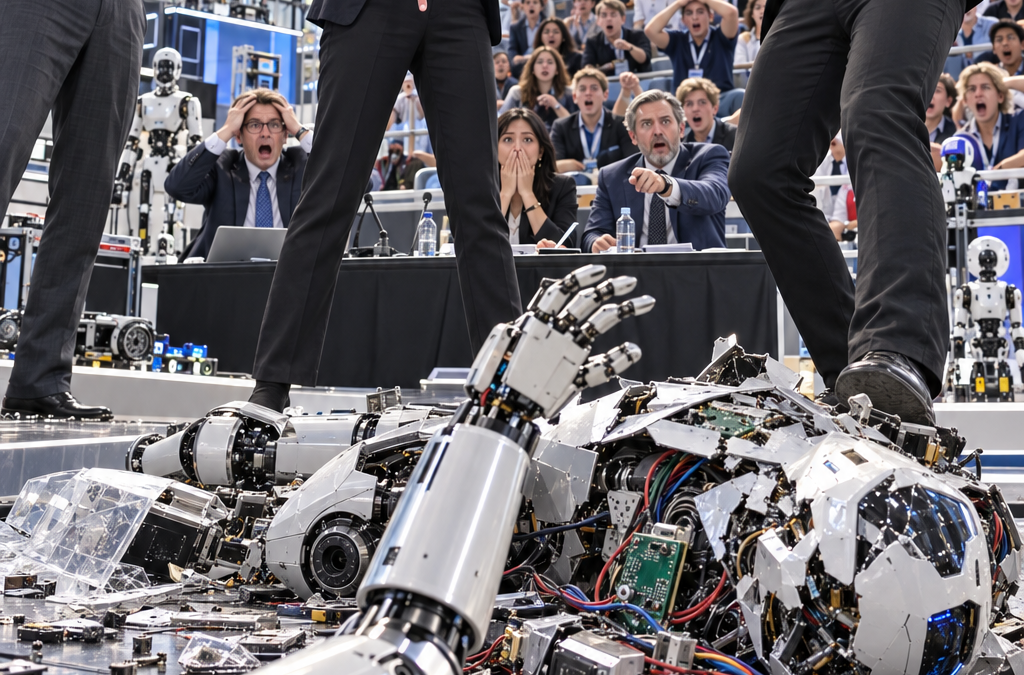
At My Robotics Presentation, My Brother Smashed The Robot I Built For 3 Years. He Laughed, “Go Win Now, Sis!” Dad Said, “It’s Just A Toy.” I Just Asked, “Did You See What It Sent Before You Broke It?” My Brother Went Pale…
My brother destroyed the robot I had spent three years building ten minutes before the biggest presentation of my life, and my father watched the pieces scatter across the floor and called it “just a toy.” I didn’t scream. I carried the broken machine to the judges and asked them to examine what had already been uploaded. Six days later, one reviewer called me about a file bearing my brother’s name—and a mistake in the code that I remembered making at two in the morning.
Part 1
The sound that stays with me isn’t the plastic casing cracking. It’s my father’s laugh afterward, short and embarrassed, the kind of laugh people use when they want everyone nearby to believe nothing serious has happened. I was already on my knees in the preparation area of the Midwestern Assistive Technology Showcase, staring at the robot’s detached arm and the bright copper wire still tethering it to the body. My brother Ryan stood over me and said, “Good luck winning now, Claire.”
Ten minutes earlier, I had been checking wheel alignment and trying not to throw up from nerves. I was twenty-four, finishing my engineering degree at Franklin State University outside Dayton, Ohio, and my entire professional life still fit inside a dented laptop and a plastic storage bin full of spare motors. I worked evenings at a grocery store, mostly stocking produce and dairy, then came home smelling like cardboard, refrigeration units, and bruised bananas. For three years, nearly every dollar I could spare had gone into the machine Ryan had just thrown onto the floor.
I called it Hazel after my grandmother, Helen Bennett, threatened to name it herself if I kept referring to it as “the mobility-assistance prototype.” Grandma was seventy-eight and stubborn about asking for help, especially after arthritis began turning ordinary tasks into negotiations with her own hands. The idea had started when I found her glasses case on the floor beside her recliner and realized she had been sitting there for almost twenty minutes waiting for someone to visit. “Why didn’t you call me?” I asked, and she looked embarrassed before saying, “Because you always come when I call.”
That sentence bothered me for weeks. I wanted to make something small enough to live beside her chair, stable enough to move across carpet, and gentle enough to pick up glasses, remote controls, pill containers, or anything else she dropped without crushing it. My first gripper flattened an empty medicine carton so completely that Grandma laughed until she coughed when I showed her the picture. I taped that carton above my folding worktable as a reminder that strength without control was useless.
Ryan was the first person in our family who made engineering feel possible to me. He was four years older, and when I was twelve, he had shown me how to solder a loose wire inside an old tabletop radio Dad was ready to throw away. Dad had watched Ryan work and said, “That boy can fix anything,” with a pride so natural that I didn’t recognize how deeply I wanted to hear something similar directed at me. For most of my childhood, Ryan was “the engineer,” while I was the organized one, the dependable one, the girl who remembered Grandma’s appointments and helped Dad fill out insurance forms.
When Ryan started asking about Hazel, I was thrilled. I sent him test videos, let him examine my development folders, and even gave him my laptop password because he occasionally borrowed the computer when his own machine was updating. He would sit beside me, scrolling through control routines and asking why I had limited the gripper pressure or chosen slower movement over speed. Sometimes he suggested things that helped, and I credited him in my notes when he did.
That trust was why his behavior during the week before the showcase confused me. He came to my apartment while I was testing Hazel and asked exactly which software version I planned to submit, whether the organizers required source files, and whether they would receive my revision history. When I told him they wanted everything—development logs, videos, source code, test dates—he became unusually serious. “Claire, maybe you should wait until next year.”
I thought he had spotted a technical problem. Instead, he talked about embarrassment, failure, and what would happen if Hazel froze in front of judges who worked for robotics firms and university labs. Dad called that same evening and gave me almost the same speech, telling me Ryan had more experience with competitions and probably understood the risks better than I did. I listened, thanked them both, and packed Hazel anyway.
The showcase occupied a conference center attached to a hotel, with portable partitions separating preparation stations and the smell of burnt coffee hanging over everything. Ryan had also been accepted with what he described as a warehouse sorting system, though I had never seen much of it because he claimed he was rebuilding the hardware at a friend’s workshop. Dad came to support both of us, but he spent most of the morning at Ryan’s station. I told myself not to care.
My final diagnostic automatically created the archive requested by the organizers. I watched the progress bar crawl across my laptop until a green box appeared: UPLOAD COMPLETE. Ryan walked in at that exact moment, looked at the screen, and asked, “What exactly did you send?” When I answered, “Everything they requested,” he stepped closer.
“Your source code too?”
“Yes.”
His face changed.
Ryan reached for the laptop, and I pulled it toward me. I remember saying, “I’m up in ten minutes,” because I still believed the situation was ordinary enough to be explained. Instead, he grabbed Hazel off the cart with both hands. I stood so quickly my chair fell backward.
“Ryan, put it down.”
He looked directly at me and slammed the robot onto the concrete floor.
The left wheel housing split. The arm snapped from its mounting plate and bounced once before landing beside my shoe. For several seconds, I couldn’t even breathe enough to speak.
Dad hurried around the partition. I pointed at Ryan and finally managed, “He did that.”
Dad stared at the pieces, then glanced toward several people who had turned to look. His face tightened with embarrassment. “Claire, don’t make a scene. It’s just a toy.”
Something inside me became very quiet.
I crouched, touched the broken arm, and saw that one internal cable was still connected. Then I looked up and noticed Ryan staring at my laptop rather than at the robot he had destroyed. His hand started moving toward the keyboard again.
I closed the lid before he could touch it.
“Did you see what it sent before you broke Hazel?” I asked.
Ryan stopped moving.
That was the first moment I understood he hadn’t destroyed my robot because he was angry.
He had destroyed it because he was afraid.
Part 2
Dad wanted me to go home. He said everyone was emotional, that Ryan had obviously “lost his temper,” and that we could deal with repairs privately after the showcase. Ryan said almost nothing, which frightened me more than any argument would have, because he was usually excellent at explaining himself. I picked up my laptop instead and walked toward the registration desk with my hands shaking so badly I had to hold it against my chest.
The woman supervising presentations introduced herself as Monica Reyes. I told her my prototype had been intentionally damaged during setup and asked whether I could present recorded demonstrations instead of withdrawing. Saying the words “my brother smashed it” made tears come before I could stop them, and I hated that because I didn’t want anyone mistaking crying for uncertainty. Monica pulled out a chair and said, “Show me what you submitted.”
A technical reviewer named Henry Cole joined us. He had silver hair, a university badge clipped to his belt, and the patient expression of someone accustomed to students talking too quickly when nervous. I opened my archive, then played the video of Hazel retrieving Grandma’s glasses case from her living-room carpet. Grandma’s laugh filled the laptop speakers when the gripper succeeded, and I nearly lost my composure again.
Henry asked me to explain the control system. I showed him the pressure limits, movement routines, error handling, and the ugly early versions I had kept because engineering professors drilled one rule into us: never delete evidence of how something failed. He asked for earlier commits, so I opened folders dated more than two years before the showcase. After several minutes, he stopped asking technical questions.
“Claire,” he said, “did you write this software yourself?”
“Yes.”
“Did anyone else work from these files?”
“Ryan looked through them sometimes. He helped troubleshoot a few things.”
Henry exchanged a look with Monica. “Your brother Ryan Bennett?”
I nodded.
They asked me to wait while they spoke privately near the registration desk. I sat alone with Grandma’s demonstration paused on the screen, her hand frozen in the frame as she reached toward Hazel. Across the room, Ryan stood beside Dad pretending to study his phone.
When Monica returned, she closed the door of the small meeting room behind her. “Ryan’s submission contains substantial sections of the same control architecture,” she said. “Enough that we need to determine authorship before either project can be fully evaluated.”
For a second I thought I had misunderstood her. Ryan’s project was supposed to be a warehouse sorter, not an assistive robot. I asked to see what she meant, and Henry turned his laptop so I could view a section of code submitted under my brother’s name. I recognized it immediately because of an inelegant workaround I had written after Hazel once trapped itself between Grandma’s coffee table and a magazine basket.
Ryan had copied it.
Not merely the idea. Not a similar solution.
My code.
Even one comment remained almost unchanged.
I felt physically cold. I remembered all the nights Ryan sat beside me asking questions, all the folders I had opened for him, all the times I had interpreted his interest as respect. He hadn’t needed to break into anything because I had given him access willingly.
“Can you keep both submissions?” I asked.
Monica nodded. “Everything already uploaded is preserved.”
“And determine who created it first?”
“Yes.”
I took a breath. “Then please do that.”
We spent nearly two hours building a timeline. I showed Henry purchase receipts for motors and controllers, emails to professors, version histories, failed test videos, design sketches, and the photograph of the medicine carton my first gripper crushed. My oldest backups were messy, poorly named, and unmistakably mine, containing half-finished ideas that later developed into the exact routines Ryan had submitted as polished work.
The damaged robot became evidence too. Monica photographed Hazel where I had placed the broken components in a spare-parts box. She also asked me to write down exactly what happened in the preparation area, including Ryan’s words and Dad’s response. I hesitated before writing, “My father witnessed the incident and told me not to make a scene because it was just a toy.”
Ryan confronted me outside the room.
“You reported me?”
“I reported what happened.”
“I was going to include you.”
“Where?”
His eyes moved toward the registration desk. “Later. If the project actually went somewhere.”
I waited for him to realize how absurd that sounded. He didn’t.
Dad joined us and lowered his voice as if I were the one embarrassing everyone. “Claire, think about what this could cost your brother. He’s been working toward this for years.”
“So have I.”
Dad opened his mouth.
I waited.
He said nothing.
That silence hurt more than when he called Hazel a toy.
Monica moved my presentation to the final afternoon block so I could organize videos. I wheeled the broken robot onto the demonstration platform with the detached arm resting beside it, and when my name was called, I told the audience the truth without discussing Ryan. “I can’t give you the live demonstration I planned,” I said, “but I can show you what I built, what failed during development, and why I made the decisions I did.”
I played Grandma’s video. I explained the crushed carton, the carpet-navigation problem, the pressure sensor, the slower grip speed, and every compromise I had made because Hazel was designed for an elderly person’s living room rather than a competition scoreboard. Henry asked technical questions, and for the first time in my life, nobody answered on my behalf.
I drove home alone afterward.
That night I spread a towel across my folding table and arranged the broken pieces carefully. The controller appeared intact. Two motors could be salvaged. The mounting plate had cracked, but I thought I could machine a replacement at school.
I was making a repair list when my phone buzzed.
It was a message from Monica.
Claire, preserve all correspondence with Ryan concerning your project. The review team found something else in his submission history.
I stared at those words for a long time.
Then I opened my email archive and searched my brother’s name.
Part 3
At first, the search produced exactly what I expected: birthday messages, family plans, grocery lists from Dad, and dozens of engineering conversations stretching back three years. Ryan had asked for videos, screenshots, code snippets, test results, and explanations of problems I was working on. Seen individually, the requests looked like ordinary interest from an older brother. Seen together after what happened at the showcase, they looked like a map of someone quietly collecting pieces.
I stayed awake until nearly four in the morning. One message from eighteen months earlier contained a video of Hazel’s first successful pressure-controlled grip, and Ryan had replied, “This is seriously good. Mind if I show someone?” I had answered, “Sure, just tell them it’s mine.” At the time, I had imagined one of his friends watching the clip.
The next morning, I searched Ryan’s name online with several phrases from my own project. I found a university newsletter from the previous year congratulating him on receiving a paid summer placement with Meridian Automation, a regional robotics company. The article described a “novel adaptive gripping control concept” he had discussed during the selection process. The language was vague, but two phrases sounded painfully familiar.
I forwarded the article to Monica.
Her reply came twenty minutes later: We are already looking at this.
That was when the problem stopped being about one showcase.
Franklin State’s academic-integrity office contacted me the following day because Ryan had listed work related to the showcase in a continuing-education certificate program affiliated with the university. I gave them permission to review my version history and sent copies of the same documentation Monica had received. I didn’t accuse Ryan of anything beyond what I could prove. I had spent three years learning that good engineering depended on measurements, not feelings.
Dad called repeatedly.
I didn’t answer until the fourth call.
“Your brother says his internship is asking questions,” he began.
“Then he should answer them.”
“Claire, this is becoming bigger than it needs to be.”
“No. It was already this big. I just didn’t know.”
Dad sighed. “You know how competitive these things are.”
I looked at Hazel’s broken housing on my table. “Is that supposed to explain stealing my work or smashing my robot?”
“He panicked.”
“He panicked because the upload created a record he couldn’t control.”
Dad went quiet.
That silence told me he knew more than he was saying.
I drove to Grandma’s house that evening because I needed somewhere familiar. Her living room still smelled faintly of lemon furniture polish and the cinnamon tea she drank after dinner, and the empty space beside her chair where Hazel normally sat looked strangely accusatory. I hadn’t told her about Ryan yet.
She noticed the missing robot immediately.
“What happened to my little butler?”
I sat across from her and told her everything.
Grandma listened without interrupting. When I finished, she took off her glasses and folded them carefully in her lap. “Your father has been doing this since you two were children,” she said.
“Doing what?”
“Deciding Ryan needs protecting and you need toughening.”
I almost laughed because the sentence was too accurate to be funny.
Grandma reminded me of things I had filed away as isolated family moments. When Ryan forgot homework, Dad drove it to school; when I forgot mine, Dad said the embarrassment would teach me responsibility. When Ryan quit baseball, Dad blamed the coach; when I wanted to quit piano, Dad told me commitment mattered. None of those things had felt catastrophic, but together they formed the same pattern I had experienced at the showcase.
“Your father loves you,” Grandma said. “But love doesn’t automatically make someone fair.”
I went home thinking about that distinction.
The next afternoon, Monica called.
Their forensic review had confirmed that several core files in Ryan’s submission originated from my development environment. Metadata connected the structure to versions I had created months before dates listed in his project documentation. Even worse, one file contained an internal identifier I had never bothered cleaning up: HELEN_GRIP_TEST_B.
Ryan had renamed the project around it.
He had not removed that identifier.
His own attempt to pass off my software had preserved my grandmother’s name inside the code.
Monica told me Ryan’s showcase entry was officially disqualified. The organizers also offered me a supervised demonstration after repairs because they wanted to evaluate Hazel under the conditions originally planned. I thanked her, then sat on the edge of my bed staring at the wall.
Six days after the showcase, Ryan and Dad appeared at my apartment.
Ryan looked exhausted. Dad looked angry in the restrained way he became when he believed anger would make him less persuasive.
“Couldn’t you have handled this privately?” Dad asked.
I pointed toward Hazel’s broken arm. “I tried handling it privately. You watched him destroy three years of work and called it a toy.”
Ryan stared at the floor.
I asked him the only question that mattered. “Why did you smash it?”
He swallowed.
“I thought if you couldn’t present, they wouldn’t compare our projects.”
Hearing him admit it made the room seem smaller.
“Why were you using my software?”
He rubbed both hands over his face. “At first I was just studying it. Then I used a section in something I was building. It worked. I kept using more.”
“You submitted it under your name.”
“I know.”
“How long?”
He didn’t answer.
Dad stepped in. “Claire, he’s telling you the truth now.”
I looked at him. “He’s telling me the truth because people found evidence.”
Ryan finally said, “Since before the Meridian interview.”
That was more than a year.
Dad closed his eyes.
I stared at him.
“You knew about Meridian,” I said.
“Of course I knew about his internship.”
“No. Did you know what he showed them?”
Dad looked away.
The room went completely still.
And for the second time in one week, I realized my brother wasn’t the only person who had been afraid of that upload.
Part 4
Dad insisted he had never known Ryan copied my code. I believed that part, mostly because he looked genuinely sick when Ryan admitted how long it had been happening. What Dad had known was that Ryan used material from my project in professional conversations, and instead of asking whether I had approved it, he assumed anything shared between siblings was fair game. That assumption had quietly turned my work into family property whenever Ryan benefited from it.
Dad confessed something else before leaving my apartment. Months earlier, Ryan had asked him to send several videos I had shown Dad of Hazel’s development because Ryan claimed he wanted them for “comparison testing.” Dad forwarded them without telling me. “I thought I was helping both of you,” he said.
“You were helping him.”
“I didn’t understand.”
“You didn’t ask.”
He had no answer.
After they left, I changed every password I owned. I revoked Ryan’s access to cloud folders, rotated my development credentials, enabled two-factor authentication, and created an encrypted backup drive that stayed locked in my desk. These were simple technical precautions, but emotionally they felt like replacing the locks on a house after discovering someone you loved had been using your key.
Repairing Hazel became the only thing that kept me from replaying family conversations all night. My professor, Dr. Elise Warren, arranged access to the machining lab after hours, and two classmates helped me fabricate a reinforced arm mount when they heard what happened. I tried to pay them back with pizza, but one of them shook his head and said, “You already covered half our lab group last semester. Consider it interest.”
That comment hit me harder than expected.
For years, my family had treated my reliability as if it required no effort. At school, people remembered the work.
Ryan’s situation deteriorated as investigators compared his showcase materials with the portfolio he used to obtain the Meridian placement. The company placed him on leave while reviewing whether proprietary decisions made during his internship had relied on misrepresented qualifications. His certificate program opened a formal misconduct case. None of those consequences came because I had demanded punishment; they came because Ryan had created records, signatures, submissions, and claims that could now be checked against mine.
Dad blamed the process before he blamed Ryan.
“He could lose his career over this,” he told me during another phone call.
“He might lose opportunities he got using work that wasn’t his.”
“You don’t sound upset.”
“I am upset. But I’m not going to pretend the solution is hiding evidence.”
Dad accused me of becoming cold.
That word bothered me for several days until Grandma gave me a better one.
“Clear,” she said.
We were sitting at her kitchen table while I replaced the rubber feet on Hazel’s rebuilt base. Grandma watched me tighten a screw and said, “People who benefit from confusion often call clarity cruelty.”
I looked up. “Have you been saving that one?”
“No. But I should put it on a pillow.”
I laughed.
Then she became serious. “Your father believes keeping peace means keeping consequences away from the person who causes the trouble. Those aren’t the same thing.”
The deeper investigation eventually uncovered something I had not expected. Ryan hadn’t only used my software because it was convenient; he had built an identity around being the successful engineer in our family, and Dad had reinforced that identity for years. Ryan admitted to the university panel that once people expected him to be exceptional, showing unfinished or ordinary work became humiliating, so borrowing pieces of mine felt easier than admitting he was struggling.
That explanation made sense.
It did not excuse him.
He had been perfectly willing to let me doubt myself so he could avoid being doubted.
Three weeks into Hazel’s repair, Ryan sent me a long email. He apologized for taking the code, for damaging the robot, and for letting Dad treat my work as less important. Then, in the final paragraph, he asked whether I would tell Meridian that some of the software had been “developed collaboratively” so their investigation would be less severe.
I read that paragraph twice.
Then I stopped reading the apology as an apology.
I replied with three sentences.
“No. I will answer every question truthfully. Do not contact me about changing the record again.”
He responded almost immediately.
Claire, please. I’m going to lose everything.
I stared at the message.
For years, I had believed being a good sister meant preventing Ryan from suffering whenever I could help. Now he was asking me to rescue him from consequences created by deliberate choices made over more than a year. The old version of me might have searched for a compromise.
Instead, I closed the laptop.
Five weeks after the showcase, Hazel stood upright again.
The replacement casing didn’t match perfectly. A faint crack remained underneath where the original housing had split. The new arm moved slightly slower because I had chosen a stronger gearbox.
But when I placed Grandma’s glasses case on the laboratory floor, Hazel rolled forward, aligned itself, lowered the gripper, and lifted the case without leaving a mark.
Dr. Warren smiled.
“You ready for the supervised demonstration?”
I looked at the scratch running along Hazel’s base.
“Yes.”
This time, I knew exactly whose work I was bringing into the room.
Part 5
The supervised demonstration took place on a Saturday morning in a university robotics lab rather than the crowded conference center. Monica attended on behalf of the showcase, Henry returned as technical reviewer, and three engineers from organizations interested in assistive technology observed from behind a long workbench. Dad asked whether he could come, and I told him no.
That answer surprised both of us.
I wasn’t trying to punish him. I simply didn’t want the most important demonstration of my life to become another moment in which I watched his face to decide whether I had done well enough. For once, I wanted the room to contain only people whose opinions were connected to the actual work.
Grandma attended.
She wore her blue cardigan and carried the same battered glasses case that had started the entire project.
Hazel completed the first pickup cleanly. For the second test, Henry placed a television remote partly underneath a low table where the robot needed to approach from an angle. Hazel corrected its position twice, lowered the arm, and brought the remote back without touching the table leg.
The third object was an unopened plastic bottle.
My hands began sweating.
That task required more grip pressure than the glasses case but enough restraint to avoid deformation. Hazel hesitated for half a second while the sensor adjusted.
Then the gripper closed.
The bottle lifted.
Nobody cheered dramatically. Real engineering labs rarely work like movies.
Henry simply wrote something on his evaluation sheet and said, “Good.”
That single word felt better than applause.
Afterward, one of the observers, an engineer from a small rehabilitation-technology company, asked whether I had considered redesigning Hazel as a modular platform for people with limited hand mobility. I told her I had a list of improvements but had built only one prototype because I had paid for almost everything myself. She handed me her card and suggested I apply for their graduate development fellowship.
I put the card in my wallet without letting myself imagine too much.
Dad called that afternoon.
“How did it go?”
“It worked.”
He sounded genuinely happy. “That’s great, Claire.”
“Yeah.”
There was a pause.
“I wish I could’ve seen it.”
I leaned against my car outside Grandma’s house. “I needed you not to be there.”
Another pause.
“I understand.”
The surprising thing was that he didn’t argue.
Dad had started seeing a counselor through his employee assistance program after Grandma told him, in language much less gentle than mine, that loving two children while consistently protecting one of them was not the same as treating them equally. He began leaving me voicemails that did not contain requests on Ryan’s behalf. I appreciated the effort without pretending effort erased history.
Ryan’s university hearing happened two weeks later.
I attended by video because they needed me to authenticate several files. He sat at a table in another room wearing a gray shirt I had given him for Christmas three years earlier. Seeing it made me remember soldering radios with him, road trips, stupid jokes at Grandma’s Thanksgiving table, and all the ordinary things that betrayal does not erase.
That was the hardest part.
If Ryan had always been cruel, walking away would have been easy.
Instead, I had to accept that someone could love me, help me, laugh with me, and still decide his future mattered enough to steal from mine.
The panel found that Ryan had misrepresented substantial portions of work used in the certificate program. They revoked credit for two modules and barred him from submitting another capstone project for a year. Meridian terminated his placement after its review determined that portions of his application portfolio were not solely his work.
Dad didn’t call me afterward.
Ryan did.
I almost ignored it, then answered because I wanted one conversation without investigators, professors, or paperwork.
“They fired me,” he said.
“I heard.”
“You happy?”
“No.”
“Sounds like you are.”
I sat at my kitchen table and watched late-afternoon sunlight move across Hazel’s repaired casing. “Ryan, I never wanted your job.”
“You wanted them to investigate.”
“Yes.”
“Same difference.”
“No, it isn’t.”
He breathed hard into the phone. “You could’ve helped me.”
I nearly laughed.
“I did help you. For years. I answered questions, showed you my files, let you use my laptop, edited applications, and defended you whenever anyone said you were arrogant. You turned my help into evidence that my work belonged to you.”
He didn’t answer.
I continued, “And when you realized people might compare our projects, you didn’t confess. You broke mine.”
“I panicked.”
“That explains the moment. It doesn’t erase the year before it.”
His voice became quieter. “So what now?”
“Now you rebuild your career with your own work.”
“And us?”
I closed my eyes.
“We’re not okay.”
That was the first time I said it without softening the sentence.
Ryan whispered, “I’m sorry.”
“I believe you’re sorry.”
It was not the same as forgiveness.
When the call ended, I cried at my kitchen table for nearly twenty minutes. Then I washed my face, reopened the fellowship application, and finished the essay I had been avoiding.
The prompt asked me to describe a technical failure that changed how I approached engineering.
I could have written about the broken housing.
Instead, I wrote about the crushed medicine carton.
The machine had taught me long before my family did that applying more force was not the same as solving a problem.
Three weeks later, the rehabilitation company invited me for an interview.
Attached to the email was a list of people I would meet.
One name stopped me.
Daniel Mercer.
I recognized it from Ryan’s old Meridian paperwork.
He had been one of the engineers who interviewed my brother.
Part 6
For several hours, I considered withdrawing my fellowship application. I told myself I didn’t want my professional future tangled with Ryan’s misconduct, but beneath that reasonable explanation was an older reflex: leave the room before someone compares us. I finally emailed the recruiter and asked whether Daniel Mercer’s involvement created any conflict because of his previous contact with my brother.
Her reply arrived the same afternoon.
Daniel had disclosed the situation himself.
They still wanted to interview me.
I drove to the company’s Cincinnati office the following Tuesday with Hazel strapped carefully into the back seat. The building was smaller than I expected, occupying two renovated floors above a medical-supply warehouse. Nothing about the place screamed prestige, which immediately made me trust it more.
Daniel Mercer met me in a conference room.
He was in his forties, wore rolled-up shirtsleeves, and didn’t waste time pretending the circumstances were ordinary. “I reviewed your brother’s application last year,” he said. “Some of the adaptive-grip concepts he described were part of why he advanced.”
My stomach tightened.
Daniel continued, “When the investigation started, I compared my notes with the materials your showcase provided. Several explanations he gave me appear to have originated in your development work.”
There it was.
Another piece.
Not a stolen line of code this time, but my reasoning.
Ryan had taken the stories behind the software—the crushed carton, pressure adjustments, carpet failures—and retold parts of them as if they demonstrated his engineering process. That explained why Dad had forwarded my videos. Ryan had been collecting not only the product but the evidence of thought behind it.
Daniel apologized for having unknowingly rewarded that.
I surprised myself by saying, “You didn’t know.”
“No,” he said. “But we’re changing how we validate portfolio claims because of it.”
That mattered to me.
Consequences should improve something.
The rest of the interview focused on Hazel. They asked hard questions about cost, reliability, user safety, battery life, cleaning, wheel obstruction, and what happened if an object rolled under furniture. Nobody seemed interested in heroic stories.
I loved it.
When I didn’t know an answer, I said so.
When Daniel challenged my assumption about carpet friction, I opened my notebook and wrote down his point instead of defending myself automatically. By the end, I felt less like a student begging to be chosen and more like an engineer discussing a machine.
They offered me the fellowship two days later.
I called Grandma first.
She shouted loudly enough that I had to pull the phone away from my ear.
Dad was second.
He congratulated me and, for once, did not mention Ryan.
That restraint felt like a small but real change.
My relationship with Dad remained awkward. We began meeting for coffee about twice a month, usually somewhere neutral, and he started apologizing in specific language rather than saying things like “mistakes were made.” He admitted that he had always assumed Ryan was more fragile because Ryan reacted loudly to failure, while I usually became quiet and solved whatever problem was in front of me.
“So I gave him more support,” Dad said.
“You gave him less accountability.”
He nodded. “Yes.”
“And because I coped better, you gave me more things to cope with.”
Dad stared into his coffee for a long time.
“Yes.”
That admission didn’t repair the past.
But it was the first useful thing he had said about it.
Ryan and I stopped speaking.
He sent occasional messages—birthday wishes, a photograph from Grandma’s house, one apology around Christmas—but I kept my responses brief or didn’t respond at all. I heard through Dad that Ryan had taken a technician job at a manufacturing plant and was completing small programming projects under supervision.
Part of me wanted to know whether he was doing well.
Another part knew curiosity was not an obligation to reconnect.
Grandma never pressured me.
“You can love someone from a distance,” she said. “It’s quieter.”
During my fellowship, Hazel evolved into something I barely recognized. We redesigned the arm so users could swap grippers, changed the wheel configuration, added a simple voice interface, and reduced the cost by replacing two custom components with standard parts. I insisted that every test include ordinary living rooms, cluttered carpets, and furniture rather than perfect laboratory floors.
One afternoon, Daniel watched Hazel retrieve a television remote from beneath a side table and said, “You know what’s unusual about your design?”
I expected something technical.
“You built around the user’s dignity.”
I thought of Grandma refusing to call me because she knew I would always come.
That had been the point from the beginning.
Months later, the company approved a small pilot program with an occupational-therapy clinic. It wasn’t a glamorous launch. Five units went into five homes, each full of flaws we quickly discovered.
One robot repeatedly mistook a black rug border for an obstacle.
Another gripper struggled with glossy plastic.
I was delighted.
Real failures were honest.
On the first anniversary of the showcase, Monica emailed to tell me Hazel had been selected for a student innovation recognition based on the repaired demonstration and documentation. She asked whether I would attend a small ceremony.
I almost declined.
Then I saw the location.
The same conference center.
The same building where Ryan had smashed Hazel.
I stared at the invitation.
A year earlier, I had left that place carrying a broken machine in a spare-parts box.
I decided I wanted to see what it felt like to walk back in without asking anyone in my family for permission.
Part 7
The conference center looked smaller when I returned. The beige carpet was the same, the coffee smelled equally terrible, and the portable partitions were stacked against the same back wall. I had spent a year remembering the place as a battlefield, but standing there again, I realized it had only been a room.
Grandma came with me.
Dad asked whether he could attend, and this time I said yes.
I made one condition clear.
“Don’t invite Ryan.”
Dad answered immediately. “I won’t.”
That simple response told me more about his progress than another apology would have.
During the recognition ceremony, Monica spoke about development records, ethical attribution, and why failed prototypes mattered. She never mentioned Ryan by name. When she handed me the plaque, she said quietly, “I’m glad you walked over to the desk that day.”
“So am I.”
Dad stood near the back beside Grandma.
He looked proud.
For the first time, his pride did not feel like something I had been starving for.
Afterward, Dad approached Hazel, which I had brought for a demonstration. He ran his fingers along the repaired housing and found the faint scratch underneath.
“You left this?”
“I reinforced it, but I didn’t replace every cosmetic piece.”
“Why?”
I shrugged. “It still works.”
Dad nodded.
Then he said, “I think I understand why you didn’t want me at the first repair demonstration.”
I waited.
“You spent your whole life looking at me after you did something, waiting to find out whether it counted.”
My throat tightened.
Dad continued, “I taught you that.”
There are apologies that ask the injured person to provide relief.
This wasn’t one of them.
He simply stood there and accepted what he had done.
“I’m working on not doing that anymore,” he said.
“I know.”
We did not hug.
That felt more honest.
Two days later, Ryan emailed me.
Dad told me about the ceremony. I’m glad it went well. I know you asked him not to invite me. I understand.
I expected another paragraph asking for forgiveness.
There wasn’t one.
Instead, he attached a photograph of a crude robotic arm mounted on a plywood base.
I built something from scratch, he wrote. It barely works. Thought you’d appreciate that.
I laughed despite myself.
Then I closed the email.
I didn’t reply.
My decision wasn’t revenge. I simply no longer believed every sign of improvement required access to my life.
Ryan had spent months wanting forgiveness because forgiveness would prove the consequences were over. I had learned that remorse and reconciliation were separate things. He could become a better person without me volunteering to be the audience.
The pilot program expanded slowly.
One of our first users was a retired schoolteacher named Marlene who had limited mobility after a stroke. During an evaluation, she dropped a paperback beside her chair and muttered, “There goes my afternoon.”
Hazel’s newer model retrieved it.
Marlene laughed.
The sound took me straight back to Grandma’s living room.
I had to look away for a second.
Engineering had always been described to me in terms of invention, competition, patents, salaries, rankings, and elegant solutions. But the moments that mattered most to me were smaller. A woman retrieving her book without waiting for someone. My grandmother getting her glasses without calling my name. A machine quietly restoring one ordinary choice.
That spring, I graduated.
Dad attended with Grandma.
Ryan did not.
He mailed me a card.
Inside, he had written, You earned every part of this yourself.
I placed it in a drawer.
I did not throw it away.
But I didn’t call him either.
After graduation, the rehabilitation company offered me a full-time junior engineering position while supporting my part-time master’s degree. I moved into a small apartment closer to Cincinnati with enough room for a real workbench instead of the folding table that had lived between my bed and the wall. The old folding table came with me anyway.
I set it beside the new bench.
The flattened medicine carton remained taped above it.
People sometimes assume the worst night of my life was watching Ryan break Hazel.
It wasn’t.
Machines can be repaired.
The worst moment was realizing that the people closest to me had become so accustomed to my effort that they considered it available for someone else to use.
The best moment wasn’t Ryan’s disqualification either.
It was learning I no longer needed Dad’s approval, Ryan’s respect, or a competition result to prove that my work belonged to me.
By the end of that year, Dad and I had something like a new relationship.
Smaller.
More careful.
Real.
Ryan and I still did not.
Then, on a cold Sunday morning in January, Grandma called.
Her voice sounded strange.
“Claire,” she said, “I need you to come over.”
I stood immediately.
“What happened?”
She hesitated.
“Ryan is here.”
Part 8
For one terrible second, I thought something had happened to Grandma. Then I heard her sigh and realized the problem was emotional rather than medical. Ryan had stopped by unexpectedly, she explained, and wanted to leave something for me.
“You don’t have to come,” Grandma said.
That mattered.
She wasn’t summoning me into reconciliation.
She was giving me a choice.
I drove over anyway.
Ryan was sitting at Grandma’s kitchen table when I arrived. He looked older than he had the year before, though perhaps he simply looked less polished. A cardboard box sat in front of him.
Dad wasn’t there.
Good.
Ryan stood when I entered.
“Hey.”
“Hey.”
Grandma remained in the living room, close enough to hear us but far enough away to give us privacy.
Ryan pushed the box toward me.
Inside were an old external drive, several notebooks, and two flash drives.
“What is this?”
“Everything I copied from you.”
My shoulders tightened.
“I deleted the copies from my computer months ago, but these were backups I forgot about. I found them while moving.”
“You could have destroyed them.”
“I thought you should decide.”
I examined the drive without touching it.
Ryan continued. “There’s also a list. Every file I remember using. Every application where I referenced your work. Everything.”
“Why now?”
He looked at the table.
“Because I spent most of last year thinking the worst thing that happened was losing Meridian. Then I started building that stupid arm I sent you.”
I almost smiled.
“It’s terrible,” he said.
“I could tell.”
That made him laugh once.
Then he became serious.
“I spent three nights trying to make the gripper stop slipping. Nobody had the answer. Nobody had years of files I could quietly look through. And I realized how often I skipped the part where you sit alone and don’t know if you’re smart enough.”
I understood what he meant.
Engineering teaches humility if you let it.
Ryan looked at me. “I stole finished answers and told myself I was borrowing ideas. Then I started stealing the history behind them too, because people wanted to know how I solved problems. I used your failures because I hadn’t earned enough of my own.”
That was the clearest apology he had ever given me.
“I’m sorry,” he said. “Not because I lost something. Because I finally understand what I took.”
I believed him.
That surprised me.
But belief did not instantly restore trust.
“Thank you for bringing this.”
He nodded.
“Are we ever going to be okay?”
I looked toward the living room.
Grandma was pretending not to listen while adjusting the blanket over her knees.
“I don’t know,” I said.
Ryan swallowed.
“Fair.”
He left ten minutes later.
There was no hug.
No dramatic promise.
No reunion.
After his car disappeared, Grandma shuffled into the kitchen.
“Well?”
“I think he meant it.”
“And?”
“And I’m still not ready.”
She nodded as if that were perfectly ordinary.
Because it was.
That afternoon, I connected the external drive to an isolated computer and reviewed the files. Ryan’s inventory appeared complete. I transferred anything I needed for documentation, then securely erased the rest.
When the progress bar reached one hundred percent, I expected to feel triumphant.
Instead, I felt tired.
Some chapters end with victory.
Others end when you finally stop carrying them.
Later, Grandma dropped her glasses case.
I started to rise automatically.
“Wait,” she said.
Hazel sat beside her chair.
Not the commercial pilot version.
The original.
Its casing was scratched, one panel slightly mismatched, and the rebuilt arm moved with the patient mechanical hum I knew better than my refrigerator.
Grandma tapped the control.
Hazel rolled forward.
The wheels crossed the rug.
The arm lowered.
The gripper closed gently around the case.
It lifted.
Grandma took it and put on her glasses.
“Still works,” she said.
“Mostly.”
She narrowed her eyes.
“Don’t start insulting my robot.”
I laughed.
Then she reached across the small table and squeezed my hand.
Three years earlier, I had started building Hazel because I hated the idea of Grandma sitting helplessly beside something she couldn’t reach. I thought the project was about giving her independence.
I understand now that it gave me some too.
Ryan eventually rebuilt his career, from what I heard. He stayed at the manufacturing company, completed his own certification, and after two years moved into an entry-level controls position. Dad once started telling me about a project Ryan had designed, then stopped himself and asked whether I wanted to hear it.
I said yes.
That was progress.
Ryan and I exchanged occasional messages after that Sunday. We never returned to the closeness we had before, and I stopped believing we were supposed to. Trust did not regenerate because enough time passed.
Dad and I remained in each other’s lives.
He still got things wrong.
So did I.
But whenever he caught himself comparing Ryan and me, he stopped.
That mattered.
The first commercial version inspired by Hazel entered a limited production run almost three years after the original showcase. My name appeared first on the engineering contribution list, followed by eleven other people who had improved everything from the sensors to the housing design. When I saw the list, I stared at it longer than I want to admit.
Not because my name was first.
Because every name belonged there.
We gave the first production unit to Grandma.
She complained that the new casing was too clean.
“No personality,” she said.
I pointed to the original Hazel beside her chair. “You can keep the old one.”
“Obviously.”
One Sunday afternoon, I watched both machines sitting in her living room—the battered prototype and the version created by a real team with proper funding, testing, manufacturing support, and documentation.
The broken scratch was still underneath the original casing.
I never repaired it.
Sometimes people ask why.
I usually tell them it wasn’t structurally important.
That’s true.
But the real reason is simpler.
I spent years believing proof of my worth would arrive when Dad finally praised me, when Ryan respected me, when judges picked me, or when some company offered me a job.
I was wrong.
The proof had been there all along.
It was in every failed test I repeated when nobody was watching. Every grocery-store shift I worked to buy another motor. Every version I saved instead of pretending the first attempt had been perfect. Every time I showed up for Grandma because she needed me.
Ryan smashing Hazel exposed what he had stolen.
But the consequences exposed something more important: how long my family had treated my strength as permission to give me less protection, less credit, and more responsibility.
I stopped accepting that arrangement.
I didn’t destroy Ryan’s future.
I refused to lie so he could keep a future built partly from my work.
I didn’t stop loving Dad.
I stopped measuring myself through him.
And I never fully forgave my brother in the way people mean when they expect everything to become normal again.
Some things shouldn’t become normal again.
Grandma’s glasses slipped from her lap one final time that afternoon.
Before I could move, Hazel was already rolling toward them.
Grandma smiled at me.
I stayed seated.
For the first time, neither of us needed me to rush in and save anything.
THE END!