I Spent 100 Hours Crocheting My Twin Brother’s 200-Square Wedding Blanket. At The Bridal Shower, Mom Lifted One Corner And Laughed, “Is That It? We’ll Put Cash In Your Name—If Money’s The Issue.” I Didn’t Flinch. I Handed The Blanket To The Bride And Whispered One Sentence. Everyone Froze—Then Mom’s Glass Hit The Floor.
At my twin brother’s bridal shower, my mother held up the blanket I had spent three months making and offered to give the couple cash “in my name” so nobody would know I was broke. I folded the blanket, handed it calmly to the bride, and whispered one sentence that shattered the room. Three weeks later, an investigator would ask why my name appeared on seven years of payments I had never received—and why my nearly blind grandmother thought those same blankets had gone to charity.
Part 1
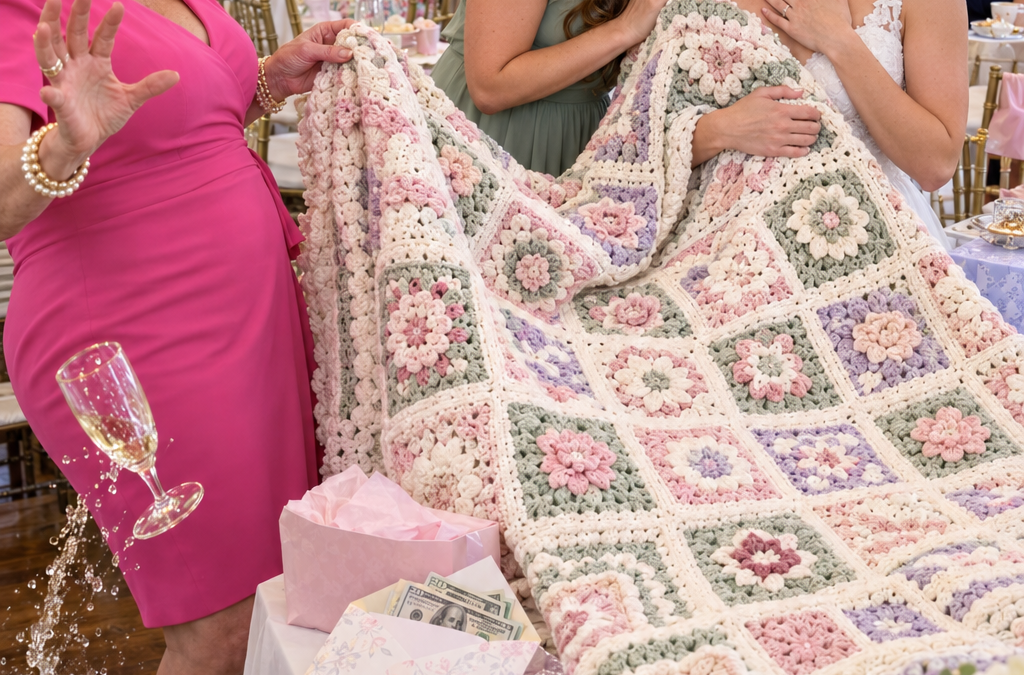
“Is that really it?” my mother asked, lifting one corner of the blanket between two fingers as though she had found it on the floor of a bus station. “Honey, I know shoeing horses doesn’t pay much, but they registered for a Dutch oven. It’s right there on the list.” Behind her, glossy registry boxes crowded the gift table at my twin brother Bennett’s co-ed bridal shower, and several relatives laughed because my mother, Marilyn Hale, had always known how to turn cruelty into something that sounded like concern.
My aunt June gave a nervous little chuckle from beside the punch bowl, and Bennett leaned against the kitchen doorway with a beer in his hand. “Mom’s right, Tess,” he said. “You could’ve just sent Claire money.” Then he looked at the floor, which was what Bennett had done our entire lives whenever our mother said something ugly that happened to benefit him.
“Nobody puts homemade yarn in a brand-new house,” Mom continued, making sure everyone could hear. “Doug and I can put cash in your name if money’s the problem. Nobody here will think less of you.” She let the blanket fall, and the corner landed against the table leg, the same corner containing the final square my grandmother Nora had made at eighty-six years old, almost completely blind, crocheting by touch and finishing it with the tiny red heart she worked into every blanket she had ever made.
I didn’t argue. I folded the blanket carefully, found that red heart with my thumb, crossed the room, and placed the whole thing into Claire Whitmore’s arms with the heart facing up. She smiled uncertainly until I leaned close and whispered, “Ask your father who’s been paying for blankets like this since 2019, because it was never me.”
Claire’s smile vanished. Someone stopped pouring lemonade halfway into a glass, Bennett froze with his beer near his mouth, and my mother—standing close enough to hear the last few words—dropped her champagne flute onto the hardwood floor. Crystal burst around her shoes, but nobody moved to pick it up.
“What did you just say to her?” Mom demanded.
“Ask Claire.”
“I’m asking you.”
“And I’m telling you to ask Claire.”
Mom took my elbow and steered me onto the front porch wearing a bright smile for the room. The instant the door closed, the smile disappeared. “Whatever little drama you’re starting, stop it now. Your brother gets married in three weeks.”
I looked at her and thought about the envelope inside my truck’s glove box, tucked beneath the registration and my hoof knife. It had arrived twenty-four days earlier from the Internal Revenue Service, informing me that Whitmore Lumber and Supply had reported paying me $41,580 the previous year for contract services. I had never worked for Whitmore Lumber, never invoiced them, and never received one dollar from them.
“I’m not starting anything,” I said. “I’m counting backward.”
She frowned because that sentence meant nothing to her. It meant something to me.
My name is Tessa Hale. I was twenty-nine then, and I made my living as a farrier around Warren and Simpson counties in Kentucky, which meant most mornings began before daylight with somebody else’s horse breathing steam over my shoulder. I drove a truck with more than two hundred thousand miles on it, rented a small cottage on a horse farm outside Bowling Green, crocheted between appointments because my grandmother taught me to keep my hands busy, and owed nobody money.
Forty minutes after I left the shower, Claire came down the driveway carrying the blanket against her chest. She climbed into my passenger seat without asking, stared through the windshield for a while, then said, “Tell me exactly what you meant.”
I opened the glove compartment and handed her the IRS notice. She read it twice, then looked at the tax identification number printed beside the company name. “That’s Dad’s company.”
“I know.”
“Why would his company have your Social Security number?”
“That’s the part I don’t know.”
Claire looked back at the house where my mother was laughing through the front window as if nothing had happened. “Dad has one of these blankets on his couch,” she said, touching my grandmother’s red heart. “He gives handmade throws to his best contractors every Christmas. He says a local woman makes them and it’s the best client gift money he spends all year.”
That January, I had attended Claire and Bennett’s engagement party at her father Graham Whitmore’s stone house outside town. I remembered sitting on the leather couch with a plate of shrimp and finding the same tiny red heart worked into a burgundy blanket behind me. At the time, I assumed Mom had bought one from Grandma Nora and given it to her boss.
I had been wrong about almost everything except the stitches.
“I don’t want you to believe me because I’m your future sister-in-law,” I told Claire. “I want you to look at the vendor records yourself.”
Her father’s company had recently promoted her to operations manager, preparing her to take over someday. Claire folded the IRS letter along its original creases and handed it back. “Seven o’clock Monday. Dad is always at the office by six-thirty.”
Monday morning, Graham Whitmore stood behind his desk smelling of cut pine and burnt coffee while I placed the notice in front of him. He was sixty-one, broad through the shoulders, with sawdust embedded permanently in the seams of his work boots, and I watched the color drain out of his face as he read.
He did not accuse me. He did not call my mother.
He picked up his desk phone and called his IT manager.
At 8:43, my own phone started vibrating against my hip while I was trimming a gelding outside Franklin. My mother had tried to log into Whitmore Lumber’s accounting system and discovered her access had been suspended pending review. She called fourteen times before lunch.
I answered none of them.
That afternoon Claire texted me: We found the vendor file. There’s a bank account attached, and I’m not putting the name in writing. Come over tonight.
Then another message appeared.
This didn’t start with your tax letter, Tess. The vendor has existed since 2019.
I stared at those words until the horse beside me stamped impatiently.
2019 was seven years earlier.
And I already knew exactly where I had spent most of that year.
At my grandmother’s house.
Part 2
Bennett and I were born four minutes apart, him first, and by kindergarten our mother had already decided which twin represented the family’s future. Bennett got travel baseball, piano lessons, new shoes before school pictures, and long talks at the kitchen table about scholarships and leadership. I was the quiet one, which in our house meant I supposedly required less, so most summers I was sent ninety minutes away to Grandma Nora’s little white house in Columbia, Kentucky.
Grandma never treated quietness as emptiness. She gave me a crochet hook when I was seven and taught me the granny square, then showed me how to work one tiny red heart into the final corner. “So whoever’s under it knows somebody meant it,” she said.
Mom hated handmade things, though I didn’t understand why. When I was twelve, I made her a purple-and-gray lap blanket for Christmas, and she opened it in front of relatives, smiled thinly, and said, “Well, that’s sweet.” A week later I found it inside a Goodwill donation bag in the garage, took it back without saying anything, and slept under it myself until college.
When I chose farrier school instead of the accounting program Mom had picked, she cried at dinner. “You’ll smell like a barn for the rest of your life,” she told me. “People will look at your hands.”
They did. My hands could calm a frightened thoroughbred, shape a hot shoe, turn the heel of a sock in poor light, and pay my own bills.
Last December Bennett called to announce that Claire Whitmore had accepted his proposal. My mother had run Graham Whitmore’s front office since 2018, after my father Doug lost the hardware store he had inherited from his father, and Mom had introduced Bennett to Claire at a company picnic. To Bennett, marrying into the Whitmore family felt like proof that Mom had been right about him all along.
I started their wedding blanket in June: two hundred squares in cream and forest green, card suits around the border because Bennett played poker every Thursday, and a white center panel threaded with tiny tomato vines because Claire grew tomatoes on her porch. I asked Grandma Nora to make the final square. It took her three days by touch.
On August nineteenth, the IRS envelope arrived.
After reading it three times, I logged into my account and pulled every income document filed under my Social Security number. Whitmore Lumber had reported $41,580 in payments to me for 2024 and another $43,120 for 2025, although the second year had not yet triggered a letter. I immediately filed the identity-theft affidavit, disputed both forms, copied everything, and kept quiet.
There was only one person at Whitmore Lumber who knew my Social Security number without asking me for it. She had filled out my school enrollment papers, health insurance forms, first job application, and college financial-aid paperwork. But before I accused my own mother, I needed proof strong enough that nobody could call it a family misunderstanding.
Claire’s kitchen provided the first real piece.
The vendor was called Hale Handcrafted. It had entered the system in November 2019 with a post-office box in Bowling Green, direct-deposit instructions, and invoices for “locally handmade premium client blankets.” Attached to the account was a tax form added when an outside bookkeeping firm took over compliance.
My full legal name was on the tax form.
So was my Social Security number.
The signature was not handwritten. Someone had typed /Tessa Hale/ into the signature box.
“Before the bookkeeping firm came in,” Claire said, “Mom handled most outside vendors.”
She meant my mother. Claire was not calling her Mom yet, but the wedding was close enough that the word had begun appearing accidentally.
“Whose name is on the bank account?”
“The business name only. Hale Handcrafted. Credit union account.”
“Can you find who registered the business?”
Claire nodded. “County records should have it.”
Bennett called her while we were sitting there. She let it ring twice before answering, and I could hear his voice from across the island asking what I had said at the shower. Claire told him to ask me.
When she hung up, she said, “He says you’ve always been jealous of him.”
“I’m not.”
She waited.
“I’ve just always been the person standing a little left of center in every family picture.”
Tuesday morning, I was holding a bay mare’s hind hoof between my knees when my parents’ Buick pulled beside my work truck. Mom emerged wearing her church cardigan and good flats. Dad remained near the hood with both hands in his pockets.
“So this is how you’re doing this?” Mom asked. “You take a piece of mail straight to my employer without talking to your own mother?”
“I’m working.”
“Arthur locked me out of the accounting system because some outside bookkeeper entered the wrong number on a form.”
“If it’s a clerical error, it should be easy to correct.”
“That isn’t the point.” She stepped closer and lowered her voice. “Your brother is getting married in three weeks. I have spent eight years building something in that office, and you’re willing to ruin his wedding because of a piece of paper?”
I set the mare’s hoof down gently.
Then Mom looked at the tools in my apron and said, “Was that what the blanket was about? Trying to prove your little hobby matters? I didn’t raise you to hand people rags and call it love.”
Dad looked at the ground.
That hurt more than I wanted it to.
“You didn’t raise me to put false information on tax forms either,” I said. “So maybe we let people whose job it is decide which one happened.”
Mom turned immediately and walked back to the car. Dad lingered long enough to open his mouth, close it, and follow her.
Wednesday afternoon, Claire sent a photograph of a county clerk’s filing.
Hale Handcrafted.
Registered November 2019.
Registrant: Marilyn J. Hale.
My mother’s real signature curved across the bottom in blue ink.
Under the picture Claire wrote: I added up every payment.
Before she could send the total, Bennett called.
He apologized awkwardly for laughing about the blanket, then asked why I was “blowing up the wedding” over something I had not completely proved. I asked him one question instead.
“Where is the sixty thousand dollars Mom and Dad are giving you toward the house?”
He hesitated.
“Grandma’s land.”
“What land?”
“Her back forty acres. Mom said Grandma sold it last year.”
Our grandmother owned half an acre, a one-bedroom house, a carport, and exactly enough grass to annoy her neighbor when nobody cut it.
“Bennett,” I said slowly, “Grandma Nora has never owned forty acres.”
The line went silent.
Then he hung up.
I called Claire back.
She read me the number she had calculated from seven years of invoices.
“Two hundred thirty-eight thousand seven hundred dollars.”
I stopped breathing for a second.
“How many blankets?”
“Six hundred twenty.”
That number was impossible.
No single person made six hundred twenty full-size crocheted blankets in seven years while holding another job. Grandma Nora certainly had not done it at eighty-six and nearly blind.
Claire spoke softly. “Then what exactly has my father been buying?”
I looked at the red heart stitched into the blanket on her couch.
“I’m going to visit my grandmother.”
Part 3
Grandma Nora’s house had green shutters, one bedroom, a hummingbird feeder she could no longer see, and a refrigerator covered with things she refused to throw away. She recognized me before I spoke because, as she said when I walked in, “You smell like horse and gas-station donuts.” I kissed the top of her head, handed her a powdered donut, and sat on the footstool beside her recliner.
“Did the bride like our blanket?”
“The bride loved it.”
Her whole face brightened. “Good. Marilyn said the shower was beautiful.”
“What else did Mom say?”
“Nothing much. Said you were tired.”
Grandma reached for her coffee by memory, then added, “I ought to speed up on the Christmas blankets. The church goes through them.”
My hands stopped.
“What church?”
“Your mama’s church in Bowling Green. For shut-ins, poor families, shelters. She started taking them the fall before the virus, I think.”
“How many do you make?”
“Ten or eleven a year now. Used to be more.”
She pointed me toward a green spiral notebook on her bookshelf. Grandma had recorded every blanket she made since my grandfather died—date, colors, recipient—and I turned the pages slowly until October 2019 began repeating the same destination.
Marilyn’s church.
Nine one year.
Ten the next.
Eleven.
Eleven.
Twelve.
Seventy-four total.
“Found them?” Grandma asked.
“Yes.”
“I’d like to make a hundred for your mama before I quit.”
I looked toward the refrigerator because I could not trust my face. There, beneath a peach-shaped magnet, was an old Polaroid I had seen all my life: a large Ford sedan buried in snow, rear windows fogged, blankets stacked almost to the roof inside. Someone had written WINTER 72 along the white border.
“Whose car was that?”
Grandma stopped chewing.
“Ours.”
“What happened?”
“That’s the winter we don’t talk about, honey.”
I let it go. Before leaving, I photographed every page of her notebook and put it back exactly where it belonged.
Seventy-four real blankets.
Whitmore Lumber had paid for six hundred twenty.
Claire discovered the remaining five hundred forty-six by visiting one of her father’s longtime contractor clients under the excuse of dropping off a fruit basket. The blanket in the contractor’s breakroom was not crocheted. It was a cheap navy fleece throw, the kind wholesalers sold by the case, with the manufacturer’s tag cut away.
Tucked in a desk drawer was the original gift card.
HANDMADE WITH LOVE BY HALE HANDCRAFTED.
MERRY CHRISTMAS FROM WHITMORE LUMBER.
Claire visited two more clients and found the same thing. The ordinary customers received nineteen-dollar fleece blankets invoiced at $385 each, while roughly ten top clients each year got Grandma Nora’s real work, which made the lie convincing whenever Graham Whitmore saw one.
The next evening Graham asked me to meet him after closing. Grandma’s burgundy-and-cream blanket lay on his desk.
“In 2019,” he said, “your mother told me you crocheted professionally on the side. She said you were struggling financially but too proud to accept help, so if I wanted locally made gifts, I should buy them through her and never mention the arrangement to you.”
He looked sick.
“I paid more than market value on purpose, Tessa. I thought I was helping you build something.”
“I never received a dollar.”
“And your grandmother?”
“She thinks she donated seventy-four blankets to a church.”
Graham closed his eyes.
When he opened them, he said, “My insurance company has to be informed. This amount probably has to go to law enforcement.”
“Then tell them.”
He searched my face.
“She’s your mother.”
“I know exactly who she is.”
I asked him not to tell Mom about the fleece blankets or Grandma’s notebook yet. If she believed the investigation involved only the tax form, I wanted to see what explanation she created.
Within two days, she began creating one.
Someone from her Sunday-school class forwarded me a group message Mom had sent: Please pray for our daughter Tessa. She is under terrible financial and emotional strain and has made some confused accusations against her family. We are trying to get her help.
The woman who forwarded it added: I don’t believe her. I’ve watched you work since you were seventeen.
The next evening, my landlady Mae Sutton walked down from the main farmhouse carrying zucchini bread. Mae was seventy-four, sharp-eyed, and had rented me my cottage for four years.
“Your mother called me,” she said.
“What did she want?”
“She said you were in trouble with the IRS and might be behind on rent. Offered to pay anything you owed ‘in your name’ so you wouldn’t be embarrassed.”
My stomach tightened.
“Then she asked me to mail her a copy of your lease. Said she might need it to help straighten out your paperwork.”
“What did you tell her?”
“That you’ve never missed rent and your lease is none of her business.”
I asked Mae to write down the date, time, and exact request while she still remembered it. The next morning she gave me a signed statement on yellow legal paper.
I put it into a blue folder with the IRS documents, Grandma’s notebook photographs, Claire’s vendor records, and the business registration.
Mom was building a story.
Tessa can’t afford things.
Tessa is financially unstable.
Tessa needs her mother to handle money for her.
At the bridal shower, I had thought she was humiliating me.
Now I understood she had been establishing a pattern.
Every time she offered to pay something “in my name,” she was making the fake business look more believable.
Thursday night at 9:12, Grandma Nora called.
She never called after eight.
When I answered, all I heard was ragged breathing.
“Grandma?”
“Tessa, honey.” Her voice cracked. “Marilyn called me. She says you went to the police over my blankets.”
“I haven’t gone to the police yet.”
“She says you’re telling people she stole money. She says investigators might come ask me questions, and if I talk about the church she could lose her job.”
A small, frightened pause.
“Did I do something wrong making them?”
“No.”
“I only wanted to keep somebody warm.”
“I know.”
“She said maybe I shouldn’t say anything until she gets this fixed.”
I was already pulling on my boots.
“Stay in your chair. I’m coming.”
When I arrived, the radio was off.
Grandma sat in her recliner with the navy square she had been making pulled apart all the way to the first chain. Loose yarn covered her lap and spilled across the floor.
“I couldn’t think what to do with my hands,” she said.
I sat on the carpet, found the loose end, and began winding it back into a ball.
After several minutes, her hand settled on the top of my head.
“Is your mama in trouble?”
“Mama made some grown-up choices.”
“She sounded scared.”
“I know.”
“She sounded like she did when she was little.”
I looked toward the refrigerator.
Toward the Polaroid.
Toward WINTER 72.
For the first time, I wondered whether the thing my mother feared most had begun long before I was born.
But whatever the reason, she had just frightened an eighty-six-year-old blind woman into silence.
And that was the moment I stopped waiting to see what my mother would do next.
Part 4
The following afternoon Mom texted me for the first time since the shower. Family dinner Saturday. Six o’clock. Just the four of us. I made your favorite. We can work this out like adults. A second message appeared ten seconds later: Bring your checkbook. I want to help with the tax bill.
My parents’ brick house sat on a neat cul-de-sac with a seasonal wreath on the door. That Saturday the wreath said GRATEFUL in wooden letters, and my mother greeted me with a hug smelling of perfume and chicken stock. The dining table was set with the good china, and seven crystal flutes lined the sideboard where there used to be eight.
Dad barely spoke. Bennett arrived carrying rolls and avoided my eyes. Mom served chicken and dumplings from Grandma Nora’s recipe and talked brightly about weather, eggs, neighbors, and—strangest of all—my horses.
After dinner she returned from the kitchen with a pie and a cream-colored folder.
“I’ve been unfair to you,” she said.
I waited.
“That IRS letter must have scared you. I understand.”
She opened the folder.
On top was a check for $15,200 payable to the United States Treasury. Beneath it was another check for $5,000 made out to me.
“That covers the taxes and penalties,” Mom said. “And the other is to help you get back on your feet. I meant what I said at the shower.”
Under the checks lay a typed statement.
I, Tessa Hale, confirm that from 2019 through 2025 I operated a craft business known as Hale Handcrafted and supplied handmade blankets to Whitmore Lumber and Supply. Because my work schedule kept me busy, my mother, Marilyn Hale, assisted with invoicing and administrative duties. All payments were made to me.
At the bottom was a blank signature line.
In Mom’s handwriting along the margin were six words she had forgotten to erase.
Say Grandma helped with big orders.
I read them three times.
“Graham’s reasonable,” Mom said. “You sign this, he gives it to the insurance people, and the review closes. Bennett gets married. Nobody gets hurt.”
“Grandma gets hurt.”
“Mama would do anything for this family.”
I looked at Bennett. He was cutting his pie into tiny pieces without eating.
I looked at Dad.
He studied the window.
“What happens if I don’t sign?”
Mom folded her hands on the tablecloth.
“Then you become the girl who lied to the IRS and tried to blame her mother when she got caught.”
She said it gently.
“That’s your Social Security number on the form, honey. Your name on the vendor paperwork. Your craft. Your blankets. Think about how this looks.”
There it was.
She had designed the trap both ways.
I folded the statement along its existing creases.
“Leave it with me. I’ll take it to Graham Monday morning.”
Relief transformed her body. Her shoulders loosened, her hands relaxed, and for the first time in years she gave me a smile that looked genuinely maternal.
“Oh, Tess. Thank you.”
She poured herself wine and lifted the glass.
“To family.”
I placed the unsigned statement inside my jacket.
Later, passing the pantry, I heard Mom speaking rapidly on the phone.
“Tonight, Bennett. Move all of it. Cash if you have to. No, you don’t tell Claire. You put it somewhere safe until this passes because I’m your mother and I’m the one who paid for it.”
I kept walking.
At home I created an online identity-theft report with Bowling Green police and received a case number. I wrote it on an index card and clipped it to my blue folder.
Sunday afternoon Grandma called sounding cheerful.
“Your mama drove down after church,” she said. “Brought me pound cake and apologized for upsetting me.”
My stomach tightened.
“She had me sign a form for the church’s taxes. Something saying how many blankets I made.”
“How many?”
“Your mama filled that part in. Said the church had exact records.”
“Did she leave you a copy?”
“No, honey. I can’t read it anyway.”
I stood with both hands against my workbench until the evening light disappeared.
At seven Monday morning, I sat in Whitmore Lumber’s conference room across from Evelyn Cross, the commercial-crime investigator assigned by Graham’s insurance company. She was around fifty, gray-haired, direct, with a digital recorder placed in the center of the table.
I gave her the IRS notice.
My identity-theft affidavit.
The police report number.
Mae Sutton’s statement about my mother requesting my lease.
Photos of Grandma’s notebook showing seventy-four blankets.
Claire supplied the business registration signed by Marilyn Hale, the vendor records, tax form, bank details, invoices, and photographs of the cheap fleece throws.
Then I unfolded Mom’s statement.
“My mother gave me this Saturday and asked me to sign it.”
Evelyn read the typed paragraphs, then stopped at the handwritten note.
“Who is Grandma?”
“My grandmother Nora Bell. Eighty-six. Legally blind.”
I told her about Sunday’s visit.
“My mother read Grandma a document and had her sign it. Grandma believes it says she made blankets for a church. My mother filled in the number.”
Graham covered his face.
Evelyn took off her glasses.
“Ms. Hale, if your mother brings me a statement signed by a legally blind elderly woman claiming she produced hundreds of blankets, after you’ve already told me this, it will not protect your mother.”
“I know.”
“It may make the situation significantly worse.”
“I know.”
“Then why are you warning me?”
“Because Grandma didn’t choose any of this.”
Mom’s interview was scheduled for ten Tuesday morning.
She arrived in pearls carrying a white leather portfolio.
I was not inside.
Claire later told me exactly what happened.
Mom sat down smiling and produced fresh invoices, payment summaries, and a signed statement from Grandma Nora declaring that she had personally made and delivered six hundred twenty handmade blankets to Hale Handcrafted between 2019 and 2025.
“My daughter has already confirmed the arrangement,” Mom said. “She was embarrassed by the tax confusion, but we’re correcting it.”
Evelyn listened without interruption.
Then she turned her laptop around.
On the screen was a photograph of Grandma’s green notebook.
Seventy-four entries.
“Mrs. Hale,” Evelyn said, “your mother kept records.”
Mom stared.
“Would you like to explain the other five hundred forty-six blankets?”
According to Claire, my mother said nothing for nearly a minute.
Outside, a forklift backed through the lumberyard, its warning signal beeping through the conference-room glass.
Finally Mom asked, “Do I need an attorney?”
Evelyn answered, “I think that would be wise.”
At 11:40, Mom walked across the customer lot carrying the white portfolio against her chest and spotted me sitting in my truck.
She came to my window.
“You gave her the letter.”
“I said I’d take it to Graham.”
“You knew what I meant.”
“Yes.”
Her eyes hardened.
“Bennett closes on his house Friday. If anything happens to that closing, it will be because of you.”
She walked away.
That night she called Graham Whitmore at home and left a rambling voicemail accusing me of inventing everything because I had always been jealous of Bennett.
But in the middle of the message she said something else.
Something neither Claire nor I understood.
“Nobody is going to see me like that again,” Mom whispered.
And suddenly I remembered the frozen Ford in Grandma’s Polaroid.
Part 5
Before ending my meeting with Evelyn, I had mentioned one more thing: the sixty-thousand-dollar house gift Mom announced at the bridal shower and the conversation I overheard through the pantry door. Telling an investigator my twin brother’s name felt like cutting into my own hand, but Claire was preparing to sign mortgage papers, and I refused to watch another person become collateral damage simply because silence was easier.
Bennett showed up at my cottage Wednesday night.
“Mom says you’re trying to send her to prison.”
“I don’t decide that.”
“She says you’ve hated me since we were born.”
“Do you believe her?”
He kicked the fence post.
I stepped down from the porch.
“Where’s the sixty thousand?”
His head snapped up.
“I heard the phone call Saturday.”
“It’s mine.”
“Where did it come from?”
“Grandma’s land.”
“She has no land.”
He looked away.
“The money came from Hale Handcrafted, didn’t it?”
His silence answered.
“Bennett, that account contains money taken from Claire’s father. You were going to buy Claire a house using money stolen from her own family.”
His face collapsed.
“She told me Grandma sold property.”
“And you believed that?”
“I asked once.”
“Once?”
“She got angry. I stopped asking.”
He rubbed both hands over his face.
“I wanted one thing to be easy. I wanted the Whitmores to look at me and think I belonged there.”
“Give the money back.”
His expression changed.
“It’s my house.”
“No. It isn’t.”
“I’m not losing my house because Mom screwed up.”
He drove away.
Thursday afternoon, financial-crimes Detective Raymond Mercer received the credit-union records through an emergency subpoena. They showed sixty thousand dollars transferred from Hale Handcrafted into Bennett’s personal savings account in August and withdrawn in cash Monday morning.
The detective called Bennett at work.
An hour later Claire called me from her car.
“He has it in a gym bag.”
“Where?”
“Toolbox in his truck.”
She gave a humorless laugh.
“Our closing is tomorrow at ten.”
Detective Mercer asked Bennett to bring the cash to the station at nine.
Friday morning, my brother walked into police headquarters with a black gym bag containing sixty thousand dollars.
At ten, Claire sat alone inside the title company lobby.
At ten twenty, she texted me.
There’s no house.
Then:
I brought the blanket with me. I don’t know why.
I was shoeing a quarter horse and could not answer until I finished the hoof.
That evening Dad came to my cottage for the first time since I moved there four years earlier. He stood beside the arena fence under the floodlights and handed me a worn envelope.
Inside was a bank notice dated September 2019.
SQUIRE HARDWARE.
DEFAULT.
NINETY DAYS TO CURE.
The family home pledged as collateral.
“I lost your grandfather’s store,” Dad said.
I looked at him.
“Two months after this notice, Mom registered Hale Handcrafted.”
He nodded.
“I was going to lose the house too. Your mother said she’d found extra work and handled it.”
“Did you ask what she was doing?”
“No.”
“You signed tax returns.”
“I signed where she pointed.”
That answer angered me more than a lie would have.
Dad stared into the dark pasture.
“If I asked, I’d have had to do something about the answer. I’d already failed everyone once.”
“Give this notice to Detective Mercer.”
He took the envelope back.
“I’m not asking you to forgive me.”
“Good.”
He flinched.
I regretted the cruelty but not the truth.
The next afternoon Bennett called from the wedding venue, a renovated dairy barn outside Alvaton.
“Can you come?”
He sat on his tailgate holding the engagement ring.
Claire’s car was gone.
“She ended it,” he said.
I sat beside him.
“She said she still loves me. That’s the worst part. She said she can’t marry someone if she doesn’t know whether he’ll tell her the truth before a detective does.”
He turned the ring box over.
“I couldn’t promise her I would’ve told her about the cash.”
There was nothing I could say.
“Fourteen thousand dollars,” he whispered. “Mom bought it. Said it came from Grandma’s land too.”
He opened the box. The diamond flashed.
“Claire wants me to give it to the detective.”
“You should.”
He leaned against my shoulder.
When we were children, we used to do that instead of hugging.
“You could’ve warned me before the shower.”
“You would’ve warned Mom.”
After a long silence, he nodded.
“Yeah.”
The wedding was canceled.
Monday, Whitmore Lumber fired Mom. Graham filed an insurance claim for $238,700, and his attorney obtained an order preventing my parents from selling or borrowing against their house while the investigation continued.
That same afternoon I was sitting on Grandma Nora’s carport threading needles when Mom’s Buick stopped along the road.
She did not pull into the driveway.
She sat behind the wheel for twenty minutes.
Finally I walked down.
Mom rolled the window halfway.
“I wasn’t coming inside.”
“I know.”
“I don’t know what I’d say.”
She looked older without makeup.
“I only meant to do it once.”
I waited.
“The bank was taking the house. Your father could barely get out of bed. Graham Whitmore wanted local handmade Christmas gifts, and I knew Mama made blankets for free.”
Her voice shook.
“I thought I’d use the money and replace it by spring.”
“But spring came.”
“Yes.”
“And then another Christmas.”
“Yes.”
For one second, I saw something other than manipulation in her face.
Fear.
Real fear.
Then she reached for her phone.
“What are you doing?”
“Bennett should still get some of that wedding money refunded. Maybe the venue deposit. I need to know what’s left.”
The moment passed.
Even after everything, she was still reaching for someone else’s money to solve the damage she had created.
She drove away while calling my brother.
When I returned to the carport, Grandma stood inside the screen door.
“That Marilyn’s engine?”
“Yes.”
“She didn’t come in?”
“No.”
Grandma nodded.
“She called me Friday night.”
“What did she want?”
“She asked me something.”
“What?”
“I told her I had to pray on it.”
Wednesday morning Dad needed a ride to the police station to give a recorded statement. I drove him and waited in the lobby.
Twenty minutes later Mom emerged from an interior hallway beside a lawyer.
She saw me and sat down in the chair next to mine.
“They want a plea,” she said.
I stared at a lost-dog flyer.
“Theft by deception. My lawyer thinks if I show restitution, maybe I avoid prison.”
I said nothing.
“The house is frozen. Your father has Social Security. Where am I supposed to find two hundred thousand dollars?”
“I don’t know.”
“You could fix this.”
“No.”
“You could tell them you knew about the business.”
“That would be a lie.”
“That would be mercy.”
Then her voice sharpened.
“You’ve had an easy life, Tessa. You’ve never slept cold. You’ve never been hungry. You never sat in the back of a car in winter wondering whether you’d wake up.”
I turned toward her.
The Polaroid.
Winter 72.
Mom continued before I could ask.
“Everything I did was so you and Bennett would never know what that felt like.”
“Who did you hurt?” I asked quietly.
She gave a small, bitter laugh. “Exactly. Graham is insured.”
“No. I’m answering your question.”
She stopped.
“You hurt Grandma. She thought she was warming poor people for seven years. You made her sign a lie because you knew she couldn’t read it.”
Mom looked away.
“And you hurt me. You stood in front of a room and mocked me for being poor while you were stealing money using my name.”
Her face became expressionless.
“I hope you never learn what desperation can make a person do.”
She stood and left.
An hour later Grandma called.
“Everybody at my house Saturday at four,” she said. “You, Bennett, your parents.”
“Saturday was supposed to be the wedding.”
“I know what day it is.”
Then she added, “Bring Graham Whitmore. And bring that wedding blanket.”
“Why?”
“I have something to give him.”
Part 6
Two days before Grandma’s meeting, another IRS envelope arrived. They had accepted my identity-theft affidavit and removed the false income from my account. I owed nothing, and because someone had used my Social Security number, I had been enrolled in an identity-protection program requiring a new PIN every tax year.
I read that page three times.
At twenty-nine years old, my own name finally had a lock my mother did not possess the key to.
That evening I called Aunt June, because Mom had been staying in her guest room since Dad gave his statement.
“She’s calmer,” June told me. “Says your grandma is going to fix everything.”
A cold feeling moved through me.
“Ask Mom to bring my fireproof box Saturday.”
“What box?”
“The gray one in her closet. Birth certificate. Social Security card. Medical records.”
June disappeared for a few minutes.
When she returned, her voice was cautious.
“She says yes. She also says after Saturday you’ll understand everything she did was for this family.”
I barely slept.
Friday evening I visited Claire to collect the wedding blanket.
She had spread it across her bed.
“I’ve been sleeping under it,” she admitted.
“That’s what it’s for.”
She traced the center vine.
“These are tomatoes.”
“Eleven. One for every summer you’ve grown them.”
Her eyes filled.
“Bennett told you that?”
“Yes.”
We folded the blanket together with Grandma’s red heart on top.
The next day, October tenth, was exactly the kind of blue Kentucky fall afternoon people choose wedding dates for. Instead of standing in a renovated barn wearing a bridesmaid dress, I arrived at Grandma Nora’s house carrying the blanket and my blue evidence folder.
My parents were already there.
So was Bennett.
Mom wore a new navy dress and stood with one hand resting on Grandma’s recliner like they were posing for a family portrait. Dad sat on a kitchen chair, shoulders bent. Bennett stood by the door.
“Come here and let me smell you,” Grandma said.
I bent down.
“Horse,” she announced.
“Freshly washed horse.”
She smiled.
Mom picked up my fireproof box and handed it over.
“Everything is there.”
I opened my folder, took out the IRS letter and PIN notice, and laid them on the coffee table facing her.
“My account has been corrected. From now on my documents stay with me, and nobody uses my name without asking me.”
Mom’s chin lifted.
“Fine. You’ve made your point.”
Then her voice softened toward Grandma.
“Mama, are you ready?”
That was when I realized Mom believed Grandma had agreed to rescue her.
Two car doors shut outside.
Graham Whitmore entered with Claire.
Graham removed his hat and bent toward Grandma.
“Mrs. Bell, I’m Graham Whitmore.”
Grandma reached up and touched his face, tracing his jaw with her fingertips the way she did with people she wanted to picture.
“You’re a big fellow.”
“Yes, ma’am.”
“Sit where I can hear you.”
He sat on the couch.
Grandma lifted a manila envelope from her lap.
“I want you to take this.”
Graham did not move.
“These are papers for my house. Realtor says it might bring around one hundred thirty thousand. It won’t cover everything Marilyn owes, but it’ll help.”
Dad covered his face.
Bennett whispered, “Grandma.”
Mom closed her eyes.
Then she exhaled.
Not grief.
Relief.
I saw it.
Graham saw it.
Grandma heard it.
Graham gently pushed the envelope back toward her lap.
“No, ma’am.”
Grandma frowned.
“My insurance carrier has already paid my business. Any restitution belongs between your daughter and the court.”
“I raised her in this house.”
“I understand.”
“If I can keep her out of jail—”
“No.”
His voice was respectful but firm.
“If I take one dollar from your house, I’m doing the same thing everyone has done for seven years. Using your hands to pay for somebody else’s choice.”
Grandma’s mouth trembled.
“You keep your house.”
She sat quietly.
Then she turned toward Mom.
“Marilyn.”
Mom’s face tightened.
“You didn’t say no.”
“Mama—”
“When I offered the house. You didn’t say, ‘Don’t do that.’”
“I was shocked.”
“I heard you breathe.”
Mom went pale.
“I can’t see, Marilyn. I can hear.”
Nobody moved.
Grandma pointed toward the old afghan folded on the couch.
“Hand me that.”
Graham placed it in her lap.
She ran her fingers over the faded yarn until they found the small pinkish heart in one corner.
“This one is older than Marilyn.”
Mom stared.
Grandma’s voice changed.
“The winter of 1972, Marilyn’s father lost his mining job. We were renting outside Russell County, and the landlord put us out December eighth.”
Nobody interrupted.
“It was snowing.”
She turned her face slightly toward the kitchen refrigerator.
“We lived six weeks inside that Ford Galaxy in the back of a Baptist church parking lot.”
Mom began crying silently.
“She was nine.”
Grandma continued.
“I put every blanket I owned over her at night. I sat in the front seat and crocheted more by touch because the church lights gave me enough glow to see my hands.”
Mom covered her mouth.
“She went to school from that car wearing an afghan because her coat was thin. Children found out and called her Rag Girl.”
The room felt smaller.
“One afternoon she came back furious, dragged every blanket out of the car, and threw them into the snow. She screamed that she’d rather freeze than wear another one.”
Grandma rubbed the faded afghan.
“I collected every blanket after dark and dried them on the church radiators.”
She paused.
“Church ladies later bought eight of my blankets at a bazaar. That money became the deposit on this house.”
I looked at Mom.
Suddenly a dozen things made sense.
Her hatred of yarn.
Her obsession with status.
Her horror of homemade gifts.
The hardware-store collapse.
The panic over losing the house.
Grandma understood it too.
“I know why she did it,” she told Graham. “She’s spent her whole life afraid of being back in that car.”
For one terrible second, sympathy moved through me.
Then Grandma turned to Mom.
“But fear explains why somebody reaches for a rope, Marilyn. It doesn’t explain why they keep pulling after everybody else starts drowning.”
Mom stared at her.
Grandma held out the afghan.
“Come here.”
Mom knelt beside the recliner.
Grandma laid the blanket across her knees.
“This was the top blanket on you in the car.”
Mom bent forward.
“I made you everything I could so you’d never be cold again.”
Her hand found Mom’s cheek.
“I did not know you were taking what I made and turning it into proof that you were better than where you came from.”
Mom’s shoulders shook.
Grandma withdrew her hand.
“This is the last blanket I’m giving you.”
Mom lifted her head.
“I’m not making you another one. Not for a church you name. Not for a customer. Not for anybody.”
“Please, Mama.”
“No.”
The word was gentle.
Final.
“That blanket was always yours. Keep it.”
Bennett unfolded his arms.
“You told me Grandma sold forty acres.”
Mom turned.
“I was trying to give you a start.”
“You looked me in the face and lied.”
“So you’d never be ashamed around the Whitmores.”
Bennett’s voice became strangely calm.
“I’m ashamed now.”
He walked outside.
Claire remained beside me.
Grandma asked to sit on the carport, so I helped her up. A few minutes later Claire brought the green-and-cream wedding blanket and spread it across both our laps.
Grandma found the stitches with her fingertips.
“Good tension,” she said. “No dropped loops.”
Claire swallowed.
“Mrs. Bell, this was the only wedding gift I received from that family that wasn’t bought with my father’s money.”
She touched the red heart.
“I’m keeping it.”
Graham stood at the edge of the porch holding his hat.
“Tessa, someday, if you ever want to sell one of your blankets, I’d be honored to buy it.”
I looked down.
“This one isn’t for sale.”
He nodded.
“It already belongs to somebody.”
Grandma pressed my hand twice beneath the blanket.
Inside the house, my mother was still kneeling with the old afghan across her knees.
And for the first time in my life, nobody went inside to comfort her.
Part 7
Mom turned herself in two days later.
Her lawyer had arranged it with Detective Mercer. She was charged with felony theft by deception, fingerprinted, photographed, and released pending court because she had no prior criminal record.
Aunt June drove her.
June told me Mom carried Grandma’s old afghan into the courthouse folded in a square on her lap. When a deputy said it could not go through booking with her, she handed it to June and said, “Don’t put it in a plastic bag.”
I did not visit.
The investigation expanded quickly once the credit-union records were examined.
The first transfers from Hale Handcrafted had gone toward delinquent mortgage payments in late 2019 and early 2020, confirming Dad’s story that the fraud began as an attempt to save the house. But after the immediate crisis ended, the payments continued.
There were vacations.
Furniture.
Bennett’s truck down payment.
A country-club membership Mom insisted was “for networking.”
The engagement ring.
The wedding deposits.
The sixty-thousand-dollar transfer.
Fear may have started the machine.
Pride kept feeding it.
Dad’s role was murkier.
Investigators found no evidence that he created invoices or accessed the business account, but he had benefited from the money and signed joint tax returns without asking questions. He gave prosecutors the old bank default notice, turned over financial records, and agreed to cooperate.
The IRS eventually assessed unpaid taxes on the hidden income.
Dad arranged a monthly payment plan.
He never asked me for help.
One Sunday he came to the farm while I was shoeing a nervous mare and stood nearby without speaking.
“Want to hold her?” I asked.
He looked surprised.
“You trust me?”
“With the horse, yes.”
That was the closest thing to forgiveness I could offer.
He held the lead rope correctly after I showed him once.
Bennett moved into a cheap apartment after the wedding collapsed. The sixty thousand went back through the investigation, and Claire surrendered the engagement ring because it had been bought with proceeds from the fake business.
Bennett voluntarily agreed to repay several other wedding expenses prosecutors could trace to the account.
Nobody ordered him to.
That mattered.
But not enough to repair what happened with Claire.
She told him she needed distance, and for once he listened.
He took a roofing job in Louisville that winter.
On our thirtieth birthday he texted at 6:04 a.m., the minute he was born.
Happy birthday to us.
I answered:
Still four minutes older.
He sent me a picture of a horse he apparently thought looked majestic.
It was the ugliest horse I had ever seen.
I saved it.
Mom’s attorney spent months negotiating a plea. The insurance carrier had reimbursed Graham, so restitution was owed primarily to the carrier and Graham’s deductible, while the criminal case focused on the deliberate deception, identity misuse, and fabricated records.
The worst evidence was not the original fraud.
It was what Mom did after being caught.
She attempted to make me sign a false confession.
She pressured Grandma into signing a false production statement.
She contacted my landlady seeking documents.
She moved money to Bennett.
She accused me of creating the fake tax form only after investigators confronted her.
Each decision had been an opportunity to stop.
She kept choosing another lie.
That was why the final consequences felt different from revenge.
I did not destroy my mother.
She kept extending the road until she reached the end herself.
In January she pleaded guilty to one felony count of theft by deception under an agreement requiring full financial disclosure and restitution. The sentencing hearing was held in March.
Graham spoke first.
He did not sound angry.
“I thought I was helping a young local craftswoman,” he told the judge. “The money matters, but the harder part is discovering the story I believed about where it went was invented.”
Then the judge asked whether I wanted to speak.
I had written my statement on an index card.
“My mother used my name and my grandmother’s hands to take money that did not belong to her,” I said. “I want the debt to remain real.”
Mom sat beside her lawyer.
“I’m not asking this court for revenge, and I’m not asking for forgiveness on her behalf. I’m asking that nobody else in this family be required to sacrifice a home, a future, a marriage, or a good name to make her choices disappear.”
I looked toward Grandma, who was not there because court tired her easily.
“My grandmother offered to sell the house she bought after surviving homelessness as a child’s mother because she thought that was love. It wasn’t her debt.”
The judge sentenced Mom to five years of probation with strict restitution requirements and a permanent felony conviction. She was prohibited from holding positions involving employer funds and required to report regularly to a probation officer.
When asked whether she wished to speak, Mom stood.
“I’m sorry,” she said to the judge.
Then she half-turned toward me.
For two seconds our eyes met.
She did not say it again.
I did not need her to.
Outside the courtroom, relatives waited as if they expected a final scene.
There was none.
No embrace.
No promise that time would heal everything.
I walked to my truck.
Dad followed several minutes later but did not get in.
“Tess.”
I turned.
“She asks about you.”
“I’m sure she does.”
“She says maybe someday.”
I opened my door.
“Maybe.”
He nodded.
That was not a promise.
The house on the cul-de-sac sold in February after legal restrictions were resolved. Once the mortgage and related debts were paid, the remaining equity went toward restitution.
The GRATEFUL wreath was still hanging on the door when the real-estate photographs went online.
I stared at that picture longer than I should have.
Mom moved permanently into Aunt June’s spare bedroom.
She found overnight work stocking shelves where she was not responsible for cash or bookkeeping.
June said Grandma’s afghan stayed folded at the foot of Mom’s bed and that Mom refused to let anyone wash it.
I never asked why.
Some things stop belonging to you once you survive them.
Spring arrived slowly.
Graham began driving to Columbia twice a month to visit Grandma Nora.
They talked about timber prices, rain, neighbors, and the price of tomatoes.
They never discussed the fraud unless Grandma brought it up.
One Saturday he arrived with a cardboard box so enormous that both of us had to carry it inside.
Yarn.
Every color imaginable.
Grandma ran her hands over the skeins like someone reading Braille.
“Well,” she said, “I suppose we’d better make something.”
And that was how the next part began.
Part 8
Grandma tore up the real-estate papers herself.
A week after the family meeting, she called the realtor who had helped prepare them, thanked her, then sat at the kitchen table with the documents between her hands. Because her grip was weak, she tore each sheet slowly down the middle and then across again.
“Best thing I’ve done all month,” she announced.
She kept the house.
The following Tuesday she asked me to drive her to the Adair County Public Library. She had decided she wanted to teach crochet.
“Children?” I asked.
“Who else has enough patience to make mistakes properly?”
The librarian gave her the community room on Tuesday afternoons.
Nine kids came the first week.
Eight girls and one boy who claimed he was only waiting for his sister, then spent two hours making the best square in the room.
Grandma could not see their stitches.
She checked them by touch.
I threaded needles, untangled yarn, corrected counting mistakes, and answered endless questions about whether horses slept standing up.
At the end of every class Grandma taught the red heart.
“One,” she told them, pressing a child’s fingers against the yarn. “Small enough nobody notices unless they’re looking.”
Her green notebook remained on the third shelf at home.
We started a new page.
No more Marilyn’s church.
Every finished blanket went directly to a women’s shelter in Bowling Green.
I delivered them myself.
The first time, Grandma insisted on riding along.
A shelter employee accepted the blanket and asked whether she could send a thank-you letter.
Grandma waved her hand.
“Just put it on somebody cold.”
As we drove home, she sat quietly with both hands on her cane.
Then she said, “That feels different.”
“Different how?”
“Like the blanket went where I sent it.”
I understood exactly what she meant.
Claire took over more responsibility at Whitmore Lumber. She and Bennett spoke occasionally, but she never discussed their relationship with me and I never asked.
The wedding blanket stayed on her bed.
One snowy evening she sent me a photograph of it spread across the comforter with the red heart near the pillow.
Her message read:
Still the only real thing.
I stared at that sentence for a long time.
I almost corrected her.
The blanket was not the only real thing.
Her father’s kindness had been real.
Grandma’s labor had been real.
My father’s shame was real.
Bennett’s regret was real.
Even Mom’s childhood fear had been real.
That was the hardest lesson in all of it.
Real pain does not excuse what someone builds on top of it.
Mom had spent decades believing that if she could collect enough symbols of security—good house, respectable son, wealthy in-laws, polished job, expensive wedding—she could permanently outrun the nine-year-old girl wrapped in smoke-smelling blankets inside a freezing car.
Then Dad lost the store.
The bank threatened the house.
That frightened child returned.
Mom reached for Grandma’s blankets because they had once been the only thing between her and the cold.
And then, after the house was saved, she kept stealing.
Not because she was starving.
Because the money gave her the feeling that nobody could look down on her again.
She used my name because she thought mine was expendable.
She used Grandma’s work because she thought love meant permanent access.
She used Bennett’s ambition because it mirrored her own.
She used Dad’s shame because she knew he would rather remain silent than risk discovering another failure.
Every one of us helped the machine in some way, even if my part was only refusing to ask questions earlier.
What changed things was not a dramatic speech.
It was paperwork.
A tax notice.
A notebook.
A bank record.
A cheap fleece throw with its tag cut away.
A handwritten margin note.
A sixty-thousand-dollar gym bag.
A blind woman’s memory.
Small things become heavy when enough of them point the same direction.
Dad began coming to the farm most Sundays.
He brought his own coffee.
Sometimes he held horses.
Sometimes he sat on an overturned bucket and watched.
One afternoon he said, “Your mother wants me to tell you she’s sorry.”
I kept rasping the hoof in front of me.
“She knows where I live.”
Dad nodded.
“She’s afraid you won’t answer.”
“That’s possible.”
He looked toward the barn door.
“I think she’s beginning to understand that.”
Months passed.
She wrote me one letter.
I opened it because ignoring a letter seemed too similar to the kind of silence our family had used for years.
It contained no excuses about Graham Whitmore, no complaints about prosecutors, and no requests for money.
She wrote about the Ford Galaxy.
She told me she could still remember waking with frost inside the windows and hearing Grandma’s crochet hook moving in the front seat.
At the bottom she wrote:
I spent my whole life trying not to be the Rag Girl and became someone who treated handmade love like a rag.
I folded the letter.
I did not answer.
Understanding is not reconciliation.
An apology can be real and still arrive after the relationship it might have saved.
That does not make the apology worthless.
It simply means consequences have their own calendar.
Grandma turned eighty-seven in February.
We held her birthday at the library because the children insisted.
They decorated paper hearts and taped them to the walls.
Graham brought a cake.
Claire brought tomatoes she had canned the previous summer.
Dad brought folding chairs.
Bennett drove down from Louisville without telling anyone until his truck appeared outside.
He and Claire stood awkwardly near the coffee table for several minutes before she finally said, “Hi.”
“Hi.”
That was all.
I was glad nobody tried to turn it into more.
During cake, one of the children asked Grandma which blanket she liked best.
Grandma leaned back.
“The unfinished one.”
The little girl frowned.
“Why?”
“Because you can still choose what happens to it.”
I looked at my brother.
At Dad.
At Claire.
At the empty chair where my mother might once have sat.
Then I looked at Grandma’s hands.
Those hands had made blankets inside a frozen car in 1972.
They had made gifts for strangers.
They had been exploited by her own daughter.
They had signed a lie they could not see.
And now they moved slowly across a child’s crooked square, finding a dropped stitch by touch.
“Right here,” Grandma said.
The child groaned.
“Do I have to start over?”
“No.”
Grandma smiled.
“You count back until you find where it went wrong.”
I laughed.
She tilted her head toward me.
“What?”
“Nothing.”
I had heard those words my entire life.
Only now did I understand them.
You did not have to destroy the whole thing because one row was wrong.
But you also could not keep crocheting over the mistake and pretend the shape would fix itself.
You went back.
You found the bad stitch.
You corrected what could be corrected.
And if somebody refused to stop pulling the yarn apart, eventually you stopped handing them the blanket.
Today I still shoe horses.
My truck has finally crossed three hundred thousand miles and makes a noise every mechanic swears means something different.
I still crochet between appointments.
Grandma and I have delivered nineteen blankets to the shelter.
Every one is listed in the green notebook.
Every one has a red heart.
My mother and I still do not speak.
People occasionally tell me I will regret that if something happens to her.
Maybe I will.
But regret is not the same thing as obligation.
I spent too much of my life watching women in my family turn love into debt.
Grandma offered her house because she loved her daughter.
Mom stole under my name because she claimed she loved her family.
I nearly kept quiet because I loved my brother.
Love without boundaries had already cost enough.
So I let my mother live with the consequences that belonged to her.
I let my brother rebuild without carrying him.
I let my father show up without pretending his silence had been harmless.
I let Claire keep the blanket without pretending she owed Bennett another chance.
And I let Grandma make things that went exactly where she intended them to go.
Last Tuesday, one of the library children finished her first full blanket.
It was crooked.
One side was several inches longer than the other.
The border changed tension halfway through.
She held it up proudly.
Grandma ran both hands across it, checked the corners, and found the small red heart.
“Who’s this for?” she asked.
“My grandpa.”
“Does he get cold?”
“He says no, but he always steals Grandma’s.”
“Then he gets this one.”
The girl hugged the blanket.
Another child asked, “Mrs. Nora, what if somebody laughs at it?”
Grandma became very still.
Then she said, “A handmade thing contains time. Time is the one thing nobody can buy back.”
She reached for the child’s hand.
“If somebody laughs at what you made with love, don’t spend your whole life trying to convince them it has value.”
I looked down at my scarred hands.
Grandma continued.
“Give it to somebody who already knows.”
Outside the library windows, rain had started over Kentucky.
My next appointment was waiting twenty miles north, a chestnut mare who hated having her back feet touched.
I packed my tools, kissed Grandma’s cheek, and headed toward the door.
“Tessa,” she called.
I turned.
She held up the newest square she had finished by touch.
A tiny red heart sat in the corner.
“Don’t forget this one.”
I walked back and took it from her.
“I won’t.”
And I didn’t.
Because the most important thing my grandmother ever taught me was never really crochet.
It was knowing what was worth repairing.
And what you finally had to stop giving away.
THE END!