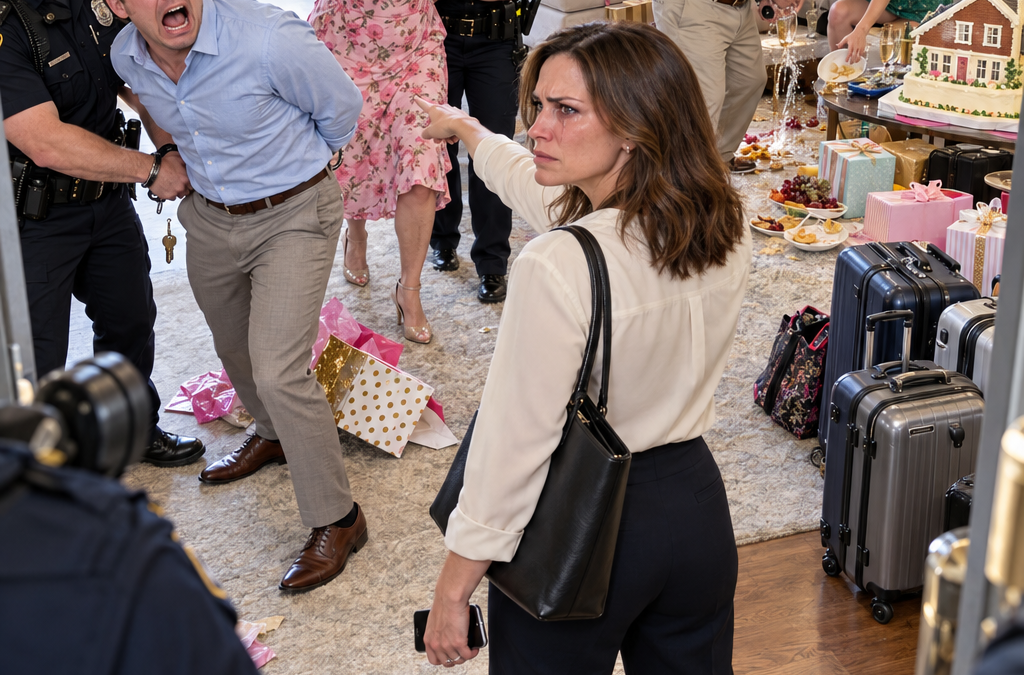
I Refused To Let My Brother Move Into My House. Then I Returned From Work To Find My Relatives Hosting His Housewarming Party In My Living Room. I Called The Police, And Every Single Person There Was Arrested. None Of Them Saw It Coming…
I came home expecting a quiet Friday night and found my family celebrating my younger brother’s “new house” inside the home I had bought with ten years of my own work. I did not scream, throw anyone out, or argue with my mother when she told me to stop being selfish. I walked back to my car and called the police. Three days later, while documenting the damage, I found a signed lease I had never seen before—and my signature was on it.
Part 1
My name is Claire Bennett, and I was thirty-two when my younger brother decided my front door was the only thing standing between him and the life he believed he deserved. I had bought my house in Worthington, Ohio, four years earlier after spending most of my twenties working as a project coordinator for a commercial construction company during the week and managing inventory for a home-improvement store on Saturdays. The house was not enormous or impressive by magazine standards: two stories, pale gray siding, three bedrooms, a narrow back deck, and an old maple tree whose roots had pushed one section of the driveway half an inch higher than the rest. But the first night I slept there, on a mattress still wrapped in plastic because I had not yet bought a bed frame, I stared at the ceiling and understood that nobody could take that room away from me because I had paid for every inch of it myself.
My brother, Ethan, was three years younger and had spent most of his adult life confusing charm with competence. He could walk into a backyard barbecue owing three people money and somehow leave with one of them offering him another loan. Our mother, Denise, called him “a late bloomer,” although by twenty-nine he had abandoned two trade programs, one landscaping business, a pressure-washing company, and an online sneaker resale operation that ended with boxes of unsold shoes stacked in her garage. Whenever I pointed out that adults eventually had to live with the results of their decisions, she would look at me as if I had failed some secret test of sisterhood. “You’ve always been stronger than Ethan,” she would say. “That means you can afford to be kinder.”
The trouble began after Ethan got engaged to Paige Lawson, a twenty-seven-year-old dental hygienist whose family lived outside Cincinnati. Paige was polite, organized, and clearly under the impression that Ethan’s life was more stable than it was. Two months before the incident, he called me and casually asked whether he and Paige could stay at my house “for maybe six weeks” while they saved money before the wedding. I told him no, because six weeks with Ethan had historically meant six months followed by a story about why leaving would be cruel. He laughed, called me dramatic, and changed the subject.
A week later, our mother tried. She came over with banana bread, sat at my kitchen table, and told me Paige’s lease was ending. “You have three bedrooms,” she said, glancing toward the staircase. “One person doesn’t need all this space.” I reminded her that one person had bought all that space, and I suggested Ethan use the money he was spending on a leased truck to rent an apartment. Her mouth tightened. “Everything with you has to be so transactional.” I stared at the loaf of banana bread between us and said, “Only when someone is asking for something that belongs to me.”
Ethan’s third attempt happened at our cousin Leah’s birthday cookout. He waited until enough relatives were nearby to make refusal uncomfortable, then announced that Paige and he only needed “a temporary landing spot” and asked whether I had reconsidered. I said I had not. Ethan’s smile disappeared, and he accused me of enjoying watching him struggle while I “sat on a whole house.” My aunt Carol murmured that family was supposed to help family, and my mother said nothing until I stood to leave; then she whispered, “You could have handled that more gently.” Before I reached my car, Ethan shouted from the patio, “Don’t worry, Claire. You don’t get to make every decision forever.”
I thought it was another tantrum. That assumption lasted until the following Friday, when I turned onto my street at six fifteen and saw cars lining both curbs. My uncle’s maroon SUV sat half on my grass. Paige’s white sedan was behind it, along with vehicles belonging to cousins, friends of Ethan’s, two people I recognized from my mother’s church, and a black pickup I had never seen before. Music reached me before I opened my car door.
My front door was standing open. Someone had removed my plain brown welcome mat and replaced it with one that said BLESS THIS HOME in looping black letters. Gold balloons were tied to the porch railing, and a banner stretched across my living-room window. When I stepped inside, I smelled grilled meat, perfume, beer, and one of my expensive candles burning somewhere upstairs. There were strangers holding paper plates in my hallway, children chasing each other up the stairs, and my aunt Carol posing for photographs beside my fireplace.
For several seconds, nobody seemed to notice me. Then my cousin Leah lowered her drink. “Claire?” she said.
The room changed slowly, face by face. Conversations stopped. My mother came through the dining room wearing a cream blouse and carrying a tray as if she were hosting. Behind her, taped to the wall above my fireplace, was a gold sign that read ETHAN & PAIGE—OUR FIRST HOME. I looked past her toward the kitchen and saw a white sheet cake on my island with CONGRATULATIONS, HOMEOWNERS written across the frosting.
“What is this?” I asked.
My mother put down the tray. “Before you get upset, Ethan was going to explain.”
“Explain what?”
Ethan appeared from the back deck holding a champagne flute. He wore a navy button-down shirt and the satisfied expression of someone waiting for applause. Paige stood several feet behind him, beautiful in a pale green dress, but the color had drained from her face the moment she saw me.
“You’re early,” Ethan said.
“I live here.”
Someone near the stairs gave a nervous laugh. Ethan rolled his eyes as if I had made an embarrassing joke. “We’re celebrating. Relax.”
I looked at the doorframe and finally noticed the splintered wood around the lock. Fresh gouges marked the jamb. There were tiny pieces of painted trim on the floor.
“You broke into my house.”
My mother stepped closer. “Claire, please don’t make a scene.”
That sentence did more to clarify the situation than anything Ethan could have said. My family had entered my home without permission, watched him force his way inside, hung decorations on my walls, eaten food in my kitchen, and somehow I was the person being warned about manners. I felt something inside me settle into a strange, almost clinical calm.
I took out my phone, photographed the broken frame, the banner, the cake, and Ethan standing beside my kitchen island. Then I turned around.
“Where are you going?” he called.
I did not answer. I walked outside, got into my car, drove two blocks away, and called the police.
When the dispatcher asked whether anyone inside was armed, I said I had no reason to believe so. When she asked whether I wanted officers to remove the people from my property, I said yes. I explained that my brother had previously asked to live there, that I had refused, that the door had visibly been forced, and that dozens of people were currently holding a housewarming party inside without my permission.
The first patrol car arrived nine minutes later. Four more followed after officers saw the size of the gathering. There was no dramatic storming of the house, no movie-style raid. Instead, officers entered carefully, shut off the music, separated people, asked who lived there, and began checking identification while I stood on the sidewalk answering questions.
The shouting started when Ethan realized they were not there to mediate a family disagreement.
“She’s my sister!” he yelled from the porch.
An officer answered, “That does not give you permission to force entry.”
My mother tried telling another officer there had been a misunderstanding. Aunt Carol insisted everybody had been invited by Ethan and should therefore be allowed to leave. Most of the guests eventually were, after officers documented their names and determined they had not participated in the entry or property damage. Ethan was arrested after my neighbor, Mr. Alvarez, showed officers doorbell footage from across the street of Ethan striking my doorframe with a pry bar while two men carried decorations from the black pickup.
One of those men had already disappeared.
My mother watched Ethan being placed in the back of the patrol car and turned toward me with a look I had never seen before—not grief, exactly, but fury mixed with fear. “You have no idea what you’ve done,” she said.
I looked at my broken door.
“No,” I said quietly. “I think Ethan made that decision this morning.”
It was after midnight before the last officer left. Paige had gone with her parents, my mother had refused to speak to me, and my living room looked like the aftermath of a wedding nobody wanted to remember. I slept at a hotel because the damaged lock would not secure properly.
Three days later, after a locksmith replaced the door hardware, I began sorting through everything they had left behind.
Under a stack of disposable plates on my kitchen island was a blue folder.
Inside were copies of utility-transfer forms, a change-of-address confirmation, and a six-page residential lease stating that Ethan Bennett had rented my entire house from me for twelve months.
The lease was dated six weeks earlier.
At the bottom of the final page was my name.
Below it was a signature that looked almost exactly like mine.
Part 2
I stared at the signature until the letters stopped looking like letters. Whoever had copied it had even reproduced the way the final stroke in Bennett curled slightly upward, a habit I had developed in college after signing my name thousands of times on work orders. The document listed Ethan as the tenant, me as the landlord, and a monthly rent so low it made no practical sense. Attached to it was an “occupancy verification” page bearing what appeared to be a notary seal.
I did not call Ethan. I did not call my mother. I put the papers into a plastic document sleeve, photographed every page, and emailed the images to myself before doing anything else. Then I called Officer Raymond, whose card I had been given the night of the party, and asked whether he could add suspected document fraud to the report.
His voice changed when I described what I had found.
“Do not write on those papers,” he said. “Do not confront anyone about them yet.”
That afternoon, I drove downtown to meet an attorney named Maya Chen, who had represented my employer in a contract dispute several years earlier. She was in her forties, small, direct, and so controlled that even silence sounded intentional when she used it. She read the fake lease twice, then examined photographs of my damaged door, walls, furniture, and the party decorations.
“Your brother may have done you a favor by leaving this behind,” she said.
I gave her a look.
“A terrible favor,” she corrected. “But evidence is evidence.”
Maya told me the party itself was emotionally outrageous but legally straightforward: forced entry, property damage, trespass, possibly theft depending on what was missing. The forged documents were different. If Ethan had used them anywhere outside my home—to obtain utilities, credit, insurance, financing, or another legal benefit—the problem could become much larger. She advised me to check my credit reports, property title, utility accounts, tax records, and any recent inquiries connected to my address.
By Tuesday, I knew the fake lease had not been created merely to fool relatives.
Someone had used it to transfer the natural-gas account into Ethan’s name two weeks before the party. The utility company had processed the request because he supplied the lease, my address, and enough personal information to satisfy their automated verification system. My electricity had not been transferred, but there had been an unsuccessful attempt. Even more disturbing, my credit report showed a soft inquiry from a mortgage brokerage I had never contacted.
Maya requested preservation of the records.
The broker’s name was Northline Residential Finance.
I searched it online and recognized the logo immediately.
It had been printed on the bottom of another sheet in the blue folder.
The next morning, Paige called me.
I almost ignored her, but something about the timing made me answer.
She sounded as though she had not slept. “Claire, I need to ask you something, and I need you not to yell at me.”
“I haven’t yelled at anyone yet.”
“I know.”
There was a long silence.
“Did you ever tell Ethan you were selling him the house?”
“No.”
“Did you ever agree to let him assume your mortgage?”
“No.”
Another silence.
Then she began crying.
Paige told me Ethan had claimed for months that I planned to move closer to downtown and had offered him my house at a “family price.” He told her the transfer was taking longer because of paperwork and taxes. He told her mother the same story, then showed Paige a copy of the lease as proof that he had already taken possession while the financing was being finalized.
“What financing?” I asked.
Paige hesitated.
Her father, Greg Lawson, had promised to contribute forty thousand dollars toward their first home if Ethan could demonstrate that he was financially prepared to purchase one. Greg had already transferred twenty thousand into a joint account after Ethan showed him what appeared to be loan-preapproval paperwork related to my address.
I sat very still at my desk.
“What happened to the money?”
“I don’t know.”
That answer scared me more than if she had named a stupid purchase.
Paige said the housewarming party had been Ethan’s idea but my mother had encouraged it. Denise told Paige that I had “mixed feelings” about giving up the house and might act strangely if I showed up. Ethan specifically chose Friday because he believed I would be working late.
“I thought you knew,” Paige whispered. “Your mom kept saying the family needed to make the transition feel real for you.”
“For me?”
“She said once everyone saw Ethan and me there as a couple, you’d stop resisting the idea.”
I closed my eyes.
That was not a misunderstanding. That was rehearsal.
When I told Maya what Paige had said, she asked whether my mother had ever possessed documents containing my Social Security number, tax information, or signature samples. The answer was unfortunately yes. Denise had kept old family tax returns, insurance records, college financial-aid forms, and copies of documents from the years when I still used her address.
Maya leaned back.
“This did not start Friday.”
We spent the next two weeks building a wall of facts. Northline Residential Finance eventually confirmed that an application had been opened using my address as the property Ethan claimed he intended to purchase. The file included the fake lease, a letter purportedly written by me confirming a planned family sale, and a photocopy of an older property-tax statement.
My signature appeared on the letter too.
So did my mother’s.
Not as a borrower.
As a witness.
I read the page in Maya’s office while traffic moved six floors below us.
Denise Bennett hereby confirms that she personally witnessed Claire Bennett agree to transfer the property to Ethan Bennett upon completion of financing.
Maya asked whether I needed a minute.
“No,” I said.
But my voice sounded different.
The part that hurt was not that Ethan had lied. Ethan had always treated truth as something flexible when he needed money.
It was that my mother had helped him manufacture a reality in which my consent did not matter.
Two days later, police obtained security footage from a convenience store near Ethan’s apartment showing him meeting the mortgage broker who had opened the file. The broker claimed Ethan presented himself as a legitimate buyer completing an informal family sale and denied knowing the documents were forged.
That question would be sorted out later.
Then Paige sent me screenshots.
One text from my mother read:
Claire has always needed pressure before she accepts what’s best for everyone.
Another said:
Once the party happens, she won’t embarrass the whole family by reversing course.
The final message had been sent the morning they broke into my house.
Make sure there are lots of pictures.
I read that sentence three times.
The party had not been a celebration after the theft.
The party had been part of the plan.
Part 3
For the first time in my life, I stopped trying to interpret my mother generously. I did not ask whether she had been manipulated by Ethan or whether she had convinced herself that she was preserving family harmony. Adults can lie to themselves in complicated ways, but they still know when they are forging another person’s name. Denise had crossed the line long before the police arrived; the party simply made the crossing visible.
Maya advised me not to engage directly with relatives because the criminal investigation was continuing and we were preparing a civil claim for the physical damage, stolen property, legal expenses, and costs associated with securing my identity and home. I followed that advice even when my phone became a parade of guilt. Aunt Carol left a voicemail telling me I was “destroying Ethan’s future over paperwork.” My cousin Leah texted that the family had made a mistake but that involving lawyers was “nuclear.”
I replied to nobody.
The silence made them angrier.
Within days, vague posts began appearing online about selfish people who valued property over blood. One cousin wrote that some women bought a house and suddenly thought they were better than everyone who had ever loved them. Ethan, released pending the criminal case, posted a long message claiming a “private family agreement” had been weaponized against him by someone who had always resented his happiness.
That post became useful evidence before lunch.
His lawyer apparently realized the same thing, because it disappeared a few hours later.
The deeper investigation moved faster once Paige agreed to cooperate. She handed over messages, emails, photographs, and access to the joint wedding-planning account she shared with Ethan. The missing twenty thousand dollars from her father had not gone toward a down payment. Almost eight thousand had been used to cover Ethan’s old business debts, several thousand had gone toward his truck lease and credit cards, and the remainder had been transferred into an account Paige had never seen.
When investigators traced that account, my mother’s name was on it.
Paige ended their engagement two days later.
She asked to meet me at a coffee shop in Dublin, and I agreed because by then she was less an antagonist than another person standing in the wreckage Ethan had created. She arrived without makeup, wearing jeans and an oversized sweatshirt, and placed the engagement ring inside a small velvet box on the table as though she needed physical proof that the relationship was over.
“I feel stupid,” she said.
“You were lied to.”
“So were you.”
“That doesn’t make you stupid either.”
She looked down at her coffee. “Your mom knew about the money.”
I already suspected it, but hearing the words still tightened something in my chest.
Paige explained that Denise had repeatedly told Ethan the house would “solve everything.” She had cosigned part of his earlier business debt, and collection notices had begun arriving at her condo. If Ethan could convince Paige’s father and a lender that he was acquiring my property at below market value, he believed he could borrow against the supposed equity after the transfer and use the money to clear multiple debts.
There was one obvious problem.
I had never agreed to transfer anything.
Their solution had apparently been pressure first, paperwork second, reality later.
“They thought once the whole family treated it like a done deal, you’d give up,” Paige said.
I almost laughed, but there was nothing funny left.
“They don’t know me very well.”
The next significant break came from the notary seal on the fake lease. The commission number belonged to a woman named Susan Marlowe, who had retired the previous year and reported her old seal missing during an office move. Her journal contained no meeting with me, Ethan, or Denise. Investigators could not immediately prove who physically placed the false seal on the papers, but the document was now impossible to defend as an innocent misunderstanding.
Maya filed the civil complaint against Ethan and Denise, limiting the claims to the people for whom we had actual evidence instead of trying to punish everyone who attended the party. We included the forced-entry damage, replacement doors and security equipment, professional cleaning, missing items, identity-protection expenses, lost work time, and other documented losses. She also preserved claims relating to the fraudulent documents pending the outcome of the criminal investigation.
“You could name more people,” she told me. “But more defendants doesn’t automatically mean a better case.”
“I don’t want revenge against guests who were stupid enough to believe Ethan,” I said. “I want responsibility from the people who planned it.”
Maya gave a small nod. “That distinction matters.”
My mother was served at her condo on a Wednesday morning.
At eleven fourteen, she called from a number I did not recognize.
I answered because I thought it might be a contractor.
“You sued me,” she said.
Her voice was thin with disbelief.
“You forged my name.”
“I was trying to keep this family from falling apart.”
“No. You were trying to keep Ethan from facing consequences.”
“He was drowning.”
“So you pushed my head underwater.”
She began crying then, but even her tears came wrapped in justification. She told me about Ethan’s debts, the collection calls, the money she had secretly covered, the fear that Paige would leave him, the humiliation of admitting to people at church that her son’s businesses had failed. She described every pressure placed on her without once acknowledging that none of them gave her the right to use my property.
Finally she said, “You don’t understand what I’ve sacrificed for both of you.”
Something in that sentence caught my attention.
“Both of us?”
She stopped speaking.
A week later, during document exchange, Maya received bank records from an old custodial account my father had established before he died when I was nineteen.
I had believed that account was exhausted by my first year of college.
It had not been.
The statements showed five withdrawals over eighteen months.
Every one had been authorized by my mother.
Every one had been transferred into accounts connected to Ethan.
The oldest withdrawal was thirteen years old.
Suddenly the forged lease was not the beginning of the story.
It was simply the first time I had caught them while they were still holding the pen.
Part 4
I remembered the afternoon my mother told me my college money was gone. I was twenty, standing in the laundry room of the apartment I shared with two other students, balancing my phone between my shoulder and ear while folding store uniforms. Denise had said investment losses and “unexpected family expenses” had reduced what my father left, and because I was already working, I should consider taking a semester off. I did not take the semester off; I added more hours and spent years believing adulthood had arrived early because life was unfair.
The bank records told a different story.
My father had left nearly equal amounts for Ethan and me. Denise had control of the accounts while we were young, but by the time she emptied mine, I was legally entitled to the money. One transfer paid off a vehicle Ethan had wrecked without adequate insurance. Another covered tuition for a technical program he quit after four months. The largest went toward the first business he eventually abandoned.
I sat across from Maya with thirteen years of resentment rearranging itself into something colder.
“She told me there was nothing left.”
Maya did not try to soften it. “There was.”
“And Ethan knew?”
“We don’t know yet.”
That became the question that bothered me most. Not because I hoped innocence would repair our relationship, but because I needed to understand how long my brother had been comfortable treating my resources as emergency supplies with his name already written on them.
During his deposition, we got the answer.
Ethan admitted he knew our mother had “moved money around” when we were younger, but claimed he did not know the account legally belonged to me. When Maya asked why he never questioned where thousands of dollars repeatedly came from, he became defensive. “Claire was always working,” he said. “She didn’t need as much help.”
I was watching remotely from Maya’s conference room when he said it.
There it was—the family philosophy in one sentence.
Because I could survive without being rescued, anything I had could be redirected toward the person who refused to learn how to survive.
Ethan’s attorney objected repeatedly when Maya asked about the fake lease and financing application, but documents are stubborn things. Emails showed that Ethan had told Northline the property was worth substantially more than my remaining mortgage balance and that his sister was “transferring equity as a gift.” A message from Denise told him to “keep Claire out of the technical stuff until everything is ready because she gets nervous about money.”
I did not get nervous about money.
I got careful about it.
That difference had apparently frustrated them for years.
Northline canceled the application and referred its file to its own legal department. Paige’s father demanded repayment of the funds Ethan had obtained through false representations. The creditors Denise had been trying to quiet learned about the investigation and stopped granting extensions.
Nothing Maya or I did created those problems.
Ethan and my mother had created them by building one lie on top of another until the entire structure depended on my signature staying forged and my mouth staying closed.
The criminal case also narrowed. Prosecutors were not interested in theatrical charges or arresting half my family. They focused on conduct they could prove: the forced entry and damage, attempted use of fraudulent documents, identity-related offenses under review, and the money obtained from Paige’s father. Denise faced scrutiny for her documented participation, though her attorney argued that Ethan had manipulated her and that she believed I would eventually consent.
That explanation might have been emotionally convenient.
The texts made it legally inconvenient.
Meanwhile, I repaired the house.
The front door and frame had to be replaced completely. The living-room wall had holes from decorations Ethan’s friends screwed into the plaster. A bedroom lamp was missing, one dining chair was broken, and wine had soaked into a rug my father bought me when I moved into my first apartment. Nothing was catastrophic by itself, but walking through the damage felt like discovering fingerprints from people who had assumed my boundaries were temporary inconveniences.
I replaced the rug.
I kept the chair.
There was something honest about the cracked rung.
One evening, Mr. Alvarez stopped by while I was touching up paint near the staircase. He was seventy-one, retired from the postal service, and had lived across the street since before I bought the place. He apologized for not calling me the moment he saw Ethan at the door.
“I thought maybe you were having work done,” he said. “Then I saw the bar.”
“You called the police?”
“I called the nonemergency line. By the time I got through, your party was already going.”
He laughed without humor.
Then he became serious. “Your mother was there before the door opened.”
I lowered the paintbrush.
“What?”
Mr. Alvarez explained that Denise arrived approximately fifteen minutes before Ethan. She walked around the side of the house, tried the back door, returned to the front, and spoke with Ethan when he arrived. She did not personally damage anything, but she was present while he forced the door and entered immediately afterward.
That contradicted her attorney’s claim that she arrived later believing Ethan had legitimate access.
Mr. Alvarez had footage.
The camera across his driveway captured nearly everything.
The video showed my mother touching Ethan’s arm before he approached my door. It showed her glancing toward the street, then stepping aside. It showed Ethan working the bar against the frame.
Most painfully, it showed her carrying a box of gold balloons into my house less than one minute after the door opened.
When Maya forwarded the video to opposing counsel, settlement discussions began almost immediately.
Denise offered to reimburse my physical losses if I dismissed the broader civil claims against her.
I refused.
Not because I wanted to bankrupt her.
Because she was still describing the problem as broken objects.
The broken door was repairable.
The stolen college money was measurable.
The use of my identity was documentable.
What I could not accept was another family bargain in which Denise paid the smallest visible bill and everyone agreed not to discuss what had made the bill possible.
Two days after we rejected the offer, my mother sent a handwritten letter through her attorney.
I read only the first page.
She wrote that she had favored Ethan because he reminded her of my father after he died. She admitted that my independence had made her assume I would “always land on my feet.” She described me as the child she never had to worry about.
Then she wrote a sentence I could not forget.
I know now that I mistook your strength for permission.
For the first time, she had named something accurately.
But naming damage is not the same as undoing it.
I folded the letter and placed it back in the envelope.
That night, my security camera sent an alert at 11:47.
A dark pickup drove slowly past my house.
It was Ethan’s.
Part 5
The truck did not stop. It rolled past the house, disappeared at the intersection, then returned twenty minutes later from the opposite direction. I saved both clips and sent them to Maya the next morning. She advised me to document everything and helped me obtain an interim protection order restricting Ethan from contacting me or entering my property while the criminal case was pending.
For a week, nothing happened.
Then another neighbor saw his truck two streets over.
The following Sunday, someone left an empty envelope under my windshield wiper while I was grocery shopping. There was nothing inside, which somehow made it worse. Police could not establish who placed it there, so I changed my routine, upgraded the exterior cameras, installed motion lights, and connected my alarm to professional monitoring.
I resented every dollar.
Security is useful, but there is a particular kind of anger in buying protection from someone who grew up eating cereal beside you.
My mother contacted Maya once to say she had warned Ethan to leave me alone. I found that almost insulting. For years, she had protected him from consequences, and now she seemed surprised that consequences no longer listened to her.
The attempted break-in happened five weeks after the party.
It was a cold Friday in November. I came home from dinner with two coworkers around ten thirty, fed the stray orange cat that sometimes appeared near my back steps, showered, and was reading on the couch when my phone buzzed with a motion alert.
The front-yard camera showed a figure near the fence.
I enlarged the image.
Ethan was wearing a dark jacket and baseball cap, but I knew the way he carried his shoulders. He stood near the gate for several seconds, looking toward the windows, then moved out of view.
My hands began shaking.
I did not go outside.
I did not turn on the porch light.
I called 911, told the dispatcher that I had an active protection order against my brother and that he was currently on my property. She instructed me to remain inside in a locked room away from windows.
From upstairs, I watched the cameras.
Ethan moved along the side of the house toward the back. He tried the gate, discovered the new lock, then returned toward the porch. For a moment he simply stood there.
Then he took a short metal tool from underneath his jacket.
The sight of it made my stomach drop because it resembled the tool he had used the first time.
He approached the front door.
Before he touched it, headlights washed across the street.
Ethan turned.
Two patrol vehicles came around the corner almost together.
What followed lasted less than a minute. Officers ordered him away from the house and told him to show his hands. He hesitated, dropped the tool, and started moving toward the sidewalk instead of complying. He made it only a short distance before officers detained him.
I watched through the camera until one of them called me and told me it was safe to come downstairs.
The officer who entered my house recognized my name from the earlier report.
“Do you want this documented as a violation?” he asked.
“Yes.”
He looked at me carefully. “Do you want to pursue charges if the evidence supports them?”
“Yes.”
There was no satisfaction in saying it.
Only exhaustion.
Ethan had spent weeks telling relatives that I was ruining his life, then walked onto my property carrying a tool while a court order specifically prohibited him from being there. Whatever story he told himself about being a victim had become more important to him than reality.
The police later confirmed his truck was parked nearby. His phone contained messages to a friend complaining that I had “stolen his house back,” language so disconnected from facts that even reading it made me uneasy. His attorney argued that Ethan only wanted to talk and had brought the tool because something on his truck was loose.
The video made that explanation difficult.
The judge revoked part of his pretrial release conditions and ordered stricter supervision while the new allegation was reviewed.
My relatives reacted exactly as they had the first time.
Aunt Carol called Maya’s office begging her to convince me not to “push this.” One cousin sent an email saying Ethan was under tremendous stress and that jail would only make him worse. My mother sent no message at all.
I wondered if she finally understood that intervening for him had stopped being kindness years earlier.
The answer came at a hearing two weeks later.
Denise appeared in person.
I attended remotely because I had no desire to sit across a hallway from either of them.
When the prosecutor described the camera footage, Ethan shook his head repeatedly. When the judge asked whether he understood the protection order, he said yes but tried to explain that the house “was supposed to be his.”
The judge interrupted.
“Was the property ever legally yours?”
Ethan went silent.
“No.”
“Was there ever a signed agreement from your sister authorizing you to own or occupy it?”
His attorney leaned toward him.
Ethan’s face changed.
“No.”
It was the first time I had heard him say the truth without decoration.
At the end of the hearing, Denise asked through her attorney whether she could provide information to prosecutors regarding the fraudulent documents in exchange for consideration in her own case.
Maya called me immediately afterward.
“Your mother may cooperate.”
I looked toward my repaired front door.
“With them?”
“Yes.”
“What does she have?”
“We don’t know yet.”
Three days later, we found out.
Denise gave investigators access to a storage box from her condo containing copies of old financial records, handwritten notes, drafts of the forged property letter, and email printouts between her and Ethan.
Buried inside was a page from a yellow legal pad.
Across the top, in my mother’s handwriting, were the words:
PLAN B—IF CLAIRE REFUSES AFTER PARTY.
Underneath were three steps.
The first was to claim Ethan had already established residency.
The second was to threaten a lawsuit based on the forged lease.
The third was to make me believe removing him could take months.
They had never expected the police to arrive before Ethan could move a single suitcase into my house.
Part 6
Seeing the words in my mother’s handwriting changed the emotional shape of everything. Until then, a small and stubborn part of me had still imagined that Denise had been pulled into Ethan’s scheme gradually, telling one lie and then another because admitting the truth became more frightening each time. The yellow page showed planning instead of panic.
Maya asked whether I wanted to read the rest of the documents immediately.
I said yes.
There were notes about my work schedule, comments about which evenings I usually went to the gym, and reminders that my backyard camera had a limited angle near the side gate. Nothing rose to the level of a sophisticated criminal operation; if anything, the notes were embarrassingly amateur. That made them more disturbing.
These were not strangers studying my life.
They were people who knew my routine because I had trusted them.
Denise’s cooperation also clarified the money.
After Ethan’s failed businesses left him with debts, she had borrowed against a small retirement account and opened a home-equity line on her condo. She was terrified of losing financial stability and ashamed to admit how much she had spent rescuing him. When Paige entered the picture and Ethan began talking about marriage, Denise decided my house was the only asset large enough to “reset” the family.
She never expected me to give it away for free.
Her plan, according to investigators, was to pressure me into selling it to Ethan for far below market value. Ethan would use the apparent equity as part of his financing, repay some debts, reimburse Denise, and preserve his engagement.
It was mathematically optimistic and legally messy.
Most important, it required my cooperation.
When I refused even temporary occupancy, they moved from persuasion into fabrication.
The fake lease was supposed to frighten me after Ethan established himself inside the property. Denise had spoken to someone who told her that removing a tenant could be complicated, and she had transformed that half-understood information into strategy. Their assumption was that I would hate public conflict more than I hated losing money.
They were wrong about both things.
The cruelest discovery, however, involved my father’s money.
Denise admitted that she had used my custodial funds years earlier because Ethan was “in crisis” and she believed she would repay them before I noticed. She never did. As one emergency became another, she rewrote the history in her own mind until the money became something she had been entitled to redistribute.
When I read her statement, I remembered every shift I had worked in college.
The bookstore where my hands cracked from opening cardboard boxes in winter.
The restaurant where I came home smelling like fryer oil at one in the morning.
The summer internship I almost lost because my car needed a repair I could not afford.
My mother had watched all of it while knowing there had once been money meant specifically to prevent those struggles.
I did not cry when I discovered the account.
I cried when I realized she had watched me struggle and still decided Ethan’s discomfort mattered more.
Paige called during that week to tell me she had accepted a job in Dayton and was moving closer to her sister. She apologized again for being part of the party.
“You came because you believed a lie,” I said.
“I also ignored things that didn’t make sense because I wanted them to be true.”
“That’s different from breaking into somebody’s house.”
She laughed softly, then became quiet.
“Ethan always talked about you like you were lucky.”
That surprised me.
“Lucky?”
“He said everything worked out for you. The house. Your career. Your savings.”
I looked around my kitchen.
Nothing in that room had worked itself out.
“I think that story made it easier for him to take from me,” I said.
Paige nodded even though she could not see me. “Probably.”
The civil case moved toward settlement after Denise’s cooperation. Maya recovered records showing the amount taken from my old custodial account, adjusted the claim to include those losses where legally appropriate, and negotiated repayment separately from the property-damage issues. Ethan refused to settle at first.
He insisted he had no money.
That was partially true.
But courts do not erase documented obligations simply because someone spent the money badly.
Eventually, his attorney persuaded him that fighting every point would only increase legal expenses. The civil settlement required repayment for property damage, security costs, certain identity-restoration expenses, and additional amounts tied to the old financial transfers. Denise agreed to a structured repayment plan and sold investments to satisfy a significant portion immediately.
Ethan signed only after mediation lasted almost nine hours.
I was in another room the entire time.
At one point, the mediator entered and said Ethan wanted to speak to me directly.
“No.”
“He says he wants to apologize.”
“No.”
The mediator did not pressure me.
Thirty minutes later, she returned with a written offer that was finally reasonable.
I signed.
I felt no triumph.
I felt tired enough to sleep for a year.
The criminal matters concluded over the following months. Ethan entered pleas resolving the forced-entry case, the protection-order violation, and related conduct, while other allegations connected to the financial documents were handled according to the evidence prosecutors believed they could prove. He received a combination of custody, supervision, restitution requirements, and mandatory counseling.
Denise avoided the harshest outcome by cooperating, making restitution, and accepting responsibility for her documented role. She received probationary conditions and financial penalties.
Some relatives called that unfair.
Others said it was too harsh.
I stopped caring what the family committee thought.
Then, on the morning the civil settlement became final, a certified envelope arrived at my office.
Inside was a copy of the settlement paperwork and a short handwritten note from my mother.
I am not asking you to forgive me. I finally understand that I trained Ethan to believe your boundaries were negotiable because I spent years treating them that way myself.
For once, I believed her.
I also knew belief did not require reconciliation.
Part 7
By spring, the legal part of my life had become boring, which was exactly what I wanted. Payments arrived through formal channels. Attorneys sent updates instead of relatives sending accusations. My phone stopped lighting up with numbers I did not recognize.
The family itself did not heal.
It fractured.
Aunt Carol stopped speaking to my mother after learning that Denise had allowed relatives to attend the housewarming without telling them the truth. Cousin Leah sent me a long apology admitting she had believed I had verbally agreed to let Ethan move in and was merely “being difficult” about timing. Several people claimed they would never have attended if they had known he broke the door.
I believed some of them.
I also did not need them back in my life.
An apology can change how you understand a person without restoring their old access to you.
Paige returned the last set of photographs investigators wanted and then disappeared from the story in the healthiest possible way. She built another life. Her father recovered part of his money through a separate agreement, and she eventually emailed me a picture from her new apartment showing an empty wall where wedding decorations had once been stored.
Starting over, she wrote.
I answered, Good luck.
That was enough.
My mother was harder.
Denise asked Maya twice whether I would agree to family counseling with her. I declined both times. Then she asked if she could send birthday cards without expecting responses.
I thought about it for several days.
Finally, I said she could send mail through a post-office box Maya’s office had helped arrange, but she was not to visit my house, call me, or use relatives as messengers.
That was the most contact I was willing to allow.
People sometimes imagine forgiveness and estrangement as opposites, but they are not. I could stop wanting my mother punished every morning for what she did and still conclude that she was unsafe to keep close. I could believe her remorse without volunteering to become the person who tested whether it was genuine.
Ethan made that decision easier.
During his supervised period, he violated a financial disclosure requirement connected to restitution and was brought back before the court. It was not a dramatic crime, just another attempt to hide money he believed should remain his. The judge extended oversight and warned him that continued noncompliance would bring more serious consequences.
When I heard, I felt almost nothing.
That frightened me for about five seconds.
Then it felt like freedom.
For most of my life, Ethan’s emergencies had generated motion in everyone around him. Denise made calls. Relatives gathered money. Someone found him a job. Someone else paid a bill. There was always a circle of people running while Ethan stood in the center explaining why none of it was his fault.
I had stepped outside that circle.
The world continued turning.
At work, I was promoted to senior project coordinator and given responsibility for a hospital renovation on the north side of Columbus. The job was stressful in ordinary ways: deadlines, subcontractors, permits, budgets, clients changing their minds. I loved every minute of its normality.
One afternoon, my supervisor, Martin, found me comparing door specifications and laughed.
“After everything you’ve dealt with, I’m guessing nobody here wants to argue with you about locks.”
I smiled.
“You’d be surprised.”
I did not turn my family disaster into an inspirational speech or a personality. Most coworkers never learned the details. I wanted my life to become larger than the worst thing my relatives had done.
At home, I made changes for myself instead of for security.
I painted the dining room a warm off-white. I replaced the cheap pendant lights over the kitchen island with fixtures I had wanted for years. I planted hydrangeas along the fence and finally repaired the raised section of driveway near the maple tree.
Above the fireplace, where Ethan had hung the HOUSEWARMING banner, I placed a framed photograph of my father teaching me to ride a bicycle.
I did not frame the court judgment.
I did not display newspaper clippings or police reports.
Those people had occupied enough wall space in my life.
The first Christmas after the case ended, I invited six friends to dinner. Mr. Alvarez came too, carrying a bottle of sparkling cider and insisting it was repayment for all the entertainment my family had provided his doorbell camera.
We ate too much.
We played cards badly.
Nobody asked to borrow money.
Nobody discussed who deserved which bedroom.
Near the end of the evening, I stepped onto the porch and saw snow beginning to collect on the sidewalk. Through the window behind me, my friends were laughing around a table I had bought with my own paycheck inside a house still legally and physically mine.
My phone buzzed.
For one second, an old reflex tightened my chest.
It was only an automated delivery notification.
I laughed at myself.
Then I noticed an envelope inside the mailbox.
No return address.
I opened it after everyone left.
Inside was a Christmas card from my mother and a photograph of her standing alone beside a small tree in her condo.
She had written only four sentences.
I hope you are safe and happy. I am keeping every promise I made in court and in writing. I know missing you is a consequence, not something you are required to fix. Merry Christmas, Claire.
I read it twice.
Then I placed it in a drawer.
Not the trash.
Not the mantel.
A drawer.
That was where our relationship belonged: acknowledged, contained, and no longer controlling the room.
Part 8
Almost two years after the housewarming party, I was walking through a hardware store when I saw the exact welcome mat Ethan had placed outside my door.
BLESS THIS HOME.
I stood in the aisle staring at it until I started laughing.
A woman pushing a cart glanced at me, probably wondering what could possibly be funny about a doormat. I almost told her the story, then decided against it. I bought potting soil instead.
That afternoon, I planted herbs beside the back steps.
The house had changed slowly.
So had I.
For months after the break-in attempts, I checked the cameras every time a car slowed outside. I woke at unfamiliar sounds and kept my phone on the nightstand with the emergency screen open. Gradually, my body learned what the legal documents already said: Ethan was no longer coming.
His court restrictions remained in place.
He had moved to an apartment in another part of the county and was working steadily enough for restitution payments to continue. I heard through Leah that he complained less about me than he once did, though I had no interest in determining whether that meant growth or simple exhaustion.
I never saw him again.
That was not tragic to me.
Some relationships end because love disappears.
Others end because love is no longer sufficient evidence that the relationship should continue.
My mother kept her distance as promised. Birthday and Christmas cards arrived through the post-office box. She never asked me to come home, never sent relatives to pressure me, and never appeared at my house.
Over time, her messages became shorter.
I appreciated that.
Remorse that constantly demands attention eventually becomes another burden placed on the injured person. Denise, at least, seemed to be learning how to carry her own.
I did not forgive her in the way movies usually portray forgiveness. There was no kitchen-table reunion, no tearful embrace, no realization that blood mattered more than everything else.
Blood had been part of the problem.
The people who hurt me had relied on it like diplomatic immunity.
What I eventually released was the need to imagine different parents and a different brother. I stopped replaying scenes from college and inventing speeches I could have given if I had known about the missing money. I stopped wondering whether the right argument at the right moment could have made Denise value my needs equally.
The past was not a contract I could renegotiate.
So I built forward.
I adopted an older golden retriever named Cooper from a rescue outside Delaware, Ohio. He had cloudy eyes, arthritis, and absolutely no concept of personal space. Within forty-eight hours, he had claimed the rug beside my bed and developed a habit of sleeping against the front door as if he had been hired by my insurance company.
The first night he barked at a delivery driver, I laughed so hard I scared him.
“You’re late,” I told him. “I already bought cameras.”
He wagged his tail anyway.
Professionally, the hospital project led to a management position. I stopped working Saturdays for extra money because, for the first time in my adult life, I no longer felt guilty when I was not being productive. I traveled to Savannah with friends, spent a week in Maine by myself, and replaced my ten-year-old car with something comfortable rather than merely practical.
None of those choices were revenge.
That distinction became important.
For a while, people who heard pieces of my story wanted the ending to be about winning. They wanted numbers: how much money I recovered, how long Ethan spent in custody, how expensive Denise’s settlement became. They wanted a final scene where I stood richer and happier while everyone who betrayed me watched from some imaginary gutter.
Life was quieter than that.
The money I recovered mostly replaced money that should never have been taken.
The legal victories mostly restored rights that should never have been challenged.
The real gain was much less dramatic.
I stopped believing that being capable meant being available for exploitation.
That lesson changed everything.
I no longer explained a “no” until it sounded like a negotiation. I stopped lending money I could not emotionally afford to lose. I noticed when people treated generosity as precedent. I became better at recognizing the difference between helping someone through bad luck and protecting someone from the consequences of repeated choices.
Those boundaries did not make my life smaller.
They made room for better people.
Leah eventually became one of them again, cautiously. A year after the case ended, she asked whether she could take me to lunch and apologize without asking for anything afterward.
I agreed.
She told me she was ashamed that she had initially defended Ethan because accepting his version of events was easier than admitting what she had witnessed.
“You were standing in your own living room,” she said, “and somehow we were acting like you were the intruder.”
“That’s exactly what it felt like.”
She nodded.
“I’m sorry.”
I believed her.
We did not become inseparable cousins.
We became two adults who occasionally had lunch.
That was enough.
On the second anniversary of the party, I came home from work and found no balloons, no cars lining the street, and no relatives waiting inside.
Cooper met me at the door carrying one of my slippers.
I made pasta, opened the back windows, and let the smell of rain move through the kitchen. Later, I sat on the porch while a summer storm rolled across the neighborhood, watching water gather along the curb under the streetlights.
I thought about the woman I had been when Ethan first asked to live with me.
She had believed boundaries only needed to be clearly stated to decent people.
I knew better now.
Some people hear a boundary and respect it.
Some hear it and begin calculating what it will cost to cross.
The important thing is not convincing the second group to become the first.
It is believing yourself the first time they show you which group they belong to.
My family did not lose me because I called the police.
They did not lose me because I hired a lawyer.
They did not even lose me because Ethan tried to take my house.
They lost me years earlier, one quiet decision at a time, every time my mother treated my effort as spare capacity and Ethan treated my independence as proof that I could afford another sacrifice. The housewarming party only made the pattern impossible for me to ignore.
That was why I never regretted making the call.
Had I walked inside that evening and argued, they would have argued back.
Had I cried, they would have called me emotional.
Had I allowed Ethan to stay one night, the fake lease might have become another weapon designed to exhaust me.
Instead, I walked away from the noise and let facts enter the room.
A broken lock.
A neighbor’s video.
A forged signature.
A fake lease.
Bank transfers.
Messages.
A yellow legal pad covered in my mother’s handwriting.
Nobody needed me to destroy my family.
They had documented the process themselves.
People occasionally ask whether I miss them.
The truthful answer is complicated.
I miss the mother I thought I had.
I miss Christmas mornings before I understood how often peace depended on my silence.
I miss being twenty-five and believing Ethan would eventually grow up and become the kind of brother who laughed about his reckless years instead of building a life around them.
But I do not miss the people they actually chose to become.
And I would never trade the life I have now for another chance to pretend.
My home is still modest.
The maple tree still lifts the driveway.
The upstairs bathroom still takes too long to get warm in January.
Cooper scratches the hardwood floor no matter how often I trim his nails.
Sometimes I stand in my kitchen and remember the white cake on the island declaring my brother the owner of something he had never earned.
The memory no longer makes me angry.
It reminds me how strange entitlement can become when nobody interrupts it.
My relatives threw Ethan a housewarming party in my home because they believed the crowd itself would make the lie stronger than my refusal.
They learned otherwise.
A room full of people can repeat the same lie.
A mother can sign beneath it.
A brother can build his future around it.
But none of that turns the lie into truth.
The house stayed mine.
More importantly, my life did too.
THE END!