I Walked Out Of Work To An Empty Parking Spot. My 2024 Corolla—Just Paid Off—Was Gone. I Called My Mom, Panicking. “Oh Son, Relax. We Gave It To Bryan. He Needs It More.” My Younger Brother Had Totaled Two Cars In Three Years. This Was My First New Car Ever. I Hung Up And Dialed 911…
I walked out of work and found an empty parking space where my paid-off Corolla had been that morning. When I called my mother, she calmly told me she and my father had “given” it to my younger brother because he needed it more, and everyone expected me to accept that like I always had. I called the police instead. Three weeks later, an insurance investigator asked me a question that made the stolen car feel almost small: “Mara, how long has your mother been calling us pretending to be you?”
Part 1
My name is Mara Collins, and at thirty-one I had been working on roofs since I was nineteen. I started hauling shingles for a contractor who thought I would quit after my first July, stayed long enough to learn flashing, vents, estimates, insurance supplements, and all the small mistakes that turn into buckets on kitchen floors, then worked my way into running a four-person crew. I was the woman who arrived at 5:30 in the morning with black coffee in a dented thermos, chalk dust on my jeans, and a lower back that popped like microwave popcorn whenever I stood too quickly. In my family, being dependable had become less of a compliment than an unpaid position.
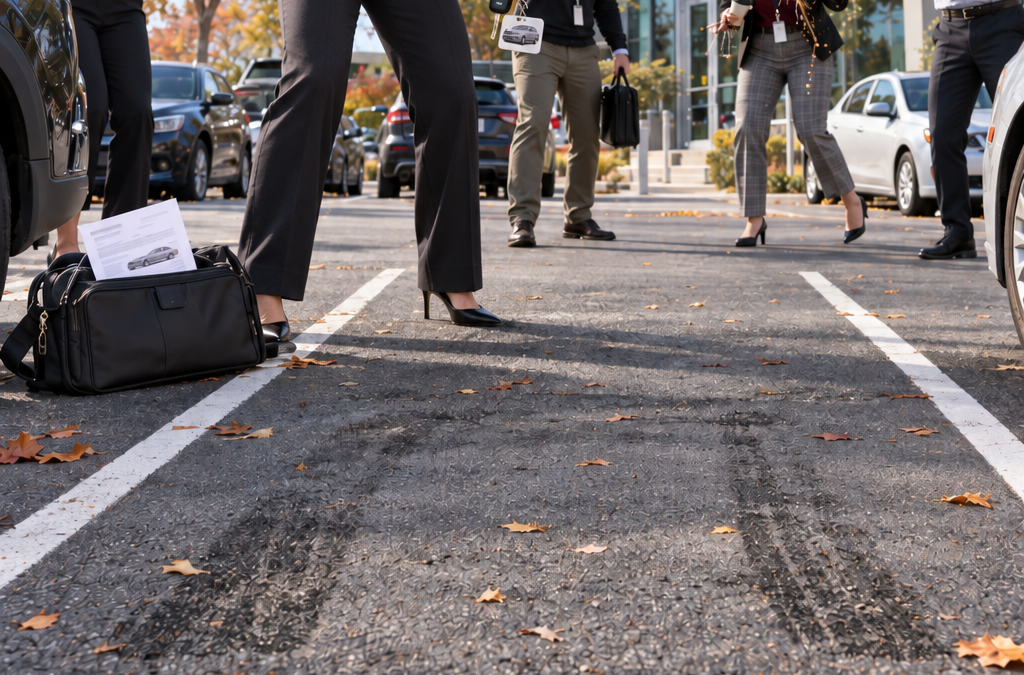
The day my car disappeared, we were replacing the roof on a strip mall outside Columbus, Ohio, the kind of place with a nail salon, a tax office, a vape store, and a church occupying what used to be a Dollar Tree. By noon, the October sun had burned through the cool morning and was bouncing hard off the pale asphalt when I climbed down, shoulders still vibrating from the compressor, thinking about the turkey sandwich in my cooler. I rounded the corner of the building and stopped at space 114 because there was nothing in it. For several seconds, I honestly thought my own memory had failed me.
I turned slowly, scanning the rows for my silver 2024 Toyota Corolla, the first new car I had ever owned and the first major thing I had paid off early. There should have been a small dent near the rear bumper, a blue parking decal in the windshield, and a removable magnetic sign for Collins Exterior Repair on the passenger door because I occasionally used it for estimates. Instead, heat shimmered above an empty rectangle of pavement. I pressed the key fob in my hand, absurdly hoping to hear a chirp from somewhere nearby, but the lot remained silent except for a delivery truck backing up behind the grocery store.
“You lose something?” Luis called from the ladder, squinting down at me.
“My car.”
He laughed because he thought I was joking, then saw my face and climbed another rung down. “Towed?”
“That’s what I’m figuring out.”
The property manager said nobody had been towed, and the towing company listed on the faded sign by the dumpster had no record of my plate. I called the police non-emergency number first, but while I waited through the menu, instinct made me call my mother. Even at thirty-one, after everything, some part of me still believed mothers belonged at the top of an emergency list.
She answered cheerfully. “Hey, honey. You still at work?”
“My car’s gone.”
There was a pause so short I almost missed it. “Oh, Mara. Relax.”
I stood absolutely still.
“What?”
“We let Tyler use it,” she said. “He needs it more right now.”
The asphalt seemed to tilt under my boots. “You did what?”
“Don’t make this into something ugly. He has interviews, and after what happened to his SUV, he has no transportation.”
“What happened to his SUV is that he totaled it.”
“Mara.”
“How did he get my keys?”
Another pause. This one mattered.
“You left a spare here.”
I closed my eyes and pictured the junk drawer in my parents’ kitchen, where I had accidentally left my spare fob months earlier after changing the battery in it. My mother had promised she would keep it safe until I picked it up. “You took my spare key and gave him my car.”
“Your father and I agreed that family helps family.”
“My name is on the title.”
“Your brother isn’t a stranger.”
“That wasn’t my question.”
She sighed in the exhausted tone she normally reserved for customer-service representatives. “You have the company truck. Tyler has nothing. You are stable. He’s trying to get stable. Why is it always so hard for you to understand that people have different needs?”
My whole childhood lived inside that sentence. Tyler needed sneakers because kids at school were cruel. Tyler needed Dad’s old truck because community college was far. Tyler needed help with rent because his roommate unexpectedly moved out. Tyler needed six hundred dollars for a forklift certification he never completed, four tires because he had worn the old ones bald, and money after his first accident because the insurance deductible was “basically robbery.” I needed very little because needing things created work for other people, and I had learned early that life was easier when I did the work myself.
“Tell him to bring it back,” I said.
“He’ll bring it back Monday.”
“It’s Wednesday.”
“He needs a few days.”
“I told him no when he asked two months ago.”
“I know.”
That was the moment the panic drained out of me and something colder took its place. “So you knew I said no.”
“You were being stubborn.”
“I’m hanging up.”
“Mara, don’t you dare call the police on your own brother.”
I ended the call.
Then I dialed 911.
I gave the dispatcher my name, plate number, VIN from the insurance app on my phone, and the location where I had last seen the vehicle. When she asked whether anyone had permission to take it, I said, “No,” and felt something inside me settle. I told her my brother had apparently taken a spare key from my parents’ house and that my mother had just admitted they knowingly gave him the car after I had already refused him permission.
Luis stood ten feet away pretending not to listen. When the call ended, he handed me my water bottle without saying anything, and I appreciated him for it more than I could explain.
That Corolla was not a luxury car. It was a base-model silver sedan with cloth seats, a backup camera, and speakers that sounded slightly tinny when I played music too loud, but I had spent twelve years convincing myself I was allowed to own something new. Before that car, I drove a sequence of machines whose dashboards glowed like Christmas trees: a Buick with a broken heater, a Ford Focus that required a screwdriver to open the trunk, and a fifteen-year-old Camry that smelled permanently of antifreeze. I knew how to replace alternators on milk crates because I had spent my twenties solving every problem with labor instead of money.
I had delayed buying the Corolla because my mother had an urgent-care bill one year, my father had fallen behind on property taxes the next, and Tyler always seemed to be standing beside some fresh crater in his own life. When I finally walked into the dealership, I put down almost a quarter of the purchase price and chose the simplest trim because reliability felt decadent enough. Three months earlier, I had made the final payment two years ahead of schedule, printed the lien-release letter, and placed it in a folder at home. I had looked at that sheet of paper longer than I looked at most birthday cards.
My parents’ reaction had been predictable.
“That seems like a lot of money for a Corolla,” Mom said.
Dad asked whether I could fix the loose flashing above their garage that weekend.
Tyler texted, Nice. I’m definitely borrowing that thing sometime.
I had replied, No, you’re not.
Two months later, he came to my apartment and asked in person. He sprawled on my couch with the confidence of someone who had rarely heard a permanent answer.
“I got a lead at this distribution place,” he said. “Good money. Benefits eventually. I just need wheels for a couple weeks.”
“No.”
He smiled like I had made a joke. “You have the work truck.”
“The Corolla is mine.”
“You barely use it during the week.”
“That doesn’t make it available.”
His smile disappeared. “You know, getting your little supervisor title has made you weird.”
“I was weird before the title.”
He left angry, and the family group chat started before he had probably reached the parking lot. Mom told me he had asked nicely. Dad wrote, We raised you to share. Tyler reminded everyone that he had once driven me to a diner after my high-school boyfriend dumped me, apparently converting a fifteen-minute favor from thirteen years earlier into permanent vehicle access.
I muted the conversation and forgot about it.
Standing in that empty parking lot, I realized they had not forgotten anything.
I finished enough paperwork to close the job safely, accepted a ride in the company truck from Luis, and spent the drive home watching my phone vibrate in the cup holder. Tyler wrote, Calm down. Mom wrote, Please don’t embarrass this family. Dad wrote, If you make this a police matter, don’t come Sunday. I did not respond to any of them.
At home, I pulled open the small fireproof box where I kept tax records, contracts, and the lien-release letter. Everything was there except one thing I suddenly wanted to see for myself: the original title envelope I remembered leaving at my parents’ house after a DMV appointment months earlier. I had taken the title home eventually, or at least I thought I had, but the memory felt slippery enough that I drove the company truck across town.
Mom was slicing zucchini when I walked into their kitchen.
I went straight to the junk drawer.
My spare key was gone.
Behind a stack of takeout menus sat the opened DMV envelope with my VIN printed through the plastic window.
It was empty.
“Where’s the document that was in this?” I asked.
Mom kept cutting.
“We needed the VIN,” she said.
“For what?”
Her knife stopped against the cutting board.
Then she looked at me and said, “To make sure Tyler was covered.”
Part 2
I had spent years fixing roof leaks caused by tiny gaps no homeowner noticed until water reached the drywall. Families could work the same way. You could stare at a ceiling for a decade and believe everything was solid, then one brown stain appeared and suddenly you understood rain had been traveling through the structure for years.
“You added him to my insurance?” I asked.
“For a few days.”
“That’s not something you can just do.”
“Oh, stop.” Mom put the knife down harder than necessary. “We called and handled it.”
“We?”
“Your father was here.”
Dad sat in his recliner ten feet away watching a local news anchor discuss highway construction. He took a slow drink of beer without turning his head.
“Dad?”
He finally looked over. “Your mother thought it was easier.”
“Easier than what?”
“Than you making everything a federal case.”
I stared at him long enough for the television weather map to change behind his shoulder. My father had always preferred quiet to fairness, provided somebody else paid the price for the quiet.
“Whose name did you use when you called?” I asked.
Mom folded her arms. “What are you accusing me of?”
“I’m asking a specific question.”
“I said I was your mother.”
“That wasn’t the question.”
She flushed. “The insurance company already had the information.”
“Did you tell them you were me?”
“You’re twisting things.”
There are moments when an argument stops being emotional and becomes evidence. I took out my phone, opened the voice-memo app, placed it on the kitchen counter, and watched my mother’s eyes drop toward it.
“What are you doing?”
“Making sure nobody forgets what was said.”
Her expression changed immediately. “Get that thing off my counter.”
I picked it up. “Fine.”
Then I left.
That night I logged into my insurance account and changed the password, security questions, phone PIN, and mailing preferences. Tyler’s name did not appear on the active policy, but there was a driver-change transaction dated eight days earlier and reversed that afternoon, which meant someone had added him and someone had removed him after I reported the car stolen. I downloaded every document before anything else could change.
At 8:17 the next morning, I called the insurer.
The representative’s pleasant script disappeared after I explained why I was calling. She placed me on hold, came back with a supervisor, and eventually transferred me to a special-investigations employee named Cynthia Harper.
“Ms. Collins, I want to confirm something,” Cynthia said. “Did you contact us last Tuesday and request that Tyler Collins be added as a temporary household driver?”
“No.”
“Did you authorize anybody to make that request on your behalf?”
“No.”
“Do you reside at 742 Brookfield Avenue?”
“That’s my parents’ address. I haven’t lived there in nine years.”
The line went quiet.
“Thank you,” she said carefully. “I need to review several account notes.”
Several.
I wrote that word down.
Cynthia asked whether I had a police report. When I gave her the number, her tone became more formal, and she told me not to discuss the insurance account with family members until she contacted me again. I wanted to ask ten questions, but years in construction had taught me that when an inspector says not to touch something, touching it usually makes the repair more expensive.
The police located my Corolla that afternoon because Tyler drove it past a patrol officer who had the plate on the report. He did not lead anybody on a chase or do anything cinematic. He pulled into a gas station, argued that it was “basically a family misunderstanding,” produced my registration from the glove compartment, and called my mother before he called me.
An officer phoned and asked whether I had given Tyler permission.
“No.”
“Ever?”
“He asked two months ago. I specifically told him he could not borrow it.”
“Do you want the vehicle returned to you?”
“Yes.”
“Do you want to pursue charges?”
That question sat heavier than I expected. I imagined Mom crying to relatives, Dad telling everyone I had ruined Tyler’s future, Tyler using the incident forever as proof that I was cold.
“I want everything documented,” I said. “And I want whatever procedure you would use if we weren’t related.”
The officer paused.
“That’s fair.”
Because Tyler had access to a real spare key and my parents claimed they believed they could authorize him, the officer explained that prosecutors might review the circumstances before deciding how to charge it. What mattered to me immediately was that Tyler was told clearly he could not keep driving the car and that I had formally denied consent. The Corolla went to an impound lot for processing, and Tyler went home with our father.
The family group chat exploded before my shift ended.
Mom: You have made your point.
Dad: We will never forget what you did today.
Tyler: Hope that little car was worth your family.
Aunt Marlene: This is absolutely heartbreaking. Brothers and sisters are supposed to support each other.
I took a screenshot, printed it at the office, and put it into a yellow file folder I bought from the supply cabinet. That folder became the first boundary I could physically hold.
Sunday dinner had been mandatory in my family long after all of us became adults, so four days after the car disappeared, I went. Mom had made pot roast. Aunt Marlene was there because family crises attracted her the way porch lights attracted moths, and Tyler sat at the table looking relaxed enough that for a second I wondered whether I had imagined everything.
“Sit,” Mom said. “We waited.”
I put the yellow folder beside the gravy boat.
“I’m not staying for dinner.”
Tyler smiled. “Oh, good. Court is in session.”
“Where’s my spare key?”
Dad sighed.
“Mara.”
“Where is it?”
Tyler pulled it from his hoodie pocket and dropped it onto the table with a little plastic clack.
“There. Happy?”
“No.”
I opened the folder.
Police report. Screenshots. Lien release. Insurance transaction record. The old message where Tyler asked for the car and my written response saying no.
Aunt Marlene shook her head. “You printed texts?”
“Yes.”
“That is not normal.”
“Neither is taking somebody’s car.”
Mom pressed her napkin flat beside her plate. “Nobody stole anything. We borrowed it for Tyler because he has been having a difficult month.”
“He’s had a difficult decade.”
“Watch yourself.”
Tyler leaned back. “You act like I robbed a bank.”
“You took a car I told you not to take.”
“Mom said it was fine.”
“Mom doesn’t own it.”
His expression tightened. “You’re obsessed with ownership.”
“No. I’m obsessed with consent.”
Dad finally set down his fork. “Enough with these therapy words.”
The strange thing was that I had not learned “consent” in therapy. I learned it from contracts, estimates, change orders, property lines, and homeowners who understood that paying for one thing did not entitle a contractor to take another. Somehow my family respected ownership perfectly when it belonged to strangers.
Mom pushed back from the table. “Do you know how humiliating it was having police come to our house?”
“Do you know how humiliating it was calling you because my car disappeared and hearing you say you gave it away?”
Her eyes went shiny. “Everything we have ever done has been for our children.”
I almost laughed.
Instead, I slid the insurance transaction across the table.
“Who called them?”
Nobody answered.
“Somebody added Tyler as a driver.”
Mom looked at Dad.
Dad looked at his plate.
Tyler looked at me, and for the first time since I arrived, the smugness drained from his face.
That was information.
“What?” I said.
“Nothing.”
“What aren’t you telling me?”
Mom stood abruptly and reached for the serving dish. “We are done discussing this tonight.”
I closed the folder.
“Then I’m done too.”
I had reached the front door when Tyler called after me.
“You better hope they don’t look too hard at that insurance account.”
I stopped.
The room went silent.
I turned back toward him.
“What does that mean?”
His face shifted almost immediately into a grin, but it arrived too late.
“Nothing,” he said.
For the first time, I believed him less than I believed my mother.
Part 3
Cynthia from the insurance company called me at 9:06 Monday morning while I was standing on a warehouse roof inspecting membrane seams. I climbed down, sat inside the company truck with the door open, and listened as she explained that the investigation had expanded beyond the recent addition of Tyler. There had been multiple calls to my insurer over the previous two years from a number associated with my mother, and several of those calls involved changing garaging information, asking about household-driver requirements, and discussing “family vehicle access.” None of those notes proved fraud by themselves, but Cynthia wanted recordings pulled.
“I barely call you people,” I said.
“That is why the pattern stood out.”
“How many calls?”
“At least six relevant contacts.”
I looked through the windshield at our crew unrolling roofing material in the distance. Six calls meant six decisions someone had made while counting on me never checking.
Cynthia asked whether I had ever lived with Tyler during that period.
“No.”
“Did he routinely drive your previous vehicle?”
“No.”
“Were you aware that your former Camry was listed for seven months as being primarily garaged at your parents’ address?”
My hand tightened around the phone.
“No.”
That Camry had been mine alone. I parked it outside my apartment every night except when I was traveling.
“Why would anyone change that?”
“Rates can vary by location, household composition, and driver history. I cannot speculate until we complete the review.”
She did not need to speculate for my stomach to understand.
Tyler had wrecked his Civic three years earlier, and the SUV the following year. After the second crash, his premiums became so high he stopped maintaining regular coverage. My mother complained constantly that insurers punished young men for “one little mistake,” which would have been a more convincing argument if Tyler’s little mistake had not involved hydroplaning on tires so bald that the mechanic later told Dad the cords were visible.
I called my sister, Jenna.
She lived in Indianapolis and worked nights as an oncology nurse. We were close in the way people from noisy families sometimes become close: no constant texting, no required holiday performances, but immediate honesty when it mattered.
“You busy?” I asked.
“I’m hiding in a stairwell eating crackers. So, medium busy.”
“Did Mom ever mess with your car insurance when you lived at home?”
The chewing stopped.
“Why?”
I told her.
For several seconds, all I heard was the hospital ventilation system through her phone.
“Mara,” she said finally, “you need to check more than your insurance.”
“What do you mean?”
“When I moved out, Mom kept using my checking account for two autopays because she said she forgot to change them.”
“That’s different.”
“No, listen. I mean she kept using it for eleven months.”
My skin prickled.
Jenna explained that she had opened her first bank account at seventeen with Mom as a joint adult. Even after Jenna moved out and started working, Mom occasionally transferred money without asking, always for household expenses she promised to replace. Jenna eventually closed the account completely after discovering three hundred dollars missing the same week her rent was due.
“Why didn’t you tell me?”
“I did. Kind of. Remember when I said Mom and I had money problems?”
“I thought you meant she kept asking for loans.”
“That’s what I wanted you to think because I was embarrassed.”
That word hurt more than anything else.
My sister had been embarrassed because someone else had taken from her.
“When you left for Indianapolis,” I said slowly, “Mom told everybody you were abandoning the family.”
“Yeah.”
“I believed some of that.”
“I know.”
“I’m sorry.”
“I know that too.”
There was no dramatic forgiveness scene. Jenna had grown up in the same house; she understood how children become translators for their parents’ version of reality.
Before hanging up, she said, “Check your credit.”
My credit report looked normal at first. Mortgage companies had not appeared out of nowhere, and there were no secret credit cards in Tyler’s name. I nearly felt foolish until I noticed an old utility account at my parents’ address that had remained connected to my name for almost four years after I moved out.
I remembered setting it up once during a winter when Dad was recovering from shoulder surgery and Mom forgot to pay the gas bill.
I had assumed she transferred it back.
She had not.
The balance was current because my mother paid it most months, but legally the account was still mine. So was the family cell-phone plan I had created years earlier because I qualified for an employee discount through a previous contractor. So were two streaming services, pest control, and an automatic roadside-assistance renewal.
None of those things were crimes. Together, they formed a picture.
I had not simply been helping during emergencies.
I had become infrastructure.
When I pulled that thread, other memories changed shape. The year Mom said she “needed my Social Security number for hospital paperwork.” The time Dad asked me to sign a financing form for a riding mower because his credit had taken a hit. The repeated reminders that I was “the responsible one,” always delivered as praise before somebody requested money, labor, a signature, or access.
Responsibility was the key they used after I started locking doors.
I spent the next week moving everything I could into separate accounts. I removed myself from my parents’ phone plan. I changed billing information on the pest-control account. I canceled the streaming subscriptions instead of fighting about who got to keep them. I called the gas company and explained that I no longer lived at Brookfield Avenue.
Mom noticed within hours.
Did you seriously cancel our Hulu?
Then:
Your father can’t watch the game package.
Then:
This is childish retaliation.
I answered once.
Please put all household services in the name of an adult who lives in your household.
Her reply came thirty seconds later.
You have become unbelievably cold.
I looked at the message while eating lunch on the tailgate of the work truck. Luis sat beside me opening a packet of hot sauce with his teeth.
“You know what’s funny?” I said.
“What?”
“I’m not angry right now.”
He squinted at me. “That is funny?”
“For me, yes.”
Friday afternoon, Cynthia called again.
They had obtained one of the recorded calls.
“Before I tell you what was discussed,” she said, “I need you to confirm your mother’s full name.”
I did.
“On the recording, the caller identifies herself as you.”
For several seconds, the entire parking lot seemed to go muffled.
“What did she ask for?”
“She requested Tyler be listed as an occasional driver and asked whether his suspended-license status would prevent coverage.”
I sat forward.
“His what?”
Another silence.
“You were unaware his license was suspended?”
“Yes.”
Cynthia exhaled softly.
“Then I think you need to speak with the investigating officer again.”
Part 4
Tyler had not lost his license because of one dramatic crime. He lost it through the boring accumulation of irresponsibility: an unpaid citation after the SUV crash, failure to provide proof of insurance, then missing a reinstatement deadline because he claimed the DMV website was “broken.” My parents knew. According to Jenna, Aunt Marlene probably knew too, which meant the entire family had demanded I hand over a car to a man who legally should not have been driving it at all.
That changed the police report.
The officer assigned to follow-up, Officer Donnelly, asked me to come in with any documentation I had. I brought the yellow folder, Cynthia’s written fraud-investigation acknowledgment, the texts, and a timeline I had made at my kitchen table.
“You do this for work?” he asked, flipping through it.
“Roofing.”
He looked at me.
“We document everything.”
He nodded as though that explained my entire personality.
The department added information about Tyler’s suspended status and forwarded the file for review. He had already been cited separately when the vehicle was recovered, and whatever happened next would depend on local prosecutors and the insurance investigation. I did not feel victorious hearing that. Mostly, I felt tired.
My mother called that night from Dad’s phone because I had stopped answering hers.
“You knew his license issue was temporary,” she said immediately.
“I didn’t know anything about it.”
“Well, you know now.”
“You gave him my car while his license was suspended.”
“We were trying to help him get it fixed.”
“How does driving illegally fix it?”
“He needed to get to work.”
“What work?”
Silence.
I had asked Aunt Marlene that question once, and she could not name the employer.
“Mom.”
“He had opportunities.”
“That’s not a workplace.”
“You always do this.”
“Do what?”
“Interrogate people until they sound bad.”
I laughed once because the sentence was so perfect I almost respected it.
“You mean ask follow-up questions?”
She lowered her voice. “Your brother has struggled because nobody gives him a chance.”
“I gave him thousands of dollars’ worth of chances.”
“Nobody asked you to keep score.”
“You did. Every time you reminded me what I owed him.”
She started crying then, but even the crying sounded organized. Mom had always been able to move from accusation to injury without changing the subject.
“Do you understand what could happen to him now?”
“Yes.”
“How can you live with that?”
I stared at the framed lien-release letter on my desk.
“How could you live with what could happen if he crashed my car?”
“He didn’t.”
“That is not an answer.”
“What do you want from me, Mara?”
The question surprised me.
Not because she meant it sincerely, but because I finally had an answer.
“I want you to stop using my name.”
She went quiet.
“My money. My accounts. My insurance. My address. My work. My time. Stop deciding those are available because you think someone else deserves them more.”
“We are your parents.”
“Yes.”
“We sacrificed for you.”
“Yes.”
“Then why are you treating us like strangers?”
“Because strangers ask before they take things.”
She hung up.
Three days later, Dad appeared at my apartment.
He stood on the porch in an old Cleveland Guardians cap holding the yellow cordless drill I had loaned him two years earlier. It was missing one battery.
“Your mother said you want your stuff back.”
“I didn’t ask for the drill.”
“Well, apparently we’re separating assets now.”
I almost invited him inside out of habit, then stopped myself.
He noticed.
“You’re really doing this.”
“Doing what?”
“Acting like we’re dangerous.”
“I think Mom pretended to be me on an insurance call.”
Dad rubbed the side of his nose.
“She panicked.”
“You knew?”
“She was trying to solve a problem.”
“With my identity.”
“You make everything sound criminal when you phrase it that way.”
I studied him. My father had spent thirty-five years avoiding conflict by reducing whatever Mom did into weather: unfortunate, temporary, nobody’s fault.
“Did she tell you she was going to say she was me?”
“No.”
That answer came too fast.
“Did you hear her make the call?”
His mouth tightened.
There it was.
“You were there.”
“I was in the kitchen.”
“And you said nothing.”
“She’d already started.”
“So?”
“What was I supposed to do? Grab the phone out of her hand?”
“Yes.”
He actually looked offended.
I laughed, not because it was funny but because something old finally became obvious. My father’s definition of peace required everybody else to absorb consequences so he would never have to interrupt Mom.
“Tyler could have killed somebody in my car.”
“He didn’t.”
“You keep saying that like luck is a moral defense.”
Dad’s face hardened. “You think because you work hard you’re better than everyone.”
“No. I think working for something means I get a say in what happens to it.”
“Your brother works.”
“Where?”
He looked away.
That answer was enough.
After he left, Jenna called.
“You okay?”
“Dad came over.”
“Oh, good. Ambassador Neutrality.”
I laughed harder than I expected.
Then she told me something that stopped it.
“When Tyler wrecked the SUV,” she said, “Mom asked me to co-sign another car for him.”
“You never told me that.”
“I said no.”
“So she came to me for the tires.”
“Probably.”
A pattern emerged that was almost elegant in its efficiency. Mom approached whichever child was least likely to resist, and when one learned to resist, she shifted to another. Jenna leaving had not created my role as family rescuer; it had concentrated it.
“She told me you moved away because you didn’t care about us,” I said.
“I know.”
“I think she told me that because she needed me to stay.”
Jenna was quiet.
“That’s what I think too.”
That night I went through old bank statements.
I had paid Mom’s urgent-care balance, part of Dad’s property taxes, Tyler’s certification course, two months of Tyler’s rent, four tires, three utility shutoff notices, and half the deductible after his first wreck.
I added the numbers.
Then I deleted the total.
The amount did not matter as much as the method.
Every payment had begun with a crisis. Every crisis ended with relief. Every relief became precedent.
Two days later, Cynthia called again.
“There is another recording you need to know about.”
I closed my office door.
“What now?”
“This call occurred approximately three weeks before the vehicle was taken.”
My hands went cold.
“What did she ask?”
Cynthia read from her notes.
“She asked whether a paid-off vehicle could be transferred to another family member without changing the primary policyholder.”
For a few seconds, I forgot how to breathe.
The theft had not been an impulsive decision made that morning.
They had been planning it.
Part 5
I listened to the insurance recording in a small conference room with Cynthia on speakerphone and a legal representative from the company explaining that they were sharing it because my identity had apparently been used. My mother’s voice came through the speakers bright and polite, the same tone she used with dentists, bank tellers, and waitresses she intended to complain about later. She gave my name, my date of birth, and enough security information to pass the first layer of verification.
Then she asked about Tyler.
She said, “My brother needs the vehicle more than I do right now.”
My stomach turned at hearing my mother speak as me.
The representative on the old call explained that ownership could not simply be changed through the insurance company, and that title transfer would require proper documentation. Mom then asked whether Tyler could be listed as the primary user while I remained the owner.
“How long did she stay on the phone?” I asked.
“Fourteen minutes,” Cynthia said.
Fourteen minutes was not panic. Fourteen minutes was planning.
Cynthia explained that the company would correct the account history, flag the unauthorized contacts, and review whether any false statements had affected premiums or underwriting. She carefully avoided promising criminal consequences because insurers do not work like television detectives, but she confirmed that impersonating a policyholder was serious enough to document and potentially refer depending on what the investigation found.
“What was she trying to accomplish?” I asked.
“We can tell you what she requested. We cannot tell you her intention.”
That was fair.
I already knew her intention.
She wanted to convert my refusal into paperwork that made the refusal irrelevant.
I called Mom afterward.
She answered on the second ring.
“Did you call my insurance company three weeks before Tyler took the car?”
Silence.
“Mom?”
“You’ve clearly decided what you think.”
“I heard the recording.”
Another silence.
This one was longer.
Finally she said, “We were exploring options.”
“We.”
“Your father and I were trying to figure out how Tyler could get reliable transportation.”
“With my car.”
“You weren’t using it during work hours.”
“It doesn’t matter.”
“It mattered to us.”
I closed my eyes.
There it was, stripped clean of euphemism.
My property mattered to them according to their need.
“You planned to take it before I ever called you from that parking lot.”
“We hoped you would come around.”
“You asked. I said no.”
“You always say no first.”
That sentence was so wrong I almost missed how revealing it was.
“No, Mom. I usually say yes.”
She breathed sharply.
“You used to.”
I hung up.
For the first time, I understood why my boundaries had produced such extreme reactions. They were not reacting to one refusal. They were reacting to the collapse of an entire system that depended on my eventual surrender.
The next week was strangely peaceful because I stopped trying to persuade anyone. I worked. I recovered the Corolla from impound, had the interior professionally cleaned, replaced the magnetic company sign Tyler had peeled halfway off, and changed every spare-key arrangement in my life.
Luis helped me install a small steel lockbox inside our shop office.
“Gold?” he asked as I slid documents inside.
“Basically.”
“Emergency cash?”
“Better.”
I held up the title.
He nodded solemnly.
“American treasure.”
I started running again after work, two miles along a creek trail behind my apartment complex. The first few evenings my knees complained and my lungs burned, but physical discomfort was familiar, clean, and honest. Nobody could reinterpret a hill.
The family responded to my silence by escalating publicly.
Mom posted a vague message on Facebook about “adult children who forget who held them when they were sick.”
Tyler posted a picture from inside somebody else’s car with the caption, You can’t stop a hustler.
Aunt Marlene commented under both with praying hands.
I did not reply.
The only family member who contacted me directly was Jenna.
“Mom called me,” she said.
“What did she want?”
“For me to talk sense into you.”
“What did you say?”
“That I moved three states away specifically so she couldn’t assign me jobs anymore.”
I smiled.
“She hang up?”
“Pretty much.”
Then Jenna’s voice softened.
“She also said something weird.”
“What?”
“She said if you keep ‘digging through paperwork,’ you’re going to hurt Dad.”
I stopped walking.
“I’m sorry?”
“She said, ‘Mara thinks she’s investigating Tyler, but she’s going to hurt her father.’”
That night I drove home without turning on the radio.
Dad.
I had been focused on Mom because she made the calls, Tyler because he took the car, and myself because the accounts were in my name. Dad existed in the background, holding his beer, avoiding conflict.
But Dad had been in the kitchen.
Dad knew about the insurance calls.
Dad had helped decide to take the car.
And years earlier, Dad was the one who handled most household finances before he claimed it stressed him too much and gave everything to Mom.
I pulled my old tax files from the closet.
Several years earlier, when I still used my parents’ address for some mail, Dad had helped me refinance a small work-truck loan. He insisted on keeping copies of my pay stubs because “you never know when the bank loses things.”
I searched for the folder.
Gone.
Maybe I had thrown it away. Maybe he had.
At midnight, I texted Jenna.
Do you remember Dad ever using our information for bills or credit?
She responded ten minutes later.
Not credit that I know of. But remember the garage loan?
I did not.
She called.
“When they replaced the garage roof and door,” she said, “Dad asked if I could be listed as a secondary contact because their credit was bad.”
“When?”
“Six years ago.”
“Did you sign anything?”
“No. I refused.”
“Did he ask Tyler?”
She laughed bitterly.
“Why would they ask Tyler when they had you?”
I barely slept.
The next morning, I called the lender listed on an old home-improvement statement I found in one of Mom’s emails she had forwarded me years earlier.
The account had been paid off.
My name was not a borrower.
I almost relaxed.
Then the representative said, “You were listed as a guarantor contact, though.”
“Guarantor?”
“Not financially liable. It appears the application referenced your income as household support.”
“I did not live there.”
A pause.
“Then I would recommend requesting a copy of the original application.”
When it arrived three days later, one sentence had been typed into the income section:
Adult daughter contributes regularly to household expenses.
No dollar amount.
No forged signature.
Nothing prosecutable.
Just the truth weaponized without my consent.
I had been used to make my parents look safer because I was expected to rescue them if they failed.
That was the deeper structure.
My money had never merely helped them.
My availability had become part of their creditworthiness.
And once I understood that, I knew the stolen car was not the beginning of the story.
It was the first time I had refused to keep the ending the same.
Part 6
The legal consequences arrived slowly, which felt more realistic than revenge stories people tell online. Tyler received citations related to driving while suspended, and the county prosecutor reviewed the vehicle complaint separately. Because he had used a real spare key supplied by our parents and because the family claimed they believed they had authority, the case did not become the dramatic felony spectacle Mom had warned everyone about.
Instead, it became something Tyler hated more.
Paperwork.
He had to appear in court. He had to pay reinstatement fees. He had to show proof of insurance if he wanted his license restored. The warehouse job he kept claiming to have nearly landed turned out to be a delivery-contractor position that required a valid license, so his own suspension—not my refusal—disqualified him.
Mom still called that my fault.
I corrected her once.
Then I stopped correcting her.
The insurance investigation ended with my account restored, security restrictions added, and a written confirmation that unauthorized changes had been removed. Mom’s impersonation was documented internally and referred to the company’s fraud process, but because the financial impact had been limited and corrected quickly, the result was more administrative than dramatic. Her access to anything associated with my policy was permanently blocked.
That mattered to me more than seeing her punished.
A locked door is useful even when nobody goes to jail for trying the handle.
Dad came by again in November.
This time he called first.
“Can we talk?”
“About what?”
“Everything.”
I considered saying no simply because I could.
Instead, I told him he could come by at six.
He arrived at 5:58 carrying no tools, no broken appliance, and no request disguised as conversation. That alone made the evening unusual.
We sat at my small kitchen table.
Dad kept his cap in both hands.
“Your mother thinks I betrayed her by coming.”
“I didn’t ask you to.”
“I know.”
He stared at the tabletop.
“I should’ve stopped the insurance call.”
“Yes.”
He looked up, surprised by how quickly I answered.
“I thought you might say something else.”
“Like what?”
“I don’t know. That you understand.”
“I understand. That doesn’t make it okay.”
He nodded slowly.
For the first time in my life, my father stayed inside discomfort instead of escaping through a joke, a television, or my mother’s anger.
“She was scared about Tyler,” he said.
“She is always scared about Tyler.”
“I know.”
“And when she’s scared, everyone else has to pay.”
He rubbed his thumb along the edge of his cap.
“I know.”
That was the closest thing to an apology he had offered.
Then he said something I did not expect.
“Your mother thinks if she doesn’t fix everything for him, he’ll disappear.”
I frowned.
“Disappear where?”
Dad told me about Tyler at nineteen, after he dropped out of community college. He had vanished for three days, sleeping in a friend’s basement after a fight with them. Mom had panicked so badly she called hospitals.
“He came home,” Dad said. “But she changed after that.”
“That was seven years ago.”
“I know.”
“She’s been paying ransom to a hostage situation that doesn’t exist.”
Dad winced.
“That’s harsh.”
“So is stealing my car.”
He nodded again.
We sat quietly.
Then I asked the question that had followed me since the lender sent the old application.
“Did you use my income to qualify for things?”
His face changed.
“Not exactly.”
“Dad.”
“We never used your credit.”
“That’s not what I asked.”
He stared toward the window.
“When money got tight, lenders would ask whether anyone helped with household expenses.”
“And you said I did.”
“You did.”
“Did you tell them I lived there?”
“Sometimes they assumed.”
“Did you correct them?”
His silence answered.
I leaned back.
Nothing in the conversation was criminal enough for a courtroom. That almost made it worse because it explained how the pattern survived so long.
Nobody had needed to forge a mortgage.
They only needed to blur a line.
Dad looked tired suddenly.
“We were proud of you.”
“That sentence always comes right before you tell me what you used me for.”
His eyes closed.
I regretted the sharpness for about three seconds.
Then I remembered the parking space.
“Mara, we got used to you handling things.”
“I know.”
“That’s not an excuse.”
“No.”
“I don’t know how to fix it.”
“You stop.”
He looked at me.
“Stop what?”
“Stop putting my name on forms. Stop giving people my number as a backup. Stop promising my money. Stop volunteering my labor. Stop assuming I will catch whatever falls.”
He nodded.
“And Mom?”
“She has to decide for herself.”
“What if she doesn’t?”
“Then I see her less.”
His face tightened.
“You’d really do that?”
“Yes.”
For once, I did not soften the answer.
After he left, I cried.
Not because I wanted my old family back, exactly. I cried because part of me still wanted a version that probably never existed: parents who were proud without being dependent, a brother who asked instead of took, a house where generosity remained generosity because no one converted it into debt.
Jenna called while I was still wiping my face.
“You okay?”
“Dad admitted some things.”
“Wow.”
“Yeah.”
“Did the earth open?”
“Not yet.”
She laughed.
Then she said, “Mom called me again.”
My shoulders sank.
“What now?”
“She wants Christmas at your apartment.”
I stared around my one-bedroom living room.
“Why?”
“Because she says neutral territory would help everyone heal.”
“No.”
“I already told her you’d say that.”
“Thank you.”
“But there’s more.”
Of course there was.
Jenna lowered her voice.
“Tyler told her he’s bringing a friend who ‘knows legal stuff’ because he wants you to sign something saying the car incident was a misunderstanding.”
I felt my entire body become still.
“What kind of something?”
“He wouldn’t show me.”
That night I texted my mother for the first time in nearly three weeks.
Do not bring Tyler to my home. Do not bring me documents. I will not sign anything.
She replied almost immediately.
Nobody is trying to trick you.
I looked at those words for a long time.
Then I added the screenshot to the yellow folder.
Part 7
Christmas happened at my parents’ house without me. I spent the morning helping Luis deliver a repaired chimney cap to an elderly customer who had discovered water stains the night before, then drove to Indianapolis and had dinner with Jenna at her apartment. We ate grocery-store rotisserie chicken, roasted potatoes, and a pecan pie one of her patients’ families had given the nurses.
It was the quietest Christmas I could remember.
I loved it.
Mom sent three messages.
Merry Christmas.
Your father misses you.
There is still time to come home.
I answered the first with Merry Christmas to you too.
Nothing else.
Two days later, Tyler sent me a photograph of a single-page statement.
It said that our dispute over the Corolla had resulted from a “family misunderstanding regarding implied permission” and that I did not wish to pursue further action.
Sign this and we can all move on, he wrote.
I called Officer Donnelly.
He told me not to sign anything I did not independently understand and reminded me that prosecution decisions were not controlled solely by private statements anyway.
Then I called Tyler.
It was our first direct conversation in weeks.
“What?” he answered.
“Who wrote the document?”
“A friend.”
“What friend?”
“Why does it matter?”
“Because the language sounds copied from somewhere.”
He laughed.
“You think you’re a lawyer now?”
“No. That’s why I’m asking.”
“It just says what happened.”
“No, it says what you want to have happened.”
“You’re still mad about a stupid car.”
“I’m not signing it.”
His voice changed.
“Mara, this is affecting my license stuff.”
“Your suspended license is affecting your license stuff.”
“You know what I mean.”
“Yes.”
“Mom said you’d eventually calm down.”
“Mom says that because she mistakes time for surrender.”
He swore.
Then came the old argument.
“You’ve always thought you were better than me.”
I looked out my apartment window at a neighbor carrying groceries through the cold.
“No, Tyler. I thought I was responsible for you.”
He stopped talking.
“And that was bad for both of us.”
“Don’t psychoanalyze me.”
“I’m not. I’m telling you what I did.”
“You’re the one who chose to help.”
“Yes.”
That answer disarmed him more than blaming Mom would have.
I continued.
“I chose to help many times. You chose to start expecting it. Mom chose to protect you from consequences. Dad chose not to interfere. We all participated. I’m only changing my part.”
For once, Tyler had no comeback ready.
“You really done?” he asked.
“Yes.”
“With me?”
“I’m done being responsible for you.”
“That wasn’t my question.”
I closed my eyes.
“I don’t know what relationship we have without that.”
He hung up.
I expected to feel powerful.
Instead, I felt grief.
But grief was not the same as regret.
January brought ordinary life back quickly. Roof leaks did not care about family estrangements, and a freeze-thaw cycle created enough emergency calls to keep us moving six days a week. I trained a new employee, negotiated a material discount with our supplier, and spent one long Saturday helping estimate repairs for a low-income senior housing complex.
My boss, Hector, called me into his office near the end of the month.
“You ever thought about buying in?”
I blinked.
“Buying what?”
“The company.”
I laughed.
He did not.
Hector was sixty-two, his knees were shot, and his daughter had no interest in roofing. He had been quietly planning retirement and wanted to sell a minority stake to someone who understood crews, customers, and margins before eventually transferring more.
“I don’t have that kind of money.”
“You have more than you think.”
He slid a folder toward me.
I almost laughed again at the color.
Yellow.
The proposal was modest enough to be possible if I saved aggressively for another year.
For the first time, I looked at my financial life without automatically subtracting future family emergencies.
The difference was startling.
No monthly utility rescues.
No Tyler loans.
No surprise insurance payments.
No parents’ subscriptions.
Within three months, my savings grew faster than it had in years.
That was not because I had suddenly become rich.
It was because the leaks had stopped.
Mom’s messages changed too.
At first they were angry.
Then short.
Then strangely ordinary.
Cold tonight. Check your pipes.
Your aunt had surgery. She’s okay.
Dad finally fixed the garage door.
I answered when I wanted to.
Love you. Glad Aunt Marlene is okay.
Good about the door.
I did not reward better behavior with immediate access. That was important.
Dad began texting separately.
He sent me a photograph of the garage door with new tracks installed correctly.
Did it myself except the spring. Hired that out like you always told me.
I smiled.
Looks good.
He replied with a thumbs-up.
Tyler disappeared from the family chat for almost two months.
Then, in March, Jenna sent me a screenshot from his social media.
He was working at a tire warehouse.
Not glamorous.
Not entrepreneurial.
A regular job.
The caption under his photograph said:
First paycheck in forever. Apparently direct deposit is real.
I laughed.
A week later, he texted me.
Need your opinion.
I stared at the screen.
Old reflexes activated instantly.
How much?
What happened?
Who needs help?
Then another message arrived.
Looking at used cars. Is 120k miles too much for a Corolla?
I read it twice.
He had not asked me for money.
I responded:
Depends on maintenance records. Get a pre-purchase inspection.
He wrote:
K.
Then:
Thanks.
That was all.
I did not offer to inspect it.
I did not offer a down payment.
I did not send him listings.
Two weeks later, he bought an eleven-year-old Mazda3 with faded paint and a clean title.
Mom called me.
“Did you know your brother bought a car?”
“Yes.”
“He did it himself.”
“I know.”
She sounded almost confused by the fact.
Then she said something I never expected.
“Maybe we should have made him do that sooner.”
I leaned against my kitchen counter.
“Yes.”
There was a long pause.
“I thought helping him was loving him.”
“Sometimes it was.”
“And sometimes?”
“You were helping him avoid being uncomfortable.”
She sniffed.
“I suppose you think I did that to you too.”
“No.”
That surprised her.
“What do you mean?”
“You did the opposite to me. You made me responsible for everybody else’s discomfort.”
Neither of us spoke for several seconds.
Then Mom said quietly, “I don’t know how to undo that.”
“You don’t undo it.”
“What do you do?”
“You stop doing it today.”
She did not apologize.
Not then.
But she did not argue either.
For my mother, silence had always been a weapon when she wanted somebody else to feel guilty.
That day, it sounded different.
It sounded like thinking.
Part 8
A year after the Corolla disappeared, I drove past the strip mall where it happened.
We had another repair nearby, and when I turned into the lot, I recognized the faded church sign, the tax office, and the exact row where I had stood with my key fob clicking uselessly in my hand. Space 114 was occupied by a blue pickup this time. Nothing about the place suggested my life had changed there.
That felt right.
Most turning points look ordinary from the outside.
By then, I owned fifteen percent of Hector’s roofing company.
The paperwork took months, and I read every page with an attorney before signing. Hector teased me about it once.
“You planning to catch me hiding a yacht in the balance sheet?”
“No.”
“Then why do you keep reading?”
“Experience.”
He laughed.
I did too.
The business investment did not make me suddenly wealthy, but it gave me something I had never known how to want: a future built around my own stability instead of everyone else’s emergencies. I upgraded our estimating software, started a safety-bonus program for crews, and created written policies for tool borrowing because apparently once you learn boundaries in one part of life, you start seeing missing fences everywhere.
Luis became a crew leader.
Jenna started visiting more often.
Sometimes we talked about our parents, but increasingly we talked about other things—her patients, my business, terrible dating apps, books, the stray orange cat that eventually decided my porch belonged to him.
I named him Flashing.
Luis said that was animal cruelty.
My relationship with Dad settled into something cautious but real. He stopped showing up with broken things and began asking before requesting help.
Can I ask you a roofing question?
Do you have time Sunday?
Would you mind looking at a photo?
The first few times, I almost cried because the change was so small.
Permission.
That was all I had wanted.
Mom took longer.
She never became a different person, and I stopped needing her to.
One afternoon she asked me to meet her for coffee.
We sat outside a bakery near her house, and she spent ten minutes talking about weather before finally setting her cup down.
“I owe you an apology.”
I waited.
She looked annoyed by my silence, which almost made me smile.
“For the car,” she added.
“For which part?”
Her eyebrows rose.
“The taking.”
“And the insurance call.”
She looked away.
“Yes.”
“And pretending to be me.”
“Yes.”
“And knowing Tyler’s license was suspended.”
Her mouth tightened.
“Yes.”
I nodded.
She stared at me.
“Aren’t you going to say something?”
“Thank you for saying it.”
“That’s all?”
“What do you want me to say?”
“I don’t know. That we can put it behind us.”
I stirred my coffee.
“We can put it in the past. That’s different.”
She did not like that answer.
But she stayed.
That mattered.
“I was scared for him,” she said.
“I know.”
“You always seemed like you could handle anything.”
“That doesn’t mean I should have to.”
“I know that now.”
I looked at her.
“Do you?”
She gave me a tired half-smile.
“I’m trying.”
I believed that she believed it.
That was enough for coffee.
It was not enough for a spare key.
Tyler and I became something like acquaintances who shared a childhood.
He kept his warehouse job.
He paid his own insurance.
He complained constantly about premiums, which I considered a promising sign of adulthood.
Six months after buying the Mazda, he called me.
Not Mom.
Not Dad.
Me.
“I hit a pothole,” he said.
“Okay.”
“Tire’s messed up.”
“Okay.”
A pause.
“I’m not asking you to pay for it.”
I smiled despite myself.
“I didn’t say you were.”
“I just need to know if this shop is ripping me off.”
He read me the estimate.
I told him the price was reasonable.
He sighed.
“Being responsible sucks.”
“Yeah.”
“Nobody tells you that.”
“Everybody tells you that.”
“Fine.”
Before hanging up, he said, “I’m sorry about your Corolla.”
The words came out quickly, almost carelessly.
I could have forced him to repeat them.
I didn’t.
“Thank you.”
“I really thought Mom had the right to let me use it.”
“She didn’t.”
“I know.”
Another pause.
“I also knew you had said no.”
There it was.
The part that mattered.
“I know.”
“I’m sorry.”
“Okay.”
He sounded surprised.
“That’s it?”
“What else do you want?”
“I don’t know.”
“Neither do I.”
We never hugged about it.
He never delivered a speech.
I never told him everything was forgiven.
Some damage does not need to become hatred, but it does not have to become trust again either.
I keep the Corolla clean now.
Not obsessively, just enough that the inside smells like fabric and coffee instead of old fast food. The magnetic company sign has been replaced with a permanent logo on the work truck because I stopped using my personal car for company estimates.
My spare key lives in a locked steel box.
The title is in a safe.
My insurance account requires a verbal PIN nobody in my family knows.
The yellow folder still exists too.
Inside are the police report, the lien release, the old screenshots, the insurance investigation letters, and the document Tyler once wanted me to sign.
I rarely open it.
I do not keep it because I expect another fight.
I keep it because memory gets generous with people we love.
Time rounds sharp corners.
A mother who impersonated you on the phone becomes a frightened parent doing her best. A father who stayed silent becomes a tired man caught in the middle. A brother who stole your car becomes a struggling kid who needed help.
Some of those descriptions contain truth.
None contain all of it.
The folder does.
One Sunday morning, I drove the Corolla out past the suburbs with the windows cracked and coffee in the cup holder. The trees had started changing, orange and red along the highway, and the car passed fifty thousand miles somewhere near a farm stand selling pumpkins.
I thought about selling it eventually.
For years that idea would have felt almost disloyal after everything the car came to represent.
Now it felt normal.
It was only a car.
That was the final lesson.
The Corolla had never been the most important thing my family took.
They had taken for granted that my competence belonged to them.
My money.
My time.
My signatures.
My labor.
My calmness.
My willingness to be the person who fixed the leak before anyone else noticed water.
When I reported the car stolen, I did not become cruel.
I stopped confusing love with unrestricted access.
There is a difference.
I still help people.
When a widow from one of our old jobs called during a storm because water was coming through her ceiling, I drove over with a tarp before she could finish asking. When Jenna had surgery, I spent four days at her apartment cooking bad soup and changing the litter box for her cat.
I help because I choose to.
That is what makes help meaningful.
My family once called that selfish.
Now even Mom sometimes says, “Are you free?” before asking for something.
Dad hired someone to repair his gutters instead of waiting for me.
Tyler paid cash for his own replacement tire.
Nothing about those changes would make an exciting movie.
That is exactly why I trust them.
Real boundaries are usually boring.
They look like passwords changed, bills separated, keys returned, phone calls unanswered until you have time, and one simple word used without a closing argument.
No.
A year earlier, I thought the worst thing that could happen was walking out of work and seeing an empty parking space.
I was wrong.
The worst thing would have been finding the car there, never discovering what my family had been doing, and continuing for another twenty years as the emergency account everyone believed they owned.
The empty space was a crisis.
The pattern was the real problem.
Calling the police got my Corolla back.
Naming the pattern gave me the rest of my life.
THE END!