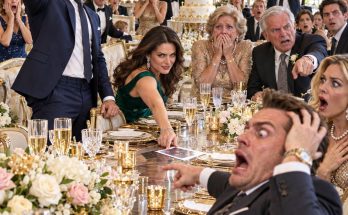
MY HUSBAND DISAPPEARED EVERY THURSDAY NIGHT FOR TWO YEARS, CLAIMING HE WAS PLAYING POKER WITH HIS FRIENDS—UNTIL I FOUND A $4,200 JEWELRY RECEIPT FOR A BRACELET HE NEVER GAVE ME. I FOLLOWED HIM TO A HOUSE ON MAPLE STREET, WHERE A WOMAN IN A RED DRESS KISSED HIM AT THE DOOR. THEN I SAW THE NAME ON HER MAILBOX: MY MAIDEN NAME. SHE LOOKED EXACTLY LIKE ME. SHAKING, I RUSHED HOME AND OPENED OUR WEDDING ALBUM. WHEN I SAW THE PHOTOGRAPH OF THE WOMAN STANDING BESIDE ME ON MY WEDDING DAY, I REALIZED THE TRUTH WAS FAR WORSE THAN AN AFFAIR—BECAUSE THE WOMAN MY HUSBAND HAD BEEN VISITING EVERY THURSDAY WAS SOMEONE MY FAMILY HAD BURIED IN LIES FOR THIRTY-FOUR YEARS…
— THE THURSDAY NIGHT LIE
For two years, my husband disappeared every Thursday night.
His explanation never changed.
“Poker with the guys, sweetheart. Don’t wait up.”
And for two years, I believed him.
My name is Emily Carter. I was thirty-four when I discovered that the marriage I thought I understood was hiding a secret that reached back farther than my wedding day, farther than my husband’s first Thursday-night excuse, and even farther than my earliest childhood memory.
My husband, Michael, was the kind of man people trusted immediately.
He remembered birthdays. He held doors open for strangers. He called my mother on holidays and sent flowers to my office when I had a difficult week.
When we married, people said I had found a good one.
I believed them.
We had been married for six years. We lived in a comfortable house outside Chicago, with a white front porch, a small garden, and a kitchen where Michael made terrible pancakes every Sunday morning.
Our life wasn’t perfect, but I thought it was real.
Then came the Thursdays.
At first, they seemed harmless.
Michael would leave around six-thirty, wearing jeans and a clean shirt, carrying a small leather wallet he called his poker kit.
He would return around eleven.
Sometimes midnight.
Sometimes later.
He always smelled faintly of cologne and mint gum.
“How’d you do?” I’d ask.
“Terrible,” he’d say, dropping his keys into the bowl beside the door. “I should’ve stayed home.”
He made it sound ordinary.
Almost comforting.
I never asked many questions because I had my own life. I worked as an interior designer, managed clients, and spent too many evenings choosing paint colors for people who couldn’t decide between two shades of white.
Michael said his poker nights helped him unwind.
I wanted to trust him.
So I did.
Until the receipt.
It happened on a Tuesday morning in October.
Michael had left his work jacket draped over a dining chair. I picked it up to hang it in the closet and felt something crinkle in the pocket.
I pulled out a narrow white receipt.
At the top was the name of a jewelry store downtown.
Below it was a description of a bracelet.
18-karat gold. Diamond accents. Custom clasp.
The total was $4,200.
I read the amount twice.
Then a third time.
My birthday had been three months earlier.
Michael had taken me to dinner that night, kissed my forehead, and told me he had something special planned for the weekend.
The weekend came and went.
There was no bracelet.
No jewelry box.
No surprise.
When I asked, he’d laughed and said the gift had been delayed.
A week later, he told me he’d decided to spend the money on our kitchen renovation instead.
I hadn’t minded.
Or at least, I had told myself I didn’t.
Now I stood in our dining room, holding a receipt for a bracelet that cost more than our first month’s mortgage payment.
The purchase date was two weeks earlier.
A Thursday.
My fingers began to tremble.
I told myself there were innocent explanations.
Perhaps it was a gift for his mother.
Perhaps he had purchased it for a client.
Perhaps the receipt had ended up in the wrong pocket.
I could have asked him.
I should have asked him.
Instead, I placed the receipt back where I had found it.
And I began paying attention.
That Thursday, Michael kissed my cheek at six twenty-three.
“Poker night,” he said.
“Have fun.”
He smiled.
“You too.”
Then he walked out the door.
I waited five minutes.
Then I grabbed my keys.
I followed him.
He didn’t drive toward his friends’ usual neighborhood.
He didn’t stop at the bar where they sometimes met.
He drove through the city, crossed a bridge, and entered a quiet residential street lined with old maples.
He stopped in front of a pale-blue house.
I parked half a block away.
For several seconds, I watched him sit in his car.
He checked his phone.
Looked at the house.
Then got out.
He walked to the front door without knocking.
The door opened immediately.
A woman stood inside.
She wore a red dress.
Her dark hair fell over one shoulder.
She smiled at my husband as if she’d been waiting for him all evening.
Then she reached up, pulled him close, and kissed him.
I pressed my hand against my mouth.
My whole body went cold.
I raised my phone and took photographs through the windshield.
One.
Two.
Three.
Michael put his hand on the woman’s waist and stepped inside.
The door closed.
I sat in the car, unable to move.
Then I noticed the mailbox beside the front steps.
A brass nameplate was fixed to the front.
I leaned forward.
The streetlight illuminated the letters.
CARTER.
My maiden name.
The same surname printed on my birth certificate.
The same name I had used before I married Michael.
I stared at it, trying to make sense of what I was seeing.
Why would a woman who kissed my husband have my maiden name?
I looked more closely at the woman in the photographs on my phone.
Her height.
Her shoulders.
Her hair.
Even the way she tilted her head when she smiled.
Something about her felt horribly familiar.
I drove home with my hands shaking against the steering wheel.
I didn’t sleep.
Instead, I went upstairs, opened the closet, and pulled out our wedding album.
Michael and I had married in June, six years earlier.
My mother had cried throughout the ceremony.
My father had walked me down the aisle.
There had been flowers, champagne, speeches, and dozens of photographs.
I turned the pages slowly.
Then I reached the photograph taken just before the ceremony.
I stood in my wedding dress, smiling at the camera.
Beside me was a woman wearing a pale-blue dress.
Her arm was around my shoulders.
Her face was turned toward mine.
I had always thought the photograph captured my cousin Rachel.
But it wasn’t Rachel.
The woman’s face was almost identical to the face I had photographed on Maple Street.
The same eyes.
The same cheekbones.
The same small dimple near the left side of her mouth.
I stared at the photograph until my eyes blurred.
Then I turned the page.
There was another photograph.
My mother stood between the two women.
One was me.
The other was the woman in the red dress.
My mother’s expression was strange.
She wasn’t smiling.
She was crying.
And written in faded ink on the back of the photograph were five words:
“My girls. Forgive me someday.”
I dropped the album.
Because suddenly, I remembered something my mother had told me when I was nine years old.
I had been looking through an old family photograph box when I found a picture of two baby girls lying beside each other in hospital bassinets.
I asked my mother why there were two babies.
She snatched the photograph from my hand so quickly that I began to cry.
Then she knelt in front of me and said, “Some things are too painful to talk about, Emily.”
I never saw that photograph again.
Until that night, I had believed it was simply a family picture I had misunderstood.
Now I knew there had been another baby.
And I had a terrible feeling that the woman in the red dress was connected to her.
My phone vibrated.
A message from Michael.
Poker’s running late. Don’t wait up. Love you.
I stared at those words.
Then I looked at the photograph of my mother standing between two nearly identical daughters.
For the first time in six years of marriage, I didn’t feel jealous.
I felt afraid.
Because I no longer believed I was looking at an ordinary affair.
I believed my husband had found someone who knew a secret about me.
And whatever that secret was, my mother had spent thirty-four years trying to bury it.
PART 1 — THE WOMAN WHO WORE MY FACE
At seven in the morning, I called my mother.
She answered on the fourth ring.
“Emily? It’s early. Is everything okay?”
I wanted to tell her everything.
I wanted to ask why there was a woman who looked exactly like me living on Maple Street. Why that woman had my maiden name on her mailbox. Why she appeared in a photograph hidden inside my wedding album.
Instead, I asked the question that had frightened me all night.
“Mom, did I have a sister?”
Silence.
Not the ordinary silence of someone thinking.
This was different.
It was the silence of someone who had just heard a door open in a room they had kept locked for decades.
“Why are you asking me that?” she whispered.
My stomach tightened.
“Just answer me.”
“Emily, where did this come from?”
“Did I have a sister?”
I heard her take a shaky breath.
Then she said, “You need to come over.”
“Mom—”
“Not on the phone. Please.”
She hung up.
I stared at my screen.
My mother, Patricia Carter, had always been the center of my family.
She organized Thanksgiving.
She remembered everyone’s favorite desserts.
She kept photographs of my childhood arranged in chronological order, with dates written neatly on the backs.
She was the person I called when I couldn’t decide whether to accept a job, when I argued with Michael, and when I needed someone to remind me that I wasn’t failing at adulthood.
She had never seemed like a woman carrying a secret.
But that morning, her voice had sounded like someone standing at the edge of a cliff.
I called in sick to work and drove to her house.
She lived in the same brick home where I’d grown up. The curtains were still white. The flower beds were still filled with roses. The little ceramic bird still sat beside the front door.
Everything looked exactly as it had when I was a child.
That made what happened inside even worse.
My mother was waiting in the kitchen.
She had made coffee but hadn’t touched it.
When I entered, she looked at me for a long time.
Then she asked, “Did you find something?”
I placed the photograph on the table.
Her face drained of color.
She reached for the picture, but I moved it out of her reach.
“Who is she?”
My mother closed her eyes.
“Emily…”
“Who is she?”
She sat down slowly.
For several seconds, I thought she might deny everything.
Instead, she began to cry.
“Her name is Anna.”
The name landed between us like something heavy.
“Anna who?”
My mother pressed a hand to her mouth.
“Anna Carter.”
I stared at her.
“Why does she look like me?”
My mother looked up.
“Because she is your identical twin sister.”
I heard the refrigerator humming.
A car passing outside.
The small clock above the stove ticking.
Ordinary sounds continuing in a world that had just become unrecognizable.
I pulled out a chair and sat down.
“No.”
My mother nodded through her tears.
“No, that’s impossible.”
“I know.”
“You told me I was an only child.”
“I know.”
“You told me I was born alone.”
She lowered her head.
“I know.”
I stood so quickly that the chair scraped across the floor.
“You let me grow up believing I had no sister?”
My mother covered her face.
“I was trying to protect you.”
“From what?”
She didn’t answer.
“From what, Mom?”
She finally looked at me.
“Your father.”
My father, Robert Carter, had died when I was twenty-six.
He had been a quiet, hardworking man who repaired commercial buildings and spent weekends restoring old furniture in his garage.
He wasn’t affectionate in the way some fathers were, but he never missed my birthdays. He taught me how to ride a bicycle, helped me study for exams, and sat in the front row when I graduated from college.
I had loved him.
I had trusted him.
And now my mother was telling me that my father had been the reason I never knew my own sister existed.
“What did he do?” I asked.
My mother looked toward the window.
Then she began telling me a story that had been buried for thirty-four years.
PART 2 — THE BABY WHO WAS DECLARED DEAD
My mother gave birth to identical twin girls in the spring of 1992.
I was born first.
Anna arrived eleven minutes later.
Both babies were small, but healthy enough to be placed under observation.
My mother said she remembered holding us together for only a few minutes.
Two tiny faces.
Two pairs of closed eyes.
Two identical little hands curled against her hospital gown.
She had already chosen our names.
Emily Rose.
Anna Grace.
She said she cried because she couldn’t believe she had been given two daughters when she’d spent years wondering whether she’d ever become a mother at all.
My father was there that night.
He held us both.
He called us his miracles.
Then the doctors discovered that Anna needed specialized medical care.
There were concerns about her heart, and the hospital recommended transferring her to a larger medical center.
My mother agreed.
My father handled the paperwork.
The next morning, he returned to her room alone.
He told her Anna had suffered a sudden complication.
He said the doctors had tried everything.
He told her their second daughter had died.
My mother was still recovering from childbirth.
She was exhausted, frightened, and in no condition to challenge a hospital administrator or demand access to every record.
She asked to see Anna.
My father told her the hospital was handling the arrangements.
He said the medical staff needed time.
He said seeing the baby would only cause more pain.
Then he told her something else.
He said the doctors had found a rare hereditary condition.
He claimed the condition might affect me, too.
According to my mother, he insisted that the hospital had advised them to keep the information private until further testing could be done.
It was all a lie.
But my mother didn’t know that.
She spent months grieving a child she believed she had lost.
She kept Anna’s blanket.
She kept the little hospital bracelet.
She even bought a birthday cake every year on the day Anna was born, although she never told anyone why.
My father watched her suffer.
And he never corrected the story.
“Why?” I whispered when my mother finished.
She shook her head.
“I didn’t understand it then.”
“But you eventually found out?”
She nodded.
“Three years later.”
She explained that a letter arrived from a medical records office.
It was brief and confusing.
It referred to a discrepancy in the twins’ discharge documentation.
My mother asked my father about it.
He told her the hospital had made a clerical error.
She didn’t believe him.
She contacted the hospital herself.
The hospital had changed its administrative systems, and the records were difficult to retrieve. Some documents were missing. Others required formal authorization.
But one nurse remembered the case.
The nurse told my mother that Anna had been transferred alive.
There was no record of a death.
My mother confronted my father again.
This time, he admitted that Anna had survived.
But he refused to explain where she had gone.
He said a private family had taken responsibility for the child’s care.
He insisted that it had been necessary.
He claimed Anna would have access to better medical treatment and financial support.
My mother demanded to know the family’s name.
My father refused.
Then he threatened to leave.
He told her that if she continued asking questions, he would make sure she lost custody of me.
He said he had enough money and influence to convince people she was unstable.
My mother was frightened.
She had no independent income.
She was caring for a young child.
And she believed my father had already proved he was willing to manipulate medical records.
So she stopped asking questions.
Or tried to.
For years, she searched quietly.
She wrote letters.
She contacted social services.
She hired an attorney for a short time, but she couldn’t afford to continue.
Every trail ended.
Eventually, my father told her that Anna had been adopted by a family in another state.
He said the adoption was closed.
He said there was no legal way to contact her.
My mother didn’t know whether that was true.
She only knew that challenging him seemed to put me at risk.
So she stayed.
She raised me.
She watched me grow up.
And every year, on my birthday, she wondered what Anna looked like.
Whether she laughed like me.
Whether she liked the same foods.
Whether she ever asked why her parents had given her away.
My mother looked at me across the kitchen table.
“I wanted to tell you,” she whispered.
“When?”
“When you were old enough.”
“I was old enough at eighteen. I was old enough at twenty-five. I was old enough when I got married.”
Tears slid down her face.
“I know.”
“Did you ever stop looking?”
She shook her head.
“No.”
I thought about the woman on Maple Street.
The woman who had kissed my husband.
The woman who had my face.
“Then how did Michael find her?”
My mother went completely still.
I leaned forward.
“Mom, how did my husband find my sister?”
She looked at me as if she had been dreading that question for years.
Then she whispered:
“Because your father may have known Michael’s family.”
PART 3 — WHY MY HUSBAND CHOSE THURSDAY
I drove home with my mother’s words echoing in my head.
Your father may have known Michael’s family.
When I entered the house, Michael was in the kitchen, making coffee.
He looked up and smiled.
“Hey, sweetheart. You’re home early.”
For one irrational second, I wanted to pretend everything was normal.
I wanted to put my arms around him and ask whether he wanted eggs.
I wanted to forget the photographs, the receipt, and the woman in the red dress.
Instead, I looked at him and asked, “Who is Anna?”
His hand stopped over the coffee machine.
It was only a second.
A tiny pause.
But I saw it.
His expression changed.
“Anna?”
“My sister.”
He set down the coffee pot.
“Emily, what are you talking about?”
I took out my phone and showed him the photographs from Maple Street.
He stared at the screen.
The silence that followed was the answer I had been afraid of.
“You knew,” I whispered.
He looked up.
“Please let me explain.”
“You knew who she was.”
“Yes.”
“How long?”
He rubbed his forehead.
“Emily—”
“How long, Michael?”
He closed his eyes.
“Almost three years.”
I stepped backward.
Three years.
We had been married for six.
For half of our marriage, my husband had known my twin sister existed.
He had visited her every Thursday night.
He had bought her a $4,200 bracelet.
And he had watched me celebrate my birthday without telling me that he had spent thousands of dollars on a woman who looked exactly like me.
I felt something inside me collapse.
“Are you having an affair with her?”
“No.”
“Then why does she kiss you?”
He looked down.
“Because she was saying goodbye.”
I laughed once, bitterly.
“Goodbye to what?”
He didn’t answer.
“Why every Thursday?”
Michael pulled out a chair.
“Please sit down.”
“I don’t want to sit down.”
He nodded.
Then he said, “I met Anna while I was researching a property development project.”
I stared at him.
“What does that have to do with anything?”
“Three years ago, my company was considering renovating an old medical building. The previous owner had donated some of the property to a charitable trust. Anna was working with that trust.”
He took a breath.
“She was looking for someone who could help her trace her original records.”
“Why you?”
“Because the building’s archives included documents connected to the hospital where you and Anna were born.”
I stared at him.
He continued.
“At first, I didn’t know she was your sister. She only knew she had been born in Illinois and had been told her biological parents were dead.”
My chest tightened.
“Her parents were not dead.”
“I know.”
“Did you tell her?”
“Not immediately.”
I looked at him in disbelief.
“What does that mean?”
Michael swallowed.
“Anna had a photograph of her birth mother. Your mother. She had been told that the woman in the picture was a nurse who had helped with her adoption.”
I felt sick.
“She thought my mother was a nurse?”
“Yes.”
“And you knew the truth?”
“Not at first.”
I stared at him.
“When did you find out?”
He looked directly at me.
“When I saw your wedding photograph in her apartment.”
My heart pounded.
The woman in the red dress had the photograph.
Michael had seen it.
He had recognized me.
And instead of telling me, he had kept visiting her.
I sat down slowly.
“What happened then?”
He took a breath.
“I asked her where she’d gotten it. She said it had been inside a box of documents her adoptive parents gave her.”
“Her adoptive parents?”
“Yes. They died when she was young. She had spent years trying to learn about her birth family.”
I looked at the receipt still lying on the kitchen table.
“And the bracelet?”
Michael’s face crumpled.
“It was for her.”
I stared at him.
“You bought my sister a $4,200 bracelet and lied to me about poker for two years.”
“Yes.”
“Why?”
He looked at me with tears in his eyes.
“Because she was going to undergo a major medical procedure. She wanted something that connected her to the family she had never known.”
I shook my head.
“You could have told me.”
“I know.”
“You could have brought her here.”
“I know.”
“You could have said, ‘Emily, you have a sister.’”
He lowered his head.
“I know.”
I stood.
“Then why didn’t you?”
Michael looked up.
And for the first time, I saw fear in his eyes.
“Because your father contacted me before he died.”
I felt cold.
“My father died eight years ago.”
“I know.”
“What did he say?”
Michael took a shaky breath.
“He told me that if I ever discovered the truth about Anna, I must never tell you.”
PART 4 — THE PROMISE MY HUSBAND SHOULD NEVER HAVE MADE
I stared at Michael.
“My father contacted you eight years ago?”
He nodded.
“Before we got married.”
I felt as though the room had tilted.
“Why would he contact you?”
“Your father and mine knew each other. They worked on a commercial property deal years ago. I didn’t realize how closely they were connected until much later.”
“My father was a building contractor. Yours owned a small insurance agency. They weren’t friends.”
“They weren’t close friends,” Michael corrected. “But they knew each other.”
I didn’t care about the distinction.
“What did my father ask you to do?”
Michael looked toward the stairs.
Then he said, “He told me there was a family secret. He said you had a twin sister who had been adopted, and that you believed she had died.”
I gripped the back of a chair.
“He told you that before our wedding?”
“Yes.”
“And you married me anyway?”
His eyes filled.
“I loved you.”
“Then you should have told me.”
“I should have.”
“Why didn’t you?”
Michael looked down at his hands.
“Your father said the truth would destroy your mother. He said she had suffered a breakdown after Anna’s birth and that she couldn’t cope with the possibility of seeing her daughter again.”
I shook my head.
“My mother never had a breakdown.”
“I know that now.”
“You didn’t know her?”
“Not well. I only knew what your father told me.”
I laughed without humor.
“So you trusted a man who lied to his own daughter about her twin sister.”
Michael flinched.
“I was young. I was trying to protect you.”
“No. You were trying to decide what I was allowed to know.”
He had no answer.
I looked at him for a long time.
Then I asked, “When did you start visiting Anna every Thursday?”
He swallowed.
“About three years ago.”
“And why Thursday?”
“That’s the day she was available.”
“Every Thursday for two years?”
“Yes.”
“What did you do there?”
He hesitated.
“We reviewed records. Talked about her medical history. Looked through documents. Sometimes we just talked.”
“Did you kiss her?”
“No.”
“I saw her kiss you.”
“She kissed my cheek that night.”
“That is not what it looked like.”
“I understand.”
I shook my head.
“Did you ever sleep with her?”
“No. Never.”
I wanted to believe him.
That was the most painful part.
Even after everything, a part of me still wanted the explanation to be true.
But trust doesn’t disappear in one dramatic moment.
It erodes.
It breaks in the small spaces between questions and answers, until one day you realize you no longer know how to tell the difference between a truth and a well-rehearsed lie.
I picked up my phone.
“I want to meet her.”
Michael nodded.
“I can arrange that.”
“No. You don’t arrange anything for me anymore.”
He looked wounded.
I didn’t care.
“I will contact her myself.”
I went upstairs and locked the bedroom door.
For the first time since our wedding, I didn’t want Michael beside me.
I sat on the edge of the bed and stared at the wall.
My sister was alive.
My father had known.
My mother had been forced to live with a lie.
And my husband had spent years meeting the one person in the world who shared my face.
I wondered what Anna knew about me.
Did she know my favorite color?
Had she seen photographs of my childhood?
Had she wondered what it would feel like to stand beside me?
Had she ever been angry that I had grown up with a mother while she grew up without one?
I imagined her sitting in that pale-blue house, looking at photographs of a family she had never met.
Then I remembered the way she had kissed Michael.
The tenderness of it.
The familiarity.
And I felt a fresh wave of confusion.
I called the number on the Maple Street property records.
A woman answered.
“Hello?”
I recognized her voice immediately.
It was the woman from the doorway.
“Anna?”
Silence.
Then, softly, “Emily?”
My throat tightened.
“Yes.”
Neither of us spoke.
Finally, Anna whispered, “I was wondering when you’d call.”
I closed my eyes.
“Why did you kiss my husband?”
She exhaled shakily.
“Because he was the only person who had kept a promise to me.”
I gripped the phone.
“What promise?”
“To help me find my family.”
I swallowed.
“Why didn’t he tell me?”
“Because he promised your father he wouldn’t.”
I looked toward the bedroom door.
Then Anna said something I would remember for the rest of my life.
“Emily, there’s something else you need to know.”
“What?”
“I didn’t ask Michael to find you.”
I frowned.
“What do you mean?”
“I was looking for you long before I met him.”
My heart began to pound.
“How long?”
Anna’s voice broke.
“Since I was eighteen.”
I sat down.
She continued.
“I found a document in my adoptive parents’ safe. It had your mother’s name on it. And yours.”
I stared at the floor.
“What did it say?”
Anna was quiet for several seconds.
Then she whispered:
“It said that one day, if I found my sister, I should tell her why our father separated us.”
PART 5 — THE HOUSE ON MAPLE STREET
I met Anna the following Saturday.
I drove to Maple Street alone.
The pale-blue house looked smaller in daylight. Its porch needed painting, and a row of white flowers grew beside the walkway.
The mailbox still carried the name CARTER.
I stood outside for almost a minute before knocking.
Anna opened the door.
For a moment, we simply stared at each other.
It was unsettling.
Not because we looked vaguely alike.
We didn’t.
We looked exactly alike.
The same dark-brown eyes.
The same narrow chin.
The same small dimple beside the left corner of our mouths.
The same tiny crescent-shaped birthmark near the collarbone.
I had spent thirty-four years looking at my reflection.
Now my reflection was standing in front of me, wearing a red sweater and holding a cup of tea.
Anna began to cry.
I didn’t know what to do.
So I cried too.
She stepped aside.
“Come in.”
The house smelled of cinnamon and old books.
Photographs covered one wall.
Some showed Anna as a child.
Others showed the couple who had adopted her.
There was a picture of her graduation, one of her first apartment, and another of her standing beside a hospital bed.
On a small shelf near the window sat a photograph of my mother.
I walked toward it.
My mother looked younger.
She was holding a baby wrapped in a yellow blanket.
Anna stood beside me.
“That was the only picture I had of her for years.”
I swallowed.
“Did your adoptive parents tell you she was your birth mother?”
“No. They told me I had been adopted as a newborn. They said my biological parents had died.”
“Why would they say that?”
“They believed it was true.”
Anna sat on the couch.
“They were kind people, Emily. They loved me. They never treated me like I was anything less than their daughter.”
I sat opposite her.
“Then why did you start searching?”
She looked down.
“Because I wanted to know where I came from.”
She explained that when she turned eighteen, she asked her adoptive parents for her adoption records.
They gave her everything they had.
There was a hospital document, an old photograph, and a sealed envelope containing a handwritten note.
The note said her biological mother had wanted to keep both children but had been unable to do so.
It didn’t explain why.
It contained my mother’s name.
And it contained a warning.
If you ever find your sister, please do not blame her for what happened.
Anna had read those words hundreds of times.
She had wondered what kind of person I was.
Whether I knew about her.
Whether I had grown up believing I was an only child.
Whether I hated her.
“Did you?” I asked.
Anna looked confused.
“Did I what?”
“Hate me?”
Her eyes filled.
“No.”
“Not even a little?”
She shook her head.
“I didn’t know you. How could I hate you?”
I looked away.
“I don’t know. Maybe because I had everything you didn’t.”
Anna was quiet for a moment.
Then she said, “I had parents who loved me. I had a home. I had a good childhood. What I didn’t have was the truth.”
I looked at her.
She continued.
“I wasn’t searching for someone to blame. I was searching for someone who might know why my life began with a lie.”
I felt ashamed.
I’d spent days imagining her as a threat.
A woman who had stolen my husband’s attention.
Someone who had deliberately entered my life.
But Anna had been searching for the same thing I was.
An explanation.
I looked around the room.
“Why the red dress?”
She smiled faintly.
“Michael told me you might follow him.”
I stared.
“He told you that?”
“Not at first. But a few weeks ago, he said he couldn’t keep lying to you. He thought you might discover the receipt.”
I felt my face grow hot.
“So you planned this?”
“No. I bought the dress because I wanted to meet you looking like myself, not like a woman waiting to be rescued.”
She paused.
“Michael said I should wear something bright. Something you’d remember.”
I looked at her.
“And the kiss?”
Anna lowered her head.
“I kissed his cheek because he had just told me he was going to tell you everything. I was grateful. He had spent two years helping me find records, contacting lawyers, and tracking down people who remembered my adoption.”
I stared at the photographs on the wall.
For two years, I had believed my husband was secretly betraying me.
Instead, he had been helping my twin sister find the truth about her birth.
But he had done it by keeping the truth from me.
I looked at Anna.
“Do you think he was right to hide it?”
She shook her head.
“No.”
“Then why did you let him?”
“Because I was afraid you’d reject me.”
Her voice cracked.
“I had spent my entire life being told my birth family was gone. When I discovered you were alive, I couldn’t bear the thought of you looking at me and seeing a stranger who had no right to be there.”
I felt tears gather in my eyes.
“You are not a stranger.”
Anna looked at me.
I reached for her hand.
“You’re my sister.”
She broke down.
And for the first time in thirty-four years, I held my twin sister.
Neither of us knew how long we stayed that way.
But when we finally pulled apart, Anna wiped her cheeks and smiled.
“There’s something I need to show you.”
She went into the bedroom and returned carrying a wooden box.
Inside were old documents, photographs, letters, and a small envelope sealed with yellowed tape.
She handed me the envelope.
On the front, in my father’s handwriting, were the words:
FOR EMILY AND ANNA — WHEN THEY ARE OLD ENOUGH TO KNOW THE TRUTH.
My hands began to shake.
“Where did you get this?”
“It was inside the box my adoptive parents gave me. They told me not to open it until I was ready.”
I stared at the envelope.
“Have you read it?”
Anna shook her head.
“I wanted us to open it together.”
I slid my finger beneath the seal.
Inside was a letter.
And the first sentence made my blood run cold.
My daughters, if you are reading this, then the lie I created has survived longer than I ever intended.
PART 6 — THE LETTER THAT CHANGED EVERYTHING
I read the letter aloud.
My father’s handwriting was neat, almost formal.
My daughters,
I do not expect forgiveness. I am not writing to defend what I did. I am writing because you deserve the truth, and because I have spent too many years convincing myself that silence was the same as protection.
When you were born, Anna required medical care that your mother and I could not afford.
I stopped.
Anna sat beside me, gripping the edge of the couch.
I continued.
I was frightened. I had lost my job, our savings were nearly gone, and the hospital told us that Anna’s treatment might require years of specialist care.
An old business associate, a man named Edward Hayes, offered to help. He and his wife had been unable to have children. They had money, medical connections, and a home that could provide Anna with the care I feared we could not.
I told myself that placing Anna with them would save her life.
My voice faltered.
The letter continued.
I agreed to a private arrangement before I fully understood the consequences. I told your mother that Anna had died because I believed the truth would destroy her. I convinced myself that if she grieved a death, she might eventually recover, while the knowledge that one daughter was growing up somewhere else would keep her in permanent pain.
I looked at Anna.
Her face was wet with tears.
My father had turned a terrible choice into a permanent lie.
I was wrong.
Those three words were written alone on the next line.
I continued reading.
Your mother never recovered from the loss I invented. I watched her keep Anna’s blanket, save money for a child she believed was buried, and look at Emily with love mixed with a sadness she could never explain.
My throat closed.
I remembered my mother holding me when I had nightmares.
I remembered her crying quietly on certain birthdays.
I remembered her becoming distant whenever someone mentioned twins.
I had thought she was simply a sentimental woman.
Now I understood that she had been grieving a daughter who was alive.
As Anna grew older, the Hayes family became attached to her. They wanted to adopt her legally. I agreed, but I was afraid the truth would come out.
I signed documents I should never have signed. I allowed people to believe that Anna’s birth family could not be located. When your mother discovered the truth, I threatened her because I feared losing both children and the life I had built.
I lowered the letter.
Anna whispered, “He knew.”
I nodded.
I continued.
Years later, I realized that my greatest mistake was not the original decision. It was the lie I built around it. Each year, I told myself that telling the truth would cause more pain than leaving things alone.
But every year, the truth became harder to tell.
I cannot ask either of you to forgive me. I can only ask that you do not spend your lives punishing yourselves for what I did.
At the bottom of the page was a final paragraph.
There is one more truth. Edward Hayes did not simply offer to help us. He asked me to keep Anna’s identity hidden because he feared that his own family would lose control of the medical foundation that funded her care. I accepted his money, and in return, I agreed to remain silent.
I stopped reading.
Anna stared at me.
“Medical foundation?”
I nodded slowly.
The same kind of foundation that had appeared in Michael’s research.
The same organization connected to the old medical building.
I looked at the date on the letter.
It had been written only months before my father’s death.
At the bottom was an address.
A law office in Chicago.
And a note:
If you want to know what happened after the adoption, speak to Helen Brooks. She has the original records.
Anna reached for the letter.
“Do you think Helen is still alive?”
“I don’t know.”
I looked at the address.
“But we’re going to find out.”
PART 7 — THE WOMAN WHO HAD BEEN WAITING FOR US
Helen Brooks was eighty-one years old.
She lived in a retirement community outside Chicago, in a small apartment filled with plants and framed photographs.
When Anna and I arrived, she was waiting by the window.
She looked at us.
Then she began to cry.
“Oh, my goodness,” she whispered. “You really did find each other.”
Anna stepped forward.
“You know who we are?”
Helen nodded.
“I’ve been hoping this day would come.”
I felt anger rise.
“Then why didn’t you tell us?”
Helen accepted the question without defending herself.
“Because I was a coward.”
She invited us to sit.
Then she explained that she had worked in the hospital’s medical records department when Anna was born.
She remembered the twins.
She remembered the transfer.
And she remembered my father signing documents that did not accurately describe what had happened.
But she had not been the person who decided Anna should be separated from us.
That decision had been made by adults who believed they knew what was best for everyone involved.
Some had wanted to help.
Others had wanted money, privacy, or control.
And once the first lie was told, everyone became frightened of being the person who exposed it.
Helen had kept copies of the original paperwork because she suspected something was wrong.
She had never expected to be asked about it again.
“Why didn’t you give the records to my mother?” I asked.
Helen looked down.
“I should have.”
“Did my father threaten you?”
“Not directly. But he told me that if I interfered, the hospital could lose funding and people could lose their jobs. I had a family. I was afraid.”
I stared at her.
“So everyone was afraid, and my mother was left to suffer.”
Helen began crying.
“Yes.”
She opened a drawer and removed a folder.
Inside were copies of medical documents, correspondence, and a record showing that Anna had been transferred to another hospital alive.
There was no death certificate.
No burial record.
No evidence that Anna had died.
Instead, there was a signed agreement outlining temporary care arrangements.
The agreement had later been altered.
A signature had been added.
A date had been changed.
The paperwork had been used to make it appear that Anna’s biological family could not be contacted.
Helen handed me another document.
It was a letter from Edward Hayes, Anna’s adoptive father.
Robert,
We agreed that Anna would receive the care she needs and that her identity would remain protected until she is old enough to make her own decisions.
I never agreed that Patricia should be told her child had died.
You must tell her the truth.
The letter was dated three years after Anna’s birth.
My father had known the truth was wrong.
He had been told to correct it.
He hadn’t.
Anna covered her mouth.
“Did my adoptive father know my mother was alive?”
Helen nodded.
“He did.”
“Then why did he never tell me?”
“From what I understand, he believed your biological father would eventually come forward. He didn’t want to interfere while you were a child. Later, he became ill, and your adoptive mother was afraid the truth would destabilize your life.”
Anna looked down.
“So everyone kept waiting for someone else to tell me.”
Helen reached for her hand.
“Yes.”
I looked at the documents.
One page contained the name of the charitable trust that had paid for Anna’s medical care.
The trust had been established by Edward Hayes.
Its purpose was to provide treatment for children whose families could not afford specialized medical services.
Over the years, the trust had funded hospitals, rehabilitation programs, and medical research.
It had also supported the building where Michael had first encountered Anna.
I looked at Helen.
“Who manages the trust now?”
“An independent board.”
“Does it still have original records?”
“I believe so.”
Anna looked at me.
“Why does that matter?”
I pointed to the papers.
“Because if my father altered these records, someone may have used those changes to control what happened to you.”
Helen nodded slowly.
“That’s possible. But you will need a qualified attorney to determine what can still be established.”
I thanked her.
Before we left, she asked us to wait.
She went to her bedroom and returned with a small white envelope.
“This was given to me by Edward Hayes shortly before he died,” she said. “He told me that if the sisters ever found each other, I should give it to them.”
Inside was a photograph of two little girls.
One wore a yellow blanket.
The other wore a white one.
They were lying side by side in bassinets.
On the back was a handwritten note:
They deserve to know they were loved from the beginning.
Anna began to sob.
I held her hand.
For thirty-four years, I had believed I was an only child.
For thirty-four years, Anna had wondered where she came from.
Now we were learning that the truth had never been lost.
It had been kept.
By people who had convinced themselves that silence was kinder than honesty.
And as I looked at the photograph of the two babies, I realized the hardest part of our story wasn’t that we had been separated.
It was that so many people had known we belonged together—and had allowed us to grow up believing otherwise.
PART 8 — THE $4,200 BRACELET
When I confronted Michael again, I brought the documents from Helen’s folder.
He read them in silence.
Then he sat down.
“I didn’t know it was this bad,” he said.
I stood across from him.
“You knew my father had lied.”
“Yes.”
“You knew Anna was my sister.”
“Yes.”
“You knew she was looking for me.”
“Yes.”
“And you still decided I wasn’t allowed to know.”
He looked up.
“I thought I was protecting you.”
“From what? Having a sister?”
“From being hurt.”
I laughed bitterly.
“Michael, I was hurt every Thursday night for two years. I was hurt when I found that receipt. I was hurt when I followed you and watched another woman kiss you. I was hurt when I realized you had shared a secret with my sister that you wouldn’t share with your own wife.”
He closed his eyes.
“I know.”
“No, you don’t. Because you still think the problem was that I found out. The problem was that you kept the truth from me.”
He nodded.
“You’re right.”
For once, he didn’t offer another explanation.
He didn’t say he had meant well.
He didn’t tell me I was overreacting.
He simply sat there and accepted what I was saying.
It didn’t repair our marriage.
But it was the first honest conversation we’d had in years.
I asked him about the bracelet.
He went to his study and returned with a photograph of the jewelry box.
“I bought it for Anna because she was about to undergo surgery,” he said. “She wanted something that would remind her she wasn’t alone.”
“What kind of surgery?”
He explained that Anna had been dealing with a medical condition that required careful monitoring and treatment. She had recently undergone a significant procedure, and the bracelet was meant to celebrate the milestone.
I stared at the picture.
It was a delicate gold bracelet with a small oval charm.
I turned the image over.
There was an inscription.
TWO HEARTS. ONE BEGINNING.
My eyes filled.
It wasn’t a romantic gift.
It was a symbol of the bond we’d never known we shared.
But the receipt still hurt.
“Why did you tell me you’d spent the money on the kitchen renovation?”
Michael looked down.
“Because I knew you’d ask questions.”
“So you lied.”
“Yes.”
“And every Thursday you went to Maple Street, you told me you were playing poker.”
“Yes.”
I swallowed.
“You could have trusted me with the truth.”
He looked at me.
“I should have.”
For the next several days, I stayed at my mother’s house.
I needed space to decide what came next.
Michael didn’t pressure me.
He sent one message each morning.
I’m here when you’re ready to talk.
I didn’t respond immediately.
I wasn’t sure whether our marriage could survive what had happened.
I loved him.
But love was no longer enough to answer the question of whether I could trust him again.
Anna visited me at my mother’s house on Sunday.
She brought a small paper bag.
Inside was a matching bracelet.
Not identical to hers, but made by the same jeweler.
She had purchased it herself.
“I know this doesn’t fix anything,” she said. “And I know the way you found out was awful.”
I looked at the bracelet.
“Why did you buy this?”
She smiled sadly.
“Because I’ve spent my whole life wondering whether I had a sister. Now I know I do.”
She took my hand.
“I don’t want us to spend another year apart because of the choices other people made.”
I began to cry.
Anna placed the bracelet in my palm.
“You don’t have to wear it,” she said. “You don’t have to forgive anyone today. I just wanted you to have something that belonged to the beginning of our story—not the lies.”
I closed my fingers around it.
For the first time, I understood what the $4,200 bracelet had meant.
It wasn’t a symbol of betrayal.
It was a symbol of a reunion that had been delayed for thirty-four years.
The betrayal had been the lie surrounding it.
PART 9 — THE SECRET MY MOTHER HAD NEVER TOLD ANYONE
My mother met Anna two weeks later.
I had worried about that meeting more than I wanted to admit.
What if Anna blamed her?
What if my mother couldn’t bear to see the daughter she’d spent decades mourning?
What if they stood in the same room and felt only anger?
Instead, when Anna walked through the front door, my mother began to shake.
She stood in the living room, staring at her daughter.
Anna stopped a few feet away.
“Hi, Mom.”
My mother covered her mouth.
Then she crossed the room and wrapped her arms around Anna.
She held her so tightly that Anna began crying.
“I’m sorry,” my mother whispered. “I’m so sorry.”
Anna shook her head.
“You didn’t know what was happening.”
“I should have fought harder.”
“You were scared.”
“I let too much time pass.”
Anna pulled back and looked at her.
“Then don’t let any more pass.”
My mother broke down.
I watched them embrace.
For years, my mother had carried the weight of a child she believed was dead.
Now that child was standing in her living room.
Alive.
Grown.
With the same eyes and smile.
They sat together for hours.
My mother told Anna about the day she was born.
The yellow blanket.
The tiny hospital bracelet.
The song she’d hummed while rocking me to sleep.
Anna told her about her adoptive parents.
The garden they had planted together.
The birthday cakes.
The stories.
The way they had loved her even when they couldn’t answer her questions.
My mother listened carefully.
She didn’t ask Anna to choose between families.
She didn’t pretend that love could erase the years of separation.
Instead, she asked Anna to tell her about her childhood.
Every detail.
Every ordinary memory.
She wanted to know what she had missed.
And Anna answered.
By the time evening came, my mother was holding Anna’s hand as though she were afraid that if she let go, someone might take her away again.
Before Anna left, my mother asked her to come back the following Sunday.
Anna smiled.
“I will.”
My mother looked at me.
Then she said, “There’s something else I need to tell you.”
My stomach tightened.
“Another secret?”
She nodded.
“I found out the truth about your father shortly before he died.”
I sat down.
“What do you mean?”
My mother explained that after my father became ill, he began sorting through old files.
One afternoon, she found a folder hidden inside a locked drawer.
It contained letters, medical records, and financial documents.
She realized that the adoption arrangement had involved more than medical care.
Edward Hayes had helped fund my father’s failing construction business.
In exchange, my father had agreed to maintain the secrecy surrounding Anna’s adoption.
The agreement had not been a formal payment for a child, but it had tied my father’s financial future to the promise that the family would remain separated.
When the business collapsed, my father became desperate.
He feared losing the money and the reputation he had built.
He feared being exposed.
And rather than admit that he had made a terrible mistake, he continued the lie.
“Did you confront him?” I asked.
My mother nodded.
“He said he was going to fix everything.”
“Did you believe him?”
“I wanted to.”
She looked down.
“He told me he had written a letter for you and Anna. He said he would contact a lawyer and make arrangements for the truth to be disclosed.”
I swallowed.
“But he never did.”
“No.”
“Why?”
My mother shook her head.
“I don’t know whether he changed his mind or whether he simply ran out of time. He died before he could do anything.”
I thought about the letter we’d found.
My father had acknowledged the lie.
He had admitted that he had hurt us.
But he had still left the truth buried until someone else uncovered it.
I felt a complicated sadness.
I didn’t hate my father.
I remembered the man who taught me to ride a bicycle.
The man who stood in the rain when I graduated.
The man who once stayed awake all night when I had a fever.
Those memories were real.
So was the harm he had caused.
I had spent my life believing that a person had to be either good or bad.
Now I understood that people could love you and still make choices that hurt you.
That understanding didn’t excuse what my father had done.
But it helped me stop treating my childhood memories as though they were all lies.
Some moments had been genuine.
Some had been damaged by the secret he kept.
And both truths could exist at the same time.
PART 10 — THE FINAL SECRET INSIDE THE BRACELET
Three months after I discovered Anna, she called me late one evening.
Her voice sounded different.
Not frightened.
Not sad.
Urgent.
“Emily, can you come over?”
“What’s wrong?”
“I found something in the paperwork from my adoptive parents.”
I drove to Maple Street immediately.
Anna was sitting at the dining table with several documents spread before her.
The gold bracelet lay beside them.
I looked at it.
“What happened?”
She pointed to a page.
“This is a record of the original trust Edward Hayes established for my medical care.”
I sat down.
The trust had been created shortly after Anna’s adoption. It was intended to cover medical expenses, education, and future support.
But the document listed two beneficiaries.
Not one.
ANNA GRACE CARTER.
EMILY ROSE CARTER.
I stared at the names.
“What?”
Anna nodded.
“Your father added you as a beneficiary years later.”
I looked at the date.
It was five years after my birth.
“Why would he do that?”
“I don’t know yet.”
The document referred to a separate account managed by a legal trustee.
It also mentioned a sealed instruction letter that would be released when both beneficiaries were located.
I stared at Anna.
“Do you have the letter?”
She nodded.
“My adoptive father kept it in the same box as my adoption records. I thought it was a medical document.”
She handed it to me.
The envelope bore the seal of a law firm that had since merged with another practice.
Inside was a short letter written by Edward Hayes.
To the legal representative of the Carter children,
If both Emily and Anna are located, please inform them that the original purpose of this trust was to ensure neither child would be financially disadvantaged by the circumstances of their separation.
The funds are intended to support education, medical care, and reasonable living expenses for both beneficiaries.
No parent, guardian, or family member should be permitted to use the trust as leverage over either child.
I read the last sentence twice.
Then I looked at Anna.
“Someone was supposed to protect us.”
She nodded.
“And someone was supposed to make sure the money belonged to us.”
We contacted the law firm.
After several weeks of document retrieval and verification, an attorney confirmed that the trust had existed for decades.
It had been funded through a combination of donations, insurance payments, and assets contributed by Edward Hayes.
The records were incomplete, and some transactions required further investigation.
But there was enough evidence to justify a formal review.
The attorney explained that my father had never been the sole owner of the trust funds.
He had been authorized to provide information and assist with certain administrative matters.
He had not been authorized to conceal the existence of a beneficiary.
And he had not been authorized to redirect trust assets for personal use.
I felt sick.
“Did he take money from us?”
The attorney was careful.
“We cannot conclude that from these documents alone. We need a complete accounting.”
We agreed to proceed.
Over the following months, financial specialists reviewed the available records.
They found that several transfers had been made through accounts connected to businesses my father once controlled.
Some had legitimate explanations.
Others could not be adequately documented.
The investigation did not produce a simple villain or a single dramatic confession.
It produced something more complicated.
A trail of decisions.
Some made out of fear.
Some made out of greed.
Some made because people had assumed nobody would ever ask questions.
The trust was eventually restructured under independent supervision.
Both Anna and I were formally recognized as beneficiaries.
The remaining assets were protected for our future.
It wasn’t a fortune that would change our lives overnight.
It was something more meaningful.
Proof that our futures had been considered even while our identities were hidden.
Then the attorney called with one final discovery.
There was an additional document attached to the trust.
A handwritten instruction from Edward Hayes.
It said that when both sisters were reunited, they should be given a sealed package held in a storage facility.
Anna and I went together.
The package contained a small wooden box.
Inside were two silver baby bracelets.
One had my name engraved on it.
The other had Anna’s.
There were also two letters.
One was addressed to me.
The other to Anna.
We sat in the car outside the storage facility and opened them together.
My letter was short.
Emily,
You may have spent your life believing you were an only child. If so, I am sorry that the adults around you allowed that belief to become a wall between you and your sister.
You were never responsible for what happened.
You were never supposed to carry the guilt.
If you have found Anna, please remember that she did not take anything from you. She was a child, just as you were.
I hope you can give each other the one thing none of us could give you when you were young: the freedom to know one another without fear.
Edward.
Anna held her letter against her chest.
She couldn’t speak.
I looked at the two baby bracelets resting in the box.
For thirty-four years, they had been separated.
One in a storage facility.
One in a family story that had never been true.
Now they were together.
And so were we.
PART 11 — THE MARRIAGE I COULDN’T SAVE WITH LOVE ALONE
Michael and I began counseling.
I wasn’t sure I wanted to stay married.
I loved him, but I didn’t know how to rebuild trust after discovering that he had knowingly withheld such an important truth.
He had not been having an affair.
That mattered.
But it didn’t erase the deception.
During one session, our counselor asked Michael why he hadn’t told me about Anna.
He answered honestly.
“Because I was afraid.”
“Afraid of what?” she asked.
“Afraid Emily would be hurt. Afraid she’d confront her father. Afraid I’d lose her if I told her the truth.”
The counselor looked at him.
“So you chose the one thing that guaranteed she would eventually be hurt.”
Michael lowered his head.
“Yes.”
I began crying.
Not because he had said something cruel.
Because he had finally said something true.
He had convinced himself that silence was an act of love.
He had decided that protecting me meant making choices for me.
And in doing so, he had repeated the same mistake my father made.
Both men had loved me.
Both had believed they knew what was best for me.
Both had used that belief to deny me the truth.
I looked at Michael.
“I don’t need you to protect me from difficult things.”
He nodded.
“I know.”
“I need you to trust me enough to face them with me.”
“I understand.”
“And if you ever hide something like this from me again, I don’t know if our marriage will survive it.”
He looked directly at me.
“I understand that too.”
For the first time, I believed he understood the seriousness of what he’d done.
But understanding wasn’t the same as repair.
Repair took time.
It took conversations neither of us wanted to have.
It took Michael answering questions without becoming defensive.
It took me admitting that I still loved him even when I was angry.
It took learning that forgiveness did not mean pretending the hurt had never happened.
There were days I wanted to leave.
There were days I wanted to believe we could start again.
And there were days when I didn’t know what I wanted.
Michael didn’t demand an answer.
He moved into the guest room.
He gave me space.
He attended every counseling session.
And slowly, I began to see that he was willing to accept the consequences of his choices rather than simply asking me to forget them.
One evening, he came home carrying a small envelope.
He placed it on the kitchen table.
“What’s this?” I asked.
“A letter.”
I opened it.
Emily,
I have spent a long time telling myself that I lied because I loved you.
I understand now that love was not the reason I lied. Fear was.
I was afraid of your pain. I was afraid of conflict. I was afraid of being the person who changed your life.
So I chose to control the truth instead of trusting you with it.
I took away your right to decide how you wanted to respond to your own family’s history.
I cannot undo that.
I cannot return the Thursdays I spent at Anna’s house while you sat at home wondering where I was.
I cannot give you back the years in which you believed you had no sister.
But I can stop asking you to accept my intentions as an excuse.
I am sorry.
I love you. And if you decide that our marriage cannot continue, I will respect that decision.
If you decide to stay, I will spend the rest of my life proving that honesty is something you can expect from me—not something you have to discover.
Michael.
I folded the letter.
Then I looked at him.
“Did you write this yourself?”
“Yes.”
I nodded.
“Thank you.”
He didn’t reach for my hand.
He didn’t ask whether I forgave him.
He simply sat beside me.
That night, for the first time in months, we talked until after midnight.
Not about Anna.
Not about my father.
Not even about the marriage.
We talked about the people we had been before we became frightened of disappointing each other.
We talked about our first apartment.
The terrible pancakes.
The trip to the coast where Michael lost his shoes in the surf.
The night we danced in our kitchen because the electricity went out.
We remembered that our marriage had once been a place where we could tell each other anything.
And we began to understand that if we wanted to save it, we would have to build that place again.
Not with promises.
With truth.
PART 12 — THE LAST THING MY FATHER LEFT BEHIND
One year after I followed Michael to Maple Street, my mother called me and Anna to her house.
She sounded nervous.
“I found something in your father’s old workshop,” she said. “Something I should have given you a long time ago.”
Anna and I arrived together.
The workshop hadn’t changed much since my father’s death. His tools were still arranged along the walls. His old workbench stood beneath the window. A faded calendar hung beside the door, frozen on the month he had died.
My mother led us to a small metal cabinet.
Inside was a wooden drawer we had never seen before.
She opened it and removed a thick envelope.
“I found this behind the bottom panel,” she said. “Your father must have hidden it there.”
My name and Anna’s were written across the front.
We sat at the workbench.
Anna opened the envelope.
Inside was a final letter from my father, dated just weeks before his death.
I began reading.
My daughters,
There is one thing I have never had the courage to tell you.
When I first agreed to let Anna live with Edward Hayes, I told myself I was saving her life.
That was partly true.
But it was not the whole truth.
I stopped.
Anna looked at me.
I continued.
I was also ashamed.
I had lost my business. I had borrowed money I could not repay. I was afraid your mother would discover how badly I had failed to provide for our family.
Edward offered to help Anna, but he also offered to help me.
I convinced myself that accepting his arrangement was a temporary solution. I believed I could repay him, restore my business, and bring Anna home before anyone had to know what happened.
Then the lies began.
I told your mother Anna had died.
I told Edward I would keep her identity secret.
I told myself I was doing what was best for both of you.
And every year that passed made it harder to admit that I had been wrong.
I looked down.
My father had not made one terrible decision.
He had made a decision, then another, then another, each one designed to protect the first.
I continued reading.
Emily, I watched you grow into a woman I was proud of. You were kind, determined, and more forgiving than I deserved.
Anna, I watched you grow through photographs Edward sent me. I saw your graduation picture. I saw you standing beside your adoptive mother. I saw the woman you became.
My hands began to shake.
I loved you both.
But I allowed my fear to decide how that love would be expressed.
I believed that if I kept the family together on the outside, I could somehow make up for what I had done in secret.
I was wrong.
Then came the final paragraph.
If you have found each other, there is something you must understand.
Your mother never stopped asking for Anna.
Not once.
She asked on birthdays. She asked on holidays. She asked when I was sick. She asked when I was dying.
And every time, I told her I would fix it tomorrow.
Tomorrow never came.
I couldn’t continue.
The letter fell into my lap.
Anna was crying silently.
My mother stood near the door, her hands pressed together.
For a long time, nobody spoke.
Then my mother sat beside us.
“I used to hate your father for what he did,” she whispered. “Then I hated myself for staying. Then I hated the years we lost.”
She looked at Anna.
“But I never hated you.”
Anna took her hand.
“I know.”
My mother began to cry.
“I want you to know that you were wanted. From the moment I knew I was carrying twins, I wanted you both.”
Anna leaned against her.
“And I want you to know I was loved,” she said. “My adoptive parents loved me. They gave me a good life.”
My mother nodded through her tears.
“I am grateful for that.”
Anna smiled sadly.
“I wish we could have had both.”
My mother closed her eyes.
“So do I.”
I looked at the letter again.
My father had spent his final years trying to write his way out of a lie he had spent decades maintaining.
He had left us explanations.
He had left us apologies.
But he had also left us a choice.
We could continue to live as people defined by what he had done.
Or we could decide that his choices would not determine the rest of our lives.
I folded the letter and placed it back in the envelope.
Then I reached for Anna’s hand.
“I’m glad I found you.”
She smiled through her tears.
“I’m glad you followed him.”
I laughed softly.
“That was probably the strangest decision I’ve ever made.”
“It was a pretty good one.”
My mother laughed too.
And for the first time, the sound of laughter filled the workshop without anyone feeling guilty for it.
We weren’t pretending the past hadn’t happened.
We were simply allowing the present to exist beside it.
That was the beginning of our family’s healing.
Not a perfect ending.
A real one.
EPILOGUE — EVERY THURSDAY AFTER THAT
Two years later, Thursday nights became my favorite part of the week.
Not because I was waiting for Michael to come home.
Not because I was checking the clock or wondering where he had gone.
But because Thursday became the night Anna came to dinner.
Sometimes she brought food.
Sometimes I cooked.
Sometimes Michael made his terrible pancakes for dinner, and Anna and I pretended they were wonderful because we knew how hard he was trying.
My mother came whenever she could.
We took photographs.
We celebrated birthdays together.
We made up for small things.
Not every missed moment could be recovered, but we could create new ones.
Anna and I discovered that we liked many of the same things.
We both loved old movies.
We both hated driving in heavy rain.
We both cried at the end of stories even when we knew exactly how they would finish.
We even discovered that we made the same expression when someone told a bad joke.
The first time it happened, Michael laughed so hard he had to leave the room.
“It’s like watching one person react twice,” he said.
Anna and I looked at each other.
Then, at exactly the same time, we told him to stop laughing.
He laughed even harder.
My marriage didn’t become perfect after the truth came out.
It became more honest.
Michael and I still had disagreements.
Sometimes the past returned unexpectedly, especially when I remembered those Thursday nights.
But he no longer asked me to trust him blindly.
He understood that trust was something we built through our choices.
And I learned that forgiveness wasn’t a switch I could turn on.
It was a decision I made repeatedly, when his actions showed me that he had changed.
We eventually renewed our vows in a small garden ceremony.
My mother sat in the front row.
Anna stood beside me.
Not as a stranger in a red dress.
Not as a face I feared seeing.
As my sister.
When it was time for photographs, the photographer asked Anna to stand next to me.
We looked so alike that he laughed.
“I’ve never had this happen before.”
Anna smiled.
“Neither have we.”
After the ceremony, my mother handed us a small box.
Inside were the two silver baby bracelets from the trust package.
She had placed them on a piece of white silk.
“I thought you might like to keep them together,” she said.
Anna and I each picked up one bracelet.
Mine had my name.
Hers had hers.
For years, those names had been separated by a lie.
Now they rested beside each other.
Anna looked at me.
“Do you ever wonder what our lives would have been like if we had grown up together?”
“All the time.”
“What do you imagine?”
I thought about it.
“I imagine we would have fought over clothes.”
She laughed.
“Definitely.”
“I imagine we would have shared secrets and annoyed our parents.”
“Absolutely.”
“And I imagine we would have known each other so well that we’d never have needed to ask why we looked alike.”
Anna’s smile softened.
“I wish we had that.”
“So do I.”
We stood together for a moment.
Then I squeezed her hand.
“But we have now.”
That evening, we returned home and placed the baby bracelets in a glass box on the shelf beside our family photographs.
The photograph of Anna and me as newborns stood in the middle.
On one side was a picture of our mother holding us.
On the other was a photograph from the vow renewal.
Three generations of memories.
Some painful.
Some joyful.
All real.
I still think about the receipt sometimes.
The $4,200 bracelet.
The pale-blue house.
The woman in the red dress kissing my husband at the door.
For a long time, those memories represented the moment my marriage began to fall apart.
Now I see them differently.
That receipt was the first clue that something was wrong.
The house on Maple Street was the place where a secret finally began to unravel.
And the woman in the red dress was not the person who had stolen my husband.
She was the sister who had been stolen from my life.
The greatest betrayal wasn’t that Michael had visited her.
It was that so many people had believed they had the right to decide what I could know about my own family.
My father believed silence would protect us.
My husband believed secrecy would spare me pain.
My mother believed waiting would eventually make the truth easier to tell.
None of them understood that silence has a cost.
It takes birthdays.
It takes ordinary conversations.
It takes the chance to stand beside someone you love and tell them who you are.
But the truth, even when it arrives late, can still give something back.
It gave me my sister.
It gave my mother the daughter she had mourned for thirty-four years.
It gave Michael and me the chance to decide whether our marriage could become honest enough to survive.
And it gave me a different understanding of forgiveness.
Forgiveness did not mean pretending my father had done nothing wrong.
It did not mean telling Michael that his lies no longer mattered.
It did not mean asking my mother to stop grieving the years she had lost.
It meant choosing not to let their mistakes determine every day that came after.
One Thursday evening, Anna arrived carrying a small cake.
“What are we celebrating?” I asked.
She placed it on the kitchen counter.
“Thirty-six years since we were born.”
I laughed.
“We didn’t know each other for thirty-four of them.”
“I know.”
She lit two candles.
“One for each of us.”
Michael came into the kitchen.
My mother followed him.
We stood around the cake, looking at the tiny flames.
Anna took my hand.
“Make a wish,” she whispered.
I closed my eyes.
I didn’t wish for the past to change.
I didn’t wish for my father to have made different choices.
I didn’t wish for the years to return.
I wished for something simpler.
More Thursdays.
More dinners.
More photographs.
More chances to learn the little things about my sister that I should have known since childhood.
More time with my mother.
More honesty in my marriage.
More ordinary days that nobody had to hide.
I opened my eyes.
Anna blew out her candle at exactly the same moment I blew out mine.
We burst into laughter.
And for a moment, we were two little girls again—not separated by paperwork, fear, or the decisions of adults.
Just sisters.
Together.
That night, after everyone had gone home, I stood in front of the glass box containing our baby bracelets.
I thought about the woman I had been two years earlier.
The woman sitting in her car on Maple Street, watching her husband kiss someone who looked exactly like her.
She had been frightened.
She had believed her marriage was ending.
She had thought she was about to discover the worst betrayal of her life.
She was right about one thing.
She was about to discover a betrayal.
But she was wrong about who had betrayed her.
And she was wrong about what she would lose.
Because sometimes the truth doesn’t arrive to destroy the life you have.
Sometimes it arrives to show you the life you never knew was missing.
I turned off the light and walked upstairs.
Michael was waiting in our bedroom.
He held out his hand.
I took it.
We didn’t need to say anything.
There would always be things we had to work through.
There would always be memories that hurt.
But there was also a future we could choose together.
And for the first time in a very long time, I felt that the truth had finally made room for something better.
Love had not erased the lies.
Forgiveness had not erased the pain.
But honesty had given us a place to begin again.
And every Thursday after that, when Anna walked through my front door, I no longer wondered where my husband had been.
I smiled, opened my arms, and welcomed my sister home.