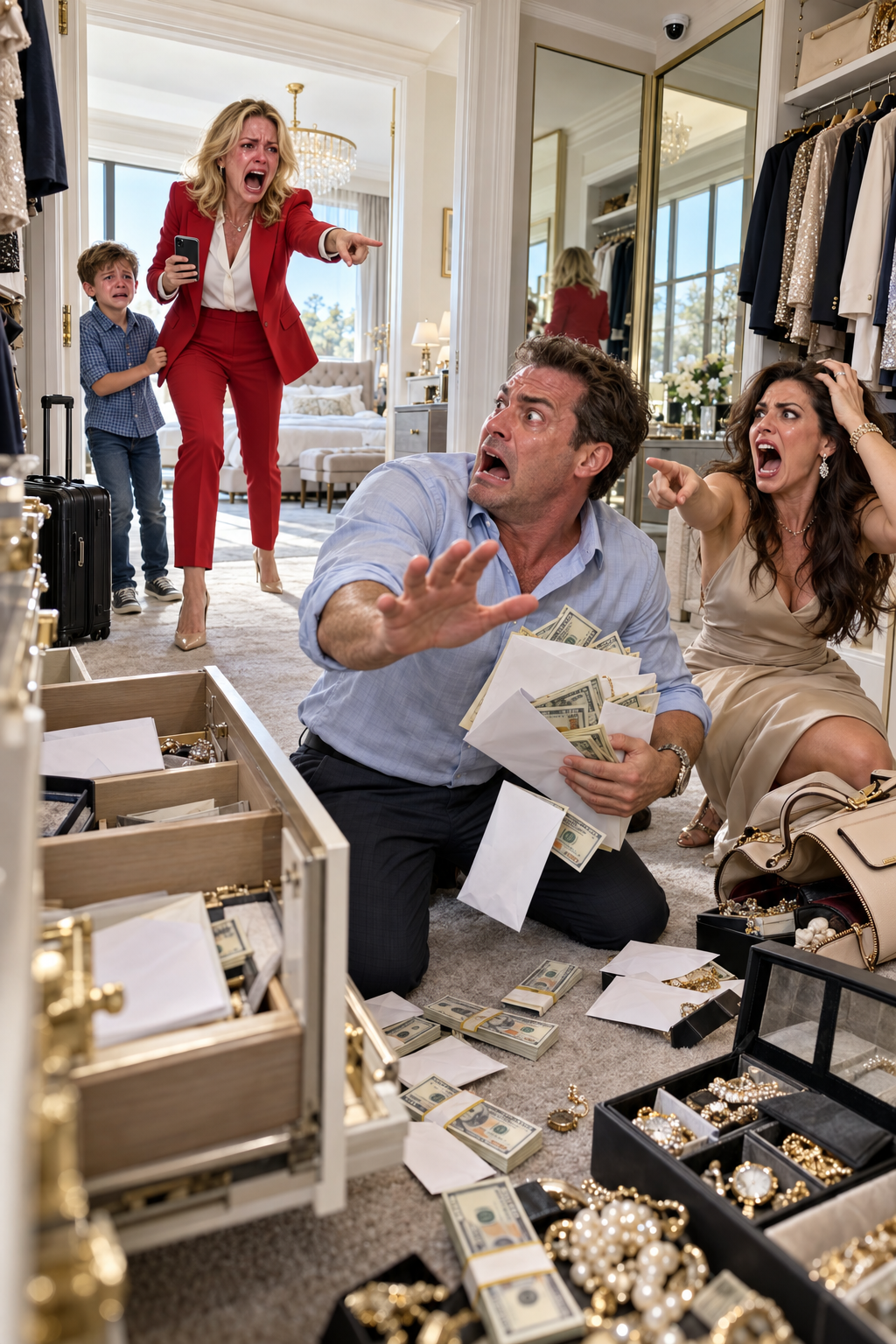
As I Was Preparing For A Business Trip, My Son Whispered, “Mom… When You’re Away, Dad Brings Another Woman Home And Steals Your Money From The Closet!” I Immediately Canceled My Trip And Secretly Set A Trap. Just One Day Later…
The morning I was supposed to fly to Chicago, my ten-year-old son pulled me into my bedroom and whispered that whenever I traveled, his father brought another woman into our house and took money from my closet. I didn’t confront my husband. I kissed him goodbye, canceled my flight, moved my son somewhere safe, and watched. Three days later, after discovering stolen cash was only the smallest part of the betrayal, I opened one of my late father’s folders and found my signature on a document I had never signed.
Part 1
My suitcase was standing beside the front door at seven fifteen that Monday morning, zipped shut except for the outside pocket where I had stuffed a granola bar and the paperback I kept pretending I would read on airplanes. I was scheduled to fly from Seattle to Chicago for a three-day conference, the kind of trip I had taken often enough that our family had developed a routine around it. My husband, Evan, drank coffee at the kitchen island while scrolling through his phone, and our son, Noah, sat at the table pushing scrambled eggs around his plate. Nothing looked unusual until Noah reached for my wrist as I passed him and said, “Mom, can you come upstairs with me?”
There was something in his voice that made me stop. Noah complained when I traveled, but normally his complaints involved promises that I would FaceTime before bedtime or bring him something from the airport bookstore. That morning he didn’t pout or bargain; he just kept hold of my wrist and glanced toward Evan as though checking whether his father had noticed. I followed him into the bedroom, and Noah quietly shut the door behind us.
His face had gone pale enough that the freckles across his nose stood out. “Mom, please don’t go,” he whispered, and when I told him I would only be gone three nights, his eyes filled immediately. I crouched so we were nearly level, thinking maybe something had happened at school, but he leaned close enough that I could feel his breath against my cheek. “Whenever you leave, Dad brings a woman here, and they go in your closet and take your money.”
For a moment, every sound in the house seemed to vanish except the hum of the heating vent. I asked him whether he had actually seen this, and Noah nodded so hard that his hair fell over his forehead. He said the woman had been there more than once, usually after dark, and that Evan had warned him not to wander downstairs when she visited. Once, Noah had come looking for a charger and seen his father putting several of my cash envelopes into a leather briefcase while the woman stood behind him laughing.
Those envelopes were our emergency fund, or at least I had believed they were. I had started keeping cash after my father died because he had always said a household should be able to survive a bank outage, a frozen card, or a storm without depending on anyone’s permission. Over the previous six months I had noticed the amount shrinking, but Evan always had an explanation: a plumber who preferred cash, a contractor deposit, groceries when his debit card had been replaced. I had assumed my bookkeeping was sloppy because trusting my husband seemed more reasonable than suspecting him of stealing from our bedroom.
“Did Dad tell you not to tell me?” I asked. Noah stared at the carpet before nodding, and that small movement hurt more than the accusation itself. “He said you’d get really mad and it would be my fault if we got divorced.” I put both hands around his face and told him very carefully that grown-ups were responsible for what grown-ups did, that nothing he told me could make him responsible for our marriage, and that he had done exactly the right thing by coming to me.
When I walked downstairs, Evan looked up from his phone and smiled. “Everything okay?” he asked, so casually that for one irrational second I wondered whether Noah had somehow misunderstood everything. Evan was the man who made pancakes shaped like animals on Sunday mornings, who had spent two nights sleeping upright beside Noah after his tonsil surgery, who still reached across the console to squeeze my knee when we drove somewhere together. Betrayal would have been easier to accept if he had looked cruel.
I told him Noah was simply upset about the trip, then walked into the bedroom and opened the closet. The envelopes were still inside the locked drawer beneath my sweaters, lined up exactly where I had left them, which told me something Noah probably didn’t realize: Evan knew where I kept the spare key. I removed every real bill, replaced the bulk with stage money left over from Noah’s school fundraiser skit, and put a small number of real bills on top so the envelopes looked untouched. Then I returned the actual cash to a lockbox in my office, took photographs of the drawer, and went downstairs with my suitcase.
As I reached the front door, I deliberately said, “I almost forgot to take some cash, but I’m leaving it here. I don’t need to carry that much around Chicago.” Evan’s head turned before he could stop himself. It was nothing dramatic, just a tiny sharpening of attention, but after fifteen years of marriage I knew the difference between my husband hearing a sentence and reacting to one. He recovered quickly, kissed my cheek, and carried the suitcase to the rideshare waiting outside.
I waved through the rear window until our house disappeared behind a row of maples. Ten minutes later I asked the driver to let me out near a grocery store, where my older sister Rachel was waiting in her SUV with Noah’s overnight bag already in the back. I had texted her from the bathroom and told her only that I needed Noah with her for a day and that I would explain everything later. When I climbed into the passenger seat instead of heading toward the airport, Rachel took one look at my face and stopped asking questions.
For almost two hours we sat several blocks away, where I could see our street through breaks in the trees. I began to hate myself for doubting a man I had loved for most of my adult life, then hated myself for considering that Noah might have invented what he saw. At eleven twenty-three, a white Lexus turned onto our street and stopped in front of my house. A woman in her mid-thirties stepped out wearing a cream coat, and Evan came through the front door before she reached the walkway.
He didn’t greet her like a colleague. He put one hand on her waist, kissed her, and looked up and down the street before letting her inside.
Rachel whispered my name, but I couldn’t answer. I opened the security-camera app on my phone, turned up the audio, and watched Evan lead the woman through my living room toward the stairs. She asked, “Are you completely sure Claire left?”
Evan laughed softly.
“She won’t be back until Thursday.”
The woman replied, “Good. Then today we get what Carter needs.”
Until that second, I had thought I understood what I was about to uncover.
Then my husband opened my closet, reached directly for the envelopes, and the woman said, “The cash is useful, but if those papers aren’t in this house, we’re in serious trouble.”
Part 2
The woman’s name, I would later learn, was Vanessa Price, but at that moment she was simply the stranger standing inside my bedroom while my husband stole from me. Evan opened the drawer without searching for the key, swept the envelopes into his briefcase, and didn’t bother counting them. Vanessa watched him with the bored impatience of someone who had witnessed the routine before. “How much has she got left?” she asked, and Evan said, “Enough to keep things moving until the closing.”
I pressed my phone against my ear even though the camera audio was already loud enough. “Closing what?” Rachel whispered beside me, but I shook my head because I had no answer. Evan and Vanessa moved through the bedroom opening drawers, checking folders and looking under stacks of old paperwork, and their behavior stopped resembling two people stealing emergency cash. They were hunting for something specific.
When they left the house forty minutes later, I followed from a distance in Rachel’s SUV. They drove to a coffee shop near Bellevue, took a corner table beside the window, and stayed there almost an hour. I couldn’t hear them, but I watched Evan make two calls while Vanessa repeatedly checked the briefcase at his feet. When they returned to the car, my phone buzzed with an alert from a voice recorder Evan kept in that briefcase for client meetings, one he had once connected to our shared cloud account and apparently forgotten was still syncing there.
I knew listening to my own husband’s recordings should have felt invasive. By then, he had already carried stolen money from my closet and searched my private files with another woman, so my moral hesitation lasted approximately three seconds. I opened the newest audio file and heard Evan telling someone, “I have the cash, but not the original papers.” A male voice answered, “Then you have nothing I need.”
Evan lowered his voice. “She keeps everything. The deed has to be somewhere.”
The unidentified man replied, “The money buys us time. The documents finish it.”
A few seconds later Vanessa asked whether “the boss” was angry, and Evan told her that if he couldn’t find the deed before I learned what the property was worth, they would lose the entire deal. Hearing those words rearranged months of seemingly harmless conversations in my memory. Evan had asked me about my late father’s records several times, had complained about property taxes on an undeveloped parcel my father and I owned east of the city, and had repeatedly suggested I sell it because “nothing but weeds and drainage ditches” would ever come from it.
That property had never mattered much to me financially. My father and I bought the forty-six acres when I was twenty-seven because he believed the county would eventually expand toward it, but after he died I kept it mostly because selling felt like closing one more door to him. Evan knew that, which was why I had never understood his recent obsession with getting rid of it. Now I wondered whether his impatience had nothing to do with taxes.
The audio abruptly changed. I heard envelopes tearing open, then Vanessa laughing. “Finally,” she said. “Let’s see how much your wife has been hiding.” Evan counted several bills, stopped, rubbed something between his fingers, and cursed so violently that Rachel looked at me. More envelopes opened, paper crumpled, and Vanessa said, “These are fake.”
For the first time that day, I almost smiled. The satisfaction lasted only seconds because Evan didn’t sound embarrassed or annoyed; he sounded terrified. “She knows,” he said. Vanessa immediately insisted that was impossible, but Evan snapped that fake bills did not magically appear in envelopes I had been keeping for years. Then he said something that made the skin tighten across my arms. “Forget the cash. If Claire moves those originals, Carter will bury me.”
Vanessa told him they should return that night. Evan refused at first because he believed I had set a trap, but she reminded him that they had less than a week before some unspecified deadline. “If Carter doesn’t have the signed transfer, he walks away,” she said. “And if he walks, we’re both finished.”
I went home before they did. Rachel took Noah to her apartment, and I entered my own house feeling like I had broken into someone else’s life. The bedroom looked completely normal except for the missing envelopes, so I began searching through the paperwork Evan had shown interest in over the previous year. Property-tax bills, insurance files, old statements and estate documents covered the bed until I found a thin manila folder wedged behind a drawer I rarely used.
Inside were photocopies relating to the acreage my father and I had purchased. The first pages were ordinary, but a recent valuation summary showed numbers so much higher than I remembered that I assumed I was misreading them. Nearby parcels had apparently been purchased at multiples of their previous value after county transportation plans and a private logistics development changed the area from forgotten farmland into strategically valuable commercial property. My “useless” land was positioned between two large tracts already assembled for development.
Then I reached the final document.
It appeared to authorize an assignment of my interest in the property, and beneath the language was a signature nearly identical to mine. Whoever had copied it knew that I formed the “C” in Claire with a high first loop and shortened the final stroke of Bennett. For several seconds I wondered whether I had signed something years earlier and forgotten, until I saw the notarization date.
March 18.
On March 18, I had been in Orlando with Noah because he developed a fever during spring break and spent most of the afternoon at an urgent-care clinic. I still had the pharmacy receipt, hotel folio and airline records because my company reimbursed part of the interrupted vacation when I handled a client emergency remotely. I had not been standing before a notary in Seattle that day.
I photographed every page, returned the folder exactly where I had found it, and called an old college friend named Maya Reynolds who practiced real-estate law. I sent her the images without telling her who I suspected. She called me thirty-five minutes later and skipped hello.
“Claire, tell me you didn’t sign this.”
“I didn’t.”
“And you can prove where you were?”
“Yes.”
Maya was quiet long enough for me to hear office noise behind her. “Then don’t confront anybody. Get the original secured. This looks like someone started building a paper trail that could eventually make a fraudulent transfer look legitimate.”
That evening I sat in darkness downstairs while Evan returned home and went directly to the bedroom. Twenty minutes later the front door opened again, and Vanessa’s voice drifted through the hallway. They searched quietly, checking drawers and whispering about the deed, while I stayed where they couldn’t see me.
When they finally left, I walked upstairs and looked at the folder again.
The false document was still there.
But lying beneath it was something I hadn’t noticed earlier: a purchase proposal from Harbor Crest Development, dated eleven years before my father died, offering him a fraction of what the property was now worth.
Across the bottom, in my father’s handwriting, were six words.
Never sell this land to Carter.
Part 3
My father, Thomas Bennett, had never been a dramatic man. He believed most problems could be improved with black coffee, a yellow legal pad and enough patience to let the loudest person in the room exhaust himself first. Seeing his handwriting beneath that old purchase offer made me sit on the bedroom floor with the folder across my knees. Dad had underlined Carter twice, hard enough that the pen had nearly torn through the paper.
The name meant something, although it took several minutes before I placed it. Richard Carter had been my father’s business partner in the early 1990s, when the two of them bought neglected agricultural parcels outside Seattle and leased them to greenhouse growers. By the time I was old enough to understand family conversations, their partnership had ended, and Carter’s name was treated like an unpleasant smell nobody wanted to discuss. Dad once told me only that Carter had become “too comfortable profiting from information other people weren’t supposed to have.”
I spent the night going through storage boxes from my father’s estate. At three in the morning I found correspondence showing that Carter had repeatedly tried to purchase the forty-six acres from us after learning about early county planning studies. Dad had refused every offer and written notes in the margins describing Carter’s tactics: pressure, misleading valuations, intermediaries and promises that deadlines were “urgent.” One page contained a sentence that made me close my eyes. Richard doesn’t need to own every parcel; he needs the one that connects the others.
By eight, I was in Maya’s office with copies spread across her conference table. She pulled corporate records and public property data while I explained everything from Noah’s warning to the forged signature. Harbor Crest Development still existed, except now it controlled a maze of affiliates that had purchased land surrounding mine. Richard Carter was its chairman and majority owner.
Maya enlarged a parcel map on her monitor. The pattern was obvious even to me. Carter’s companies owned property on both sides of my acreage, but my land sat across the most practical route for a planned access road connecting their distribution project to a future transportation corridor. “Your property isn’t valuable because it’s pretty,” Maya said. “It’s valuable because without it, they may need a more expensive route, new approvals and months of delay.”
“How much are we talking about?”
She gave me a range that made me laugh once from pure disbelief. The lowest number was several times what Evan had ever implied the land might be worth.
Driving home, I remembered every dinner when Evan had told me I was sentimental about “a patch of mud.” I remembered him suggesting that selling could pay for Noah’s college, then pretending to lose interest when I declined. I remembered one night six months earlier when he said, “Your dad wasn’t always right about everything, Claire,” and I had defended him so sharply that Evan apologized.
The cruelest part was how carefully he had studied me. Evan knew I would resist a direct demand, so he had spent months making the land feel inconvenient and embarrassing. He wanted me tired of thinking about it before he ever put papers in front of me.
That afternoon I called him from my office and said I had been cleaning out Dad’s files. Evan responded too quickly. “Did you find the deed?”
I let two seconds pass. “Not yet. Why?”
“No reason. You’ve just been talking about that property lately.”
I had not mentioned the property in months. I told him I was considering selling because the taxes annoyed me, and the sound of his breathing changed. Evan, who had spent a year telling me the land was worthless, suddenly warned me not to rush because prices might rise. I almost admired the desperation required to reverse an entire argument without acknowledging it.
“Maybe I’ll ask Maya to handle it,” I said.
“Maya Reynolds?”
“Yes.”
He went silent again. My husband knew exactly what kind of attorney Maya was, and he understood what would happen if a competent lawyer reviewed the files. “You don’t need to involve attorneys yet,” he finally said. “I could make a few calls for you.”
I thanked him and ended the conversation.
That evening I placed a decoy folder on the dining-room table containing outdated maps, harmless photocopies and a handwritten note suggesting another investment group had shown interest. I didn’t name any actual buyer. I simply wrote, Possible competing offer—decision Friday, then left the page visible beneath a legal pad.
Evan came home carrying takeout. He kissed me, asked about Noah and behaved with such practiced normality that I understood why I had missed everything for so long. During dinner his eyes kept drifting toward the folder. Eventually he stood to refill his water, paused beside the table and asked, “What’s that?”
“Just Dad’s property stuff.”
He opened the cover. “You got an offer?”
“Maybe.”
The color left his face for half a second. He began warning me about scams, predatory investors and the danger of moving too quickly, all arguments that were reasonable in isolation and absurd coming from a man who had been encouraging me to unload the same property cheaply. When I said I would let an attorney decide, his jaw tightened.
Later, after I went upstairs, I heard Evan pacing in his home office. Through our shared cloud account, another audio file appeared.
“I need more time,” he told someone.
A man answered, “You don’t have more time. The financing window is tied to the county approval.”
“Claire may have another buyer.”
The response came cold and immediate. “Then your usefulness has an expiration date.”
Evan swore softly. “I can get her signature.”
“You told me that weeks ago.”
“I’ll get it.”
“Three days, Evan.”
The call ended.
I sat on the edge of the bed staring at the dark screen of my phone. Three days meant Carter wasn’t simply hoping Evan would persuade me eventually. Something was scheduled, financed or contractually dependent on controlling my land before a deadline.
The next morning I moved the real deed, the forged authorization and Dad’s original notes into a bank safe-deposit box. Maya also helped me notify the appropriate offices that any transaction involving the parcel required additional identity verification and direct contact with me. We did it quietly, without alerting Evan.
I then began reconstructing the missing cash.
What I found bothered me almost as much as the land scheme. The withdrawals and stolen envelopes lined up with payments to a title service, private consultants and unexplained transfers connected to Harbor Crest’s acquisition work. Evan had not merely taken money to finance an affair.
He had been using my own emergency savings to help pay the expenses of trying to steal my property.
And when I checked one transfer more closely, the recipient’s last name was not Carter or Price.
It was Mercer.
Evan’s older brother was Daniel Mercer.
Part 4
Daniel had been part of my life almost as long as Evan. He was six years older, quieter, divorced twice and employed in what he vaguely described as “property services,” which apparently involved knowing every clerk, inspector and contractor within thirty miles. At holidays he brought expensive bottles of bourbon and criticized government paperwork with the authority of a man permanently inconvenienced by rules. I had never particularly liked him, but I had trusted him because he was family.
The transfer I found had gone to Mercer Administrative Consulting, a company Daniel registered four years earlier. Maya located additional public records showing the firm had performed document-delivery and filing work for several Harbor Crest affiliates. Nothing about that relationship was necessarily illegal, but paired with the forged signature and Evan’s calls, it made coincidence difficult to defend. I began wondering how many times Daniel had sat at my Thanksgiving table already knowing his brother was searching my bedroom for a deed.
I didn’t confront either of them. Instead, I behaved so normally that maintaining the performance became exhausting. I made coffee, answered work emails, asked Evan whether he wanted salmon or pasta for dinner, and slept beside him while keeping enough distance that he could mistake it for restlessness. Every ordinary thing felt grotesque once I knew the man breathing next to me had described me to strangers as someone he could manipulate.
Noah remained with Rachel. Evan complained that our son should be home, but I said Rachel had offered to keep him because I had extra work after canceling Chicago. The truth was simpler: Noah had already carried a secret that should never have belonged to a child. Whatever happened next, I would not allow him to become an audience.
On Wednesday afternoon, a black sedan stopped outside our house. A silver-haired man stepped out wearing a charcoal overcoat, and although I had seen only old photographs of Richard Carter, I recognized him immediately. Evan met him on the patio rather than inviting him inside, apparently unaware that the kitchen security camera covered most of the backyard through the glass doors.
Carter did not waste time pretending they were friends. “You promised me a clean acquisition,” he said. “Instead, she’s talking to lawyers and imaginary buyers.”
Evan kept his voice low. “I can still get her to sign.”
“Then do it.”
“She’ll read the agreement.”
“That’s your problem.”
Evan looked toward the house. “She trusted me for fifteen years.”
Carter’s expression barely moved. “Then you have spent fifteen years building exactly the advantage I hired you for.”
That sentence changed something in me. Until then, a small part of my mind had tried to preserve some version of my marriage in which Evan had become desperate recently, made terrible decisions and drifted into deeper trouble than he intended. Carter’s words suggested something colder: trust itself had become an asset Evan was willing to monetize.
Then Carter said, “If she had signed the first assignment, we wouldn’t be standing here.”
Evan answered, “The notary issue made it too risky.”
“So now you put legitimate papers in front of her and make sure she doesn’t understand what matters.”
My hands went numb.
The forged document hadn’t been the whole plan. It had been a rehearsal or fallback, something they hoped would create enough paper to support a later transfer. Now they wanted my real signature on a document designed to accomplish the same result more safely.
That evening Evan came home with flowers.
Not supermarket flowers. Peonies from the florist near Pike Place where he used to stop on anniversaries, wrapped in brown paper exactly the way I liked. “You’ve seemed stressed,” he said, setting them on the counter. I thanked him because I wanted to see what came next.
We ate dinner together, and halfway through the meal he mentioned “an old business contact” who might be interested in the acreage. He said the man could save me the trouble of listing it, getting appraisals or dealing with months of negotiation. I asked the buyer’s name.
“Peter Lang.”
I almost admired how smoothly he lied.
“What company?”
“He invests privately.”
“What does he want the land for?”
Evan shrugged. “Probably long-term development.”
I set down my fork. “Then I’d like to meet him.”
His hand stopped around his water glass. “He travels constantly. It would be easier to use a representative.”
“If somebody wants something that belonged to my father, I’m meeting him.”
Evan smiled, but irritation flickered underneath. “You’re making this more complicated than it has to be.”
“That land has existed for thirty years. It can survive another week.”
Later, another synchronized recording appeared in the shared account. Evan told Carter I demanded to meet the buyer, and Carter called me “a problem that should have been managed months ago.” Then a third voice entered the conversation.
Daniel.
“You pushed too hard,” my brother-in-law said. “She notices pressure.”
Evan replied, “Don’t tell me how my wife thinks.”
Daniel laughed once. “Apparently somebody has to.”
I sat frozen while they discussed parcel numbers, filing requirements and the possibility of presenting documents as routine tax paperwork. Daniel warned them that the county had tightened identity procedures and that any mismatch could trigger scrutiny. Carter told him to stop worrying and focus on getting the correct forms ready.
The casual way they spoke horrified me more than shouting would have. My marriage, my inheritance and my signature were treated as administrative obstacles in a business meeting.
The following morning, Maya and I made our plan. We would let Evan present whatever paperwork he intended to use, but I would insist that any signing occur at a reputable title office with an independent officer present. Maya would attend as my counsel. We also gathered proof that I had been in Florida on the date of the forged notarization and preserved the recordings, bank records and camera footage.
I told Rachel what we were doing. She grabbed both my hands and asked whether I was sure I wanted to let the situation go that far. “What if he realizes you know?”
“He already stole from me,” I said. “He already forged me. If I confront him alone, he’ll tell everyone it was a misunderstanding between spouses. I want him explaining these papers to people who understand exactly what they are.”
That night Evan entered our bedroom carrying a polished black binder.
He placed it on the dresser and smiled.
“Good news,” he said. “My buyer improved the offer.”
I looked at the binder.
“How improved?”
“Enough that I think you should sign tomorrow.”
For the first time since Noah whispered to me, I felt almost calm.
“Fine,” I said. “But we sign at a title company.”
Evan’s smile disappeared.
Part 5
The silence between us lasted maybe two seconds, but I watched Evan calculate through each one. He expected me either to sign at home or refuse entirely; he had apparently never considered that I might agree under conditions he couldn’t control. “A title company seems unnecessary,” he said, finally recovering. “These are straightforward documents.”
“Then a title company shouldn’t be a problem.”
He gave me the gentle, patient expression he used when he wanted me to feel unreasonable. “Claire, you’re turning a simple private sale into a legal production.”
“I’m selling land my father left me. I’m comfortable being overly careful.”
That ended the discussion because objecting more strongly would have exposed exactly what he was trying to hide. Evan agreed to arrange a meeting for the following afternoon. After he went downstairs, I sat on the bed staring at the black binder and thought about how many times in our marriage I had surrendered a decision simply because he sounded confident.
The next morning I woke before him. I looked at Evan sleeping and tried to find the man I had married in that familiar face. We met when I was thirty-two, at a charity auction where he accidentally bid against me for a terrible landscape painting because neither of us understood the silent-auction rules. For years I had told that story as proof that love could begin with something ridiculous.
Now even our happiest memories felt contaminated by questions.
When had he first spoken with Carter?
When had my property stopped being part of my history and become part of his business plan?
And when had he decided I was foolish enough to betray?
I met Maya at her office before the signing. She reviewed copies of the binder that I had photographed while Evan showered. The sale agreement contained a price that looked respectable until compared with current commercial valuations, but the worst language was buried inside related assignments and access provisions. Taken together, Maya explained, the package could give the buyer far more control than an ordinary sale while limiting my ability to challenge certain steps later.
“They’re counting on you seeing the headline price and trusting your husband about the rest,” she said.
“That sounds like Evan.”
Maya closed the folder. “Once you expose what you know, you need to assume the marriage is over.”
“It ended before I found out.”
She studied me for a moment and nodded.
The meeting was set at Cascadia Title downtown, where one of Maya’s professional contacts, a senior title officer named Helen Strauss, had agreed to handle the proposed transaction. Evan believed he had chosen the office because Daniel had once filed documents there, but Maya had already alerted Helen that I had concerns about authenticity. We did not ask Helen to accuse anyone in advance; we wanted the documents examined normally.
Evan and I arrived together at two ten. Carter was already seated in the conference room.
My husband’s fictional “private investor” Peter Lang had vanished.
Carter stood when I entered. He was polished, gray-haired and gracious in the way powerful men sometimes become when they are trying to make domination resemble courtesy. “Claire Bennett,” he said. “I knew your father.”
“I know.”
His smile faltered.
Then Maya stepped through the doorway behind me.
Carter looked at Evan.
Evan looked at me.
I pulled out a chair. “You said this was straightforward. My attorney is only here to make sure it stays that way.”
Helen began reviewing the packet while the four of us sat in a silence broken by paper turning. Within minutes she stopped at the parcel description and asked why one attachment referenced a different tax lot. Evan answered before Carter could speak, claiming it was an old clerical error. Helen moved to an authorization document and frowned again.
“This notarization appears to have been previously submitted as supporting documentation,” she said.
Carter leaned forward. “It was.”
Helen looked at me. “Ms. Bennett, do you recognize this signature?”
I let the moment sit.
“It looks like mine.”
Evan exhaled almost invisibly.
Then I continued.
“But I didn’t sign it.”
The room changed.
Carter said there must be confusion. Evan immediately suggested I had forgotten. I opened my bag and placed my passport, airline confirmation, hotel invoice and urgent-care receipt on the table. “The date says I appeared before a Seattle notary on March eighteenth. That afternoon I was in Florida with my son.”
Evan stood so quickly his chair rolled backward.
“Claire, what are you doing?”
“Answering her question.”
Carter tried to interrupt, but Maya told him he could wait. Helen examined the records, then said she could not proceed with the transaction and would need the questionable documentation preserved for review. Carter’s composure cracked for the first time.
“This is an internal paperwork issue,” he said. “There’s no reason to dramatize it.”
I reached into my bag again and placed copies of Dad’s old correspondence on the table. Then I added maps showing Harbor Crest’s surrounding acquisitions, records of payments tied to Evan’s thefts, and still images from my security cameras showing him and Vanessa searching my bedroom.
Evan went white.
“I know about the money,” I said. “I know about Vanessa. I know you searched for the deed every time you thought I was traveling. I know Daniel helped with filings. And I know Mr. Carter has been trying to obtain this land since my father refused him.”
Evan stared at the photographs as though they belonged to another man.
“Claire, I can explain.”
“No. You can explain to people whose job is deciding whether explanations matter.”
The conference-room door opened before anyone answered.
Daniel walked in carrying a document envelope.
He took two steps, saw Maya, saw the papers spread across the table and stopped.
Carter muttered something under his breath.
Daniel looked directly at Evan.
“You said she didn’t know.”
There it was.
Not denial.
Not surprise.
Confirmation.
Part 6
Daniel’s face changed the moment he heard his own words. He tried to retreat into confusion, claiming he had meant that I didn’t know about the meeting, but nobody in the room believed him. Helen asked him to place the envelope on the table and not remove anything, and Daniel responded by looking at Carter as though waiting for instructions. That glance said more than any speech could have.
Evan finally turned toward me. “Claire, please. We need to talk privately.”
“No.”
“This is our marriage.”
“You made it a business transaction.”
His expression crumpled then, not from remorse but from losing control of the audience. At home he could have cried, apologized, blamed stress, accused me of misunderstanding and worn me down through sheer emotional familiarity. In that room, every claim had to survive people who understood documents better than promises.
Daniel began talking first. He said Carter had approached Evan about the property two years earlier after learning we were married. According to Daniel, the original plan was perfectly legal: convince me to sell, collect a finder’s fee and walk away. But when I refused, Carter continued increasing the incentive while Evan accumulated personal debts from investments he had hidden from me.
“What investments?” I asked.
Evan looked at the floor.
Daniel answered for him. A failed restaurant partnership, speculative cryptocurrency losses and money borrowed against accounts I didn’t know existed had left Evan far deeper in debt than our household finances suggested. Carter offered him a way out if he could deliver my land below market value. The commission alone would clear most of what Evan owed.
Vanessa entered the picture because she worked in acquisitions for Harbor Crest. The affair apparently began after the scheme, not before it, which somehow made it worse. She hadn’t seduced my husband into betraying me; betraying me was the project that introduced them.
Daniel insisted the forged document was Evan’s idea.
Evan snapped, “That’s a lie.”
“Oh, now it’s a lie?”
“You prepared it.”
“You gave me her signature samples.”
Carter slammed his palm against the table and told both of them to stop talking. The instinct to silence them was so immediate that even Helen stared at him. Maya simply wrote something on her notepad.
The story spilled out anyway. Evan had given Daniel copies of documents I had legitimately signed over the years so he could mimic my handwriting. Daniel used his relationships with document runners and service companies to make paperwork appear routine. The stolen cash from my closet paid fees, reimbursements and some of Evan’s debts because moving the money through our joint accounts risked creating records I might notice.
“You took cash from our emergency fund to finance this?” I asked.
Evan finally met my eyes. “I was going to put it back.”
I laughed once.
It was the saddest sound I had ever heard myself make.
“You were going to put back the money after you sold my land without telling me?”
His mouth opened, but nothing came out.
Carter’s attorney arrived before the discussion went further and immediately instructed him not to answer questions. Maya did the same for me, except she also reminded everyone that the disputed documents were now in the title company’s possession and that I intended to report the suspected forgery and theft. The meeting ended without signatures, without a sale and without Carter securing the last parcel his project needed.
Evan followed me into the hallway.
“Claire.”
I kept walking.
“Claire, wait.”
I stopped only when he said, “What about Noah?”
The use of our son’s name made me turn.
“What about him?”
“We can’t destroy his family over this.”
I looked at the man who had convinced Noah that speaking the truth could cause our divorce. “You already told a ten-year-old that protecting your secret was his responsibility.”
Evan’s face drained.
He understood immediately.
“Noah told you.”
“He saved me from you.”
For the first time, genuine shame appeared. Evan leaned against the wall and covered his mouth with one hand. “I never meant to scare him.”
“You told him our family could break if he talked.”
“I panicked.”
“He was carrying that panic while you brought Vanessa into our house.”
He began crying then, quietly at first, and years earlier that sight would have undone me. I had loved him enough to forgive things he had never even done. But once I imagined Noah standing in the hallway while his father stole from my closet, sympathy hardened into something closer to clarity.
I left with Maya.
By evening I had filed an initial police report and turned over copies of the relevant recordings, financial records and images. Maya connected me with both a family-law attorney and counsel experienced in property fraud. The forged document became more than evidence of marital betrayal; it opened questions about attempted fraud, false filing and conspiracy that none of us could fully predict yet.
Evan did not come home that night. He sent twenty-seven messages.
Some apologized.
Some blamed Carter.
Some blamed debt.
Some reminded me of our wedding.
Some said Vanessa meant nothing.
The last one said, I did all of this because I was terrified of losing everything.
I typed a response, deleted it, typed another and deleted that too.
Then I opened the banking records again.
Evan had lied about one thing Daniel said.
His debt was real, but the earliest payment from a Carter-affiliated company predated those losses by almost fourteen months.
That meant he had not joined the scheme because he became desperate.
The scheme came first.
And the next morning, when Maya obtained additional records, I learned why.
Part 7
Evan had first received money connected to Carter only seven months after our wedding.
The payment was small enough to disappear into the background of our lives, labeled as consulting income from a company that no longer existed. A second payment came the following year, then another. None were large enough to explain a conspiracy by themselves, but together they established something I had resisted considering.
Carter had known who Evan was before Evan ever asked me on our first date.
I sat in Maya’s office staring at the transaction history. “Are you saying Carter introduced us?”
“No,” she said. “We don’t know that.”
“But Evan was already doing work for one of his companies.”
“That appears true.”
The distinction mattered legally and almost not at all emotionally.
I drove to Rachel’s apartment and found Noah building a cardboard city across her living-room floor. He looked up when I entered, studying my expression the way children learn to study weather. “Is Dad mad at me?”
I sat beside him so quickly that I knocked over one of the cardboard towers.
“No.”
“Did you tell him I told you?”
“He figured it out.”
Noah’s mouth tightened.
I put my arms around him. “Listen to me. Your dad made choices before you ever said anything. Nothing happening now is because you told the truth.”
He leaned against my shoulder. “Are you getting divorced?”
There was no useful lie.
“Yes.”
He cried without making much noise, and I hated Evan more in that moment than I had when I saw him kiss Vanessa. An affair hurt me. Theft hurt me. The property scheme threatened my future. But making our child afraid that honesty could destroy the family had placed poison inside someone who had done nothing wrong.
I filed for divorce that afternoon.
Evan’s attorney contacted mine two days later and asked whether I would consider handling the separation privately if Evan cooperated with the property investigation. I refused any agreement that required me to conceal evidence, though I agreed not to use Noah as leverage or expose personal details unnecessarily. I wanted accountability, not spectacle.
The legal investigation moved slower than television would have made it seem. Nobody was marched from the title office in handcuffs. Investigators requested records, interviewed employees, examined signatures and traced filings. Carter’s company released a statement calling the matter a dispute involving unauthorized actions by outside individuals, which was corporate language for building a wall between the company and the people who had just been acting on its behalf.
Vanessa contacted me through an attorney. She offered information.
I almost refused simply because hearing her name made my stomach tighten, but Maya reminded me that understanding the scheme mattered more than punishing my own emotions. Vanessa claimed Carter had been obsessed with my property because Harbor Crest had promised investors that the access corridor would be assembled before the end of the quarter. Missing the parcel would force expensive redesigns and trigger provisions in financing agreements.
She also said something I did not expect.
“Evan talked about you constantly,” Vanessa told me during a formal interview attended by lawyers.
I stared at her.
“Not lovingly.”
“I assumed that.”
“He said you never understood money. That your father gave you assets you didn’t know how to use.”
“My father and I bought that land together.”
She looked genuinely surprised.
“Evan said you inherited everything.”
That lie revealed more than insult. Evan had built his justification by rewriting me into a passive beneficiary who deserved to be managed. If he admitted I had chosen the investment with Dad, paid part of the original purchase myself and understood exactly why we held it, then stealing it became harder even for him to rationalize.
The affair, Vanessa said, began after months of meetings. She did not ask me to forgive her and I did not offer to. She had entered my home, mocked me, searched my belongings and helped spend stolen money. Her willingness to cooperate now may have been useful, but usefulness was not repentance.
Daniel also began cooperating once investigators confronted him with records. Each person tried to minimize his own role by enlarging everyone else’s, and the result was that the entire scheme became clearer. Carter had exerted pressure, Daniel handled paperwork, Vanessa managed acquisition details, and Evan supplied access to the one person they all needed.
Me.
But none of it worked without Evan’s intimate knowledge of my routines.
He knew when I traveled.
He knew where I stored records.
He knew which memories of my father made me emotional.
He knew which financial explanations I was least likely to challenge because marriage had taught me not to treat every inconsistency like an audit.
Months passed.
Carter’s project stalled while the ownership issue and related investigations continued. Harbor Crest eventually pursued an alternate route at substantially higher cost, and investors began questioning why management had allowed one privately held parcel to become so critical. The consequences did not come because I turned out to be secretly more powerful than everyone else.
They came because Carter had structured a major project around acquiring property he did not own, while Evan and the others repeatedly chose fraud and deception rather than accept my refusal.
Their own shortcuts created the collapse.
One rainy afternoon, Evan asked to see me without lawyers.
I agreed to meet at a public café.
He looked older.
Not ruined.
Not transformed.
Simply tired.
“I loved you,” he said.
I stirred my coffee.
“You may have.”
His eyes filled. “You don’t believe me?”
“I believe people can love someone and still choose themselves over that person every day.”
He swallowed.
“I want another chance.”
“No.”
“For Noah.”
“Especially not for Noah.”
He looked down at his hands.
“I made terrible choices.”
“You made a system.”
That silenced him.
I stood to leave, and he said my name one last time.
“Was there ever a moment you almost forgave me?”
I thought about the airport suitcase, the flowers, the forged signature and Noah’s trembling voice.
“No.”
And for the first time since that Monday morning, the answer didn’t hurt to say.
Part 8
The divorce took eleven months.
There were disputes over accounts, property, hidden debts and the money Evan had taken, but the rural acreage was never seriously in question once the records were examined. I had purchased my original interest before marriage with my father, and the valid documents remained secure. Whatever fantasies Carter and Evan built around that land ended in conference rooms full of attorneys instead of the effortless transfer they imagined.
The criminal and regulatory matters moved on their own schedules. Daniel accepted responsibility for his role in falsified paperwork and cooperated extensively. Vanessa’s cooperation reduced her exposure but did not erase what she had done. Carter spent months insisting he had authorized only legitimate acquisition efforts while former employees, payment records and communications told a more complicated story.
Evan eventually admitted taking my cash and participating in efforts to obtain my signature under false pretenses. The precise legal consequences were less cinematic than people expect from stories about betrayal: hearings, agreements, financial penalties, restrictions, legal bills and years of professional damage. Nobody dramatically confessed beneath a spotlight.
They simply lost control of the story because documents outlasted excuses.
Harbor Crest abandoned its original access plan.
The company had spent so aggressively assembling surrounding parcels that rerouting became expensive enough to damage the economics of the project. Investors forced leadership changes, Carter’s reputation collapsed inside an industry where reputation had been one of his greatest assets, and several former partners distanced themselves from him. My land remained untouched.
I did not sell it.
Not because it had become valuable.
Because for the first time I understood exactly what Dad had protected.
One Saturday in early spring, I drove Noah there.
The property looked spectacularly unimpressive. Wet grass reached halfway up our boots, alder trees crowded the drainage ditch, and a weathered fence leaned like it had given up arguing with gravity. Noah stared across the field and said, “This is what everybody was fighting about?”
I laughed.
“Pretty much.”
“It’s kind of ugly.”
“Your grandpa would be devastated to hear that.”
We walked until we reached an old cedar post where Dad had once marked the boundary with orange paint. I told Noah how his grandfather and I bought the land when I was younger, how we spent Saturdays measuring fence lines and eating sandwiches from a cooler because Dad refused to pay restaurant prices on workdays. I did not tell him the adult details of the fraud.
Those could wait.
What Noah needed was a history larger than his father’s mistakes.
Our house changed after Evan left. At first the rooms felt too quiet, then gradually the quiet became peaceful. I replaced the bedroom carpet, not because anything terrible happened on it but because I wanted one physical thing to look different when I woke up.
Rachel helped me repaint the home office.
Noah chose a terrible blue.
I let him keep it.
Therapy became part of our routine for a while, separately and together. Noah needed help understanding that telling the truth had protected us rather than broken us. I needed help accepting that vigilance was not the same thing as wisdom and that I could not prevent every betrayal by becoming suspicious of everyone.
Some nights I still woke wondering whether I had missed signs because I was naïve.
Eventually I stopped asking that question.
Trust is not stupidity.
Trust is what makes marriage possible.
The disgrace belonged to the person who weaponized it.
About a year after the divorce became final, I received a letter from Evan. He had written before, usually through attorneys or short messages concerning Noah, but this one was different. He apologized without mentioning Carter, Vanessa, debt or pressure.
He wrote, I kept telling myself I was protecting our future while taking away your right to choose it.
That sentence was probably the closest he ever came to understanding.
I did not answer.
Forgiveness, to me, did not require reopening a door.
Evan remained Noah’s father, and I supported their relationship within boundaries recommended by professionals and shaped by what Noah felt safe handling. I never asked my son to hate him.
I also never taught him that being family erased consequences.
My own life became smaller in some ways and larger in others. I traveled less during the first year because Noah needed stability, then gradually returned to the work I had always enjoyed. I stopped apologizing for ambition as though every night away from home created an emotional debt someone else was entitled to collect.
Two years after the morning Noah stopped me at the door, Chicago appeared on my calendar again.
Same conference.
Same hotel.
Same early flight.
I packed the night before and came downstairs to find Noah, now twelve, eating cereal in sweatpants. My suitcase stood where it had stood that first morning, beside the front door.
For a second I felt the entire past overlap with the present.
Noah noticed me looking at him.
“What?”
“Nothing.”
He narrowed his eyes suspiciously. “You’re being weird.”
“I’m allowed. I’m your mother.”
He finished his cereal, rinsed the bowl and walked over to hug me. He was taller now, nearly reaching my shoulder.
“You have your charger?”
“Yes.”
“Laptop?”
“Yes.”
“Airport snacks?”
“Yes, Dad.”
He groaned at the joke.
Then his expression grew serious.
“Mom?”
My body reacted before my mind did.
“What is it?”
He smiled.
“Have a good trip.”
That was all.
No whisper.
No fear.
No secret pressing against a child’s chest.
I held him a little tighter than necessary.
“I will.”
At the airport, I stood near the gate watching airplanes move through the pale morning light. For years I had measured security in things I could hold: cash in envelopes, property records, a house, a marriage, signatures on paper.
I understood it differently now.
The money had never been the most valuable thing Evan stole.
The land had never been the most valuable thing I saved.
What mattered was that one frightened little boy had trusted me with the truth, and when he did, I believed him enough to act.
That choice cost me the marriage I thought I had.
It also gave us a home where nobody had to whisper again.
THE END!