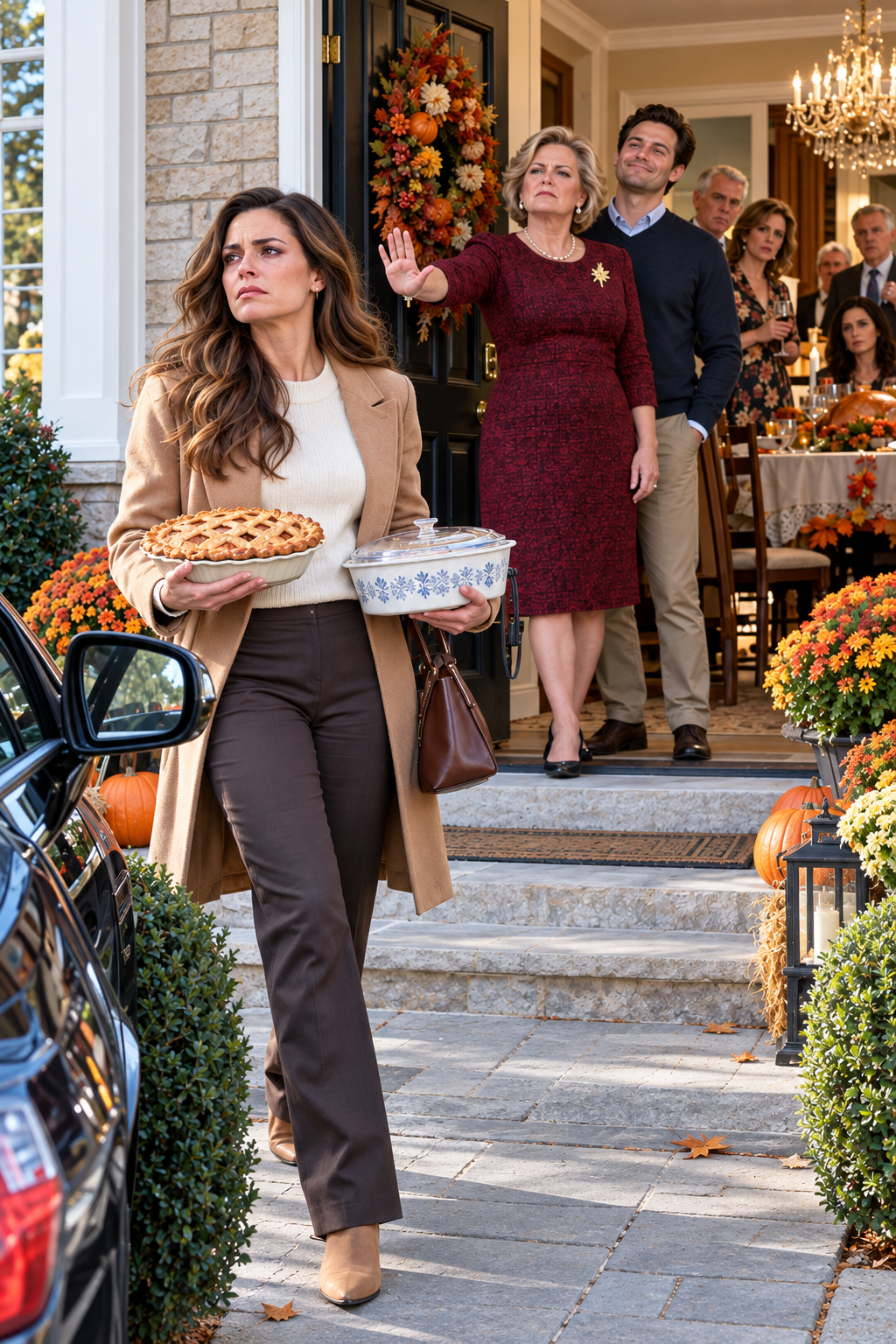
My mother-in-law blocked the doorway, looked at the dishes in my arms, and told me I wasn’t welcome at Thanksgiving. My husband stood behind her, smiled, and said, “My mother’s word is law.” I carried my late mother’s pie back to the car and drove away without begging for a seat. By sunrise, my phone showed 67 missed calls—but the family emergency waiting behind them would force everyone to confront what they had done to me the night before together.
### Part 1
“You’re not welcome at Thanksgiving dinner.”
For a second, I honestly thought I had misunderstood Marlene Cole. I was standing on her front porch with a warm sweet potato casserole pressed against my ribs and my late mother’s pecan pie balanced carefully on top, while cold November air slipped under the collar of my coat. Through the open doorway, I could smell roasted turkey, sage dressing, browned butter, and the cinnamon candles Marlene lit every holiday. Somewhere near the dining room, my sister-in-law Rebecca laughed at something, silverware clinked against china, and a football announcer shouted from the television. Everything sounded exactly like Thanksgiving was supposed to sound, except Marlene had planted herself across the doorway like a guard at a private club.
“You heard me, Erin,” she said, folding her arms.
I looked past her shoulder. My husband Daniel stood about fifteen feet away holding a glass of iced tea. We had been married fourteen years. He knew how much that pie meant to me. He knew I had rearranged my duty schedule weeks earlier because, for once, I wanted a holiday that didn’t involve a phone buzzing beside my plate or somebody saying, “We understand you’re Army, but family should come first.” I looked at him and said only his name. “Daniel?”
He glanced at his mother, then at me, and gave me that thin, uncomfortable smile I had seen a thousand times whenever Marlene created a problem he expected me to solve.
“Mom’s word is law,” he said.
Something inside me became very quiet.
The old version of me would have asked Marlene what I had done. I would have tried to calm everybody down, found the misunderstanding, apologized for something I probably hadn’t done, and entered the house grateful for permission to sit at a table where I had spent years earning my place. Instead, I smiled. “All right.”
Marlene’s expression actually changed. She had expected resistance. Daniel straightened as if he was about to say something, but I had already turned around. I walked down the brick path, opened my car, set both dishes carefully on the passenger-side floor, and drove away.
Twenty minutes later, my phone buzzed at a red light.
Daniel: Where are you going?
Then another message.
Erin, seriously. Mom will calm down. Don’t make this bigger than it is.
I read that one twice. Apparently being publicly rejected from Thanksgiving was a small thing. My refusal to tolerate it was what might “make it bigger.”
I turned my phone facedown.
That morning had started at 4:47. I remember because my alarm was set for five, but I woke before it, staring into the darkness while Daniel breathed beside me. I slipped downstairs in old gray sweatpants and opened the kitchen cabinet where my mother’s pecan pie recipe was still taped inside the door. The paper had yellowed around the edges, and there was a brown fingerprint near the bottom where Mom had touched it years ago with cinnamon and flour on her hands. She had been gone six years. Making that pie was one of the few holiday traditions that still made me feel as if she had entered the room before everyone else.
By 6:30, the pie was cooling on a wire rack. The sweet potatoes were boiling. Daniel wandered downstairs around eight, poured coffee, and said, “Smells good.”
“Your mother asked me to bring two dishes.”
He only grunted.
That should have warned me.
“You okay?”
“Fine.”
“Is your mom okay?”
Daniel stared into his coffee. “She’s in one of her moods.”
I laughed because Marlene had been “in one of her moods” for most of our marriage. She had never openly hated me when Daniel and I first married, but over the years my military career became evidence in a case she seemed determined to build. If I missed a birthday because I was working, I “chose the Army.” If I arrived late after driving across North Carolina following a twelve-hour day, she remembered the lateness and forgot the drive. When Daniel’s father Thomas had been hospitalized two years earlier, I had taken him to follow-up appointments whenever Daniel could not leave work. When a storm damaged their roof, I quietly covered most of the repair deductible from savings. When their property taxes hit during a difficult year, I helped again. Marlene never seemed to remember any of that.
At 11:04 that morning, she had even texted me.
Dinner at 2. Don’t be late.
Nothing suggested I was about to be turned away.
That was why I had pulled onto their street at 1:43 feeling almost relieved. Cars lined both sides of the road. Children were running through the yard. Daniel had driven over earlier to help Thomas move folding chairs from the garage. I remember thinking, Normal. Please, just give me one normal Thanksgiving.
Instead, twenty minutes later, I was driving back toward base with enough food for ten people and a husband who apparently believed marriage meant standing behind his mother while she humiliated his wife.
I could have gone home, but I didn’t want to sit alone in the kitchen staring at food I had made for people who didn’t want me. So I stopped at a common area near base where I knew a few service members were spending Thanksgiving. A young specialist named Miguel Santos was sitting at a plastic table eating something beige from a microwave container.
He looked up. “Ma’am. Didn’t expect to see you here.”
“Already eat?”
He looked at his meal. “Depends how flexible your definition of food is.”
I lifted the casserole. “I can improve your situation.”
Forty minutes later, nine of us were sitting around two pushed-together tables. Somebody found instant mashed potatoes. Sergeant Lewis discovered cranberry sauce in a cabinet. A civilian mechanic named Harold Briggs showed up with leftover turkey his daughter had packed for him. We used paper plates, mismatched forks, and coffee cups that definitely belonged to different decades.
And somehow, there was more laughter around that ugly little table than I had heard at Marlene’s house in years.
My phone buzzed again.
Daniel: Are you coming back?
I watched Miguel argue that canned cranberry sauce was superior to homemade while a young lieutenant across from me called her grandmother in Ohio on speakerphone.
“No,” I whispered.
Not tonight.
By six, our accidental dinner had grown to fourteen people. Harold, who was seventy-two and retired Army, sat beside me while eating a second slice of my mother’s pie. “Your mom knew what she was doing.”
“She did.”
“She gone?”
“Six years.”
He nodded without giving me one of those automatic sympathy speeches. After a moment, he asked, “So why are you really here?”
I smiled. “You always this nosy?”
“Only when pie is involved.”
I gave him the short version: mother-in-law, porch, not welcome, husband behind her.
When I repeated Daniel’s line—“Mom’s word is law”—Harold slowly set down his fork.
“He actually said that?”
“Word for word.”
He leaned back. “I was married forty-three years before my wife passed. Loved my mother. Loved my wife. Never once confused which woman I had made vows to.”
That landed harder than I wanted it to.
Around seven, Daniel sent a picture. Everyone was seated around Marlene’s dining table smiling. Beneath it he had written:
See? No drama. Maybe next year will be different.
I stared at the photograph until something inside me finally clicked.
Apparently, there had been “no drama” because the only person humiliated had quietly removed herself.
I locked my phone.
When I reached home around nine, the house was dark. Daniel was still celebrating Thanksgiving with the people who had excluded me. I made tea, sat at the kitchen table, opened my laptop, and for reasons I could not explain at first, pulled up our household budget.
Mortgage. Insurance. Utilities. Savings.
Then I started scrolling through everything connected to Daniel’s parents.
Thomas’s medical appointments.
Their insurance renewal.
The roof contractor.
The monthly bill I had quietly placed on automatic payment.
Property-tax reminders.
Maintenance contacts.
The Christmas cabin reservation near Asheville that I had arranged and paid the refundable deposit for from my personal account.
I stared at the list.
Whenever somebody needed money, transportation, organization, a reminder, a solution, or someone responsible, I was family.
But when dinner was served, I wasn’t welcome.
I opened a blank document and began listing every responsibility I had quietly taken on over fourteen years.
I wasn’t planning revenge.
I was simply going to stop protecting people from the consequences of treating me as optional.
By the time Daniel’s key turned in the front door, I had reached item number twenty-seven—and I was beginning to understand that Thanksgiving was not the real problem with my marriage.
It was only the first night I had finally stopped pretending not to see it.
### Part 2
Daniel entered the kitchen a little after ten carrying a foil-covered plate. “Mom sent leftovers.”
For one second, I almost laughed. The absurdity was so perfect that anger couldn’t compete with it. Marlene had refused to let me sit at her table, but apparently I was worthy of refrigerated turkey once everybody else had finished.
I looked at the plate. “Put it wherever you want.”
Daniel sighed as if I were the exhausting one. He shoved it into the refrigerator, came back, and leaned against the counter. “You embarrassed her.”
I stared at him. “I embarrassed your mother?”
“You left without saying anything.”
“She told me I wasn’t welcome.”
“She didn’t tell you to make some dramatic statement.”
“I said, ‘All right,’ and walked to my car.”
“You know what I mean.”
Actually, I did. He meant I was supposed to negotiate for the right to be respected. I was supposed to make Marlene feel powerful without making Daniel feel uncomfortable. I was supposed to perform the entire emotional cleanup afterward so everyone else could enjoy dessert.
“I’m tired,” I said. “We’ll talk tomorrow.”
Daniel shook his head. “You always shut down when you’re angry.”
“No. Usually I explain myself until everybody else feels better. Tonight I’m tired.”
I closed the laptop and went upstairs. Daniel slept in the guest room.
The next morning, I woke before him and reopened the list. In daylight, it was worse. I had become the unpaid administrator of two households without even noticing when it happened. Thomas’s cardiology appointments were in my calendar. Marlene’s homeowner’s insurance renewal was saved in my reminders. I knew which plumber they trusted, which mechanic serviced Thomas’s car, when their property taxes were due, where their medical paperwork was kept, and which cousin needed transportation to the Christmas cabin.
None of that was legally my responsibility.
I had volunteered because I believed family meant making each other’s lives easier.
So I began separating kindness from obligation.
I didn’t move shared money. I didn’t cancel anything that would cause penalties without warning. I didn’t create traps. I wrote Daniel a detailed email listing every task and expense involving his parents that I had handled voluntarily. I attached account information, dates, contact numbers, and instructions.
At the bottom, I wrote:
Beginning December 1, these responsibilities are yours. I have transferred everything you need.
Then I canceled the Christmas cabin.
That reservation was mine. I had booked it, paid the refundable deposit from my personal account, and spent weeks organizing everyone’s rooms and schedules. I was not spending Christmas coordinating another holiday for people who had just shown me exactly how little my presence mattered.
Then I packed a suitcase.
Daniel appeared in the bedroom doorway while I was folding uniforms. “What are you doing?”
“I’m staying near base for a while.”
His face changed immediately. “You’re leaving me over Thanksgiving?”
I zipped the suitcase. “No. I’m leaving because my husband watched his mother humiliate me and smiled.”
“I wasn’t smiling at you.”
“That makes it better?”
“I was uncomfortable.”
“So was I.”
He rubbed his forehead. “You know how Mom is.”
There it was.
The sentence that had excused fourteen years.
I looked directly at him. “Yes, Daniel. I know exactly how your mother is. The problem is that after fourteen years, I also know exactly how you are when she treats me that way.”
He went silent.
I carried the suitcase downstairs. He followed me, talking faster now. “You’re being dramatic.”
I stopped with my hand on the front door.
“I hope you keep saying that.”
“What?”
“Because every time you do, you remind me why I’m leaving.”
That afternoon, Marlene texted.
Daniel says you canceled Christmas.
Then another.
You’re punishing the whole family because you didn’t get your way.
I read both messages and put my phone away.
Later Daniel called twice. I ignored him. On the third call I sent one message.
I’m not angry because I missed dinner. I’m hurt because my husband watched someone humiliate me and chose her comfort over my dignity.
He didn’t answer for almost six hours.
That silence told me more than an argument could have.
Over the next two days, consequences arrived quietly. Daniel called because he couldn’t locate Thomas’s cardiology appointment details. I forwarded the information. He called about the roof company. I sent the number. He asked which insurance payment was due in December. I explained exactly where the paperwork was.
I never withheld information.
I simply stopped doing the work.
By Sunday evening, frustration had replaced his confidence. “You’ve been handling all of this for years?”
“Yes.”
“I didn’t realize there was this much.”
“I know.”
A pause followed. Then he asked, “Why didn’t you tell me?”
That question almost hurt more than Thanksgiving.
“I did.”
“What?”
“Every time I asked you to take something over. Every time I told you I was exhausted. Every time I said I couldn’t keep track of your parents’ appointments and our household and my career and everything else. You just assumed I would keep doing it because I always did.”
He had no answer.
What I didn’t know was that something else had started happening at Marlene’s house.
Rebecca had sent Thomas the Thanksgiving photographs. He noticed I wasn’t in any of them. According to Rebecca, Thomas asked Marlene why.
Marlene told him, “Erin decided she’d rather go back to base.”
That story bothered Thomas because he remembered seeing me on the porch holding two hot dishes. He remembered the pie. He remembered the expression on my face when I left.
So he called Rebecca.
Rebecca had been standing close enough to hear almost everything.
“No, Dad,” she told him. “Erin didn’t decide to leave. Mom told her she wasn’t welcome.”
Thomas confronted Marlene Sunday afternoon.
Daniel was there.
Later, Rebecca told me Thomas asked my husband only one question.
“Did your wife come here expecting to eat Thanksgiving dinner with us?”
Daniel admitted that I had.
“And you let her drive away alone?”
Nobody answered.
That should have ended the conversation. Instead, Thomas started asking questions he had apparently never asked before.
Who had paid most of the roof deductible?
Who had helped when their property taxes came due?
Who arranged his medical appointments after his hospitalization?
Who organized insurance paperwork?
Who booked the Christmas trips?
Thomas had always assumed Daniel handled most of those things.
Daniel finally told the truth.
Me.
According to Rebecca, Thomas sat in his recliner for a long time without speaking. Then he looked at Marlene.
“Did you know?”
She didn’t.
At 8:16 Sunday evening, my phone rang.
Thomas Cole.
I nearly ignored it. Something stopped me.
“Hello?”
His voice sounded tired. “Erin. It’s Thomas.”
“I know.”
There was a long pause.
Then my father-in-law said something I had never expected to hear.
“I think this family owes you the truth.”
I sat down on the edge of the narrow bed in my temporary room. “What truth?”
“The one Marlene has been telling everybody about why you left Thanksgiving.”
A cold feeling moved through my stomach.
“What has she been saying?”
Thomas took a slow breath.
“That you chose the Army over us again.”
Again.
That one word explained more about the last fourteen years than Thomas probably realized.
“I came with food,” I said.
“I know.”
“I got up before five to make my mother’s pie.”
“Rebecca told me.”
I stared at the wall.
Thomas’s voice lowered. “Erin, I heard Marlene say it. I saw you leave. And I told myself it was between you, Daniel, and her. That was cowardly.”
I didn’t know what to say.
Most apologies arrive wrapped in excuses.
Thomas offered none.
“You should have had a chair at my table,” he said.
My eyes burned.
“Thank you.”
Then he told me what he had learned about the roof, the taxes, the appointments, and all the invisible work I had done.
“I thought Daniel was handling most of that.”
“He wasn’t.”
“Why didn’t you ever tell us?”
“Because you were family. I wasn’t buying recognition.”
Thomas gave a sad little laugh. “Well, apparently we were happy enough to accept your help while doing a terrible job of giving you respect for free.”
Before hanging up, he said, “I’m sorry.”
I believed him.
But after the call ended, another thought kept bothering me.
Marlene had not merely excluded me.
She had immediately rewritten what happened so the entire family would believe I had abandoned them.
And if Thomas had not noticed one missing person in a Thanksgiving photograph, I might never have known.
### Part 3
Rebecca called the following morning.
“I owe you an apology,” she said before I could even say hello. “I heard enough at the door to know Mom threw you out. I should have said something.”
“You were shocked.”
“So were you.”
“Fair.”
She exhaled. “There’s something else. Mom’s version has already traveled.”
Of course it had.
Two cousins believed I had shown up angry, argued with Marlene, and stormed out. An aunt had been told I never intended to stay because “the Army always comes first.” Somebody else apparently heard that I had ruined Thanksgiving because Daniel wouldn’t leave with me.
Every version made Marlene the disappointed mother and me the difficult daughter-in-law.
Rebecca offered to start calling people.
“No.”
“Erin, they should know.”
“If somebody asks, tell them exactly what happened. But I’m not running a public-relations campaign for my own dignity.”
“You’re sure?”
“I’m tired, Rebecca.”
And I was.
Daniel texted that afternoon asking to meet.
Fourteen years deserved at least one conversation where neither of us could hide behind a screen, so I agreed. We met at a coffee shop off a busy road near base. Daniel was already sitting in the back with untouched coffee in front of him. He looked exhausted.
“Dad tore into me,” he said after I sat down.
“This isn’t about your father.”
“I know.”
“Do you?”
He rubbed both hands over his face. “Erin, I screwed up.”
“Yes.”
“I should have stopped Mom.”
“Yes.”
His mouth tightened. He seemed annoyed by how calmly I agreed. “I’m trying to apologize.”
“Then apologize. Don’t explain.”
That stopped him.
He looked down at the table. “I’m sorry I let her speak to you that way. I’m sorry I said what I said. And I’m sorry I let you leave.”
“Why did you?”
“I didn’t want to fight with Mom.”
“So you chose to hurt me instead.”
“I didn’t choose that.”
“You had two uncomfortable options, Daniel. Tell your mother she was wrong, or let your wife walk away alone. You chose the one that was easier for you.”
He said nothing.
After nearly a minute, he whispered, “You know how she is.”
I almost laughed.
“Yes. And after fourteen years, I know how you are when she is like that.”
His eyes dropped.
I told him something I had tried to explain many times before. “I never asked you to abandon your mother. Marriage isn’t choosing your wife every time your mother speaks. It’s knowing right from wrong even when the person who’s wrong raised you.”
He nodded.
Then I brought up the photograph.
“Do you know what bothered me most about the picture you sent?”
He winced. “The ‘no drama’ comment.”
“You actually believed there was no drama because I wasn’t there to object.”
“I was trying to calm things down.”
“No. You were relieved. Your mother got exactly what she wanted, everybody kept eating, and the only person who paid for that peace was me.”
That finally broke through something.
Daniel leaned back.
“I didn’t see it like that.”
“I know.”
Those two words seemed to hurt him more than anything else.
“When are you coming home?” he asked.
“I don’t know.”
“Erin—”
“I’m not filing for divorce tomorrow. But I’m also not walking back through our front door because one conversation made you uncomfortable enough to say sorry.”
“What do you want me to do?”
“Figure out why keeping your mother comfortable became more important than protecting our marriage.”
He nodded slowly.
“Counseling?”
“It would be a beginning.”
I left before either of us could turn that conversation into a fake resolution.
The next few days were strangely quiet. Thomas sent one text thanking me for speaking with him. Rebecca checked in once. Marlene said nothing.
Then, at 5:38 one morning, I woke naturally.
The room was dark except for thin blue light leaking around the curtains. I reached for my phone to check the time.
For several seconds, my brain could not understand what I was seeing.
67 missed calls.
Daniel.
Rebecca.
Thomas.
Marlene.
Two cousins.
Three numbers I barely recognized.
There were seventeen text messages.
The newest was from Daniel, sent four minutes earlier.
Erin, please answer. Dad collapsed. We’re at Cumberland Regional.
Every ounce of anger in me disappeared beneath one thought.
Thomas.
I was dressed and moving toward my car within minutes.
Daniel answered my call before the first ring finished.
“Erin?”
“I’m coming. What happened?”
“Dad collapsed in the bathroom. Mom heard him fall. The ambulance brought him in about an hour ago.”
“Is he conscious?”
“Off and on.”
“What have the doctors said?”
“They’re running tests. I don’t know.”
I could hear Marlene crying in the background.
“I’ll be there soon.”
“Erin?”
“Yes?”
“Thank you.”
I ended the call.
I wasn’t going for Daniel, and I certainly wasn’t going because Thanksgiving had been forgiven overnight. I was going because Thomas had called me when silence would have protected him. He had admitted his failure without demanding anything from me in return.
Boundaries did not require cruelty.
I reached the hospital while the sky was turning gray. Rebecca met me near the emergency entrance and hugged me before speaking.
“Dad’s stable.”
I exhaled hard enough that my knees weakened. “What happened?”
“They think his blood pressure dropped dangerously low. They’re checking his medications and running more tests.”
Inside the waiting room, Daniel stood when he saw me. Marlene remained hunched over a paper cup, her hair uncombed, her face pale. I had never seen her look small before. Marlene usually entered every room as if she had inherited it. That morning she looked like any terrified wife waiting for a doctor.
A nurse asked whether we had Thomas’s current medication list.
Daniel looked through a plastic bag. “I think so.”
“Think?”
He looked helpless.
Marlene lifted her face toward me. “I don’t know which ones he took yesterday.”
Her hands were shaking.
“All right,” I said automatically. “We organize what we know. Then we correct anything we don’t.”
I lined up the bottles, wrote down the information, and gave the nurse Thomas’s cardiologist’s contact details. Rebecca made a call. Daniel found the insurance card.
Nobody talked about Thanksgiving.
At 7:30, a physician told us Thomas was awake and improving. They wanted to admit him for observation, but the immediate danger had passed.
Marlene covered her face.
For the first time since I arrived, I could breathe normally.
Later, a nurse came out and said, “Mr. Cole is asking for Erin.”
Thomas looked pale against the hospital sheets, but when I walked in, his mouth curled into a weak smile.
“Well,” he said, “this is embarrassing.”
I laughed. “You always did know how to get attention.”
“Sixty-seven calls enough?”
“So I’ve heard.”
He became serious.
“I’m glad you came.”
“Of course I came.”
He studied me. “Would’ve understood if you didn’t.”
I shook my head. “I can be angry with somebody and still care whether they’re alive.”
His eyes filled. He reached for my hand.
When I stepped back into the hallway fifteen minutes later, Marlene was waiting beside the vending machines.
“Can we talk?”
Every instinct in me said I wasn’t ready.
But I nodded.
She stared at the floor for several seconds before speaking.
“I was cruel to you.”
No excuse followed.
I waited.
“I’ve been angry for years,” she said.
“I know.”
“When Daniel married you, I thought things would stay mostly the same. Then he started calling you first.”
“That’s usually what happens when people get married.”
“I know that now.”
She twisted a tissue between her fingers. “You had your career. You knew how to handle everything. When Thomas got sick, you knew what questions to ask. When something broke, you found somebody to fix it. Daniel depended on you. Thomas respected you.”
Her voice cracked.
“And instead of being grateful, I felt replaced.”
There it was.
Not justification.
The truth.
“So you punished me for being his wife.”
“Yes.”
She finally looked at me.
“I’m ashamed of that.”
I could have listed fourteen years of insults, Thanksgiving, and the lies she told afterward.
I didn’t need to.
She remembered them.
“Helping you today does not erase what happened.”
“I know.”
“Feeling sorry for you right now does not mean I trust you.”
“I know.”
Then she asked quietly, “Why did you come?”
I thought about Thomas lying behind those doors, about my own mother, about empty chairs and silent houses.
“Because I would never leave you alone on the worst morning of your life just because you left me alone on Thanksgiving.”
Marlene covered her mouth.
I walked away before either of us could mistake compassion for reconciliation.
Near the elevator, Daniel stopped me.
“Are you coming home?”
Hope was already appearing in his face, and that told me how badly he still wanted one dramatic morning to solve years of problems.
“Not yet.”
His shoulders fell.
“I came because your father needed people who cared about him. Our marriage still needs work.”
“What do I do?”
The elevator doors opened.
“If you really want me home, stop asking when I’m coming back.”
He stared at me. “What should I ask?”
I held his gaze.
“Ask yourself what has to change before I should.”
Then the doors closed, and for the first time in fourteen years, fixing our marriage was no longer automatically my job.
### Part 4
Thomas went home two days later with new instructions, adjusted medication, and strict orders to slow down, which he treated as a personal insult. Rebecca joked that doctors could probably get him to follow directions more easily if they told him mowing his own lawn was now mandatory.
I visited once that week.
Marlene made coffee. She didn’t mention Thanksgiving, and neither did I. There was no dramatic embrace, no instant forgiveness, no magical family reunion. Something had changed, but damage accumulated over fourteen years does not disappear because fear makes people temporarily honest.
Daniel and I began counseling the following Tuesday.
He chose the counselor and made the appointment himself.
That mattered.
During our second session, the counselor asked him a simple question.
“Why did you smile when your mother told Erin she wasn’t welcome?”
Daniel stared at the carpet.
“Because I was nervous.”
“What were you afraid of?”
“Mom getting angry.”
The counselor waited.
Daniel looked at me.
“I knew Erin would handle it.”
I felt something cold move through me.
“What does that mean?” I asked.
“You’re strong.”
I almost laughed.
“So because I’m strong, I was the safer person to hurt.”
His face changed.
“I never thought about it like that.”
“But that’s exactly what you did.”
For years, Daniel had mistaken my ability to survive disrespect for permission to keep asking me to survive more of it.
That realization changed the entire conversation.
We stopped talking only about Thanksgiving and began talking about patterns. Every holiday Marlene controlled. Every time Daniel asked me to “be the bigger person.” Every situation where he let somebody cross my boundaries because confrontation with me felt safer than confrontation with them.
Then the counselor asked me why I had carried so many responsibilities without forcing the issue earlier.
That question was uncomfortable because the answer involved me, too.
“I liked being useful,” I admitted. “After my mother died, helping people became the easiest way for me to feel necessary. I told myself it was love.”
“And when you were overwhelmed?”
“I handled it.”
“And when you were hurt?”
“I handled that, too.”
The counselor nodded. “Strength can become a hiding place.”
That sentence stayed with me.
Daniel improved in ways I could see. He took over his parents’ appointments without asking me to rescue him. He handled the insurance paperwork. He made his own calendar. Most importantly, he finally told Marlene she could no longer control decisions inside our marriage.
I wasn’t there when he did it.
Later, he told me she cried, became angry, and accused me of turning him against her.
“What did you say?” I asked.
“I told her you didn’t make me say anything. I should’ve said it years ago.”
That was the first time I believed he truly understood.
But understanding something after fourteen years does not automatically restore what fourteen years destroyed.
Three weeks after Thomas left the hospital, Rebecca invited everyone to Sunday lunch. I nearly declined, but Thomas called.
“I’d like you there,” he said. “Only if you’re comfortable.”
So I went.
Rebecca’s dining room was small enough that extra chairs made everyone squeeze together. We ate pot roast, mashed potatoes, carrots, and store-bought rolls while Thomas complained about low-sodium food. Halfway through lunch, Daniel set down his fork.
“Can I say something?”
The table went quiet.
I immediately wanted to disappear.
Daniel looked at me, then at everyone else.
“Thanksgiving should never have happened the way it did. Erin was disrespected in front of this family, and instead of standing beside my wife, I made it worse.”
Marlene stared at her plate.
“That was my failure,” Daniel continued. “Not hers.”
My throat tightened despite everything.
There was no explanation about how difficult his mother was. No joke. No excuse.
Just responsibility.
Then Marlene spoke.
“I need to say something, too.”
Her voice trembled.
“I deliberately told Erin she wasn’t welcome in my house. After she left, I lied about why because I knew what I had done was wrong.”
Nobody moved.
“I blamed Erin’s military career for things that were actually about me. I resented the fact that my son built a life that did not revolve around me anymore.”
She looked at me.
“I’m sorry.”
An older version of me would have said, “It’s okay.”
It wasn’t.
So I said, “Thank you for apologizing.”
Marlene waited.
“I believe you mean it,” I continued. “But I’m not ready to pretend we’re close.”
Her eyes became wet. “I understand.”
Then Thomas cleared his throat.
“Oh, good,” Marlene muttered. “Now everybody gets a speech.”
A few people laughed.
Thomas leaned forward. “When you get to my age, you start convincing yourself keeping the peace is the same thing as having peace.”
The room quieted again.
“It isn’t. I watched things happen in my own family because I didn’t want an argument. Thanksgiving was one of them. All that accomplished was making sure the wrong person had to swallow the argument alone.”
His words stayed with me long after lunch ended.
Outside, Daniel offered to drive me back toward base. When we reached my building, he didn’t ask me to come home. That was new.
“Counseling Thursday,” he said. “Six-thirty.”
“I’ll be there.”
I opened the passenger door.
“Erin?”
I turned.
“I miss you.”
“I miss you, too.”
Hope flashed across his face.
Then I added, “But missing each other isn’t enough.”
“I know.”
And I believed he finally did.
The problem was that I had started realizing something else.
I missed Daniel.
But I did not miss the marriage we had actually lived in.
I missed the version of us I had kept promising myself we could become.
There is a difference.
Over the next two months, Daniel did almost everything a person is supposed to do after realizing they failed someone. He attended counseling. He established boundaries with Marlene. He stopped expecting me to manage his parents’ lives. He defended me when relatives repeated Marlene’s old Thanksgiving story.
And somehow, watching him become the husband I had needed for years made me sadder instead of happier.
Because now I knew he had always been capable of it.
He simply had not believed change was necessary until I left.
One evening after counseling, we sat in his car while rain tapped softly against the windshield.
“I’ve been looking at houses closer to base,” I said.
Daniel slowly turned toward me.
“Houses?”
“For me.”
His face went still.
“You mean… permanently?”
“I don’t know yet.”
“I thought we were rebuilding.”
“We are rebuilding something. I’m just not sure it’s our marriage.”
He stared through the windshield.
“I’ve done everything you asked.”
“I know.”
“Then what else am I supposed to do?”
That question told me how differently we still saw the problem.
“Daniel, marriage isn’t a test where you complete the assignments and get me back as the prize.”
He flinched.
“I’m not trying to punish you.”
“It feels like punishment.”
“I spent fourteen years swallowing hurt so your mother wouldn’t be uncomfortable. I’m finally asking what I want when nobody else’s feelings are deciding for me.”
“And what do you want?”
The rain grew heavier.
I looked at the man I had loved for nearly half my adult life.
“I want to know who I am when I’m not managing everybody else.”
Daniel’s eyes filled.
For once, I didn’t reach over to comfort him.
Not because I wanted him to suffer.
Because his feelings were finally his responsibility.
A week later, I signed a lease on a small townhouse ten minutes from base.
I had not filed for divorce.
But for the first time, I had built a life that did not depend on whether Daniel, Marlene, or anybody else approved of my chair at their table.
And once I had the keys in my hand, I realized the hardest question was no longer whether Daniel could change.
It was whether I still wanted to return even if he did.
### Part 5
By spring, the answer became clear.
Daniel and I had continued counseling for months. He changed in real, measurable ways, and I respected him for finally doing the work. Marlene stopped calling him three times a day. She stopped treating every family decision as a referendum on her importance. Thomas recovered well and became strangely enthusiastic about reminding everybody to “watch the sodium,” usually while reaching for food he was not supposed to eat.
But my marriage had changed in another way.
Distance gave me enough quiet to hear myself.
I no longer checked two households before going to bed. I stopped waking with a mental list of things I had forgotten to do for somebody else. My townhouse was small, but every object inside it belonged there because I wanted it there. I bought a blue couch Daniel once said was impractical. I left books stacked beside it. I invited Miguel, Rebecca, and several others over for dinner one Saturday and served food from mismatched dishes without caring whether the table looked perfect.
One night after everyone left, I sat alone in that quiet living room and realized I did not feel lonely.
I felt peaceful.
The following counseling session, I told Daniel.
“I think I want a divorce.”
He closed his eyes.
Our counselor didn’t speak.
Daniel stayed quiet for nearly a minute. Then he whispered, “Because of Thanksgiving?”
“No.”
His eyes opened.
“Thanksgiving showed me something that had been true for years. I disappeared inside this marriage one compromise at a time.”
“I can keep changing.”
“I know.”
“Then why can’t we fix it?”
“Because your change matters, Daniel. It matters for you, and it will matter in every relationship you have for the rest of your life. But I don’t owe our marriage another decade just because you finally became willing to see me.”
He cried.
So did I.
There was no dramatic shouting. No thrown rings. No villain speech.
Fourteen years deserved more respect than that.
Daniel eventually nodded.
“I wish I’d understood sooner.”
“So do I.”
“I really did love you.”
“I know.”
That was what made it painful.
Love had existed.
So had neglect.
Those truths could occupy the same room.
Our divorce was finalized quietly several months later. We divided things fairly. I kept the townhouse and eventually bought a modest house closer to base. Daniel kept our old home. We were civil, but I stopped being the person he called whenever life became difficult. He had family, friends, a counselor, and eventually his own ability to solve problems.
Marlene called me once after the divorce papers were signed.
“I suppose you hate me.”
“No.”
She sounded surprised.
“I don’t hate you, Marlene.”
“Then maybe someday—”
“I forgive the apology you gave me. But forgiveness isn’t the same as wanting the relationship back.”
She went quiet.
“I understand.”
I think she finally did.
Thomas and I remained in occasional contact. He sent birthday messages. I checked on his health every few months because I genuinely cared about him, not because anybody expected me to. Rebecca and I became closer after she stopped treating family loyalty as silence.
The following November, Thanksgiving arrived again.
My alarm went off at five.
For several seconds, I lay staring at the ceiling, remembering a porch, a burgundy sweater, a warm casserole, and Daniel saying, “Mom’s word is law.”
Then I got out of bed and walked into my own kitchen.
Mom’s old recipe card was taped inside a cabinet door.
“Well, Mom,” I whispered. “Let’s try Thanksgiving again.”
By seven, the pecan pie was cooling.
But this year I wasn’t driving it to Marlene’s house.
I was hosting.
The idea had started with that accidental Thanksgiving on base. Miguel had never stopped talking about the pie. Lieutenant Hannah Mercer had since been promoted and married, but she and her husband were staying nearby that year. Harold Briggs had already announced he would arrive early because, according to him, “old men get first choice of chairs.”
I invited service members who could not travel home. Rebecca asked if she could come with her kids. Thomas called two days before Thanksgiving and cautiously asked whether my invitation genuinely included him.
“It does.”
“Marlene?”
I paused.
“Not this year.”
Thomas didn’t argue.
“I understand.”
That mattered.
By noon, sixteen chairs surrounded tables pushed together through my dining room and living room. Nothing matched. I had borrowed folding chairs. Miguel arrived carrying cornbread stuffing. Hannah brought potatoes. Harold walked in wearing a ridiculous sweater covered in tiny embroidered turkeys.
“You actually paid money for that?” I asked.
“It was on sale.”
“Of course it was.”
He hugged me.
Then he looked around at the crowded room.
“Now this looks like Thanksgiving.”
Rebecca’s children chased one another through the hallway. Thomas stood near the kitchen explaining football to a young private who clearly regretted asking one question. Somebody burned rolls. Somebody else opened a window because the kitchen was too warm.
Nobody had assigned me a seat.
Nobody had decided whether I belonged.
I had built the table.
Just before we ate, Thomas asked if he could say something.
I pointed at him. “If this becomes a twenty-minute speech, I’m charging you rent.”
Everyone laughed.
Thomas looked around.
“Last Thanksgiving, there was an empty chair at my table.”
The room became quieter.
“I don’t mean physically. I mean there was someone who belonged with us, and we failed to act like it.”
He looked at me.
“I thought keeping quiet was keeping peace. Erin taught me silence can choose a side whether you mean it to or not.”
My throat tightened.
Thomas lifted his glass.
“So this year, I’m thankful for people brave enough to leave tables where they aren’t respected—and generous enough to build better ones.”
Harold whispered, “Amen.”
We ate.
We laughed.
Nobody spent more than five minutes arguing about football before someone changed the subject. Miguel took three slices of pecan pie and denied it while crumbs were still on his shirt. Hannah called her grandmother after dinner and passed the phone around so everyone could say hello.
Late that afternoon, I carried empty plates into the kitchen and looked through the doorway at sixteen people scattered around my house.
A year earlier, I had believed Thanksgiving ended when Marlene closed her door to me.
Now I understood that was when something else opened.
Around sunset, my phone buzzed.
Daniel.
For a second, I considered ignoring it. Then I opened the message.
Happy Thanksgiving, Erin. I hope you’re happy. I mean that.
I stared at it for a while.
Then I typed:
I am. I hope you are too.
His reply came a minute later.
Getting there.
I smiled and put the phone away.
That was enough.
I didn’t need him miserable to prove I had been wronged. I didn’t need Marlene begging for forgiveness every holiday. I didn’t need everybody who had believed her lies to apologize.
My life had become larger than the wound.
When most of the guests had gone, Harold and I sat on the back porch drinking coffee while cool air moved through the trees.
“You know what I remember about last Thanksgiving?” he asked.
“What?”
“You sitting at that ugly plastic table trying very hard to act like you weren’t heartbroken.”
“I thought I was hiding it.”
“You were terrible at it.”
I laughed.
He smiled into his coffee.
“But you stayed. You fed people. That mattered.”
“I needed somewhere to go.”
“No,” he said. “You needed somewhere you were wanted. There’s a difference.”
I looked through the window at Rebecca helping Thomas find his coat.
He was right.
For years, I had confused being needed with being loved.
Marlene needed me to solve problems.
Daniel needed me to absorb conflict.
His family needed my money, time, scheduling, patience, and competence.
But needing someone is not the same thing as honoring them.
That was the lesson I had almost missed.
When I finally went inside, the pie plate was empty except for crumbs. I ran my finger lightly over the edge and thought of my mother.
She used to tell me, “Never fight somebody for permission to sit where you’re already supposed to belong.”
I had forgotten that for a long time.
Those 67 missed calls were not the ending of my story. They were not even the biggest surprise.
The real turning point had happened the afternoon before, when I stood on a porch carrying food I had made with love and heard someone tell me I was not welcome.
For once, I believed her.
And instead of begging her to change her mind, I left.
Walking away did not destroy my marriage.
It revealed what had already been broken.
Setting boundaries did not destroy Daniel’s family.
It forced people to see what silence had been protecting.
And refusing to return did not make me bitter.
It finally gave me enough space to become myself again.
A year after I lost my seat at somebody else’s Thanksgiving table, I stood in my own kitchen listening to laughter spill from a room full of people who had never asked me to earn the right to belong.
That was when I understood something I wish I had learned much earlier.
Sometimes the most powerful thing you can do when someone says, “You’re not welcome,” is believe them the first time.
Then go build a place where nobody has to beg for a chair.
THE END!