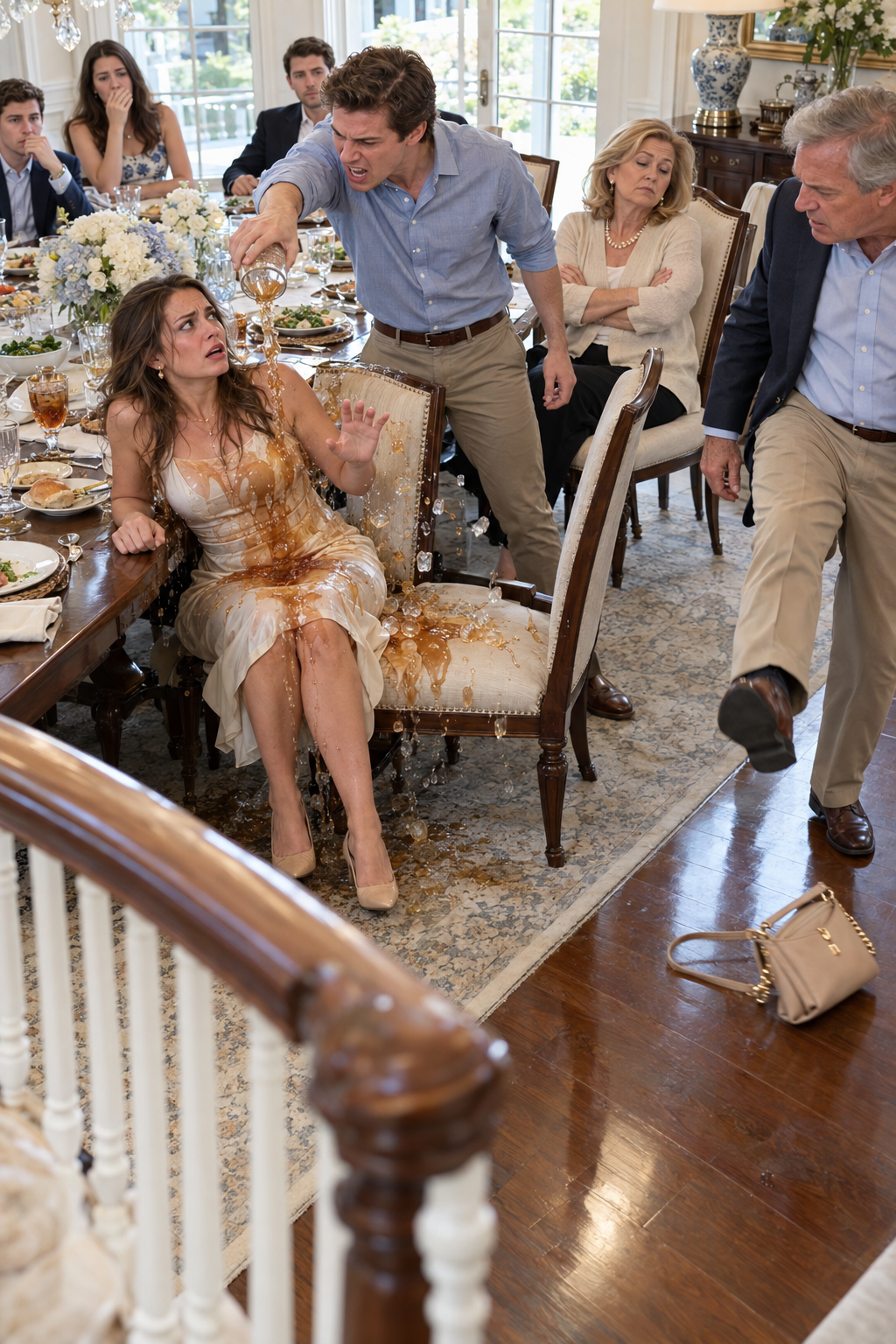
“That’s My Chair!” My Brother Dumped Iced Tea In My Lap For Sitting In “His Chair”—In The House I Bought. Dad Kicked My Purse Across The Floor. “Always Playing The Victim.” Mom Sighed. “Honey, Stop Being So Sensitive.” I Thanked Them For Dinner. By 7 A.M., A “For Sale” Sign Was Staked In The Front Yard. That Was Only The Beginning…
My brother poured iced tea into my lap because I sat in “his” chair, and my father kicked my purse away while my mother told me to stop being sensitive. None of them mentioned that I owned the house, paid the mortgage, or had already discovered the papers they planned to pressure me into signing. By sunrise, a FOR SALE sign stood in my mother’s tulips. Weeks later, while checking old records, I discovered something worse: the debt I had spent half my life repaying had never really been mine.
Part 1
The ice was still sliding off my knees when my father kicked my purse across the dining room floor. It spun once under the sideboard, coming to rest beneath a manila envelope covered in yellow SIGN HERE tabs, while my mother sighed and said, “Claire, honey, stop being so sensitive.” My brother Tyler lowered himself into the oak armchair I had apparently committed a crime by sitting in, picked up his fork, and reached for another slice of ham. I stood there in wet jeans, listening to ice cubes click against hardwood I had paid to refinish.
It was Mother’s Day in Pella, Iowa, and three hours earlier my father had been accepting compliments on the church steps about “his” beautiful old house. Martin Van Doren shook hands with both hands, the way church elders did, while people admired the fresh porch paint and the red-and-yellow tulips lining the front walk. “The Lord gave it back to us,” he told an older couple from the congregation, and I smiled because correcting him would have embarrassed him. My name was on the deed, my name was on the mortgage, and for five years every payment had come out of my checking account.
I was thirty-six and worked forty miles away in Des Moines auditing hospital bills, which meant I spent my weekdays examining whether strangers were being charged for things that never happened. I could find a duplicate medication charge buried on page twelve, an operating-room fee entered twice, or an insurance adjustment that should have erased thousands from somebody’s balance. At work, people joked that nothing got past me. At home, apparently, nearly everything did.
Mom had spent the afternoon producing the kind of dinner she believed excused any tension: glazed ham, buttery rolls, green beans with bacon, scalloped potatoes, and a Dutch apple pie cooling on the windowsill. “After dessert, we’ll all sit down and talk,” she said too casually when I arrived. I asked what about, and she waved a butter knife. “Nothing dramatic.”
Then I saw the envelope.
It sat squarely on the dining-room sideboard, positioned so neatly it could not have been accidental. Yellow tabs stuck from its edges, each one printed with SIGN HERE, and beside it was a black pen. Two weeks earlier Tyler had appeared at my apartment carrying an almost identical envelope, the first time in six years he had bothered to visit me there.
“It’s just paperwork,” he had said, leaning against my kitchen counter and looking around my two-bedroom apartment as though assessing its resale value. Inside had been a deed transferring ownership of the Pella house from me to Dad, while leaving the mortgage in my name. There was even a sticky note with the name of a local notary and an appointment time already penciled in.
“Dad’s sixty-six,” Tyler said. “Let him die in his own house.”
“He lives there.”
“You know what I mean.”
“Whose idea is this?”
Tyler shrugged. “Everybody’s.”
That word stayed with me. Everybody’s. Apparently everybody meant Dad, Mom, and Tyler, while I was merely the person whose signature and bank account were required to make their decision possible.
I had told Tyler I would think about it. The minute he left, I called Ruth Becker, the realtor who had helped me buy the house five years earlier. She listened without interrupting, then said, “If you decide to sell, I’ll have everything ready. Nothing goes live until you say so.”
So on Mother’s Day, when I saw the second envelope waiting beside the family photographs, I knew what dessert was really for.
The chair incident began almost stupidly. Mom pointed toward the oak armchair at the head of the table and said, “Sit down, honey. Tyler won’t care.” Tyler had claimed the chair after his divorce the previous fall, when he moved back home at thirty-four with three duffel bags, a pickup full of tools, and the certainty that the household would reorganize around him. Dad had surrendered the head of the table immediately because, as he put it, “A man needs his place.”
I sat because Mom told me to.
Tyler walked in from the porch carrying his phone in one hand and a glass of iced tea in the other. He stopped when he saw me, looked at the chair, and said, “That’s my chair.”
“Mom told me to sit here.”
He crossed the room slowly.
Then he tipped the glass.
He didn’t fling it in anger. That would almost have been easier to understand. He simply turned his wrist and poured the entire drink over my lap while everyone watched.
Cold tea soaked through my jeans in one sheet. Ice settled between my thighs and rolled onto the floor, and for several seconds my body forgot what reaction it was supposed to have. Dad continued cutting his ham into small, even pieces, while Mom reached across the table with a napkin—not toward me, but toward the spreading stain near her gravy boat.
“Tyler,” Dad said.
I thought, finally.
Then Dad added, “The tablecloth.”
That was when I stood.
I bent toward my purse, and Dad’s shoe came out beneath the table. One flat shove sent it skating under the sideboard.
“Always playing the victim,” he said.
My mother sighed. “Claire, honey, stop being so sensitive. There are sweatpants in the hall closet.”
Tyler pulled his chair back into position and began eating.
I knelt to retrieve my purse. The yellow SIGN HERE tabs were level with my eyes, three inches above my face. Nobody mentioned the documents. Nobody apologized.
I stood, folded my wet napkin twice, and placed it beside my plate.
“Thank you for dinner.”
It was an old reflex. I had spent twenty years thanking those people for everything from rides to doctor appointments to permission to exist without making them angry.
Mom called after me about pie.
I drove back to Des Moines with the seat heater on because my jeans were freezing against my legs.
At 9:14 that night, I texted Ruth one word.
Tomorrow.
Her answer arrived before I had put the phone down.
Six?
At six the next morning, her car was parked outside the house with the trunk open. A FOR SALE sign lay across the spare tire.
Mom’s tulips were heavy with dew. Ruth, sixty-two and wearing work gloves over a quilted vest, drove the metal stake halfway into the flower bed and then offered me the rubber mallet handle-first.
“Your yard,” she said. “Last swing belongs to you.”
I hit it once.
The stake sank into the ground, crushing one red tulip beneath the post.
The kitchen light came on behind my parents’ curtains.
My father called before I reached the edge of town.
“Whatever that is in the yard,” he said, “you take it down before the neighbors see it.”
For thirty-six years, I had known exactly what came after that tone.
This time I said, “No.”
There was a silence so complete I could hear my tires crossing the seams in the highway.
Dad finally spoke to someone behind him instead of to me. “She’ll have it down by Sunday.”
Then he hung up.
But the sign stayed.
And by Tuesday morning, half the town believed I was throwing my parents onto the street because of a spilled glass of tea.
Part 2
The prayer request arrived in my inbox before nine Tuesday morning. A cousin had forwarded it from my parents’ church without adding a single word, probably because even she wasn’t sure whether she believed it. The subject line read PRAYER REQUEST—VAN DOREN FAMILY, and beneath it someone had written that Martin and Elaine Van Doren were in danger of “losing their home for the second time” because their daughter, who “held the title for technical reasons,” had listed the property after “a misunderstanding at Mother’s Day dinner.”
A misunderstanding. That was the word they had chosen for my brother deliberately pouring iced tea over me while our parents watched. By lunchtime, one of Mom’s friends had posted a picture of the house on Facebook with the tulips and FOR SALE sign visible in the foreground, followed by a paragraph reminding people of the benefit supper the church had held when I had cancer at sixteen. “Some of you remember what this family sacrificed for Claire,” she wrote. “Please keep Martin and Elaine in your prayers.”
The comments multiplied faster than I could read them. Shameful. Kids today have no gratitude. Martin gave everything for that girl. One woman wrote that she remembered bringing three pans of cinnamon rolls to the fundraiser and couldn’t believe this was how I repaid my parents.
I typed three different responses and deleted all three.
Ruth called me while the post was still open on my phone. “Don’t argue online.”
“I know.”
“Paper beats mouth.”
“I know.”
“I’m saying it because sometimes smart people need to hear the obvious thing twice.”
That evening, paper had not yet arrived, but two church elders had.
They appeared on the landing outside my apartment carrying Bibles and the solemn expressions of men who believed they had been assigned an unpleasant but righteous duty. One had taught my eighth-grade catechism class and still called me Claire-Bear. I made coffee because apparently humiliation had not killed my manners.
They sat close together on my couch while I took the wooden chair across from them. After several minutes about grace and family unity, the older one opened his Bible to Exodus. “Honor your father and mother,” he read.
“I know the verse.”
The younger elder put his mug down. “Your father says your illness cost them over four hundred thousand dollars.”
My hands stopped moving.
He continued. “The congregation helped where it could. Your father carried the rest. And now a glass of tea is worth putting them out of their home?”
Four hundred thousand.
I heard the number differently than I would have at sixteen. At work, I saw $400,000 hospital bills regularly. That number did not mean anyone actually paid $400,000. It meant that was what the hospital charged before insurance adjustments, negotiated rates, assistance programs, write-offs, and payments.
I could have explained all of that.
Instead I said, “Thank you for coming.”
The older elder frowned. “Claire—”
“I’m not taking down the sign.”
They left their coffee half finished.
After they were gone, I washed all three mugs and opened my bedroom closet.
A white binder sat on the top shelf behind two sweaters.
My mother had given it to me fourteen years earlier, on the day we moved out of that same Pella house after foreclosure. The handwritten label on its spine said CLAIRE—HOSPITAL.
I had been twenty-two, a month from graduating college. The church had loaned my family a box truck, and I was carrying cartons out of the empty dining room when Mom called me back inside. Without furniture, every footstep echoed.
She pressed the binder into my hands.
“This is what you cost,” she said.
The first page displayed total hospital charges exceeding four hundred thousand dollars.
Dad appeared in the doorway carrying a lamp. “You want to know what you cost this family? Count it.”
I closed the binder.
“I’m sorry,” I said.
I had been apologizing ever since.
At sixteen, I had been treated for cancer over the better part of three years. My parents drove me to appointments, sat in waiting rooms, slept badly, lost work hours, and watched my hair come out in clumps. I knew it had been awful for them, and because they repeatedly reminded me of the financial devastation, I treated every good thing in my adult life as repayment.
After college, I sent money home every month.
When Dad’s truck died and his credit was still damaged from foreclosure, I financed another one in my name and put him on my insurance.
When phone plans got expensive, I paid the family plan.
When our old house came back onto the market five years earlier, Ruth called me before the listing went public. I had enough for the down payment and good enough credit for the mortgage, so I bought it.
On moving day, I put the keys in Dad’s palm.
The following Sunday he stood in church and said, “The Lord gave me my home back.”
People applauded.
I never corrected him.
Once, while helping Mom unpack dishes, I asked why Dad couldn’t simply tell people I had bought it.
“Your father lost that house because of you once,” she said. “Let him have this.”
So I did.
Now I stood in my apartment staring at the binder.
I didn’t open it that night.
Instead, I sat at my kitchen table and prepared formal thirty-day notices for Dad, Mom, and Tyler. The house was under my ownership, and Ruth had already connected me with an attorney who made certain everything complied with Iowa requirements. I signed each notice and arranged for proper service.
Then I called my insurance company.
“I need to remove two drivers.”
Dad and Tyler came off my policy effective midnight.
The family phone plan was next. Their lines would leave my account at the end of the billing cycle.
Finally, I texted Dad.
I’ll be picking up the truck tomorrow morning.
He answered immediately.
You’ll regret this.
The next morning, a rideshare driver dropped me beside the curb in Pella. I used my spare key, climbed into the truck I legally owned, and found Dad’s church bulletin folded neatly on the passenger seat.
The living-room curtain moved.
I saw my father standing behind it.
He never came outside.
I backed past the FOR SALE sign and drove away.
That evening, sitting on the kitchen floor of my apartment, I finally pulled the white binder from its shelf.
The first page still said $412,000.
But above the number was a word I understood now.
Charges.
Not payments.
I started turning pages.
Part 3
Once I began reading the binder like an auditor instead of a guilty daughter, the story changed within twenty minutes. Behind the dramatic hospital summaries were insurance explanations of benefits, negotiated adjustments, write-offs, and statements showing what my parents had actually been responsible for. I spread them across the kitchen floor in chronological order, exactly the way I would reconstruct a stranger’s medical account at work. By midnight, my legal pad showed a family responsibility of roughly fifty-one thousand dollars over several years, not four hundred thousand.
Fifty-one thousand was still real money. My father had been a mechanic and Mom had stayed home through most of my treatment, so I was not pretending it had been easy. But the final statement showed a zero balance in 2008, and I had been told repeatedly that my medical debt caused the family to lose the house in 2012.
At the back of the binder, I found a folded yellow flyer.
BENEFIT SUPPER FOR CLAIRE VAN DOREN.
The church logo had faded, but beneath it was the name of the organizer: Marlene Visscher.
Mrs. Visscher had been the pastor’s wife when I was sick, though everyone still called her that long after her husband died. I remembered her from the benefit supper, carrying folding chairs through the packed fellowship hall while I stood near the entrance in a knit cap shaking hands with everyone who came through. Mom had told me, “People paid to help you. They need to see you appreciate it.”
Three times Mrs. Visscher had brought me a chair.
Three times I had refused to sit.
I called the number on the flyer the next morning.
She answered on the fourth ring.
When I said my name, there was a pause followed by, “Well, I wondered when you’d finally call.”
Her house smelled like coffee and cinnamon when I arrived the following Monday. She was nearly eighty now, small and sharp-eyed, and before she would discuss anything she pointed toward a chair at her kitchen table.
“Sit.”
“I’m fine.”
“Claire.”
Something in her voice made me sit.
She poured coffee, then told me she had heard my father’s version after church. He had arrived in Mom’s old Buick because his truck was gone and spent half an hour in the narthex explaining that his ungrateful daughter had put him out of the home he had sacrificed everything to save.
“I need to know how much the church gave my family,” I said.
Mrs. Visscher looked at me over her cup. “Why?”
“When the house sells, I’ll repay it.”
“No.”
“I’m serious.”
“So am I.”
She crossed the kitchen and pulled open a drawer. From beneath a stack of recipe books, she removed a green cloth ledger with rounded corners.
The page was labeled SUPPER FOR CLAIRE.
Names filled both sides in looping handwriting: soup donations, pie auction receipts, freewill offerings, anonymous gifts. The total at the bottom had been underlined twice.
$41,600.
I stared at it.
Mrs. Visscher tapped the page. “I handed the check to your mother myself.”
Combined with insurance, that meant my parents’ uncovered medical expense had been roughly $9,400.
Not $400,000.
Not enough to explain a foreclosure four years after the medical balance reached zero.
Mrs. Visscher slid a Dutch almond pastry across the table.
“You never ate at your supper,” she said.
I remembered standing four hours in the fellowship hall while people filed past me. My knees had hurt from treatment, and the smell of soup had made me nauseated. Every time someone hugged me, Mom whispered, “Say thank you.”
I picked up the pastry.
The first bite made my throat tighten.
Mrs. Visscher turned toward the window and gave me the privacy of not being watched.
That night I sat at my kitchen table and wrote another column.
The money I had sent my parents after college. Their phone bill. Dad’s truck payments and insurance. Five years of property taxes and mortgage payments on a home I did not occupy. The original down payment.
More than two hundred thousand dollars.
I had repaid a $9,400 expense more than twenty times.
But the missing question bothered me more than the money.
If my illness had not taken the house, what had?
I opened my laptop and searched the county land records.
The foreclosure file came first.
The bank had not foreclosed on the original family mortgage.
It had foreclosed on a later loan.
A second mortgage.
$72,000.
Borrowers: Martin Van Doren and Elaine Van Doren.
Recorded July 2010.
I stared at the date until I understood why it bothered me.
That summer had a name in our family, except nobody ever said it aloud.
Three weeks before that mortgage was recorded, Tyler had rolled his pickup on a gravel road outside Pella.
He was eighteen. I was twenty and home from college.
I remembered the phone ringing after midnight and Dad driving us to the hospital faster than I had ever seen him drive. Tyler lay on a gurney with blood dried beside his hairline and gravel embedded in one arm. He smelled strongly of beer.
A boy named Ethan Hollis had been riding with him.
Ethan’s lower leg had been badly crushed.
At the hospital intake desk, Dad told someone it had been an ATV accident on private property.
It had not.
It had been Tyler’s pickup.
I remembered Tyler mumbling, “I only had a couple.”
Dad snapped, “Not another word.”
On the drive home, Mom turned around in the passenger seat.
“We do not talk about tonight,” she said. “Not at church, not anywhere.”
A few weeks later, my parents dressed in church clothes on a Monday morning and went to the bank. Dad stopped sleeping. The Hollis family sold their house before winter and moved away.
And one evening that August, my father’s sister Nora had parked her car in our driveway.
Aunt Nora.
The aunt who had supposedly demanded repayment of $15,000 she had lent my parents for my cancer treatment.
The aunt Dad had declared “dead to this family.”
The aunt who had nevertheless sent me a Christmas card every year for fourteen years.
I had saved every card.
I had never answered one.
The following Saturday, I placed the shoebox of cards on the passenger seat and drove toward Nora’s farm.
For the first time in my life, I was beginning to wonder whether my parents had lied about more than money.
Part 4
Aunt Nora’s farmhouse sat southwest of town at the end of a gravel lane lined with cottonwoods. She was already on the porch when I parked, wearing rubber boots and a canvas gardening jacket, one hand on the railing as if she had stepped outside because she recognized my car. I got out carrying the shoebox against my chest and started apologizing before I reached the steps.
“I got every card,” I said. “I kept all of them. I’m sorry I never wrote back.”
Nora watched me.
“And I know about the fifteen thousand dollars,” I continued. “Dad said it was for my treatment. I know that’s why you two stopped speaking.”
“You still cheat at cribbage?” she asked.
I stopped.
When I was sick, Aunt Nora had sometimes driven me to the cancer center in Iowa City. We spent hours playing cribbage beside my IV pole while she accused me of inventing rules whenever I won.
Before I could answer, she disappeared inside.
She returned carrying one yellowed sheet of paper.
At the top was a cribbage score from the year I was sixteen.
CLAIRE 41. NORA 12.
“That,” she said, “is the only debt between us I ever kept track of.”
I sat on the porch step.
Nora opened the door. “Come inside before the flies carry you away.”
Her kitchen looked almost unchanged from childhood. A dented metal recipe box painted with strawberries sat on the counter, and she went directly to it.
After flipping through several cards, she pulled out a piece of notebook paper folded into thirds.
I recognized my father’s handwriting immediately.
The date was August 2010.
Nora,
The bank gave us $72,000 against the house. The Hollises want $87,000 to settle everything and keep Tyler’s name out of the paper. I need $15,000 by Friday. Don’t tell Elaine’s people or the kids.
Martin.
I read it twice.
Then a third time.
“The fifteen thousand wasn’t for me.”
“No.”
“For Tyler.”
Nora nodded.
“The crash?”
“Yes.”
The kitchen seemed to tilt slightly, though neither of us moved.
She told me Dad had come to her after Tyler’s accident. Ethan Hollis needed surgeries and long rehabilitation, and there were questions about underage drinking, reckless driving, insurance, and what could happen if the family pursued the matter publicly. Dad wanted the settlement handled privately.
The bank loaned my parents $72,000 against the house.
Nora supplied the remaining $15,000.
$87,000 total.
Dad never repaid Nora.
She never asked.
Two years later, after Dad lost his job and could no longer carry the loan, the bank foreclosed.
My cancer had nothing to do with it.
“Why didn’t you tell me?” I asked.
Nora stared at the table for a long moment. “Because your father made me promise not to tell anyone about Tyler.”
“But after he blamed me?”
“I confronted him.”
She had gone to the house during the foreclosure move and overheard Dad telling relatives that my medical bills had destroyed the family financially. Nora followed him onto the porch and said, “You do not put this on that girl.”
Dad ordered her off the property.
Then he told everyone she had become bitter because she wanted her money back.
“I kept his secret,” Nora said. “I thought protecting you meant keeping quiet about Tyler. I was wrong.”
Fourteen Christmas cards.
Fourteen years of an open door I had refused to walk through because I believed she had abandoned us over money spent saving my life.
I rubbed my thumb over the fold in Dad’s letter.
My phone vibrated.
The message came from Pastor Samuel Hart, the current minister at my parents’ church.
Martin has requested a family reconciliation meeting with the consistory Saturday morning at the house. Mrs. Visscher has agreed to attend. Would you be willing to come?
I almost laughed.
Dad had invited Mrs. Visscher because he believed the woman who organized my fundraiser would prove how much he had sacrificed.
He had no idea I had seen her ledger.
He had no idea I had opened the hospital binder.
And he certainly did not know his sister had kept the letter.
I showed Nora the message.
“He thinks you never told me,” I said.
“He thinks I still keep promises better than he does.”
“Will you come with me?”
Nora looked down at Dad’s letter.
“You don’t have to say anything,” I added. “Just sit beside me.”
She folded the paper carefully.
“I’ve waited fourteen years to sit beside you in that house.”
While all of that was happening, Tyler had started trying to sabotage the sale.
During the first showing, he called in sick from the implement dealership and followed a young couple through the house without Ruth’s permission. He told them the basement flooded every spring and suggested Dad had hidden foundation cracks for years.
The buyers left in eleven minutes.
The wife cried in their car.
Ruth phoned me from the curb.
“I am going to say something very impolite about your brother.”
“Is the basement damaged?”
“I’ve sold houses in this town for thirty-five years. I’ve never seen water down there.”
I hired a structural engineer anyway.
He spent two hours examining the foundation, checking moisture levels, inspecting drainage, and photographing everything. His report found no structural failure and no evidence of recurring flooding.
“Your foundation is better than mine,” he said.
Ruth put the report directly into the seller disclosure packet.
Then we installed a lockbox and required written notice for every showing.
When the young couple returned, Ruth placed the engineering report on the kitchen counter where Tyler used to lean.
They read it.
They made an offer.
I accepted.
Closing would be in July.
The house had to be vacant.
The night Ruth attached the red UNDER CONTRACT rider to the sign, Dad called four times.
I let every call go to voicemail.
His final message lasted only six seconds.
“You think you’ve won something.”
I sat at my apartment table with the hospital records, Mrs. Visscher’s fundraiser total, the second mortgage, and Dad’s letter arranged in front of me.
For years, I had thought I was paying a debt.
Now I understood what I had really been paying for.
Their silence.
Part 5
Saturday morning, Aunt Nora and I walked up the path together. The FOR SALE sign stood among flattened tulip leaves with UNDER CONTRACT fixed across it in red, and Dad opened the front door before we knocked. When he saw Nora, something crossed his face too quickly to name.
“This is a family meeting,” he said.
Pastor Hart’s voice came from the living room. “She is family, Martin.”
The room had been arranged like a church council meeting. Pastor Hart and two elders occupied the sofa, Mrs. Visscher sat straight-backed beside the front window, and Dad’s recliner had been positioned slightly apart as though someone had already decided where the authority in the room belonged. Mom hovered near the coffee table beside a pitcher of iced tea and a plate of pastries.
Tyler leaned against the fireplace with his arms crossed.
In the center of the rug sat the oak armchair from the dining room.
Alone.
Facing everyone.
“Sit, Claire,” Tyler said. “We saved your favorite chair.”
Mom gave a nervous smile. “Iced tea?”
I looked at the chair.
Then I picked it up.
It was heavier than I expected, and one leg bumped the coffee table while I carried it across the room. Nobody offered to help.
I placed it beside Mrs. Visscher.
“Aunt Nora.”
Nora sat in Tyler’s chair.
I went into the kitchen and brought back a plain wooden chair from the breakfast table. I put it beside hers and sat with my purse on my lap.
Tyler’s arms slowly uncrossed.
Dad asked Pastor Hart to pray.
The moment the amen finished, Dad stood and unfolded a white handkerchief.
“Thirty-seven years,” he began.
He spoke mostly to the elders, barely looking at me. He described working in freezing garages, fixing other men’s engines while his children slept warm, and carrying a financial burden no father should have been forced to carry. Then his voice cracked exactly where I expected it to.
“This girl’s sickness cost us our home once.”
This girl.
“The church helped,” he continued. “A few thousand dollars. God bless everyone who gave. But the rest was mine. More than four hundred thousand dollars.”
Mrs. Visscher did not move.
Dad pressed the handkerchief to his eye.
“And after the Lord helped us get our home back, she puts us out because her brother spilled a drink.”
Tyler made quotation marks with his fingers.
“Tell them how I attacked you.”
Mom sighed.
“Claire, just apologize. Take the sign down. We can all move on.”
The older elder leaned forward. “Would you like to respond?”
Every eye in the room turned toward me.
I put my hand on my purse.
“May I ask Mrs. Visscher one question?”
Dad looked surprised, then almost relieved.
“Of course.”
He believed she was his witness.
I turned toward her.
“Mrs. Visscher, how much did the benefit supper for my treatment raise in 2006?”
“Forty-one thousand six hundred dollars.”
Nobody spoke.
“And whose names were on the check?”
“Martin and Elaine Van Doren.”
Dad lowered the handkerchief.
Mrs. Visscher continued. “I put it directly into Elaine’s hands.”
“A few thousand,” I said quietly.
Dad’s jaw tightened.
I removed three papers from my purse and placed them on the coffee table.
“The hospital charged more than four hundred thousand dollars over the course of my treatment. Insurance paid or adjusted most of that. According to the records Mom gave me, my family’s actual responsibility was approximately fifty-one thousand.”
One elder picked up my worksheet.
I pointed to the next line.
“Subtract the church fundraiser, and my parents were responsible for about nine thousand four hundred dollars.”
“That isn’t the whole story,” Dad said.
“The final medical balance was zero in 2008.”
“You can make numbers say whatever you want.”
“No. Numbers are usually the part that says exactly what happened.”
Dad’s cheeks reddened.
“The bills kept coming. Years of bills. That house disappeared because of what we spent keeping you alive.”
“We lost the house in 2012.”
Silence.
“Four years after my last medical balance.”
Mom sat down.
I reached into my purse again.
“So tell them about July 2010.”
Dad went pale.
Tyler looked from me to him. “What about July?”
I laid the county record on the table.
“Second mortgage. Seventy-two thousand dollars. Signed by Martin and Elaine Van Doren.”
Pastor Hart leaned forward.
“That is the debt the bank foreclosed on.”
Tyler pushed away from the fireplace.
Dad said, “That’s private.”
“Three weeks after Tyler rolled his pickup.”
Tyler’s face changed.
“You have no right,” Dad said.
I unfolded the final paper.
Nora sat motionless beside me.
I read one sentence.
“The Hollises want $87,000 to settle everything and keep Tyler’s name out of the paper.”
No one in the room breathed.
Dad stood abruptly. “That is not—”
“It’s your handwriting.”
I held the letter where the elders could see it.
“Aunt Nora kept it for sixteen years.”
Pastor Hart looked toward her.
Nora nodded once.
Tyler stared at Dad.
“You told me her cancer took the house.”
Dad said nothing.
“You told me that my whole life.”
“Tyler—”
“You let me blame her.”
His voice broke on the final word.
Dad turned toward him. “I protected you.”
“From what?”
“You were eighteen. You had been drinking. Ethan could barely walk afterward. Your name would have been in every newspaper in the county. I saved your future.”
Tyler looked toward me, then at the chair beside Nora.
“I’ve been living in her house,” he said. “Sitting at her table. Telling her she owed us.”
Mom set the iced tea pitcher down.
The glass hit the table with a soft knock.
“I signed the mortgage too,” she said.
Tyler stared at her.
Mom’s eyes were dry.
“It was for the family.”
Something strange happened then.
Dad sat slowly in his recliner and began to cry.
Not quietly.
Not privately.
He cried in front of his pastor and the elders because his version of the story had collapsed.
A week earlier, when I stood dripping beside the dining table, he had looked at me and said, “Always playing the victim.”
Nobody repeated those words now.
But everyone in the room heard them.
Part 6
Pastor Hart stood and rested one hand on Dad’s shoulder. “Martin, the elders and I need to speak with you outside.”
Dad looked at him as if he had misunderstood.
“Now?”
“Now.”
The three men walked onto the porch and down into the front yard. Through the window, I could see them standing beside the sign while Dad spoke rapidly and the elders listened without nodding.
Tyler left through the kitchen.
The back door slammed.
Mom and I were left facing each other across the coffee table.
For once, she did not sigh.
“Everyone knows now,” she said. “Everything is out. There’s no reason to sell anymore.”
“The sale is already under contract.”
“You can stop it.”
“No.”
“Claire.”
“The closing date stands.”
She twisted a dish towel between both hands. “Where are we supposed to go?”
“The notices gave you thirty days.”
“After everything we did for you?”
There it was.
I looked at her.
“After everything.”
She opened her mouth, but no words came.
Mrs. Visscher rose from the chair by the window and picked up her purse. As she passed me, she stopped, opened my handbag without asking, and tucked a small yellow ticket inside.
It was faded and soft at the edges.
ADMIT ONE—SUPPER FOR CLAIRE.
“You still owe me a supper,” she said.
Then she left.
Nora stood from the oak armchair and offered me her hand.
We walked out together.
On the porch step, my knee caught slightly on the edge, and her fingers closed under my elbow.
“Watch your step.”
It was such a small thing that I almost cried.
They moved out before the deadline.
The church deacons helped my parents find a two-bedroom duplex on the edge of town. Tyler moved with them temporarily, though according to a cousin he spent most evenings at a friend’s place.
The attorney had prepared eviction papers in case they refused to leave.
I never needed them.
On the final evening, Ruth met me at the house and opened the lockbox.
The rooms were empty.
Without rugs and furniture, our footsteps echoed the way they had during the foreclosure fourteen years earlier.
Small nail holes dotted the walls where Mom had removed family photographs.
In the dining room, the oak table remained.
The buyers wanted it.
I had agreed.
My hand moved along its edge until I reached the head.
A pale white ring marked the wood where Tyler’s sweating iced-tea glass had sat.
I stared at it.
Ruth noticed.
“Want me to see if I can get that out?”
“No.”
“You sure?”
“It belongs to the house now.”
At the far end of the table lay Dad’s keys.
The same set I had placed in his hand five years earlier on the front porch.
They had been warm from my pocket then.
Now they were cold.
I handed them to Ruth.
She locked the house behind us.
Two days later, Mrs. Visscher texted me a photograph of the Sunday church bulletin propped against her sugar bowl.
The announcement was three lines beneath a youth car wash.
Elder Martin Van Doren has requested release from the consistory effective immediately.
That afternoon the prayer chain sent a correction to everyone who had received the original message. It apologized for sharing incomplete information regarding my parents’ housing situation and asked recipients to disregard the earlier request.
Mom’s friend deleted her Facebook post.
Then she texted me.
I’m sorry. I didn’t know.
My cousin called.
“Claire, I should have called you before believing any of it.”
“Thank you for saying that.”
“You’re not angry?”
“I’m tired.”
That was closer to the truth.
Aunt Nora went back to church the following Sunday for the first time in fourteen years.
When she called afterward, I asked how it felt.
“Mrs. Visscher saved me a seat.”
I laughed harder than the sentence deserved.
Then another message arrived.
Tyler.
Found Ethan Hollis. Lives near Cedar Falls. Walks with a cane. I’m driving up Saturday. I’m going to apologize in person.
I stared at the message.
For years, my brother and I had been placed on opposite sides of a debt neither of us understood. Dad had convinced Tyler that I had destroyed the family financially; he had convinced me that Nora abandoned us over my treatment; he had convinced a church that his suffering proved his goodness.
Tyler had still poured iced tea on me.
He had still helped pressure me over the house.
Knowing he had been lied to did not erase what he chose to become while believing those lies.
I put the phone down without answering.
That debt was his.
For almost four weeks, Mom said nothing.
Then came closing day.
The young buyers sat across from me at a long conference table in the title company, holding hands beneath the edge as though they thought nobody noticed. A bowl of peppermints sat between us, and a tired window air conditioner rattled against the July heat.
“Sign here,” the title officer said.
For once, those words did not frighten me.
I signed.
Initialed.
Signed again.
With each page, the mortgage balance disappeared until the officer finally said, “Loan payoff confirmed.”
Five years of payments vanished from my shoulders in one sentence.
The young woman buying the house leaned across the table.
“We’ll take good care of it.”
“I know.”
My phone buzzed.
Mom.
Honey, your father isn’t doing well. I know you’re hurting, but can’t we be a family again? Come for Christmas. The duplex is small, but we’ll make room.
I began typing.
I’m sorry, but—
Deleted.
I’m sorry you feel—
Deleted.
Every response I knew began with an apology.
So I wrote one that didn’t.
I’m not hurt anymore, Mom. I’m just done paying. Take care of each other.
I sent it.
Then I turned my phone face down and finished closing on the house.
Part 7
Selling the house solved the legal problem, but it did not immediately solve what happened inside me whenever someone offered kindness. I discovered that gratitude had become almost mechanical, a reflex connected to debt. A coworker brought me coffee and I offered to Venmo her before taking the cup; my neighbor watered my plants for one weekend and I showed up with an expensive bottle of olive oil because simply saying thank you felt dangerously unfinished. Receiving anything without repayment made my skin itch.
My therapist called it conditioned obligation.
I called it being raised by Martin and Elaine Van Doren.
For years, my parents had taught me that every sacrifice was an invoice. Rides to chemotherapy, meals, health insurance, worry, shelter, even parental love itself—all of it eventually appeared in the accounting book.
What made the lesson powerful was that some of their sacrifices had been real.
Dad really had sat beside my hospital bed.
Mom really had washed my sheets when medication made me sick.
They really had been afraid.
That was what had kept me trapped.
Cruel people are easy to leave when they are cruel every minute.
My parents had hugged me, fed me, prayed over me, and then used those same moments as collateral for the next twenty years.
In August, Tyler called.
I almost ignored it.
Then I answered.
“I went to see Ethan.”
I said nothing.
“He knew I was coming. I called first.”
“How did it go?”
“Bad.”
His voice sounded older than it had a month before.
Ethan had spent years dealing with surgeries and chronic pain. His family’s settlement had helped with expenses but had never restored what happened that night. Tyler told him the truth: that he had been drinking, that he drove, that his father arranged the private settlement, and that for years he had allowed the accident to become something no one discussed.
“What did Ethan say?”
“He said my apology didn’t change his leg.”
I closed my eyes.
“That sounds fair.”
“He also said he was glad I finally came.”
Tyler breathed slowly into the phone.
“I’m not asking you to forgive me.”
“Good.”
A short, startled laugh escaped him.
“I deserved that.”
“Yes.”
“I keep thinking about the chair.”
“So do I.”
“Dad gave me that seat like I had earned something by getting divorced and coming home. I acted like the whole house belonged to me.”
“You knew it didn’t.”
“I know.”
“And you came to my apartment with papers designed to take it from me.”
“I know.”
“And you poured a drink on me.”
“I know.”
He did not explain.
That mattered more than an apology would have.
“I’m sorry, Claire.”
I leaned against my kitchen counter.
“I believe you’re sorry.”
“Is that the same as forgiveness?”
“No.”
He breathed out.
“Okay.”
I never cut Tyler completely from my life, but I stopped pretending blood entitled him to closeness. We spoke occasionally. He moved out of my parents’ duplex before fall and rented a small place near his job. Months later, he sent me a photograph of an old oak chair sitting beside a dumpster.
Finally got my own chair.
I laughed and did not reply.
Dad never called me directly.
He sent messages through relatives for a while.
Your father is devastated.
Your father says the church misunderstood.
Your father says he only wanted to protect Tyler.
Your father says a parent sometimes has to make impossible choices.
I stopped responding to messengers.
Protecting Tyler had been one choice.
Blaming me had been another.
Keeping my cancer binder like a ledger of debt was another.
Accepting my money for years was another.
Trying to have the house transferred into his name while I kept the mortgage was another.
There had never been one terrible decision.
There had been hundreds of convenient ones.
Mom texted every few weeks.
Pictures of casseroles.
A photograph of the duplex after she planted two pots of red geraniums.
Dad sitting in a folding chair at a minor-league baseball game.
She never apologized.
The closest she came was a message in September.
I wish everything hadn’t gotten so complicated.
I read it twice.
Nothing had gotten complicated.
We had discovered the truth.
Those were different things.
I left the message unanswered.
Meanwhile, Aunt Nora and I developed the kind of relationship we might have had all along. Some Saturday mornings I drove to her farm, where she put me to work snapping beans, peeling apples, or holding a flashlight while she complained about machinery older than both of us. She never treated our lost years as something I needed to repay.
One afternoon, I finally asked why she kept sending cards.
“Because someday you might wonder whether the door was open.”
“That simple?”
“Yes.”
“You weren’t angry?”
“Of course I was angry.”
“At me?”
“No. At your father.”
She looked at me.
“Adults should know where to put their anger.”
I wrote that sentence down after I got home.
Mrs. Visscher also became part of my life again. She had a habit of calling without greeting and beginning conversations with instructions.
“Saturday. Six o’clock. Nora’s porch.”
“Why?”
“Supper.”
“I can bring—”
“No.”
“I could make—”
“No.”
“Can I at least—”
“You have a ticket.”
The yellow ticket was still in my purse.
I had carried it since the meeting.
On the last Saturday of August, I drove to Nora’s farm with nothing in my hands.
No pie.
No flowers.
No check.
Nothing to settle an account.
That was harder than confronting my father.
Part 8
Sweet corn had come in all at once that week, and Nora’s porch looked like a small agricultural emergency. A galvanized tub overflowed with fresh ears from a neighbor’s field, an enamel table sat near the railing, and an aluminum pan waited for husks. Mrs. Visscher arrived carrying a pie and tomatoes, then announced, “Supper at six. I’m collecting on a twenty-year-old debt.”
I touched my purse.
The ticket was inside.
Three chairs surrounded the table.
Nobody told me which one was mine.
For one strange second, I stood there waiting.
Then I understood what I was doing.
I pulled out the chair between Nora and Mrs. Visscher and sat.
Nobody reacted.
Nora simply nudged the corn tub toward me with her boot.
We started shucking.
Silk clung to my fingers. Husks piled around our shoes. Cottonwood leaves moved above the yard, and somewhere beyond the field a tractor groaned steadily toward the road.
Mrs. Visscher went inside and returned carrying a pitcher of iced tea.
She poured three glasses.
When she slid mine across the table, condensation had already begun collecting on the outside.
I looked at it longer than I meant to.
“You’re eating this time,” she said.
I wrapped my hand around the glass.
Cold soaked into my fingers.
“Thank you.”
The words came out softly.
Then I waited automatically for the rest.
You shouldn’t have.
I’ll repay you.
What do I owe?
Nothing came.
Nora tossed an ear into the pan. “Shuck faster. You were quicker at sixteen.”
“She was quicker at everything at sixteen,” Mrs. Visscher said.
“So were we.”
“Speak for yourself.”
I laughed hard enough to drop the corn.
My phone lay face down on the kitchen windowsill behind us.
Mom had texted that morning.
I had not opened it.
For the first time, ignoring a message did not feel like cruelty.
It felt like choosing when I was available.
After the corn was cleaned, Nora carried out her old cribbage board. The holes along the track were worn smooth from decades of pegs.
“You still cheat?” she asked.
“Only when necessary.”
“Your definition of necessary is suspiciously broad.”
Mrs. Visscher came through the screen door carrying steaming corn.
“Cards later. She eats first.”
Twenty years earlier, I had stood through my own benefit supper because my mother believed gratitude required witnesses.
That August evening, nobody watched to see whether I appreciated the food enough.
I ate buttered corn.
Tomatoes with salt and pepper.
Potato salad.
Warm pie.
Mrs. Visscher refilled my iced tea without asking, and I let her.
Nobody kept count.
After supper, the light faded behind the cottonwoods. Moths began circling the porch lamp, and Nora finally dealt the cards.
I thought about the binder.
Four hundred twelve thousand dollars in charges.
Fifty-one thousand in patient responsibility.
Forty-one thousand six hundred raised by people who wanted to help.
Approximately nine thousand four hundred left.
Paid in full before I turned nineteen.
For nearly two decades, I had allowed that number to grow inside me until it seemed larger than any amount I could repay.
I financed trucks.
Covered insurance.
Paid mortgages.
Handed over houses.
Swallowed insults.
Sat wherever I was told.
Said thank you while my jeans dripped iced tea onto my shoes.
And none of it had been enough because the debt was never designed to be paid.
That was the point.
A payable debt eventually ends.
My parents needed mine to continue forever.
Their mistake was giving the adult version of me the records.
Paper beat mouth.
Months after closing, I drove through Pella and passed the old house.
The new owners had painted the front door dark green. A child’s bicycle lay on the lawn, and somebody had planted mums where the FOR SALE sign once stood.
I did not slow down.
The house was no longer my parents’.
It was no longer mine either.
That surprised me by feeling better than ownership ever had.
Tyler kept working on himself from a distance. We eventually met for coffee once, nearly a year later, and when he reached the table first he chose the ordinary chair facing the door.
I noticed.
He noticed me noticing.
“Don’t say it.”
“I wasn’t going to.”
“That’s my chair,” he said, then winced at his own joke.
I almost laughed.
Almost.
He grew serious.
“I’m still sorry.”
“I know.”
“Dad says I betrayed him.”
“That’s between you and Dad.”
“Mom wants everyone together for Christmas.”
“I won’t be there.”
“I figured.”
He nodded.
That was the whole conversation.
No reunion.
No dramatic embrace.
No promise to become the family we had never actually been.
I could wish Tyler well without volunteering to become close to him again.
I could love my mother without answering every message.
I could remember that my father once held my hand during chemotherapy without allowing that memory to purchase the rest of my life.
Those truths were not contradictions.
They were boundaries.
Nora dealt the first cribbage hand while Mrs. Visscher carried our empty plates inside.
My phone remained facedown on the windowsill.
Nora tapped the deck against the table.
“Cut.”
I cut.
She dealt.
On a clean score sheet beneath my name, she made the first mark.
The porch light buzzed overhead, and the September air smelled faintly of cut grass and warm dust.
For years, my father had dared me to count what I cost.
Eventually, I did.
The number was $9,400.
Paid in full before I was nineteen.
Everything after that had been interest invented by people who needed me to remain indebted.
I don’t count like that anymore.
A gift that comes with an invoice was never really a gift.
Love that requires lifelong repayment is not generosity.
And a family that needs you permanently guilty is not protecting you.
Nora looked over her cards.
“You’re staring.”
“Thinking.”
“Dangerous habit.”
I smiled and picked up my hand.
Behind us, my unopened phone remained silent.
In front of me sat two women, three glasses of iced tea, an old cribbage board, and a chair nobody had assigned to me.
For the first time in my life, I understood that I did not need permission to sit down.
And I did not owe anyone for the seat.
THE END!