The call came on a Tuesday afternoon at Fort Sill, the kind of Oklahoma afternoon that felt baked flat under white heat.
Rose Owen sat at a metal desk buried under training schedules, equipment checklists, and a stack of personnel forms that needed signatures before sunset.
Outside, boots struck pavement in steady rhythm, a drill sergeant’s voice cracked across the yard, and somewhere farther off, artillery rolled like distant thunder.
Her phone buzzed against a file folder.
Charleston, South Carolina.
She stared at the screen for half a second before answering, already knowing whose voice she would hear.
“Rose, darling.”
Janet never said her name without turning it into something sticky.
Even after all these years, Rose could hear the performance in it.
The false warmth.
The deliberate softness.
The practiced grace of a woman who had learned how to dress cruelty in silk.
“I wanted to let you know we’ve made a decision about that little trust fund your mother left you,” Janet said.
“Tiffany needs it for her wedding.
A proper wedding.
Nantucket, not some tacky ballroom here.
It’s ridiculous for that money to just sit there while you’re off playing soldier.
And honestly, if your mother were alive to see what you’ve become, she’d be absolutely mortified.”
Rose kept her face still.
She had expected this call for weeks.
Maybe months.
Janet paused, waiting for the sound she loved most from other people: hurt.
Shock.
Panic.
Some small surrender she could pin to a board and admire later.
Rose reached over, tapped her recording app, and said evenly, “Thank you for letting me know.”
Silence.
On the other end of the line, Janet’s breathing shifted.
Rose could picture her in the sunroom back in Charleston, manicured hand on the arm of one of the blue upholstered chairs she had bought after replacing Rose’s mother’s old linen furniture.
Eyes narrowed.
Smile stretched thinner.
“Well,” Janet said at last, “I’m glad you’re being reasonable for once.
Your father and I have already spoken to our attorney about the transfer.
We’ll handle everything from here.”
She ended the call a minute later with a brittle little laugh, as if she had won something.
Rose locked the recording, backed it up twice, and lowered the phone slowly onto her desk.
She didn’t cry.
She didn’t slam a drawer or curse under her breath or let herself relive the old reflex of feeling small.
Instead, she opened the footlocker beneath her bunk that night and pulled out a three-ring binder with a handwritten label on the spine: Contingency Plan: Nightingale.
Inside were six months of evidence.
Screenshots of Janet asking suspicious questions about trust access.
Emails from Tiffany calling Rose selfish for “hoarding family money.”
Property records.
Notes from phone conversations.
Copies of estate documents.
A sealed letter in Elizabeth Owen’s handwriting.
And clipped to the inside cover, a candid photograph of her mother laughing on the deck of a sailboat, wind pushing loose strands of hair across her face, joy bright in her eyes.
Beneath the photograph, Rose had written in block capitals: Protect the legacy.
Execute the mission.
No mercy for those who dishonor the fallen.
Janet thought that call had been an act of power.
What it actually was, Rose knew, was the mistake that ended everything.
Her mother
had died when Rose was seventeen.
Ovarian cancer was a cruel kind of erasure.
It didn’t just take Elizabeth Owen’s body.
It rewrote the atmosphere of the house before it ever emptied her room.
By the time the funeral came and went, every corner of the old Charleston home felt wounded.
Elizabeth had been the center of it all—smart, sharp, impossibly warm, the kind of woman who made people stand a little straighter when she entered a room because she carried herself like someone who knew exactly who she was.
Rose had adored her.
They sailed together on weekends.
Cooked together on rainy days.
Read on the screened porch with bare feet tucked under them and glasses of sweet tea sweating onto coaster rings her father always forgot to use.
When Elizabeth got sick, Rose became the quiet witness to everything nobody else wanted to name: the fear, the fatigue, the way pain hollowed people out from the inside while the rest of the world insisted on positivity because it was easier than honesty.
Her father, Charles Owen, loved Elizabeth.
Rose never doubted that.
But grief hit him like a collapsing roof.
He became absent while still standing in the same rooms.
He forgot appointments, stopped opening mail, sat in silence at the dining table after work as if language itself had become too heavy.
Rose was drowning in her own grief, but she was still seventeen.
She still noticed who began filling the empty spaces first.
Janet Mercer arrived with pound cake and sympathy.
A church acquaintance had sent her.
Or that was the story.
She stood on their porch in a pale cardigan with sorrow arranged carefully on her face and said she had heard the family could use help.
She started with casseroles and errands.
Then she stayed for coffee.
Then she began dropping by without asking.
Rose mistrusted her immediately.
Not because Janet did anything obvious at first, but because she never seemed truly sad in the house.
She seemed alert.
Interested.
As if she were measuring the rooms while everyone else was still mourning in them.
Charles saw steadiness where Rose saw calculation.
Within months Janet was in the kitchen giving opinions about curtains.
Within a year she had married Charles in a small ceremony Rose had not been asked to help plan.
Her daughter, Tiffany, moved in soon after carrying garment bags and vanity cases into the guest room like a girl checking into a resort.
Tiffany was only a year younger than Rose, but she had the serene entitlement of someone who had been taught all her life that other people’s homes could become hers if she smiled brightly enough.
She was pretty in the way magazines had trained the world to reward.
Polished hair.
White teeth.
A chirping laugh.
She called Charles “Dad” before the wedding gifts had even all been opened.
The changes began quietly.
A throw blanket was replaced.
Curtains changed.
Elizabeth’s ceramic bowl collection disappeared from the dining room sideboard because Janet said it looked dated.
Then the photographs started coming down.
Rose noticed first because she always noticed where her mother still lived in the house.
One day the framed black-and-white of Elizabeth on their wedding day was gone from the hall.
A week later the portrait of
Elizabeth and Rose on Sullivan’s Island vanished from the den.
In their place came abstract prints and glossy frames holding Janet and Tiffany in coordinated Easter dresses, on ski trips, at garden luncheons Rose had never heard of.
When Rose asked where her mother’s things were, Janet smiled and said, “Sweetheart, we all grieve differently.
But this house can’t stay a shrine forever.”
Charles, exhausted and fragile and unwilling to fight, nodded.
That was how it happened.
Not with one monstrous act at first, but with a thousand smaller thefts disguised as practicality.
The cruelest one came the spring after Janet moved in.
The Elizabeth had been a thirty-two-foot sailboat with white trim and weathered teak, named after Rose’s mother the summer before Rose was born.
Her parents had taken it out nearly every weekend.
After Elizabeth got sick, Rose and her mother still sometimes sat on the dock beside it just to watch the water and pretend there would be more time.
Janet sold it while Rose was away at an ROTC leadership weekend.
By the time Rose came home, the slip was empty.
The explanation was delivered over dinner like a scheduling note.
“It was too expensive to maintain,” Janet said, cutting her salmon.
“And honestly, no one was using it.”
Tiffany got a white Mercedes that same month.
Rose confronted her father in his study, heart pounding so hard she could barely shape the words.
“You sold Mom’s boat?”
Charles didn’t stand.
He didn’t even close the file he was pretending to read.
“Your mother is gone, Rose,” he said with sudden harshness, as if anger were easier than guilt.
“Life moves on.
We have to think about the family we have now, not the one we lost.”
That sentence changed her.
Before that night, Rose still believed grief might explain everything.
After that night, she began to understand that grief and betrayal could sit in the same chair and wear the same face.
She stopped begging people to remember.
She started paying attention.
She noticed that Janet intercepted the mail more often than not.
She noticed Tiffany trying on Elizabeth’s pearl earrings in the mirror with a shrug and saying, “They’re not doing anyone any good in a box.”
She noticed legal envelopes vanish from the desk.
One night, walking past the home office, she heard Janet on the phone in a low, excited voice telling someone that once Rose was out of the house, “all of this becomes much easier.”
Rose stood in the hallway with the lights off and learned the first lesson that would later make her dangerous: when someone thinks you’re powerless, they get sloppy in front of you.
She left for basic training three weeks later.
Janet treated her departure like a social inconvenience.
Tiffany hugged her at the airport and whispered, “I could never live like that.
It sounds miserable.”
Charles promised to call more than he did.
Charleston receded through the airport glass, and Rose told herself that distance might save what was left of her.
In some ways, it did.
The Army gave structure to pain.
It gave her routine when memory wanted to drown her.
It taught her how to separate emotion from action, how to slow her breathing under pressure, how to observe before reacting.
It didn’t erase grief.
Nothing could.
But it sharpened her into someone who could carry it without collapsing.
Then, six months before Janet’s call, everything changed.
Rose got a message from an unfamiliar Charleston number while she was on lunch break.
This is Thomas Bell.
I was Elizabeth Owen’s attorney.
There is a document your mother instructed me to release only under specific circumstances.
I believe those circumstances may now exist.
Rose read the message three times.
Bell was retired, in his seventies, and living part-time in Beaufort by then.
She met him on a weekend leave in a quiet office lined with old maritime prints and law books that smelled like dust and cedar.
He studied her face for a long moment before opening a file box.
“Your mother was not sentimental about money,” he said.
“But she was fiercely practical about character.”
Inside the box was the trust paperwork Rose had only vaguely known existed, along with amendments made during Elizabeth’s final year.
Most of the trust was straightforward: funds set aside for Rose’s education, housing, and long-term security.
But attached to it was something else—a sealed directive to be opened if an attempt was made by any family member or spouse to divert, coerce, or unlawfully obtain access to the trust or to dispose of Elizabeth’s personal property contrary to her written wishes.
Bell slid the envelope across the desk.
Rose’s hands shook when she opened it.
My dearest Rose,
If you are reading this, then someone in this family has shown you exactly who they are.
Your mother’s handwriting nearly undid her.
Elizabeth had known Charles might remarry.
She had not resented that possibility.
But she had feared what grief might make him vulnerable to, and she had documented everything carefully.
If any conflict arose over the trust, an independent trustee would take full temporary control.
If coercion or fraud was attempted, the responsible parties could be removed from any estate-related authority and referred for civil action.
There was more.
Elizabeth had also written a private inventory of heirlooms, personal effects, and specific items that legally remained designated to Rose alone.
Jewelry.
Letters.
paintings.
Certain pieces of furniture.
The sailboat, if still owned.
Bell’s mouth tightened when he reached that line.
“If it was sold after her death and without regard to the estate instructions,” he said quietly, “that may matter.”
For the first time in years, Rose felt something steadier than grief.
Purpose.
She began gathering everything.
She did it the way the Army had taught her to prepare for any operation: quietly, methodically, without wasted motion.
She requested records.
Saved texts.
Logged dates.
Forwarded suspicious messages to a secure folder.
When Tiffany posted a photo wearing Elizabeth’s pearls with the caption something old, something borrowed, something perfect, Rose took screenshots.
When Janet emailed asking Rose to sign “a routine family document” without legal review, Rose archived it.
When Charles sent a vague, uneasy text about simplifying things, she wrote down the time and preserved the thread.
Thomas Bell connected her with a litigation attorney in Charleston named Amelia Price, a woman with a precise voice and the kind of stillness that made careless people talk too much around her.
“Do not warn them,” Amelia told Rose at their first meeting.
“People like this expose themselves
best when they believe the target is tired.”
So Rose let them believe exactly that.
She became polite.
Brief.
Distant.
When Janet pushed, Rose didn’t push back.
When Tiffany made snide remarks about military pay and “wasted potential,” Rose ignored them.
Each time, Janet seemed to grow bolder.
Then came the wedding.
Tiffany got engaged to a private equity associate named Camden Wells who wore loafers without socks and spoke as if every sentence had been pre-approved by a country club.
Within a week, Janet’s messages became more aggressive.
Venues were expensive.
Expectations were high.
Family should come together at times like this.
Surely Rose understood that some sacrifices were necessary.
Rose said very little.
The less she said, the more Janet revealed.
By the time the Tuesday call came from Fort Sill, Amelia Price had already told Rose that one explicit statement of intent could be enough to trigger formal intervention.
Janet, with her usual arrogance, delivered it herself.
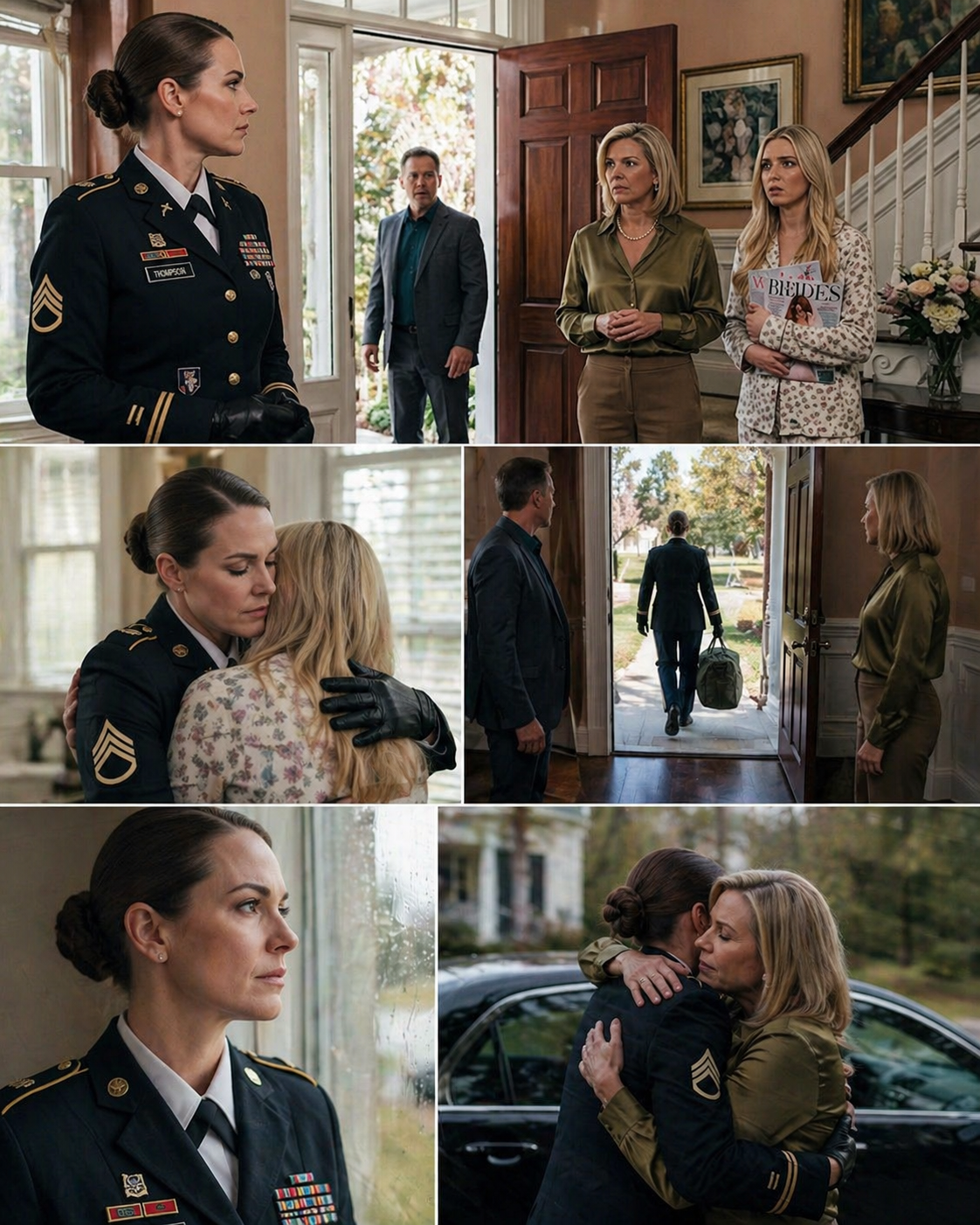
Three days later Rose was on a plane to Charleston in full dress uniform.
Not because Amelia had told her to dress that way.
In fact, Amelia had laughed softly when Rose mentioned it.
“That’s for you, then,” she said.
It was.
Rose wanted the visual truth of herself to enter that house before a single word did.
She wanted Janet to see, all at once, the person she had failed to break.
Charleston was damp and bright when Rose landed.
The air smelled faintly of salt and blooming jasmine.
She drove straight from the airport to the old house, the one with the white columns and blue shutters and iron gate her mother had once decorated with magnolia wreaths every winter.
From the street, everything looked immaculate.
Betrayal often does.
Janet opened the door after the second knock.
For one polished second, she wore her social smile.
Then she saw the uniform.
Something in her face tightened.
“Rose,” she said.
“You should have told us you were coming.”
“That would have defeated the purpose.”
Janet gave a brittle laugh and stepped aside.
Inside, the house felt wrong in all the familiar ways.
The foyer table was new.
Elizabeth’s piano was gone.
The scent in the air was not lemon oil and old wood the way Rose remembered but expensive candles and something floral that made the room feel staged.
Tiffany appeared in the archway in cream lounge clothes, a bridal magazine tucked under one arm.
Her smile vanished when she took in Rose’s expression.
Charles stood slowly from the sitting room, his face pale.
“You came home,” he said, but it wasn’t relief in his voice.
It was dread.
Rose set her gloves on the foyer table.
“I did.”
Janet recovered first.
“Well, this doesn’t need to be dramatic.
We were going to talk to you after everything was finalized.”
“That’s interesting,” Rose said.
“Because your call suggested the opposite.”
Janet’s eyes sharpened.
“I don’t know what you think you heard—”
“Oh, I know exactly what I heard.”
The room changed.
Not visibly.
The furniture stayed where it was.
Light still pooled on the hardwood.
Somewhere in the kitchen a refrigerator hummed.
But the balance of power shifted so suddenly that even Tiffany seemed to feel it.
Charles looked from Janet to Rose with an expression Rose had not
seen on him in years: uncertainty stripped of excuses.
Janet crossed her arms.
“This is my house too, and I will not be accused of stealing from family.”
Rose held her gaze.
“Then you should be very grateful I came with a lawyer instead of a sheriff.”
At that exact moment, the front gate clicked open outside.
Janet went still.
Footsteps sounded on the front walk.
A knock followed—measured, firm, familiar to Rose because she had heard it once before in an office full of old law books.
When Charles opened the door, Thomas Bell entered first, thinner than Rose remembered but upright and composed, Amelia Price just behind him with a leather portfolio in hand.
Janet’s face lost all remaining color.
“No,” she said under her breath, as if the word were meant to stop reality from crossing the threshold.
Bell looked around the foyer once, his gaze settling briefly on the empty corner where Elizabeth’s piano should have been.
“Mrs.
Mercer-Owen,” he said.
“Mr.
Owen.”
Amelia did not smile.
“We need to discuss the attempted misappropriation of trust assets, the removal and sale of protected estate property, and several communications that may constitute coercion and fraud.”
Tiffany let out a short, disbelieving laugh.
“This is insane.”
“No,” Rose said quietly.
“What was insane was thinking I wouldn’t fight back.”
What followed unraveled fast.
Amelia laid out copies of the trust documents on the dining room table Janet had recently refinished in a glossy black stain Elizabeth would have hated.
She explained the independent trustee provision.
The conflict trigger.
The sealed directive.
Bell identified Elizabeth’s handwriting and confirmed the documents’ validity.
Janet tried indignation first.
Then she tried confusion.
Then wounded outrage.
“I have done everything for this family,” she snapped.
“Everything.
Charles was falling apart when I came here.
This house was a mausoleum.
Rose was impossible.
Ungrateful.
Hostile.
I put this family back together.”
Charles flinched, but he still said nothing.
Amelia pressed a button on her phone and Janet’s recorded voice filled the dining room.
I wanted to let you know we’ve made a decision about that little trust fund your mother left you.
Tiffany needs it for her wedding…
Janet’s mouth fell open.
Rose watched Tiffany’s expression first—shock, then fear, then furious calculation as she realized there would be no wedding money coming from the trust.
Charles looked as if he had aged ten years in ten seconds.
“That’s out of context,” Janet said sharply.
Amelia slid printed email copies across the table.
Then screenshots.
Then bank inquiry records.
Then a list of estate items designated solely to Rose, several of which had already been removed, worn, stored elsewhere, or sold.
Bell spoke only once more, and when he did, his voice was soft enough to make the room lean toward it.
“Elizabeth anticipated the possibility of pressure after her death.
That is why she planned for it.”
Rose looked at her father.
“This was not confusion,” she said.
“This was not grief.
This was years.”
Charles sat down heavily, staring at the papers in front of him.
“Janet,” he said, and his voice broke on the name.
“Tell me this isn’t true.”
Janet turned on him with stunning speed.
“Oh, don’t do that,” she snapped.
“Don’t suddenly act innocent.
You signed things.
You looked
away.
You let me handle it because it was easier than dealing with your daughter and your ghost of a wife.”
The room went dead still.
Tiffany whispered, “Mom.”
But Janet was too far gone to stop.
“She was dead,” Janet said, eyes blazing now, years of resentment finally stripping the varnish off her voice.
“Elizabeth was dead, Charles.
But in this house, in your head, in Rose’s endless little martyr act, she was still everywhere.
I was the one who had to live with that.
I was the one who had to compete with a saint.
So yes, I took space.
I took control.
I took what should have gone to the family actually living here.”
There it was.
Not just greed.
Entitlement.
Resentment.
Confession dressed as justification.
Charles covered his mouth with one hand.
Rose felt something inside her go very still.
She had imagined this moment a hundred different ways over six months—rage, triumph, vindication, grief.
What she felt instead was clarity.
The kind that arrives when the last lie has finally been forced into daylight and there is nothing left to negotiate with.
Amelia closed her portfolio.
“Mrs.
Mercer-Owen,” she said, “as of this moment, you are to cease all contact with trust institutions, estate representatives, and asset managers connected to Elizabeth Owen’s estate.
Any further attempt to interfere will be documented and pursued.
We will also be seeking recovery related to the unauthorized sale of protected property and the return of all designated personal effects.”
Tiffany burst into tears.
Janet stood rigid, shaking with fury.
Charles looked at Rose as if seeing her clearly for the first time in years.
“I didn’t know how far it had gone,” he said.
It was too late for that sentence.
Too late for all the soft, broken apologies that might once have mattered.
Rose met his eyes and answered with the truth.
“You knew enough.”
He looked down.
That afternoon stretched into paperwork, inventory demands, legal notices, and the slow collapse of the mythology Janet had built around herself.
Amelia arranged for immediate formal control of the trust.
Bell documented the estate violations.
Before sunset, Janet was no longer allowed authority over a single piece of Elizabeth Owen’s legacy.
The pearls were returned first.
Then the letters.
Then a cedar box of Elizabeth’s jewelry Rose had assumed was lost for good.
The sailboat was gone beyond recovery, but the sale trail existed, and with it, consequences.
By evening, Camden Wells had called off the Nantucket deposits.
Word had spread through Tiffany’s wedding circle with the speed only scandal ever managed in Charleston.
The celebration Janet had tried to finance with stolen memory began falling apart before dinner.
Rose stood alone later that night in her mother’s old bedroom, now redecorated in pale neutrals and stripped of almost everything personal, and held the recovered pearls in her hand.
She expected to feel victorious.
Instead she felt the sharp ache of how much had been taken before justice arrived.
Some things can be restored.
Some can only be named and mourned honestly.
Charles knocked softly on the half-open door.
He looked smaller than she remembered.
“I am sorry,” he said.
Rose believed he meant it.
She also knew that remorse was not the same thing as repair.
“My mother protected
me,” she said, turning the pearls over in her palm.
“She did that while she was dying.
You were supposed to do it while you were alive.”
He closed his eyes.
There was nothing he could say to that.
Rose left Charleston two days later with the trust secured, her mother’s letters packed carefully in her bag, and a legal process in motion that would keep Janet away from the rest.
Tiffany’s wedding still happened months later, but smaller, quieter, funded without a dollar of Elizabeth Owen’s money.
Janet never forgave Rose for the exposure.
Rose never asked her to.
Back at Fort Sill, life resumed its rhythm—formations, paperwork, dust, early alarms, long days.
But something fundamental had changed.
The weight she had been carrying since seventeen no longer felt like a hand pressing her under water.
Her mother’s memory was no longer trapped inside a house ruled by people who had treated love like an asset to be stripped for parts.
It was hers again.
Sometimes justice doesn’t look like revenge.
Sometimes it looks like records, signatures, patience, and one moment in a dining room when the right people finally hear the truth out loud.
And still, anyone hearing the story could argue over the part that hurt most.
Was Janet the villain because she wanted what was never hers?
Was Charles worse because he let it happen while telling himself grief made him helpless?
Or was the real red flag the first small theft everyone excused because it seemed easier than confronting what it meant?
Rose knew her answer.
The biggest betrayals never begin with the grand, shocking crime.
They begin the first time someone counts on your pain to keep you quiet.