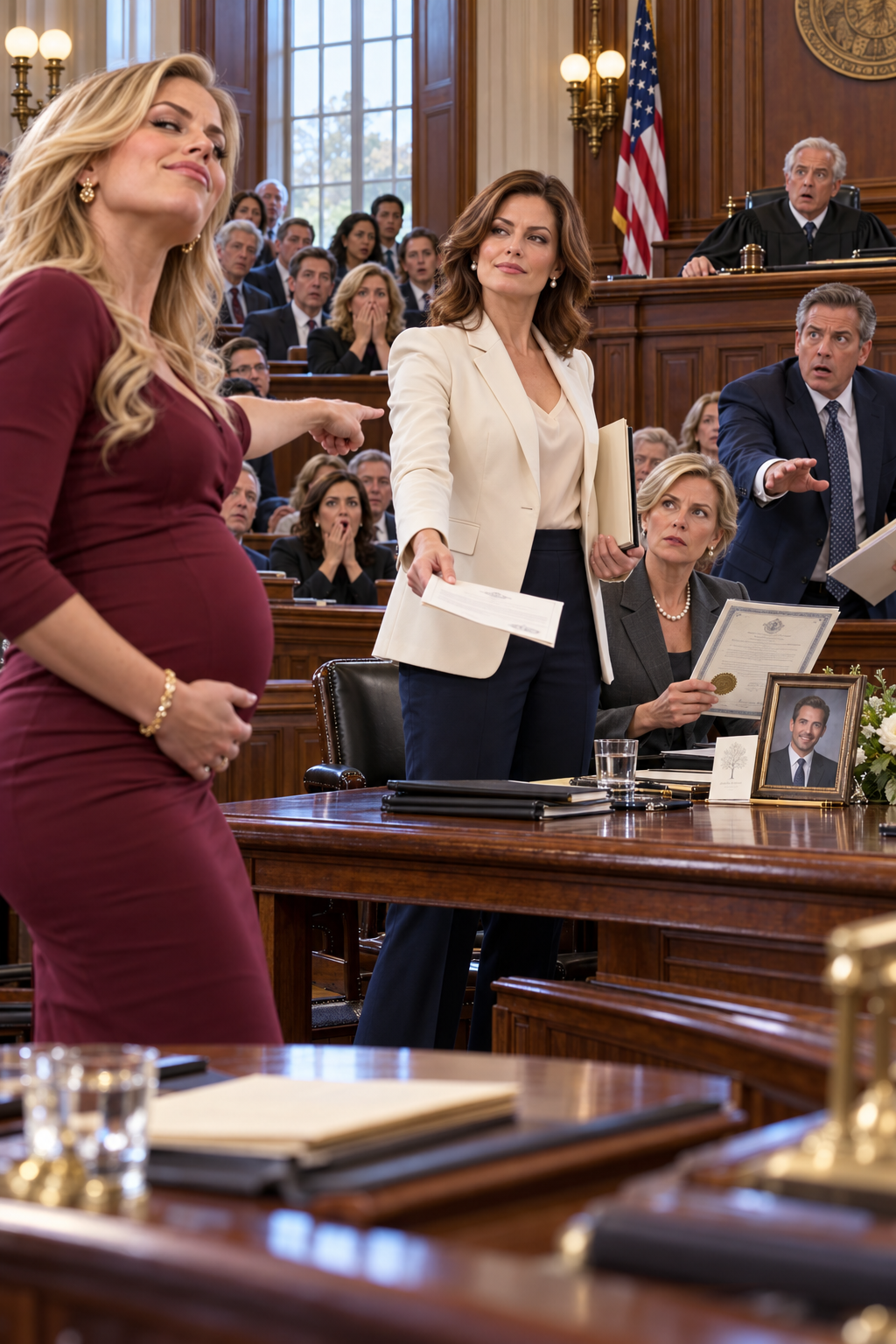
My Coworker Entered Court Three Months Pregnant And Demanded Half My Assets Because She Was Carrying My Husband’s Child. She Didn’t Know He Had Died 5 Years Earlier. “You’re Certain The Father Is My Husband?” I Asked. Sienna Lifted Her Chin.
My coworker walked into court three months pregnant and demanded five million dollars, plus half the property my husband had left me. She accused him of assaulting her, and the people we worked with watched me as though refusing to pay made me guilty. I didn’t argue when she said his name. I simply handed my attorney permission to reveal the truth. Eleven days later, I discovered a payment authorization bearing my husband’s signature, dated four years after his funeral. Suddenly, the lawsuit wasn’t the only thing that frightened me.
## Part 1: The Woman Who Wanted Everything My Husband Had Left Behind
The first thing I noticed about Delaney Price that morning was the white maternity dress she had chosen for court. It was October in Boston, cold enough that everyone else wore wool coats, but Delaney had arrived in a sleeveless dress that made her three-month pregnancy impossible to overlook. She stood beside her attorney, one hand resting protectively against her stomach, while her mother arranged a tissue in her other hand. When Delaney saw me enter the courtroom, she lowered her eyes with the carefully practiced expression of someone preparing to be wronged in public.
I had known Delaney for three years at Marston Design Collaborative, where I worked as a senior contracts manager and she handled administrative coordination for our commercial projects. She was twenty-seven, twelve years younger than me, and had a remarkable talent for making small requests sound like opportunities to demonstrate kindness. When she admired a silver bracelet I wore to work, I gave it to her because it had been sitting in my jewelry drawer for years. When she forgot her wallet at the coffee shop downstairs, I paid without mentioning it again, although eventually I noticed she forgot her wallet whenever we went together.
Our relationship changed the afternoon she saw me getting out of a dark green Aston Martin outside the office. The car had belonged to my husband, Thomas, and I rarely drove it because the leather seats still carried the faint smell of his favorite cedarwood cologne. Delaney walked around the front bumper, staring at the polished hood, and asked whether I had finally decided to treat myself. I told her it was my husband’s car, which was true, although I didn’t explain anything else.
My father used to say that money was easiest to live with when strangers didn’t know exactly how much of it you had. I had inherited some property, accumulated investments, and continued working because I enjoyed negotiating contracts and building something useful with my days. My coworkers knew I was comfortable financially, but I never discussed my accounts, the family trust, or the apartment I maintained across town. Delaney apparently decided that whatever I wasn’t telling her had to be extraordinary.
Now she was suing me as the trustee of my husband’s estate, alleging that Thomas had assaulted her, fathered her unborn child, and abandoned her when she demanded responsibility. Her attorney had filed an emergency motion seeking to restrict transfers from several trusts until her claims could be heard. The complaint requested five million dollars in damages and what Delaney described as the child’s rightful share of my husband’s property. None of those demands established a legal entitlement, but they were enough to bring us before a judge and attract half my department to the public hearing.
Judge Evelyn Mercer had barely finished explaining the purpose of the proceedings when Delaney’s mother jumped up from the gallery. “Where is that disgusting man?” Marlene Price demanded, pointing at me with a trembling finger. “My daughter has been trying to get him to take responsibility, and his wife keeps protecting him. Why isn’t he here to answer for what he did?” The judge instructed her to sit down and warned that another interruption would get her removed.
Delaney began crying as though her mother’s outburst had surprised her. “I didn’t want any of this,” she told the judge, pressing the tissue beneath her eyes. “I kept asking Mrs. Warren to help me settle it privately, but she wouldn’t even acknowledge what happened. I can’t sleep, I can’t face my friends, and I don’t know how I’m supposed to raise a baby when the father has decided I don’t exist.” Her attorney placed a reassuring hand on her arm while several of my coworkers exchanged disgusted looks.
I recognized Graham Bell from human resources sitting in the second row, alongside Rebecca from accounting and two women from our project administration team. Graham had once asked me to help his daughter apply for an internship, and I had spent an entire Saturday reviewing her portfolio. When our eyes met, he looked away so quickly that I understood Delaney had already told everyone her version. I wondered how many of them had heard the accusation before anyone thought to ask me a question.
My attorney, Naomi Keene, sat beside me with an orderly stack of documents and a yellow legal pad. She was a practical woman in her early fifties who preferred inexpensive fountain pens, comfortable shoes, and arguments she could support with records. Before the hearing, she had asked whether I wanted her to challenge the complaint immediately on procedural grounds. I told her I wanted Delaney to explain her accusations first, because something about the way she had identified my husband made me suspect there was more to this than a simple demand for money.
When the judge permitted my attorney to question her, Delaney described delivering an urgent project file to my apartment at Eastbank Residences four months earlier. She claimed that a handsome man in an expensive suit had appeared near the elevator, introduced himself as Thomas Warren, and told her I was running late. According to her account, he suggested that she wait in his car, locked the doors when she got inside, and assaulted her. She then alleged that he threatened to distribute compromising photographs unless she continued meeting him at hotels.
I watched her face while she spoke, searching for some indication that she understood the seriousness of what she was saying. An accusation of sexual assault was not a misunderstanding that could be erased by identifying the wrong person, and if someone had hurt her, that person needed to be investigated. But Delaney had named my husband, claimed he was currently avoiding responsibility, and insisted I was hiding him. I knew those particular claims were impossible, and I needed to understand why she had chosen them.
“Do you have evidence identifying the man?” Naomi asked.
Delaney glanced at her attorney, then nodded vigorously. “Security footage from the building, photographs of his car, and messages he sent me. I also know his wife has access to the money he’s hiding, which is why she needs to be held responsible.”
Her attorney introduced a short surveillance clip taken outside Eastbank Residences. It showed Delaney approaching a broad-shouldered man near the entrance, speaking with him for perhaps twenty seconds, and following him toward a parking garage. His back remained toward the camera, and the footage stopped before either person reached a vehicle. The judge watched it twice, then asked whether any additional recordings showed what occurred afterward.
“Those were deleted,” Delaney answered. “He had access to everything in that building.”
The man’s gray overcoat bothered me more than his broad shoulders, because I recognized the distinctive dark patches on its elbows. Thomas had owned one like it, a coat I had personally delivered to a donation center while clearing out his belongings. I couldn’t determine whether the garment was the same one, but the resemblance was enough to make my stomach tighten. More troubling was the fact that somebody had apparently been using an apartment where I hadn’t spent a night in years.
Naomi asked why Delaney had gone to a private residence with a company file rather than contacting me first. Delaney replied that she had found my address in our employee directory and thought I would appreciate her initiative. I knew perfectly well that residential addresses weren’t included in the directory accessible to administrative staff. I wrote Graham Bell’s name in the margin of my legal pad and slid it toward Naomi.
“One final question,” Naomi said. “Can you identify the man you claim assaulted you by his full name?”
Delaney straightened, grateful for what she apparently considered an easy question. “Thomas Alexander Warren,” she announced, looking directly at me. “Her husband. He told me his name himself, and he told me his wife controlled all his money.”
I felt the courtroom grow strangely quiet around me, although people were still shifting in their seats. Naomi closed her legal pad, looked toward the folder beside her briefcase, and waited for my signal. For the first time that morning, I understood that someone had not merely borrowed my husband’s possessions.
Someone had been living inside the identity of a dead man.
## Part 2: The Death Certificate That Changed Everything in Court
I had spent five years learning how to say my husband’s name without breaking down. I could mention Thomas during a dinner conversation, answer questions about his work, and listen politely when someone told me how much they missed him. But hearing Delaney use his full name to support a story about violence and abandonment produced a different kind of pain. It felt as though somebody had walked into our house, removed his photograph from the mantel, and begun inventing an entirely different person.
“Your Honor,” Naomi said, standing, “before we address the requested asset restrictions, the respondent would like to introduce three certified public records relevant to the identity of the alleged father.”
Judge Mercer nodded. Naomi handed the clerk copies of Thomas’s death certificate, the probate court’s final order, and the report documenting the highway collision that had killed him. She explained that the records had been obtained directly from the appropriate government offices and authenticated in advance of the hearing. Delaney continued watching us with an irritated expression, apparently expecting some technical objection to her financial demands.
The judge studied the death certificate for several seconds before looking at Delaney’s attorney. “Mr. Bennett, your client has alleged that Thomas Warren assaulted her approximately four months ago and subsequently maintained contact with her. This certificate records his death on November fourteenth, five years ago. Do you have any basis for questioning the authenticity of this record?”
Aaron Bennett looked down at his copy, then slowly removed his glasses. “Your Honor, this information was not disclosed to me by my client,” he said. “I would respectfully request a brief opportunity to confer with her.”
“Wasn’t disclosed?” Marlene Price exclaimed from the gallery. “Of course they have some fancy document saying he’s dead. People like her can pay someone to make anything disappear.”
Judge Mercer turned toward Marlene with an expression that ended the outburst. “You are not a party giving testimony, Mrs. Price, and this is your final warning.” She then instructed both attorneys to approach the bench, where they spoke for several minutes while Delaney stared at the certificate as though she expected its dates to change. I could see her breathing become shallow, and for a moment I wondered whether she had genuinely believed the man she met was Thomas.
That possibility mattered to me, although it did not excuse the things she had said about him. A living man could have deceived Delaney by taking my husband’s name and using his old apartment, just as someone could be a victim of one deception and participate in another. I wanted the distinction established rather than allowing the courtroom to turn into another spectacle. The truth of her experience with the impostor would require evidence beyond the document that proved my husband was dead.
When the attorneys returned to their tables, Judge Mercer asked Delaney a simple question. “Ms. Price, did you personally verify that the man who introduced himself as Thomas Warren was married to Mrs. Warren?”
Delaney’s gaze moved to her mother. “He had her keys,” she answered. “He knew where she worked, and he drove her car. He told me he was tired of his marriage and wanted someone who would appreciate him.”
“That is not what I asked,” the judge said.
“No,” Delaney whispered. “I didn’t check.”
I had expected satisfaction when she finally acknowledged the truth, but what I felt was an uncomfortable mixture of anger and dread. Somebody had known enough about my life to create a believable imitation of Thomas, and that person had apparently been using property held by a trust I was responsible for overseeing. Delaney might have been fooled initially, but her accusations had already endangered my reputation and exposed private details about my finances. The emergency motion was only the first part of a larger problem.
“Did this man ever tell you he was a doctor?” Naomi asked after the judge permitted limited additional questioning. “Did he mention the hospital where Thomas Warren worked?”
Delaney hesitated. “He said he used to be a surgeon, but now he managed his investments.”
Thomas had never expressed the slightest interest in managing investment portfolios, and even after exhausting fourteen-hour shifts he had talked more enthusiastically about his patients than his finances. He had been a pediatric cardiac surgeon who occasionally forgot where he parked and could never remember the password to our streaming account. The idea of him introducing himself to a young stranger by boasting about investments would have been amusing under different circumstances. In that courtroom, it told me that whoever was impersonating him had borrowed the outline of his life without understanding the man.
Naomi asked for the full recording from Eastbank Residences, including its source and the chain of custody through which Delaney had obtained it. She also requested preservation of relevant communications, financial transfers, and property-management records, arguing that the identity of the man in the video had become essential. Delaney’s attorney agreed that further investigation was necessary, though he protested that his client might herself have been deceived. Judge Mercer refused the emergency request to freeze my assets, reserved judgment on the remaining claims, and directed the attorneys to address the serious discrepancies before any further hearing.
The courtroom did not erupt into theatrical applause or outrage. Instead, people became uncomfortably quiet, which was worse for the coworkers who had come expecting to witness my humiliation. Rebecca kept looking between Delaney and me, while Graham sat with his hands clasped so tightly that his knuckles had turned white. I wondered whether he was simply embarrassed by his earlier assumptions or whether he knew something about how Delaney had obtained my private address.
As Naomi gathered our papers, Delaney suddenly spoke across the aisle. “I didn’t make him up, Elise. He told me he was your husband, and he had things that belonged to you. He even showed me a picture of the two of you at some house by the ocean.”
My hand stopped on the strap of my handbag. Thomas and I had spent our wedding anniversary at a rented cottage in Maine, where he had taken a photograph of us standing barefoot on a narrow wooden porch. That photograph had been displayed in our apartment for years before I brought it home after the funeral. I had packed it in a linen-lined box with his other personal belongings, none of which should have been available to a stranger.
“What house?” I asked.
Delaney wiped her cheeks and looked away. “I don’t remember.”
“Was it a blue cottage, with a red canoe beside the steps?”
Her eyes lifted before she could stop herself. “Yes.”
Naomi glanced at me, understanding immediately that this was not an ordinary detail pulled from a public obituary. Thomas’s professional photograph was available online, but almost nobody outside our families had seen the Maine picture. I could remember exactly where I had stored it, and the memory made the back of my neck prickle. Someone had opened boxes containing belongings I had never authorized anyone to touch.
In the hallway afterward, Marlene Price approached me while Delaney spoke privately with her attorney. “Maybe my daughter got the name wrong,” she said, her voice sharp enough to suggest that she considered the admission a personal favor. “But somebody made her pregnant, and you have enough money to help her without making things uglier.”
I looked at the woman who had spent the morning calling my husband a criminal. “Your daughter accused Thomas of a serious crime, under oath, and you repeated it to an entire courtroom,” I answered. “If she was deceived, I hope the man responsible is identified. But you are not going to make my husband’s estate pay for a lie because you find that more convenient.”
Marlene opened her mouth, then noticed Naomi standing beside me and said nothing. I walked toward the elevators without waiting for an apology, knowing one offered at that moment would have meant very little. Behind me, I heard Delaney crying again, but this time her mother was telling her to be quiet.
We reached the parking garage before Naomi spoke. “Eastbank unit 3002 is still part of the Warren Memorial Housing Trust, correct?” she asked, putting her briefcase in the back seat. I nodded and explained that the apartment was supposed to be used by visiting medical fellows working at Thomas’s former hospital. Naomi looked toward the building across the street, then asked who had been checking the occupancy reports since the trust transferred daily management to Bridgepoint Residential.
“Stephen Calder reviews them for the foundation,” I answered. “He was Thomas’s friend. Why?”
Naomi took out her phone and showed me the copy of Delaney’s surveillance video she had received during the hearing. Someone had cropped the original file, but a faint reflection in the glass entrance door showed the man in the gray coat holding a familiar silver key ring. The ring had been custom-made for Thomas, with a small engraved outline of the Maine coastline, and it should have been locked in the apartment’s private storage cabinet.
That afternoon, Naomi contacted Bridgepoint Residential and requested the occupancy records, maintenance logs, and access history for unit 3002. The agency promised to provide everything after checking with its property manager. At six seventeen, however, she called me with an unexpected response.
Bridgepoint claimed the apartment had been unoccupied for the past nine months because of extensive plumbing repairs.
According to the security footage, someone had been using it four months ago, and Delaney had met him at the entrance. I stood in my kitchen listening to Naomi explain the discrepancy while Thomas’s old wall clock ticked above the doorway. If the apartment was officially empty, someone had been lying about considerably more than his name.
## Part 3: The Apartment Where My Dead Husband Still Seemed to Live
Thomas and I had bought the Eastbank apartment eight years earlier, when his hospital began recruiting medical fellows from overseas and struggling to find them affordable housing in Boston. The building was expensive, but Thomas believed that the apartment could eventually serve a purpose beyond our occasional weekends in the city. After his death, I placed it in a charitable housing trust and arranged for visiting doctors to stay there at reduced cost. A property-management company handled the practical details, while the Warren Memorial Foundation reimbursed the trust for approved housing expenses.
Stephen Calder had helped establish the arrangement. He had worked alongside Thomas on several hospital fundraising projects and had become one of our closest friends during the final years of our marriage. After the funeral, Stephen brought groceries to my house, drove me to appointments when I couldn’t concentrate, and quietly handled paperwork I couldn’t bear to read. When he offered to oversee the foundation’s housing accounts, I accepted because I trusted him more than anyone outside my family.
That trust was the reason I hadn’t examined the apartment’s daily operations closely in years. The foundation employed an accountant, Bridgepoint Residential submitted quarterly reports, and annual financial statements went to an outside tax preparer. Nothing had raised an obvious alarm in the summaries I received, and I had gradually stopped asking detailed questions. The discovery that a stranger had been living in unit 3002 made me ashamed of that complacency.
The following morning, Naomi accompanied me to Eastbank Residences with a licensed private investigator named Daniel Ortiz. We had notified the property-management agency, and the building superintendent met us in the lobby with the necessary access authorization. The elevator smelled of furniture polish and fresh coffee, just as it had when Thomas and I used to arrive on Friday evenings. I watched the floor numbers illuminate one by one, remembering how Thomas always leaned against the mirrored wall because his feet hurt after surgery.
When the superintendent unlocked unit 3002, the first thing I noticed was that the plumbing worked perfectly. The bathroom sink ran clear, the kitchen faucet had been polished, and there was no sign of the extensive renovations supposedly keeping the apartment vacant. Instead, the rooms had been furnished with expensive-looking accessories that didn’t belong to us. A half-empty bottle of cologne stood beside the bedroom mirror, two wineglasses waited in the sink, and a man’s designer jacket hung over a dining chair.
In Thomas’s study, I found an open cardboard box that I recognized immediately. I had packed it after his funeral and marked the side with a black felt-tip pen, intending to sort through the contents when I could manage the memories. Someone had broken the original packing tape and removed several items, including the framed photograph from Maine. The photograph now stood on the bookshelf beside an unfamiliar silver watch.
His gray overcoat hung inside the bedroom closet, the same coat Delaney’s video had shown. I touched the dark patches on the elbows and remembered sewing one of them back into place after Thomas caught it on a hospital door. I had given the coat to a charitable donation center before moving the apartment’s remaining belongings into storage, which suggested that whoever occupied the unit had acquired possessions through more than one channel. The coat also had an old hospital parking permit tucked into its pocket.
“Elise,” Naomi said from the study doorway, “I think you need to see something.”
She had found a leather folder containing copies of Thomas’s obituary, photographs of our properties, and several printouts from the memorial foundation’s website. There were notes in the margins about my employment, the car I drove, and the approximate value of the housing trust. One page described me as emotionally vulnerable about Thomas, with a handwritten instruction underneath: “Use his name. She won’t want publicity.” I stood looking at that sentence until Daniel gently suggested photographing everything before we disturbed the arrangement.
The investigator identified several envelopes addressed to Nolan Kessler, a thirty-four-year-old former real estate broker whose name also appeared on a stack of overdue credit-card notices. His professional license had been revoked after complaints involving forged transaction documents, and public records showed multiple civil judgments against him. The building superintendent recognized Nolan’s photograph and said he had been staying in the apartment for most of the year. According to the superintendent, Nolan had claimed to be a visiting hospital consultant whose arrangements were being handled privately.
Bridgepoint’s property manager was a woman named Holly Kessler. Daniel discovered that she and Nolan were cousins, although their relationship had never been disclosed in the management reports. Holly had authorized temporary building credentials, waived ordinary visitor registration, and entered maintenance notes describing repairs that had apparently never happened. Naomi immediately notified Bridgepoint’s corporate office and requested that the company preserve its records rather than allow Holly to continue handling the investigation.
Before leaving, I opened the closet where Thomas had kept his books on American history. Many volumes were missing, but I found his old copy of John Adams’s letters beneath a pile of brochures advertising luxury investment services. Inside the front cover, Thomas had written a dedication to me on our second anniversary, teasing me about my preference for detective novels. I slipped the book into an evidence bag with Daniel’s help, unwilling to lose another piece of my marriage to somebody else’s performance.
Back at my office, the situation grew stranger. The foundation’s housing reports showed that unit 3002 had been assigned to a visiting medical fellow named Dr. Leah Serrano during the same months Bridgepoint claimed it was uninhabitable. Reimbursement payments had continued throughout the supposed plumbing emergency, and the total was substantial enough to require verification. When Naomi contacted the hospital’s graduate medical education office, nobody could identify a visiting fellow by that name.
I called Stephen Calder, expecting surprise and immediate concern. Instead, he sounded irritated that I had gone to the property without consulting him first. “Elise, you can’t run a charitable program by treating every administrative discrepancy as a crime,” he said, while a printer rattled somewhere in the background. “Holly is inexperienced, and these rental arrangements get complicated, especially when hospital rotations change.”
“Someone has been living there under Thomas’s name,” I told him. “His private belongings were taken out of storage, and the foundation has been paying for a tenant the hospital doesn’t recognize.”
Stephen paused for several seconds before answering. “I understand why you’re upset, but I think your attorney is turning an unfortunate situation into something bigger than it needs to be.”
I had known Stephen long enough to recognize his habit of becoming patronizing when a conversation threatened his authority. He suggested discussing the matter privately over dinner, then reminded me that the foundation’s annual fundraising dinner was approaching and that donors disliked uncertainty. I told him the trust would cooperate with an independent audit, whether donors liked it or not. For the first time since we met, Stephen ended our conversation without saying goodbye.
That evening, Naomi sent me a preliminary accounting summary from the documents she had obtained. The apartment had generated more than twenty-eight thousand dollars in questionable reimbursements during the recent vacancy period, but the ledger also contained payments associated with other properties. Several listed addresses appeared to be ordinary residential units with no obvious connection to the hospital. Naomi had asked a forensic accountant to examine the entire housing program rather than treating unit 3002 as an isolated irregularity.
At the bottom of the oldest questionable entry was an electronic approval bearing Thomas’s full name. I enlarged the signature on my computer screen and recognized its uneven capital T, the strange little hook he made beneath the W, and the abbreviated middle initial he used on hospital forms. The authorization had been submitted the previous spring, nearly five years after the collision that killed him.
It wasn’t simply a stranger using my husband’s name to impress a woman.
Someone had been using his authority to move money through a charitable foundation, and the paperwork suggested the deception had been going on long before Delaney Price entered my life.
## Part 4: The Man Who Borrowed My Husband’s Life and Name
Nolan Kessler had built his borrowed identity out of objects that belonged to Thomas and information other people had been careless enough to leave available. Daniel Ortiz established that Nolan had once brokered luxury condominiums and understood how to make expensive surroundings look like personal wealth. He knew which hotel bars catered to executives, how to obtain designer clothing without paying full price, and how to describe investments convincingly without naming anything that could be verified. What he did not possess was money, a reliable job, or the ownership interest he had repeatedly claimed.
Delaney had met him on a Thursday afternoon after obtaining my old residential address through someone at work. She had genuinely gone to the apartment with a project folder, although the documents inside were not urgent and could easily have been emailed. Security records showed her waiting near the entrance before Nolan appeared and introduced himself. Their first conversation lasted longer than the edited footage suggested, and the available images showed him opening the building door and inviting her inside.
It was still possible that Delaney had experienced coercion later, and I didn’t pretend that the absence of an assault on camera settled the question. But her account of being immediately forced into a locked vehicle no longer matched the unedited footage, which placed both of them in the lobby after their meeting. Naomi requested the complete recordings from Bridgepoint and preserved the discrepancy for the investigators reviewing Delaney’s allegations. We needed facts, not guesses based on which person seemed more sympathetic.
Financial records obtained through the civil discovery process revealed that Nolan and Delaney had begun exchanging money several weeks after meeting. Delaney had transferred approximately forty thousand dollars to accounts he represented as private investment partnerships, expecting unusually large returns. He had sent her photographs of waterfront properties and promised that Thomas Warren’s fortune would eventually belong to them. Several accounts received deposits and then immediately transferred the funds elsewhere, including payments for hotel stays and outstanding debts.
The most revealing material came from messages Delaney had preserved, apparently because she believed they proved Nolan’s promises. In one exchange, he told her that my husband’s estate was controlled by a difficult widow who would rather pay a substantial settlement than endure public humiliation. In another, he suggested that a pregnancy would give her leverage over assets he could not currently access. She responded enthusiastically, asking how much money they could obtain without waiting for a trial.
Naomi showed me those excerpts in her conference room, where the blinds were half closed against the late-afternoon sun. “These don’t establish every element of a fraud case,” she cautioned, “but they show the financial claim wasn’t invented by your coworker acting alone.” She had referred relevant information to the authorities and requested that the civil court preserve additional electronic evidence. I asked whether we could speak to Nolan directly, and Naomi explained that any approach needed to be coordinated carefully so we wouldn’t interfere with the investigation.
Three days later, Nolan agreed to meet Daniel Ortiz at a hotel lounge, apparently believing the investigator represented a potential private investor. By then, detectives had gathered enough independent information concerning the false lease records and financial transfers to begin questioning him formally. I stayed away at Naomi’s insistence, although every part of me wanted to ask him how he had managed to sleep in Thomas’s bed. Daniel later described Nolan’s expression when he realized the people asking questions knew his real identity.
At first, Nolan insisted that Delaney had misunderstood their relationship. He admitted using Thomas’s apartment but claimed the property manager had given him permission to stay temporarily. When shown the messages about the settlement, he said Delaney had pressured him into writing things he never intended seriously. He maintained that the idea of naming Thomas in the lawsuit had come from Delaney and her mother, not from him.
The detectives were interested in a different question: who had provided Nolan with information about the trust’s finances and my personal circumstances? His possession of my husband’s old photographs could be explained by unauthorized access to the apartment, but his notes contained financial details that weren’t publicly available. One document accurately described the trust’s restricted accounts and identified which assets could not be transferred without approval from a second trustee. That information could only have come from someone with access to internal records.
Nolan stopped answering questions when the detectives asked about Stephen Calder. He requested an attorney, and the interview ended, but the name had already produced a reaction that Daniel considered significant. Naomi reminded me that a reaction wasn’t proof of wrongdoing and that we needed documentation. I was grateful for her restraint because I was having trouble imagining that Stephen, of all people, could have deliberately helped someone impersonate Thomas.
Meanwhile, Delaney returned to work for two days before Marston placed her on administrative leave while the allegations involving employee information were investigated. She avoided my office but sent a message asking whether we could talk without lawyers. I forwarded it to Naomi rather than responding, and within an hour another message arrived. This one contained an apology for mentioning Thomas’s name, followed immediately by a request that I help her recover the money Nolan had taken.
There was no acknowledgment of what she had accused my husband of doing. There was no concern about the property she had helped expose to misuse, or the people affected by the trust’s missing funds. She wanted me to regard the entire situation as an embarrassing misunderstanding caused by a dishonest boyfriend. When Naomi offered to communicate through counsel, Delaney replied that she had thought I was a kinder person.
The following week, the forensic accountant delivered her first findings. The housing program had paid reimbursements on several properties that could not be matched to verified fellows, and a significant portion of those payments had gone through accounts associated with Bridgepoint Residential. The suspected losses extended back more than four years. Even more troubling, an outside consulting company had received a management fee each time a supposed fellow was approved.
That company was called Calder Strategic Services.
It had been registered by Stephen’s wife six years earlier, although she had never been listed as an employee of the memorial foundation. Its invoices described vague administrative work and were submitted through the same electronic approval system that displayed Thomas’s forged signature. Naomi traced one of the payments to a bank account that had also received money from Nolan.
The apparent connection left me sitting silently at my desk long after everyone else had gone home. Stephen had carried Thomas’s casket, helped me organize the funeral, and promised to protect the charitable work my husband cared about most. He had spent years treating me like family while someone drained funds from the housing program he supervised.
Then Naomi called with one more detail from Nolan’s recovered messages. Six weeks before Delaney filed her lawsuit, someone identified only as SC had written to him, “She is starting to ask about the housing accounts. Keep her occupied until the review is finished.”
I looked at the date and remembered the morning I had asked Stephen why the foundation’s maintenance expenses were rising.
Delaney’s lawsuit might not have started as a plan to silence me, but somebody had clearly recognized its usefulness.
## Part 5: The Betrayal Hidden Inside My Husband’s Memorial Foundation
When Stephen Calder asked me to meet him for breakfast, I chose a restaurant three blocks from my office rather than the private club where we usually discussed foundation business. I didn’t tell him about the message Naomi had uncovered, and I didn’t mention the consulting company registered to his wife. I wanted to hear what he would say when he believed I knew only about the apartment. More importantly, I wanted to find out whether there was any innocent explanation left for the things we had discovered.
Stephen arrived wearing a navy cashmere coat and carrying the leather portfolio Thomas had given him for his fiftieth birthday. He kissed my cheek as though nothing had changed, ordered coffee for both of us without asking, and complained about the foundation’s demanding donors. When I told him the housing accounts were being independently audited, his expression tightened. “You can’t let one employee’s ridiculous lawsuit destroy everything Thomas built,” he said, lowering his voice as the server passed our table.
“The lawsuit and the missing money are separate problems,” I replied. “The audit will establish whether the housing expenses were legitimate.”
Stephen shook his head and began explaining how charitable programs operated in practice. He talked about temporary housing shortages, rotating fellows, invoices submitted late, and the difficulty of keeping donors satisfied. Most of what he said was technically reasonable, but none of it explained why a deceased doctor had approved payments years after his death. When I asked him about Calder Strategic Services, Stephen put down his coffee cup so abruptly that some spilled across the saucer.
“My wife’s business provided administrative assistance,” he said. “That arrangement was approved before Thomas died.”
“Then you won’t object to showing the auditor the signed contract and the work your wife performed.”
He watched me for several seconds, apparently deciding how much I knew. “Elise, you’re becoming unnecessarily adversarial. Your husband trusted me with this foundation because he understood that you weren’t interested in day-to-day financial management.” He reached across the table as though he intended to take my hand, but I moved it away.
Thomas had certainly understood that I disliked charitable fundraising dinners and preferred numbers that could be reconciled against actual invoices. He had also trusted my judgment enough to ask me to serve as a trustee, knowing I would question arrangements that didn’t make sense. Hearing Stephen use my husband’s supposed opinion to discourage scrutiny was the first moment I felt something close to certainty. Whatever he was hiding, he had grown accustomed to treating my grief as permission to do as he pleased.
I asked him one final question before leaving. “Do you know Nolan Kessler?”
Stephen looked toward the restaurant entrance before answering. “The name sounds familiar, but I meet a lot of people through the properties.”
“He was living in Thomas’s apartment and using his name.”
“Then I hope the police deal with him,” Stephen said, pushing back his chair. “And I hope you’ll remember who stood beside you when everyone else disappeared.”
I paid for my own breakfast, walked back to the office, and told Naomi exactly what he had said. She listened without interrupting, then explained that the foundation needed independent legal representation because Stephen’s conduct potentially implicated its board and finances. We engaged outside counsel, notified our insurer, and arranged a special trustees’ meeting. I also requested a temporary suspension of disputed reimbursements while ensuring that verified fellows would continue receiving housing support.
That last decision brought me into contact with Dr. Mira Campos, a young physician who had applied for subsidized housing through the foundation the previous year. She was completing a pediatric cardiology fellowship at Thomas’s former hospital and had recently returned from maternity leave. When I explained that we were reviewing past applications, she became visibly uncomfortable. She said the program had informed her that all available units were occupied, even though she had repeatedly asked about cancellations.
Mira had spent eleven weeks renting a room from a distant relative and commuting ninety minutes each way while working unpredictable hospital shifts. Her savings had disappeared into transportation, temporary childcare, and rent, and she eventually gave up applying for the housing assistance altogether. She wasn’t bitter when she told me this; she seemed embarrassed, as though needing help from a charitable program reflected poorly on her. That made the conversation harder than any argument I had experienced in court.
I asked whether she still had the foundation’s rejection notices. Mira forwarded three emails, each signed by an administrator whose name I recognized from the financial records. On one of the dates she had been told every unit was occupied, the trust had reimbursed Bridgepoint for a supposed fellow who did not appear in the hospital’s records. I sat with those two documents side by side, understanding that the missing money had not been an abstract accounting problem.
Thomas had wanted the apartments available to people like Mira, who were giving up years of ordinary life to learn how to treat critically ill children. Stephen and his associates had turned those apartments into sources of private income while actual doctors were turned away. The discovery changed my priorities from recovering money to identifying every person who had been denied assistance. I asked the audit team to reconstruct the waiting lists and contact the hospital’s fellowship office.
The special trustees’ meeting was held the following Monday. Stephen arrived with two board members who had supported him for years, apparently expecting the rest of us to accept his explanation and move on. Naomi presented verified discrepancies, the conflicts involving his wife’s consulting company, and the suspicious approvals attributed to Thomas. The outside attorney explained that Stephen should not participate in decisions concerning his own conduct, and the board voted to suspend his financial authority pending the investigation.
Stephen took the result badly. He accused me of exploiting my husband’s memory for personal revenge, then suggested that the foundation might collapse if donors learned about the audit. I reminded him that the program existed to help medical fellows, not to protect the reputation of its administrators. He left before the meeting ended, carrying the portfolio Thomas had given him.
That night, my mother-in-law, June Warren, came to my house with a casserole and a paper bag full of groceries. She had heard about the lawsuit from a neighbor and the foundation investigation from a retired hospital administrator. June was seventy-three, a former school librarian with arthritis in both hands, and she remained the only person who still sometimes called Thomas “Tommy.” When I told her what Stephen might have done, she sat quietly at the kitchen table until the oven timer interrupted us.
“I never liked how quickly he started making decisions for you after the funeral,” she admitted. “But you were barely eating, and he sounded so certain about everything.”
I told her she wasn’t responsible for what Stephen had chosen to do. We ate dinner in the kitchen, where Thomas had once insisted on teaching his mother to make fresh pasta and covered every surface with flour. June asked whether I would keep running the foundation if the investigation confirmed the theft. I said I didn’t know, because for the first time I was afraid that Thomas’s legacy had become something I couldn’t repair.
Before leaving, June reached into her handbag and took out an envelope she had found while organizing old papers. Thomas had sent it to her several weeks before his death, along with a draft of the housing program’s operating principles. He had asked her to keep a copy because he was worried the program could become too dependent on the personal judgment of a few administrators. One handwritten sentence near the bottom stayed with me long after June went home.
“If my name is ever used to keep someone from asking where the money went, something has gone terribly wrong.”
The following morning, Naomi received additional records from investigators examining Nolan’s communications. The messages appeared to connect Stephen to the plan to pressure me over Delaney’s lawsuit, and one contained a proposed settlement amount that matched the demand filed in court. A second message instructed Nolan to ensure that any agreement included confidentiality provisions and broad releases concerning the housing trust.
Stephen hadn’t merely tolerated a con artist who happened to be occupying Thomas’s apartment.
He appeared to have helped turn Delaney’s accusations into a weapon against the one person authorized to demand a full accounting of the foundation.
## Part 6: The Lies That Finally Turned Delaney Against Her Own Accomplices
Delaney’s attorney requested a meeting in early December, two months after the original hearing. Aaron Bennett explained that he had withdrawn from representing her in the asset dispute once it became clear that she had concealed important information about the man she accused. A new attorney was helping her respond to the civil investigation, and Delaney wanted to provide evidence against Nolan. Naomi agreed to receive the information through counsel, but she made clear that cooperating now would not erase Delaney’s earlier statements.
By then, investigators had established that Delaney knew Nolan’s real identity before filing the lawsuit. A photograph recovered from her phone showed his old real estate license on a kitchen counter, with his full name clearly visible. The image was dated seventeen days before her attorney submitted the complaint naming Thomas. In messages exchanged afterward, Delaney asked why they couldn’t pursue Nolan’s supposed investments directly, and Nolan replied that the widow’s estate was the only place real money could be found.
Delaney’s mother had participated in those conversations. Marlene suggested claiming that Nolan had used Thomas’s identity throughout their relationship, even after the truth became apparent, and urged her daughter to describe the encounters as coercive. One message contained a draft of the demand letter, with instructions to emphasize the pregnancy and my alleged refusal to cooperate. Delaney replied that five million dollars seemed excessive until Nolan promised he could make the settlement disappear through foreign accounts.
I read the messages in Naomi’s office and felt something inside me settle. Delaney had been deceived about Nolan’s wealth and perhaps about his intentions when their relationship began, but the available evidence showed that she knowingly helped direct false accusations toward Thomas. Her pregnancy was real, and she had legitimate reasons to seek support from the actual father. What she had no right to do was transform those circumstances into a claim against a man who had been dead for five years.
The investigation also addressed the assault allegation rather than treating the forged identity as an answer to everything. Detectives reviewed hotel records, communications, available surveillance, and the specific incidents Delaney had described. Several records directly contradicted her timeline, while messages between Delaney, Nolan, and Marlene discussed changing details to make the alleged encounters sound more frightening. Delaney eventually acknowledged through counsel that the accusations she had made against Thomas were false.
She offered to retract them publicly if I agreed not to pursue any civil action against her. Naomi brought me the proposal without recommending that I accept it. I read the short statement Delaney had prepared and noticed that it described the entire matter as confusion caused by an assumed identity. It did not say she had known Nolan’s real name before suing me, and it suggested that my family’s privacy concerns had somehow prolonged the misunderstanding.
I returned the statement unsigned. “If she wants to tell the truth, she can tell the whole truth,” I said. “I’m not buying an apology that protects her from the consequences of what she did.”
While the legal investigation continued, my employer completed its own review of the unauthorized access to personnel records. Graham Bell admitted that Delaney had asked him to retrieve my residential information, claiming she needed to deliver confidential documents after hours. He had used his human resources credentials to obtain an archived address and forwarded it to her through a personal email account. He insisted that he had not known what she intended to do with it, although the compliance team found he had also accessed several unrelated employees’ records without a business reason.
Graham was dismissed after the investigation concluded, and the company notified affected employees about the unauthorized access. Other coworkers who had circulated Delaney’s accusations were instructed to remove inappropriate internal messages, while management reviewed its procedures for handling allegations involving employees. I had no authority over the disciplinary decisions, but I provided the information requested by the investigators. The results were uncomfortable for everyone, particularly the people who had treated the courthouse like an afternoon’s entertainment.
Rebecca from accounting asked to meet me privately in the conference room where we had once discussed quarterly budgets. She looked tired and frightened, with a paper cup of coffee trembling slightly between her hands. “I should have asked you what happened before believing everything,” she said. “Delaney told us you were trying to make her disappear with lawyers, and I thought coming to court meant supporting someone who needed help.”
I understood why people had been concerned when Delaney described being assaulted. I didn’t blame them for taking the possibility seriously, because ignoring such claims could also cause terrible harm. What hurt was their willingness to decide I was guilty of protecting an abuser before they had heard any evidence, and the casual enjoyment some of them had taken in imagining my humiliation. I told Rebecca I accepted that she regretted it, but I wasn’t ready to return to the friendship we had before.
The more difficult confrontation came from Stephen. He called me after the foundation’s auditors reported their preliminary findings to the board, requesting one private conversation before the attorneys became further involved. I refused to meet him alone, so he left a voicemail that Naomi later preserved. In it, he said he had made financial decisions Thomas would have understood, accused me of destroying an important charitable program, and suggested that my husband had wanted him to protect me from complicated responsibilities.
I played the recording twice while sitting in Thomas’s study at home. The room still contained his reading chair, a brass desk lamp, and an unfinished model sailboat that I had never moved because I liked seeing it exactly where he left it. Stephen’s voice sounded familiar enough to bring back the terrible weeks after the funeral, when I had relied on him because I couldn’t trust myself to remember appointments. I wondered how often he had mistaken my gratitude for permanent permission to control things that belonged to me.
Naomi told me the investigation had identified more than four hundred thousand dollars in suspected improper payments and reimbursements across several years. The accounting was still being finalized, but the evidence connected Stephen, Holly Kessler, and Nolan through consulting agreements, false occupancy records, and transfers between related accounts. Stephen’s electronic credentials had been used repeatedly to approve payments bearing Thomas’s copied signature. The prosecutor’s office was reviewing potential charges, and the foundation was preparing civil claims to recover the missing funds.
I expected the financial findings to be the worst part. Then the audit team discovered an email Stephen had sent shortly after Thomas’s death, discussing how to minimize trustee involvement while continuing to use the deceased founder’s existing approval template. The recipients included Holly and an accounting contractor, and the message specifically mentioned that I was grieving and unlikely to request operational reports for some time. Its language was clinical, almost casual, as though the loss of my husband had simply created a convenient administrative opportunity.
I forwarded the email to June, who called a few minutes later. She tried to speak, but her voice broke before she could finish the first sentence. I told her we would do everything possible to recover the money and protect the program, although I understood that neither of us would ever look at Stephen the same way again. He had stood beside us at the funeral, listened to our memories, and already begun planning how to exploit Thomas’s absence.
A week before Christmas, Delaney gave her first formal statement acknowledging that she had known the lawsuit’s central identification was false. She also supplied the investigators with messages showing Nolan and Stephen discussing how to keep me occupied during the foundation’s financial review. In return, prosecutors agreed to consider her cooperation when evaluating the charges, without promising immunity. Her mother was separately questioned about her role in preparing the misleading allegations and financial demands.
Naomi called that evening with one additional development. Investigators had identified a payment from the foundation’s consulting funds to Nolan shortly before Delaney filed her complaint. The transfer was labeled “confidential reputation management,” and Stephen had personally approved it.
I remembered him telling me over breakfast that I was allowing Delaney’s lawsuit to destroy Thomas’s work.
Now there was documentary evidence suggesting he had helped finance the very attack he blamed me for refusing to ignore.
## Part 7: The People Who Tried to Ruin Me Faced Their Own Reckoning
The criminal investigation took longer than anyone outside the process seemed to expect. For months, attorneys exchanged documents, accountants reconstructed transactions, and investigators interviewed hospital administrators who had never realized the housing program’s financial records were unreliable. I attended meetings, signed statements, answered questions, and occasionally found myself staring at the same spreadsheet long after I had stopped understanding the numbers. There were days when I wished I could simply close the foundation, sell its remaining properties, and never hear Stephen Calder’s name again.
But closing the program would have punished the people Thomas had wanted to help. Instead, the trustees appointed an independent administrator, suspended contracts with Bridgepoint Residential, and established new approval procedures requiring verification of actual housing placements. An outside accounting firm took over financial oversight, and the board began reviewing historical applications to identify doctors who had been improperly denied assistance. We also pursued recovery through civil litigation and the insurance policies available to the foundation.
The final forensic accounting report identified approximately four hundred eighty thousand dollars in improper or unsupported payments. Some had been routed to Stephen’s consulting arrangements, while others had gone to property-management accounts controlled by Holly and expenses benefiting Nolan. Investigators concluded that Stephen had used the housing program’s complicated reimbursement system to conceal the diversion of funds. He had continued approving transactions under Thomas’s copied electronic signature even after being warned that the practice violated the foundation’s internal rules.
The discovery that hurt me most concerned the first year after Thomas died. Several questionable payments had been approved while I was still meeting with a grief counselor and struggling to return to work. Stephen had written to an associate that he could handle approvals without interference because I was “not in a position to supervise details.” I remembered the casseroles he brought, the sympathetic calls, and the reassuring way he used to tell me that everything was under control.
He hadn’t needed to steal money to live comfortably. Stephen owned a beautiful house, belonged to an expensive country club, and received a generous salary from the hospital’s fundraising organization. The investigation revealed that he had accumulated personal debts through unsuccessful investments and had used charitable funds to conceal the resulting financial pressure. His decisions had become progressively more desperate, particularly when auditors began asking questions and donors requested better reporting.
Nolan’s behavior had been driven by similar financial problems, although his fraud began on a smaller scale. He had used Thomas’s old apartment to impress Delaney, borrowed possessions to support his invented identity, and spent money he didn’t have to maintain the illusion. When Delaney became pregnant, he recognized that she might expect financial security he could never provide. Stephen then encouraged him to redirect her expectations toward my husband’s estate, using the resulting lawsuit as both a potential source of money and a distraction from the foundation’s records.
The plan depended on two assumptions: that I would fear public scandal enough to pay quietly, and that nobody would check Thomas’s death records before serious money changed hands. Delaney’s willingness to repeat Nolan’s claims had made the plan possible, while her insistence on filing in court ultimately exposed it. The complaint created a permanent record of the false identification, and her edited surveillance footage led investigators directly to the apartment. The evidence she believed would force my surrender became the starting point for unraveling the larger fraud.
In the spring, Delaney gave birth to a boy named Oliver. A separate parentage proceeding eventually established through genetic testing that Nolan was his biological father. The result surprised nobody involved in the investigation, but it finally removed the last possible connection between the child and Thomas’s estate. Delaney’s maternal aunt, who lived in Connecticut, agreed to help care for Oliver while Delaney addressed the criminal proceedings and arranged more stable living conditions.
I never met the child, and I didn’t believe he had any responsibility for the circumstances surrounding his birth. He deserved stability, affection, and adults who cared more about his future than their own financial fantasies. When Naomi explained that the legitimate father’s responsibility for support would be handled separately, I was relieved that the legal system could distinguish the child’s needs from the fraudulent lawsuit. Whatever I thought about Delaney, Oliver had done nothing wrong.
The original civil claims against my husband’s estate were dismissed with prejudice after Delaney formally withdrew them. Her sworn corrections became part of the court record, and my attorney pursued a separate civil action for the documented harm caused by the false allegations and coordinated attempt to obtain money. The matter eventually ended with a financial judgment, a written retraction, and enforceable restrictions against repeating the defamatory claims. I instructed Naomi to pursue collection only through lawful procedures rather than allowing the case to dominate another decade of my life.
The criminal cases proceeded separately. Nolan pleaded guilty to fraud-related offenses involving the financial transfers and false property arrangements, receiving a prison sentence and restitution obligations. Holly cooperated with investigators, admitted falsifying occupancy and maintenance records, and received a reduced sentence that included supervision and restitution. Stephen, after initially denying almost everything, eventually entered a guilty plea involving theft and misuse of charitable assets.
His sentencing hearing was the only one I attended.
Stephen looked older than I remembered, his once-impeccable hair thinning and his expensive suit hanging loosely across his shoulders. The courtroom was smaller than the one where Delaney had first accused Thomas, and this time there were no curious coworkers waiting to watch a scandal. The prosecutor described the financial losses and the consequences for legitimate housing applicants. When I was invited to provide a victim impact statement on behalf of the foundation, I spoke about Mira Campos and the other fellows who had been turned away while fraudulent occupants received support.
I didn’t mention Stephen’s betrayal of my friendship until the end. “He knew exactly why Thomas created this program,” I said. “He knew how much I trusted him, and he knew I was grieving when the first improper payments were approved. He chose to use those circumstances for personal gain, and the people who suffered were the doctors and families the foundation existed to serve.”
Stephen looked down throughout my statement. His attorney later told the court that he regretted his actions, but I had no interest in evaluating the sincerity of that regret. The judge imposed a custodial sentence, restitution obligations, and restrictions relating to future fiduciary responsibilities. When the hearing ended, I left without approaching him.
Delaney’s case concluded through a plea agreement reflecting both her false statements and her cooperation with investigators. She received a short jail sentence followed by probation, community service, and financial obligations arising from the civil judgment. Marlene also entered a plea concerning her participation in the attempted financial scheme and received supervised probation with mandatory community service. Their future circumstances were no longer something I intended to manage or monitor.
At Marston, the investigation had permanently changed my relationships. A few coworkers apologized sincerely, while others avoided me because acknowledging what happened would require confronting their own behavior. Graham never returned to the company, and our information-security procedures were substantially revised. I remained in my position, although I stopped treating the workplace as a place where every friendly conversation needed to become a personal friendship.
Fourteen months after Delaney’s first court appearance, the foundation’s administrators announced that they had recovered enough money through insurance and settlements to restore its immediate operations. Not every dollar had been recovered, and some claims remained outstanding, but the program could again provide housing without depending on questionable reimbursements. The trustees approved assistance for several fellows whose earlier applications had been denied unfairly. Dr. Mira Campos was among the first people invited to help develop the new application guidelines.
That evening, June came over with a small wooden box containing Thomas’s old photographs and correspondence. We sat on the living room floor sorting through letters, laughing occasionally at his terrible handwriting and his tendency to save meaningless receipts. Near the bottom, we found a note he had written to me years before the accident, apparently intending to include it with an anniversary gift. It contained no warning about betrayal or money, only a simple observation about the life we shared.
“I like that we are building things neither of us has to own alone.”
I read the sentence twice, then folded the note carefully and placed it inside my desk. After everything that had happened, I was finally beginning to understand how much more difficult rebuilding could be than winning a case.
## Part 8: I Kept My Husband’s Legacy and Left the Betrayal Behind
The following October, almost two years after Delaney first walked into court, I drove Thomas’s Aston Martin north toward the Massachusetts coast. The weather had turned cool overnight, and the trees along the highway were beginning to show the first deep reds and oranges of autumn. I had a thermos of coffee on the passenger seat and a canvas bag containing lunch, a paperback novel, and Thomas’s old silver pocket watch. For once, I wasn’t traveling to meet an attorney, review financial records, or solve a problem created by somebody else’s dishonesty.
I had begun taking these drives after the foundation stabilized, usually on Sunday mornings when the roads were quiet. Sometimes I went to the coast, sometimes to the small towns Thomas and I had visited, and sometimes I simply drove without choosing a destination. The car still reminded me of him, but the memories no longer made every journey painful. I could listen to the radio, stop for coffee, and enjoy the ordinary pleasure of moving through the world without feeling guilty that he wasn’t beside me.
The previous afternoon, I had attended the reopening of the foundation’s renovated housing program. Eastbank unit 3002 had been cleaned, repaired, and furnished with practical things that visiting doctors actually needed. The expensive decorative furniture Nolan had brought inside was gone, replaced by sturdy tables, comfortable chairs, and a small desk beside the window. Thomas’s personal belongings had been returned to my house, where I could decide what to keep without worrying that strangers might help themselves to pieces of our marriage.
The foundation had also changed in ways that would have pleased him. Its board now included a physician who had previously received housing assistance, an independent financial professional, and a representative selected by current fellowship applicants. No individual administrator could authorize reimbursements without supporting documentation, and the annual financial statements were available for public review. I continued serving as a trustee but no longer confused personal loyalty with responsible oversight.
Mira Campos spoke briefly at the reopening, describing what stable housing meant to doctors trying to balance demanding training with family responsibilities. She didn’t turn her remarks into a tribute to wealthy donors or an elaborate celebration of the foundation’s survival. Instead, she thanked the people who had helped redesign a program that was supposed to make difficult lives slightly easier. I liked that Thomas’s name appeared on a small plaque near the entrance rather than across a giant banner.
After the ceremony, a young fellow approached me to say he would be moving into one of the apartments the following month. His name was Andrew, and he had recently completed his first year of pediatric cardiology training. He explained that his wife was a public school teacher and they had a baby girl who had just learned to stand while holding on to furniture. They were relieved to have found a place where they could afford to live without adding another hour to his daily commute.
I asked how he was enjoying the program, and he smiled in the exhausted way I remembered from Thomas’s early hospital years. “Most days I feel like I don’t know nearly enough,” he admitted. “But every few weeks, a kid goes home who might not have gone home a few years ago, and that makes the hard parts easier.”
I thought about Thomas spending evenings at our kitchen table, explaining surgical procedures with saltshakers and folded napkins because he was too excited about a patient’s recovery to notice that dinner was getting cold. Andrew had never met my husband, and I didn’t feel compelled to tell him about the resemblance. I simply wished him luck and asked the housing coordinator to make sure the apartment had everything his family needed.
My life outside the foundation had changed too. I had reduced my hours at Marston and begun consulting independently on nonprofit construction and facility-management contracts. It was work I enjoyed, and I liked being able to decline projects that didn’t fit my schedule. I spent more time with June, joined a neighborhood book club, and finally took the pottery classes I had been considering for years.
I wasn’t searching for someone to replace Thomas. There were occasional dinners with friends, invitations to social events, and a few people who expressed romantic interest, but I didn’t feel that a new relationship was necessary to prove I had recovered. I had been happily married, then terribly lonely, and eventually learned that those experiences could belong to the same life without defining everything still ahead of me. If companionship arrived naturally, I would consider it, but I wasn’t going to make loneliness the reason for choosing someone.
Delaney tried contacting me one final time after completing her jail sentence. Her letter arrived through Naomi’s office and contained several pages about the financial deception, her mother’s influence, and how frightened she had been about raising Oliver without support. She wrote that she regretted accusing Thomas and wished she could undo the public damage to his reputation. Near the end, she asked whether I might someday understand why she had made the choices she did.
I read the letter once and returned it to its envelope. I understood the circumstances she described, but understanding them did not require excusing the decisions that followed. She had multiple opportunities to tell the truth after learning Nolan’s identity, and she had chosen to pursue money by inventing allegations against someone who could not defend himself. I hoped she became a responsible mother and built an honest life, but I did not want any part in it.
Naomi asked whether I wanted to respond. I told her no, and that was the end of our conversation about Delaney. I had no desire to punish her beyond the consequences already established by the courts, but I wasn’t willing to offer emotional reassurance simply because she had finally recognized what she had done. Forgiveness would have been meaningful only if it came freely, and I didn’t feel it.
Marlene never contacted me again. I occasionally received administrative updates about the restitution accounts, but Naomi handled those matters without involving me in unnecessary details. Nolan’s name appeared in one final report concerning the disposition of assets connected to his fraud, and Stephen’s attorney continued dealing with the foundation’s remaining recovery claims. None of those developments required a response from me.
As I approached the coast, I turned off the highway and followed a familiar road through salt marshes and low wooded hills. Thomas and I had discovered the place during our first year of marriage when a canceled hotel reservation forced us to find somewhere else to spend the weekend. We had stopped at a small diner, eaten blueberry pancakes, and walked along the beach in weather much too cold for the jackets we were wearing. He bought the silver pocket watch at an antique shop that afternoon and later had our wedding date engraved on the back.
I parked near the bluff and climbed the short trail overlooking the Atlantic. The wind carried the smell of salt and damp grass, while gulls circled above the rocks and a fishing boat moved slowly across the horizon. I found a sheltered place beside a weathered bench and poured coffee from my thermos. The ocean was darker than I remembered from our last visit, its surface broken by patches of sunlight and the distant movement of waves.
Thomas’s ashes had been scattered not far from there, and for several years I couldn’t visit without crying. The place reminded me too strongly of everything we had planned and everything that had ended without warning. Today I could remember the beautiful parts of our marriage without immediately returning to the hospital call that changed my life. Grief was still present, but it no longer occupied every available space.
I took out the pocket watch and opened its silver cover. It had stopped working years earlier, and I had never taken it to be repaired because I liked the soft click of the hinge more than the ticking mechanism. The inscription inside was worn but readable: “For all the ordinary days.”
Thomas had chosen those words because he believed ordinary days mattered more than anniversaries or expensive trips. He loved making breakfast while I read the newspaper, walking through grocery stores debating what to cook, and falling asleep with an open book on his chest. When we talked about the future, he imagined simple things: a garden, more time at the coast, and perhaps the chance to work fewer hours while continuing to help children.
For a long time after his death, I had treated happiness as something that belonged entirely to our past. The lawsuit forced me to confront people who saw his absence as an opportunity, but it also revealed how many decent people had quietly continued the work he cared about. Mira and the other doctors, June, Naomi, the new trustees, and the families who would benefit from stable housing had all helped restore meaning to something Stephen tried to exploit. I could no longer look at the foundation as a monument to a lost marriage; it was an ongoing responsibility shared with people who understood its purpose.
I stayed on the bluff until the coffee was gone and the wind became uncomfortable. Then I returned the watch to my coat pocket and walked toward the car, stopping briefly to watch a family making their way down the path. A little girl in a yellow raincoat was asking her father why the ocean didn’t spill over the edge, and he was trying to answer while carrying a stroller across the uneven ground. The mother laughed, offered her daughter a better explanation, and reached for her husband’s hand.
I watched them for a moment, not with envy but with an unexpected sense of gratitude. Thomas and I had known that kind of ordinary happiness, and losing him did not mean those years had been erased. Neither did the cruelty of people who tried to profit from his memory. They had taken money, damaged trust, and caused pain, but their actions had also exposed wrongdoing that might otherwise have continued hurting people for years.
I had spent much of the previous two years pursuing answers because I believed somebody needed to defend my husband’s name. In the end, the most important work had been protecting what he wanted his name to accomplish. That distinction mattered more than the judgments, apologies, or prison sentences, although I had no regrets about holding the people responsible accountable.
When I reached the car, I placed my handbag on the passenger seat and started the engine. The dashboard lights flickered on, the familiar leather steering wheel settled beneath my hands, and the radio began playing a song Thomas used to hum badly while washing dishes. I smiled, adjusted the mirror, and pulled onto the road.
I didn’t forgive Delaney, Stephen, or the others who had helped them. I no longer needed explanations from them, and I had stopped organizing my life around the possibility of receiving apologies that might never be sincere. Their choices had consequences, and those consequences belonged to them.
Thomas had left me a life filled with memories, responsibilities, and opportunities I was only beginning to appreciate again. I intended to keep caring for the things we had built, but I would no longer measure my future by what had been taken from me.
For the first time in years, I was driving home with plans for tomorrow instead of regrets about yesterday.
THE END!