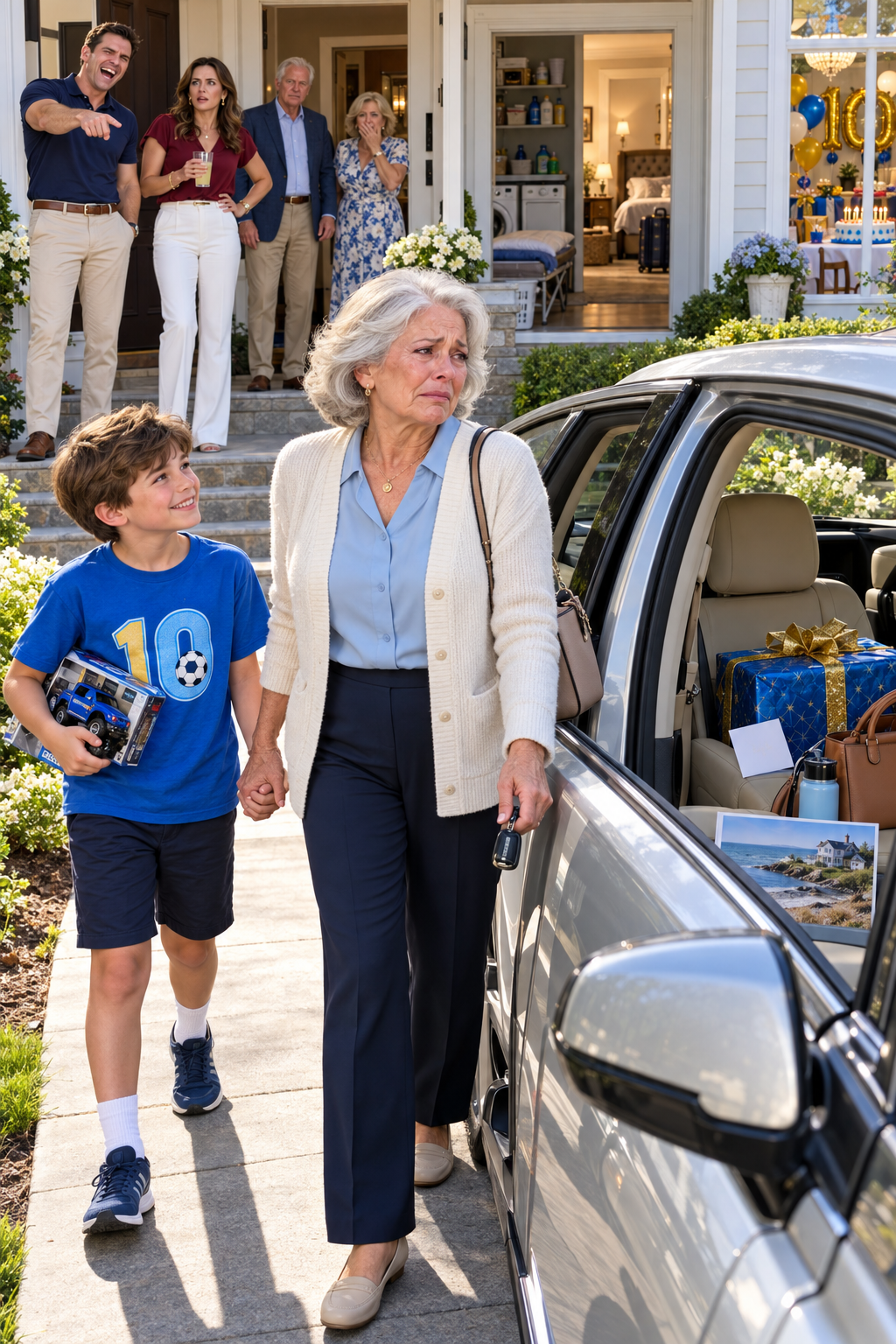
My Grandson’s 10th Birthday. I Drove 6 Hours With His Present On The Seat. My Son Gave His In-Laws The Guest Room And Put Me In The Laundry Room. When I Asked For The Couch, He Laughed In Front Of Them. “Mom, You’re Lucky You Got Invited.” I Didn’t Argue. For 2 Years, I’d Turned Down A Cottage By The Sea To Stay Near My Son’s Kids. So I Picked Up My Keys. My Grandson Caught Me At The Car, Barefoot, And…
My son gave his wealthy in-laws the guest bedroom and told me to sleep on a folding cot beside the dryer. When I asked for the couch instead, he laughed and said I should be grateful he’d invited me at all. Nobody defended me. I simply packed my things and walked toward my car. By the following afternoon, an envelope intended for a mysterious woman would expose a secret my son had protected for nearly two years—and explain why he’d been so determined to keep me invisible.
## Part 1
The folding cot was squeezed between a clothes dryer and a metal shelving unit loaded with detergent, cleaning supplies, and half-empty paint cans. Someone had placed a small pillow at one end and folded my grandmother’s blue quilt across the foot, as though arranging those two things carefully could turn a basement laundry room into suitable accommodations for a sixty-six-year-old woman. A yellow note on the pillow said, “Claire,” in my son’s handwriting. I stood there holding my overnight bag, listening to the furnace start behind the wall, and wondered how many people had walked past that cot without thinking there was anything wrong with it.
Upstairs, laughter floated through the heating vents. I recognized my son’s voice, followed by the deeper chuckle of his father-in-law, a man who wore expensive watches and liked to explain why cheaper ones didn’t keep good time. The smell of grilled steak drifted down the basement stairs, mixing with fabric softener and the faint dampness of concrete. I went upstairs and asked Nathan whether I might sleep on the living room couch instead, explaining that the basement floor was cold and my back had been troubling me since the long drive.
Nathan glanced toward his father-in-law before answering. “Mom, it’s one night. You’re lucky we could squeeze you in at all,” he said, smiling as though he’d delivered a clever joke. Frank Bellamy laughed from his leather recliner, and his wife, Susan, lifted her wineglass to cover a smile. I waited for Nathan to recognize how cruel he’d sounded, but he only turned back toward the television.
“All right,” I said.
Those two words were all I trusted myself to say. I returned to the basement, sat carefully on the cot, and looked at my quilt. My own mother had stitched it during a winter when money was scarce and our family heated only three rooms of the house. I’d brought it to Nathan’s home two years earlier because my grandchildren said it made their guest bedroom smell like me.
That night, it smelled faintly of dryer sheets.
My name is Claire Mercer, and for most of my adult life I lived in a modest house overlooking Lake Superior, just outside Marquette, Michigan. My husband, Thomas, repaired boats and built wooden models in his spare time, while I made my living servicing pianos in churches, schools, and private homes across the Upper Peninsula. We raised one child, Nathan, who grew into a bright, capable boy with his father’s dark hair and my unfortunate habit of apologizing whenever someone else was inconvenienced. For a long time, I believed that being a good mother meant making sure my child never had to question whether I would be there.
Thomas died in November 2020 after a brief illness that made our forty-three years together feel suddenly insufficient. His tools remained on their hooks in the garage, and his unfinished projects sat exactly where he’d left them because I couldn’t bear to decide what should happen to them. I continued working part-time, though climbing stairs with a heavy tuning case was becoming harder. The house felt enormous after dark, particularly when winter storms turned the windows white and the road disappeared beneath drifting snow.
In February 2022, Nathan called while I was washing the dinner dishes. He lived near Grand Rapids with his wife, Paige, and their children, Finn and Lucy, and I could hear both youngsters arguing about something in the background. Paige had accepted a full-time position at the hospital pharmacy, working alternating weeks of long shifts, and Nathan’s sales territory required frequent overnight trips. Their usual after-school arrangement had fallen apart, and the waiting list for another program stretched into autumn.
“We’ve tried everything,” Nathan said. “I hate asking you, Mom, especially with that drive, but could you come down on Paige’s work weeks? Just until we get our feet under us.”
He sounded exhausted, and I remembered being thirty-eight with a mortgage, children, and more responsibilities than hours in the day. I remembered my own mother appearing at our door with a casserole whenever she sensed I was overwhelmed. Above all, I remembered how good it felt to be useful to somebody after months of wandering through an empty house.
“Of course I can,” I told him. “We’ll work something out.”
What Nathan didn’t know was that another offer had arrived three days earlier, tucked inside a cream-colored envelope from Maine. Thomas’s older sister, Evelyn, was preparing to leave her cottage on Deer Isle and move closer to her daughter in Portland. She’d offered to sell me the cottage at a family price because she knew Thomas and I had once dreamed of retiring there.
The property was a weathered gray house above a sheltered cove, with a blue front door, crooked porch steps, and a view of fishing boats heading out before sunrise. Thomas and I had spent eleven summers there, drinking coffee beneath the porch roof while the gulls quarreled over the water. The place needed a new roof and some electrical work, but Evelyn’s asking price of $135,000 was within reach if I sold my house in Michigan. For the first time since my husband’s funeral, I’d allowed myself to imagine a future that wasn’t organized around what I’d lost.
Evelyn had included a photograph showing the kitchen table beside the window. On the back, she had written, “You always looked happiest here, Claire. I’d love to see you make it yours.”
I placed that photograph beside Nathan’s school portrait on my mantel and stared at both for most of the evening. Moving to Maine would mean living far from my grandchildren, missing school concerts, birthday dinners, and the little accidents of family life that grandmothers treasure. Nathan had just told me how badly he needed help, and I knew he wasn’t likely to admit it again if I refused. I called Evelyn the following morning and told her I needed more time.
“How much time?” she asked.
“A few months, maybe until fall.”
She was quiet before saying, “Honey, don’t make a permanent decision because somebody has a temporary problem.”
I promised I wouldn’t, and at the time I meant it.
Two weeks later, I began driving south every other Sunday. I packed a cooler with sandwiches, a thermos of coffee, and whatever groceries I thought the children might enjoy, then followed the highway through forests and small towns before crossing the Mackinac Bridge. Some trips took six hours; others stretched beyond seven when the weather turned ugly. Once, freezing rain forced me into a motel near Gaylord, where I spent eighty-seven dollars on a room because I was afraid to drive another mile.
Nathan’s relief when I arrived seemed worth every inconvenience. Finn would come running from the front porch, Lucy would insist I carry her even when my shoulder ached, and Paige often hugged me with an exhaustion that required no explanation. They gave me the upstairs guest bedroom, with a comfortable mattress, a small reading lamp, and a window overlooking the backyard. Finn made a sign for the door that read, “GRANDMA’S ROOM,” decorating it with crooked musical notes.
During those first months, I cooked breakfasts, packed lunches, washed sports uniforms, collected children from school, and helped with homework. I taught Finn his first simple piano pieces on an old upright Nathan had bought at an estate sale. Lucy liked to sit beside me on the bench and press whichever keys her brother wasn’t using, then announce that we’d composed a duet. Their laughter filled spaces inside me that had been silent since Thomas died.
Nathan said frequently that he didn’t know what they’d do without me. Paige thanked me after nearly every shift, sometimes resting her forehead against my shoulder before she went upstairs. I didn’t need more than that, or so I told myself. Helping them felt like a reasonable exchange for belonging somewhere again.
I didn’t notice when a favor gradually became a schedule nobody questioned. I didn’t notice when my return trips to Marquette stopped being discussed, or when Nathan began referring to my visits as “Grandma’s weeks,” as though they’d always existed. And I certainly didn’t notice that my son’s father-in-law had begun asking increasingly specific questions about the woman looking after his grandchildren.
The first time I heard Frank mention her, I was standing at the kitchen sink, and Nathan had his phone on speaker.
“Still happy with the childcare arrangement?” Frank asked.
“Couldn’t be better,” Nathan replied.
“Good,” Frank said. “Then we’ll keep things exactly as they are.”
Nathan reached for his phone and switched off the speaker so quickly that I nearly dropped the glass I was washing.
I assumed he wanted privacy for a business conversation. It never occurred to me that I was standing in the middle of a conversation about myself—and that I was the only person who didn’t know what it meant.
## Part 2
By the autumn of 2022, I had driven between Marquette and Grand Rapids often enough to recognize roadside barns by their roofs and predict which gas stations would have fresh coffee. My Subaru had passed 180,000 miles, and the mechanic warned that another winter of long-distance driving would probably mean replacing the suspension. I thanked him, paid for the necessary repairs, and continued making the trip. When Nathan asked whether I could arrive a day early because he had a meeting in Kalamazoo, I rearranged two piano appointments without mentioning what they would cost me.
There were moments that made the sacrifices seem perfectly sensible. Finn learned to play the first verse of “America the Beautiful” and insisted on performing it for me every evening until Lucy complained that the piano was keeping her stuffed animals awake. Paige once came home after a twelve-hour shift to find dinner ready and the children asleep, and she sat at the kitchen counter crying quietly over a bowl of soup. She told me she’d begun to believe she could be a good mother and a good pharmacist, instead of constantly failing one responsibility to fulfill the other.
I wanted her to have that life. I’d spent years encouraging younger women not to surrender careers they’d worked hard to build, and Paige was excellent at her job. She handled complicated medication questions with patience and had an extraordinary ability to remain calm when everyone around her was frightened. But she also trusted Nathan to manage the household finances, and his reassuring phrases seemed designed to end conversations rather than invite them.
When Paige asked whether she should give me money for the children’s care, Nathan answered before I could speak. “Mom doesn’t want this to turn into a job. We’ve already talked about it.”
I looked at him, surprised. We’d never discussed payment, and I hadn’t requested any, but I also hadn’t considered whether I should be reimbursed for gasoline, repairs, or the professional appointments I was losing. Paige glanced at me for confirmation, and I gave the little smile women my age sometimes use when they’re trying not to embarrass somebody in front of their family. I said I was happy to help, and the matter was apparently settled.
A few weeks later, I discovered two twenty-dollar bills tucked into the cup holder of my car, secured with a narrow strip of paper bearing the words “For your trip.” I assumed Nathan had reconsidered and was trying to help without making an uncomfortable announcement. I called to thank him, and he said, “Don’t worry about it, Mom,” before changing the subject to a troublesome customer. I was touched enough to cry in the parking lot of a grocery store.
The money appeared regularly after that, usually on the mornings I drove north. Rather than spend it, I began putting the folded bills in a coffee tin at home, thinking I could give them to Finn and Lucy for something special when they were older. I told myself their father was learning to recognize the smaller costs of generosity. I didn’t know the handwriting on those strips of paper belonged to somebody else.
The first unmistakable warning came at Nathan’s company barbecue the following spring. He’d invited several contractors and their spouses to the house, and Paige asked if I could prepare the salads while she took the children to a birthday party. I arrived downstairs wearing an ordinary blue cardigan and found Nathan examining me with the uneasy expression he’d had as a teenager when I threatened to attend his school dances. “Could you maybe change before everyone gets here?” he asked.
I looked down at my sweater, wondering whether I’d spilled something on it. He explained that people from his company would be visiting, and he wanted the afternoon to feel like a professional event. Then he asked me to move my old Subaru from the driveway to a side street because guests would need parking. I did both things, although his tone bothered me more than the requests themselves.
Later, carrying a platter of sandwiches toward the patio, I heard a contractor ask who had prepared everything. Nathan answered, “We have help during the busy weeks,” and immediately began discussing a new commercial account. I stood behind the sliding door, watching him entertain men who were younger than I was by twenty years, and wondered why saying his mother had made sandwiches would have been so difficult.
By then, Nathan had joined an expensive golf club outside Grand Rapids. He said membership was essential because builders and developers made decisions on golf courses that they’d never make in conference rooms. Frank belonged to a similar club outside Chicago, and the two men could talk for hours about handicaps, private dining rooms, and acquaintances whose names meant nothing to me. Nathan had also leased a large luxury pickup truck, explaining that successful clients expected their sales representative to look successful.
None of those things seemed particularly concerning at first. Nathan had always been ambitious, and he genuinely worked hard. Yet I noticed him studying his banking app whenever he thought Paige wasn’t looking, and twice I saw him silence calls that appeared to come from his truck dealership. When I asked whether business was slowing, he told me the market was simply shifting and there was nothing to worry about.
In April 2023, Evelyn sent another letter, this one enclosed with an estimate for the cottage roof. Her daughter had found her an apartment near Portland, and the move was becoming increasingly urgent because the stairs were difficult for her knees. She still wanted me to have the house, but her son believed she should sell it on the open market while coastal property was valuable. “I can hold him off for a little longer,” she wrote, “but I need to know whether you are choosing this life or just remembering it.”
I sat at my kitchen table with the letter beside my calendar. Every second week was marked with a blue square for Grand Rapids, while my tuning appointments had been squeezed into the spaces between. I calculated what I’d spent on gasoline, repairs, groceries, and overnight stops, then stopped adding when the total passed several thousand dollars. More troubling was the amount of time I’d surrendered without ever asking how long the arrangement would last.
That evening, I called Nathan and asked whether he and Paige had made progress finding after-school care. He sounded irritated almost immediately, explaining that programs were expensive, inconvenient, and rarely open late enough for Paige’s shifts. “I thought things were working,” he said. “The kids are happy, and you keep telling us you enjoy coming.”
“I do enjoy them,” I answered. “That doesn’t mean I can keep driving forever.”
He sighed, then reminded me that Finn was having trouble with fractions and Lucy had just begun kindergarten. He explained how much the children depended on my presence, and I felt ashamed of considering a move that would take me away from them. Before we hung up, I told him we’d revisit the question after summer.
Evelyn received another letter from me containing the familiar request for patience. She called two days later and talked about the tide pools beneath her cottage, the roses Thomas had planted along the fence, and the local piano teacher who’d been asking whether I might ever move east. She didn’t lecture me, but she did say something I carried around for months. “Your grandchildren are going to grow up, Claire. You deserve somewhere to grow older.”
That summer, Frank and Susan visited during Paige’s week off, so I wasn’t there. After they left, I returned to discover my quilt folded inside a linen closet and Finn’s sign removed from the guest bedroom door. Paige explained that her mother had allergies and preferred her own pillows and bedding. I understood, but I was less prepared to discover my reading glasses and slippers packed into a cardboard box in the hallway.
Finn found me putting them away. “Grandpa Frank says this is the nice guest room,” he announced. “I told him it was yours, but Dad said not to make things complicated.”
I asked whether he’d been upset, and he shrugged. “I just thought they should know.”
The following winter, I became more careful about leaving my belongings in that room. The slippers went into my overnight bag, and the glasses stayed on a cord around my neck. I noticed that Nathan preferred discussing my visits when Paige wasn’t present, and whenever her parents called, he took the conversations outside or into his office. I attributed this to the private way some families handled financial matters, although I couldn’t explain why childcare seemed to require such secrecy.
Then, in February 2024, Nathan sent a message about Finn’s tenth birthday party.
“Frank and Susan are coming for the weekend. We’re tight on space, so maybe come the following Sunday instead. We’ll celebrate with you separately.”
I read the message while sitting beside Thomas’s unfinished wooden model of a coastal schooner, which still occupied the corner of my dining room. The party was scheduled for March 9, and I hadn’t missed one of Finn’s birthdays since he was born. I typed several answers and deleted them before putting down the phone.
Five days later, an envelope arrived with an upside-down postage stamp and my address written in Finn’s large, determined handwriting. Inside was a birthday invitation he’d made himself, showing me sitting at the piano beside a cake with ten candles. Beneath the drawing, he had written, “Please come even if Dad says the house is full. You are the person I want to play my new song for.”
I called Nathan that evening and told him I’d be coming to the party.
His response was silence, followed by a sigh.
“Mom, you really couldn’t just do what I asked this once?”
I stared at Finn’s drawing pinned to my refrigerator. For the first time in two years, my son’s wishes and my own were pointing in completely different directions.
“I’ll see you Saturday,” I said, and ended the call.
## Part 3
For the three weeks before Finn’s birthday, I spent most evenings working at Thomas’s old bench in the garage. The unfinished schooner had been sitting beneath a cotton sheet since his illness, its tiny deck fittings and railings arranged in labeled compartments that only he would have understood. I’d avoided touching it for years because finishing his work felt dangerously close to accepting that he never would. But Finn had recently asked about the grandfather who’d taught me to recognize different kinds of boats, and I realized that the model could give him something photographs couldn’t.
Thomas had drawn the plans during our last summer in Maine, copying a working sailboat he’d admired in the harbor. I followed his penciled measurements, cut replacement pieces from thin strips of cedar, and learned to shape the missing railing without breaking it. My hands were less steady than they had been when I was young, but four decades of adjusting delicate piano mechanisms had taught me patience. On the final evening, I painted a small compass rose on the stern and attached a brass plate engraved with Finn’s initials.
I wrapped the model in two towels and secured it on the passenger seat of my Subaru. Then I placed my overnight bag in the back, checked the weather, and set two alarms for early Saturday morning. There were warnings about freezing rain along the highway, but the worst of the storm was expected to pass before I reached the bridge. I wanted to arrive before lunch so I could help Paige prepare for the party.
Snow began falling near St. Ignace, and by the time I crossed the Mackinac Bridge, wind was pushing against the car hard enough to make the steering wheel tremble. I drove slowly behind a delivery truck, watching the red taillights disappear and reappear through the blowing snow. Thomas used to whistle whenever we crossed that bridge, a habit I once found irritating and now missed with an ache that surprised me. I caught myself whistling halfway across.
I reached Nathan’s neighborhood shortly before noon. Frank and Susan’s silver Mercedes occupied the usual space in the driveway, so I parked along the curb and carried my overnight bag toward the house. Nathan opened the door before I rang the bell, wearing dark trousers and a pressed shirt that looked far too formal for a child’s birthday weekend. He glanced past me toward the car.
“You came early,” he said.
“I thought Paige might need help.”
His jaw tightened. “We had everything organized.”
Before I could answer, Lucy appeared behind him, wearing mismatched socks and holding a stuffed rabbit by one ear. She screamed my name and threw her arms around my waist, nearly knocking my bag onto the porch. Finn came down the stairs more cautiously, but the smile he gave me was worth every uncomfortable mile of the drive. Paige emerged from the kitchen, wiping flour from her hands, and hugged me longer than usual.
“I’m glad you came,” she whispered.
Frank and Susan were settled in the living room. Frank rose to shake my hand and commented on the weather, while Susan said the trip sounded exhausting and asked whether I’d brought warmer shoes. They were both perfectly polite, although I had the strange sensation of having arrived unexpectedly at an event where everybody else had been given the schedule. Nathan kept looking toward the staircase whenever anyone mentioned sleeping arrangements.
I went upstairs to put away my bag and found the guest bedroom occupied by two expensive suitcases, several garment bags, and Susan’s cosmetics arranged across the dresser. My reading lamp had been moved to the closet, and the drawer where I normally kept my spare sweater was filled with travel accessories. I stood there for a moment, then brought my bag back downstairs.
Nathan was waiting near the kitchen.
“Your stuff’s in the basement,” he said. “Just for tonight.”
I followed the stairs down and discovered the folding cot beside the dryer. My mother’s quilt had been taken from the linen closet and arranged at its foot, while a plastic storage box held the belongings I’d left upstairs. Above the cot, an exposed pipe ran toward the water heater, and the only window was a narrow rectangle level with the backyard grass. Even the basement bathroom was on the other side of the house, past the furnace and Nathan’s old exercise equipment.
I returned upstairs and asked about the couch, trying to keep my voice low. Nathan made his joke about how fortunate I was to be included, and Frank and Susan laughed while the television continued playing behind them. Paige was upstairs helping Lucy change clothes, so she didn’t hear the exchange. What hurt most wasn’t the basement itself; it was seeing my son look toward Frank for approval before deciding how to answer me.
I said nothing further and spent the afternoon making potato salad, arranging chairs, and helping Finn practice his new piano piece. He’d chosen a simple arrangement of “Moon River,” and he kept stumbling over the same change in the left hand. We worked through it together until he could play the phrase without stopping. When he finished, he leaned against my shoulder and told me he wished I could stay for all of his birthdays, even when he was grown.
At dinner, Frank complimented Paige on the meal, then began talking about how difficult it had been to find reliable childcare when she was young. Susan recalled interviewing several nannies and discovering that some were better at presenting themselves than watching children. Nathan listened with an expression I couldn’t read, cutting his steak into unnecessarily small pieces. When Frank mentioned how grateful he was that Finn and Lucy had someone dependable now, Nathan reached for his water glass.
“I’ve got something for your caregiver,” Frank said. “A Christmas thank-you I never managed to deliver. Will she be coming on Monday?”
Nathan’s knife stopped moving.
“She’s taking a few days off,” he replied. “Mom’s helping out while she’s away.”
I looked from one man to the other. Paige was busy wiping sauce from Lucy’s chin and didn’t appear to have heard the exchange. Frank nodded, disappointed, then asked Nathan to make sure the woman knew how much they appreciated her. Nathan said he would, but he didn’t look at me for the remainder of the meal.
The word “caregiver” bothered me long after dinner. It wasn’t impossible that they’d occasionally hired somebody else, but I knew every school pickup, every doctor appointment, every sick day, and every afternoon when Nathan had been out of town. On Paige’s work weeks, there was no invisible professional filling the gaps. There was only me, my car, my calendar, and the children.
At nine o’clock, I went downstairs and sat on the cot. Someone had started the dryer, and its steady vibration traveled through the metal frame into my hip. I looked around for a place to hang my coat, found none, and laid it across my bag. Then I noticed I’d missed a call from Evelyn.
Her voicemail was brief, but it changed the shape of everything around me. Her son had arranged for a real estate agent to visit the cottage in April, and if I couldn’t commit before then, she could no longer hold the property. Her voice trembled slightly when she said she understood if my answer was no, although she’d hoped I might finally choose something for myself.
I listened twice before calling her back, but she didn’t answer. I stared at the photograph of the cottage on my phone and thought about another summer of driving through Michigan, another autumn of postponed decisions, and another winter wondering whether my own life could begin after everyone else’s needs had been satisfied. The hum of the dryer rose behind me.
I folded the quilt and packed my glasses. I could sleep at a motel and come back for the party, I decided, and afterward I could tell Nathan that our childcare arrangement needed to end. There was no need for another argument. I collected my keys, carried my things through the garage, and walked down the driveway toward my car.
I had just unlocked the door when Finn shouted my name.
He was running toward me in rocket-patterned pajamas, his bare feet slapping into wet snow that had turned to slush beside the curb. I dropped my bag and hurried to meet him, horrified by the sight of his feet sinking into the icy water. He grabbed my coat with both hands, his face flushed from the cold.
“Grandma, are you leaving because Dad made you sleep downstairs?”
I could have lied, but he was looking straight at me with an expression far too serious for a child who should have been thinking about birthday cake. I told him I needed a more comfortable place to sleep and that I’d return the next day. He nodded slowly, then asked whether he could tell me something without getting his father into trouble.
“Grandpa Frank keeps asking about our nanny,” Finn said. “But we don’t have a nanny, Grandma. We have you.”
A movement on the porch caught my eye. Frank stood beside his car, holding a charging cable he’d apparently retrieved from the glove compartment. He had stopped halfway up the steps, and from the way he was staring at us, I knew he’d heard every word.
“Claire,” he said, coming down the steps. “How long have you been looking after the children?”
“Since March 2022. Every other week.”
“All the pickups? Their meals? The nights when Nathan’s traveling?”
I nodded, still rubbing Finn’s freezing hands between my palms. Frank looked at the boy, removed his own jacket, and wrapped it around him before speaking again.
“Have Nathan and Paige been paying you?”
“No,” I answered. “I’ve never asked them to.”
Frank’s face lost its color.
He explained that he’d been sending Nathan $1,150 every month for childcare, beginning in July 2022, because he wanted Paige to continue working without worrying about the expense. Nathan had described the caregiver as an experienced older woman from northern Michigan, someone excellent with children who preferred not to deal directly with the grandparents. Frank had accepted the arrangement and sent the money into an account Nathan controlled.
Twenty months. Twenty-three thousand dollars.
I stared at him, waiting for some sensible explanation to arrive. Finn shivered inside Frank’s jacket and asked whether grown-ups were supposed to give money to grandmothers for making pancakes. Neither of us could answer him.
Then Frank looked toward the lighted windows of the house and said something that frightened me more than the amount.
“Claire, I think Nathan has been lying to all of us.”
## Part 4
I carried Finn back inside because his feet were numb and he was beginning to cry. Frank followed, holding my overnight bag in one hand and Finn’s slippers in the other, his usual self-assurance replaced by an expression of stunned concentration. We found a towel in the mudroom, and I dried the boy’s feet until he complained that I was rubbing too hard. Nathan appeared in the doorway and stopped when he saw his father-in-law’s jacket around Finn’s shoulders.
“What happened?” Nathan asked.
“He ran outside without shoes,” I said. “I was leaving.”
Nathan’s eyes moved to Frank’s face, and I watched him recognize that something had changed. He tried to smile, but the expression lasted less than a second before Frank told him that they’d be discussing the childcare payments in the morning. Nathan said nothing. He only stepped aside while I led Finn upstairs to find his socks.
In Finn’s bedroom, I explained that adults sometimes made mistakes they needed to straighten out, but none of it was his responsibility. He asked whether I’d still be there for his birthday, and I promised I would return before the guests arrived. Then he asked whether he could sleep at the motel with me instead of staying home. I kissed his forehead and told him he belonged in his own warm bed that night.
I left through the front door fifteen minutes later, passing Nathan in the hallway. He started to say something, then stopped when he noticed Frank standing behind him. I waited for an apology or even a request to speak privately, but my son looked down at his phone. For the first time, I understood that his silence wasn’t confusion. He was deciding how much trouble he could avoid by saying nothing.
The motel near the highway had two floors, a vending machine outside the office, and a young receptionist who offered me a ground-floor room when he saw how stiffly I was walking. I carried my quilt inside, spread it across the bed, and placed Thomas’s model schooner on the dresser, still wrapped in towels. The room smelled of coffee and disinfectant, but the mattress was clean and there was a real bathroom ten steps away. I sat on the edge of the bed and felt more comfortable than I had in my son’s house.
At eleven, my phone rang.
Frank apologized without waiting for me to speak. He said he was ashamed of laughing when Nathan mocked me, and he acknowledged that he’d been more concerned about avoiding an awkward moment than about whether I was being treated respectfully. He’d also asked Nathan to keep the childcare assistance private because Paige had reacted badly to earlier financial gifts. He thought he was protecting his daughter’s pride, when in fact he’d created a secrecy that Nathan had been able to exploit.
“I should’ve asked more questions,” Frank said.
“I wish someone had asked me one,” I answered.
He remained silent for a moment. Then he said he intended to tell Paige everything after Finn’s party, and he hoped I would be present because the money had been sent for work I’d actually performed. I told him I would come for the birthday, but I didn’t want Finn’s celebration turned into an argument about his father. Frank agreed, although the hesitation in his voice made me uncertain he could keep that promise.
After the call, I sat awake examining the last two years with a clarity I hadn’t wanted before. Nathan had repeatedly discouraged me from accepting other commitments, concealed my relationship to the supposed paid caregiver, and allowed me to believe the gasoline money came from him. He’d let Paige think my help was effortless and Frank believe a professional was receiving his payments. The insult in the laundry room had been part of a much longer effort to keep separate people from asking the same questions.
At five the next morning, I called Evelyn.
She answered on the third ring, sleepy but immediately concerned. I told her I wanted the cottage, assuming she was still willing to sell it to me, and that I could arrange for an inspection and begin preparing my Michigan house for sale. She asked what had happened, and for a moment I couldn’t find the words. Finally, I told her that I’d discovered how much of my life I’d spent trying to earn a welcome from people who’d stopped noticing what I gave.
Evelyn didn’t offer a comforting proverb. She asked whether I had enough money for the deposit, whether my back could tolerate packing, and whether I wanted her daughter to recommend a local real estate attorney. Those practical questions steadied me more than sympathy would have. Before we hung up, she said she would call the agent and postpone the listing until we’d had a chance to complete the purchase.
I slept for another hour, then washed my face, dressed in a dark green blouse, and unwrapped the model schooner to check whether the delicate railings had survived the drive. Finn’s initials glinted on the stern. I brushed a tiny speck of sawdust from the deck and remembered Thomas teaching our son to sand wood along the grain instead of across it. I wondered when Nathan had begun caring more about what strangers thought than about the people who loved him.
At one thirty, I returned to the house. Balloons filled the living room, and a homemade banner hung above the fireplace, its letters colored by Lucy in bright pink and purple. Children rushed between the kitchen and backyard while parents stood holding paper plates and plastic cups. Nathan opened the door with a forced smile and asked whether I was feeling better.
“I wasn’t sick,” I replied.
His face tightened. “Mom, please. We’re having a party.”
“I know. That’s why I’m here.”
Paige met me near the stairs and asked where I’d slept. Nathan had told her I’d decided to leave because I was tired from the drive, but she noticed my overnight bag was missing and kept studying my face. I told her the truth in a quiet voice: I’d been given the basement cot, and I had chosen to sleep somewhere more comfortable. She looked toward her husband, then back at me.
“Why didn’t you tell me?”
“Because I wanted Finn to have his birthday without another problem to worry about.”
Paige took my hand. “I need to talk to you later.”
Finn discovered the schooner before I could hide it with the other gifts. He unwrapped the towels carefully, tracing the railings with his fingers and leaning close to inspect the miniature wheelhouse. When I explained that his grandfather had started it years earlier, his eyes filled with tears. He carried it straight to the piano, where he placed it on the closed lid and told everyone within hearing distance that the boat had been made by two grandparents.
He played “Moon River” afterward, stumbling once, then recovering without looking at me for help. I applauded until my palms stung. Paige stood beside the kitchen doorway with tears in her eyes, and even Nathan seemed genuinely proud of his son. For twenty beautiful minutes, the house felt like a family home instead of a place where everyone was protecting separate versions of the truth.
The candles were blown out shortly after three. Finn received his presents, Lucy collected the discarded ribbons, and the younger children were sent into the backyard to play a game organized by one of the neighbors. I thought the hardest part of the afternoon might be behind us. Then Frank approached me carrying a cream-colored envelope.
He’d originally written “To Our Wonderful Caregiver” across the front. Now he’d crossed out those words and written my name beneath them. He said he wanted to give it to me before everyone left, and I understood from his expression that he’d been holding it for months. I accepted it, but when he began explaining its history, Paige overheard him.
“What caregiver?” she asked.
The adults nearest the kitchen stopped talking. Frank explained that he’d been helping Nathan pay for childcare, and Paige stared at him as though he’d begun speaking another language. She said they had never hired a nanny and that Claire—me—had been handling the children during her work weeks.
Nathan tried to interrupt. “This is a misunderstanding. Dad gave us help with household expenses.”
Frank shook his head. “I transferred $1,150 every month specifically for childcare. You told me you were paying someone.”
Paige set down the cake knife she was holding. “Nathan, you told me your mother wouldn’t accept money. You said I’d hurt her feelings if I brought it up.”
I stood beside the piano, holding the unopened envelope and wishing Finn were farther away. He was near the backyard door, looking from one adult to another with growing uncertainty. I asked Paige to take him outside, but she was staring at Nathan, waiting for an answer he’d apparently spent twenty months avoiding.
Then I made the mistake of trying to soften what was happening.
“Nathan did leave money for my gas sometimes,” I said. “I always appreciated that.”
Paige turned toward me. Her face changed so abruptly that I stopped speaking.
“Claire,” she whispered. “I put that money in your car. Nathan told me he’d take care of everything else.”
I thought of those folded bills, the paper strips, and the coffee tin in my cupboard. Nathan had accepted my gratitude without once telling me the truth.
One of the neighbors quietly began gathering her children’s coats. Frank stood with his hands at his sides, looking much older than he had the night before. Paige asked Nathan where the childcare money had gone, and when he failed to answer, she asked again.
Finally, Nathan pushed through the kitchen door and disappeared into the garage.
Paige looked at the people still standing in her living room, then at the open doorway.
“Twenty-three thousand dollars,” she said, her voice barely audible. “And he let his mother sleep beside the dryer.”
## Part 5
The birthday party ended twenty minutes later, although nobody officially announced it was over. Parents collected jackets, children complained about leaving, and Paige walked through the rooms thanking people who could barely meet her eyes. Finn sat at the piano bench with Thomas’s schooner in his lap, watching his father remain absent from the festivities. I sat beside him and asked whether he wanted another piece of cake, but he shook his head.
“Is Dad in trouble because I told Grandpa Frank about the nanny?” he whispered.
I put my arm around him. “Your dad is responsible for his own choices, sweetheart. You didn’t cause any of this by telling the truth.”
He thought about that, then asked whether I still loved his father. I told him I did, and that loving someone didn’t mean pretending everything they did was right. He nodded without looking convinced, which was reasonable because I wasn’t entirely convinced I knew how to live by those words myself.
After the last guests departed, Paige asked Frank and Susan to stay while she spoke to Nathan. I offered to take the children upstairs, but she said she wanted me present because the conversation concerned my time, labor, and trust. Nathan eventually emerged from the garage, his eyes red and his expensive shirt wrinkled. He sat at the kitchen table without looking at anybody.
Frank brought out his phone and opened the record of transfers. There were twenty payments, each for $1,150, with descriptions identifying them as childcare assistance. The money had gone into a checking account Nathan maintained separately from the one he shared with Paige. Frank had never requested receipts, partly because he trusted his son-in-law and partly because he didn’t want Paige to discover he’d been helping.
“I should’ve told you about the arrangement,” Frank admitted to his daughter. “But I had no reason to think the money wasn’t going where Nathan said it was.”
Paige looked at her father, then at her husband. “You both decided I couldn’t be trusted to know what was happening in my own house.”
Neither man had a good answer.
Nathan finally explained that he’d joined the Ridgemont Country Club in July 2022 because his largest customers were members. The initiation fee had been charged to a credit card, and the monthly dues were considerably more expensive than he’d expected. He’d also leased a truck whose payments exceeded what he could comfortably afford after a decline in sales commissions. When Frank offered financial help for childcare, Nathan convinced himself that using the money for business-related expenses would eventually benefit the whole family.
“Those people don’t hand contracts to the salesman driving the oldest truck in the parking lot,” he said. “You have to look like you belong before they’ll take you seriously.”
I asked whether belonging had required keeping his mother out of sight.
He rubbed his forehead. “It wasn’t like that.”
“Then tell me what it was like.”
Nathan looked toward Frank. He admitted that the club had been a way to compete with men who’d grown up with money, attended expensive universities, and entered careers with connections he didn’t have. He wanted Frank to see him as someone who could provide for Paige without assistance, even while accepting money from him every month. If Frank discovered the caregiver was his mother, Nathan worried he’d realize how dependent the household had become on unpaid family help.
“So you hid me,” I said.
“I didn’t think of it that way.”
“You moved my belongings downstairs every time her parents visited. You asked me to stay away from family gatherings, and yesterday you laughed when I asked for a decent bed.”
Nathan lowered his head. “I know.”
Paige asked why he’d continued after the first few months, once it became obvious the children were settled and his mother was doing the work reliably. He admitted that he’d already spent the early payments and couldn’t repay Frank without revealing what had happened. Each month he’d told himself the next large commission would fix everything, and each month the balance of what he’d concealed increased. By the time the truth threatened to emerge, telling another lie had become easier than facing the first one.
Frank stood and walked to the window, his expression impossible to read. He had spent years praising Nathan’s professional ambition, treating the young man’s expensive habits as signs of progress. Now he was learning that the image he’d admired had partly been financed by money intended to provide a safe, stable arrangement for his grandchildren. I wondered how much of Nathan’s desperation to impress him had begun as a response to Frank’s approval.
Paige retrieved a folder from the office and placed several statements on the table. She’d noticed credit card balances rising and had asked Nathan about them repeatedly, but he’d told her they reflected temporary business expenses awaiting reimbursement. She’d accepted his explanation because she’d trusted him to tell her if their finances were in trouble. Now she opened a statement showing thousands in purchases, interest, and club charges that had nothing to do with selling heating equipment.
“Have you been using our savings to make these payments, too?” she asked.
Nathan hesitated.
That hesitation told her more than a quick denial could have. When he finally admitted he’d transferred several thousand dollars out of their joint emergency fund, Paige pushed back her chair. She said she needed copies of every account statement, every loan agreement, and every financial obligation bearing either of their names.
Susan began crying quietly. Frank stared at the floor. I found myself studying the crumbs around Finn’s birthday cake, because I couldn’t bear to watch another marriage acquire cracks that might never fully close.
Nathan turned toward me, almost pleading. “Mom, I know I screwed up. I’ll make it right.”
I asked him what that meant. He began talking about finding more customers, reducing expenses, and paying back the money, but none of those promises addressed the thing I couldn’t stop remembering. He had seen me standing in a laundry room with my bag and decided I didn’t deserve a better place to sleep because it might embarrass him.
“I wasn’t asking you to make me comfortable at the club,” I said. “I was asking you to make room for me in your house.”
His face crumpled, and for a moment he looked like the little boy who used to cry after breaking something precious and ask me whether it could be repaired. I wanted to reach for him out of forty years of habit. Instead, I kept my hands in my lap.
I told them about Evelyn’s cottage, the offer I’d received two years earlier, and the decision I’d repeatedly postponed because the children needed me. Paige covered her mouth when I explained that the house was being prepared for sale and I’d finally agreed to buy it. Nathan stared at me in disbelief.
“You’re moving to Maine?”
“Yes.”
“But that’s practically the other side of the country.”
“I know where it is, Nathan.”
He looked toward Paige, seemingly expecting her to persuade me to reconsider. She only asked whether I’d found someone to handle the purchase and whether I needed help preparing my Michigan house. It was the first question anyone in that room had asked about what I needed rather than what my decision would cost them.
Frank said Nathan would repay the entire $23,000. I told him I wasn’t prepared to make a decision about receiving the money that night, but I would not accept another arrangement negotiated without my knowledge. After discussing it with Paige, I wanted a written repayment agreement placing the money into protected savings accounts for Finn and Lucy, with payments Nathan could actually manage. Frank agreed that the matter should be handled openly and in writing.
Later, Paige followed me into the hallway while Nathan remained at the table. She apologized for not questioning the childcare arrangement more carefully, but I reminded her how consistently her husband had supplied reassuring answers. I also told her about the money in my car, and she smiled sadly when I said I’d saved every folded bill. She asked why I hadn’t spent it on the exhausting journeys.
“I thought it came from Nathan,” I answered. “I wanted to believe he’d noticed.”
Paige held my hands for a long moment. Then she said she’d believed Nathan’s assurances about much more than gas money, and she was beginning to understand how expensive that trust had become.
Before I left, Nathan approached me beside the front door. He asked whether I could postpone Maine until summer, just long enough to help them sort out childcare while Paige decided what to do. There was no anger in his voice this time, only exhaustion and fear. But the request was painfully familiar.
I looked at the man I’d raised and realized he still thought my sacrifices were available whenever his plans collapsed.
“No,” I said gently. “That is the part of this arrangement that has ended.”
## Part 6
The following Monday, I drove north toward Marquette with a suitcase in the back seat and an unopened envelope from Frank on the passenger seat. The roads were clear for most of the journey, and the sky above the Mackinac Bridge had the pale brightness that sometimes arrives before a spring thaw. I stopped at a rest area and called Evelyn to confirm the cottage inspection. Then I called my real estate agent and asked her to begin preparing my Michigan home for sale.
At home, I found the familiar silence waiting inside the front door. Thomas’s coat still hung on a peg beside mine, and the hallway smelled faintly of cedar from the small chest he’d built for our wedding anniversary. I walked through the rooms with a notebook, writing down which pieces of furniture I’d keep and which would be sold or donated. Instead of feeling that I was dismantling the life we’d made, I began to understand that I was carrying the parts worth keeping into a different one.
The work was more difficult than I’d expected. Forty-three years of marriage had filled our closets with photographs, old holiday decorations, carefully labeled screws, broken fishing reels, and objects that held no meaning until I picked them up. I discovered the receipt from the piano Thomas had bought me when I opened my tuning business, along with a note he’d written on the back. He’d joked that investing in a woman who could hear mistakes nobody else noticed was cheaper than buying a new boat.
I laughed so suddenly that I startled myself. Then I sat on the bedroom floor and cried for the first time since leaving Nathan’s house. I wasn’t crying only because Thomas was gone or because my son had betrayed me. I was grieving all the years I’d spent believing that if I kept working, helping, and asking for very little, the people I loved would naturally make room for me.
Paige called three days later with news that she’d met with a financial counselor. Nathan’s club membership had been canceled, and he’d begun the process of returning his leased truck early, although doing so carried penalties. The couple had agreed to close their separate discretionary spending accounts and identify every debt before making any decisions about their marriage. Paige had also discovered that Nathan had omitted several business expenses from their household budget, leaving their savings considerably smaller than she had believed.
She spoke calmly, but I could hear how tired she was. She’d spent her days caring for patients and her evenings sorting bank statements, while trying to protect Finn and Lucy from the tension around them. Nathan was sleeping in the guest bedroom, and she’d asked him not to discuss their problems with the children except when they were both present. I told her she didn’t have to manage the situation alone, but I didn’t offer to resume my old schedule.
Paige surprised me by saying she’d already contacted the school district. There was an after-school program with two spaces becoming available after spring break, and she’d arranged for a coworker to help on the occasional evening when she couldn’t leave the hospital on time. Nathan would be responsible for pickups on the days he wasn’t traveling, which meant he would need to renegotiate part of his sales territory. The solution wasn’t perfect, but it existed once both parents treated childcare as their own responsibility rather than mine.
“I should’ve done this ages ago,” she admitted.
“Maybe,” I said. “But you’re doing it now.”
The following weekend, Nathan called and asked whether I’d reconsidered staying in Michigan. He said the children missed me, that Lucy had cried when she saw my empty room, and that Finn was worried moving to Maine meant he wouldn’t see me anymore. I believed all of that, and it hurt more than any insult Nathan had delivered. But when I suggested arranging regular video calls and planning summer visits, he complained that traveling to Maine would be expensive and inconvenient.
I let the silence settle between us.
“Do you know how many miles I’ve driven for your family in the last two years?” I asked.
He said he’d never calculated it, so I gave him a rough estimate. I explained that I’d spent hundreds of hours on highways and tens of thousands of miles away from my own house, often driving through dangerous weather because his family needed me on Monday morning. Then I told him that if he wanted his children to maintain a relationship with their grandmother, he would have to accept some of the inconvenience himself.
Nathan began to apologize, but I stopped him. I wasn’t asking for another apology; I was explaining what would be different. I would no longer commit to every other week, arrange my life around his schedule, or let him determine whether my visits were convenient. I wanted to remain part of my grandchildren’s lives, and I hoped he would help make that possible, but I wouldn’t surrender my home to guarantee it.
For several days afterward, Nathan didn’t call. I spoke to Paige and the children, and I sent Finn photographs of the cottage so he could choose which room he wanted to sleep in when he visited. He asked whether there would be a piano, and I told him Evelyn had an old upright that needed work. Lucy wanted to know whether lobsters could pinch through rubber boots, which sent us both into laughter when I admitted I wasn’t certain.
The financial agreement arrived in early April. Nathan had signed a repayment schedule acknowledging that $23,000 received for childcare had been used without the knowledge or benefit of the person who performed that work. With Paige’s consent, monthly repayments would be divided between education accounts for Finn and Lucy, and statements would be available to both parents. Frank had insisted on having a lawyer prepare the agreement, which Nathan initially resented until he understood that his father-in-law no longer considered informal promises sufficient.
I also opened Frank’s envelope. It contained a handwritten Christmas card intended for the caregiver, thanking her for helping the children feel secure while their parents worked. Beneath the card was a check he’d written months earlier for a holiday gift, now voided and replaced with a new one bearing my name. I returned the check with a note saying his apology mattered more than the money, but I kept the card because, for all the confusion surrounding it, the gratitude had been real.
By mid-April, my house was ready for photographs. The agent placed flowers on the kitchen table, opened the curtains overlooking the lake, and asked whether I wanted to remove the framed photograph of Thomas from the mantel. I considered it before telling her to leave it exactly where it was. Anyone buying that house would be purchasing rooms that had held an entire marriage, and I didn’t mind if the photographs reflected that truth.
An offer arrived within ten days from a married couple who taught at Northern Michigan University. They loved the old hardwood floors and wanted a property where they could watch storms move across Lake Superior. Their offer was close to my asking price, and the inspection found nothing that would prevent a sale. I signed the agreement with shaking hands, then called Evelyn and told her the Maine purchase could proceed.
Nathan learned the news from Paige. He called that evening, sounding stunned that I was actually going through with it. He’d apparently imagined my plans would dissolve as soon as the children began missing me, just as they had before. I told him the closing dates were arranged and that a moving company was scheduled.
“You’re really leaving,” he said.
“Yes, Nathan.”
“Even after everything we’ve talked about?”
I looked through my kitchen window at the stretch of lake turning silver beneath the evening sky. “Especially after everything we’ve talked about.”
He was quiet long enough that I heard somebody speaking to him in the background. Then he asked whether I could forgive him, saying he understood that he’d made a terrible mistake. I told him I believed he regretted being discovered, and perhaps regretted what he’d done as well, but I wasn’t ready to pretend those were the same thing.
He began crying. I listened without trying to stop him, which may have been the hardest thing I’d done since the day he was born. Finally, I said I hoped he would keep doing the work of changing, whether or not I ever felt able to forgive him.
On April 30, I packed the Subaru with Thomas’s tools, my tuning equipment, family photographs, and my mother’s quilt. The model schooner was already with Finn, who’d promised to bring it when he visited Maine. I walked through the empty house once more, stopping in the kitchen where Nathan had taken his first steps and in the hallway where Thomas had once kissed me after receiving frightening medical news.
The next morning, I handed my keys to the real estate agent and started east. I wasn’t certain what awaited me beyond the long drive, the expensive repairs, or the unfamiliar neighbors. I only knew that when I reached the blue door above the cove, the room waiting on the other side would belong to me.
## Part 7
The first thing I noticed about Deer Isle was the smell. Salt water, wet pine, diesel fuel, and seaweed mingled in the air as I crossed the bridge and followed the narrow road toward Evelyn’s cottage. The second thing was how small everything seemed compared with my memories, as though time had carefully reduced the distances between the familiar houses and the harbor. When I turned into the gravel driveway, the blue front door opened before I’d switched off the engine.
Evelyn stood on the porch wearing a thick cardigan and holding a dish towel. Her hair had gone almost entirely white, and she moved more cautiously than she had during my last visit, but her smile was unmistakable. She came down the steps to hug me, and for several minutes neither of us said much. When we finally separated, she took one look at my tired face and told me she’d made soup.
The property transaction wasn’t finished yet. My Michigan sale was scheduled to close in June, and Evelyn had arranged with her attorney for me to occupy the cottage under a temporary written agreement until the purchase funds arrived. Her son had initially objected, arguing that she’d already given me an unusually generous price, but Evelyn reminded him that she’d spent thirty-six years deciding what to do with the house. I appreciated her determination more than she knew, especially after spending so long feeling that my own decisions required approval from everyone around me.
The cottage needed considerable work. The roof leaked above the pantry, two downstairs windows refused to close properly, and the bathroom floor dipped near the tub. A local contractor named Dennis Rourke inspected everything and gave me an estimate that made me sit down at the kitchen table. He recommended replacing the roof before autumn and repairing the bathroom framing immediately, while postponing several cosmetic improvements until I’d recovered financially from the move.
I agreed, although spending that much money on repairs frightened me. For two years, I’d treated nearly every expense relating to myself as something to postpone, minimize, or apologize for. Now I was signing checks to make a place safe and comfortable because I intended to live there. The difference took some getting used to.
Evelyn stayed for three weeks while she finished moving her belongings to Portland. We sorted dishes, argued affectionately about which lamps she should take, and found a box of Thomas’s old photographs beneath an upstairs bed. One showed him standing beside a fishing boat with our son on his shoulders, both of them squinting into the sun. Nathan couldn’t have been more than six years old, and the sight of his trusting little face nearly stopped my breath.
I put the photograph in my bedroom instead of hiding it. Loving the boy Nathan had been didn’t require me to excuse the man he’d become. I was slowly discovering that memories could remain precious even when the relationships connected to them had changed. I also learned that choosing distance was not the same thing as wishing somebody harm.
By June, my Michigan house had sold, the cottage purchase was complete, and my belongings had arrived in a moving truck too large for the narrow driveway. Dennis repaired the damaged bathroom framing, and his crew began replacing the roof between stretches of coastal rain. I spent my mornings unpacking books and my afternoons walking along the shore, collecting smooth stones that I arranged on the kitchen windowsill. Some evenings, I missed Lake Superior so intensely that I wondered whether I’d made another foolish decision.
But those feelings passed in ways I hadn’t expected. One morning, a neighbor knocked to ask whether I really repaired pianos, explaining that the instrument at the island’s community center had been sounding terrible for years. I brought my tuning case the following day and spent four hours working on an upright that had survived more generations of local children than anyone could count. When I finished, a retired schoolteacher named Margaret Ellis played a hymn so beautifully that several volunteers stopped what they were doing to listen.
Margaret invited me to join a small group of women who met on Thursday mornings for coffee. They talked about ferry schedules, gardening problems, grandchildren, and the rising price of groceries, rarely asking me for anything beyond an opinion. I found that strangely difficult at first. I was accustomed to conversations in which someone needed a meal prepared, a child collected, or a schedule adjusted.
One Thursday, Margaret asked whether I wanted to go with her to an outdoor concert the following weekend. I immediately began explaining that I could probably rearrange a few things, though nothing actually prevented me from going. She looked amused and asked whether I’d already made plans. When I said no, she replied that I didn’t need a more elaborate reason to accept an invitation.
I thought about that conversation all the way home.
Throughout the summer, I spoke to Finn and Lucy every Sunday evening. Finn showed me his progress on the piano, occasionally turning the camera toward the keyboard so I could correct his hand position. Lucy reported on school, her friends, and a collection of insects she’d begun keeping in jars before Paige persuaded her that most of them would prefer living outdoors. Their calls were often interrupted by arguments, requests for snacks, and misplaced homework, and I treasured every untidy minute.
Nathan called less frequently. He’d accepted a smaller sales territory so he could handle more school pickups, and he’d begun working with a financial counselor to reduce his debt. Paige told me he’d moved out of their bedroom permanently and was attending counseling on his own, although she hadn’t decided whether their marriage could survive what had happened. I listened without offering predictions, because I’d learned how dangerous it could be to confuse somebody’s determination to repair a relationship with the other person’s obligation to accept it.
In July, Paige arranged to bring the children to Maine for a week. She had several vacation days available, and Nathan agreed to share the driving because the trip was too long for her to manage comfortably with both children alone. They planned to stop overnight in New York, arrive on a Saturday afternoon, and stay until the following weekend. I prepared the two upstairs bedrooms with fresh sheets, placed a small vase of wildflowers beside each bed, and stocked the refrigerator with the ingredients for Finn’s favorite pancakes.
The car arrived shortly after four, dusty from the highway and packed so tightly that Lucy’s stuffed rabbit was wedged between two suitcases. Finn climbed out first, carrying the model schooner in its protective box, and ran toward me with such enthusiasm that I staggered backward against the porch railing. Lucy followed, shouting questions about the ocean before I’d finished hugging her brother. Paige emerged looking exhausted but happy.
Nathan was the last to get out. He stood beside the car for a moment, surveying the cottage and the view beyond it, then asked whether I needed help unloading. I thanked him and said I’d prepared rooms for Paige and the children. He seemed surprised when I explained that I hadn’t planned for him to stay overnight, but there was a comfortable inn nearby if he wanted to remain on the island.
“I thought maybe we could all spend the week together,” he said quietly.
I looked toward the children, who were already exploring the porch with Paige. “You and I still have things to work through, Nathan. I’m glad you brought them, but I’m not ready to have you stay in my home.”
He nodded after a long pause. I could tell he was hurt, and I didn’t take pleasure in it. But I wasn’t going to create the appearance of reconciliation simply because everyone had traveled a long distance.
Nathan booked a room in town and joined us for two afternoon outings that week. He took Finn to watch the fishing boats unload their catch, helped Lucy collect shells on a rocky beach, and treated Paige with the careful politeness of someone who knew he no longer possessed the rights he had once taken for granted. I watched him listen when the children spoke instead of checking his phone, and I hoped those small changes would last. I didn’t mistake them for payment against what he’d done.
One evening, after Nathan had returned to his inn, Finn found me on the porch tuning the old upright piano. He sat beside me, watching the sun descend toward the water, and asked why his parents seemed different lately. I explained that grown-ups sometimes had serious problems to solve and that his parents were trying to decide what kind of family life would be healthiest for everyone. I assured him that none of those problems had been caused by him or Lucy.
“Are you still mad at Dad?” he asked.
“Sometimes I am.”
“Will you ever stop?”
I considered giving him a reassuring answer, but I knew he would recognize something false. Instead, I said that I hoped his father would become someone we could both trust, and that trust had to be built through actions over time. Finn thought about that before asking whether we could finish his piano lesson. I smiled and moved over on the bench to make room.
The week ended with a seafood supper on the porch. Paige prepared vegetables, Nathan grilled the fish, and the children argued about whether the model schooner should stay in Maine or return to Michigan. Finn eventually decided to leave it on my bookshelf, explaining that it gave him a reason to come back. I looked at the little wooden boat, completed by my hands from Thomas’s unfinished work, and felt the complicated comfort of knowing that some things could be carried forward without being restored to what they’d once been.
After they left, the house seemed unusually quiet. I washed the sheets, put away the children’s games, and returned to my ordinary routine of piano appointments, walks, and coffee with Margaret. I had learned that I could miss the people I loved without following them everywhere they went. The empty bedrooms reminded me of a good visit rather than a life I’d abandoned.
In September, Paige called and told me she’d made a decision about her marriage.
She had consulted an attorney and was filing for divorce. Nathan had finally provided complete financial records, and although he’d begun correcting the damage, she no longer believed she could rebuild the trust their marriage required. She was sad, frightened about the children, and relieved to have stopped debating the same question every night.
I sat beside the kitchen window, watching rain move across the cove while she spoke. I didn’t congratulate her, criticize Nathan, or suggest she reconsider. I told her I loved her and would support her and the children without interfering in the decisions that belonged to them.
After we hung up, I realized that my son’s choices had damaged far more than a few bank accounts. They’d changed the lives of people who had trusted him for years, and no apology could make those consequences disappear. I knew then that the future I’d imagined for our family was gone, even though the family itself was not.
## Part 8
Two years have passed since the night my son put me in the laundry room, and the morning light comes through my bedroom window differently than it did in Michigan. On clear days, it reflects off the cove and spreads across the ceiling before my alarm goes off. I still wake early, although I no longer have children to collect from school or a six-hour drive to prepare for. Sometimes I make coffee and sit on the porch for an hour without accomplishing anything more important than watching the tide change.
I’m sixty-eight now. The cottage roof is sound, the bathroom floor no longer dips, and the blue front door has been repainted because salt air is merciless on neglected wood. I kept Thomas’s photographs, my mother’s quilt, and the rocking chair we bought during our first year of marriage. I also kept the piano, although maintaining an old upright near the ocean requires considerably more attention than Thomas ever would have considered reasonable.
My tuning business has become surprisingly busy. I work at the community center, several churches, a small school, and private homes scattered across the island. One family owns an aging grand piano that belonged to the wife’s grandmother, and she reminds me of myself when I was young, insisting the instrument is worth restoring despite its practical disadvantages. On the days my knees bother me, I schedule fewer appointments and refuse to apologize for doing so.
Margaret has become one of my closest friends. We take turns hosting Thursday coffee, attend concerts together, and occasionally drive to Blue Hill for lunch when we want to see somewhere different. She has a dry sense of humor and an extraordinary talent for recognizing when somebody is trying to make her feel guilty about saying no. Once, when I canceled an outing because I was exhausted, she told me that friendship wasn’t a performance evaluation and I should go back to bed.
I did, and she never mentioned it again.
Evelyn visits every August for a week. Her knees have worsened, but she remains fiercely interested in every repair I’ve made to the cottage and insists on inspecting the garden whenever the weather allows. She likes to claim that I’ve changed far too much about her old house, although I notice she spends most afternoons smiling at the improvements. We sit together on the porch and talk about Thomas, childhood memories, and the strange business of growing older while still discovering parts of ourselves we’d never had time to meet.
The family in Michigan has settled into a different arrangement. Paige and Nathan’s divorce became final the following spring, and they share custody of Finn and Lucy according to a schedule designed around school and work. Nathan moved into a smaller townhouse and sold the truck he’d once believed essential to his professional reputation. He also left the country club, although that decision was less graceful than he’d imagined because he still owed money when he canceled his membership.
His career didn’t collapse. In fact, he eventually found a position with a smaller heating and cooling company that offered a dependable salary and fewer opportunities to confuse expensive appearances with success. He no longer travels nearly as much, and Paige tells me he’s become reliable about school pickups, homework, and weekend activities. Those are good changes, and I’m genuinely glad for them.
But his marriage ended, and his relationship with me will never be the same.
The repayment agreement remains in effect. Nathan deposits four hundred dollars every month into the children’s education accounts, with statements available to Paige and Frank. The full amount hasn’t been repaid yet, but he’s made the scheduled payments without missing one, and neither Paige nor I has had to remind him. Frank told me recently that he sometimes wishes he’d handled the original assistance differently, but I reminded him that the responsibility for taking the money belonged to the person who spent it.
Frank and Susan have visited the cottage twice. Their first visit was awkward, especially when Frank noticed how much work I’d done myself and began asking questions about my expenses. I explained that the cottage purchase had been possible because I’d sold my Michigan home, saved carefully for years, and accepted Evelyn’s generous family price. It wasn’t a reward for what Nathan had done. It was a future I’d nearly missed because I’d spent too long putting everybody else’s needs ahead of my own.
Frank apologized again for laughing that March night. I accepted his apology because he’d acknowledged his behavior without asking me to excuse it or forget it. Susan apologized as well, admitting that she’d thought the sleeping arrangement was uncomfortable but had been afraid of causing tension with her daughter and son-in-law. I told her that remaining silent had already been a choice, and she didn’t argue.
The children come every summer, usually for ten days. Paige brings them when her schedule permits, and Nathan has made the long drive twice, staying at the inn when he visits. Finn is twelve now and has grown so tall that I occasionally mistake him for his father when I see him from behind. He studies piano with a teacher in Grand Rapids and recently performed a Clementi sonatina at a school recital, sending me a recording afterward because he wanted my opinion.
He played beautifully. His timing was careful, his phrasing thoughtful, and the difficult passage near the end contained only one small hesitation. I listened three times before calling to tell him how proud I was. He asked whether the piano sounded out of tune, and I laughed because he was beginning to hear the same subtle problems that had shaped my entire working life.
Lucy is eight and considers herself an expert on coastal wildlife. She keeps a notebook filled with drawings of crabs, shorebirds, and creatures she’d like to find in the tide pools. Last summer, she convinced Margaret to help her build a small display of shells and beach glass for the community center. Margaret later told me that Lucy possessed the organizational abilities of a determined city mayor, which I took as high praise.
The children know their parents are divorced, and they understand that their grandmother and father have a complicated relationship. Paige and I have tried to answer their questions honestly without burdening them with adult resentments. Nathan has also respected that boundary, at least as far as I can tell. Whatever mistakes he made as a husband and son, I want his children to have the chance to know him as a responsible father.
That doesn’t require me to pretend I trust him as I once did.
Last Christmas, Nathan called and asked whether he could come to Maine for a few days after New Year’s. He said he’d been thinking about our old holiday traditions, particularly the afternoons when Thomas made cinnamon rolls while I played carols on the piano. He missed the easy conversations we’d once had and wondered whether spending more time together might help us find our way back. I listened, then explained that I wasn’t ready for a visit arranged around the hope of restoring our old relationship.
He sounded disappointed. “How long are you going to hold this against me, Mom?”
I told him I wasn’t keeping a calendar. I wasn’t refusing contact to punish him or waiting for him to suffer enough to satisfy me. I simply no longer felt comfortable giving him the same access to my life, and the fact that he’d changed some of his habits didn’t obligate me to change that decision. We could continue speaking by phone, sharing family news, and seeing each other when it made sense, but I wasn’t going to recreate the closeness he’d damaged simply because he wanted it back.
After a long silence, Nathan apologized for the question. He said he understood that he’d hurt me more deeply than he’d allowed himself to acknowledge. This time, he didn’t follow his apology with a request or an explanation about how difficult his own life had become. We spoke for another ten minutes about Finn’s school concert and Lucy’s birthday plans before saying goodbye.
I sat on the porch afterward and felt sad. I sometimes miss the uncomplicated happiness of believing my son would always care about me in the way I’d cared for him. I miss the boy who brought me wildflowers from the roadside and the young man who called after his first serious job interview because he wanted to hear my voice. Those memories remain, but they cannot erase the adult who knowingly used my time, concealed money meant for my work, and laughed when I asked for a place to sleep.
There was no great moment of forgiveness that afternoon, and I don’t expect one.
I’ve learned that a person can continue loving someone while accepting that certain forms of trust are gone. I’ve also learned that distance doesn’t have to mean hatred. I want Nathan to be healthy, to provide for his children, and to build an honest life from the pieces left after his mistakes. I simply no longer believe it is my responsibility to make those things happen for him.
The coffee tin from my Michigan kitchen now sits on a shelf beside the piano. Before moving, I counted the folded bills that Paige had left in my car over nearly two years and discovered that I’d saved $1,760. I’d originally intended to give the money to Nathan for the children’s future, but after learning the truth, I discussed it with Paige and decided to use it for something directly connected to the children instead. I bought a small digital piano for the room they use during summer visits and saved the remaining money for their travel expenses.
The little paper strips are still in the tin. I kept them because they remind me that kindness can be quiet and still be genuine, even when someone else tries to take credit for it. Paige never asked me to return any of the money, and we’ve remained close in a way I hadn’t expected after her divorce. She calls sometimes simply to tell me about her day, and I call her when I want advice about something completely unrelated to the children.
Last July, on the anniversary of Thomas’s birthday, Finn woke before sunrise and asked me to take him down to the harbor. We walked along the damp road while fishing boats prepared to leave, their running lights reflecting in the water. He carried the little wooden schooner under one arm because he wanted to compare the model with the boats tied along the docks. When we reached the pier, he stood beside me and asked whether his grandfather would have liked living in Maine.
I looked at the boats, the gulls circling overhead, and the hills rising beyond the harbor. Thomas had once told me he wanted to spend his final years somewhere he could smell the ocean from the bedroom window. He never got that chance, but his unfinished boat had brought his grandson and me to the same shore he’d loved. I told Finn that his grandfather would have been delighted by this place, though he probably would have complained about the cost of repairing everything.
Finn laughed, then asked whether I was happy.
It was such a simple question, yet I hadn’t expected it. For years, people had asked whether I was available, whether I could help, whether I minded making another trip, or whether I could adjust my plans. Very few had asked whether the life I was living made me happy. I looked down at my grandson, who’d stood barefoot in March slush two years earlier because he couldn’t bear to let me leave without knowing why.
“Yes,” I told him. “I really am.”
He smiled and leaned against my arm. We watched a fishing boat move slowly out of the harbor, and after a while he asked whether we could make pancakes when we got home. I told him we could, provided he helped wash the dishes afterward. He agreed immediately, although I suspected his enthusiasm would fade when the plates were stacked beside the sink.
On our way back, we stopped to buy blueberries from a roadside stand. Finn carried the bag while I told him about the summer Thomas and I had first visited the island, long before his father was born. He asked questions about the cottage, the boats, and whether I’d ever been afraid to start a life so far from everything familiar. I told him that I had been, and that sometimes the most worthwhile decisions remained frightening even after you knew they were right.
We reached the cottage just as Lucy appeared at the upstairs window, demanding to know why we’d gone out without her. Paige was making coffee in the kitchen, and the house smelled of toast, salt air, and the faint sweetness of the blueberries Finn had insisted on opening immediately. The children’s beds were unmade, their shoes crowded the hallway, and someone had left a damp towel on the bathroom floor. I found myself smiling at the disorder.
It was the ordinary mess of people who were happy to be there.
Later that afternoon, after the children had gone to the beach with Paige, I sat at the old piano and opened the wooden lid. Thomas’s photograph stood on the windowsill beside Finn’s schooner, and my mother’s quilt lay folded across the rocking chair. I played a few notes, listened carefully, and adjusted a string that had drifted slightly out of tune. Outside, the water moved against the rocks with a steady rhythm.
I thought about that folding cot in Nathan’s basement, the little yellow note, and the years I’d spent making myself smaller so the people around me wouldn’t be inconvenienced. I no longer felt the sharp anger that had carried me out of his driveway, although I remembered exactly why I’d left. The important thing was no longer whether Nathan understood what he’d taken from me. It was that I’d stopped offering him the opportunity to take it again.
I closed the piano and walked toward the porch, where the afternoon sun was warming the boards. There were groceries to buy tomorrow, a neighbor’s piano to tune on Thursday, and two grandchildren who would soon return hungry from the beach. I had plans for the autumn, friends expecting me for coffee, and a home whose doors opened according to my own wishes.
For forty-three years, Thomas and I had built a life together, and for two more, I’d allowed that life to shrink around my son’s needs. I couldn’t recover the time I’d lost or restore the trust that had been broken. But I could decide what to do with the years remaining, and for the first time in a very long while, those decisions belonged entirely to me.
When I heard Finn calling from the path below, I stepped outside to meet him.
He wasn’t asking whether I could make room for someone else.
He was coming home to a place where I had finally made room for myself.
THE END!