For as long as I could remember, my grandparents were the definition of love.
Fifty-seven years together.
Not loud, not dramatic—just steady. Every Saturday morning, like clockwork, my grandfather Thomas would walk to the market and come back with fresh flowers for my grandmother. Roses, lilies, daisies… it didn’t matter. What mattered was that he never missed a single week.
Even when he was sick.
Even when it snowed.
Even when he could barely walk.
“Love is consistency,” he used to tell me. “Not big words. Small actions, repeated forever.”
So when he passed away, it didn’t just feel like we lost him… it felt like something sacred had been taken from the world.
The house became unbearably quiet.
My grandmother stopped opening the curtains. The dining table stayed set for two, but only one chair was ever used. And the first Saturday without him… we all felt it.
No flowers arrived.
No footsteps at the door.
Just silence.
Until the knock came.
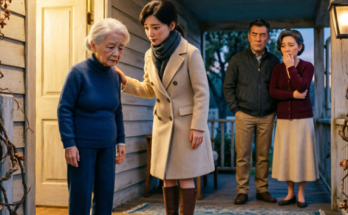
It was late afternoon. I remember because the sunlight was already fading. I opened the door, expecting maybe a neighbor.
Instead, there was a man I had never seen before.
Mid-40s, serious expression, holding a plain envelope.
“I’m here for Thomas,” he said.
My heart dropped. “He passed away.”
The man nodded slowly. “I know. He asked me to deliver this… after his death.”
He held out the envelope.
It had my grandmother’s name on it—in my grandfather’s handwriting.
Everything in the room seemed to freeze.
We called her over.
Her hands trembled as she took it. For a long moment, she just stared at his handwriting… like she was afraid to break something by opening it.
Then, slowly… she did.
Inside was a letter.
I’ll never forget the way her face changed as she read the first line.
Her lips parted. Her breath caught.
And then she whispered, barely audible:
“I’m sorry I didn’t tell you this earlier… there’s something I hid from you for most of my life.”
The room went completely silent.
My grandmother kept reading, her hands shaking more with every line.
Then she stopped.
Looked up at me.
And said something I never expected to hear:
“We need to go somewhere.”
The address in the letter was about two hours away.
A small town none of us had ever been to.
We drove in silence.
No music. No conversation. Just the weight of that letter sitting between us like a living thing.
When we arrived, it wasn’t what I expected.
No mansion. No secret estate.
Just a small, aging house at the end of a quiet street.
White paint peeling.
A porch that creaked.
A single light on inside.
My grandmother hesitated before knocking.
But before her hand even touched the door—
It opened.
A woman stood there.
Late 50s. Tired eyes. The kind of face that looked like it had been waiting… for a very long time.
She looked straight at my grandmother.
And said:
“I know who you are.”
My stomach dropped.
Then she stepped aside.
“You need to know something Thomas was hiding from you. Come in.”
Inside, the house was simple. Neat. Lived-in.
But what hit me immediately—
Photos.
On every wall.
And in every single one…
Was my grandfather.
Younger, yes.
But unmistakably him.
Smiling.
Laughing.
Standing next to… her.
And then I saw something else.
A boy.
In some photos, a teenager.
In others, a grown man.
He had my grandfather’s eyes.
My grandmother’s hand gripped my arm so tightly it hurt.
“What is this?” she whispered.
The woman exhaled slowly.
“My name is Eleanor,” she said. “And… Thomas was my husband too.”
The words didn’t make sense.
They just… didn’t.
My grandmother shook her head immediately. “No. That’s not possible. We were married for fifty-seven years.”
Eleanor nodded.
“And he was married to me… for thirty.”
The room tilted.
I thought my grandmother might collapse.
“He… he had two families?” I said, barely able to form the words.
Eleanor looked at me—not with pride, not with anger… but with something worse.
Resignation.
“He met me during a work trip,” she said quietly. “He told me he was a widower.”
My grandmother made a broken sound.
“And when I found out the truth…” Eleanor continued, “I was already pregnant.”
Silence.
Heavy. Crushing silence.
“He promised he would leave,” Eleanor said. “But he never did. He said he couldn’t hurt you. That you were his life.”
“And what was I?” my grandmother whispered.
Eleanor’s voice cracked.
“The secret he carried.”
We learned everything that night.
Thomas had lived a double life for decades.
Two homes.
Two routines.
Two sets of promises.
He arranged everything carefully—travel schedules, excuses, “business trips.”
He had loved both women.
In different ways.
In the worst possible way.
“He came every Saturday morning here,” Eleanor said softly. “Then went back and brought you flowers.”
My grandmother’s face went pale.
Saturday.
The same day.
The same ritual.
The same man.
Two lives, perfectly divided.
“But why tell us now?” I asked.
Eleanor walked to a small table and picked up another envelope.
“He didn’t want me to tell you while he was alive,” she said. “He was afraid it would destroy you.”
“So he waited until he was gone?” I snapped.
She nodded.
“He said… you deserved the truth. Even if it came too late.”
Before we left, Eleanor showed us one last thing.
A box.
Inside were dozens of letters.
All written by my grandfather.
To my grandmother.
But never sent.
Letters filled with guilt.
Apologies.
Confessions he never had the courage to say out loud.
One line stayed with me forever:
“I loved you honestly… but I lived dishonestly.”
The drive home was different.
Not silent.
But heavier.
Because now we knew.
And knowing… changed everything.
The next Saturday morning came.
We didn’t expect anything.
But when I walked into the kitchen—
There they were.
Fresh flowers.
On the table.
I froze.
“Grandma…?”
She was standing by the window.
Calm.
Stronger than I had ever seen her.
“I bought them,” she said softly.
“For myself.”
That was the day I realized something.
Love isn’t just about what someone gives you.
It’s about what you choose to keep… after the truth breaks everything.
And my grandmother?
She chose to keep the flowers.
But not the illusion.
Ending Line:
Some secrets destroy love…
but the truth reveals who you really are when it’s gone.