I Was Unconscious When The Surgeon Warned Mom I Might Die. She Said, “Call When She Wakes. Tessa Has A Dress Fitting!” A Week Later, My Parents Came For Grandma’s Cabin Keys, But My Apartment Was Empty. Dad Read My Note And Sank To The Floor. “Celeste, Why Didn’t You Tell Me She Needed Blood?”
The surgeon told my mother I might not survive the night. She asked whether I was conscious, then said my sister had a wedding dress fitting she couldn’t miss. While strangers came forward to help save my life, my family went on planning a celebration. I didn’t confront them when I woke up. I asked for the hospital records and started writing down everything that had happened. Two days later, I discovered someone had accessed my bank account while I was unconscious, and the first clue pointed straight back to my mother’s house.
Part 1
The last thing I remember before the crash was a deer standing in the middle of a wet Ohio highway, looking almost insulted that I expected it to move. I was thirty-seven years old, exhausted after a fourteen-hour inspection at a pharmaceutical supplier, and thinking about the leftover chicken in my refrigerator. My headlights caught the animal’s eyes, I turned the steering wheel, and the world became an explosion of glass, metal, and white light. When I opened my eyes again, almost two days had disappeared, and a machine beside my hospital bed was making a noise I couldn’t identify.
My name is Naomi Pierce, and until that accident, I believed I understood the difference between being useful and being loved. I had spent most of my life confusing the two, largely because my mother had taught me that usefulness was the only quality worth praising in me. Celeste Pierce was a woman who could organize a church fundraiser for two hundred people without wrinkling her blouse, but she couldn’t remember the last time she’d asked whether I was happy. My younger sister, Tessa, never had to wonder whether she was loved because our mother made sure the entire neighborhood knew.
When I was twelve, my parents left me with Grandma Edith for a weekend while they took four-year-old Tessa to a children’s beauty competition in Cincinnati. Grandma lived in a cedar-sided cabin surrounded by apple trees, a vegetable garden, and enough weeds to occupy a dozen grandchildren. Wanting to surprise her, I decided to harvest the potatoes before she came home from her weekly grocery trip. By sunset, I had filled nine burlap sacks, torn the tenth, and managed to scatter several pounds of potatoes into a muddy drainage ditch.
My mother arrived wearing pearls and carrying Tessa’s participation trophy, which she displayed before taking off her coat. She looked past the nine full sacks standing neatly beside the barn and pointed toward the ditch. “Good Lord, Naomi, you really are a workhorse, aren’t you?” she said, shaking her head. “All that effort, and you still manage to make a mess.”
Grandma Edith came outside with a dish towel over her shoulder and stood between us. “The child did more work today than most adults manage in a weekend,” she told my mother, but Celeste had already turned away to help Tessa unwrap her trophy. Grandma took me into the kitchen, washed the dirt from my cracked fingernails, and made me sit down to eat peach cobbler before I could apologize again. “Honey, if somebody only notices the potatoes you dropped, stop carrying their sacks,” she said. I remembered those words for twenty-five years without once following her advice.
After Grandma died, she left me the cabin and its twelve acres in a properly executed will. My mother began referring to it as “the family place” before the funeral flowers had wilted, and nobody corrected her except me. Dad, Martin Pierce, preferred to keep the peace, which usually meant letting Celeste finish whatever she had started. Growing up, I thought his silence was gentleness; adulthood had gradually taught me how expensive that gentleness could become.
I built a career around noticing the things other people overlooked, eventually becoming the director of quality assurance at a pharmaceutical manufacturing facility outside Columbus. My department investigated production problems, audited suppliers, and made sure products couldn’t leave the plant until every discrepancy had been properly addressed. I wasn’t popular with managers who preferred shortcuts, but the people working under me knew I’d never ask them to sign their names to something they couldn’t defend. My favorite phrase was simple: “If there’s no record, there’s no proof.”
Outside work, my life was considerably smaller, although I liked it that way. I owned a modest one-bedroom condominium, drove a seven-year-old Subaru, and had saved $126,000 toward a farmhouse where I could finally keep a horse of my own. My closest friend, Hannah Reed, managed a riding stable near the Indiana border, and she’d spent eighteen years trying to convince me that buying a horse before buying the property made more sense. She was the person who taught me to ride at nineteen, holding the reins while I shook so badly that my boots rattled against the stirrups.
“Hold steady,” she’d said that first afternoon, standing beside a patient gray gelding named Winston. “I’ll take care of my end, and you take care of yours.” It became our private expression, something we said whenever one of us faced a difficult decision, a broken-down car, or an ordinary miserable Tuesday. Hannah had been present for my first apartment, my promotion, Grandma Edith’s funeral, and every birthday my family managed to forget. Yet when I filled out my emergency contact information at work, I listed my mother because I thought that was what daughters were supposed to do.
Nine days before the accident, my family invited me to Sunday dinner, which should have warned me something was coming. Tessa and her fiancé, Grant Bell, had spent the summer planning a wedding that seemed determined to bankrupt everyone within driving distance. Grant sold commercial insurance, wore expensive watches, and had a remarkable ability to make financial difficulties sound like opportunities. He’d been engaged to my sister for eleven months and had already asked me twice whether Grandma’s land could be developed.
That Sunday, he arrived carrying an architectural brochure for a riverside condominium listed at $410,000. Tessa had fallen in love with its enormous windows, marble countertops, and a kitchen island she described as “the heart of our future family.” Together, she and Grant had $284,000 available through savings and help from his relatives, but the seller wanted a cash closing before leaving Ohio. I recognized the missing amount before my mother reached for her second glass of wine.
“Naomi has more than enough sitting in that savings account,” Celeste said, as casually as if she were offering my last dinner roll. Tessa leaned toward me and explained that Grant expected a substantial promotion by Christmas, so anything I contributed would come back quickly. Grant opened a spreadsheet on his phone showing projected bonuses, but there was no written loan agreement, no collateral, and no plan for what would happen if the promotion never materialized. When I asked those questions, his expression changed from friendly to faintly offended.
“I’m not a stranger asking you for money,” he said. “We’re about to be family.”
“Then you should understand why I’m not lending my entire savings without security,” I answered. “Actually, I’m not lending it at all.”
My mother set down the serving spoon hard enough to chip the edge of her favorite platter. She wanted to know why a single woman needed a farmhouse, whether I intended to become an eccentric old lady surrounded by animals, and how I could deny my little sister an opportunity to start her marriage properly. Tessa stared at the tablecloth while Grant pressed his lips together, and Dad continued cutting his roast beef into pieces so small they looked like something prepared for a toddler. I explained that I’d spent eight years building those savings and wasn’t going to erase them because somebody else had chosen a property they couldn’t afford.
Celeste smiled then, which was worse than shouting. “Well, I suppose Tessa’s wedding guests will still enjoy the barbecue at our cabin next month,” she said. I reminded her that Grandma Edith had left the cabin to me, and she waved away the correction without looking up. Grant’s eyes moved toward mine, and I caught something in his expression that made me think the cabin had already been included in a plan nobody had discussed with me.
I left before dessert, although leaving my mother’s house without helping clean the kitchen felt more rebellious than refusing the loan. Halfway home, my phone rang with a message from Tessa: “Please don’t punish me because you don’t like Grant.” I parked beneath a gas station awning and stared at the sentence for several minutes before answering that I loved her but couldn’t finance the condo. She sent back a single thumbs-up.
The following week was consumed by a supplier audit involving missing inspection records and mislabeled containers. By Tuesday afternoon, I’d found enough inconsistencies to stop an entire production shipment, and I was too tired to enjoy being right. Rain began before sunset, turning the rural roads black and glossy beneath the headlights. At 10:31 p.m., I sent Hannah a voice message telling her I was on my way home and complaining that the local deer apparently considered the highway their personal living room.
She answered with a photograph of a shaggy little foal born that morning and the words, “Hold steady. Come meet this troublemaker Saturday.” I was smiling when I rounded the bend near a line of dark trees. The deer appeared from nowhere, I jerked the wheel, and the tires lost their grip on the wet pavement. I remember the guardrail coming toward me and then the terrible sensation of the road disappearing beneath the car.
I learned later that a truck driver stopped, called 911, and stayed beside the wreckage until rescuers cut through the twisted driver’s door. My spleen had ruptured, my liver was bleeding, several ribs were fractured, and my left wrist had been crushed against the steering wheel. The emergency team took me to a regional hospital where a surgeon named Dr. Adrian Patel ordered immediate surgery. He also made a telephone call to the woman listed as my closest family member.
At 11:41 that night, my mother was told that I might not survive the operation and that the hospital urgently needed help locating eligible O-negative blood donors to replenish its dangerously limited supply. She asked whether I was awake, learned that I wasn’t, and said something the surgeon later recorded almost word for word. “She’s worked herself into the ground again,” Celeste told him. “Call when she wakes up. Tessa has a dress fitting in the morning.”
My mother hung up, switched off her bedroom lamp, and went to sleep beside a man whose blood donor card identified him as O-negative.
Part 2
Hannah later told me that she’d answered a call from my phone shortly after midnight, expecting to hear me complain about the weather. Instead, a nurse named June Alvarez explained that I’d been in a serious accident and was being taken into emergency surgery. Hannah asked which hospital, wrote the address on the back of an envelope, and left her apartment wearing sweatpants, work boots, and a winter coat she hadn’t bothered to zip. She drove through nearly two hours of hard rain and thick fog, calling me repeatedly even though she knew I couldn’t answer.
A tractor-trailer had jackknifed across the main highway, forcing her onto a county road she hadn’t used in years. At one point, she pulled into a closed service station because the fog was so dense she couldn’t see the road markings, and she admitted she considered waiting for daylight. Then she remembered how I once drove ninety miles after her father died because she couldn’t bear to be alone in the house. She turned around, found another route, and kept driving.
When she finally reached the hospital, a television in the waiting room was advertising kitchen appliances to three empty chairs. Hannah found the surgical desk, identified herself as my emergency support person, and asked whether any relatives had arrived. Nobody had. The receptionist said my mother had been contacted, but there was no note indicating she intended to come.
Hannah spent the next two hours watching hospital employees pass through swinging doors while she drank coffee that smelled like burnt cardboard. She called my parents twice, getting voicemail both times, then sent my sister a message explaining that I was critically injured. Tessa replied almost forty minutes later, asking whether she needed to cancel anything scheduled for Wednesday. Hannah typed a response, deleted it, and called her instead.
“Tessa, your sister could die,” she said. “I’m not asking about your calendar.”
“I know, and I’m upset,” Tessa answered. “But Mom said the hospital has everything under control.”
At 3:38 in the morning, Dr. Patel came through the double doors with a paper cup in his hand and the exhausted expression of a man who had been working against a deadline he couldn’t negotiate. The surgical team had removed my damaged spleen, repaired the bleeding in my liver, and stabilized me after significant blood loss. I had received emergency transfusions, including O-negative red blood cells, from the hospital’s existing inventory. I was alive, but I needed intensive care, and the hospital was still working to replenish the blood products it had used.
“Are you family?” Dr. Patel asked Hannah.
“Not legally,” she told him. “But I’m the person who’s here.”
He looked toward the empty waiting room before explaining that the next twenty-four hours would be difficult. My injuries were extensive, my breathing needed mechanical support, and complications remained possible. Hannah listened without interrupting, then asked for the blood bank’s telephone number. She knew more people who would inconvenience themselves for an injured horse than my mother knew people willing to inconvenience themselves for me, and she intended to make use of every one of them.
By breakfast, Hannah had contacted most of the riding community in western Ohio and eastern Indiana. At eleven, seven volunteers had appeared at the blood donation center, some eligible to donate immediately and others willing to complete the screening process or be contacted when needed. A riding instructor named Brooke left her own daughter’s birthday breakfast early, while a retired firefighter drove forty miles after seeing Hannah’s message shared online. One of the stable hands, a six-foot-two young man named Owen, became so pale during screening that a nurse made him lie down before anyone collected a single drop.
When Hannah told me that story afterward, she laughed until she cried. She said Owen had insisted he was fine while lying flat on the floor, one hand raised as though volunteering to answer a question. The donors’ contributions couldn’t be handed straight from their arms to mine, but the blood center arranged compatible donations, replenishment efforts, and testing through its normal procedures. Those strangers helped ensure the hospital could continue caring for patients who needed what I had nearly exhausted.
At 11:56 that same morning, my mother posted photographs of Tessa standing in a bridal salon beneath a crystal chandelier. My sister wore a white satin gown with tiny buttons running down the back, and Celeste stood beside her, looking proudly at the camera. The caption read, “My beautiful girl is almost ready for her big day.” Hannah saw it while sitting outside the ICU, her phone balanced on a paper cup of vending-machine soup.
She took a screenshot because something in her already understood that I might one day need it. A woman from our hometown commented beneath the photograph, asking whether Celeste’s older daughter was all right after an accident. My mother replied that I was resting comfortably and that there was no reason for anyone to worry. At that precise moment, I was unconscious, attached to a ventilator, and being watched for signs of further bleeding.
Meanwhile, Grant had found a way to make himself useful to my family. My mother had called the hospital and asked whether someone could collect my belongings, explaining that she was worried about my purse and expensive phone disappearing. Grant arrived that evening, presented identification, and signed a property-release log after staff accepted the arrangement. He left carrying a plastic bag containing my wallet, keys, bank cards, and phone, without making any effort to see me.
That was the first decision he made which left a trail he couldn’t erase. The second came several hours later, when he discovered my phone still operated with the same four-digit code I’d used since high school. My mother had selected that code herself when I was fourteen, insisting I use her birthday so I’d never forget it. Over the years, I’d changed phones, jobs, apartments, and passwords, but somehow kept those four ridiculous numbers for the device and, through a different login process, as part of my banking access.
I hadn’t given Celeste permission to enter my accounts, but she knew enough about my habits to help someone who wanted to try. My father later testified that he heard her whispering numbers into the telephone from the kitchen shortly before two on Thursday morning. When he appeared in the doorway, she told him she was helping Grant confirm a payment connected to the wedding. He asked no further questions, which was the kind of mistake he’d spent an entire marriage making.
At 1:58 a.m., $60,000 left my savings account. Five minutes later, another $66,000 followed, both transfers going to an account controlled by my mother, which had previously received small family reimbursements from me. Someone using my phone had approved the verification requests, and the transactions slipped through the bank’s existing transfer settings before the unusual activity was flagged. While the money moved, I remained sedated in intensive care, unable to open my eyes, much less authorize six figures in payments.
I woke properly Thursday afternoon with Hannah holding a damp washcloth against my forehead. The first thing I asked was whether my inspection report had been submitted, because apparently part of my brain still believed unfinished paperwork was the greatest threat to my survival. Hannah told me the factory had everything covered, and then she explained the accident in short, careful sentences. She didn’t mention my mother until I asked directly.
“Did Mom come?”
Hannah looked at the floor, then at the monitors, and finally back at me. “No,” she said. “Dr. Patel called her before surgery. She knew how bad it was.”
I wanted to ask what my mother had said, but speaking felt like dragging sandpaper down my throat. Hannah told me anyway, not cruelly, but because she’d always believed I deserved the truth even when it made both of us uncomfortable. When she repeated the part about Tessa’s dress fitting, I stared at the white ceiling tiles and concentrated on counting the small holes in them. There were thirty-six above my bed, and I counted them seven times before I trusted myself to speak.
“Where’s Dad?” I finally asked.
“Honey, I don’t know.”
The next morning, I called my mother using Hannah’s phone. Celeste answered on the fourth ring and greeted me with, “Well, there’s my stubborn girl,” sounding as though I’d merely recovered from a seasonal cold. She said she’d known I would be fine, complained about the stress I’d caused, and explained that Tessa had needed additional alterations because the first fitting had run late. Not once did she ask whether I was in pain.
“Mom, did you understand that I could have died?” I asked.
“Of course I understood, Naomi. But the doctor said you were in capable hands, and there wasn’t anything I could have done. Besides, Hannah was there, wasn’t she?”
I looked across the room at Hannah, who was carefully peeling an orange with the small knife from her lunch tray. I thought about my father wearing a blood donor pin every Sunday and my mother deciding he didn’t need to know his own daughter required help. For the first time, I didn’t try to make excuses for her. I ended the call without arguing and asked Hannah to bring me a notebook.
There was one other matter I needed to address before I could sleep. I wanted to check whether the automatic payment for my condominium had cleared, so I borrowed Hannah’s phone and called my bank when the mobile application refused to recognize the new device. After confirming my identity, I asked the representative to read back my recent transactions. She paused halfway through the list and asked whether I recognized two large transfers made early Thursday morning.
“What transfers?” I asked.
She told me the amounts, the time, and the receiving account, and for a moment I thought my injuries must have affected my hearing. My entire farmhouse fund was gone, transferred while I was under anesthesia to a bank account belonging to Celeste Pierce. The representative explained that the transfers appeared to have been authorized from my registered device and that an investigation would be required. I told her to freeze every available access method, then called my mother again.
“Someone transferred my savings to your account,” I said. “Did you know about it?”
Celeste didn’t sound surprised. “Naomi, we’ve already discussed this. You agreed to help Tessa, and I don’t appreciate you pretending otherwise.”
“I was unconscious when those transfers happened.”
“Then perhaps you don’t remember what you told us before the accident.”
I hung up before she could finish, because I finally understood that my mother wasn’t merely indifferent to what had happened to me. She was counting on my inability to prove what had happened while I couldn’t speak.
That afternoon, my colleague Avery brought me a replacement phone after helping me work with the carrier to secure my number. Once my messaging account restored its backed-up conversations, an unfamiliar audio message appeared among the notifications. It had been sent from my mother’s account to my number during the hours I was unconscious. I tapped it, heard Celeste say, “Grant, use my birthday, zero-seven-zero-three, and finish it before she wakes up,” and felt the last remaining piece of my childhood trust break without making a sound.
Part 3
By Friday evening, I had given the bank a formal fraud statement and spoken to a police officer who seemed uncertain whether he was dealing with theft or a family argument that had become unnecessarily complicated. I explained that I’d been unconscious on a ventilator when the transfers were made, that I hadn’t given anyone permission to access my phone, and that my mother had received the entire amount. The officer asked whether we’d argued about money recently, and I described the Sunday dinner in enough detail to make him put down his pen. He promised that a detective would contact me after reviewing the records.
Avery helped me preserve the audio message in several places, including a secure folder my mother couldn’t reach. She also arranged for the bank to send me written transaction confirmations and notified our company’s security department that my work-issued telephone number had potentially been compromised. I appreciated how little she asked about the personal details, especially when she handed me a folder and said, “You’re always telling us to separate what we know from what we assume.” Until then, I hadn’t realized how much I needed someone to speak to me as though I was still competent.
Hannah brought a small notebook from the hospital gift shop, and I began constructing a timeline. I wrote down the accident, my admission, the operation, the phone calls, and the transfers, marking anything I couldn’t verify with a question mark. My left wrist was immobilized, my right hand trembled after a few minutes, and concentrating made the numbers swim across the page. Still, writing gave me something to do besides stare at the door and wonder why nobody from my family had walked through it.
Shortly after midnight, Hannah went down to her car for a charging cable and the clean clothes she’d been carrying around since Wednesday. I was half asleep when someone entered my room, and I assumed it was the nurse until I saw a man’s blue shirt near the foot of my bed. Grant stood beside me holding his phone, wearing the tense, irritated expression he used when a waitress made a mistake with his order. He leaned close enough that I could smell peppermint gum on his breath.
“Naomi, I need you to clear something up,” he whispered. “Tell the camera you gave your mother that money.”
I tried to reach for the call button, but he’d moved it onto the table beyond my right hand. He lifted his phone, began recording, and repeated that I needed to confirm the transfer before I created an unnecessary legal problem for everyone. My chest hurt when I inhaled, and my thoughts kept slipping apart, but I understood enough to know he wanted a statement he could use against me. When I shook my head, he lowered his voice until it became almost gentle.
“Come on. You told Celeste she could have it. Just say that.”
I remember trying to tell him to leave, but my mouth was so dry that what emerged barely resembled words. He moved the phone closer, his other hand gripping the edge of the bed, and told me that Tessa couldn’t endure another family scandal before her wedding. Something in his face frightened me more than his anger because he seemed completely convinced that my wishes no longer mattered. He wasn’t visiting an injured woman; he was fixing a problem.
Hannah came through the door carrying her jacket, saw the phone in his hand, and stopped so abruptly that the charging cable fell to the floor. “Get away from her,” she said, moving toward the bed. Grant claimed my mother had asked him to check on me, but Hannah pointed to the screen and demanded to know why he was recording. He shoved her with his shoulder as she reached past him for the call button, and she struck the metal stand holding my intravenous equipment.
The stand toppled, pulling a line from my hand and sending the pump’s alarm shrieking through the room. Hannah grabbed the tubing before it could drag across the floor, and Grant tried to push past her, catching her above the eye with the hard corner of his phone. Blood ran down her cheek, bright against the pale fabric of her shirt. He was gone before the first nurse reached my doorway.
Hannah pressed a towel against my bleeding hand while June checked the equipment and called for additional staff. A security officer took our statements, noting that a man matching Grant’s description had left through the rear stairwell at 1:58 a.m. Hannah needed four stitches above her eyebrow, but she kept insisting that someone stay with me until she returned. I was furious with Grant, terrified by how easily he had reached me, and almost unbearably ashamed that my friend had been injured while protecting me.
When she came back, she sat beside the bed with a strip of medical tape covering her stitches. “Don’t apologize,” she told me before I could speak. “You didn’t invite that idiot into your room.” I reached for her hand, and she held mine carefully, avoiding the bruised fingers. For most of my life, I’d been the person who solved everyone else’s emergencies, and I had no idea how to receive that kind of loyalty without feeling that I owed something in return.
The following morning, Detective Elena Morales arrived with a folder under her arm. She listened while I explained the unauthorized transfers and Grant’s visit, then asked Hannah to describe the assault separately. Morales was a practical-looking woman in her forties who didn’t interrupt or offer comforting assurances she couldn’t keep. She explained that the financial investigation would require bank records, device information, and statements from everyone involved, but that the hospital incident was already supported by witnesses and medical documentation.
“Your mother is going to say you authorized the transfers,” she warned.
“She already has.”
“Then we’re going to need more than your word against hers.”
I handed her the saved audio message, the account information, and the first pages of my timeline. She listened to Celeste’s voice telling Grant to finish before I woke up, and her expression tightened slightly. “That’s useful,” she said, writing something in her notebook. It was the first time anyone outside my small circle had looked at the evidence without immediately asking whether I might have misunderstood my own mother.
By Sunday morning, Celeste had already begun preparing a competing version of events. A cousin sent me a screenshot of a Facebook post in which my mother requested prayers because her older daughter was experiencing “confusion and emotional instability” after surgery. She described me as frightened, heavily medicated, and vulnerable to people who might influence me for financial reasons. Beneath the post, family acquaintances reassured her that mothers always knew their children best.
Tessa called shortly afterward and asked why I’d sent the police after Grant. She said he had been trying to help me resolve a misunderstanding, and that Hannah had become violent for no reason. I told her Hannah had four stitches in her face and that Grant had entered my room after midnight to record a statement I had refused to give. Tessa was silent long enough that I thought the call had disconnected.
“Mom said you asked him to come,” she finally whispered.
“Would you have believed me if I’d told you otherwise?”
She didn’t answer that question. Instead, she began crying and said she didn’t know how she was supposed to enjoy her wedding when everyone was determined to destroy it. I felt the old urge to comfort her, the reflex that had made me surrender birthday plans, vacation days, and countless weekends whenever Tessa was unhappy. But my chest tightened when I tried to take a deep breath, and I remembered that I’d almost died before the wedding even happened.
“You’re allowed to be upset,” I told her. “You’re not allowed to make me responsible for what Grant did.”
When the call ended, I expected to feel guilty. Instead, I felt an unfamiliar emptiness, as though a lifelong obligation had quietly expired. I put my phone down and watched Hannah sleep in the visitor’s chair, her injured face turned toward the window. For the first time, I began to understand that surviving the accident might be the simplest part of getting my life back.
Later that afternoon, June told me a physician had requested a formal assessment of my decision-making capacity after my mother raised concerns about my mental state. I understood what the request meant, but I also understood what Celeste intended to accomplish with it. She had already told the bank that I agreed to the transfers, told my sister that Hannah was dangerous, and told our neighbors that I couldn’t think clearly. Now she wanted a medical record suggesting the same thing, and I began to wonder how many people would believe her before anyone bothered to check.
Part 4
On Sunday afternoon, Hannah reluctantly left the hospital for a regional youth riding competition her students had spent six months preparing to attend. She’d tried to withdraw the entire team, but I reminded her that children who had practiced every weekend deserved their chance, and that I was surrounded by trained medical professionals. Before leaving, she wrote “HOLD STEADY” across my cast with a blue marker, then placed her telephone number beneath it. I promised to call if anything changed, although neither of us imagined how soon that promise would matter.
The hospital had moved me from the intensive care area to a shared rehabilitation room that morning. My roommate, Leona Brooks, was a seventy-eight-year-old retired dairy farmer recovering from a broken hip, with opinions about everything from hospital coffee to the proper way to stack hay. She snored like a freight train, watched game shows at an unreasonable volume, and refused to let anyone refer to her as elderly. After hearing about my accident, she announced that I looked too skinny to survive another decent windstorm and started giving me half her desserts.
At three o’clock, Grant walked into the room carrying a vase of white chrysanthemums and a brown envelope. He had apparently entered through a different ward entrance before the hospital completed the visitor restrictions requested after the first incident. Leona looked at him over her glasses and asked whether he had mistaken us for a funeral home. He gave her a strained smile, set the flowers on my nightstand, and pulled a chair close to my bed.
“I don’t want any trouble,” he said. “I just need you to sign something.”
Inside the envelope was a typed declaration stating that I had voluntarily given my mother $126,000 for Tessa’s condominium purchase and had no further financial claims against anyone involved. It also asked me to withdraw the police complaint and confirm that Grant had only been trying to assist me during his previous visit. He’d left enough space at the bottom for my signature, the date, and a witness. I recognized the careful wording of someone who expected the document to be scrutinized later.
“I’m not signing that,” I said.
Grant sighed and explained that the police were being difficult about the transfers and the condominium closing was only days away. He said Tessa hadn’t stopped crying, Celeste’s blood pressure was becoming a concern, and everyone would suffer if I continued behaving irrationally. I asked him to leave, but instead he put a pen in my right hand and attempted to curl my fingers around it. The pen fell onto the blanket when I opened my hand.
“You’re making this harder than it needs to be,” he said.
He grabbed my left forearm above the cast, squeezing hard enough that pain shot through my wrist and into my shoulder. I cried out, and he leaned closer, telling me that my mother had already arranged for someone to evaluate whether I was capable of handling my own affairs. He said a confused woman who lived alone and spent her free time with stable workers would have difficulty convincing anyone that her respectable family had robbed her. The expression on his face was so cold that I knew asking politely wouldn’t make him leave.
I tried to reach the call button, but he blocked my movement, and fear swallowed the carefully organized thoughts I’d been holding together since waking up. I twisted toward the other side of the bed, intending to get far enough away to shout for the nurses at their station. My weak legs slid off the mattress before I realized they couldn’t support my weight, and I fell heavily against the floor, dragging the bedside stand down beside me. A sharp tearing sensation went through my abdomen, followed by a spreading warmth beneath my hospital gown.
Leona woke at the crash, took one look at Grant standing over me, and began yelling with a force I wouldn’t have believed possible from a woman with a broken hip. She swung her cane toward his legs, forcing him back as she shouted for help. Nurses arrived within seconds, followed by an orderly and security staff who prevented Grant from leaving. He insisted that I’d fallen by myself, which was technically true, until Leona began describing exactly what had happened beforehand.
“That man grabbed her broken arm,” she announced. “I saw the whole thing, and don’t you dare tell me I’m confused.”
June photographed the fresh finger-shaped marks forming above my cast, collected the unsigned declaration, and recorded the names of everyone present. Two surgical staples had torn loose during my fall, requiring treatment and delaying my recovery. Dr. Patel examined the wound with such concentrated silence that I knew he was angrier than he wanted to show. When he finished, he told me my body couldn’t continue absorbing injuries simply because other people refused to respect the word no.
Grant was removed from the property, and the hospital implemented a formal ban against further visits. Leona demanded that her statement include the fact that she had seen his hand around my arm, then asked June to find her reading glasses so she could review what she’d signed. I lay awake afterward, looking at the bruises while my stomach throbbed, and felt a level of humiliation I hadn’t experienced since childhood. But underneath the humiliation was a clearer feeling: every attempt to silence me was creating another witness.
The next morning, a psychiatrist named Dr. Samuel Price arrived to evaluate my awareness and decision-making ability. He asked routine questions about the date, the hospital, my medical condition, and my understanding of the financial dispute, then listened while I explained why I’d refused to sign Grant’s declaration. I showed him my notebook, distinguishing direct observations from information supplied by Hannah, the hospital, and the bank. He spent nearly an hour with me before concluding that I was fully oriented, understood my choices, and showed no evidence that my accusations arose from confusion or delusional thinking.
Leona insisted on knowing whether she’d passed the examination too. Dr. Price told her he hadn’t been evaluating her, and she replied that this was unfortunate because she enjoyed proving doctors wrong. For the first time since my accident, I laughed without immediately feeling guilty about it. The pain reminded me to stop almost at once, but that small moment of humor restored something I’d thought was gone.
Later that day, I requested copies of my medical records through the hospital’s patient services office. I sat in bed reading operative reports, nursing notes, medication administration records, and documentation of both violent visits. Eventually, I reached Dr. Patel’s first telephone note, entered at 11:41 p.m. on the night of my accident. He had documented my mother’s refusal to come, including her statement that Tessa had a dress fitting.
Reading those words was different from hearing Hannah describe them. On the page, my mother’s response wasn’t part of an argument that somebody might misremember; it existed beneath my medical record number, beside an official timestamp, written by a physician with no reason to exaggerate. He had also noted that the family was asked to help identify suitable donors because of the blood bank’s shortage. I stopped reading when I realized he’d specifically mentioned the urgency of finding O-negative donors.
My father had that blood type. He’d donated for decades, displaying his donor recognition pin at church dinners and community breakfasts, and my mother knew it as well as I did. If someone had told him his daughter was bleeding internally and compatible donors were needed, I had no doubt he would have driven to the hospital. But Celeste had apparently decided that information belonged to her alone.
That evening, my mother called from an unfamiliar number and announced that she and Dad would be stopping at my condominium the next day. Grant’s relatives were arriving for the wedding, she explained, and she needed the keys to Grandma Edith’s cabin so they could stay there comfortably. She added that the condominium purchase was proceeding despite my accusations and that I should stop embarrassing the family before I permanently damaged my relationship with Tessa. I asked whether she’d told my father about the surgeon’s request for blood donors.
“Your father knows everything he needs to know,” she replied. “And I don’t appreciate you dragging him into your drama.”
For years, I’d believed that my mother controlled our family by speaking the loudest. That evening, I began to understand that she also controlled it by deciding what everyone was allowed to know. I called Hannah, then Avery, and asked them to help me move everything out of my condominium before my parents arrived. I was no longer willing to live somewhere my mother could enter with a spare key and take whatever she believed belonged to her.
Hannah borrowed the riding center’s enclosed equipment trailer, and six friends packed my apartment while I directed them from the hospital through a video call. Owen carried my bookcases downstairs, Brooke wrapped my dishes in old newspapers, and Avery collected the files containing Grandma Edith’s deed, my financial records, and my personal documents. By nine that evening, the place was empty except for dust along the baseboards and the pale rectangles where pictures had hung. Watching the furniture disappear into a trailer made my throat tighten, but every box carried out felt like a decision I’d finally made for myself.
I wrote a letter that night, not an emotional plea but a precise account of what had happened. It began with the surgeon’s call, identified the donors who had come when my family didn’t, and continued through the unauthorized transfers and Grant’s attempts to force my cooperation. I included the exact time I had been unconscious and the exact amount my mother had received. Beneath those facts, I addressed my father directly, telling him that the hospital had requested O-negative donors while he sat at home unaware.
At the bottom, I wrote, “Dad, I don’t know what Mom told you, but I know what she didn’t tell you. I needed the kind of blood you’ve spent your life giving to strangers. I survived because other people came when they were called, and I cannot keep pretending silence is the same thing as kindness.” I ended by informing them that my emergency contacts, financial access, and living arrangements had been changed. I didn’t ask either of them to apologize, because an apology was no longer something I trusted them to give honestly.
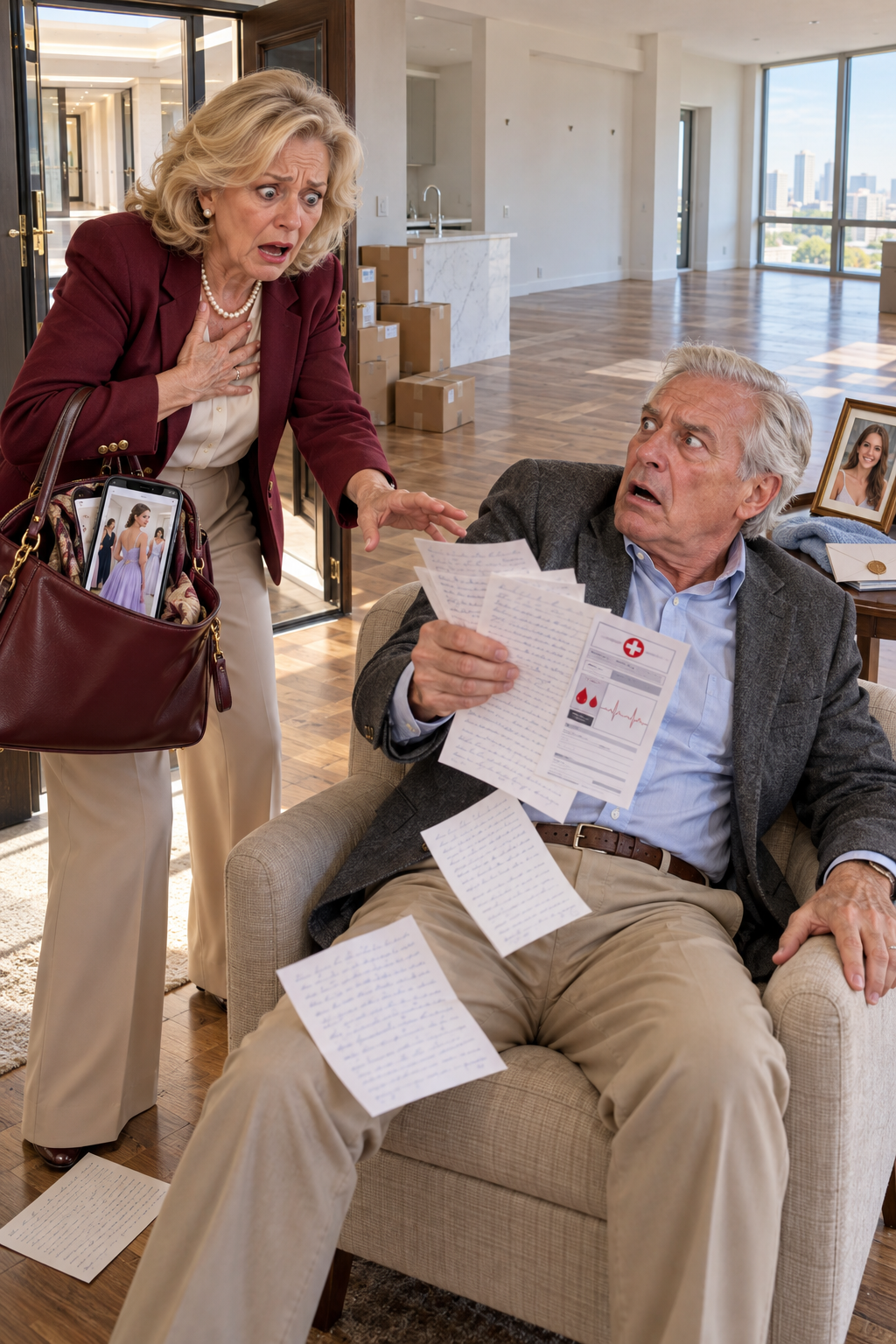
Hannah left the letter on the empty windowsill the following morning. My mother arrived with her spare key, expecting to collect the cabin keys and perhaps remind me that everything in our family eventually returned to her control. Instead, she found bare floors, silent rooms, and a single folded piece of paper beneath the sunlight. Dad picked it up first, and what he read would finally force him to ask a question he’d spent thirty-seven years avoiding.
Part 5
I didn’t know exactly what happened inside my empty condominium until Dad described it several days later. He said he’d expected to find evidence that I’d been influenced by Hannah, perhaps some dramatic letter demanding an apology or threatening to cut off the family. Instead, he found a report listing dates, times, medical procedures, bank transactions, and the names of people who’d witnessed what happened. He read the section about my surgery twice before looking at my mother and asking whether the hospital had requested O-negative donors.
Celeste apparently tried to change the subject by reminding him that they still needed the cabin keys. Dad asked again, and when she admitted that the surgeon had mentioned blood donors, he demanded to know why she hadn’t woken him. She told him he’d only have become upset and that the hospital had eventually found what it needed anyway. My father sat down against the wall because his legs felt too weak to carry him, clutching the letter he’d just read.
For forty years, Dad had given blood at community drives, church-sponsored donation events, and regional hospitals. He’d always said donating was the easiest way an ordinary person could help save a life without knowing whose life it might be. Now he knew that his own daughter had nearly died while he slept a short drive away from a telephone that nobody had bothered to use. My mother reportedly accused him of being melodramatic and reminded him that Tessa’s wedding was less than a month away.
The next morning, my phone displayed a message from him that consisted of only six words: “I didn’t know about the blood.”
I read it several times, waiting for something else to appear. I wanted to hear that he’d asked why nobody had come to the hospital, why Grant had taken my possessions, or why our family’s money problems had somehow become mine to solve. Instead, he’d chosen the one piece of information that absolved him from deliberate neglect. I understood that he’d been deceived about the donors, but I also knew he hadn’t called me or visited after learning about the accident.
“I believe you,” I finally wrote back. “But you knew I was hurt.”
His reply arrived almost an hour later. “I know.”
That was the closest my father had ever come to acknowledging that his silence could hurt somebody. I didn’t answer, and he didn’t send another message that day. Hannah suggested that I leave the conversation alone until I could stand without assistance. For once, I accepted advice without attempting to fix the person who’d disappointed me.
Meanwhile, Tessa and Grant were preparing to close on the condominium. My sister continued sending messages insisting that our mother believed I’d agreed to help, although her certainty had begun to sound rehearsed. She asked whether I could simply let the transaction go through and settle the disagreement later. I told her there was no disagreement about what I’d authorized, only a theft she was willing to benefit from.
“Did you know Grant took my phone from the hospital?” I asked her.
“He said Mom asked him to protect your things.”
“And did he explain why he needed my banking information?”
Tessa began crying and told me I was asking questions she couldn’t answer. I realized she was finally encountering the part of our family’s arrangement I’d endured all my life: she could remain comfortable only as long as she refused to examine how that comfort had been provided. I didn’t think she’d helped plan the theft, but I no longer believed innocence excused someone who chose not to look at evidence. I asked her to postpone the closing until the investigation was complete, and she said Grant wouldn’t agree.
Detective Morales called Wednesday afternoon with an update that left me staring at the window long after we’d hung up. The bank had confirmed the receiving account, but my mother had withdrawn most of the transferred funds in cash before the formal fraud restriction took effect. The police were seeking additional records, and Grant’s attorney had already contacted the department, disputing that anything criminal had occurred. Morales warned me that financial investigations moved more slowly than real estate transactions.
I opened the condominium listing Tessa had sent me before the accident. The owner was a retired judge named Judith Keene, a widow in her seventies who was selling the property to move closer to her grandchildren in North Carolina. Her phone number appeared in a public listing associated with the sale, and I called it before I could lose my nerve. When she answered, I identified myself and explained that I believed part of her purchase price consisted of money transferred without my permission while I was unconscious in intensive care.
Mrs. Keene listened without interrupting. Then she asked whether I’d reported the matter to the police, whether I possessed written evidence, and whether the buyers had been informed of the dispute. Her questions reminded me of the audits I’d conducted at work: she was trying to determine which facts could be verified independently. When I told her I had bank statements, medical records, and a recording involving the buyers, she was silent for several seconds.
“I’m not going to decide who’s telling the truth over the telephone,” she said. “But neither am I going to proceed with a questionable closing without hearing the facts. Bring what you have tomorrow morning, and I’ll ask the title representative to attend.”
That night, Hannah helped me assemble a binder divided into sections with labeled tabs. Avery had printed my banking records and telecommunications logs, while June provided the properly released hospital documentation describing both assaults. I included the psychiatrist’s assessment, the property-release record showing Grant had collected my phone, and the voice message from Celeste. I also copied the police report and the signed statement from Leona, who had added a handwritten note declaring that she was perfectly capable of recognizing a bully.
Hannah watched me work until almost midnight, occasionally bringing water or reminding me to stop when my hand began trembling. She asked whether I genuinely expected Grant to admit anything in front of a retired judge. I told her I didn’t need a confession to establish that the money was disputed, but I needed the seller and title company to know the circumstances before they accepted it. Hannah nodded, then placed a small photograph of the blood donors inside the front cover.
“That one isn’t evidence of a crime,” I pointed out.
“No,” she said. “It’s evidence of who showed up.”
Dr. Patel approved my discharge Thursday morning with strict instructions about rest, wound care, and avoiding physical strain. He reminded me that living without a spleen required ongoing precautions against infection and that further injury could undo weeks of healing. I promised to follow every instruction, although he looked unconvinced when I mentioned attending a real estate meeting that same afternoon. Hannah arranged a wheelchair and drove me to the judge’s building, where the elevator was so narrow we had to turn the chair sideways to enter.
Everyone was already gathered when we arrived. Tessa stood beside Grant wearing a cream-colored sweater I’d given her for Christmas, while Celeste occupied the center of the room as though she’d organized the meeting herself. Dad stood near the window with his hands clasped behind him, staring down at the street. A large garment bag containing Tessa’s wedding dress hung over the back of a dining chair, and I recognized the gold ribbon tied around its zipper.
My mother saw the wheelchair first. Her expression flickered with something that might have been surprise or embarrassment before settling into irritation. “Really, Naomi?” she said. “You couldn’t give your sister one peaceful day?”
Mrs. Keene asked Celeste to sit down and reminded everyone that the title representative had a legal responsibility to address questions about the origin of the purchase funds. She also explained that the scheduled closing would not proceed until those questions were resolved. Grant objected that the sale was an all-cash transaction and claimed I was attempting to sabotage it out of jealousy. I placed my binder on the table, opened it to the first section, and asked for ten minutes.
I showed the bank statements documenting my savings over eight years, then the two transfers that emptied the account. Mrs. Keene read the dates aloud, and I opened the hospital records showing that I’d been sedated and mechanically ventilated at those exact times. The title representative leaned forward to examine the entries, while Tessa kept looking from my face to the numbers on the page. My mother interrupted twice to insist that I’d agreed to make a gift before the accident.
“Then perhaps someone can explain why the verification codes were used while I couldn’t communicate,” I said.
I played Celeste’s recorded message, and her voice filled the room, clear and unmistakable. The judge asked whether those were her words, and my mother claimed she’d only been helping Grant complete a transaction I’d already approved. Dad turned from the window and looked directly at her. For the first time in my life, she seemed uncertain what he’d do next.
Grant abruptly produced his phone. “Enough,” he said, scrolling through his recordings. “I have proof from Naomi herself.”
He played a short video showing me pale and half conscious in my hospital bed, his voice urging me to confirm that I’d given Celeste the money. My own voice emerged as a weak, broken murmur, barely audible beneath the equipment. Grant paused the recording and announced that I had clearly agreed.
I asked Mrs. Keene to check the recording’s timestamp. It matched the night Hannah received four stitches after confronting him in my hospital room, less than half an hour after I’d received treatment that left me heavily sedated. When I showed the security report and Hannah’s medical record, Grant stopped smiling. Tessa turned toward him with an expression I’d never seen before, and Mrs. Keene removed her glasses.
“This transaction is not going forward today,” she said.
Part 6
The room went silent except for the hum of the refrigerator behind the kitchen wall. Tessa was still staring at Grant, apparently waiting for him to produce an explanation that would return everything to the way it had been ten minutes earlier. My mother insisted that Mrs. Keene had misunderstood the situation and began describing me as an unstable woman motivated by resentment. The judge told her that the evidence raised serious questions about consent, and that no responsible closing agent would ignore an active fraud allegation involving the purchase funds.
Grant leaned across the table and reached for the binder. “You can’t just drag a bunch of private medical records into somebody’s kitchen and call it evidence,” he snapped. I reminded him that the records belonged to me and that he had no right to touch them. He grabbed the edge anyway, pulling hard enough to bend the metal rings and scatter several pages across the floor. Hannah caught the other side before he could take the entire folder.
One sheet slid toward the dining chair behind him, the page containing Dr. Patel’s record of my mother’s telephone call. Without thinking, I pushed myself upward to reach it, forgetting the warning that I wasn’t supposed to stand without assistance. Grant turned, shoved both hands against my upper chest, and sent me backward into the wheelchair. Its rear wheels rolled into a heavy bookcase, knocking several books to the floor as pain exploded through my healing ribs.
I couldn’t draw a complete breath. Hannah lunged toward me, shouting for Grant to back away, but he was already insisting that I’d attacked him. My mother hurried forward, not to check whether I was hurt, but to tell everyone that Grant had been provoked. I remember looking up from the wheelchair and seeing Dad move away from the window.
He crossed the room in three quick steps and seized Grant by both arms. Grant tried to wrench free, but my father had spent thirty years working as a mechanic and still possessed the strength of someone accustomed to lifting heavy equipment. He pushed Grant into a chair and held him there while Hannah checked my breathing. “Sit still,” Dad said, his voice low and unrecognizable.
Celeste stared at him as though he’d suddenly begun speaking another language. “Martin, what are you doing? You’re hurting him.”
Dad looked at her without releasing Grant. “He just put his hands on our daughter.”
For a moment, my mother seemed genuinely bewildered that this detail mattered more than the wedding. Then she looked toward Tessa and demanded that somebody think about how traumatic the afternoon had become for her youngest child. Tessa didn’t respond. She was still watching Grant, whose face had turned an angry shade of red.
Mrs. Keene called the police, and Hannah asked me to remain seated until someone could evaluate my injuries. I focused on taking shallow breaths while the judge’s title representative gathered the scattered documents and photographed the disrupted table. Grant insisted the shove had been an accident, but the adults in that room had seen it happen. Even my mother couldn’t make the witnesses disappear.
When the officers arrived, Mrs. Keene described the assault and showed them the evidence we’d been reviewing. Dad released Grant only when instructed to do so, and an officer separated everyone for statements. I told them that my mother had received the stolen funds and that Detective Morales was already investigating the transactions. Celeste began protesting that she’d done nothing wrong, but Dad spoke before she could finish.
“The money is in the wedding dress bag,” he said.
I turned toward him, startled. He explained that he’d seen Celeste remove thick envelopes from the bank and place them inside the garment bag while claiming she was keeping the funds safe until the real estate deal was complete. Tessa looked at her mother in disbelief, then walked to the chair and placed one hand on the zipper. When the officers explained that they needed permission or appropriate legal authority to search the bag, my sister said the dress and its cover belonged to her and that she wanted to know what was inside.
She opened it herself, revealing several bulky envelopes tucked into the folds of protective fabric around the gown. The officers photographed what she exposed, consulted their supervisor, and secured the money for the ongoing investigation after establishing the necessary grounds for seizure. My mother watched without speaking as the envelopes were removed. They contained the cash she’d withdrawn from the account that had received my savings.
Tessa sank onto the nearest chair, her engagement ring glittering against the white fabric in her lap. “You told me Naomi gave it to us,” she whispered.
Celeste began to answer, but my sister shook her head. “You knew she was in the hospital. You knew she couldn’t have done it.”
Grant tried to approach Tessa, and an officer ordered him to remain where he was. When he continued arguing, he was taken into custody in connection with the assault and the outstanding investigation. I watched him disappear into the hallway without feeling triumphant. My chest hurt too much, and I was staring at the evidence of how easily a beautiful wedding could become an excuse for cruelty.
Dad helped Hannah maneuver my wheelchair toward the elevator. Outside, he held the passenger door while she arranged pillows to protect my ribs, and I noticed that his donor pin was still attached to his jacket. He opened his mouth several times, but nothing emerged until I was nearly settled in the seat. Then he said, “I should have come to the hospital.”
“Yes,” I answered. “You should have.”
He lowered his eyes and nodded. I didn’t offer comfort, and he didn’t ask for it. When Hannah drove away, he remained standing at the curb with the same helpless expression I’d seen on his face whenever my mother began one of her tirades. The difference was that he’d finally done something instead of merely witnessing the damage.
At the emergency department, imaging showed that one of my healing rib fractures had shifted slightly, although my surgical repair remained intact. The physician examining me asked how I’d managed to injure myself again so soon after discharge. Hannah gave a short, incredulous laugh, then explained what had happened at the closing. When the doctor left the room, she began crying so suddenly that I reached for her before remembering I couldn’t sit forward.
She’d been holding herself together since the accident, organizing donors, dealing with security officers, sleeping in uncomfortable chairs, and keeping me focused whenever the pain became overwhelming. Now she sat beside me with tears running over the pale stitches above her eyebrow. “I keep thinking about what would have happened if I hadn’t answered that call,” she admitted. “What if I’d left my phone in the barn? What if nobody had known where you were?”
I squeezed her hand, feeling the roughened skin from years of handling reins and farm equipment. “You answered,” I told her. “That’s what happened.”
The next afternoon, I moved into the small apartment above Hannah’s riding center office. My furniture was already there, although she’d arranged the room so carefully that it didn’t look like a temporary refuge. A wide window overlooked the paddocks, where horses wandered through autumn grass beside a fence that needed repainting. Someone had placed fresh towels in the bathroom, stocked the refrigerator, and left a handwritten list of people willing to drive me to follow-up appointments.
For five weeks, I learned how much work recovering required. I needed help opening jars, fastening buttons, changing dressings, and climbing stairs without losing my breath. Hannah’s mother, Linda, appeared every few days with soup and homemade bread, while Brooke installed a sturdy rail beside the bathtub. Owen drove me to appointments, telling every nurse within hearing distance that he’d helped organize the blood donors, although he admitted he’d nearly fainted during the screening.
I tried to repay everyone with money, favors, or promises of future assistance. Hannah finally sat beside me at the kitchen table and told me to stop turning kindness into a transaction. She reminded me that she’d borrowed my car when her truck broke down, slept on my sofa after her divorce, and called me during plenty of emergencies that hadn’t involved hospitals. “This isn’t a debt, Naomi,” she said. “It’s what people do when they care about each other.”
I wanted to believe her, but every time someone carried my groceries or brought me a cup of tea, I heard my mother’s voice insisting that I was becoming a burden. That voice had followed me out of childhood, through college, and into a career where I was praised for never needing help. Now I was learning that independence didn’t mean refusing support from everyone around me. Sometimes it meant choosing whose hands you trusted.
Two weeks after the failed closing, Detective Morales called to say Grant’s attorney had requested a meeting. Investigators had obtained the relevant banking and device records, and the audio message matched the sequence of events I’d documented. Grant was no longer denying that he’d accessed my phone; his explanation had shifted to claiming that Celeste assured him I’d given permission. He also admitted that he’d recorded me in the hospital because my mother wanted something they could show the bank if I complained.
I asked whether Celeste would be charged. Morales explained that the evidence strongly supported Grant’s unauthorized access and involvement, but proving my mother’s precise criminal intent would require additional investigation. She cautioned that being the recipient of stolen money wasn’t the same as establishing every element of a conspiracy beyond a reasonable doubt. I hated how carefully the law separated the parts of a betrayal that had felt indivisible to me.
Still, the money was secured, Grant faced serious consequences, and the condominium deal had collapsed. My mother could no longer claim that nothing had happened, because too many strangers had seen the evidence. The harder question was whether my family would ever stop expecting me to repair the consequences of their own choices. I received my answer that evening when Celeste sent a message accusing me of destroying Tessa’s future and asking what I intended to do to make things right.
Part 7
My mother’s messages arrived in waves, sometimes furious, sometimes wounded, and occasionally so affectionate that I almost wondered whether she’d forgotten what she’d done. She accused me of humiliating the family, ruining Tessa’s engagement, and turning a private financial arrangement into a criminal investigation. Then she’d ask whether I was eating properly or remind me that cold weather could aggravate old injuries. Every expression of concern came attached to a demand that I withdraw my accusations.
I saved everything in a folder for Detective Morales. Celeste insisted that she had merely misunderstood our conversation about the loan, despite the recording in which she’d ordered Grant to complete the transaction before I woke up. She complained that her reputation had suffered because people at church were whispering about the failed condominium purchase. Not once did she acknowledge that I’d nearly died while she helped my sister choose a wedding dress.
Three weeks after the closing collapsed, Tessa called to tell me she’d ended her engagement. She had moved out of the apartment she shared with Grant and was staying with a coworker while she figured out where to go next. I could hear traffic through her phone, and she sounded exhausted rather than dramatic. She said Grant continued insisting that he’d been following our mother’s instructions and that he’d never intended for anybody to get hurt.
“Then why did he keep putting his hands on me?” I asked.
“I don’t know,” she whispered.
I waited while she cried, but I didn’t rush to reassure her that none of it was her responsibility. Eventually, she admitted that Grant had been pressing her to secure my money long before the Sunday dinner and that she had allowed herself to believe his promises because she wanted the condominium so badly. She knew I’d refused the loan, she said, but our mother later claimed I’d changed my mind. Instead of asking me directly, Tessa had accepted the explanation that allowed her wedding plans to continue.
“I thought you would be angry for a while and then everything would go back to normal,” she admitted.
Her words hurt because they described our family more accurately than any excuse my mother had offered. Tessa had grown up watching me surrender things whenever she wanted them, and she’d never been required to think seriously about what those sacrifices cost. I told her I was sorry her engagement had ended, but that I wasn’t responsible for rescuing her from the consequences of marrying a man who had assaulted her sister. She cried harder, and I allowed the silence to remain between us.
For once, I didn’t fill it with promises.
Winter arrived while I was still rebuilding my strength. The scar down my abdomen had healed into a raised line that pulled whenever I stretched, and my wrist became stiff whenever the weather turned cold. Because I’d lost my spleen, my medical team helped me establish a schedule of preventive vaccinations and precautions for infections. My body had survived, but survival wasn’t the same thing as returning to exactly the person I’d been before.
At work, the company offered me a position in Indianapolis, closer to Hannah’s stable, supervising quality systems at a smaller manufacturing facility. The title wasn’t as impressive as my previous one, and the office was considerably less glamorous, but the salary was almost identical and the hours were more predictable. I accepted after visiting the plant and meeting the people I’d be working with. For the first time, I made a professional decision based partly on how I wanted to live rather than how much responsibility I could carry.
The legal process moved slowly through winter. Grant eventually agreed to a negotiated resolution that included a guilty plea on the financial offense, probation, restitution for Hannah’s injury-related expenses, and responsibility for significant legal costs. The assaults and the attempted coercion were documented in the case, and the court imposed restrictions intended to prevent further contact with me. He avoided prison, which initially disappointed me, but he lost his professional license eligibility for certain financial work and the future he’d repeatedly used to justify taking my money.
Celeste’s situation remained legally more complicated. Investigators had evidence that she’d received the money and supplied my access code, but her attorney maintained that she’d believed I authorized the arrangement before the accident. She wasn’t criminally convicted, although her involvement was preserved in the investigative record and the disputed funds remained subject to the recovery process. The uncertainty bothered me until I recognized that I didn’t need a criminal judgment to decide whether she deserved access to my life.
My father cooperated fully with the investigation. He confirmed hearing Celeste give Grant the code, described the cash withdrawal, and admitted that he’d failed to ask questions because he feared upsetting her. Morales later told me his statement had been unusually detailed, as if he’d finally understood the difference between remembering something and taking responsibility for it. I didn’t thank him immediately, because I was still angry that he’d waited until somebody nearly killed me to develop a backbone.
In February, he sent me a voice message. It was the first one he’d ever recorded, and he sounded uncomfortable speaking without somebody else directing the conversation. He told me he’d donated blood that morning and had asked the center to dedicate the donation in my honor. He also said he’d been volunteering with a regional donor organization to encourage other people to register.
“I know it doesn’t change what happened,” he said. “I should’ve made sure you were safe. I should’ve asked where you were. I spent too many years telling myself that staying quiet made me a good father.”
I listened to the recording while sitting beside the window, watching Hannah lead two horses across a field dusted with snow. Dad didn’t ask me to forgive him or invite him back into my life, and that restraint mattered more than another apology would have. I sent him a short reply thanking him for cooperating with the police. Then I put my phone down and went outside to help Hannah brush one of the older horses.
Celeste was less willing to accept boundaries. She announced that she’d removed me from her will, threatened to stop inviting me to family gatherings, and accused Hannah of turning me against my own mother. When none of those messages received a response, she claimed that she and Dad would come to the stable and demand a conversation in person. Hannah told her in writing that the property was private and that uninvited visitors wouldn’t be admitted.
My father refused to drive Celeste there. He told her that I had asked for no contact and that he intended to respect my decision, whether she liked it or not. He later informed me that their marriage had become strained because he was no longer willing to agree automatically with everything she said. I listened without offering advice, because their relationship was theirs to manage.
By April, the recovered funds were released back to me after the necessary legal procedures were completed. I opened my banking application that morning and stared at the restored balance, feeling neither excitement nor the dramatic sense of victory I’d once imagined. Eight years of savings had returned, but the months of recovery, fear, and grief weren’t something a bank could reimburse. I was grateful to have the money, yet I understood that financial restitution could never recreate the woman who had driven home from work that September evening.
A few days later, Tessa sent me a photograph of herself standing outside a small rented apartment. She’d found a job with a local insurance administrator, started paying her own bills, and bought secondhand furniture instead of waiting for our mother to supply whatever she wanted. She said she was learning how much effort ordinary life required when nobody else was constantly making it easier. I appreciated that she’d begun taking responsibility, but I didn’t interpret it as a request to restore our old relationship.
Our conversations became occasional and cautious. We talked about work, weather, and sometimes Grandma Edith, but I refused to discuss Celeste or act as the messenger between them. Tessa apologized more than once, and eventually I asked her to stop repeating the apology unless there was something new she needed to acknowledge. I didn’t hate my sister, but I no longer trusted her with access to my money, my home, or the private parts of my life.
In late May, Dad asked whether he could visit Grandma Edith’s cabin to check the roof and clean the gutters. I gave permission through Hannah, who had taken temporary custody of the keys, but I made it clear that the property still belonged solely to me. Dad drove there alone, spent the weekend repairing a damaged porch railing, and sent photographs of the work without attaching a request for praise. It was a small, practical gesture, and for once I allowed it to be exactly that.
By early summer, I was riding again, cautiously, on a gentle older mare who seemed to understand when I needed to stop. Hannah watched from the fence while I circled the arena, and afterward she handed me a real estate listing she’d found through a neighbor. It showed a small farmhouse on three acres adjoining the stable, with a neglected barn, a vegetable garden, and a kitchen window facing the morning sun. I stared at the photographs until Hannah began smiling.
“You’re allowed to want something again,” she said.
I looked down at the price, calculated what I could afford without exhausting my restored savings, and realized the dream I’d almost surrendered was still possible. I had spent my entire life being the person who carried everyone else’s burdens. Now, for the first time, I could use what I’d earned to build something that belonged entirely to me.
Part 8
I bought the farmhouse in August, nearly eleven months after the accident. It was smaller than the one I’d originally imagined, with uneven floors, old brass doorknobs, and a back porch that sagged slightly toward the garden. The barn needed repairs, and the kitchen cabinets had been painted an unfortunate shade of yellow sometime during the previous century. But the windows faced east, the fences were sturdy, and I could see Hannah’s riding pastures beyond the trees.
At the closing, I sat across from a title agent who patiently explained every document before asking for my signature. Nobody leaned over my shoulder, nobody told me to hurry, and nobody tried to turn my money into proof of how much I loved them. I signed the papers with my right hand while my left rested comfortably on the table. When the agent handed me the keys, I felt something settle inside me that had been restless since the night of the accident.
Hannah helped me move in over two weekends. Owen brought a trailer, Brooke contributed an old farmhouse table, and Linda arrived with curtains she’d sewn from fabric she said had been sitting in her closet for years. I tried to buy everyone dinner, but they organized a barbecue in my backyard instead. We sat beneath strings of inexpensive lights while the horses grazed beyond the fence and the evening smelled of charcoal, cut grass, and warm bread.
It wasn’t a celebration my mother would have admired. The plates didn’t match, the chairs were borrowed, and somebody spilled lemonade on the picnic table before we’d even started eating. But nobody criticized the food or complained about who hadn’t contributed enough. I watched Hannah arguing good-naturedly with Owen about whether the barn door needed replacing and felt a kind of happiness I’d never known how to ask for.
A month later, I visited a rescue organization that worked with neglected farm animals. They had an elderly chestnut draft mare named Hazel who had spent years hauling heavy equipment for a small logging operation before being surrendered when her health deteriorated. Her coat was dull, her hooves needed attention, and she flinched whenever somebody moved too quickly near her head. The rescue director warned me that she might never become comfortable carrying a rider again.
“That’s fine,” I said. “I’m not looking for a horse who has to do anything for me.”
Hazel arrived at the farmhouse on a cool Saturday morning. She stepped cautiously down the trailer ramp, surveyed the paddock, and lowered her head to sniff the grass as though she wasn’t entirely convinced it belonged to her. Hannah stood beside me holding the lead rope, ready to help if the mare became frightened. We gave Hazel plenty of room, and eventually she wandered toward the water trough without looking back.
Over the following weeks, I learned her habits. She liked carrots cut into small pieces, hated the sound of the garden hose, and preferred standing beneath the old maple tree whenever the afternoon sun became too strong. I never forced her to approach me, never demanded affection, and never interpreted her caution as ingratitude. Some evenings, I’d simply sit on an overturned bucket near the fence while she grazed a few feet away.
One afternoon, she walked over and rested her heavy head against my shoulder. I stood completely still, feeling the warmth of her breath through my sweater, until she moved away again. It was such an ordinary gesture that I almost laughed at how much it affected me. For the first time, I understood Grandma Edith’s lesson about the potatoes in a way I hadn’t been capable of understanding as a child.
A living creature didn’t have to earn the right to rest.
My mother tried contacting me again that fall. She sent a long message claiming she’d always loved me, that families sometimes made mistakes, and that she hoped I’d finally developed enough maturity to recognize everything she’d sacrificed for her children. There was no acknowledgment of the stolen money, the hospital calls, or the injuries inflicted by the man she’d recruited to help her. She ended by saying she missed the daughter who used to understand her.
I read the message once and deleted it. I didn’t send a cruel response, an explanation, or a final statement about forgiveness. Celeste already knew why I didn’t want her in my life, and another conversation would only give her an opportunity to argue about the facts. I blocked the number and continued repairing the fence beside Hazel’s paddock.
Dad remained an occasional presence, although our relationship never returned to what it had been. He visited Grandma Edith’s cabin several times with my permission and sent photographs of the garden he’d begun restoring. Sometimes he mailed postcards from blood donation events, telling me how many new donors had registered through the organization where he volunteered. I replied when I wanted to, and there were months when we didn’t speak at all.
One afternoon, he stopped by the farmhouse to return some tools he’d borrowed for the cabin. We stood beside the paddock while Hazel grazed nearby, and he said Grandma Edith would have loved the place. I agreed, remembering the old woman who’d washed dirt from my hands without once asking why I hadn’t managed to harvest the potatoes perfectly. Dad looked toward the barn, then told me he was proud of the life I’d built.
“Thank you,” I said, but I didn’t invite him inside.
He nodded as though he understood. The visit lasted fifteen minutes, and when he left, I didn’t feel guilty for letting him go. There was room in my life for occasional kindness without pretending that years of silence had become harmless.
Tessa’s life changed more slowly. She continued working, stopped accepting financial gifts from our parents, and began seeing a counselor after recognizing how much of her adult identity had depended on receiving approval from our mother. She sent me a birthday card that winter without asking for anything in return. Inside, she’d written that she was learning to make decisions without expecting someone else to pay for them.
I kept the card in a kitchen drawer. We weren’t close again, and I didn’t know whether we ever would be, but I appreciated the effort without feeling obligated to reward it with immediate trust. Some injuries could heal while leaving scars, and I was no longer ashamed of having them. I had learned that boundaries weren’t punishments; they were the conditions under which I could finally live without fear.
By the following September, I had settled into a routine that felt almost luxurious in its simplicity. I went to work, came home before dark most evenings, fed Hazel, cooked dinner, and occasionally sat on the porch listening to crickets until the sky turned black. My bank accounts were secure, my emergency contact information listed Hannah, and the front door opened only for people I’d invited inside. I kept an overnight bag prepared for occasional hospital visits because my health required more attention than before, but that preparation no longer felt like weakness.
One stormy Friday night, Hannah called just before midnight. She was returning from a regional riding event when her truck lost power on the interstate, leaving her stranded with a horse trailer and a frightened mare named Willow. Roadside assistance had been notified, but she was worried about the horse, the worsening weather, and the possibility that the shoulder would become dangerous. Her voice sounded strained in a way I hadn’t heard since the night she’d driven to my hospital.
“Naomi, I’m sorry to call so late,” she said. “I know you hate driving in storms now.”
I stood in my kitchen listening to rain strike the windows. Outside, the wind moved through the maple trees, and Hazel shifted beneath the barn roof as thunder rolled across the fields. The thought of driving toward a dark highway made my stomach tighten, bringing back the memory of headlights, wet pavement, and the deer standing motionless in front of my car. I took a moment to steady my breathing before answering.
“Tell me exactly where you are.”
Hannah gave me the mile marker and explained that a highway patrol officer was already on the way to help protect the scene. I told her to stay inside her truck until it was safe, then called the equine transport service we used for emergencies and arranged for assistance. When the officer confirmed that the shoulder was secured and access was safe, I drove out with blankets, dry clothes, a thermos of coffee, and a towing company number written on a piece of paper. I didn’t hurry, and when visibility became poor, I slowed down until I could see the road clearly.
The storm was beginning to ease when I reached the service area where the transport crew had moved Hannah and Willow. Hannah stood beneath a concrete awning, soaked through her jacket, holding a lead rope while the nervous mare stamped at the pavement. A patrol vehicle idled nearby, its lights reflecting from puddles along the curb. She looked up as my headlights swept across the parking lot, and the relief on her face nearly undid me.
“You came,” she said when I climbed out.
“Of course I came.”
I handed her a dry jacket, checked that the transport crew had everything they needed, and helped settle Willow into the replacement trailer. Hannah was shivering so badly she could barely unscrew the thermos lid, so I poured her coffee and made her sit inside my warm car. We waited together until the damaged truck was secured and the transport crew was ready to take the horse home. Nobody rushed, nobody accused anyone of ruining the evening, and nobody demanded an apology for needing help.
Afterward, I drove Hannah back to the stable while the transport service followed with Willow. She rested her head against the passenger window, exhausted, and I kept both hands on the steering wheel as the last of the rain moved away from us. The road was quiet, and I noticed that I could pass a line of trees without holding my breath. Fear hadn’t disappeared, but it no longer made every decision for me.
“Do you remember what you said when you taught me to ride?” I asked.
Hannah smiled without opening her eyes. “Probably something incredibly wise.”
“You told me to hold steady. You said you’d take care of your end, and I’d take care of mine.”
She turned toward me then, her face illuminated briefly by a passing streetlight. The thin scar above her eyebrow was barely visible now, but I could still remember how frightened I’d been when I first saw her bleeding in that hospital room. She reached across the center console and rested her hand beside mine, not asking for anything. “Still true,” she said.
We reached my farmhouse shortly after three in the morning. The porch light was glowing, and through the fence I could see Hazel standing beneath the overhang of her stall, watching the driveway with sleepy curiosity. Hannah offered to help me unload the blankets and coffee, but I told her they could stay in the car until morning. We were both tired, the horses were safe, and nothing in the world required us to solve another problem before sunrise.
Inside, I warmed leftover soup while Hannah changed into dry clothes I’d kept in the guest room. She returned wearing one of my oversized sweatshirts, sat at the kitchen table, and looked around at the shelves of books, the old farmhouse clock, and the little framed photograph of Grandma Edith beside the window. Then she smiled and said, “You know, this place really feels like you.”
I looked around too. The kitchen wasn’t perfect, the floor still creaked beside the refrigerator, and there were plenty of things I hadn’t finished repairing. But every imperfect corner belonged to a life I’d chosen, shared with people who didn’t measure my worth by what I could provide them. I realized that for the first time since childhood, I could enjoy a home without worrying about which small mistake somebody might notice.
The next morning, sunlight spilled across my kitchen floor while Hannah slept in the guest room and Hazel waited patiently beside the fence. I made coffee, opened the back door, and breathed in the cool air, smelling damp earth and fresh hay. My mother’s number wasn’t in my phone, and I hadn’t spoken to her in months. I didn’t miss the arguments, the demands, or the exhausting hope that one day she’d become the mother I’d needed.
I thought about the night of my surgery, when a hospital had called the woman who gave birth to me and she’d chosen a wedding dress instead. For years, I believed family was something that could demand anything from me simply because we shared a history. But the people who had saved me weren’t the ones who claimed ownership of that history. They were the ones who drove through storms, donated blood, carried furniture, cooked meals, and sat quietly beside me when I had nothing left to give.
Hazel lifted her head when I approached, then returned to eating her breakfast without a trace of concern. I rested one hand against her warm shoulder, feeling the steady movement of her breathing beneath my palm. There was no work waiting for her, no impossible standard she had to meet, and no punishment coming if she needed a day to rest. I stood there in the sunlight, listening to the sounds of my own peaceful home, and understood that the same was finally true for me.
I had spent thirty-seven years trying to become the daughter my mother would choose.
At last, I had chosen myself.
THE END!