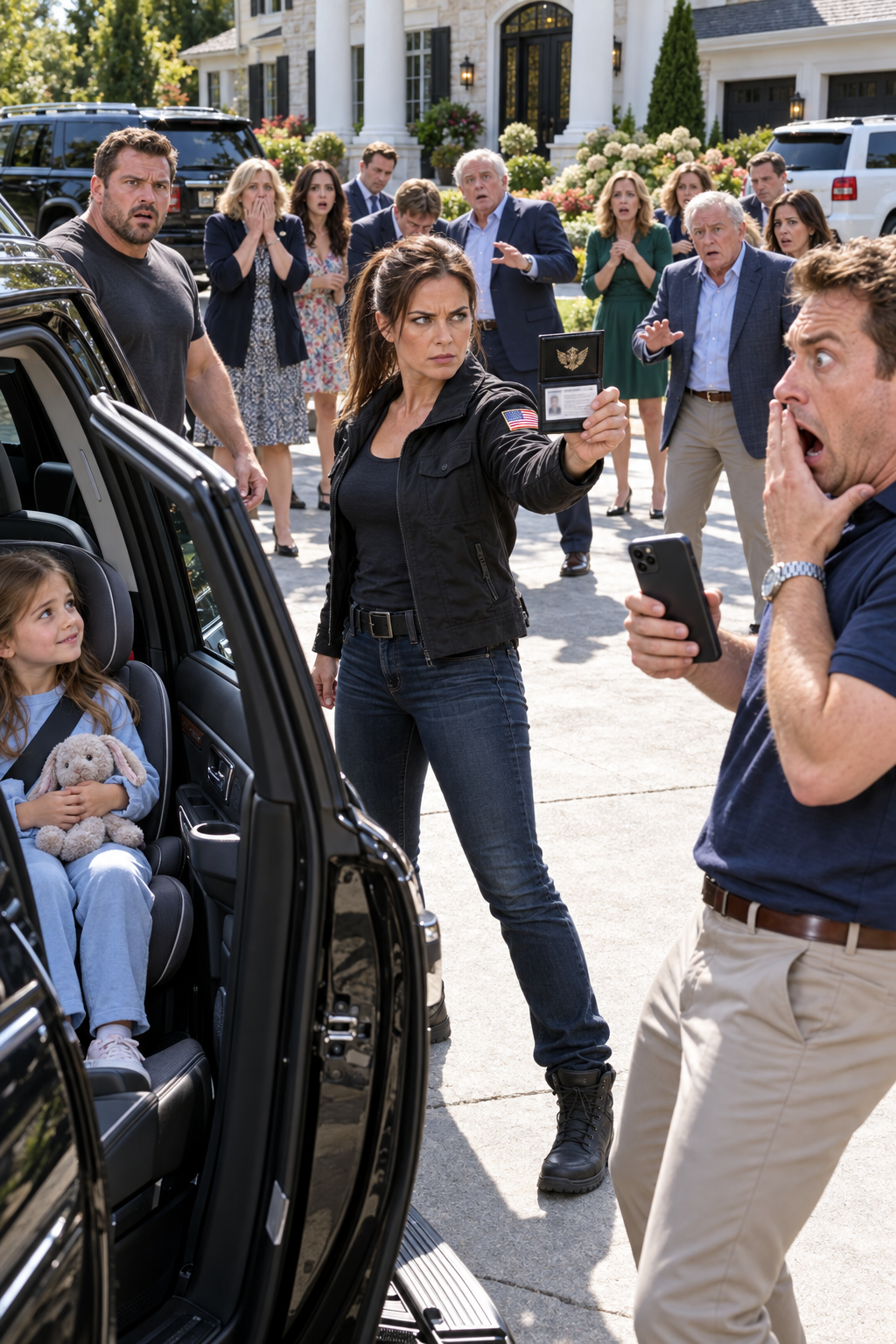
My Ex-Husband’s Brother Shattered My 7-Year-Old Daughter’s Jaw. It Had To Be Wired Shut. My Ex-Husband Filmed It, Laughing. “Maybe Now She’ll Stop Crying For Her Mommy.” When I Got There, I Lifted My Daughter Off The Floor. I’d Spent 16 Years In A Unit That Never Appeared On Any Roster. I Carried Her To My SUV. Then His Entire Family Surrounded Us—Eleven Of Them. “You’re Not Leaving With The Girl.” I Gently Put My Daughter In The Passenger Seat. Then I Turned Around. And They Turned Pale When They Saw What Was In My Hand…
When I found my seven-year-old daughter bleeding beside my ex-husband’s fireplace, his older brother insisted she had deserved what happened, and the rest of the family wanted me to stop making a scene. I didn’t argue. I picked her up and headed for the hospital, only to find eleven relatives blocking my SUV. Four days later, while my daughter was recovering from surgery, an envelope arrived containing a document prepared weeks before the assault. Suddenly, I understood that her injury wasn’t the only thing they had been trying to hide.
Part 1: The Eleven People Who Wouldn’t Let Us Leave
The first warning came at 2:17 on a Saturday afternoon, while I was standing in my kitchen with a dish towel over my shoulder and a half-finished grocery list on the counter. My daughter, Lucy, was spending the weekend with her father, and I had been trying to enjoy the kind of quiet I once believed divorced parents were supposed to appreciate. Then my phone lit up with a name I hadn’t seen on the screen in almost a year: Benjamin Westcott, my ex-husband’s younger brother.
“Elena,” he said when I answered, “you need to come get Lucy.” His voice sounded muffled, as though he were speaking with one hand over his mouth, and I could hear several people arguing behind him. When I asked what had happened, he said she had hurt her face, then immediately added that he thought she would be all right. “Ben, I need you to tell me whether she’s conscious and whether she’s bleeding,” I said, already reaching for my car keys. He answered the first question quickly, hesitated over the second, and finally whispered, “Please just come.”
I was forty years old, and for sixteen of those years I had worked in federal emergency response, coordinating evacuations, recovery teams, and medical logistics during disasters. That career had taught me that the most frightening information often came from what people refused to answer, but nothing in my professional life had prepared me to hear that kind of hesitation about my own child. I called my ex-husband, Daniel, three times while heading down the stairs to the garage. He rejected the third call.
Daniel and I had been divorced for two years, after a marriage that had slowly become an exhausting negotiation between what I wanted for our family and what his family expected from me. He was a charming man when nobody challenged him, and there had been years when I confused his ability to avoid conflict with kindness. His mother, Celia, called him devoted because he attended every family dinner, while his older brother, Reid, called him soft whenever he disagreed with anything. I had once believed that raising Lucy together would force Daniel to grow beyond those loyalties.
The drive to his house took eighteen minutes, although I remember almost none of the traffic lights. I remember the smell of rain rising from hot pavement, the grocery list sliding from the passenger seat into the footwell, and my phone sitting silent beside the gearshift. Lucy had been increasingly reluctant to visit Daniel’s house during the previous six months, sometimes counting how many nights remained before she could come home. Whenever I raised the subject, Daniel accused me of teaching her to be dependent.
There were eight vehicles crowded around his driveway when I arrived, and another two parked farther down the street. His family had gathered for Celia’s birthday lunch, which explained why so many people were there but not why Ben was standing on the porch with his face drained of color. I pushed past him and heard my daughter’s breathing before I saw her. It was a small, wet, irregular sound coming from the living room.
Lucy was sitting on the floor beside the stone fireplace, one hand pressed beneath her chin and the other gripping the hem of her lavender sweater. Blood had dried at the corner of her mouth, her left cheek was swollen, and her jaw looked wrong in a way that made my stomach turn. Daniel stood near the couch holding his phone, while Reid leaned against the mantel with his arms folded and Celia kept repeating that everyone needed to calm down. When Lucy saw me, she tried to say “Mommy,” but the movement made her recoil in pain.
I knelt beside her without touching her face. “Honey, I’m here, and I’m taking you to get help,” I said, moving carefully so I could support her head and shoulders. Daniel stepped forward and told me she had stumbled during a tantrum, while Reid announced that she had been screaming for attention and needed to learn some manners. I looked at Reid’s reddened face, then at my daughter, whose eyes had followed him even when he wasn’t speaking. “Did somebody hit her?” I asked, and the room went quiet for the first time.
“Don’t start accusing people,” Celia said. Reid gave a humorless laugh and replied, “I barely touched her, and she threw herself backward.” Daniel opened his mouth, closed it, and looked down at his phone. I didn’t need a confession to know that Lucy required immediate medical attention, and I wasn’t going to waste another minute arguing about which adult preferred which version of events.
When I lifted her, Lucy gave a muffled cry that stopped halfway out, and she immediately tried to apologize. I told her she hadn’t done anything wrong, carried her through the hallway, and asked Ben to bring the small overnight bag beside the door. Daniel followed us outside, insisting we needed to discuss what had happened before I involved a hospital. I told him we could discuss it after Lucy had been examined, and that was when Reid shouted, “Nobody is taking her anywhere until we settle this.”
By the time I reached my SUV, eleven relatives had followed us into the driveway. I eased Lucy into the passenger seat, secured her as carefully as her injury allowed, and turned to find Daniel standing beside my driver’s door while Reid occupied the space directly in front of the hood. Celia stood with two of her sisters near the rear bumper, and several cousins had spread themselves along the passenger side. Nobody had instructed them to form a barricade, at least not where I could hear, but their positions made their intentions unmistakable.
I took out my phone and called 911. “My seven-year-old daughter has a serious facial injury,” I told the dispatcher, giving the address, “and several adults are preventing me from leaving for emergency medical care.” Daniel began telling everyone that I was exaggerating, while Celia demanded that I put the phone away before I ruined the family. When Reid stepped closer, I took the black leather credential wallet from my jacket, opened it, and held it where he could see the federal identification inside.
The credential gave me no authority over a domestic dispute, and I said nothing to suggest otherwise. It did, however, remind several people that I had spent my working life documenting emergencies rather than negotiating them away, and their confidence faltered long enough for me to speak. “There’s a dispatcher listening, there are cameras above the garage, and my daughter is hurt,” I said. “Move away from the vehicle.”
Reid called me dramatic, but Ben suddenly stepped out of the line of people beside the driver’s side, and one cousin shifted backward with him. Daniel looked toward the garage camera, then at Lucy through the window, and something uncertain crossed his face. When I approached my door, he hesitated for another terrible second before finally stepping aside. I got into the driver’s seat, locked the doors, and told the dispatcher I had a clear exit and was heading toward the children’s emergency department.
I drove out slowly while Reid struck the hood with his palm, and I could still see Celia waving both arms in my rearview mirror when I turned onto the street. Lucy reached across the center console and touched my wrist with two fingers. “Sorry,” she managed to whisper, and when I told her there was nothing to apologize for, she tried again. “I couldn’t stop crying.”
At the hospital entrance, a nurse rushed out with a wheelchair, and I finally let myself feel how hard my hands were shaking. I followed Lucy through a set of automatic doors while another nurse asked what had caused her injury, and I realized I couldn’t give a truthful answer beyond what I had seen. Then my phone vibrated with a message from Ben. It contained only ten words: “Daniel was recording before Reid even entered the room.”
Part 2: The Injury Nobody Wanted a Doctor to Examine
The emergency department smelled of disinfectant, wet umbrellas, and coffee that had been sitting too long in a paper cup. Lucy lay beneath a thin hospital blanket while nurses measured her vital signs and a physician examined her swelling without making her speak unnecessarily. When a nurse asked whether she felt safe returning to her father’s house, Lucy gripped my fingers and shook her head. The nurse made a quiet note in the chart, then asked me to step into the hallway.
Dr. Priya Raman, a pediatric facial surgeon, met me outside the imaging room with the expression of someone who had difficult information and understood that delivering it gently wouldn’t make it less painful. Lucy had multiple fractures in her lower jaw, including one that had displaced the bone enough to require surgical stabilization. There was also concern about the force of the impact and whether she had sustained additional injuries that weren’t immediately obvious. “She’s stable,” Dr. Raman said, “but she needs treatment today, and recovery will take time.”
I asked whether the injury was consistent with falling from a standing position, because I wanted to understand what the evidence could establish. Dr. Raman explained that medical findings alone wouldn’t determine every detail of the event, but the fracture pattern and history would be carefully documented. She also told me the injury was serious enough that the hospital was initiating its required child protection procedures. For the first time that afternoon, I was surrounded by adults who were interested in my daughter rather than the consequences of telling the truth.
A social worker named Andrea brought me a paper cup of water and asked whether I wanted anyone called. I almost gave her Daniel’s number out of habit, because he was Lucy’s father and emergencies involving a child were supposed to bring parents together. Then I remembered him standing between me and the driver’s door while our daughter struggled to breathe through her pain. Instead, I asked her to contact my attorney, Rachel Pike.
Rachel had represented me during the final months of my divorce, when Daniel became convinced that my work schedule made me less suitable to be Lucy’s primary parent. She answered from her office, listened without interrupting, and asked whether Lucy was receiving treatment. Then she told me to preserve every message, avoid confronting Daniel’s relatives, and give investigators an accurate account of what I had personally witnessed rather than what I suspected. “I’m seeking emergency custody protections,” she said, “but Elena, you need to let the medical team and investigators establish what happened.”
I knew she was right, although some part of me wanted to drive straight back and demand answers from every person who had watched my daughter bleed. Instead, I sat outside the operating area with my phone on silent while Rachel contacted the hospital and began the legal paperwork. Messages accumulated from Daniel, Celia, and two cousins whose names I barely recognized. Daniel wrote that Lucy had slipped, that Reid had reacted without thinking, and that I was causing irreversible damage by involving the police.
Celia’s message was longer and somehow worse. She reminded me that Lucy had always been emotional, said Reid had practically raised his younger siblings, and insisted there was no reason for outsiders to turn a family misunderstanding into a scandal. She ended by asking whether I really wanted Lucy growing up with the knowledge that her mother had torn apart her father’s family. I read the message twice, then forwarded it to Rachel without replying.
Lucy went into surgery that evening. I stood beside her bed until the staff came to take her, brushing a strand of hair away from her forehead and telling her I would be waiting when she woke up. She had always disliked hospitals, partly because she associated them with the days when my work took me away after major storms, and now she looked at the hallway with frightened concentration. “Am I in trouble?” she whispered, and I had to swallow before answering.
“No, sweetheart,” I said. “The grown-ups are supposed to keep you safe, and none of this is your fault.” She stared at me for a long moment, searching for a condition I might add, then finally closed her eyes. I watched the doors close behind her and realized that the thing frightening me most wasn’t what she had suffered physically. It was that she seemed to believe an adult’s anger could make her injury deserved.
While Lucy was in surgery, a detective named Monica Vale arrived to take my statement. She was a practical woman with short dark hair and an unhurried manner, and she asked me to describe the scene in the order it happened. I told her about Ben’s call, the unanswered calls to Daniel, the blood beside the fireplace, Reid’s admission that he had touched Lucy, and the relatives surrounding my vehicle. When she asked whether I knew what had happened before my arrival, I told her I didn’t.
I also showed her Ben’s message about the recording. Detective Vale made a note and told me investigators would pursue the original file and any relevant camera footage rather than rely on copies passed between family members. She was especially interested in the delay before Lucy received medical care and the apparent attempt to stop me from leaving. “People don’t always agree about what they witnessed,” she said, “but records give us a way to test their accounts.”
After midnight, Dr. Raman told me Lucy’s procedure had gone as expected and that her jaw had been stabilized. She would require follow-up appointments, a restricted diet, careful pain management, and time before she could eat normally again. There would also be emotional consequences, although those would become clearer only after the immediate crisis had passed. I listened, took notes, and asked the kinds of precise questions I had learned to ask whenever fear threatened to overwhelm my judgment.
When Lucy was settled in recovery, I finally opened a voicemail Daniel had left earlier that night. He sounded exhausted and indignant, explaining that Reid hadn’t intended to injure anyone and that Lucy had been behaving terribly before the accident. Then his tone changed, and he said something I couldn’t stop thinking about: “You know how important it is that we establish what she’s really like when you’re not around.” I played that sentence again, wondering why a father sitting outside the hospital where his daughter was undergoing surgery would be thinking about establishing anything.
During our marriage, Daniel had kept a notebook of my emergency deployments, recording missed dinners, canceled weekends, and occasions when his mother had collected Lucy from school. He called it practical planning, although during the divorce he used those same records to argue that my career made him the more reliable parent. We ultimately settled on an arrangement that kept Lucy’s primary residence with me while preserving substantial parenting time with him. I thought that particular argument had ended with the divorce judgment.
Four days after the injury, Lucy was home on the couch with pillows behind her back and a little whiteboard beside her, because talking remained uncomfortable. I had just finished preparing a meal she could manage when a courier delivered a thick envelope from Rachel’s office. Inside was a copy of a custody petition Daniel’s attorney had prepared before the assault, seeking to change Lucy’s primary residence and restrict my decision-making authority. Its supporting materials referred to an ongoing pattern of emotional instability, recordings of Lucy’s behavior, and a planned family meeting intended to collect further evidence.
The document was dated three weeks before Reid hurt her.
I stared at the paragraph describing how Lucy supposedly became distressed whenever she was separated from me. Until that moment, I had believed Daniel’s family had gathered for Celia’s birthday and then tried to hide a terrible act of violence. Now I had to consider a second possibility: someone had been preparing to turn my daughter’s distress into evidence against me long before the afternoon she was injured.
Part 3: The Video Daniel Thought Would Prove His Case
The next morning, Rachel sat across from me at my kitchen table with Daniel’s petition spread between our coffee cups. Lucy was asleep upstairs, and I had been awake since four, reading the same paragraphs until their language no longer sounded like English. The petition described a child who was excessively attached to her mother, struggled with reasonable discipline, and displayed escalating distress during visits with her father. It never mentioned that Lucy had repeatedly told me she was afraid of Reid.
“This wasn’t filed with the court before the incident,” Rachel explained, tapping the date on the attorney’s cover letter. “It was prepared for Daniel’s approval, and the family was apparently gathering material to support it.” She pointed to a reference about recorded examples of Lucy’s behavior, which troubled her more than the allegations themselves. Daniel wasn’t simply complaining about our daughter’s adjustment to divorce; he appeared to have been systematically collecting footage of her most vulnerable moments.
I thought about the weekends Lucy returned home exhausted, the way she sometimes asked whether crying was rude, and the occasions when she requested permission to telephone me instead of simply picking up her little tablet. Daniel had insisted that constant contact with me prevented her from adjusting to his household, so I had reluctantly agreed to scheduled calls rather than unrestricted access. At the time, I thought I was compromising in good faith. Now I wondered whether I had unknowingly helped him create the very distress he intended to document.
Rachel noticed my expression. “Don’t turn this into a trial of every parenting decision you’ve made,” she said. “What matters is what these adults chose to do, and whether Lucy is safe with them.” She explained that the emergency restrictions were already protecting Lucy while the court reviewed the evidence, and that our next step was to establish the pattern without asking a traumatized child to relive it repeatedly. I promised I would leave the questioning to trained professionals, even though I had a hundred questions pressing against my teeth.
That afternoon, Lucy woke from a nap and asked for the box of colored pencils she kept under the coffee table. Drawing had always helped her settle herself, but she pushed the pencils aside and reached for her whiteboard instead. She wrote three words in careful, uneven letters: “Bad in video.” When I asked what she meant, she erased the board so quickly that her sleeve caught the edge of the marker tray.
I resisted the urge to ask who had recorded her, what had happened, or whether she had been told to perform for the camera. Instead, I said, “You aren’t bad in a video or anywhere else,” and offered her another sheet of drawing paper. She looked at me suspiciously, as though I had failed to understand an important rule, then began drawing our kitchen with its crooked yellow curtains. That evening, I photographed the whiteboard message from memory in my own notes and told Rachel what had happened, careful not to turn my daughter’s words into conclusions they couldn’t support.
Six days after the assault, Detective Vale called to say investigators had obtained the original video file Daniel recorded that afternoon. She couldn’t share every aspect of the investigation, but she explained that the recording and available witness statements supported a more serious account than the family’s initial claim of an accidental fall. Eventually, through the appropriate legal process, a copy became available to Rachel and me. I asked whether I needed to watch it, and Rachel told me that understanding what Daniel had done would matter, but I could choose when and with whom.
I watched it in Rachel’s office with the volume turned low and a box of tissues sitting untouched beside my chair. The first image was Lucy standing near the fireplace, crying while Daniel held his phone horizontally in front of him. He was telling her that she had to learn to stay with him without calling me every time she became upset. When she asked whether she could go home, he answered, “See, this is exactly what I’ve been talking about.”
Reid entered the picture less than a minute later, carrying a drink and asking why a seven-year-old was being allowed to run the household. Lucy stepped away from him and asked Daniel to stop recording, but her father told her she needed to behave normally if she didn’t want people seeing her act that way. Reid ordered her to quit crying, moving closer as she backed toward the fireplace. Then he struck her across the face.
The blow turned her body sideways, and the side of her jaw hit the stone edge of the hearth before she fell onto the rug. Daniel’s phone jolted, and for a second there was silence except for Lucy’s frightened, wounded breathing. Then Daniel made a short, ugly sound that took me several moments to recognize as laughter. “Well, maybe she’ll remember that next time,” he said.
I felt as though someone had reached inside my chest and closed a fist around my lungs. The video continued long enough to show Reid insisting he hadn’t hit her hard, Celia entering the room, and Ben repeatedly saying they needed to call someone. Nobody immediately went to Lucy, and Daniel kept filming while his daughter sat on the floor trying to hold her jaw still. I stopped the recording before the end and asked Rachel to turn off the screen.
I had spent years excusing Daniel’s inability to stand up to his brother, partly because Reid was loud and intimidating and partly because Daniel had learned to disappear inside his family’s opinions. But watching him film our daughter while she begged for comfort forced me to recognize something I had been unwilling to name. He wasn’t merely failing to challenge Reid. He was using Lucy’s pain to build a case against me.
Detective Vale later confirmed that the video had been preserved with its original timing information, which mattered because several relatives had claimed the recording began only after Lucy was injured. She also told me that investigators were examining other relevant recordings and messages, including material showing what Daniel hoped to accomplish by filming his daughter. Those messages were not yet something I could review, and she cautioned me against assuming that every family member had shared the same plan. I understood the distinction, but it didn’t make the driveway easier to remember.
That night, after Lucy fell asleep, I looked through old photographs from family gatherings and found an image of Daniel holding her on his shoulders at the county fair. He was laughing, Lucy was reaching for a balloon, and Reid was standing beside them with a hand on Daniel’s back. I studied that photograph longer than I expected, grieving a version of fatherhood I had once sincerely believed existed. Then Rachel forwarded a newly disclosed excerpt from Daniel’s messages, written shortly before the recording began: “If she starts asking for Elena again, keep the camera running. We need the judge to see it.”
Part 4: The Family Had Been Practicing This for Months
Ben called me directly eleven days after the assault, shortly after eight in the evening. I was folding Lucy’s pajamas when his name appeared on my phone, and my first instinct was to ignore it because I couldn’t bear another relative telling me that everyone was suffering. Instead, I answered and told him plainly that anything important about the case needed to go to investigators. He said he understood, but he wanted to tell me something personal before he gave his formal statement.
“I’m sorry I waited to call you,” he said. His voice broke on the last word, and for a moment I could hear the same frightened young man who had whispered into his phone on that Saturday afternoon. He told me that Reid had threatened to throw him out of the family business if he involved the police, and that Celia had insisted Lucy was frightened only because she knew I would overreact. Ben had been afraid of losing his job and his family, but he admitted that fear wasn’t an excuse for leaving my daughter on the floor.
I had known Ben since he was seventeen, an awkward teenager who preferred repairing old engines to sitting through his mother’s elaborate family dinners. At thirty-one, he worked in the estimating department of Westcott Residential, a construction company established by his grandfather and now largely controlled by Reid. Daniel handled customer relationships and marketing, while Celia still treated every employee’s personal decisions as matters for family discussion. Ben had a mortgage and two children, and Reid controlled whether his paycheck kept arriving.
“Tell Detective Vale everything you know,” I said. Ben promised he would, then hesitated and asked whether Lucy had been able to eat anything yet. I told him she was healing but couldn’t chew, and that she was afraid of doing something wrong whenever an adult raised their voice. He grew quiet, and when he finally spoke, he said, “That’s what they were trying to teach her.”
Two days later, Ben gave investigators a statement that changed the case. According to his account, Celia had become increasingly frustrated after Daniel failed to convince me to change our custody arrangement voluntarily. She believed Lucy needed more time with the Westcotts, where the family could correct what she described as my influence, and she encouraged Daniel to collect examples of Lucy becoming upset whenever she was denied contact with me. The purpose was to persuade a judge that the distress came from my parenting rather than anything happening in their home.
Reid had taken charge of what the family privately called Lucy’s independence exercises. He expected her to finish meals without complaining, greet adults promptly, tolerate teasing without crying, and stop asking for me during visits. If she became upset, Daniel was encouraged to record her instead of comforting her, supposedly to demonstrate how unreasonable her behavior had become. Ben said he had witnessed the approach twice before and had challenged it once, only to be told he was undermining Daniel’s authority.
The afternoon Lucy was injured, Celia’s birthday lunch had been real, but the gathering also provided an audience of relatives Daniel hoped would support his account of Lucy’s behavior. Several people had already agreed to write statements describing how dependent she seemed whenever I wasn’t present. Ben believed Reid became angry when Lucy refused to stop crying because the recording wasn’t producing the calm, obedient response the family expected. Whether every relative knew about the custody strategy remained unclear, but the people who surrounded my SUV afterward had all seen enough to know Lucy needed help.
Rachel explained that the messages and recordings would now matter in two separate legal proceedings. The criminal investigation concerned Reid’s violence and the actions surrounding the injury, while the custody case concerned Daniel’s judgment, his treatment of Lucy, and whether he could provide a safe environment. The fact that one man had struck her did not excuse the father who had created the conditions and then resisted medical care. Neither did it make every person in the driveway equally responsible for everything that had happened.
I had my own records, including text exchanges about calls Daniel had refused to allow and emails in which he complained that Lucy embarrassed him by asking to come home. I gave Rachel the complete conversations rather than isolated passages, because I didn’t want anyone to accuse me of constructing a misleading timeline. One email from Celia, sent four months earlier, informed me that Lucy would no longer be permitted to telephone during family dinners because her requests were disrupting everyone. At the time, I had responded with a polite request for flexibility.
Reading that exchange now made me feel physically sick. I had tried so hard to avoid becoming the angry ex-wife that I had allowed other people to define what counted as reasonable treatment of my child. I knew there was no single email that would have predicted Reid’s assault, but the pattern of punishment for ordinary childhood distress was clearer than I had wanted to acknowledge. What I had called cooperation had gradually become permission for Daniel’s family to make rules over Lucy’s feelings.
The day after Ben’s statement, Celia left a voicemail accusing me of manipulating him against his brothers. She said Reid’s business was suffering because clients had heard about the investigation, and she wanted me to understand that innocent employees and their children might lose their livelihoods. For years, that argument would have worked on me, because the possibility of hurting other people had been the most reliable way to make me surrender an important boundary. This time, I saved the voicemail and sent it to Rachel.
That evening, Lucy sat beside me while I arranged photographs for a school project she had missed. She chose a picture of us at the beach, another of our elderly neighbor’s dog, and one of herself grinning with a popsicle in each hand. Then she hesitated over a photograph of Daniel pushing her on a swing. “Can I keep this one?” she asked carefully.
“Of course you can,” I said. “You don’t have to stop loving your dad because he made choices that hurt you.” Lucy ran her fingertip along the edge of the photograph and asked whether that meant he would be coming to our house. I told her he wasn’t allowed to visit right now and that any future contact would have to be safe. She looked relieved, but the relief disappeared when she asked whether Grandma Celia would be angry with her for talking about what happened.
I assured her that she was allowed to tell the truth and that grown-ups were responsible for managing their own feelings. Later, after she went to bed, I found that she had placed the photograph of Daniel underneath her pillow instead of gluing it onto the project. I left it there, understanding that she could miss the father she remembered without wanting to return to the father she feared. My phone buzzed with a message from Rachel just before midnight: investigators had uncovered additional recordings, and at least one showed Reid confronting Lucy long before the day he broke her jaw.
Part 5: The Evidence They Couldn’t Explain Away
The additional recording was from a Sunday afternoon in early spring, three months before Lucy’s injury. Daniel had placed his phone on a kitchen counter while Reid stood over Lucy, who was sitting at the table with a plate of untouched food. She was asking whether she could call me because she didn’t feel well, and Reid kept telling her that her mother couldn’t rescue her every time she disliked something. When Lucy started crying, he leaned closer and threatened to take away her belongings if she continued.
Nothing in that recording approached the physical violence of the later assault, but the investigators considered it important because it contradicted Daniel’s assertion that Reid had never frightened Lucy before. The video also showed Daniel ignoring her requests for help, telling her to listen to her uncle rather than asking what was wrong. When Rachel described the footage, I remembered the Monday after that visit, when Lucy had complained of a stomachache before school. She had asked whether being scared of somebody counted as being disrespectful.
I had told her fear wasn’t disrespectful, then asked Daniel whether something had happened during the weekend. He accused me of interrogating her and said she was trying to avoid ordinary expectations, and I had chosen not to pursue the argument after Lucy seemed better. I thought about that conversation so often that Rachel eventually asked me to write down what I remembered and stop replaying it. “You’re gathering evidence against yourself in a trial that doesn’t exist,” she said. “We have to deal with what happened, not invent a world where you could have predicted every terrible decision.”
Lucy’s physical recovery was slow enough to make time feel unfamiliar. She hated the restricted diet, became frustrated when speaking hurt, and sometimes woke at night convinced she had heard Reid’s voice in the hallway. Her school arranged temporary accommodations and sent home artwork from classmates, including a card covered with crooked stars and a message promising to save her seat at lunch. The ordinary kindness of children nearly undid me after weeks of listening to adults explain why her suffering was inconvenient.
We began working with a child therapist named Dr. Evelyn Harper, who specialized in trauma and family violence. She didn’t ask Lucy to describe the assault during their first session, choosing instead to talk about school, favorite animals, and the things that made her feel comfortable or uncomfortable. Afterward, she explained to me that children sometimes develop a powerful belief that they can prevent frightening situations by becoming perfectly obedient. Lucy’s repeated apologies, fear of crying, and constant checking of my mood were consistent with that kind of response, although Evelyn was careful not to reduce her to a diagnosis.
Evelyn encouraged me to let Lucy express anger without treating it as a problem that needed immediate correction. One evening, Lucy became furious because I had bought the wrong flavor of yogurt, and she pushed the container away with enough force to spill it across the table. I almost told her to use a nicer tone, then noticed how quickly she shrank back in her chair. Instead, I handed her a towel and said, “It’s okay to be angry, and we can clean up the mess together.”
She watched me as though she expected the real punishment to arrive afterward. When it didn’t, she started crying, and I sat beside her until she was ready to help wipe the table. We still had rules in our house, but I began paying more attention to the difference between correcting behavior and making a child afraid to express a need. It was a distinction I wished every adult around that fireplace had understood.
Meanwhile, the Westcott family began unraveling under the weight of its own changing explanations. One cousin told investigators she had believed Reid barely touched Lucy, then admitted she had actually been in the kitchen when the injury occurred. Another acknowledged that Celia had asked everyone to avoid discussing the incident until they could agree on what to tell me. A third confirmed that Daniel had instructed people to stop me from leaving because he was afraid I would take Lucy directly to the police.
Ben’s statement made the biggest difference, not because he was innocent, but because he admitted his own participation. He acknowledged standing beside my SUV and waiting for Daniel to tell him what to do, despite knowing Lucy needed medical attention. Investigators also obtained the exterior camera footage, which showed the relatives moving into position as I carried Lucy outside. Whatever they later claimed about their intentions, the recording established that my path to the driver’s seat had been blocked.
Daniel began accusing me of using my federal position to intimidate his family, and a complaint eventually reached my agency. I provided the requested account, explained that I had not claimed police authority or attempted to influence the investigation, and disclosed that I had displayed my emergency-response identification during an active attempt to obstruct my departure. My supervisors reviewed the matter through the proper process, including whether I had complied with agency rules. I was relieved when the review concluded without disciplinary action, but the experience reinforced how important it was to let ordinary legal procedures handle the case.
Celia continued contacting people who knew me, including a former colleague who called to warn me that she was describing me as unstable and vindictive. I thanked him, asked him not to engage, and forwarded the details to Rachel. We documented everything while avoiding public arguments, even after someone posted a distorted account of the incident in a neighborhood group. I didn’t need strangers deciding whether my daughter’s injury was serious enough to deserve sympathy.
Three weeks after the assault, Lucy participated in a professionally conducted forensic interview. I waited in another room because I didn’t want my presence to influence what she said, and afterward I was given only the information appropriate for me to know. Her account was consistent with the central facts already established by the recording: she had asked for me, Reid became angry, he hit her, and she struck the fireplace. Most painfully, she still believed she might have prevented everything by crying less.
That evening, she asked me whether her grandmother hated her. I told her I didn’t know exactly what Celia felt, but I knew that Lucy hadn’t done anything to deserve cruelty or silence from an adult. Then she asked whether I was going to make her forgive everybody once her jaw healed. I pulled her close, being careful of her face, and said, “No, sweetheart. Getting better doesn’t mean you owe anyone forgiveness.”
For the first time since the hospital, she seemed to believe me without searching for another answer. She fell asleep against my shoulder while I read a chapter from her favorite book, her small hand resting over mine. Later that night, Rachel sent me the date for our temporary custody hearing and warned me that Daniel intended to argue for continued unsupervised parenting time. He was still insisting that because he hadn’t personally struck Lucy, there was no reason to keep him away from her.
Part 6: The Day Her Father Had to Answer Questions
The custody hearing took place on a gray Thursday morning, seven weeks after the assault. I wore a navy jacket and the same low-heeled shoes I had worn to countless emergency briefings, choosing clothes that made me feel steady rather than impressive. Rachel met me outside the courtroom and reminded me that the hearing wasn’t a chance to tell the judge every painful story from my marriage. We were there to demonstrate why Lucy’s safety required a different arrangement.
Daniel arrived with his attorney and sat several rows away from me. He looked thinner than he had in the hospital parking lot, with dark circles beneath his eyes and a suit that hung awkwardly from his shoulders. Celia sat behind him holding a leather handbag tightly against her knees, while Reid was absent because of the pending criminal case. I caught Daniel looking at me once, and for a second I saw the familiar expression he wore whenever he wanted me to make an uncomfortable situation easier.
Rachel began with the medical evidence, the hospital’s documentation, and the circumstances under which Lucy reached emergency care. The judge reviewed the records establishing the seriousness of the injury, then heard about the delay between the assault and my arrival. The exterior footage showed relatives blocking my vehicle, and the relevant portions of Daniel’s phone recording demonstrated his response to Lucy’s distress before and after Reid struck her. I watched the judge take notes without changing expression.
Daniel’s attorney argued that the assault had been an isolated act by another adult and that Daniel shouldn’t lose his relationship with Lucy because of his brother’s behavior. Rachel didn’t dispute that a child could benefit from a healthy relationship with both parents, but she asked the court to examine what Daniel had done when his daughter needed protection. He had chosen to record her distress, failed to intervene before the violence, delayed medical assistance, and participated in preventing her mother from leaving. Those decisions were his own.
When Daniel testified, he initially spoke in the gentle voice he used whenever he wanted strangers to believe he was being reasonable. He acknowledged that Reid had lost his temper but insisted nobody expected Lucy to suffer a serious injury. He described himself as overwhelmed by the confusion afterward and claimed the relatives had simply wanted everyone to calm down before accusations were made. Then Rachel asked why he had kept recording after Lucy said she was frightened.
Daniel said he wanted to show me how she behaved during visits. Rachel asked why showing me was more important than comforting her, and he answered that I always believed Lucy’s side of things without considering his. The judge interrupted to ask whether Lucy had been injured when Daniel continued filming. He admitted she had.
Rachel then asked why Daniel had laughed after Reid struck her. He looked at the table for several seconds before saying it had been a nervous reaction that he regretted. I wanted to believe there was some explanation that would make those few seconds less cruel, but the recording showed what it showed. My daughter had been hurt, and the sound that escaped her father had not been an expression of concern.
The judge asked Daniel directly whether he had attempted to stop me from obtaining medical treatment. Daniel answered that he had wanted to talk first because he believed I might overreact. When the judge asked what possible reaction could justify delaying care for a child with a visibly injured jaw, Daniel had no meaningful answer. He finally admitted that he had been more worried about the family argument becoming a police matter than about the seriousness of Lucy’s injuries.
I testified after a short recess. Rachel asked about Lucy’s behavior before and after the assault, the steps I had taken to maintain her relationship with Daniel, and the boundaries I now believed were necessary. I described the sleepless nights, the apologies, the difficulty eating, and the moments when Lucy seemed afraid to ask for ordinary things. I didn’t call Daniel a monster or claim to know what was in his heart. I told the judge that I could no longer trust him to protect our daughter when protecting her required disagreeing with his family.
The judge continued the restrictions on Daniel’s unsupervised parenting time and ordered that any contact occur only under approved professional supervision, subject to Lucy’s welfare and further review. Daniel was also required to complete appropriate evaluations and recommended services before seeking changes, and Reid was prohibited from contact with Lucy. The court maintained her residence with me and limited Daniel’s decision-making authority concerning her care. Rachel explained that the order could be reviewed, but that the immediate priority was preserving her safety and stability.
Celia approached me in the corridor afterward, her eyes red and her handbag dangling from one wrist. “I hope you’re satisfied,” she said quietly. “My family is falling apart, and you don’t seem to care.” I looked at the woman who had spent years reminding me how much the Westcotts had done for Lucy, and I finally understood that she still considered the family’s reputation the most urgent injury in the room. I told her that my daughter was recovering from surgery and that I had nothing else to discuss with her.
She reached for my arm, but Rachel stepped beside me, and Celia withdrew her hand. I walked away without raising my voice, although my legs were trembling by the time we reached the parking garage. Rachel asked whether I wanted a few minutes before driving, and I sat in my car until the shaking passed. Then I picked Lucy up from my sister’s house and took her for a gentle walk beside the lake.
She asked whether the judge had said she could stay with me. I told her yes, and explained that any time with her father would have to happen in a safe setting approved by the people responsible for protecting her. She listened, watched two ducks fighting over a piece of bread, and asked whether we could stop for a smoothie on the way home. I had expected a complicated emotional reaction, but she seemed most interested in having an ordinary afternoon.
That night, Daniel sent Rachel a letter intended for me. Most of it described his regret and his hope that we could someday return to cooperative parenting, but the final paragraph caught my attention. He admitted that Reid’s temper had frightened him for years and that he had known Lucy was becoming afraid of her uncle. “I convinced myself that if I let Reid teach her to be tougher,” he wrote, “she’d stop crying, and everyone would finally leave me alone.”
Part 7: The Apologies That Arrived After Everything Was Lost
I read Daniel’s letter three times before putting it back into its envelope. For years, I had wondered whether he understood how much influence Reid held over his decisions, and now he was admitting that he had sacrificed our daughter’s sense of safety to avoid becoming his brother’s next target. I believed he was ashamed, but shame didn’t change what he had allowed to happen. When Rachel asked whether I wanted to respond, I told her there was nothing I could say that would make his explanation acceptable.
The criminal case moved more slowly than the custody proceedings. Investigators collected additional statements, reviewed the recordings, and examined the delay in Lucy’s medical treatment and the actions surrounding my vehicle. Reid initially maintained that Lucy had lost her balance after he tried to discipline her, but the video contradicted his description of the physical contact. His attorney eventually stopped presenting the incident as an ordinary fall and began negotiating over the consequences of the assault.
The Westcott family business suffered almost immediately, although not in the spectacular way Celia had predicted. Clients began asking whether Reid remained responsible for supervising employees in their homes, and several projects were reassigned after partners became concerned about the publicity and his behavior. Ben told investigators that Reid had pressured him to retract parts of his statement, and company records became relevant when questions arose about whether his employment had been threatened. Eventually, the remaining owners removed Reid from his management responsibilities while the criminal case continued.
Celia blamed me for the damage, telling mutual acquaintances that I could have handled the situation quietly. The accusation became almost absurd when I thought about what quiet handling would have required: pretending my daughter had fallen, accepting the delay in treatment, and letting Daniel continue using her distress as evidence that she needed less time with me. I hadn’t invented a single recording or forced a single witness to contradict themselves. The family’s consequences grew directly from the choices its members had made.
Ben resigned from the company near the end of summer and accepted a less lucrative position with an independent contractor. He sent a short letter through Rachel explaining that he had wanted to tell me the truth earlier but had lacked the courage to risk his livelihood and his mother’s approval. He didn’t ask to see Lucy or request forgiveness, and I respected that he seemed to understand the difference between taking responsibility and demanding relief from guilt. I asked Rachel to acknowledge receipt without promising any future relationship.
Lucy’s recovery continued alongside all of this, progressing unevenly in ways I hadn’t expected. Some days she laughed with her friends during supervised playdates, and other days she became upset when a man spoke loudly in a grocery store. Evelyn helped us develop routines for those moments, teaching Lucy to notice when she felt afraid and tell me without worrying about whether the fear made sense. I learned to stop asking whether she was better yet and instead ask what she needed that day.
One Saturday, we went to a garden center because Lucy wanted to plant something that would be growing when she could eat normally again. She chose a small strawberry plant and insisted on carrying it herself, although she nearly dropped the plastic pot in the parking lot. At home, we put it near the kitchen window, and she checked the soil every morning before school. Watching her care for something so ordinary reminded me that healing didn’t always announce itself through dramatic breakthroughs.
Daniel began the evaluations and counseling required under the custody order, but his progress didn’t convince Lucy that she wanted contact. A professional involved in the case explained that supervised sessions could be considered carefully when clinically appropriate, without forcing her to endure encounters that might overwhelm her. I agreed to follow the process while making clear that protecting her mattered more than satisfying a timetable. I would not turn her recovery into another performance intended to prove that adults were getting what they wanted.
In early autumn, Reid entered a guilty plea to a serious assault charge arising from Lucy’s injuries. The court considered the medical evidence, the video, his conduct afterward, and the circumstances of the offense before imposing a custodial sentence and financial obligations connected to the harm he had caused. The outcome did not resolve every question about what the other relatives had done, and some matters were addressed separately or produced no criminal charges. But Reid could no longer describe the incident as an unfortunate misunderstanding that everyone else had exaggerated.
I attended his sentencing because I wanted the court to understand how deeply the assault had affected my daughter. I described the surgery, the months of medical appointments, the nights she woke frightened, and the way she had apologized for crying while her jaw was broken. I did not ask for a punishment designed to destroy Reid’s life, and I did not offer him forgiveness. I asked the court to recognize that he had injured a child who had been depending on the adults around her to keep her safe.
Reid sat with his hands clasped and his eyes lowered while I spoke. At one point he looked directly at me, and I recognized the same man who had laughed beside the fireplace and struck my SUV when I tried to leave. He appeared smaller now, stripped of the relatives who once echoed his every opinion, but I felt no pleasure in his humiliation. What I felt was the terrible waste of knowing that one adult’s uncontrolled anger had changed my child’s life for reasons she would never fully understand.
After sentencing, Celia sent me a handwritten letter through an acquaintance. She wrote that she wished she had insisted on getting Lucy to a hospital, that she regretted the family’s behavior, and that she hoped time might soften my feelings toward her. Then she spent two paragraphs explaining how much Reid had suffered and how lonely Daniel had become. I put the letter away without answering, because even in her apology she seemed unable to keep the injured child at the center of the story.
Daniel’s apology was different. In a later written statement, he acknowledged that Lucy had been afraid of Reid, that he had encouraged the recordings, and that he had delayed medical treatment because he feared the consequences for his family. He admitted that surrounding my SUV had been wrong, and he stopped suggesting that I had somehow caused the crisis by calling for help. Those admissions mattered for the proceedings, but they didn’t erase the choices that made them necessary.
By late autumn, the remaining custody issues were moving toward a longer-term order preserving Lucy’s residence and primary care with me, while keeping Daniel’s contact subject to strict safety conditions and professional oversight. I no longer spent my evenings imagining ways to persuade him to become the father Lucy deserved. That responsibility belonged to him, and whether he eventually changed would not determine the safety of our home. My job was to give our daughter the freedom to grow without constantly managing somebody else’s anger.
Part 8: The First Time My Daughter Stopped Apologizing
The first week of December brought a cold rain that left silver lines down our kitchen windows. Lucy had returned to school full-time, although we still kept her medical appointments on the calendar and checked in regularly with Evelyn. Her classmates had learned not to ask endless questions about her injury, and she had become especially close to a girl named Natalie who lived three streets away. They spent afternoons making paper animals and arguing cheerfully about which drawings belonged on the refrigerator.
There were still hard days. Lucy sometimes refused invitations to crowded birthday parties, and sudden arguments between adults could make her retreat into silence. But she had also started disagreeing with me about small things, such as which jacket she wanted to wear or whether her homework really needed another revision. The first time she crossed her arms and told me, “Mom, you’re being unfair,” I had to turn toward the sink so she wouldn’t see how relieved I felt.
We had spent months teaching her that disagreement wasn’t dangerous, and she was finally beginning to test whether I meant it. I could insist that she finish her homework without threatening her right to feel angry about it. I could be tired after work without making her responsible for cheering me up. Our house was becoming a place where love didn’t depend on everyone remaining agreeable.
My own life changed in quieter ways. I accepted a different assignment within my agency, one that allowed me to continue meaningful emergency-planning work while reducing the unpredictable travel I had once treated as unavoidable. I hadn’t made the change because Daniel’s family had been right about my career, but because the experience had forced me to reconsider what I wanted our ordinary days to look like. I wanted to be present for school concerts, Saturday pancakes, and the occasional afternoon when Lucy simply needed someone to sit beside her.
Rachel continued handling the remaining legal matters, and I stopped treating each new message as a crisis that required my immediate attention. A longer-term custody order eventually confirmed Lucy’s primary home with me and restricted Daniel to supervised contact under the conditions established by the court. Reid remained barred from contact, and there was no arrangement requiring Lucy to return to the house where she had been injured. For the first time since the assault, I could look at the calendar without seeing a countdown to another unsafe handoff.
Daniel sent a birthday card when Lucy turned eight. It arrived through the approved channels, and Evelyn helped me decide how to offer it to Lucy without making her feel obligated to respond. She opened it, read the message, and placed it in the same memory box where she kept photographs from before the divorce. When I asked whether she wanted to write anything back, she thought for a moment and said, “Not today.”
“That’s okay,” I told her. She looked surprised that the decision could be so simple, then went back to arranging her birthday stickers. I didn’t need her to reject her father to prove she trusted me, and I didn’t need her to welcome him back to demonstrate that I was a fair parent. The relationship would have to develop around her welfare, not around Daniel’s disappointment.
In therapy, Lucy began talking about the afternoon at her father’s house without immediately apologizing. She described feeling trapped when everyone spoke about her as though she weren’t in the room, and how frightening it was when Daniel held up his phone instead of coming to her. She remembered Reid’s anger more clearly than the actual impact, and she sometimes asked why adults who claimed to love her had behaved that way. Evelyn helped her understand that she could be loved imperfectly, disappointed deeply, and still entitled to safety.
One evening, Lucy asked me whether Reid was angry with her because he had gone to jail. I told her his punishment was a consequence of his own actions and that it was not her responsibility to make him feel better. She considered that answer while twisting the end of her pajama sleeve around one finger. Then she asked, “If I’d stopped crying, would he still have gotten mad?”
“I don’t know what he would have done,” I answered, “but even if you had cried all afternoon, he had no right to hit you.” Lucy watched my face for a few seconds, then nodded slowly. For the first time, she didn’t follow the conversation with an apology.
We kept the strawberry plant on the kitchen windowsill through the beginning of winter, although its leaves had started to brown and Lucy worried she had done something wrong. I explained that plants changed with the seasons, that resting wasn’t the same as failing, and that sometimes growing meant surviving a period when nothing looked especially beautiful. She decided we should leave it alone and see what happened when spring came. The next morning, she drew a little sign that said “Still Growing” and taped it beside the pot.
On the day Dr. Raman cleared her to resume a normal diet without the restrictions that had dominated so many months, Lucy asked whether we could celebrate at home instead of going to a restaurant. She had become tired of people making a fuss over every milestone, and she wanted the familiar yellow kitchen where she could eat without strangers watching her. I told her she could choose dinner, and she requested macaroni and cheese, roasted chicken, and an apple. The apple surprised me because it had once been her favorite snack, but we hadn’t bought many since the surgery.
I stopped at the grocery store on the way home and chose a bag of crisp red apples, turning them over in my hands beneath the bright produce lights. I remembered the hospital’s white corridors, the diagrams Dr. Raman had used to explain Lucy’s fractures, and the terrible first days when even swallowing was uncomfortable. Standing there beside a stack of ordinary fruit, I realized how many things I had once taken for granted. An apple was no longer just an apple.
That evening, I cut one into thin slices and placed them beside Lucy’s plate. She picked up a piece, examined it with exaggerated seriousness, and told me I was watching her like she was performing a magic trick. I apologized for staring, and she grinned before taking a careful bite. The small crunch seemed impossibly loud in the quiet kitchen.
She chewed slowly, then took another bite, and her smile widened. “It doesn’t hurt, Mom,” she said. I felt tears rising, but I didn’t want to make the moment about my emotions, so I asked whether she wanted another slice. She nodded enthusiastically and reached for the plate before I could move it closer.
We ate together while rain tapped against the windows and the dishwasher hummed in the background. Lucy told me Natalie had invited her to help build a miniature village for a school project, and she wanted to know whether cardboard boxes counted as recyclable material if somebody had drawn on them. I answered her questions, listened to her plans, and tried to remember when conversation had last felt so uncomplicated. There was no lawyer calling, no angry voicemail waiting, and no reason for either of us to explain why we wanted to be home.
After dinner, Lucy helped me clear the table and then stood by the kitchen window looking at the streetlights reflecting on the wet pavement. “Mom,” she said, turning toward me, “do I ever have to go back to Dad’s old house?” I knew which house she meant, the one with the stone fireplace and the driveway full of people who had refused to move. I told her that she was not going back there, and that the arrangements protecting her were in place precisely because what happened should never happen again.
She considered my answer, then asked whether her dad might someday become a better person. I said I hoped he would, because people could learn from their mistakes if they were willing to accept responsibility and change their behavior. But I also told her that his improvement was not something she had to wait for, earn, or make happen. Whatever he chose to do next, she deserved to feel safe and loved now.
“And I don’t have to forgive Uncle Reid?” she asked. I told her no, that forgiveness was a personal choice and not a debt she owed someone who had hurt her. She seemed satisfied by that, then climbed onto a kitchen chair to retrieve the little box of photographs she kept on the shelf. She looked through them for a few minutes, carefully placed Daniel’s birthday card beneath a picture from the county fair, and closed the lid.
I knew the coming years might bring difficult questions, changing feelings, and occasions when Lucy wanted to know more about the adults who had failed her. I couldn’t promise that the legal process would never need another hearing, or that she would never have a frightened night again. But I could promise to believe her when she said something was wrong, to take her pain seriously, and to protect her without requiring her to become easy or obedient in return.
Later, while I washed the dishes, Lucy returned to the table and took the last apple slice from the plate. She bit into it without hesitation, humming softly to herself, and then asked whether we could plant another strawberry plant in spring. I said yes, and she began talking about how we might need a bigger pot this time. As I watched her plan something ordinary and hopeful, I understood that I didn’t need to make peace with the people who had hurt her in order to give her a peaceful life.
I had spent years believing that being a good mother meant preserving every relationship that might matter to my daughter. Now I understood that some relationships could remain meaningful only from a safe distance, and some doors needed to stay closed regardless of who was standing on the other side. I had no intention of forgiving Reid, and whatever regret Daniel carried would not restore the trust he had destroyed. My daughter was growing up in a home where tears weren’t evidence against her, where fear was worth listening to, and where nobody had to earn protection by remaining silent.
Lucy finished her apple, set the plate in the sink, and ran upstairs to get ready for bed. Halfway up, she called down, “Mom, can we make pancakes tomorrow?” I told her we could, and she shouted, “With strawberries!” before disappearing into her room.
I stood alone in the kitchen for a moment, listening to the ordinary sounds of my daughter getting ready for another day. She wasn’t apologizing, asking permission to be happy, or worrying about whether somebody would get angry because she wanted something.
She was simply making plans for breakfast.
And after everything we had survived, that was enough.
THE END!