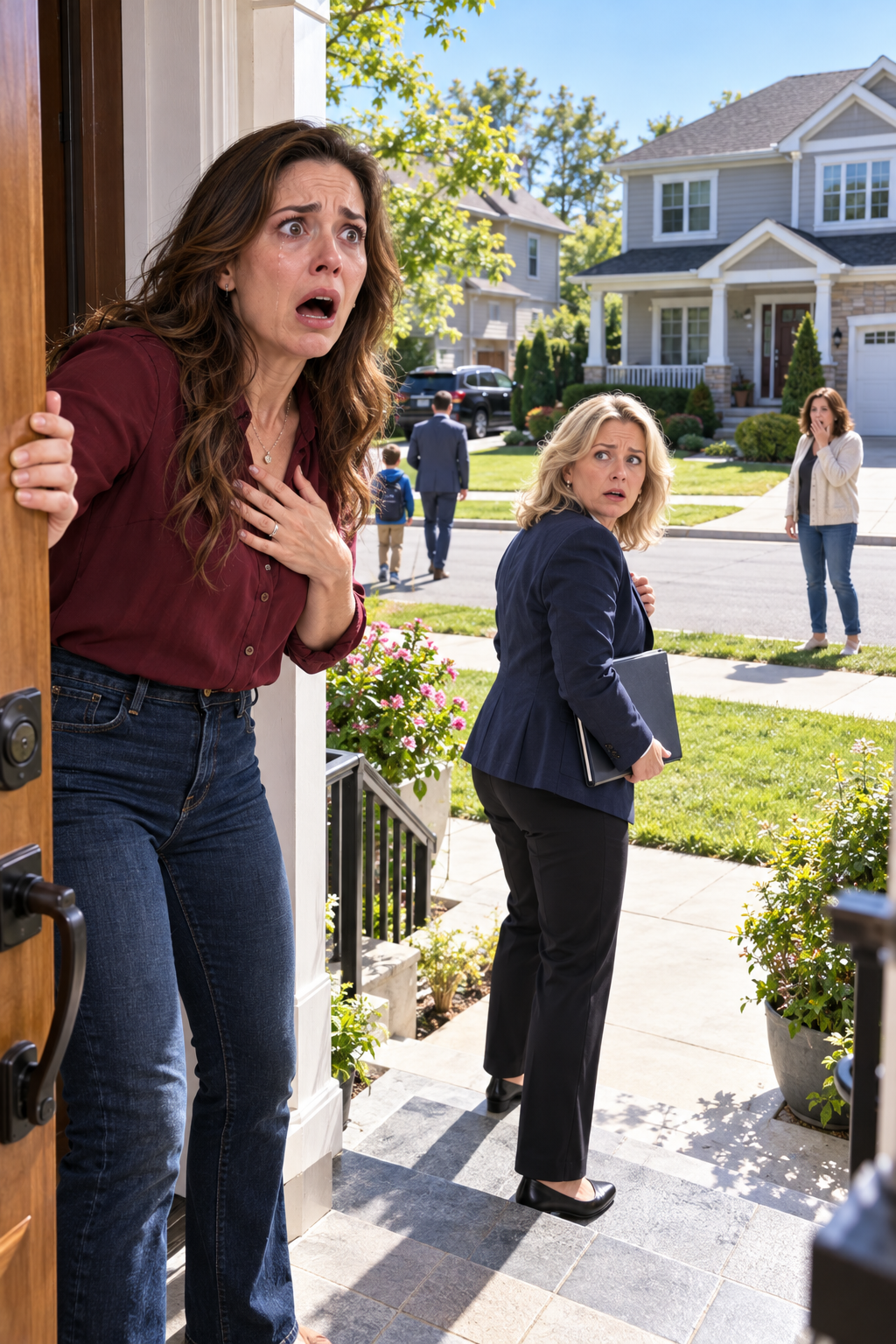
My son told his teacher I lock him in a closet. I have never done that. When the caseworker asked him to show her which closet, he took her hand, walked out our front door, and crossed the street.
My seven-year-old son told his teacher I locked him in a closet whenever he misbehaved. I had never done anything like that, but when a child protection investigator came to our home, my son quietly took her hand and led her across the street. Our kindest neighbor was waiting at the door, smiling as though nothing was wrong. I thought I understood what had happened until, six days later, I found something hidden in my son’s jacket that made me question every afternoon he had spent away from me.
Part 1: The Woman Across the Street
The first time I noticed my son was afraid of our hallway closet, I thought he’d watched something frightening on television. Arlo was seven, and seven-year-olds could turn a coat hanging in the dark into a monster without much encouragement. He’d always had a vivid imagination, especially when it came to dinosaurs, space creatures, and things that might be hiding under beds. I had no idea that the one thing frightening him wasn’t imaginary at all.
My name is Willa Sloane, and at thirty-five, I thought I had a fairly solid understanding of what it meant to be an exhausted working mother. I worked as a CT technologist at a hospital in Chandler, Arizona, spending twelve-hour shifts moving injured strangers through a scanner while doctors waited for images that could change somebody’s life. I could recognize bleeding inside a human skull from a monitor, but I couldn’t recognize the fear sitting across from me at breakfast. That is a difficult thing to admit, even now.
Arlo and I lived in a modest three-bedroom house on a street where the mailboxes leaned slightly, the gravel yards were decorated with ceramic animals, and everyone knew whose car belonged where. I’d bought the place after my divorce, stretching my savings and borrowing a little from my mother because I wanted Arlo to grow up somewhere he could call his own. His father, Quinn, lived in Idaho after taking a construction management job that paid better than anything he’d found in Arizona, and although he called regularly and kept up with child support, most ordinary parenting decisions landed on me. When Arlo developed a fever at midnight or forgot his lunchbox on a Wednesday, there was nobody else standing in my kitchen.
That was why Etta Kincaid seemed like a blessing.
She was sixty-nine, with short silver hair, cheerful pink reading glasses, and the sort of front porch that made people slow down when they passed. There were hanging baskets of yellow flowers, a wooden bench painted turquoise, and a small bell beside her front door that chimed whenever the breeze came through. Etta had worked in an elementary school cafeteria for twenty-seven years, and half the adults in our neighborhood remembered her handing them extra apple slices when they were children. She made lemon bars for new neighbors, organized collections for families who’d lost jobs, and never let anyone walk past her house without asking how they were doing.
Her husband, Gordon, was seventy-four and had retired from a company that serviced commercial air-conditioning systems. He was a big man with thick white eyebrows, a habit of wearing plaid shirts regardless of the temperature, and a workshop full of clocks he enjoyed taking apart. During our first year on the street, he’d repaired a loose hinge on our backyard gate and refused to accept payment. He’d shown Arlo how to use a screwdriver, letting him tighten screws in an old wooden radio while Etta brought us iced tea.
When Etta offered to watch Arlo after school, I almost hugged her.
The after-school program closed before my hospital shift ended, and private childcare with evening hours cost more than my mortgage payment. Etta said she missed having children around and could use a little extra income now that Gordon was retired. We agreed on a weekly amount that was reasonable for both of us, and three afternoons a week she met Arlo at the school bus stop, gave him a snack, helped with homework, and kept him until I finished work.
For the first four months, everything appeared wonderful. Arlo came home talking about homemade cornbread, card games, and how Miss Etta let him use the special scissors with the wavy edges. She bought him a little plastic telescope at a church rummage sale and placed a folded blanket on her porch so he could watch the moon when I worked late. Once, after he spent an entire afternoon making a cardboard spaceship, she sent me a photograph of him grinning beside it.
I kept that photograph on my phone.
It made me feel that even when I couldn’t be home, my son was having a childhood filled with ordinary kindness.
The first strange moment came at a neighborhood potluck in November. Etta had invited us over early, and Gordon was sitting at the dining table while she arranged casserole dishes along the counter. Arlo ran into the living room carrying a toy rocket, accidentally knocking a folded newspaper from Gordon’s chair. Gordon shot to his feet so quickly that the table shook, demanding to know why a stranger was touching his property.
Etta immediately stepped between them. “Gordon, sweetheart, that’s Arlo from across the street,” she said, holding his arm and smiling too widely. Gordon stared at her for several seconds before sitting down again, muttering that people ought to keep their hands to themselves. Etta laughed and blamed his reaction on a poor night’s sleep.
I understood that aging could bring confusion, and I had seen patients with memory problems become frightened in unfamiliar situations. But Gordon was in his own home, and his reaction had been more intense than ordinary forgetfulness. When I quietly asked Etta afterward whether he’d seen a doctor, she said his physician knew about his memory difficulties and there was nothing to worry about. I accepted her answer because she was his wife and because, frankly, I needed her.
By January, Arlo began having trouble sleeping.
He’d wake up calling for me, sometimes with damp pajamas, embarrassed and apologizing before I could say anything. He wanted the hallway light left on and refused to fetch games from the closet near our bedrooms, even though he’d always been the one who loved digging through the board game boxes. When I asked what was frightening him, he rubbed his fingers along the seam of his pajama shirt and said he didn’t like it when doors clicked.
Around the same time, I noticed a yellowing bruise on his upper arm. He said he couldn’t remember how he’d gotten it, which wasn’t unusual for a child who spent recess running across playground equipment. When I asked Etta, she explained that Arlo had stumbled while climbing off the backyard swing and she’d caught him before he fell. She seemed embarrassed and offered to show me exactly where it happened.
I believed her.
The following week, I found pieces of purple crayon in his jeans while sorting laundry. Arlo had an enormous box of crayons at home, but purple was missing from almost every set, and the little pieces in his pockets were worn down until there was barely anything left to hold. I asked whether he was taking crayons from school, and he shook his head so fiercely that I thought I’d frightened him with the accusation. I let it go, promising myself I would ask his teacher.
Then came the Thursday morning that changed everything.
I was at the hospital, preparing to scan a patient who’d been injured in a highway collision, when my phone vibrated with a number I didn’t recognize. I silenced it, but it rang again before the patient was even positioned on the table. During a brief pause, I stepped into the corridor and answered, expecting something about my insurance or another medical bill.
“Ms. Sloane? This is Imani Price with the Arizona Department of Child Safety.”
My stomach tightened before she finished introducing herself.
She told me Arlo had made a statement at school that morning, and his teacher had reported it because she was legally required to do so. During a classroom discussion about places children felt safe, Arlo had said his mother sometimes locked him in a small, dark closet when he’d been bad. Ms. Price explained that they needed to speak with me and check on his safety.
I pressed my back against the cold hallway wall. “I’ve never locked my son in a closet,” I said, keeping my voice low because two nurses were walking past. “There isn’t even a lock on the closet in our house.”
“I understand that’s what you’re telling me,” she replied. “I still need to follow up on his statement.”
She arranged to visit us the next afternoon and asked me not to question Arlo about the allegation beforehand. When I returned to the scanning room, I could barely remember what I’d been doing, although my hands continued moving through the routine automatically. I spent the rest of that shift thinking about every time I’d raised my voice, every time I’d sent him to his bedroom, every time he’d cried because I wouldn’t let him have another cookie. Nothing explained why he would say something so specific.
That evening, Etta opened her front door before I reached the porch. She was wearing a blue apron sprinkled with flour and holding a dish towel, her familiar smile bright beneath the porch light. “Long day again, sweetheart?” she asked, adding that Arlo had finished his homework and eaten two helpings of chicken and rice.
Arlo appeared behind her with his backpack already zipped. Normally he would launch himself at me, talking so fast that half the words ran together, but that night he walked quietly down the steps and climbed into the car. Etta waved from the doorway until we drove away.
At home, while I warmed some milk, I tried to ask about school without violating the investigator’s instructions. Arlo watched the microwave turn and asked whether I was angry with him. I knelt in front of his chair and said there was nothing he could tell me that would make me stop loving him, but instead of looking relieved, he began crying. He wouldn’t say why.
The following afternoon, Ms. Price arrived carrying a canvas bag and a thin folder.
She was around forty, dressed plainly, and spoke with the deliberate patience of someone who understood how frightened I was. She examined Arlo’s bedroom, our bathroom, and the hallway closet, noting that its door had an ordinary handle and couldn’t be locked from the outside. Then she sat on the living room rug, asked Arlo about the model planets hanging above his bed, and let him demonstrate how his favorite toy rover could climb over books.
After several minutes, she asked whether he could show her the closet he’d mentioned at school.
Arlo looked at me, then back at her. Without speaking, he stood, took her hand, and walked toward the front door.
I followed them outside without stopping to put on my shoes. The afternoon pavement was hot beneath my feet, and a delivery truck was turning onto our street, but I barely noticed either one. Arlo led Ms. Price across the road, up the narrow walkway bordered by yellow flowers, and stopped in front of Etta Kincaid’s house.
He pointed toward the front door.
Then he whispered, “It’s in there.”
Part 2: The Closet With the Brass Latch
I had walked through Etta’s front door dozens of times without ever feeling afraid. That afternoon, standing beside the investigator while my son stared at the doormat, I noticed things I’d always overlooked. The curtains were drawn despite the sunshine, the living room television was turned up too loudly, and the air smelled of furniture polish and something burned in the kitchen. Behind the front window, a shadow moved away as we approached.
Etta opened the door almost immediately. “Well, look who’s here,” she said, reaching toward Arlo before noticing that he had pressed himself against Ms. Price’s leg. Her smile became more careful when the investigator introduced herself and showed her identification. Etta invited us inside, saying she had absolutely nothing to hide and was always happy to help anyone concerned about children.
Arlo guided us past the living room, where Gordon sat in his recliner with a blanket over his knees. He was watching an old western, but his eyes followed us with an uneasiness that made me wonder whether he knew who we were. When Etta asked if he wanted some water, he didn’t answer. He only adjusted the blanket and stared at my son.
We reached a narrow hallway near the laundry room.
There were three doors: a bathroom, a guest bedroom, and a shallow closet where Etta stored winter coats and cleaning supplies. On the closet door was a small brass sliding bolt, mounted high enough that Arlo couldn’t reach it. Its metal surface was brighter than the surrounding paint, and two newer screws stood out against the old wood.
I stopped so suddenly that Ms. Price nearly bumped into me.
“What is that doing there?” I asked.
Etta glanced at the bolt. “Oh, that little thing? Gordon was getting into the supplies when he couldn’t sleep. I was afraid he’d hurt himself, so I put a latch on the door.”
Ms. Price asked whether Arlo ever went into the closet.
“Only when he’s playing,” Etta answered. “He likes pretending it’s a spaceship. You know how children are.”
I looked down at Arlo. His hands were clasped tightly against his chest, and he wouldn’t raise his eyes.
Ms. Price asked him if this was the closet he’d been talking about. He gave one small nod, so slight that I might have missed it if I hadn’t been watching him. Etta leaned toward him and said he was her imaginative little astronaut, reminding him how much fun they had playing make-believe. Arlo moved closer to my side.
From the living room, Gordon suddenly called Etta’s name.
“Who brought those people in here?”
Etta turned toward him with a practiced expression of patience. “They’re our friends, honey.”
“I don’t know them.”
His voice had sharpened, and something hard struck the floor. Etta excused herself, hurrying back toward the living room while telling him everything was fine. Ms. Price examined the hallway for another moment before quietly thanking me and guiding Arlo back outside.
We crossed the street without speaking.
Once we were inside our own house, I turned to her. “She has been locking him in there, hasn’t she?”
Ms. Price placed her folder on the coffee table. “Your son’s behavior and what we’ve observed raise serious concerns,” she said. “But I can’t tell you exactly what happened until we’ve completed the appropriate interviews.”
I wanted her to say Etta was responsible and that the mistake had been fixed. Instead, she explained that the investigation still involved me because Arlo had identified his mother in the original disclosure. He would need to speak with a trained child interviewer, and she was arranging additional steps to make sure he was safe.
She also told me Arlo could not return to Etta’s house.
That should have felt like relief, but fear spread through me instead. My next hospital shift was Monday morning, my son was too young to stay home alone, and there was no one within driving distance who could take over his care immediately. When Ms. Price explained that she wanted another trusted adult available during the initial safety assessment, I stared at the floor, realizing that the woman across the street had become the foundation of our daily lives.
“Who do you have?” she asked.
“My mother lives in Yuma,” I answered. “She’s sixty-two and still working.”
“Could you call her?”
I nodded, although I already knew what that phone call would cost my mother.
After the investigator left, Arlo asked if he’d done something wrong. I told him he hadn’t, and that adults were working out a problem he didn’t need to solve. He sat beside me on the couch, holding a stuffed triceratops whose fabric horns had gone crooked after years of being washed. When I asked whether he wanted dinner, he said he wasn’t hungry.
I made his favorite grilled cheese anyway and cut it into four triangles.
He ate one before asking if I had to work the next day. When I told him I was home, his shoulders loosened enough for me to notice. It was the first time I’d seen that reaction to my work schedule, and I hated that I couldn’t tell whether it was new or whether I’d been too busy to see it before.
That night, I called my mother.
Celeste Aranda answered from the kitchen of her small house in Yuma, where she worked as a receptionist for a veterinary clinic. She listened without interrupting while I told her about the teacher, the investigation, and the brass latch on Etta’s closet. The only sound on her end was the steady tapping of something against the counter, which I recognized as her fingernail when she was trying to control her temper.
When I finished, she asked one question.
“Did Arlo say you did it, or did somebody tell him you did it?”
I opened my mouth and found I didn’t have an answer.
“Mom, he’s seven. Maybe he got confused.”
“Maybe,” she said. “But confusion has a reason.”
She arrived the next morning with two suitcases, a bag of groceries, and an expression I hadn’t seen since I was sixteen and a neighbor’s teenage son had backed his truck into our mailbox and blamed me. She hugged Arlo, made him scrambled eggs, and told him she planned to spend some time with us. Then, while he watched cartoons, she sat across from me at the kitchen table and asked me to write down everything I’d noticed since the holidays.
I started with the bruise in January.
Then the nightmares, the wet sheets, the refusal to open the hallway closet, and his sudden fear whenever I said it was time to go across the street. My mother listened as I explained that I’d assumed he was simply getting older and developing anxieties. When I mentioned the purple crayons, she circled those words on her notepad without explaining why.
“Did Etta ever ask you not to come inside?” she asked.
“No. But she usually had him ready on the porch.”
“What about Gordon?”
“He’s been having memory problems. Sometimes he doesn’t recognize people.”
My mother set down her pen. “And you were leaving a seven-year-old in that house until after sunset?”
I felt the accusation even though she hadn’t raised her voice. “Etta said she was taking care of him.”
My mother reached across the table and covered my hand with hers. “I know what she said, sweetheart. I’m asking what you actually saw.”
That question followed me for the rest of the day.
Late that afternoon, while Arlo helped my mother assemble a puzzle, I sat by the front window and watched Etta’s house. I had spent years rushing home from work, collecting my child, and moving immediately into dinner, baths, and bedtime. I’d never sat still long enough to study what happened across the road between five and seven.
At 5:43, Gordon appeared in the front window.
He stood there in his undershirt, looking toward the street as though waiting for someone. A moment later, Etta approached him from behind and gently guided him away. The curtains shifted, then closed.
At 6:12, I heard a sharp crash.
I stood up, thinking something heavy had fallen. Through the closed windows, I could hear Gordon shouting, his voice carrying across the street in frightened bursts. Etta answered him, but I couldn’t understand her words, and the shouting continued for nearly twenty minutes.
When it finally stopped, I saw Etta come out to the porch.
She sat on the turquoise bench with her head bowed and her hands pressed over her face. From a distance, she looked smaller than I’d ever seen her. I understood for the first time that the cheerful woman who waved from her doorway might be living inside a situation far more serious than she’d admitted.
But she was an adult who could call for help.
My son hadn’t been.
The next day, while folding Arlo’s clean clothes, I reached into the cuff of his light jacket and felt something hard caught in the stitching. I pulled out a tiny piece of purple wax, flattened on one side and scratched by something sharp. It was too small to write with, but the color matched the crayon fragments I’d been finding for months.
I brought it to my mother.
She examined it beneath the kitchen light, then looked toward the house across the street.
“What was he using these for, Willa?”
For the first time, I wondered whether my son had been trying to leave behind something I could recognize.
Part 3: The Words He Thought Came From Me
On Monday morning, Arlo asked whether he could stay home from school. He wasn’t sick, and he hadn’t slept badly the previous night, but he stood beside the breakfast table with his backpack hanging from one shoulder and said he didn’t want anyone asking him questions. I told him that his teacher cared about him and that he could always tell her the truth. He looked at me for a moment before asking, “Even if the truth makes somebody sad?”
I wanted to ask who he was worried about hurting. Instead, I told him that grown-ups were responsible for their own feelings and that children didn’t have to hide things to protect them. My mother watched from the kitchen counter, saying nothing until Arlo walked out to the car. Then she reminded me that the investigator had specifically asked us not to interview him ourselves.
I knew she was right.
The hardest thing about those days wasn’t the uncertainty about Etta. It was living beside my son while knowing that something important had happened to him and that I wasn’t supposed to ask him to explain. I could ask whether he wanted pancakes, whether his sneakers felt too tight, or whether he needed help with his homework, but the question consuming every minute of my day had to remain unspoken.
Ms. Price called that afternoon to confirm an appointment at a child advocacy center for Wednesday. She explained that a specially trained interviewer would speak with Arlo alone, allowing him to describe events in his own words without pressure from the adults involved. A detective would review the information, and someone would speak with me afterward about anything relevant to his immediate safety. She sounded reassuring, but I understood that the process had been designed for situations where adults could not simply be trusted.
Tuesday brought the first message from Etta.
She wrote that Arlo hadn’t been at the bus stop and asked whether he was feeling better. I replied that he was fine and would be staying with family while the investigation continued. Less than five minutes later, she called, but I let the phone ring.
Her voicemail was gentle enough to make me feel guilty.
“Willa, honey, whatever misunderstanding has happened, I hope you know I love that little boy. I don’t want you to get yourself worked up over something innocent. Call me when you’re ready.”
That evening, our next-door neighbor, Peggy Laird, knocked with a basket of tomatoes from her garden. Peggy was a retired accountant who had lived on the street long enough to remember when our houses were surrounded by empty fields. After a few minutes of awkward conversation, she mentioned that Etta was terribly upset and that people were starting to talk. Then she said she’d hate to see a good woman ruined because a child had misunderstood a game.
I asked what game she was talking about.
Peggy hesitated. “I don’t know the details. Etta said Arlo made up something about hiding in her closet.”
“Did she tell you the state was investigating me?”
“She said things had gotten out of hand.”
I could feel anger climbing into my throat, but I kept my voice even. “Then you should know she hasn’t told you the whole story.”
Peggy glanced toward Etta’s house and adjusted the basket against her hip. She told me Etta had helped practically everyone on the street at some point, including Peggy when her husband was ill. I thanked her for the tomatoes and closed the door, realizing that Etta had already begun telling a version of events in which she was the person being mistreated.
Wednesday morning, my mother and I took Arlo to the advocacy center. Its waiting room had a fish tank, shelves of picture books, and a rug printed with winding roads for toy cars. Arlo sat on the floor pushing a little yellow bus around a painted intersection while I filled out paperwork with hands that wouldn’t stop shaking. When the interviewer came for him, he asked whether I would still be there when he finished.
“Right here,” I promised.
He disappeared down the hallway carrying his stuffed dinosaur.
I watched the clock above the reception desk move through fifty-two minutes. My mother offered me coffee, but I couldn’t imagine swallowing anything. I kept thinking about the morning Arlo had learned to ride his bicycle, when I’d let go of the seat before telling him and watched him wobble away under his own power. That day, standing beside the sidewalk, I’d been frightened for a few seconds because I couldn’t reach him fast enough if he fell.
This was different.
This was realizing he might have been falling for months while I thought somebody else was holding the bicycle steady.
When the interview ended, Arlo emerged with a small stuffed fox he’d been allowed to choose. He went straight to my mother, who took him outside to look at the garden near the parking lot. A detective named Rowan Pike introduced himself and asked me to sit with him in a quiet room beside the waiting area.
He explained that Arlo had provided a detailed account of being placed in the hallway closet at Etta’s house. According to Arlo, it happened whenever Gordon became frightened or angry, especially late in the afternoon. Etta told him to stay quiet, sometimes secured the door from the outside, and wouldn’t let him out until the shouting stopped.
I gripped the arms of my chair. “How often?”
“He’s described it happening repeatedly over several months. We don’t have a reliable number yet.”
Then Detective Pike told me about the bruise.
Arlo had remembered Gordon grabbing his arm one afternoon after mistaking him for someone who didn’t belong in the house. Etta had separated them, and afterward she began putting Arlo inside the closet whenever she thought Gordon might become upset. She’d told my son that the closet was safer than the living room, that he was helping her, and that good boys didn’t make noise when adults were having problems.
I couldn’t understand why Arlo had named me.
Detective Pike looked down at his notes before answering.
“Your son said Mrs. Kincaid told him you had agreed to the arrangement. She told him the closet was where you wanted him to go when he wasn’t behaving.”
I stared at him.
“She said I wanted that?”
“That’s what he understood.”
The room felt suddenly too small.
I thought of every evening Arlo had climbed into my car without meeting my eyes. Every time he’d apologized for wetting the bed, every time he’d asked if I was angry, every time he’d checked my face before answering a simple question. He hadn’t been keeping a secret from me because he thought I would be horrified.
He’d been keeping it because he thought I already knew.
Detective Pike explained that the next steps would depend on corroborating evidence, interviews, and the prosecutor’s assessment. He cautioned me that even a consistent disclosure didn’t mean every allegation could be resolved immediately. He had arranged to speak with Etta and would let me know if they needed anything else from our family.
Outside, Arlo was sitting beside my mother, making his stuffed fox jump along the edge of the flower bed.
I knelt in front of him.
“Sweetheart, I want you to know something,” I said. “I have never wanted anyone to put you somewhere dark when you’re scared.”
His expression changed.
“Not even when I’m bad?”
“Not even then.”
He looked down at the fox, smoothing its little ears between his fingers. Then he asked a question I will remember for the rest of my life.
“Then why did Miss Etta say you told her?”
I wrapped my arms around him and held him until my knees hurt against the pavement.
For months, a woman I’d trusted had apparently been using my name to make my son accept something I would have stopped the moment I knew.
And I still didn’t know how to prove it.
Part 4: The Neighborhood Saint Had Something to Hide
By Thursday, the street had begun treating me like a woman who’d committed an unforgivable offense. Nobody shouted anything or confronted me directly, which would have been easier to handle. Instead, conversations ended when I approached, Peggy stopped waving from her driveway, and the neighborhood group chat filled with messages about kindness, gratitude, and respecting elderly people who had devoted their lives to others. Nobody used my name, but nobody needed to.
The detective called with an update that afternoon. Etta had denied confining Arlo as punishment and insisted the closet was sometimes part of his imaginative games. She acknowledged Gordon’s increasing confusion but claimed she had never left the child alone with him during a difficult episode. When asked why Arlo believed his mother had authorized the confinement, she suggested he was distressed by my work schedule and might have misunderstood something she’d said.
I asked whether they had seen the inside of the closet.
They had, but only during a limited voluntary visit. Etta opened the door, showed them coats, cleaning products, and a vacuum, and explained that the latch was meant to protect Gordon from dangerous household supplies. Detective Pike said they were pursuing additional evidence rather than relying on one family’s account against another. He sounded frustrated but professional, and I knew enough about investigations to understand that being certain in my own mind was not the same thing as proving something.
Six days after the investigator had come to our house, I finally cleaned out the mudroom where we’d dropped our jackets and bags during that terrible week. Arlo’s jacket was hanging from a hook, its lining partly torn near the bottom seam, and I remembered the purple crayon I’d found caught in the cuff. When I turned the jacket inside out to check the damage, a small folded square of paper slipped from beneath the loose lining.
It was part of an old grocery receipt.
On the blank back, someone had drawn a rectangle in purple crayon. Inside it were short vertical marks, grouped unevenly in clusters, and beneath them Arlo had written two words in shaky block letters.
WAIT QUIET.
I sat on the mudroom floor with the paper in my hand.
For a long time, I couldn’t make myself stand.
I photographed both sides and sent the images to Detective Pike, explaining exactly where I’d found the paper. He called within the hour and asked me to place it in a clean envelope without handling it further. When I said I thought Arlo might have used the marks to measure how long he was kept inside, the detective told me it was a reasonable possibility but that they needed to avoid drawing conclusions before examining the physical evidence.
That night, my mother found me staring at the envelope on the kitchen table.
She sat beside me and told me about caring for my grandfather during the final years of his life. He had sometimes awakened believing he was twenty-five, looking for a bus that had stopped running decades earlier, and once accused her of stealing a watch that was sitting on his own wrist. She reminded me that confusion could produce genuine terror, especially when familiar rooms stopped feeling familiar. But she also said that the illness didn’t excuse what Etta had apparently done to Arlo.
“I understand how a woman could be overwhelmed,” my mother said. “I don’t understand how she could close a door on a child and go back to making dinner.”
I thought about that distinction for hours.
On Friday, I had a meeting with my hospital supervisor, a woman named Hadley Finch who had been generous with my schedule during emergencies but had never been especially patient with surprises. I told her there was an ongoing family safety matter involving my son and that I needed temporary flexibility while childcare was being arranged. I didn’t hide the existence of the investigation, though I kept Arlo’s statements private.
Hadley looked at me for a moment before asking whether the authorities had restricted my ability to work.
I told her they hadn’t.
“Then we’ll talk about the schedule,” she said. “Your personal life is your business, but I do need to know when you can actually be here.”
She offered a short temporary adjustment and the possibility of moving to a different shift when a vacancy opened. I thanked her, knowing that even this modest accommodation depended on colleagues changing their own schedules. I also knew my mother couldn’t remain in Chandler indefinitely without losing her job.
When I got home, a paper bag was sitting beside my front door.
Inside were two containers of Etta’s homemade chicken soup, a loaf of bread wrapped in foil, and a note written in her familiar round handwriting.
For my favorite boy. I hope we can all get back to normal soon.
I didn’t take the food into the kitchen.
I left it sealed in the garage and photographed the note.
The following morning, I saw Etta standing beside her mailbox and decided to speak to her. My mother was inside with Arlo, and I had promised I wouldn’t discuss his interview, but I needed to understand why she’d apparently told other neighbors that I was accusing her unfairly. Etta looked tired, with pale skin under her makeup and a small bandage around one finger, yet she greeted me with the same warm voice she’d used for years.
“Willa, honey, I’ve been so worried about you.”
I stayed on the sidewalk. “Please stop telling people this is some kind of misunderstanding.”
Her smile faltered.
“Well, what else am I supposed to call it?”
“You know what Arlo said.”
“Children say all sorts of things when they’re upset.”
She took a step closer, lowering her voice. “I know you’ve been under terrible pressure. Working those long hours, doing everything by yourself. Nobody would judge you for needing some help.”
I stared at her.
“Are you suggesting I did something to my son?”
“I’m saying tired people sometimes forget how children interpret things.”
For the first time, I saw something beneath her grandmotherly manner that had nothing to do with kindness. She wasn’t shouting or threatening me. She was calmly offering me a way to accept responsibility for something I hadn’t done, as though she expected my exhaustion to make the suggestion reasonable.
I told her never to contact Arlo again until the authorities had finished their work.
Her expression hardened for less than a second.
Then she glanced toward my house and said, “You’ll find that life gets complicated without people willing to help.”
I walked away before I said something I would regret.
That afternoon, I searched for her adult son, Simon Kincaid. I remembered meeting him once during a Christmas visit, when he’d arrived from northern Arizona carrying a cooler and wearing a baseball cap from a forestry company. He lived outside Flagstaff with his wife and two daughters, and Etta had always described him as too busy to come down very often.
I found a public contact number for the company where he worked and left a message requesting that he call me about a family safety concern.
He called that evening.
At first, he sounded irritated that a neighbor had contacted him at work. But when I explained that Gordon’s behavior had become frightening and that Arlo had allegedly been confined inside the house, his voice changed. He asked whether his father had hurt anyone, and when I told him about the bruise, he went silent.
Then he told me something I hadn’t expected.
His father had received a diagnosis involving significant cognitive impairment more than a year earlier. Simon had tried to arrange a professional assessment of his parents’ home, but Etta canceled the appointment and told him the doctors were exaggerating. Since then, every time he offered to help, she’d insisted they were managing perfectly.
“She told me she was still babysitting,” he said quietly. “I thought that meant Dad must be doing better.”
I closed my eyes.
Simon said he would drive down the next day and speak with both parents. Before ending the call, he asked whether I thought his mother had deliberately harmed my son. I told him I couldn’t answer that question for him, but that she had been warned something was seriously wrong and had kept accepting responsibility for a child.
An hour later, Etta called my phone.
This time, I answered.
“I understand you’ve been speaking to Simon,” she said, her voice perfectly controlled. “You’ve made this much worse than it needed to be.”
I asked whether she’d been lying to him about Gordon’s condition.
She didn’t answer immediately.
Then she said, “If you want to see what you’ve done, come over tomorrow. I’ll show you everything.”
Part 5: What He Had Written on the Wall
I didn’t sleep much that night. Every time I closed my eyes, I pictured Arlo standing inside that narrow closet while someone slid the bolt across the door. I kept wondering whether he’d called for me, whether he’d believed I could hear him, and whether he’d eventually stopped because nobody came. By dawn, I had decided that whatever Etta intended to show me, I wasn’t leaving without understanding what my son had endured.
My mother wanted to come with me.
I told her I needed her to stay with Arlo, and that I didn’t want him anywhere near the house. She argued that Etta had already demonstrated she could twist a conversation, but I promised to keep the visit brief, stay near the door, and leave if anything felt unsafe. Before I walked out, my mother made me send Detective Pike a message explaining that Etta had invited me over and that I intended to speak with her.
At ten that morning, I crossed the street.
Etta opened the door wearing a pale green sweater and the same gold necklace she’d worn every Sunday for as long as I’d known her. The house was unusually quiet, and I noticed an overnight bag sitting beside the stairs. When I asked whether Simon had arrived, she said he was expected later but had already been calling all morning, insisting they discuss Gordon’s care.
“He’s talking about taking his father away,” she said.
“He’s trying to get him help.”
“That’s easy to say when you haven’t spent forty-six years loving someone.”
She stepped aside and let me enter.
Gordon was asleep in his recliner, his head tilted toward the window, with a half-finished crossword puzzle on the table beside him. On the wall behind the television hung photographs of him and Etta as young parents, standing in front of a camper at the Grand Canyon, holding Simon on the day he graduated from high school, and dancing at a wedding years earlier. I understood why she feared losing the man in those pictures. I also understood that she’d been asking my son to pay for her refusal to accept the man Gordon had become.
Etta motioned toward the sofa.
“I thought we could have a grown-up conversation without everybody making accusations.”
“I don’t want coffee or a conversation about the neighborhood,” I told her. “I want to see the closet.”
She studied my face.
Then she stood and led me down the hallway.
The brass bolt was still on the door. I noticed a faint rectangular outline in the paint beneath it, as though something else had once been mounted there. Etta explained that Gordon had broken an older latch during an episode of confusion and that she’d replaced it herself. I wondered whether the new bolt had been installed for the reason she was giving me or because she’d needed something Arlo couldn’t open.
“Go ahead,” she said, stepping aside.
I slid the bolt back.
The closet smelled of cedar, dust, and fabric that hadn’t been worn in years. There were coats hanging from a metal rod, including a heavy brown jacket with a torn pocket, and several plastic containers stacked against the wall. A narrow strip of light entered from the hallway, but when I leaned inside, my body blocked most of it.
I could barely see the back.
I moved the coats to one side and knelt.
At first, I thought the purple lines on the wall were scratches left by furniture. Then I realized they had been made with crayon, the same deep violet shade I’d found in Arlo’s laundry. There were hundreds of small marks, some carefully grouped into sets of five, others crossing through one another where the child drawing them had apparently lost track.
They covered the lower portion of the wall from the corner to the baseboard.
Beside them was a picture.
A little square room, a stick figure with short hair, and a closed door with an enormous round knob. Above the figure, Arlo had drawn a clock without numbers, its hands pointing in different directions. Underneath it, in uneven letters, he’d written something so simple that I had to sit back on my heels before I could read it again.
MOM SAID WAIT.
I took out my phone.
My first photograph was blurry because my hands wouldn’t stay still. I photographed the wall from several angles, then the closet door, the latch, and the view from the back corner. I didn’t touch the markings or move anything else.
Behind me, Etta made a small sound.
I turned.
She was standing in the hallway with one hand pressed against her mouth.
“He counted,” she said.
I didn’t answer.
“He counted because he was frightened, and counting helped him settle down.”
My chest tightened so painfully that I thought I might be sick.
“You knew he was scared?”
Etta nodded, tears gathering in her eyes.
“Of course I knew. I wasn’t blind, Willa.”
“Then why did you keep putting him in there?”
She wiped her cheeks with both hands.
For several seconds, she seemed unable to speak. Then the explanation came out in fragments, beginning with Gordon’s worsening memory and ending with the afternoons when he no longer recognized his own home. Sometimes he believed he was back at his parents’ house, sometimes he accused Etta of letting strangers inside, and sometimes he became convinced someone was stealing from him.
One afternoon in January, he’d found Arlo standing near the laundry room and grabbed his arm.
“He thought your boy was somebody breaking in,” Etta whispered. “He didn’t know who he was.”
She told me she’d managed to pull Gordon away and settle him in his chair, but afterward she’d been terrified it might happen again. She couldn’t afford to hire someone to supervise her husband, and she couldn’t bear the thought of putting him in residential care. So she’d decided the simplest solution was to keep Arlo somewhere Gordon couldn’t reach him when his agitation began.
“The closet was the only place with a door close enough to the living room that I could hear him,” she said. “I knew he was safe there.”
I looked toward the dark little space behind me.
“Safe?”
“He wasn’t going to get hurt.”
“He was seven years old, Etta.”
“I never meant to frighten him.”
“You shut him in the dark.”
She shook her head, crying harder.
“He was only supposed to stay until Gordon calmed down. Sometimes it was ten minutes, sometimes longer. I always went back for him.”
I stood so quickly that my shoulder struck the hanging coats.
“How much longer?”
She wouldn’t look at me.
“Sometimes I lost track. Gordon needed me, and your son would get upset if he heard the shouting.”
I asked about the marks on the wall.
Etta said she’d given Arlo crayons after he complained that there was nothing to do inside the closet. She’d told him he could make a mark for every minute or every time he finished counting to twenty, and she’d promised to come back when the house was quiet. In time, counting had become part of the routine.
I remembered the little square of receipt paper tucked into his jacket.
WAIT QUIET.
Those weren’t the rules of a game.
They were the instructions a frightened child had been trying to obey.
Then I asked the question that had been burning inside me since Detective Pike told me what Arlo had said.
“Why did you tell him I wanted you to do it?”
Etta stared past me at the wall.
“He wouldn’t stop asking for you.”
I felt the air leave my lungs.
“He cried the first few times, and Gordon could hear him. It made everything worse.” Her voice broke. “I told him you knew what we were doing and that you wanted him to cooperate. I thought if he believed you agreed, he would settle down.”
I gripped the doorframe.
“So you let him believe I was punishing him?”
“I told him he was being a good boy by listening.”
“That’s not what you told him.”
Etta looked away.
Eventually, she admitted that when Arlo continued crying, she’d told him his mother expected him to behave and that children who didn’t listen sometimes had to stay in the closet. She said she’d been desperate to quiet him, that Gordon’s shouting frightened her, and that every day had become a struggle to manage both of them. It was only after I asked why she hadn’t stopped babysitting that she mentioned the money.
The weekly payments helped cover their household expenses.
Gordon’s care had become costly, and Etta had fallen behind on bills. She told me she was embarrassed to ask Simon for help, especially after spending years insisting they didn’t need him. She was afraid that if she admitted she couldn’t manage, her son would insist on taking over their lives.
“So you kept taking my money,” I said.
She didn’t deny it.
“You could have told me the truth.”
“You would have taken Arlo away.”
“Yes.”
The word came out sharper than I’d intended.
“Of course I would have.”
Etta began crying again, telling me how much she loved my son, how she’d made him dinner and helped him learn to read. I believed that she had cared about him in some way, and perhaps that was the most unbearable part. She had been capable of ordinary affection and terrible selfishness in the same afternoon, and she’d chosen to protect the life she wanted at the expense of a child who trusted her.
Then Gordon woke up.
He called out from the living room, demanding to know who was speaking in his house. Etta hurried toward him, wiping her face, and I followed as far as the hallway entrance. Gordon stood beside his chair, confused and trembling, his attention fixed on me.
“Get out,” he said.
Etta approached him slowly.
“It’s all right, sweetheart. Willa’s just leaving.”
He caught her wrist as she reached toward him.
She winced but didn’t pull away, speaking softly until his grip loosened. His expression changed from anger to confusion, and he asked where Simon had gone, though Simon hadn’t arrived yet. I looked at Etta’s wrist, then at the pictures above the television.
I could see how desperate her life had become.
I could also see exactly how long she had been hiding it.
I walked out without another word.
On my side of the street, I sent Detective Pike the photographs and a detailed account of what Etta had admitted. Then I called Ms. Price and told her there was physical evidence inside the closet that needed to be preserved. Both asked me not to return to the house or discuss the evidence publicly, and I agreed.
When I entered our home, Arlo was sitting at the kitchen table beside my mother, coloring a picture of a rocket.
He smiled when he saw me.
I went to him, knelt beside his chair, and held him for so long that he finally asked whether I’d been crying.
“Yes, sweetheart.”
“Why?”
I looked at his small hands, one wrapped around a red crayon.
“Because I found out somebody wasn’t telling us the truth.”
He thought about that.
Then he reached over and quietly closed the open box of crayons.
Part 6: The Evidence Changed Everything
Simon Kincaid arrived that afternoon, and by evening, an ambulance had taken Gordon to the hospital for an assessment. I learned this from Detective Pike, who called after speaking with Simon and coordinating with the appropriate services. Gordon had become increasingly distressed during his son’s visit, and Simon realized within minutes that his father’s condition was far more serious than he’d understood from telephone calls. For the first time, Etta could no longer maintain that everything at home was under control.
Detective Pike told me that my photographs, Arlo’s statements, the paper found in his jacket, and Etta’s admissions gave investigators important grounds to continue the case. He asked me to write down the conversation as accurately as I could remember it, identifying anything I was certain about and anything I might be paraphrasing. I stayed at my kitchen table until nearly midnight, reconstructing her words while my mother slept in the guest room and Arlo breathed quietly through the baby monitor I’d brought out of storage. I hadn’t used that monitor in years, but hearing him turn over in bed was the only thing that helped me finish.
The next morning, Simon called.
He apologized for disturbing me, then asked whether I would be willing to speak with him about what I’d witnessed. I told him that the authorities were handling the investigation and that I didn’t want to complicate it. He understood, but before hanging up, he said something I had not expected.
“My mother told me she’d been protecting your boy.”
I sat down at the kitchen counter.
“Protecting him from what, Simon?”
“From Dad. She still doesn’t seem to understand what that means.”
He explained that Gordon had become frightened during the hospital assessment and had trouble identifying familiar relatives. The doctors were reviewing his medical history and determining what level of care would be safest. Simon said he had spent years trying to persuade his mother to accept help, but she would end every conversation by assuring him they were fine.
“She’s always been the person who could fix anything,” he said. “I think she couldn’t stand being the one who needed help.”
I listened without offering comfort.
He wasn’t responsible for his mother’s decisions, and I didn’t want to punish him for them. But I also wasn’t willing to turn our conversation into a discussion about how difficult her life had been. Whatever burdens Etta carried, she’d made a conscious choice to take money for caring for Arlo while repeatedly placing him somewhere no child should have been confined.
Simon seemed to understand.
Before ending the call, he told me he’d found a folder containing canceled home-care appointments and letters from a memory clinic dating back many months. Etta had kept the paperwork in a kitchen drawer, hidden beneath warranties for old appliances. There were several handwritten reminders from Gordon’s doctor recommending a safer care arrangement and additional supervision.
I sat looking at the phone after he hung up.
That folder explained why Etta had been so defensive whenever I asked about Gordon’s memory. It also exposed how long she’d been making decisions based on preserving appearances rather than dealing with the situation in front of her. What had happened to Arlo wasn’t a single desperate afternoon. It was the result of months of concealed problems, avoided decisions, and an adult who had decided other people could bear the consequences.
Three days later, Ms. Price came to our house again.
She spoke with my mother, reviewed the safety arrangements, and updated me on the investigation. Arlo’s account had remained consistent, and the evidence from Etta’s home was being documented. She was careful not to promise a particular legal outcome, but she told me there was no basis at that point to continue treating me as the person responsible for the confinement.
I wanted to feel relieved.
Instead, I felt hollow.
I had spent days worrying that authorities might believe I was a mother who hurt her child, while the real danger had been living across the street. Even after Ms. Price’s visit, I found myself watching Arlo too closely, wondering whether ordinary quietness meant he was frightened and whether a smile meant he was hiding something. He began asking why I kept looking at him.
One afternoon, my mother found me standing outside his bedroom while he played.
“You’re allowed to stop checking for a minute,” she said.
I told her that I should have noticed sooner.
She didn’t tell me I was blameless.
Instead, she said, “You missed signs because you trusted someone. Now you have to make different choices. But don’t make him responsible for convincing you he’s okay every five minutes.”
That was the first useful thing anyone had said to me about guilt.
Over the following weeks, I learned that protecting Arlo involved much more than keeping him away from Etta. His pediatrician referred us to a child therapist who specialized in difficult experiences, and I arranged an initial appointment while my mother continued staying with us. At the first session, Arlo refused to enter the playroom unless I stood near the doorway.
The therapist, Dr. Bisset, didn’t force him.
She brought a basket of toy animals to the waiting area and sat on the floor several feet away. After a few minutes, Arlo picked up a small fox and began making it walk along the edge of a chair. Dr. Bisset asked whether the fox liked quiet places, and Arlo answered that it liked places where it could see the door.
She nodded.
“Then we’ll make sure it can.”
I cried in the parking lot afterward, though Arlo had spent most of the appointment talking about animals and drawing a spaceship.
At home, we made a new rule about doors. Arlo could ask me to leave his bedroom door open at night, and if I needed to close a door for privacy, I explained why. We also practiced telling trusted adults when something felt wrong, even if another adult had instructed him to keep it secret.
I was careful not to turn every conversation into a lesson about what had happened.
Some nights, he wanted to tell me about the closet. Other nights, he only wanted to discuss whether astronauts could bring pets to Mars. Dr. Bisset explained that recovery was rarely a straight line and that my job was to respond to what he needed rather than constantly searching for proof that he was improving.
Meanwhile, the neighborhood grew quieter.
Detectives returned to Etta’s house to document the physical evidence as part of their investigation. Simon arranged for Gordon to receive continued medical care, and Etta stopped appearing on the porch each morning. A few neighbors asked questions, but I refused to discuss Arlo’s private statements with people who had already decided what to believe.
Then Peggy knocked on my door.
She wasn’t carrying tomatoes this time.
She looked uncomfortable and asked whether she could speak to me for a moment. She said she’d heard from Simon that Gordon had been struggling for a long time and that the situation with Arlo was more serious than she’d realized. Then she admitted Etta had told her I was accusing an innocent elderly woman because I felt guilty about leaving my son while I worked.
“I shouldn’t have repeated any of it,” Peggy said.
I looked at her.
“No, you shouldn’t have.”
She apologized, then waited as though expecting me to tell her everything was fine.
I didn’t.
I told her that the person who needed kindness from our neighborhood was my son, and that he didn’t owe anyone an explanation. Peggy nodded, wiped her eyes, and walked home. I watched her go without feeling either victorious or particularly satisfied.
The next month, the agency formally concluded that the allegation against me was unsubstantiated. Ms. Price called to explain the outcome and said the investigation concerning Etta was proceeding separately. I thanked her for taking Arlo seriously, because despite the fear I’d experienced, I knew the report had brought his situation to light.
That afternoon, I received a message from Simon.
His father would be moving into a supervised memory-care community near Flagstaff, close enough for Simon to visit regularly. He said Gordon’s doctors believed his condition had been progressing for some time, and that the transition would be difficult but necessary. He thanked me for making him understand what was happening, although I knew that hadn’t been my intention when I’d first called him.
Then he added that his mother wanted to speak with me.
I stared at the message for several minutes.
There had been a time when Etta could have called me from across the street, and I would have dropped whatever I was doing to help her.
That time was gone.
I told Simon I wasn’t willing to speak with her privately, and that anything relating to the investigation should go through the appropriate people. He accepted my decision without argument.
That evening, while I was putting fresh sheets on Arlo’s bed, he stood beside the dresser and asked whether Miss Etta was angry with him.
I told him that what adults felt about the truth was not something he had to manage.
He picked at a loose thread on his stuffed dinosaur.
“She said I was making everything hard.”
I sat on the edge of his bed.
“When did she say that?”
He shrugged.
“Sometimes. When I cried.”
I held out my hand, and he came to sit beside me.
“Arlo, you never made anything hard by being scared.”
He leaned against my shoulder.
Then he asked the question I’d been dreading since the day he led the investigator across the street.
“If you have to work again, who gets to decide where I go?”
Part 7: A Good Reputation Could Not Undo What She Did
I didn’t answer Arlo immediately, because I wanted to give him something better than another promise that everything would be fine. I pulled him into my lap and told him that I was responsible for choosing adults who could safely care for him, but that he always had the right to tell me when something frightened him. I explained that he didn’t have to obey a grown-up who told him to keep something dangerous secret, and that even if someone claimed I had given them permission, he could ask me directly.
“What if they say you’re busy?” he asked.
“Then you tell your teacher, or Grandma, or another adult you trust.”
He considered that.
“Even if they get mad?”
“Especially then.”
For the first time since the investigation began, he looked satisfied with an answer.
In May, my mother made a decision that changed our lives almost as much as Etta’s betrayal had. She had spent weeks driving between Chandler and Yuma, using vacation days, taking unpaid time off, and asking coworkers to cover shifts. One evening, after Arlo went to bed, she told me she’d been offered a position at a small veterinary clinic less than fifteen minutes from our house.
“I’ve already given notice,” she said.
I stared at her.
“Mom, you can’t move your whole life because of this.”
She stirred her tea.
“I’m not moving because of Etta Kincaid. I’m moving because my daughter and grandson need family nearby, and because I’d like to be able to come over for dinner without driving halfway across Arizona.”
I asked about her house, her friends, and the church group she’d spent years organizing. She said she was keeping the house for the moment and that friends were perfectly capable of visiting one another. Then she smiled and told me she’d already found a small rental apartment with a shaded patio and enough room for Arlo to leave his toys scattered around.
I cried harder than I had when the investigator cleared me.
By June, my mother had moved into her apartment, and I had transferred to an earlier shift at the hospital. The schedule wasn’t perfect, and I occasionally worked weekends, but we no longer depended on one neighbor who controlled our entire childcare arrangement. My mother picked Arlo up from school on the days I worked, and Quinn agreed to adjust some of his summer visitation dates so Arlo could maintain his therapy appointments.
Quinn and I had never been good at being married, but we’d gradually learned to be decent parents in separate households. When I finally told him the full extent of what had happened, he was furious, then frightened, then unusually quiet. He apologized for not being closer when Arlo needed him and asked what he could do besides getting angry.
I told him to keep calling.
To show up when he said he would.
To avoid making Arlo explain what had happened over and over again.
Quinn listened.
He began sending Arlo short videos from Idaho, showing him construction equipment and the mountains near his job. During their scheduled calls, he asked about school, dinosaurs, and whatever project Arlo was building. He didn’t demand details about Etta or suggest that Arlo should have told us sooner.
That mattered more than any dramatic apology.
Arlo’s recovery happened in small, uneven steps.
By early summer, he was sleeping through most nights again, although he still wanted the hallway light left on. He began going into our closet to retrieve games, provided I stayed nearby, and stopped apologizing every time he spilled something. But he startled when doors shut unexpectedly, and once, during a visit to the library, he refused to enter a small children’s reading room because the door had a latch.
We left without making it an issue.
Later, Dr. Bisset explained that avoiding unnecessary distress wasn’t the same thing as allowing fear to control his life. She worked with Arlo gradually, helping him practice entering and leaving spaces where he could see how the doors opened. The goal wasn’t to force him to become fearless. It was to let him experience being in control again.
Meanwhile, the criminal case against Etta continued.
I received occasional updates through the victim services office, usually confirming that the matter remained under review or that a hearing had been scheduled. I didn’t follow every rumor circulating through the neighborhood, and I refused to respond when someone anonymously posted online about how quickly people judged elderly caregivers. The evidence was in the hands of investigators, and I had already spent too much of my life trying to make people understand something they didn’t want to hear.
One morning in August, Simon called.
He told me Gordon had settled into the memory-care community and was receiving regular supervision, though some days were still difficult. Simon visited often, and his daughters had begun sending their grandfather photographs with large handwritten labels to help him recognize family members. He said the staff were helping Gordon maintain routines, and that his mother was staying temporarily in Flagstaff while deciding what to do with the house.
Then Simon apologized.
Not for himself, exactly, but for having been so willing to believe his parents were fine.
“I knew Mom was hiding something,” he said. “I thought it was pride. I didn’t think a child was involved.”
I thanked him for helping his father, but I didn’t pretend his family’s relief erased what Arlo had experienced.
Simon seemed to understand.
“She keeps saying she never meant for this to happen,” he told me.
I looked toward the backyard, where Arlo was helping my mother water a small tomato plant.
“She meant to close the door,” I said. “She meant to keep taking care of him without telling me the truth. And she meant to let him believe I wanted it.”
Simon was quiet.
“That’s what she needs to take responsibility for.”
We ended the conversation without discussing forgiveness.
In September, Etta accepted a plea agreement involving a misdemeanor child neglect charge. The court imposed probation and conditions restricting her from providing unsupervised childcare, along with other requirements established by the agreement. Her attorney spoke about the strain of caring for a spouse with serious cognitive decline and about her long history of helping children in the community.
I didn’t dispute that history.
I had lived beside her kindness, eaten her food, and trusted her with the person I loved most. But a history of generous acts did not transform confinement into protection, and her husband’s illness did not give her permission to place my son in a locked closet. I wanted the court to understand that distinction, so I prepared a short victim impact statement.
I wrote about Arlo’s fear of closed doors.
I wrote about the nightmares, the embarrassment of wet pajamas, and the months when he believed his own mother had instructed another adult to punish him. I described how hard he’d worked to trust ordinary routines again and how much effort it had taken our family to make him feel safe. I didn’t include every private detail he’d shared in therapy, because the court didn’t need to own every piece of his childhood.
On the day of the hearing, my mother came with me.
Etta sat near the front of the courtroom wearing a navy cardigan, looking thinner than I remembered. For a moment, when she turned her head, I saw the woman who had brought soup to my house when I had the flu. Then I remembered the purple marks on her closet wall and the words she’d written into my son’s understanding of his own mother.
When I read my statement, my voice trembled once.
I kept going.
Etta cried as she listened, but I didn’t look at her long enough to decide whether the tears came from remorse, shame, or grief. Those feelings belonged to her, and I no longer believed it was my responsibility to interpret them. I had come to speak about my child, not to manage the emotions of the woman who had hurt him.
After the hearing, her attorney approached through a court staff member and asked whether I’d be willing to receive a written apology.
I said no.
Perhaps the letter contained something sincere. Perhaps Etta had finally understood how thoroughly she’d betrayed us. I didn’t need to read it to know that my son deserved a life in which he wasn’t expected to comfort the person responsible for his fear.
Outside the courthouse, my mother asked how I felt.
I looked up at the pale Arizona sky.
“Tired,” I said.
She slipped her arm through mine.
“Then let’s go home.”
When we reached our street, a real estate sign stood in Etta’s front yard.
For the first time since March, I could look at the house without wondering whether my son was trapped somewhere inside it.
But that evening, as I turned off the kitchen light, Arlo asked me something that made me realize the hardest part of the story wasn’t over.
“Mom, if Miss Etta was nice before, how do I know when somebody is really nice?”
Part 8: The Door Stayed Open
I wish I’d had a perfect answer to Arlo’s question. I wanted to tell him that good people were easy to recognize, that the adults who smiled and baked cookies and remembered birthdays would never hurt him. But Etta had done all those things, and pretending otherwise would only teach him that kindness was something simple and easy to identify. So I sat beside him at the kitchen table and told him the truth as carefully as I could.
“Sometimes people do nice things and still make harmful choices,” I said. “That’s why you don’t have to decide whether somebody is good or bad before you tell me something feels wrong.”
Arlo frowned.
“What if everybody likes them?”
“That doesn’t mean you have to.”
He thought about that for a while.
Then he asked whether I had liked Miss Etta.
“Very much,” I said.
“Do you still?”
I looked at him, remembering how Etta had once spent an entire rainy afternoon helping him build a model of the solar system from paper plates. I remembered the meals she’d brought me after difficult shifts and the cheerful notes she left when Arlo accomplished something at school. Those memories were real, but they couldn’t excuse what she’d done.
“I remember things about her that were kind,” I told him. “But I don’t trust her anymore, and I won’t let her take care of you again.”
He nodded.
That seemed to be enough.
As autumn approached, our house slowly developed a rhythm that didn’t revolve around appointments, investigators, and whispered conversations after bedtime. Arlo started second grade, carrying a backpack covered in little planets and a lunchbox with a broken zipper I kept forgetting to replace. He made friends with a boy who lived two blocks away and became obsessed with building elaborate marble tracks across the living room floor.
My mother came over most afternoons.
Sometimes she brought dinner, sometimes she helped with homework, and sometimes she simply sat at the kitchen table reading while Arlo played. We argued occasionally, usually about whether she was feeding him too many snacks, but those arguments felt wonderfully ordinary. They belonged to a family figuring out daily life, not a family responding to something terrible.
I started sleeping better too.
For months, I’d been waking in the middle of the night, convinced I’d heard Arlo calling from somewhere I couldn’t reach. I would walk down the hallway, check his bedroom, and stand there listening until his breathing reassured me. Eventually, I began trusting the quiet again.
I also learned to stop treating every difficult moment as evidence that I was failing him.
If Arlo had a bad dream, it didn’t mean therapy wasn’t working. If he became upset when I corrected him, it didn’t mean I’d damaged his trust forever. He was allowed to be seven and then eight, with all the ordinary fears, stubbornness, silliness, and occasional bad moods that came with growing up.
That realization didn’t arrive all at once.
It came during grocery shopping, when he insisted we buy the cereal with the cartoon astronaut on the box. It came when he complained about practicing his spelling words and rolled his eyes at me for reminding him to brush his teeth. It came when he slammed his bedroom door after an argument about screen time, then opened it himself five minutes later and asked whether we could start over.
The sound of that door closing startled me.
Arlo noticed.
He looked at my face, then at the open doorway behind him.
“Mom, it’s okay. I can open it.”
I smiled, though my eyes stung.
“I know, sweetheart.”
And this time, I did.
Across the street, Etta’s house stood empty for several weeks. The hanging baskets dried out, the turquoise bench disappeared, and someone took down the little wind chime that had marked so many afternoons of my life. When a landscaping crew arrived to clear the yard, I watched them carry away the painted wooden planters Gordon had built years before his illness.
It felt strange to see the house becoming an ordinary property again.
For a long time, it had been the center of everything I feared.
Now it was a building with faded shutters, a neglected lawn, and a realtor’s sign leaning slightly toward the sidewalk. I no longer checked the curtains when I came home from work. I no longer wondered what happened inside after sunset.
One Saturday morning, Peggy stopped me while I was trimming a bush near our driveway.
She told me the house had received an offer and asked whether I’d heard anything about the buyers. I said I hadn’t, and she shifted uncomfortably before bringing up Etta. She said she’d spent a lot of time thinking about how quickly the neighborhood had defended someone based on reputation alone.
“I think we all wanted to believe the easiest story,” she admitted.
I set down my pruning shears.
“The easy story left a little boy with nobody speaking up for him.”
Peggy nodded.
She didn’t try to excuse herself this time. She simply told me she was sorry and asked whether Arlo was doing better. I gave her a brief answer and went back to work.
That was enough.
I didn’t need the neighborhood to hold a meeting, issue a collective apology, or spend the rest of its life talking about what happened. I needed my son to be able to ride his bicycle down the street without becoming a subject of conversation. I needed the adults around him to understand that his experiences belonged to him.
By October, his therapy sessions had become less frequent.
Dr. Bisset said he was developing a stronger sense of safety and was becoming more comfortable expressing difficult feelings. She cautioned that certain fears might return at different ages or during stressful periods, and that we should continue responding patiently if they did. I appreciated that she didn’t promise me a neat ending in which every trace of what happened disappeared.
One afternoon, Arlo emerged from her office carrying a large sheet of paper.
He held it against his chest as though it were something fragile.
“Can we put this on the refrigerator?” he asked.
“Of course.”
He turned it around.
It was a drawing of our hallway.
He’d included the little table near my bedroom, the framed photograph of us at the zoo, and the crooked blue rug that always slid out of place when I vacuumed. At the end of the hallway was our closet, drawn much larger than it was in real life.
The door stood wide open.
Inside were boxes of games, my old winter jacket, and the folded stepladder I kept promising to put in the garage. A bright yellow light filled the space, and on the floor sat a small boy holding an enormous purple crayon. The boy was smiling.
I looked at Arlo.
“Tell me about this.”
He pointed to the yellow light.
“That’s so you can see everything.”
Then he touched the little boy.
“That’s me.”
I nodded.
“And what’s he doing?”
“Drawing.”
“What is he drawing?”
Arlo shrugged.
“Whatever he wants.”
I stood there looking at the picture, unable to speak for a moment.
For months, purple crayons had been the thing I associated with fear. I’d seen their broken pieces in his pockets, the marks on the closet wall, and the paper he’d hidden inside his jacket. Now he’d used one to draw a picture of himself in a place where the door was open and nothing was keeping him inside.
I asked whether I could have a copy for my bedroom.
He smiled.
“You can have the real one. I can make another.”
We stopped at the grocery store on the way home and bought a new box of crayons. Arlo chose the large one with nearly every color imaginable, then insisted on picking out a notebook so he could make more drawings. At the checkout, he noticed a little girl struggling to reach a package of stickers and offered to help her.
I watched him hand her the package.
She thanked him.
He shrugged and walked back to me, already talking about whether we should make homemade pizza for dinner.
It was such a small, unremarkable moment that I nearly missed how much it meant to me.
My son still wanted to help people.
What Etta had done hadn’t taken that part of him away.
That evening, Quinn called to discuss his next visit. Arlo showed him the new drawings through the phone, explaining that he was making a book about a spaceship with rooms that could change shape. Quinn listened, asked questions, and promised to bring a model rocket when he visited.
Afterward, Arlo helped my mother make pizza dough while I chopped vegetables.
Flour covered the counter, the kitchen smelled of warm bread and tomato sauce, and my mother complained that the oven was taking too long to heat. Arlo laughed when she got a streak of flour across her nose and reached for the dish towel to wipe it away.
For a moment, I stood in the doorway and watched them.
I thought about how close I had come to losing the ordinary trust that made a home feel safe.
It hadn’t happened because I didn’t love my son, and it hadn’t happened because Etta was some stranger who had walked into our lives. It had happened because someone we trusted had made a series of choices that served her own needs, and because I had accepted comforting explanations instead of taking my son’s changing behavior seriously. Understanding that didn’t mean spending the rest of our lives trapped in guilt.
It meant making different choices when the truth finally became visible.
Later that night, I tucked Arlo into bed.
He asked for his dinosaur, his water bottle, and the hallway light to stay on. I gave him all three, then sat beside him while he described a complicated plan for building a spaceship in the backyard. His eyelids began to droop halfway through the explanation.
Before I stood, he caught my hand.
“Mom?”
“Yeah, buddy?”
“If somebody tells me you said something, I can still ask you myself, right?”
“Always.”
“Even if it’s a grown-up?”
“Especially if it’s a grown-up.”
He released my hand and rolled onto his side.
I left his bedroom door open the way he liked it.
At the end of the hall, our closet stood open too, with the vacuum, the games, and my old jacket clearly visible beneath the light. I no longer rushed to close it just because it reminded me of something painful. Arlo sometimes went inside to get his toys, and every time, he came out when he was ready.
The drawing he’d made at therapy was taped to our refrigerator, surrounded by school photographs, grocery lists, and a calendar full of ordinary plans.
I never spoke to Etta again.
I didn’t send her updates about Arlo, didn’t invite her to explain herself one last time, and didn’t ask him to forgive her for something he was still learning to understand. Her marriage, her fear of losing Gordon, and the difficult circumstances of her life were real, but they remained hers to face. They no longer belonged in the center of my son’s childhood.
Sometimes I still remember the afternoon Arlo led the investigator across the street.
I remember the hot pavement beneath my bare feet, the cheerful flowers beside Etta’s walkway, and the bewildering sight of my little boy standing in front of a door I had trusted for months. I remember wondering why he’d brought us there, when the answer had been waiting behind that door all along.
I cannot give him back those afternoons.
But I can listen when he speaks, believe him when something feels wrong, and make sure he knows that his safety matters more than any adult’s reputation, comfort, or approval.
And when he calls from his bedroom at night, I answer.
Not because I expect him to be frightened forever.
Because now, when Arlo calls for his mother, he knows she will come.
THE END!