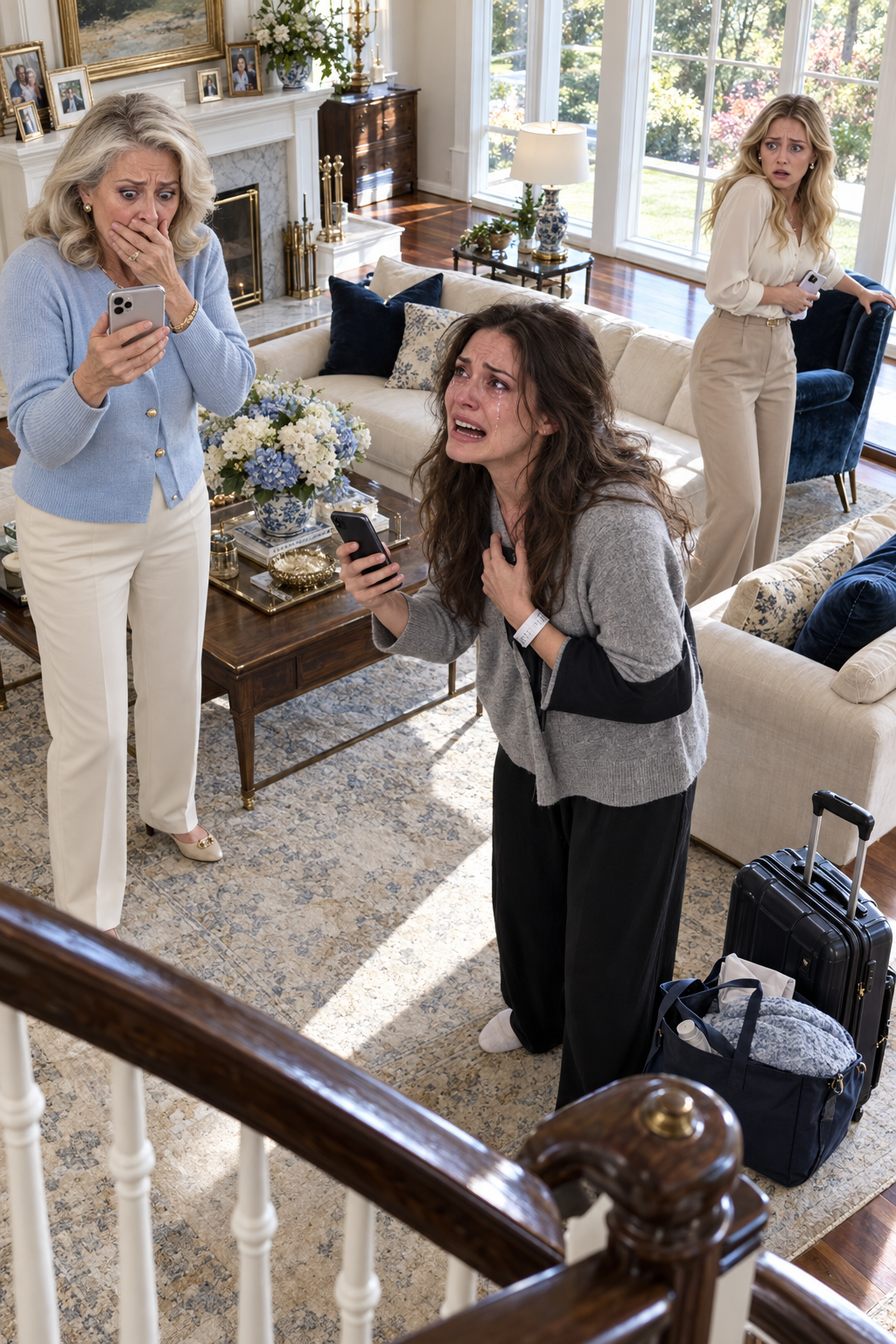
The Night I Fell 22 Feet Off A Roof, The Only One Who Sat With Me Was A Nurse I’d Never Met. 19 Days In The ICU. Not One Visitor. When I Finally Came Home, Mom Said “Why Didn’t You Let Us Know?” I Told Her “I Did. 23 Calis.” Mom Checked Her Phone. My Sister Went White. 2 Years Later…
When I nearly died after falling from a warehouse roof, my mother never visited, never answered my calls, and apparently never cared enough to ask whether I was alive. My older sister assured me she was protecting Mom from stress, and everyone believed her. I stopped arguing and rebuilt my life without them. Two years later, that same sister wanted Mom to sell our childhood home. I was ready to refuse until one careless sentence about my father’s money exposed something far worse.
Part 1
The first person to hold my hand after the accident was a woman named Inez Pritchard, a sixty-two-year-old intensive care nurse who had never met me before that night. She sat beside my hospital bed in Columbus, Ohio, while machines breathed for me and the doctors waited to see whether the bleeding inside my chest would stop. My mother was nearly three hours away, my sister had been told I might not survive, and the visitor’s chair remained empty. Inez later told me that whenever I reached blindly toward the breathing tube, she put her fingers into my palm and waited for me to settle.
My name is Willa Kessler, and until September 2022, I thought I understood my family. I was twenty-seven, worked as a commercial heating and air-conditioning technician, and rented a small apartment in Fort Wayne, Indiana, where the kitchen window looked directly at a brick wall. My older sister, Corinne, lived near our mother in Huntington with her husband, Wesley, and their two children. We weren’t the kind of family that shared everything, but I believed we would show up when it mattered.
Our father, Leon Kessler, had died three years earlier after collapsing while clearing snow from his driveway. He was sixty-one and had spent most of his adult life delivering industrial parts, coming home with cracked hands, a tired back, and something funny he’d heard on the radio. Dad believed a person’s word ought to be worth more than the paper it was written on, which probably explains why he never imagined his own children would need lawyers to sort out what he left behind. His death left Mom with a mortgage-free house, an aging blue Buick, and a $120,000 life insurance payment.
Mom’s name is Daphne, and she is the sort of woman who rinses aluminum foil so she can reuse it. She kept Dad’s insurance money untouched in a separate savings account, even when the water heater failed and the Buick needed expensive repairs. Every Christmas, she reminded Corinne and me that the money was meant to help us buy homes someday, sixty thousand dollars apiece. We always told her there was no hurry, and I believed the arrangement was as permanent as Dad’s photograph above the fireplace.
Corinne was four years older than me, which gave her plenty of practice telling people what I meant before I finished speaking. In high school, she could talk her way out of a detention slip while I got punished for rolling my eyes. As adults, our differences became more practical: I fixed broken equipment, while Corinne managed schedules, paperwork, appointments, and people. When Mom needed help after Dad died, Corinne naturally became the person who handled things.
She organized Mom’s medical appointments, arranged automatic bill payments, replaced her old phone, and set up every password Mom used. There was a small spiral notebook in Corinne’s purse containing login information for everything from online banking to the church newsletter. I thought it was generous, especially because I lived farther away and spent so much time working. When Mom needed a procedure for a blocked heart artery the following spring, Corinne took charge of her recovery, and I was grateful.
I didn’t notice how often gratitude had started replacing questions.
After the procedure, Corinne developed a habit of deciding what Mom could handle. If I mentioned an unusually dangerous job, she would interrupt and say, “Don’t tell Mom that part; you know how she worries.” If Wesley lost a customer or the kids brought home bad grades, Corinne wanted everyone to keep it quiet until Mom’s next checkup. Her reasoning sounded sensible, and because Mom was recovering well, I never challenged the arrangement. Looking back, I can see how easily concern becomes control when nobody asks who gave someone the authority.
The September job was at a distribution warehouse outside Columbus, where my employer, Fenwick Mechanical, had been contracted to replace fourteen rooftop cooling units. Our crew consisted of four technicians, a crane operator, and a supervisor who spent most of his time arguing with a clipboard. I loved rooftop work, particularly early in the morning when the air still smelled like wet gravel and you could watch delivery trucks gathering below. I was usually the only woman on a crew, but after six years in the trade, the men who knew me cared considerably more about whether I could troubleshoot a compressor than whether I belonged on a roof.
The afternoon of September ninth was unusually warm, with a steady wind blowing loose insulation across the roof. We were moving a long section of piping backward toward a replacement unit, and I remember calling to my coworker that we needed to shift left. Earlier that week, a section of protective barrier had been removed near the edge to accommodate the crane, and orange warning tape had been stretched across the opening. I remembered seeing that tape before lunch.
I didn’t see it when I took my final step.
The next part exists in other people’s memories, not mine. My coworker heard metal scrape across the roof, turned around, and saw me disappear backward over the edge. I fell twenty-two feet and struck a pile of wooden pallets that broke apart beneath me, absorbing enough of the impact to keep it from killing me outright. By the time the ambulance arrived, I had broken my pelvis, several ribs, and my left wrist, and one damaged rib had punctured a lung.
My supervisor, Artie Fenwick, followed the ambulance to the hospital. He called our office to find my emergency contact information, only to discover that the number I’d provided six years earlier belonged to Corinne. I’d listed her because Mom rarely charged her phone and refused to drive after dark, while Corinne always answered. It seemed like a reasonable choice when I was twenty-one, young enough to believe an emergency contact was merely a box you filled in before starting work.
That evening, the hospital called Corinne and explained that I was in critical condition. She was told I had suffered serious internal injuries, that I had been placed on a ventilator, and that family members should come as soon as possible. A hospital employee offered to contact Mom directly, recognizing that Corinne might need help delivering the news. Corinne declined and promised she would take care of it herself.
I knew none of this at the time.
While Corinne was answering that call, my mother was preparing supper in the kitchen where we’d grown up. Her kitchen calendar still had the church’s September bake sale circled, and Dad’s old reading glasses were still inside the drawer beside the refrigerator. I used to picture her there during my recovery, turning toward the telephone when it rang and setting down whatever she was holding. For weeks afterward, I couldn’t understand why that familiar image never became reality.
Inez came on duty just after seven that first night. She had short gray hair, a narrow face, reading glasses attached to a beaded chain, and a manner that discouraged unnecessary conversation without ever making anyone feel unwelcome. She’d worked critical care for thirty-five years and could recognize a frightened patient from the way the numbers changed on a monitor. When she looked at my chart and realized I was alone, she brought the visitor’s chair closer.
During her break, she ate crackers from a paper sleeve and watched a thunderstorm move across the hospital windows. Every so often, my hand stirred beneath the blanket, and she leaned forward to offer hers. The doctors had already done everything they could for the moment, but she knew the difference between keeping someone alive and making them less alone. Years later, when she described that night to me, she said, “Honey, I couldn’t promise you’d wake up, but I figured somebody ought to be there if you did.”
By morning, I was still alive, though far from conscious, and my sister had already made the first decision that would change our family permanently. She had decided my mother wouldn’t hear the truth about what happened to me. What I didn’t know was that keeping Mom away from my hospital bed would eventually become useful for something Corinne wanted far more than my recovery.
Part 2
I spent five days dependent on a breathing machine and almost three weeks in intensive care. My memories from those first days are fractured into strange impressions: a plastic cup of ice chips I wasn’t allowed to have yet, someone checking the movement of my feet, the squeak of rubber soles against polished floors. I remember being cold even though the room wasn’t cold, and I remember feeling that I had forgotten something important. By the sixth morning, when the breathing tube was removed, I had one clear thought: I needed to call my mother.
My phone had been destroyed in the fall. A nurse brought me a clear property bag containing my broken watch, a torn work shirt, my wallet, and pieces of the phone that looked as though somebody had stepped on them. I asked whether I could use the bedside telephone, and she showed me how to dial outside the hospital. My voice sounded terrible, rough and weak, but I figured Mom wouldn’t care once she heard I was alive.
The call went directly to voicemail.
Mom had always been careless about charging her phone, so I didn’t worry immediately. I left a message saying I’d been injured at work, I was safe at a hospital in Columbus, and I wanted her to call my room when she could. I tried again after lunch and once more before evening. Nothing.
When I called Corinne, she answered with such obvious relief that I almost cried.
“Willa, thank God. Are you really talking?” she asked, and I could hear a television playing somewhere behind her. I said yes, that I was exhausted and hurting, but the doctors thought I was past the worst part. Corinne told me she’d been beside herself with worry and that the children had been asking about me. Then I asked where Mom was, and everything about the conversation changed.
“She’s resting,” Corinne said. “Her heart has been acting up a little, and I don’t want her making herself sick over this.”
“Does she know I’m in intensive care?”
“She knows you had an accident.”
“That’s not what I asked.”
Corinne sighed, the familiar sound she made whenever she believed I was complicating something simple. She explained that Mom had already endured enough medical stress and that the doctors didn’t want her driving long distances while emotional. She promised to arrange a call the following morning, then suggested I concentrate on healing instead of worrying about everyone at home. I didn’t like it, but the pain in my ribs was making it difficult to talk, and I let her end the conversation.
The following morning came and went without a call from Mom. Corinne said she’d taken her to an appointment, though when I asked which doctor, she responded so vaguely that I assumed she hadn’t heard me properly. On Friday, the explanation was that Mom’s phone had been malfunctioning and Corinne was planning to replace it. On Saturday, Corinne promised to visit me herself, only to call that afternoon saying her youngest child had developed a fever.
Every explanation had just enough truth in it to sound reasonable.
Inez noticed the pattern before I did. She came into my room one evening carrying a blanket warmed in the linen cabinet and found me holding the telephone receiver against my forehead. I’d just heard Mom’s voicemail greeting for the sixth time, and the cheerful recording of her voice hurt more than I expected. Inez draped the blanket over my legs and asked whether I wanted her to contact a hospital social worker.
“My sister’s handling things,” I told her.
“Is she?” Inez asked.
It wasn’t an accusation, exactly, but she looked at the empty chair while she said it. Then she picked up the green marker from the whiteboard beside my bed and drew a small vertical line in the bottom corner. The board held my name, my care team’s names, and the date, and the new mark looked oddly out of place. When I asked what it meant, she said she was keeping track of the times I’d tried to call home.
I laughed because it seemed unnecessary. Inez didn’t laugh back.
Over the following days, the whiteboard became an unofficial record of my stubbornness. I called early in the morning, late in the evening, and sometimes in the middle of the day when the loneliness became harder to bear than the physical pain. Most calls went straight to voicemail, and on the rare occasions when I spoke to Corinne, she always knew exactly why Mom couldn’t come to the telephone. She was showering, sleeping, meeting a friend, or too upset to have a conversation.
A younger nurse named Felix encouraged me to let the hospital contact another relative. I told him there wasn’t anyone else nearby, although I later realized that wasn’t entirely true; Mom had friends from church who would have driven through a snowstorm if she asked. My problem was that I couldn’t imagine Corinne deliberately keeping information from us, so I kept accepting explanations that made less sense with every passing day. When Felix asked whether Mom even knew the name of my hospital, I had no answer.
On my seventh conscious day, Inez took matters a little further. She called Mom’s number from her own cellphone, saying an unfamiliar number sometimes got through when hospital switchboards didn’t. We stood there listening to the immediate voicemail greeting, and Inez frowned at the screen before disconnecting. She had intended to introduce herself and reassure Mom that I was recovering, but she decided against leaving a message after the failed call.
“Funny,” she said quietly, and walked over to add another green line.
I asked what was funny, but she only told me to get some sleep. I knew her well enough by then to recognize that her silence meant she was thinking. I didn’t press her because some part of me had already started entertaining possibilities I wasn’t ready to face. If Mom had decided not to visit, if she’d heard how badly I was hurt and chosen to stay home, I wasn’t sure which part of that would hurt most.
Meanwhile, Corinne continued telling me she would come down to Columbus. The first weekend had been disrupted by her child’s fever, the next by Wesley’s business trip, and the third by heavy rain. I knew Corinne disliked highway driving in bad weather, but I was beginning to understand that there would always be another reason she couldn’t make it. By then I could barely walk between two parallel bars, and even getting into a chair required a physical therapist and an amount of determination I hadn’t known I possessed.
On my last full night in intensive care, Inez counted the lines on the whiteboard. Twenty-three calls, grouped neatly in sets of five, with three marks left over. She photographed the board with my permission, explaining that someone might eventually want a reminder of how hard I’d tried. Then she sat beside me and asked a question so simple that I couldn’t answer immediately.
“When you get home, Willa, are you going to believe what people tell you, or are you going to believe what you’ve seen?”
I told her I hoped there wouldn’t be a difference. She removed her glasses and rubbed the bridge of her nose, looking suddenly older than she had during those exhausting night shifts. After a while, she said she’d worked with families who couldn’t afford to travel, families estranged for decades, and families who loved one another but were too frightened to enter a hospital. What troubled her about mine was that someone kept insisting everything was being handled while nobody appeared to be handling anything.
I didn’t know what to say.
Four days later, the hospital discharged me with a walker, a wrist brace, and instructions that made my apartment seem like an obstacle course. Artie drove down from Fort Wayne to collect me, loading my belongings into his truck while insisting that his company’s safety procedures were going to change. He’d called me regularly throughout my hospitalization, sent photographs from the crew, and kept my paycheck situation from becoming another crisis. When he asked where I wanted to go first, I said Huntington.
It was Sunday, and Mom usually made supper for Corinne’s family. I imagined walking through the kitchen door, seeing her face, and finally clearing up whatever misunderstanding had separated us. I’d rehearsed that moment throughout the drive, right down to the hug I hoped my injuries would allow. But when Mom saw me standing beside the table with my walker, her expression wasn’t relief alone.
She looked surprised.
“Willa,” she said, staring at the brace on my wrist. “Why didn’t anybody tell me it was this serious?”
Across the table, Corinne stopped cutting her daughter’s meat, and the knife remained suspended above the plate. In that instant, I realized my mother hadn’t been avoiding me at all. Someone had been making sure she never knew enough to come.
Part 3
Mom crossed the kitchen before I could answer her and wrapped her arms carefully around my shoulders. She smelled of hand lotion, roasted onions, and the lavender detergent she’d used since I was a child. I wanted to hold on to her, but my injured pelvis made the embrace awkward, and when she stepped back, I saw tears collecting in her eyes. She asked how long I’d been using the walker, why my face looked thinner, and whether the doctors had explained what was wrong with my wrist.
“I was in intensive care for nineteen days,” I said.
Mom stared at me.
“Corinne told me you strained something in your back.”
The room went quiet except for the kitchen clock. Wesley lowered his fork, and the children looked toward their mother, sensing that the adults had stumbled into something they weren’t supposed to discuss. Corinne recovered first, pushing her chair backward and stepping between Mom and me with a concerned expression. She told Mom that I’d insisted on keeping the details private because of her heart, and that she had merely respected my wishes.
“That’s not true,” I said.
Corinne looked wounded, as though I’d struck her without warning. “Willa, you were barely conscious when we talked, and you told me not to frighten her. I was trying to keep everybody calm.”
“I wasn’t conscious when you first got the call.”
“That’s not what I meant.”
“Then tell me what you meant.”
Mom raised one hand, asking us both to stop. She wanted to know why I hadn’t called her, and I told her I’d called twenty-three times from the hospital room, leaving messages whenever the voicemail system allowed it. Her eyes shifted toward the phone sitting on the counter, beside a half-empty bottle of dish soap. She picked it up and searched through her recent calls.
There was nothing from Columbus.
I gave her the hospital’s main number, and she searched again. Corinne stood beside the stove explaining that my memory might have been affected by the accident, that hospital systems sometimes routed calls strangely, and that Mom’s old phone had been behaving unpredictably. The more Corinne talked, the more unsure Mom looked. I was the only person in the room who had spent weeks fighting for the strength to walk, yet somehow I was also the person expected to prove that I’d wanted my mother.
Mom opened her voicemail and showed me several saved messages from church friends and her pharmacy. None were mine. I could see her struggling to reconcile my account with the blank screen in her hand, and I knew she desperately wanted an explanation that didn’t require believing her older daughter had lied. Corinne gave her one before I could speak again.
“Maybe the hospital was using a different number,” she suggested. “Maybe those messages went somewhere else.”
That was the moment I understood how Corinne worked. She never needed to prove her version of events; she only needed to introduce enough uncertainty that nobody felt comfortable challenging it. I looked at Wesley, hoping he might say something, but he was studying the gravy on his plate. The children were silent, and Mom was crying softly into a dish towel.
I told her I needed to go home.
She tried to make me sit down for supper, but my legs were trembling, and I didn’t trust myself to stay calm. Artie was still outside in the truck because I’d asked him to wait until I knew whether Mom wanted me there. I kissed her cheek, promising we’d talk when I felt better, and turned toward the door. That’s when I noticed a shiny house-shaped keychain lying beside Corinne’s purse.
There was a real estate company’s name printed on the back.
“You bought a house?” I asked.
Corinne picked it up too quickly. She said she and Wesley had found a place closer to the children’s school and had completed the purchase during my hospitalization. I congratulated them automatically, then asked whether Wesley’s dealership had given him a promotion because they’d previously said they couldn’t afford a larger mortgage. Corinne answered that they’d been saving for years, while Mom suddenly became fascinated by a stain on the tablecloth.
I might have asked another question if my body hadn’t been hurting so badly. Instead, I went outside, climbed into Artie’s passenger seat, and stared through the windshield while he started the engine. He didn’t ask what had happened until we reached the highway. When I told him Mom hadn’t known how serious my injuries were, he tightened his hands around the steering wheel and said, “That doesn’t sound like a misunderstanding to me.”
For the next several weeks, my world shrank to medical appointments, physical therapy, and learning how to perform ordinary tasks without hurting myself. I couldn’t carry a laundry basket or stand long enough to cook anything complicated, and I hated depending on neighbors for groceries. The accident had made me afraid of unexpected movements, particularly the sensation of losing my balance. Sometimes I’d wake with my heart pounding because my dreams put me back at the warehouse edge.
Mom called twice in October, both times sounding uncertain about what she was allowed to ask. She wanted to know whether I was eating properly and whether Artie was treating me fairly, but she avoided the subject of my unanswered calls. Corinne apparently told her I was recovering well and would return to work soon. I didn’t have the energy to correct every version of my life that Corinne delivered on my behalf.
In early November, Mom called because her phone kept displaying storage warnings. Corinne had gone out of town with Wesley, and Mom was tired of being told she’d have to wait for someone else to fix it. My physical therapist had recently cleared me to drive short distances, so I offered to come up the following afternoon. It was the first request from Mom that didn’t sound like Corinne had helped her rehearse it.
When I arrived, the house smelled like cinnamon and damp leaves. Mom had been sorting her pantry, and there were expiration dates written in pencil on masking tape attached to soup cans. She handed me the phone and went outside to protect the last chrysanthemums from the approaching frost. I fixed the storage problem within minutes, then decided to check whether the device had any connection settings that might explain our missing calls.
I found a list of blocked numbers.
There were two entries. The first was a Columbus telephone number I recognized from my discharge paperwork: the hospital’s main outgoing line. The second was an unfamiliar Ohio cellphone number.
At first, I assumed there must be an innocent explanation. Maybe Corinne had blocked a billing service or mistaken the hospital for an unwanted caller, and Mom simply hadn’t realized what she’d done. But then I opened the voicemail application and scrolled down to a section labeled for blocked messages. Inside were seventeen recordings.
The first was dated September fourteenth, the morning I’d been allowed to speak after the breathing tube was removed.
I pressed play.
“Hi, Mom, it’s Willa. I’m in Columbus, and I had an accident. I’m going to be all right, but I really need to hear your voice.”
I stood in the kitchen holding her phone as the message ended. Then I played another, and another, hearing myself gradually become weaker, quieter, and less hopeful. By the last recording, I wasn’t trying to explain the accident anymore. I was simply asking whether she could call me.
I checked the dates carefully, because something about them made my stomach tighten. The hospital’s number had been blocked before my first outgoing call could reach Mom. Whoever had done it hadn’t reacted to an inconvenient series of messages; they’d prevented the messages from appearing in the first place. Then I remembered Corinne’s confident expression at that Sunday dinner and her explanation that I must have been confused.
Mom came inside carrying a flowerpot and stopped when she saw my face. She asked whether I’d found something wrong with the phone, and for a moment I wanted to play every recording so she could hear the truth immediately. But Corinne had spent years becoming Mom’s most trusted interpreter of anything confusing, and I couldn’t risk another confrontation without preserving what I’d found. I told Mom the storage problem was fixed, copied the relevant information and recordings for safekeeping, and drove home.
Before bed, I called Corinne.
“I need you at Mom’s house on Sunday,” I told her.
She asked what was wrong, and I said we’d discuss it when she arrived. There was a long silence before she asked whether I’d been looking through Mom’s phone. I hadn’t mentioned the phone, and hearing her ask about it told me more than any confession could have.
Part 4
Corinne arrived at Mom’s house the following Sunday wearing the cream-colored sweater she usually reserved for church and family photographs. She carried a bakery box containing pumpkin muffins, kissed Mom’s cheek, and asked why everyone looked so serious. I sat at the kitchen table with Mom’s phone, a folder of printed screenshots, and my discharge paperwork. There was something unsettling about watching Corinne behave normally when I knew she’d already guessed what was waiting.
I explained that I’d been trying to understand why none of my hospital calls reached Mom. Then I opened the blocked-message folder and played the recording from September fourteenth. My voice filled the kitchen, thin and unsteady, asking Mom to call because I was frightened and wanted to know she was there. Mom’s hand moved slowly toward her mouth.
Corinne stared at the phone without speaking.
I played a second recording, dated three days later, in which I mentioned that the doctors wanted me to begin physical therapy. Mom whispered that she remembered that particular day because Corinne had taken her shopping for new curtains. I stopped the recording before it finished and turned the phone so both women could see the blocked-number list. Then I asked Corinne who had added the hospital’s number.
Her eyes filled with tears almost immediately.
“I did,” she admitted.
Mom looked at her sharply. “Why would you do that?”
“Because you weren’t well,” Corinne said, her voice breaking. “Because I’d just watched you go through that heart procedure, and then they called to say Willa might die. I couldn’t bear the thought of you driving all the way to Columbus and having something happen on the road.”
I had expected denial, and the admission briefly knocked me off balance. Corinne continued speaking before anyone could question her, explaining that she’d intended to remove the block once my condition improved. She said the hospital had frightened her, that she hadn’t slept properly for days, and that every time she considered telling Mom the truth, she imagined losing both of us. Eventually, she said, the deception had grown so large that she couldn’t figure out how to undo it.
“Then why did you keep telling me you were coming to visit?” I asked.
Corinne wiped her cheeks with a tissue. She said she’d meant to come each time, but Wesley had work obligations, and the children needed her, and the weather had been bad. When I asked why she’d told Mom my injuries were minor, she replied that she’d panicked and hadn’t known how to explain my hospitalization without causing another medical emergency. The details shifted as she spoke, but the central claim remained the same: everything she’d done had been motivated by concern.
I wanted to believe that because believing it would have made the world simpler.
Instead, I asked whether she understood what nineteen nights without my family had felt like. I described waking to an empty chair, listening to other patients receive visitors, and watching Inez mark each failed call on the whiteboard. I told her about the evening I’d become so frightened that I asked a nurse whether someone from home could simply confirm Mom was alive and well. Corinne lowered her head, and for one moment, I thought she might finally understand the harm she’d caused.
“I’m sorry you went through that,” she whispered. “But I was terrified, too.”
That small word—too—stayed with me.
She had taken my emergency and made herself the injured party, asking us to judge her intentions rather than her decisions. I asked when she’d blocked the hospital’s number, and she said the night the hospital first contacted her. When I pointed out that she couldn’t possibly have been reacting to distressing calls Mom had never received, she insisted she’d been trying to prevent the distress before it happened. It sounded logical until I remembered that she’d had nearly three weeks to reconsider.
Mom reached across the table and took Corinne’s hand.
“I know you were scared,” she said softly.
I waited for Mom to turn toward me, to say that being frightened didn’t excuse keeping a critically injured daughter from her mother. Instead, she spoke about how difficult the months after her heart procedure had been and how much Corinne had helped her. She acknowledged that the blocking was wrong, but she also asked me to recognize that my sister had been under enormous pressure. When I tried to explain that Corinne had known exactly what she was doing, Mom said, “Willa, please don’t make this worse than it already is.”
The words hit harder than I expected.
Mom didn’t intend to hurt me, and I knew that. She was trying to save whatever remained of a family that had already lost Dad, and Corinne lived close enough to be part of her daily life. But I was standing there with seventeen recorded messages proving that I’d begged for help, and somehow the conversation had become about whether I was being sufficiently compassionate toward the person who silenced them. I realized there was nothing else I could say that afternoon that would change her mind.
Corinne invited me to Thanksgiving, promising we could put the whole misunderstanding behind us. She said the children missed me and wanted me to see their new bedrooms. Mom nodded hopefully, as if the promise of a holiday dinner could repair what had happened. I told them I wouldn’t be coming and left before either could begin negotiating.
For a while, I stopped visiting Huntington altogether.
I wasn’t trying to punish Mom, although I knew my absence hurt her. I simply needed to recover without having my feelings edited by my sister. I returned to physical therapy, learned to climb stairs without gripping the railing so hard my fingers went numb, and eventually resumed light duties at Fenwick Mechanical. By January, I was working full days again, mostly preparing estimates and inspecting ground-level equipment.
At night, I kept returning to the timing of Corinne’s decisions. Fear could explain one bad choice, even a terrible one, but she hadn’t just concealed the initial accident. She’d blocked the number, invented a less serious injury, intercepted weeks of communication, and repeatedly promised visits she never intended to make. Those were separate decisions, made across separate days, requiring separate lies.
That winter, I requested copies of my hospital records.
The envelope arrived thick enough to require its own space on the kitchen table. Most pages contained measurements, abbreviations, and descriptions of procedures I barely understood. Buried among them were the nursing notes from my first night, including an entry recorded by Inez at 9:11 p.m. It stated that my emergency contact, Corinne Pike, had been informed that I was intubated, sedated, and in critical but stable condition.
The note also recorded that family visitation was strongly encouraged and that Corinne declined an offer to have the hospital chaplain contact my mother.
I read it several times.
Corinne hadn’t misunderstood the severity of my injuries, and she hadn’t merely failed to volunteer information. Someone at the hospital had offered to tell Mom directly, and Corinne had actively prevented that contact. I printed the page and placed it with my screenshots, then sat in my dark apartment trying to understand what she could possibly have gained.
In February, I called the hospital and asked whether Inez Pritchard still worked there. When she came to the telephone, I introduced myself, and she recognized me before I finished explaining. I told her about the blocked calls, the confrontation, and the nursing note, expecting her to tell me that some people handled emergencies badly. Instead, she asked me to read the second blocked number from Mom’s phone.
I read it aloud.
Inez was quiet for several seconds.
“Willa,” she said, “that’s my personal cellphone. Your sister didn’t just keep the hospital from reaching your mother. She made sure I couldn’t reach her, either.”
Part 5
I sat down on the edge of my bed after Inez told me about her number. I remembered watching her make that call beside my hospital bed, the little crease between her eyebrows when it went straight to voicemail. At the time, I’d assumed it was another technical problem, one more inconvenience in a month filled with them. Now I wondered whether Corinne had seen Inez’s attempted call, recognized it as another possible route to Mom, and blocked that number as well.
“Do you remember what my sister told you the night of the accident?” I asked.
“Enough to know she understood the situation,” Inez replied.
She explained that she’d personally informed Corinne of my condition and encouraged her to arrange a family visit. Corinne had sounded calm, even businesslike, asking how long I was likely to remain unconscious and whether I would be capable of making decisions when I woke. Inez couldn’t give her those answers, and she remembered being surprised by how quickly the conversation turned toward practical matters. Her professional notes were all she could officially rely on, but the questions had stayed in her mind.
“Why would she ask about me making decisions?” I wondered aloud.
“I can’t tell you what she intended,” Inez said. “I can only tell you what happened.”
She was right, and I didn’t want to turn suspicion into certainty without evidence. I thanked her and asked whether she would be willing to speak with Mom if the opportunity ever arose. Inez said she would gladly explain what she’d personally witnessed, provided the conversation respected my privacy and didn’t interfere with her work. She also told me she expected to retire within a couple of years, then invited me to call before that happened.
I put her number into my new phone under a name I knew I’d never confuse with anyone else’s.
The following spring, I was cleared to resume rooftop work. Artie had rewritten the company’s fall-protection procedures, and every employee now attended quarterly safety training. I volunteered to lead some of the sessions, partly because I understood the equipment and partly because I knew exactly what a careless assumption could cost. When one new technician complained about the additional harness checks, I showed him an X-ray of the hardware holding my pelvis together.
He never complained again.
Returning to work gave me something my family had taken away during my recovery: the ability to trust my own judgment. I could diagnose a faulty motor, organize a crew, and tell a building owner that an expensive repair wasn’t necessary. My coworkers depended on my decisions, and the apprentices began coming to me when they were uncertain. Outside of work, however, I remained cautious about relationships, especially with people who insisted they knew what was best for me.
Mom and I continued speaking by telephone.
She called most Sunday afternoons, usually after church, and asked about my job, the weather, and whether I’d met anyone interesting. I answered her questions, but our conversations had become polite in a way that would have been unimaginable when Dad was alive. She occasionally invited me to dinner, and I usually declined because Corinne would be there. Neither of us knew how to discuss the fact that she had forgiven Corinne for something I hadn’t agreed to forgive.
Corinne sent messages every few months. Her birthday text included a photograph of the children holding a cake, while her Christmas card contained a handwritten paragraph about family being more important than mistakes. Around Easter, she emailed to say she had started counseling and was learning how fear could lead people to make unhealthy choices. The message sounded thoughtful, but it never mentioned why she’d continued lying long after the initial emergency had passed.
I left it unanswered.
By the summer of 2024, almost two years after the accident, I had been promoted to lead service technician. I’d paid off the remaining balance on my truck and started saving toward a down payment on a modest house outside Fort Wayne. Nothing extravagant appealed to me; I wanted a garage, a small yard, and enough room to invite friends over without moving furniture. I had even obtained preliminary mortgage approval, though I hadn’t found a place worth buying.
Then, one Wednesday evening in September, Mom called at an hour when she would usually have been watching television.
“Willa, I need your opinion about something,” she began.
Her voice was careful, and I immediately wondered whether Corinne was sitting beside her. Mom told me Wesley had lost his job during the summer after the farm-equipment dealership closed one of its branches. Corinne was working part-time at a dental office, but their mortgage payment was substantial, and they had two children to support. I felt sorry for the children and worried about how the family’s finances would affect them.
Then Mom mentioned the house.
“Corinne thinks I should sell this place and move into their basement,” she said.
I stood beside my kitchen counter, looking at the apartment wall that had been my view for nearly seven years. Mom explained that Corinne and Wesley had finished their basement with a bedroom, bathroom, and separate exterior entrance. They believed she’d be safer living with family, and the proceeds from selling her home could help them manage their mortgage until Wesley found another job. Corinne had already arranged for a real estate agent to visit the property on Saturday.
I thought about Dad’s workshop, the maple tree he’d planted the year I started kindergarten, and the pencil marks recording our heights on the pantry doorframe. I thought about Mom’s garden, the neighbors who brought her mail inside when she traveled, and the church office where she worked three mornings a week. Selling that house would mean surrendering the life she’d maintained independently for decades. Yet she’d called me as though she needed permission to object to something that should have been entirely her decision.
“Do you actually want to leave?” I asked.
“I don’t know,” she admitted. “I’ve lived here so long, but Corinne says I’m being selfish keeping all this space when they need help.”
I asked how much money she expected to give them from the sale. She said she would retain enough for her own expenses and contribute to their mortgage temporarily, although Corinne hadn’t given her an exact figure. The vagueness alarmed me, especially because Mom sounded embarrassed about discussing money at all. I reminded her that she could help without selling her home, but she replied that she didn’t have much savings left.
That surprised me.
Dad’s insurance money had been substantial, and Mom had always been careful with expenses. I asked whether she’d needed to use it for her medical bills, but she hesitated before answering. Finally, she said, “I just don’t want things to end up like they did with your father’s money.”
I turned away from the window.
“What happened with Dad’s money?”
There was a long silence.
“Well, when Corinne bought her house, you told her you didn’t want your portion,” Mom said. “She said you thought she should have it because you weren’t buying anything. I was upset at first, but I thought you were being generous.”
I could hear the refrigerator humming.
“Mom, I never said that.”
“Corinne told me you did.”
“When?”
“While you were in the hospital.”
I gripped the counter.
Mom explained that Corinne had spoken with me during my recovery and passed along a message saying I wanted her to receive the full insurance account. She said Corinne had sent her a text confirming the conversation, and she had relied on that assurance when signing the bank paperwork. According to Mom, the transfer had happened shortly before Corinne and Wesley completed their home purchase.
“How much did you give her?” I asked.
Mom sounded confused that I needed to ask.
“All of it, honey. The whole hundred and twenty thousand.”
Part 6
I slept badly that night, replaying every conversation I’d had with Corinne during my hospitalization. I remembered asking for Mom, arguing about the unanswered calls, and enduring cheerful updates about the children and the weather. Not once had we discussed Dad’s insurance money, and certainly not the idea of giving my sister an additional sixty thousand dollars. I could barely stand without assistance at the time, and the last thing on my mind had been helping someone buy a larger house.
The following morning, I called Mom and asked whether she still had the paperwork.
“Of course,” she said. “It’s in the green file box.”
That box had been part of our family for as long as I could remember. Dad used it for property tax records, insurance policies, appliance warranties, and the instructions for a lawn mower he’d sold ten years before he died. Mom kept everything in carefully labeled folders, and I knew there was a good chance the documents hadn’t moved since Corinne brought them over. I took the afternoon off and drove to Huntington.
Mom had already placed the box on the kitchen table when I arrived. She looked tired, and two cups of tea sat untouched beside a folder labeled HOUSE PURCHASE. I asked whether Corinne knew I was coming, and Mom shook her head. For the first time in years, she had agreed to discuss a family matter without consulting my sister.
Inside the folder was a bank document dated September twentieth, 2022. It identified Mom as the giver of a $120,000 financial gift to Corinne and Wesley, intended for their home purchase. The letter stated that the money was not a loan and that repayment was neither required nor expected. Mom’s signature appeared at the bottom, along with the signature of a loan officer who had witnessed it.
I looked at the date again.
September twentieth was the twelfth day after my fall.
I had still been in intensive care, and Corinne had called me that afternoon to ask whether I liked the hospital food. She’d sounded almost cheerful, telling me to concentrate on getting better because everything at home was under control. I remembered thinking how strange it was that she could be discussing food while I was worried about whether my mother knew where I was. Now that conversation had acquired an entirely different meaning.
There was a yellow sticky note attached to the folder in Corinne’s unmistakable handwriting. It instructed Mom to sign beside the highlighted tabs and explained that the forms were routine mortgage paperwork. Below that, Corinne had written that she’d already checked everything and Mom didn’t need to worry about the details. The note was affectionate, decorated with a small heart.
“Did you read the gift letter before signing?” I asked.
Mom looked down.
“Not carefully. Corinne said the bank needed it quickly.”
I asked why the entire amount had been transferred when the original plan was to divide the money equally. Mom told me Corinne had claimed I’d encouraged her to use my half because I was happy living in an apartment and had no immediate plans to purchase a home. She said Corinne had explained that combining both portions would strengthen the loan application and prevent the lender from delaying their purchase. Mom had been reluctant until Corinne forwarded a text describing my supposed agreement.
She found that message on her phone.
It was dated September nineteenth, the day before she signed the gift letter. Corinne had written that she’d spoken with me and that I wanted her to keep the money because she needed it more. The message added that I was doing well, didn’t want Mom worrying, and felt no resentment about the arrangement. Seeing those claims together made me feel colder than the hospital room ever had.
“That’s not a message from me,” I told Mom. “That’s Corinne telling you what she claims I said.”
Mom read the screen twice. She seemed to be realizing how completely she’d depended on Corinne to interpret my wishes during those weeks. I reminded her that my own phone had been destroyed, that nearly every call I made had been an attempt to reach her, and that Corinne had already admitted blocking them. Mom pressed her fingers against her forehead.
“But why would she do all that?” she whispered.
I didn’t answer immediately because I wanted to be certain before saying something that couldn’t be unsaid. We compared the dates of the hospital calls, the blocked messages, and the financial paperwork. Corinne had learned about my injuries on September ninth, blocked the hospital number, and kept Mom ignorant while preparing the transfer. Eleven days later, Mom signed away the entire insurance account, and Corinne completed her home purchase shortly afterward.
The pattern was difficult to ignore.
Mom began remembering small details she’d dismissed at the time. Corinne had been unusually anxious about the mortgage deadline and had asked whether Mom could transfer the money before the end of the month. She’d insisted that the bank needed the full amount and that the purchase would fall apart without it. Whenever Mom expressed concern about my portion, Corinne repeated that I’d already agreed.
“She told me you were happy for her,” Mom said, almost to herself. “I remember asking twice.”
I asked whether she’d received any independent financial advice before transferring the money. She shook her head and admitted she’d let Corinne arrange the appointment because she didn’t understand mortgage paperwork. Then she opened the folder again, searching through the pages as though an overlooked document might somehow change the facts. Her hands were trembling.
I sat beside her rather than across from her.
For a long time, I didn’t say anything. It would have been easy to announce that I’d been right about Corinne all along, but Mom was beginning to understand that her own decisions had been manipulated, and I knew how humiliating that realization could be. She had trusted the daughter who lived nearby, who attended appointments and managed her accounts, who had been there after Dad died. Now she was discovering that those years of assistance had given Corinne access to the money and information she needed.
Mom finally asked why Corinne would be trying to sell her house now.
“Because their mortgage is in trouble,” I said. “And you’re the only person left she thinks she can convince to pay for it.”
She closed her eyes.
I reminded Mom that Corinne might genuinely have believed her new house was necessary for the family, but that need couldn’t justify hiding a medical emergency or falsely claiming I’d surrendered my inheritance. I also explained that we didn’t yet know every detail of the loan application or whether anyone else had been misled. What we did have was evidence that the financial transfer had been arranged while Corinne controlled communication between us.
Mom asked what I wanted to do.
I considered the question carefully. Two years earlier, I’d wanted someone to believe me, to recognize that I hadn’t been confused or unreasonable, and to acknowledge that being abandoned in intensive care had been devastating. Now I understood that Corinne’s actions had affected much more than my recovery. But I didn’t want my mother’s realization to become another argument in which someone pressured her to make a decision she didn’t understand.
“I want you to hear from someone who was actually there,” I said.
I took out my phone and called Inez.
She answered on the third ring, sounding as though I’d interrupted her packing a suitcase. I explained that Mom had discovered documents connecting Corinne’s silence during my hospitalization to a substantial financial transfer. Inez listened without interrupting, then told me that the following evening would be her final shift before retirement. After thirty-six years in nursing, she was moving to Kentucky to live near her younger sister.
I asked whether we could come to Columbus before her shift began.
“Bring your mother,” she said. “I’ll meet you in the cafeteria at six.”
Mom looked at me uncertainly when I ended the call. I explained that Inez was the nurse who’d cared for me during those first terrible nights, the woman who’d personally spoken to Corinne and documented their conversation. She had no financial interest in our family and no reason to invent details. More importantly, she’d known what was happening at the hospital when Mom had been told practically nothing.
That evening, I contacted a mortgage specialist I’d spoken with during my own house search. I asked general questions about purchasing property from a family member at a reduced price, including something called a gift of equity. She explained that the difference between the property’s market value and the sale price could sometimes count toward the buyer’s equity, subject to the lender’s rules and proper documentation. She also encouraged me to consult an independent attorney if an older relative intended to remain in the property.
I wasn’t ready to suggest the arrangement to Mom yet. I wanted her to make an informed decision, and I wanted the house protected without turning myself into another person managing her life. Still, I wrote down the details and folded the paper into my wallet. For the first time since Mom mentioned the realtor, I could see a possible way forward that didn’t require her to surrender her home.
Friday morning, I arrived in Huntington shortly after noon.
Mom was waiting on the porch with her purse, a cardigan, and the green folder of documents. She’d dressed more carefully than usual, wearing the small gold earrings Dad had given her for their thirtieth anniversary. When I asked whether she needed anything before we left, she shook her head and climbed into my truck. Halfway down the driveway, she touched my arm and asked the question she’d been avoiding since the previous evening.
“Willa, did you think I didn’t love you when I never came to the hospital?”
I kept my eyes on the road.
“For a while, Mom, I thought you knew everything and chose not to come.”
She turned toward the passenger window, and I heard her struggling not to cry. Then she asked whether meeting Inez would make things better between us. I told her I didn’t know, but at least afterward, neither of us would have to rely on Corinne to explain what had happened.
Part 7
The drive to Columbus took us through stretches of farmland where September corn stood taller than the fences. Mom held the green folder on her lap, occasionally straightening its edges or checking that the papers were still in order. We passed the exits I’d traveled with Artie after my discharge, and I remembered how frightened I’d been of every bump in the road. This time, the truck felt steady beneath me, but the conversation I was preparing for made my stomach tighten.
Somewhere outside Lima, Mom asked whether Inez would remember her sister’s exact words from two years earlier. I explained that she had written a nursing note immediately after speaking with Corinne, which was more reliable than either of us trying to reconstruct an old conversation. Mom nodded and looked down at her hands. After several miles, she said she wished she’d questioned Corinne more carefully when I appeared at the house with my walker.
“I wish you had, too,” I answered.
She looked at me, perhaps expecting reassurance, but I couldn’t pretend that her reaction hadn’t hurt. I told her I understood she’d been given false information and that Corinne had deliberately made it difficult for us to communicate. But when I’d finally come home with evidence of that deception, Mom had asked me to move past it before she understood what had happened. She listened without interrupting, and after a while, she said that avoiding conflict had sometimes seemed easier than facing the possibility that one of her daughters was lying.
We reached the hospital just before six.
The cafeteria was in the lower level, past a gift shop and a hallway smelling faintly of disinfectant. A refrigerated display case held wrapped sandwiches, fruit cups, and a lemon pie that looked almost exactly as it had during my hospitalization. I bought Mom a cup of tea and found a table near the windows, where evening light made pale rectangles across the floor. She kept watching the entrance, anxious in a way I hadn’t seen since Dad’s funeral.
At 5:57, Inez walked into the cafeteria wearing navy scrubs and carrying a canvas bag covered in embroidered flowers. Her gray hair was shorter than I remembered, and her glasses still hung from the same beaded chain. She spotted me immediately, smiled, and came straight across the room. When I stood up, she looked me over from head to foot.
“Well, would you look at you,” she said. “Standing without somebody holding your elbow.”
Then she turned to Mom.
“You must be Daphne.”
Mom nodded, and before either woman said anything else, Inez opened her arms. My mother, who rarely hugged strangers, stepped forward and held on to her for several seconds. When they separated, Mom’s eyes were wet. Inez pulled out a chair, sat down, and asked whether we wanted to hear everything from the beginning.
She spoke plainly.
Inez explained the severity of my injuries, the emergency treatment I’d required, and how uncertain my condition had been during the first night. She described calling Corinne shortly after nine, identifying herself as my nurse, and explaining that I was unconscious, supported by a ventilator, and in critical condition. Family members had been encouraged to visit because the medical team could not guarantee how I would respond over the following hours. Corinne had acknowledged the information and promised to notify our mother.
“I offered to have our chaplain contact you,” Inez told Mom. “Your daughter said that wouldn’t be necessary because she would handle it herself.”
Mom stared at her.
“She told me Willa hurt her back,” she said. “She said it wasn’t anything serious.”
Inez’s expression softened, but she didn’t change her account. She told Mom that she’d documented the conversation that night and that the medical record confirmed Corinne had been informed of my condition. Then she described finding me awake days later, struggling to reach home despite being weak and frightened. She remembered the calls because she’d watched my hope fade a little more each time the telephone went unanswered.
Mom asked why the hospital hadn’t called her directly.
Inez explained that Corinne had been listed as my emergency contact and had confirmed she would relay the information. Once I was able to communicate for myself, I had repeatedly attempted to reach Mom and had told the staff that my sister was coordinating everything. The medical team had encouraged additional contact, but the information available to them hadn’t revealed that Corinne was deliberately blocking communication. Inez was careful not to suggest she knew Corinne’s private motives.
“I can’t explain why your daughter did it,” she said. “I can tell you your other daughter wanted you there.”
I opened the green folder and placed the nursing note on the table.
Mom read it slowly, moving her finger beneath each line. I watched her stop at the entry describing the offer to contact her through the chaplain. She closed her eyes briefly, then reached for the next paper. It was the gift letter she’d signed on September twentieth.
I placed Corinne’s message beside it.
“Eleven days after the accident, Corinne told you I’d given away my share of Dad’s money,” I said. “The next day, you signed the transfer, and she called me in intensive care as though nothing unusual was happening. A few days later, she bought her house.”
Mom looked from the financial documents to the hospital note.
For the first time, she wasn’t asking Corinne’s intentions to excuse Corinne’s decisions. She was comparing dates, statements, and actions the way she used to check Dad’s expense receipts against his bank records. The hospital call, the blocked numbers, the invented minor injury, and the money transfer had occurred in an order that now made a terrible kind of sense. Corinne had needed access to Mom’s savings, and keeping me away from her had removed the one person likely to question the arrangement.
Inez reached into her pocket and took out her phone.
“There’s one more thing I’d like your mother to see,” she said.
She opened a photograph taken in my hospital room on the final night I spent in intensive care. The whiteboard filled the screen, showing my name, the date, and the twenty-three green lines in the lower corner. Inez explained that she’d marked every unsuccessful attempt I made to reach Mom. Other nurses had witnessed some of those calls, but she was the one who had kept the count.
Mom touched the phone screen.
“Twenty-three,” she whispered.
Inez nodded.
“She kept asking for you.”
Mom covered her face and began crying. She wasn’t sobbing dramatically or apologizing repeatedly; she simply sat there with tears running between her fingers, unable to look at me. Inez held one of her hands, and I took the other. For the first time since the accident, I felt that Mom understood the loneliness I’d been trying to describe.
After several minutes, Mom unfolded a cafeteria napkin and dried her face. She looked at me and said, “I believed the person who was standing in front of me instead of the person who was trying to reach me.”
I told her that was true.
She nodded slowly.
“And when you finally came home, I did it again.”
I didn’t answer, because she wasn’t asking a question.
We sat together until the cafeteria became quieter and the evening staff started coming through for dinner. Eventually, Mom asked what she should do about Corinne and the house. I told her the first decision was entirely hers and that she didn’t have to sell simply because someone else needed money. She straightened her shoulders and said she wanted to remain in the home she’d shared with Dad.
“Then tell Corinne you’re not selling,” I said.
“I will.”
I explained the mortgage specialist’s suggestion about a gift of equity. If Mom wanted, we could have her house independently appraised and explore a purchase in which a sixty-thousand-dollar discount would provide part of my equity. She could receive the remaining purchase proceeds for her own financial security, while I would assume responsibility for the mortgage, taxes, insurance, and maintenance. We could also consult separate legal advisers about protecting her right to remain in the home, with every detail disclosed to the lender.
Mom listened carefully.
“You’re saying you could buy it, but I wouldn’t have to move?”
“Only if everyone involved agrees to the arrangement,” I said. “And I’d move back in, at least to start with, so you wouldn’t be living there alone. But you get your own lawyer before signing anything, and if you don’t like the plan, we forget it.”
She considered that for a long time.
Then she asked whether I wanted the house because I loved it or because I felt someone owed me something. I told her both feelings were probably involved, but I wouldn’t buy it unless the financial terms worked and she genuinely wanted the arrangement. I didn’t want another family transaction built on pressure and promises nobody had examined. She smiled faintly and said Dad would have appreciated seeing us insist on reading the paperwork.
Inez laughed.
“If there’s one thing I’ve learned about families, it’s that good intentions don’t replace a signed agreement.”
We walked her to the staff elevators shortly before seven. She hugged Mom again, then turned to me and adjusted the collar of my jacket as though I were still her patient. She told me to keep up with my medical appointments, wear my safety equipment, and stop pretending I could move heavy furniture alone. When the elevator arrived, she stepped inside with her canvas bag and raised one hand.
“Call your mother,” she told me.
“I will.”
“And Daphne,” she added, looking past me, “answer her.”
Mom laughed through fresh tears and promised she would.
On the drive home, the sky darkened over the fields, and neither of us spoke for nearly an hour. Then Mom took the green folder from her purse and said she’d like to make two appointments on Monday, one with an attorney and one with the real estate agent to cancel Saturday’s visit. I reminded her that she could simply call the agent herself, and she agreed. She wanted Corinne to hear the decision directly from her, without me speaking on her behalf.
When we pulled into the driveway, Mom looked at the house for a long time.
“I spent two years thinking you didn’t need me anymore,” she said. “Now I know somebody worked very hard to make us both believe that.”
She opened the truck door, stepped onto the driveway, and walked toward the porch. For the first time since Dad died, I saw my mother preparing to make a difficult decision without asking Corinne what she thought.
Part 8
The real estate agent arrived Saturday morning in a white SUV with a photograph of herself printed on the side. She carried a folder of recent neighborhood sales and looked prepared to inspect every room in the house. Mom met her on the porch before she reached the front steps. I watched from the living room window as Mom explained that she would not be listing the property and apologized for the unnecessary trip.
The agent looked surprised but remained professional. She confirmed that no listing agreement had been signed, thanked Mom for letting her know, and returned to her vehicle. Mom waited until the SUV had backed out of the driveway before coming inside. She was just closing the front door when Corinne arrived carrying a clipboard and two travel mugs.
“Where’s the realtor?” she asked.
Mom took a breath.
“I sent her home.”
Corinne looked past Mom and saw me standing beside Dad’s old recliner. Her face changed, and she set the travel mugs on the hall table without offering either of them to anyone. She wanted to know why I was there, whether I’d been pressuring Mom, and what had happened to their agreement. Mom interrupted before I could respond.
“There was no agreement, Corinne. There was a suggestion, and I’ve decided against it.”
Corinne shook her head.
“Mom, we’ve talked about this for weeks. You said you understood.”
“I understand more now than I did.”
Mom led us into the kitchen, where the green file box was open on the table. The hospital note, blocked-number screenshots, Corinne’s September nineteenth message, and the $120,000 gift letter were arranged beside one another. Corinne stopped walking when she saw them. For several seconds, she looked like a person who’d entered the wrong house.
Mom sat down and asked her to do the same.
Corinne remained standing.
“Yesterday, Willa took me to Columbus,” Mom began. “I met the nurse who cared for her after the accident.”
Corinne gave a small, incredulous laugh. She asked why anyone would drive nearly three hours to discuss something that had happened two years earlier, particularly when I was now healthy and working again. Mom didn’t answer the question. She picked up the nursing note and read aloud the part confirming that Corinne had been told about my critical condition.
“That woman doesn’t know what was happening in our family,” Corinne said.
“She knows what she told you.”
“Mom, I’ve apologized for the phone situation.”
Mom placed the note down.
“You apologized for being afraid. You never told me you were trying to buy your house with money you knew Willa expected to receive.”
Corinne glanced toward me, and I recognized the expression immediately. It was the look she gave whenever she wanted me to become angry enough that everyone else would focus on my behavior instead of hers. I said nothing. I hadn’t driven Mom to Columbus to win another shouting match.
Mom continued.
“You told me Willa agreed to give you her half. You knew she hadn’t. And while she was in intensive care, you kept me from speaking to her until after I’d signed the paperwork.”
Corinne sat down heavily.
For a moment, I thought she might finally tell us the truth without dressing it up. Instead, she began explaining how difficult the mortgage process had been and how Wesley’s income varied because of his sales commissions. Their lender had questioned their reserves, and the house they wanted was more expensive than they’d originally intended. They had already paid for inspections and made promises to the children about moving before the financing became uncertain.
“We needed the money,” she said.
Mom waited.
Corinne looked at me.
“Willa wasn’t buying a house then. She didn’t even know when she’d be working again.”
I felt something inside me settle.
There it was, beneath all the talk about Mom’s heart and Corinne’s fear. My sister had looked at my injuries, my uncertain future, and the money Dad intended for me and decided that her needs mattered more. She hadn’t taken the money because she believed I would freely give it to her. She’d taken it because she knew I was in no position to stop her.
“You thought I wouldn’t need it because I might never work again?” I asked.
Corinne’s expression tightened.
“That’s not what I said.”
“But it’s what you were counting on.”
She didn’t answer.
Mom stood up from the table.
“I’m not selling this house,” she said. “I’m not moving into your basement, and I’m not giving you money for your mortgage. Willa and I are going to investigate another arrangement, with independent legal advice, because I still intend to honor your father’s wishes as fairly as I can.”
Corinne stared at her.
“You’d rather put this house in Willa’s name than help your grandchildren keep theirs?”
Mom didn’t move.
“Your children need a safe place to live,” she said. “They don’t need that particular house. You and Wesley chose a mortgage you couldn’t manage without money that wasn’t meant entirely for you. I’m not going to solve that decision by giving up the only home I’ve ever owned.”
Corinne began crying again, but this time Mom didn’t reach for her hand. She told her that she loved her and the children, but love didn’t mean handing over control of her finances. She also asked Corinne to return the password notebook and stop accessing her accounts, phone settings, and personal documents. Corinne protested that she’d spent years helping, and Mom acknowledged the help without allowing it to erase what had happened.
I watched my mother separate gratitude from obligation, something I’d struggled to do for years.
Corinne eventually stood and collected her purse. At the doorway, she turned toward me and said that I must be pleased with myself. I told her I was relieved Mom finally knew the truth, but there was nothing about the last two years that made me happy. She asked whether I intended to hold the accident against her forever. I answered that the accident wasn’t what I held against her.
“You weren’t responsible for my fall,” I said. “You were responsible for what you did afterward.”
She left without another word.
Over the following weeks, Mom arranged independent legal and financial advice. Her attorney reviewed the earlier gift documents, explained the limited options for recovering money already transferred, and helped her remove Corinne’s access to her accounts. We also obtained a professional appraisal and spoke with lenders about a family purchase that would protect Mom’s occupancy rights and comply with the financing requirements. Nothing was signed until she had reviewed the terms privately with her own attorney.
The house appraised at approximately $190,000. Under the arrangement ultimately approved, Mom sold it to me for $130,000, with the sixty-thousand-dollar difference documented as a gift of equity. I financed the purchase, moved back to Huntington, and took responsibility for the property’s expenses. Mom received the sale proceeds, which she placed in accounts under her exclusive control, and her attorney ensured that her right to remain in the house was properly protected.
The arrangement didn’t magically replace Dad’s lost insurance money. I was taking on a mortgage, and Mom was transferring a valuable asset to me at a discount. But it gave me equity equivalent to the portion Dad had intended for me, while leaving Mom with savings, housing security, and decisions she could make for herself. Most importantly, every signature followed a full explanation rather than someone’s promise that reading wasn’t necessary.
Our closing took place in November.
Mom arrived carrying a notebook containing questions she’d written for the title officer. She read the settlement statement slowly, asked about two fees she didn’t recognize, and requested clarification about the occupancy provisions before she signed. Nobody rushed her. When the last document was completed, she handed me the house keys across the table.
I looked at them, then handed them back.
“You still need these,” I said.
Mom smiled.
“And you’ll still need to knock if my bedroom door is closed.”
I moved into my old bedroom temporarily while we converted the unused downstairs study into a small living area for me. The arrangement wasn’t glamorous, but I had space, Mom had privacy, and I could drive to work without difficulty. I replaced the aging furnace, repaired the loose porch railing, and finally cleared out Dad’s workshop, keeping his best tools and donating the rest to a vocational training program. For the first time in years, being in that house didn’t feel like returning to an argument.
Corinne and Wesley listed their home the following January. Their financial problems had grown beyond the mortgage, and without another infusion of family money, they couldn’t sustain the payments. The property sold in March for less than they’d hoped, leaving them with little after their closing expenses and debts. They moved into a smaller rental closer to Wesley’s parents, and he found work with an agricultural supply company several months later.
I didn’t celebrate their losses.
The children hadn’t chosen any of it, and I knew how frightening a sudden move could feel at their ages. Mom continued sending birthday cards and visiting when arrangements could be made without discussing her finances. I never asked her to stop loving her grandchildren or even to stop loving Corinne. What I asked was that she stop allowing love to substitute for judgment.
Wesley came to see me once after they moved.
He stood on the porch holding his cap and admitted that Corinne had told him Mom had voluntarily given them the insurance money with my blessing. He said he hadn’t known about the blocked hospital calls or the false message until the confrontation. I believed he hadn’t known everything, although I couldn’t understand why he’d never questioned such a generous gift. He apologized for his silence at that Sunday dinner, and I thanked him without pretending it made the memory easier.
He asked whether I might eventually speak to Corinne again.
I told him I didn’t know what there was left to say.
Corinne wrote one final letter that summer. She acknowledged that she’d lied about my consent and concealed my condition because she was afraid Mom would abandon the house purchase to be with me. She said she’d convinced herself I would recover and that I would eventually understand why she’d needed the money. There were apologies, but there was also a request that I stop making her feel like the worst person in the family.
I read the letter twice, folded it, and placed it in the same file as the hospital records.
I didn’t respond.
Forgiving her wouldn’t change the money, the injuries, or the nights I spent staring at the empty visitor’s chair. More importantly, I no longer believed family membership entitled someone to unlimited access to my trust. I could wish Corinne a stable life without inviting her back into mine. That distinction became easier to live with as the months passed.
Mom changed her emergency contact information everywhere. She learned how to check blocked numbers, verify transfers, and recover passwords without calling Corinne. Every Sunday evening, she reviewed her phone settings while I washed the supper dishes. She liked doing it herself, and I liked watching her become confident with things she’d once believed were beyond her.
Our relationship wasn’t instantly repaired.
There were uncomfortable conversations about the years she’d accepted Corinne’s explanations and the times she’d chosen peace over asking difficult questions. Sometimes Mom apologized, and sometimes I told her an apology wasn’t what I needed that day. But she listened now, even when she didn’t like what she heard. Slowly, that became more valuable than another promise that everything would be fine.
Inez retired to Kentucky as planned. She spent her first spring growing tomatoes, arguing with squirrels, and sending photographs of her garden to former coworkers. We exchanged occasional messages, and Mom insisted on sending her a handwritten Christmas card. In June, Inez called to say she would be visiting a nursing-school friend in Fort Wayne and asked whether we’d be home that Sunday.
Mom immediately offered to cook supper.
She made pot roast with carrots, mashed potatoes, green beans, and the same gravy she’d served the day I returned from Columbus. Inez arrived carrying a homemade blackberry cobbler and a little potted tomato plant for the kitchen windowsill. We ate until nobody wanted dessert, then ate the cobbler anyway while Inez told stories about decades of night shifts. Mom laughed so hard at one story that she had to take off her glasses and wipe her eyes.
After supper, we cleared the table together.
Inez washed, Mom put dishes away, and I dried, listening to them argue cheerfully about the proper way to stack plates. The kitchen smelled of coffee and dish soap, and the evening sun shone through the curtains Mom had chosen without asking Corinne’s opinion. On the refrigerator hung a small magnetic whiteboard where Mom listed appointments, groceries, and reminders about the garden. A green marker dangled from a string attached to its side.
Inez noticed it while reaching for a clean towel.
She picked up the marker and drew a single vertical line in the lower corner.
Mom turned around.
“What’s that for?”
Inez looked at me and smiled.
“First Sunday supper since I came back into your lives,” she said. “Seems worth keeping track of.”
Mom studied the mark for a moment, then took the marker gently from her hand.
“I think I’ll keep counting,” she replied.
There are more than thirty marks on that refrigerator now. Mom adds another after every Sunday supper, occasionally reminding me if work keeps me late and I arrive after the food is already on the table. She never lets me draw the lines myself, and I don’t argue with her about it. Some things matter more when the person responsible chooses to do them.
I still have the photograph of the hospital whiteboard with its twenty-three marks. I keep it beside my medical records, not because I want to relive those weeks, but because it reminds me how easily someone can manipulate a family by controlling what others are allowed to know. My sister’s lies cost her the trust she once depended on, and when her own financial decisions caught up with her, she no longer had my mother waiting to rescue her. There was no dramatic victory, no public humiliation, and no moment when she finally said everything I wanted to hear.
There was only the truth, and what each of us chose to do with it.
One Sunday evening, long after Inez had gone home, Mom and I sat on the porch watching the last light disappear behind the maple tree Dad had planted. She asked whether I ever wished we’d discovered what Corinne had done sooner. I told her I thought about it sometimes, especially when my hip ached after a long workday or I remembered how frightened I’d been in the hospital. Then she asked whether I believed our family could ever become what it had been before.
“No, Mom,” I said. “I don’t think it should.”
She looked at me, waiting.
“Back then, we thought keeping the peace meant trusting whatever Corinne told us. Now we ask questions, make our own decisions, and tell each other things even when they’re difficult. I’d rather have that than go back to pretending nothing was wrong.”
Mom nodded and rested her hand over mine.
For a long time, we sat quietly listening to the crickets and the occasional car passing on the road. The porch light clicked on, illuminating the steps Dad had repaired so many times and the flowerbeds Mom still insisted on tending herself. Inside, the kitchen was clean, the telephone was charging, and the little green marks remained on the refrigerator. I knew then that I didn’t need my sister’s forgiveness, confession, or approval to feel at home again.
The first twenty-three marks belonged to the days someone kept my mother from hearing me.
The new ones belong to the days she chooses to listen.
THE END!