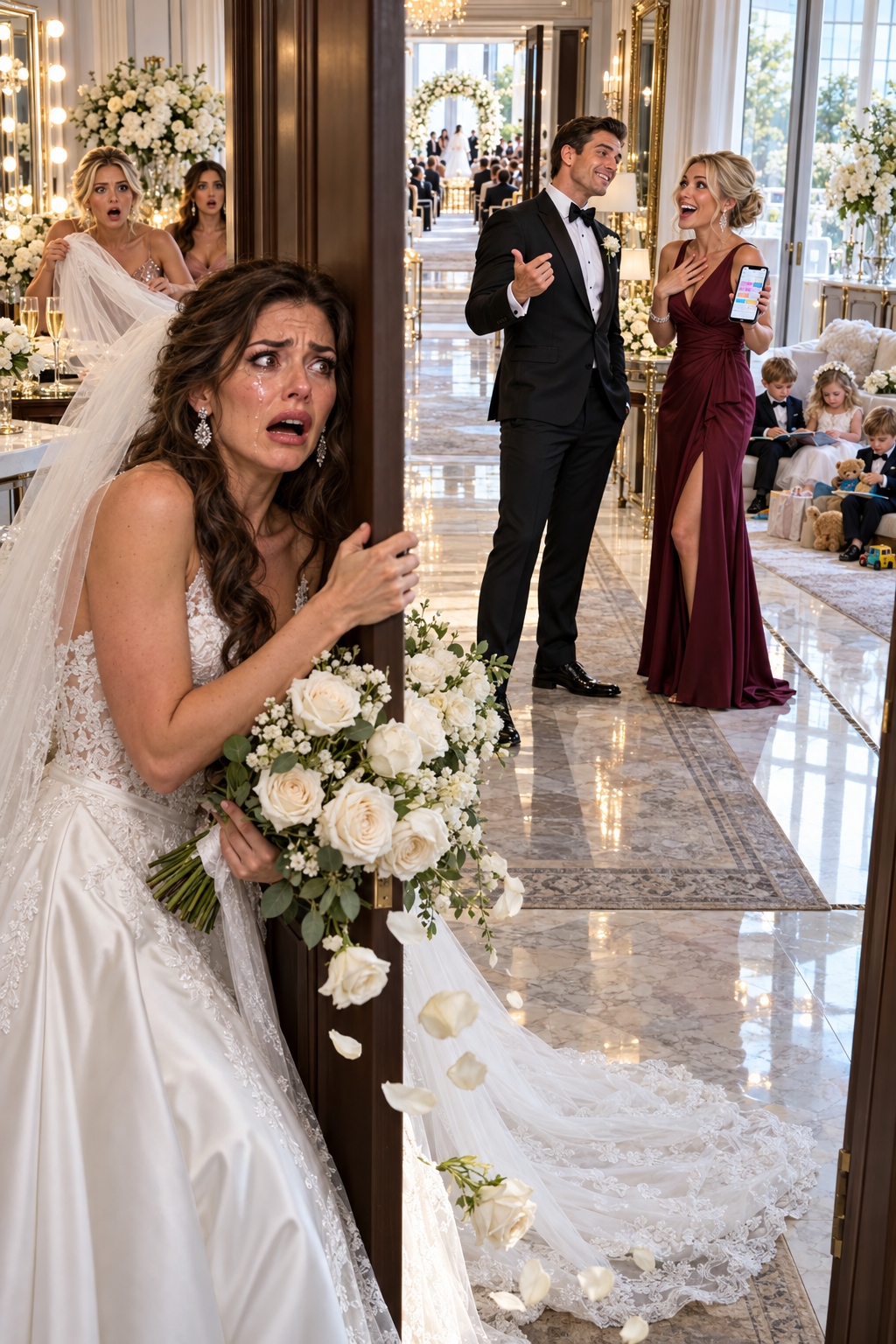
10 Minutes Before Our Wedding, I Heard My Fiancé Tell His Sister, “Don’t Worry About Daycare Anymore. Mara Will Take Care Of All Three Kids Starting Monday.”
Ten minutes before my wedding, I took off my heels to surprise my fiancé and overheard him promising his sister that I would quit my job to raise her three children. She laughed and asked whether I knew. He said marriage would make it difficult for me to refuse. I didn’t scream or confront him. I walked down the aisle anyway, carrying something he never expected. Three days later, a bank investigator showed me an application bearing a married name I had never legally taken.
Part 1
At 3:50 on a Saturday afternoon in October, I was walking barefoot through the back hallway of Alder Grove Community Church, carrying my wedding shoes by their silver straps. The ceremony was supposed to begin in ten minutes, and the pastor’s assistant had just told me my fiancé wanted a private moment before we exchanged vows. I thought Grant was nervous, and I wanted to catch him off guard with a kiss. Instead, I stopped outside the fellowship room when I heard him say something that made the cold tile beneath my stockings feel strangely distant.
“Don’t worry about daycare anymore. Mara will take care of all three kids starting Monday.”
His sister, Brenna, laughed. “Does she actually know that’s what she’s doing?”
“She knows family comes first,” Grant answered. “Once we’re married, she’ll come around. She’s not going to embarrass herself by backing out over a little babysitting.”
I pressed my palm against the painted cinder-block wall, trying to understand how the man I was supposed to marry in ten minutes had just volunteered my entire future without asking me. Monday was supposed to be my first day in a new position, the biggest promotion of my career. Grant knew that because I had told him myself, sitting across from him at our favorite Thai restaurant, barely able to contain my excitement. He had smiled, raised his glass, and told me he was proud of me.
My name is Mara Ellison, and at thirty-four, I had spent nearly a decade working as a property claims adjuster for Cedarline Mutual Insurance in Columbus, Ohio. My job involved examining reports, photographs, contractor estimates, and the occasional story that changed significantly once someone realized I had checked the dates. I was good at noticing inconsistencies because I had learned that dishonesty rarely arrived as one enormous lie. Usually, it came as several small explanations that didn’t quite fit together.
Somehow, I had forgotten that lesson when I fell in love.
Fourteen months earlier, my coworker had dragged me to a housewarming party in Clintonville, where I met Grant Hensley beside a kitchen counter covered with appetizers. He was thirty-six, managed regional accounts for a building supply company, and had the kind of relaxed confidence that made everyone feel they had known him for years. When he learned what I did for a living, he grinned and said, “So you’re professionally suspicious of people.” I told him I preferred the phrase “professionally difficult to impress,” and he laughed hard enough to spill his drink.
Grant called the next morning, exactly when he said he would, and asked whether I wanted breakfast. Our first date lasted almost four hours because he kept finding interesting questions to ask, and I kept giving him longer answers than I intended. He remembered that I hated cilantro, that my mother collected antique cookbooks, and that I wanted to visit the Maine coast someday. After years of dating men who treated basic consideration as an extraordinary sacrifice, his attention felt like relief.
My mother, June, liked him immediately, which should have been the first sign that something unusual was happening. She had spent thirty-two years working as a public librarian and could usually identify a person’s worst quality before dessert arrived. When Grant repaired her stubborn kitchen cabinet one Sunday afternoon, she sent him home with homemade chicken soup and later told me, “That man notices what needs doing.” I thought she was right.
The Hensleys welcomed me enthusiastically, or at least that was how I understood it then. Grant’s mother, Odessa, arranged Sunday dinners with military precision, while his father, Victor, mostly listened and occasionally delivered a dry remark that made everyone laugh. Grant’s younger sister, Brenna Vale, had three children under eight and a husband named Micah who worked rotating shifts maintaining electrical systems at a manufacturing plant. There was always a child crying, a missing shoe, or a scheduling problem, and everyone seemed accustomed to reorganizing their lives around Brenna’s emergencies.
At first, I admired how closely the family looked after one another. When Brenna needed someone to collect her daughter from school, Grant would rearrange an appointment, and when Odessa complained about a broken appliance, he showed up carrying tools. He told people I was different from the women he had dated before because I was “easygoing.” I believed he meant I was reasonable, although he usually said it after I agreed to something I hadn’t wanted.
Grant proposed in March, standing in my kitchen while dinner burned on the stove because he had been too nervous to remember the timer. I said yes before he finished asking, and he held me so tightly I could feel his heart beating through his shirt. We planned a small outdoor wedding for the following June, with fewer than forty guests and enough time to save without draining our emergency funds. It was exactly the sort of wedding I wanted.
Two months later, Odessa announced that a beautiful reception room at the Hawthorne had suddenly become available on October 17. She had already paid the deposit, and Grant called it an incredible opportunity that we would regret losing. I protested that five months wasn’t enough time to organize everything while working full-time, but he kissed my forehead and said, “That’s why you’ve got me, sweetheart.”
The following evening, I checked the venue’s public booking calendar while comparing catering options. October 17 hadn’t suddenly become available at all; the room had been marked as reserved since March 29, barely two weeks after our engagement. I showed Grant the screenshot, expecting some harmless explanation involving his mother’s habit of making arrangements without consulting anyone.
“She probably put a hold on it,” he said, hardly looking at my phone.
“Then why did you tell me another couple canceled?”
“Because that’s what Mom told me. Mara, are you seriously investigating our wedding?”
His voice carried just enough irritation to make me feel ridiculous. I apologized, closed the calendar, and convinced myself that the date mattered less than the marriage.
I didn’t know why October was so important to his family.
Not yet.
Part 2
The first time Brenna asked me to babysit, it was presented as a small favor. She needed to run errands on a Saturday afternoon and couldn’t coordinate the children’s schedules with Micah’s overnight shift. I agreed to watch seven-year-old Poppy, four-year-old Leo, and two-year-old Kit for an hour, partly because I liked the children and partly because Brenna sounded genuinely exhausted. Three hours later, she returned without shopping bags, smelling faintly of expensive perfume and carrying a coffee she hadn’t thought to bring home for me.
During those three hours, Kit had overturned a bowl of crackers, Leo had developed a passionate objection to wearing pants, and Poppy had repeatedly changed the rules of a card game whenever she started losing. I managed, although I was relieved when Brenna finally pulled into the driveway. While I cleaned orange juice from the kitchen table, Poppy climbed onto the stool beside me and asked whether she could bring her favorite blanket when she came to my house. I told her she was always welcome to visit.
“Not for visiting,” she explained. “For when you’re our daycare.”
I looked at her. “What do you mean, sweetheart?”
“Mommy said Aunt Mara is going to watch us instead of Little Sprouts. She said we won’t have to go there anymore after your wedding.”
Children have an unnerving way of delivering information without understanding why it matters. Poppy returned to arranging her cards, leaving me staring at her reflection in the dark kitchen window. I told myself Brenna was probably teasing her, but then I noticed a printed letter held against the refrigerator by a magnetic pizza advertisement. It was from Little Sprouts Learning Center, confirming that all three children’s enrollment would terminate effective October 2.
The letter listed their monthly tuition as $1,860, along with a reminder that canceled places could not be guaranteed if the family reapplied. October 2 had been the previous day, meaning Brenna had already withdrawn them. I took a photograph, an instinct from work that I didn’t particularly like recognizing in my future sister-in-law’s kitchen. When she came inside, I asked whether she had found another childcare arrangement.
“Oh, we’re working on something,” she said, lifting Kit onto her hip. “It’s amazing what you can manage when everybody pitches in.”
That evening, I told Grant what Poppy had said. He was sitting on my couch watching highlights from a football game, and he didn’t even pause the television before telling me that Brenna liked making jokes. When I mentioned the enrollment letter, he shrugged and said Micah’s schedule was changing. I wanted to ask why a woman with three children would permanently cancel their daycare before confirming another arrangement, but Grant’s expression had already hardened.
“Please don’t turn this into one of your insurance investigations,” he said. “It’s embarrassing when you do that with my family.”
I let the conversation end because we had guests coming the following morning, and I didn’t want another argument.
Five days later, our pastor accidentally confirmed that something was wrong.
Pastor Samuel Reed had been conducting premarital counseling at Alder Grove for more than twenty years. During our final session, he leaned back in his chair and asked whether I felt prepared for the significant changes ahead. I assumed he meant marriage, combining finances, and eventually deciding whether we wanted children of our own. Then he smiled and said, “Grant tells me you’ve agreed to take some time away from your career to help Brenna with her little ones. That’s a very generous commitment.”
I stared at him long enough for his smile to fade. “I haven’t agreed to anything like that.”
He glanced toward Grant, who immediately shifted in his chair. “I said we were discussing ways to help my sister. That’s all.”
“That’s not what you told me,” Pastor Reed answered, quietly enough that I almost missed it.
Grant reached for my hand, but I moved it into my lap. We finished the session with the pastor discussing the importance of honest communication, a subject that seemed to interest my fiancé considerably less than it had twenty minutes earlier. In the parking lot, I demanded to know why he was telling people I intended to leave my job. He insisted the pastor had misunderstood and accused me of making an innocent conversation sound malicious.
There was another reason I should have stopped the wedding preparations that afternoon.
In July, Grant had suggested opening a joint savings account at Opal Community Credit Union to make wedding payments easier. By early October, we had deposited $12,400 between us, including $6,800 from my personal savings. Grant handled most of the vendors because his company frequently negotiated contracts, and I believed he was more comfortable with large purchases. He also promised to arrange our honeymoon at a resort in Kauai through Brenna’s travel rewards account.
On October 9, I opened the credit union app during lunch and found only $3,100 remaining.
I went straight to the branch, where a member services representative named Teresa Singh helped me review the transactions. Two transfers of $4,650 each had gone to an account belonging to Brenna Vale, one in September and another on October 2. Grant had mentioned reimbursing his sister for the honeymoon, but $9,300 seemed extraordinary for a trip supposedly purchased with travel points. When Teresa asked whether I recognized the recipient, I explained that she was about to become my sister-in-law.
“Both account holders have withdrawal authority,” Teresa said carefully. “So these transfers don’t require a second signature. But if you have concerns, we can discuss safeguards for future transactions.”
She offered to explain our options for restricting withdrawals and protecting my remaining funds. I imagined Grant’s reaction if he discovered I had asked the bank to limit his access eight days before our wedding, especially after the arguments about Brenna. I thanked Teresa, collected the statements, and left without making a change.
That night, Grant told me the transfers covered a nonrefundable honeymoon reservation, room upgrades, and transportation. He promised to email the confirmation and reminded me how stressful wedding planning had become. The PDF arrived later that evening, decorated with a tropical photograph and a hotel logo. I filed it beside the catering contract without examining it.
Three days later, my boss called me into her office and offered me a promotion to senior claims specialist, with a special investigations assignment and a salary of $94,000.
My new position started Monday, October 19.
When I told Grant, he smiled for a moment, then reached for his water glass.
“Monday?” he asked. “What time Monday?”
“Seven-thirty in the morning.”
He set the glass down without drinking.
Part 3
I mistook Grant’s reaction to my promotion for concern about how our schedules would affect married life. He had been talking about buying a larger house, and I knew that a more demanding position might complicate some of those plans. When I explained that the new salary would make a down payment easier, he nodded and said we could discuss everything after the wedding. But he never asked what the new job involved or how I felt about finally earning the opportunity I had spent years pursuing.
My boss, Camille Benton, had noticed my ability to reconstruct complicated claims from details other people overlooked. The promotion meant working alongside special investigators, supervising difficult cases, and building a career that could eventually take me into regional management. I had worked late nights, handled angry customers, and studied new industry regulations on weekends to become qualified. I wasn’t prepared to surrender that future, especially not for an arrangement nobody had bothered to discuss with me.
At the rehearsal dinner on Friday, October 16, Odessa stood beneath the restaurant’s warm pendant lights and delivered a toast about the importance of family loyalty. She praised Brenna for raising three beautiful children and Grant for being a dependable brother who always kept his promises. Then she turned toward me with a smile that seemed almost ceremonial. “And now Mara will join us,” she said, “because she understands that the strongest families are built by women willing to put others before themselves.”
Everyone applauded, and Brenna squeezed my arm beneath the table. “You’re going to be such a lifesaver,” she whispered. Grant continued smiling at his mother, although his hand settled firmly over mine when I tried to pull away. I waited until dinner ended before approaching Odessa near the coat check. I told her that I had accepted a promotion and would be starting work at seven-thirty Monday morning.
“Of course, sweetheart,” she replied. “We’ll sort out everyone’s schedules once you’re officially family.”
“There aren’t any schedules to sort out. I’m working Monday.”
Her smile thinned. “Let’s not make tomorrow uncomfortable over something we can easily discuss afterward.”
She turned away before I could respond, leaving me standing beneath a row of winter coats while guests moved around us. I could hear Grant laughing somewhere behind me, and for the first time, that familiar sound irritated me. It occurred to me that everyone in his family seemed to know something about my future except me. Still, I couldn’t persuade myself to call off a wedding based on suspicious looks and conversations that always ended before anyone said anything concrete.
My mother noticed my mood when I returned to the table. She asked whether Grant and I were fighting, and I told her it was wedding stress because I didn’t want to explain something I barely understood. She looked toward Odessa, then back at me. “You don’t owe anyone your silence just because they’ve bought dinner,” she said, and I promised I would talk to Grant in the morning.
I barely slept that night. My dress hung from the closet door, its ivory fabric catching the streetlight through my apartment blinds, while my phone kept lighting up with messages about flowers, transportation, and seating arrangements. Grant sent a photograph of his wedding shoes and a joke about remembering which foot came first. I stared at the picture, wondering whether I was exaggerating every unpleasant detail because I was frightened of getting married.
By noon Saturday, the church was crowded with relatives, hair spray, flower boxes, and people looking for misplaced belongings. Keira Shaw, my best friend since college, helped fasten the buttons on my dress while telling me about a minor emergency involving the cake delivery. She worked in event production and had spent the morning coordinating vendors because she considered complicated schedules a personal challenge. When she asked whether I was happy, I said I was nervous, and she didn’t quite accept the answer.
At 3:50, I reached that fellowship room door and heard Grant promising Brenna my Mondays.
I stood motionless while she asked whether I knew the arrangement, and Grant dismissed the possibility that I would refuse. My phone was already in the small satin purse hanging from my wrist. I switched on the voice recorder because I wanted evidence that I hadn’t imagined what I had heard, although a part of me still hoped he would say something that explained everything. Instead, Brenna lowered her voice and made the conversation worse.
“I already canceled their places,” she said. “They won’t take the kids back without putting us on another waiting list.”
“Good. Then there’s no reason for her to start that new job.”
“She was pretty excited about it at dinner.”
“She’ll get over it. It’s not like we’re asking her to do anything she can’t handle.”
I heard a chair scrape across the floor. Brenna sounded less cheerful when she said, “And the other arrangement? We’re still settling everything this way?”
“Yes. You get the money from the account, you get childcare for a year, and we’re even.”
“You’re sure she won’t find out?”
Grant chuckled. “Mara hates confrontation. She’ll agree to practically anything if it keeps everybody happy.”
The words were worse than an insult because he sounded entirely certain of them. For fourteen months, he had watched me compromise, apologize, and accept explanations I didn’t believe, and he had apparently concluded those were permanent features of my personality. I listened for another minute, long enough to hear him explain that my supposed resignation had already been mentioned to several relatives. Then I stopped recording and walked toward the bridal room without putting my shoes back on.
It was 3:54 when I sent copies of the recording to my personal email, my mother, and Keira. I added one sentence to Keira’s message: “I need you to play this over the church speakers before the vows. Please trust me.” She called immediately, and I answered with shaking hands, telling her only that Grant had arranged for me to quit my job without my knowledge. She listened, said she would handle the audio, and told me to keep my phone available.
Odessa appeared moments later and inspected me as though she were checking a table setting. She complained that my eyes looked tired, reminded me that seventy guests had traveled to see her son married, and told me not to become emotional during the ceremony. When I said I understood, she patted my cheek and smiled. “Good girl. Today isn’t the day for unnecessary surprises.”
After she left, Brenna stepped inside carrying a small handbag and a package of crackers. She explained that Kit became difficult when he was hungry, so I should keep snacks available on Monday. I looked at the package and asked whether she had discussed this with Micah. Her expression flickered, but she recovered quickly and said her husband trusted the family to figure things out.
Grant came in last, handsome in his navy suit, with the same warm smile that had made me believe he was the safest person I’d ever known. He kissed my cheek and asked whether I was ready to become Mrs. Hensley. I looked at his face and realized I no longer wanted an explanation from him. I wanted to know how much of my life he had already promised away.
At four o’clock, the organ began playing.
Keira stood near the sound booth when I stepped into the aisle, and she gave me a small nod. My mother sat in the front pew with her phone in her lap, her eyes unusually bright, while Grant waited at the altar wearing a smile that grew wider as I approached. I walked toward him, carrying my bouquet with both hands, and he whispered that I looked beautiful.
Pastor Reed opened his ceremony folder.
Before he could begin, I asked for the microphone.
Part 4
Grant’s fingers tightened around mine when I told Pastor Reed that I wanted to share something with our guests before the ceremony began. He leaned close and whispered, “Whatever it is, sweetheart, can it wait until the reception?” I shook my head and said it was something everyone needed to hear before deciding whether there should be a reception. The pastor studied my face for a moment, then handed me the microphone.
“I was going to marry Grant today because I believed we were building a life together,” I said. “Ten minutes ago, I overheard a conversation that made me realize he’s been planning a different life for me. I think it would be fair for everyone to hear that conversation before I make any promises.”
Odessa stood so abruptly that her purse slipped from her lap. “Mara, this is completely inappropriate,” she snapped, while several guests turned toward her. Grant tried to take the microphone, telling me that I had obviously misunderstood something private. I stepped away from his hand and asked Keira to play the recording.
The speakers crackled for a second, and then Brenna’s voice filled the sanctuary.
I heard her explaining that she had canceled the children’s daycare enrollment, followed by Grant saying there was no reason for me to begin my new position. Guests shifted in their seats as he described how easily I could be persuaded to abandon my plans. When the conversation reached his promise that Brenna would receive money and a year of free childcare, Odessa gripped the back of the pew in front of her.
“What money?” she demanded, turning toward Grant.
He said nothing.
The recording continued until his voice announced that I would agree to almost anything if it kept everybody happy. I watched his expression change from disbelief to anger, then to something frightened and calculating. He looked toward Keira as if she were responsible for what he had said. When the audio stopped, the silence felt heavier than the music that had filled the church only minutes earlier.
“That conversation was private,” Grant said.
“So was my future,” I answered. “Apparently, you felt entitled to discuss it with everyone except me.”
His father, Victor, rose from the second pew. He had always been the quietest Hensley, a retired heating and cooling technician whose opinions usually emerged in short sentences after everyone else had finished talking. He looked at his son and asked why wedding money had been sent to Brenna. Grant immediately said there was nothing to worry about, but Brenna was already shaking her head.
“You told me it would be covered,” she whispered.
“Brenna,” Grant warned.
“Thirty-one thousand dollars, Grant. You told me I’d get it back.”
A man stood near the middle of the sanctuary.
It was Micah, Brenna’s husband.
“What thirty-one thousand dollars?”
He had been working nights for several weeks, and the exhaustion on his face made his confusion especially painful to watch. Brenna pressed both hands against her mouth, but Micah repeated the question, slowly this time. Finally, she admitted that she had borrowed against the small rental property she inherited from their grandmother and advanced the money to help Grant’s struggling flooring business. The property was titled only in her name, and she had never told Micah because Grant had promised to repay her before the borrowing affected their household.
Grant protested that the money had been an investment, not a loan. Brenna immediately contradicted him, explaining that her payments began increasing in November and that he had promised to cover the obligation with a combination of cash and a year’s worth of childcare. I realized why the Hawthorne had been reserved months ahead, why the wedding couldn’t wait until June, and why Brenna had canceled daycare before anyone confirmed who would care for her children. They had built a repayment schedule around my unpaid labor.
Micah stared at his wife. “You mortgaged the rental house and didn’t tell me?”
Brenna reached toward him, but he moved away. “And you agreed to make Mara work for free to pay your brother’s debt?”
Odessa started insisting that none of this belonged in a church, and Victor turned toward her with an expression I had never seen before. “Our son arranged to use another person’s life to pay what he owes,” he said. “Where would you prefer we discuss that?” She sat down without answering.
I didn’t feel powerful standing at the altar. My hands were trembling so badly that I had to hold the microphone with both of them, and I could see my mother crying in the front pew. I had imagined this afternoon hundreds of times, always as the beginning of something beautiful. Now I could hear someone coughing near the back and the faint hum of the church ventilation system, ordinary sounds continuing through the collapse of my engagement.
“There isn’t going to be a wedding,” I told the guests. “I’m sorry you traveled here, but I won’t marry someone who made commitments using my money and my time without my permission.”
Grant turned toward me with wet eyes. “Mara, please. We can fix this.”
I looked at him and realized he was still assuming I would help solve a problem he had deliberately created. “You had fourteen months to tell me the truth,” I replied. “You waited until I had no room left to say no.”
Pastor Reed offered to escort me through the side entrance, but I wanted to leave through the same aisle I had entered. Keira met me halfway, and my mother joined us at the doors while Grant remained near the altar answering questions from his father. We passed the nursery, where the children were still playing under the supervision of church volunteers. Poppy waved through the glass, completely unaware of the argument involving the adults she trusted.
I waved back.
Outside, the October air smelled of damp leaves and freshly cut grass. My mother held my hand while Keira helped me into the back seat of her car. Camille Benton, who had attended as my boss and friend, followed us to the parking lot and leaned through the open window. “Your office will be ready Monday morning,” she said. “Seven-thirty, just like we agreed.”
For the first time that day, I cried.
That evening, I sat on Keira’s couch wearing borrowed sweatpants, with my wedding dress folded over the back of a dining chair. We ordered pizza because neither of us could imagine cooking, and I began assembling everything I knew into a single folder. The daycare termination notice, the credit union statements, the ceremony recording, and the honeymoon confirmation all went into separate sections.
The following morning, I called the hotel in Kauai.
The reservations agent searched for my name, Grant’s name, Brenna’s name, and the dates printed on our itinerary. She found no reservation, no cancellation, and no record that any booking had ever existed. When I opened the PDF’s document properties on my laptop, the author field contained Grant’s initials, and the file had been created in a word-processing program the evening I requested proof.
There had never been a honeymoon.
I had known Grant was trying to take my time and my career, but until that moment, I hadn’t understood that he had also invented an entire vacation to explain where our savings had gone.
On Monday morning, I arrived at Cedarline Mutual fifteen minutes early.
At noon, I received a call from Teresa Singh at the credit union.
“Mara,” she said, “our account review uncovered something involving your name. We need you to come in.”
Part 5
Teresa met me at the branch with a man named Miles Navarro, a compliance investigator who wore a gray cardigan and spoke with the careful precision of someone accustomed to delivering unpleasant information. He introduced himself, confirmed my identity, and explained that my complaint about the missing wedding money had prompted a broader review of the account. I expected to hear more about Grant’s transfers to Brenna. Instead, Miles opened a folder and placed a business credit application in front of me.
The application requested a $60,000 line of credit for Hensley Surface Works LLC, a small flooring installation business Grant had started on the side. I knew the company existed, although he had described it as a minor project that occasionally generated extra income. What I hadn’t known was that he had applied for financing on October 14, three days before our wedding, and listed me as his spouse and proposed co-applicant.
My name appeared as Mara Hensley.
Below it was my new job title, my $94,000 salary, and a combined household income of $165,500.
I stared at the application, remembering the dinner when I had told Grant about my promotion. He had asked when I started work, and I had assumed he was concerned about our schedule. The following morning, he had submitted my income to a lender as part of his business financing request. He had used the exact salary figure from my offer letter.
“Did he sign my name?” I asked.
“The application wasn’t completed,” Miles answered. “A request for electronic authorization was issued, but our identity verification process flagged discrepancies before funds could be approved.”
He showed me the email address provided for my signature. It used my first name, Grant’s surname, and a domain I had never registered, creating something that looked legitimate at a glance. The contact telephone number belonged to Grant, and the application indicated that the supposed co-applicant would be available for a verification call after the wedding weekend. According to the records Miles was able to show me, that authorization had never been completed.
The room seemed unusually warm. I thought about how often Grant had handed me his phone to read messages or asked me to confirm small transactions because his hands were busy. I could picture him approaching me in Brenna’s kitchen, explaining that he needed one quick approval for the business before I started watching the children. If I had trusted him the way I trusted him a month earlier, I might have answered without understanding what I was agreeing to.
Miles made sure I understood the distinction between the two financial problems. Grant had possessed legal authority to transfer money from our jointly owned wedding account, even if he had misrepresented why the transfers were necessary. Using my identity to pursue credit without my authorization raised a separate and more serious concern. The application had been stopped, but Miles recommended that I protect my credit reports and speak with an attorney.
I left the branch carrying copies of the documents I was entitled to receive and an information sheet explaining how to place a security freeze on my credit files. Back in my car, I called each credit bureau and completed the process before returning to work. I also requested that the credit union review how the remaining $3,100 in our joint account could be protected while the dispute was resolved. For the first time since the wedding, I felt that I was dealing with problems that could be documented and addressed instead of arguments I was expected to forget.
On Tuesday morning, I met with Iris Moreno, a consumer and family law attorney whose office overlooked a busy intersection downtown. She listened without interrupting while I explained the wedding, the transfers, the nonexistent honeymoon, and the credit application. When I mentioned playing the recording in church, she stopped writing and asked exactly where I had been standing when I made it. I told her I had been outside the room, not participating in the conversation.
“That recording may create legal problems of its own,” she said. “I don’t want you playing it again, posting it online, or sending it to anyone else until I’ve evaluated the circumstances.”
I admitted that three people already possessed copies. She told me to preserve the originals and avoid further distribution, then turned to the banking documents. Unlike the recording, those records established dates, amounts, and representations that could be evaluated independently. She would seek recovery of my financial contribution and address any attempted use of my identity through the appropriate channels.
I signed an engagement agreement that morning.
Grant had already sent twenty-seven messages. Some were apologies, some blamed wedding stress, and several accused me of humiliating his family over a misunderstanding. One claimed that I had destroyed his relationship with his father, while another insisted he had been trying to build financial security for both of us. I forwarded the messages to Iris and stopped responding.
On Wednesday, an envelope arrived at my office with Victor Hensley’s return address. Inside was a letter written in the deliberate handwriting I recognized from the Christmas cards he used to send. He explained that he had reviewed the transfers and arranged to replace the missing $9,300 through his own savings, with repayment from Grant to be his problem. A cashier’s check was enclosed, payable as Iris had directed for handling the disputed funds.
The final paragraph was only three sentences.
“I did not know what my son was asking you to sacrifice. I should have paid closer attention to what was happening in my own family. You do not owe any of us another conversation.”
I read the letter twice.
Iris later arranged for the restored wedding funds to be accounted for separately, and I recovered the $6,800 I had originally contributed. The remaining contributions and Victor’s reimbursement arrangement were handled without requiring another meeting between Grant and me. Recovering my savings felt important, but it didn’t make the previous fourteen months disappear.
That Friday, Micah contacted Iris through his own attorney. He wanted her to know that Brenna had borrowed against her inherited property in April, and the loan’s favorable initial payment period was ending in November. She had been counting on the October wedding for months because Grant’s promised repayment depended on my becoming available for childcare before the larger payments began.
I looked again at the screenshot of the Hawthorne’s booking calendar.
October 17 hadn’t been a fortunate cancellation.
It had been their deadline.
Part 6
The Monday after the wedding, I had expected to spend my first day as a senior claims specialist feeling embarrassed, distracted, and incapable of doing the work I had fought so hard to earn. Instead, Camille placed a difficult commercial property file on my desk shortly after nine and asked me to review the supporting invoices. She wasn’t pretending nothing had happened; she understood that work could sometimes be a place where things still followed rules. I spent the morning identifying inconsistencies in equipment charges and felt, for the first time in several days, that I recognized myself.
The following weeks were less straightforward. I cried in grocery store parking lots, woke up reaching for a phone that no longer contained Grant’s good-morning messages, and occasionally caught myself thinking about whether I had overreacted. Those moments frightened me because the evidence was sitting in a folder on my desk at home. Knowing what someone had done didn’t automatically erase the habit of wanting to believe better of them.
Grant continued trying to contact me until Iris sent a formal letter directing him to communicate through her office. He sent flowers to my workplace, which Camille quietly returned, and left a lengthy voicemail insisting that his business had only needed temporary financing. In one message, he acknowledged that he should have discussed the childcare arrangement with me, but he described it as “helping Brenna through a difficult year.” He never explained why helping his sister required sacrificing a job I loved or why he had provided an unfamiliar email address for a credit application in my name.
By late October, Opal Community Credit Union had completed the portion of its investigation it was able to disclose to me. The business credit request remained denied, and Grant’s membership was terminated following the compliance review. Miles couldn’t tell me whether additional proceedings would result from the application, and Iris advised me not to confuse a documented concern with a guaranteed legal outcome. I had provided the information requested, protected my finances, and decided not to make the rest of my life revolve around what might happen to Grant.
Through a mutual acquaintance, I learned that Brenna and Micah were living separately while they worked through the financial consequences of her borrowing. He had moved into his brother’s spare room, and Brenna was meeting with a nonprofit credit counselor to develop a repayment plan. The rental property hadn’t disappeared, but the debt against it remained, and losing the free childcare she had counted on forced her to find a more affordable arrangement. Nothing about that situation was satisfying because there were three children involved who had never been responsible for the choices their parents made.
Odessa sent a handwritten letter in November.
She wrote that Grant had behaved foolishly but believed my decision to expose everything publicly was unnecessarily cruel. According to her, marriage required forgiveness, and I should consider how much suffering could have been avoided if I had discussed the problem privately. She reminded me that Grant had genuinely loved me and that everyone deserved a second chance. The letter ended with an invitation to Thanksgiving dinner, as though a family meal could somehow return us to the people we had been before October 17.
I gave the letter to Iris.
There was no response.
My mother was less restrained. When Odessa called her directly and suggested that I had always been too independent to make a marriage work, Mom told her that independence was not the same thing as dishonesty. She also pointed out that I had repeatedly tried to raise my concerns before the wedding and had been dismissed each time. Odessa ended the call, and my mother made herself a cup of tea, then drove across town to tell me what had happened.
By December, my apartment had stopped feeling like the place where a wedding never began. Keira helped me rearrange the living room, and we spent an entire Saturday moving bookshelves, arguing over furniture placement, and ordering Chinese food. I replaced the framed engagement photograph above the fireplace with a watercolor painting of the Maine coastline. It wasn’t a declaration of independence or some dramatic transformation; I simply wanted to look at something that belonged to the future rather than the past.
A few days before Christmas, a card arrived without a return address. Inside was a drawing of a purple cat, a crooked Christmas tree, and three children holding hands. Beneath the picture, in Poppy’s uneven handwriting, were the words, “I hope you are happy at your job. I miss you.”
I sat at my kitchen table for a long time with that card in my hands.
I missed Poppy, Leo, and Kit, too. I missed their ridiculous games and the way Kit would fall asleep against my shoulder after fighting a nap for forty minutes. Their parents had tried to turn my affection for them into an obligation, but that didn’t make the affection itself dishonest. I put the card on my refrigerator and allowed myself to be sad without interpreting that sadness as a reason to reopen contact.
In January, I completed my first major investigation in the new position. A group of contractors had submitted overlapping repair charges to several insurers, disguising repeated invoices beneath slightly altered company names. The inconsistencies were subtle, but the same unusual description appeared in six separate documents. When Camille reviewed my findings, she set a ginger cookie beside my keyboard and said, “I knew you’d catch it.”
That afternoon, I drove home in my aging Honda with the heater rattling beneath the dashboard. I stopped for groceries, bought fresh flowers because the apartment had looked dull that morning, and called my mother to ask whether she wanted Sunday dinner. She offered to bring soup, and I told her to bring enough for Keira. Nothing remarkable happened, which was becoming my favorite part of ordinary life.
I hadn’t forgiven Grant, and I wasn’t interested in forgiving him simply because enough time had passed. I no longer needed to know whether he missed me, whether he regretted losing me, or whether his family finally understood what they had done. Those questions had once occupied entire nights, but their answers couldn’t change my decision.
The wedding photograph I had imagined never existed. Neither did the honeymoon, the happy first year of marriage, or the house Grant had promised we would eventually buy. What existed instead was a career I had protected, friendships that had survived an ugly public moment, and the quiet understanding that I could love someone deeply without surrendering the right to decide what happened to my own life.
Sometimes I still think about the detail that began everything.
I had taken off my wedding shoes because I wanted to surprise the man I loved.
He had been sitting behind an open door, confidently giving away a future that wasn’t his to give.
And when I walked away from that church, I wasn’t throwing my future away.
I was finally taking it back.
THE END!