My Sister Left Five Kids on My Doorstep and Flew to Paris. I Took Them to the Father She Had Hidden Them From for Two Years.
My Sister Dumped All 5 Kids On My Doorstep And Left For 3 Weeks In Europe. Dad Said, “Don’t Be Selfish.” So I Drove Them To The Father She’d Hidden Them From For 2 Years. She Landed In Paris To 40 Missed Calls.
My sister abandoned all five of her children on my doorstep before sunrise, then boarded a flight to Paris for what she called a three-week vacation. When I protested, our father told me to stop being selfish. I didn’t argue. I fed the kids, kept them safe, and made one phone call that changed everything. By the time my sister landed in France, she had forty missed calls. And hidden inside her youngest child’s diaper bag was a travel document proving her vacation had never been a vacation at all.
Part 1
At 12:15 on a Tuesday morning, I was sitting in my younger sister’s minivan outside a brick house in Nashville, watching my phone light up for the thirty-ninth time. The dashboard smelled faintly of apple juice, crushed crackers, and the artificial cherry scent of an air freshener hanging from the rearview mirror. Behind me were five empty seats, including a toddler’s car seat with a plastic dinosaur wedged beneath one strap. The children who belonged in those seats were asleep inside the house, where their father had been waiting to see them for two years.
The fortieth call came from my father, Warren Calder, and I watched his name disappear without answering. Somewhere at Charles de Gaulle Airport, my sister Laurel was probably collecting her luggage, expecting to spend three carefree weeks in France with a man she’d met online. She had no idea that the children she’d left with me were now sleeping beneath their father’s roof. I should have felt guilty about what I’d done, but the only thing I felt was the strange exhaustion that comes after discovering how thoroughly people you love have lied to you.
Nineteen hours earlier, I hadn’t known anything was wrong.
My name is June Calder, I’m thirty-seven, and I operate computer-controlled milling machines at a manufacturing plant outside Bowling Green, Kentucky. I’m single, own a modest two-bedroom house, and usually leave for work before most of my neighbors turn on their kitchen lights. Monday, August 31, was supposed to be different because I’d taken the morning off for a dental appointment. At 6:40, while I was standing barefoot in my kitchen waiting for the coffee to finish brewing, somebody leaned on my doorbell like the house was burning.
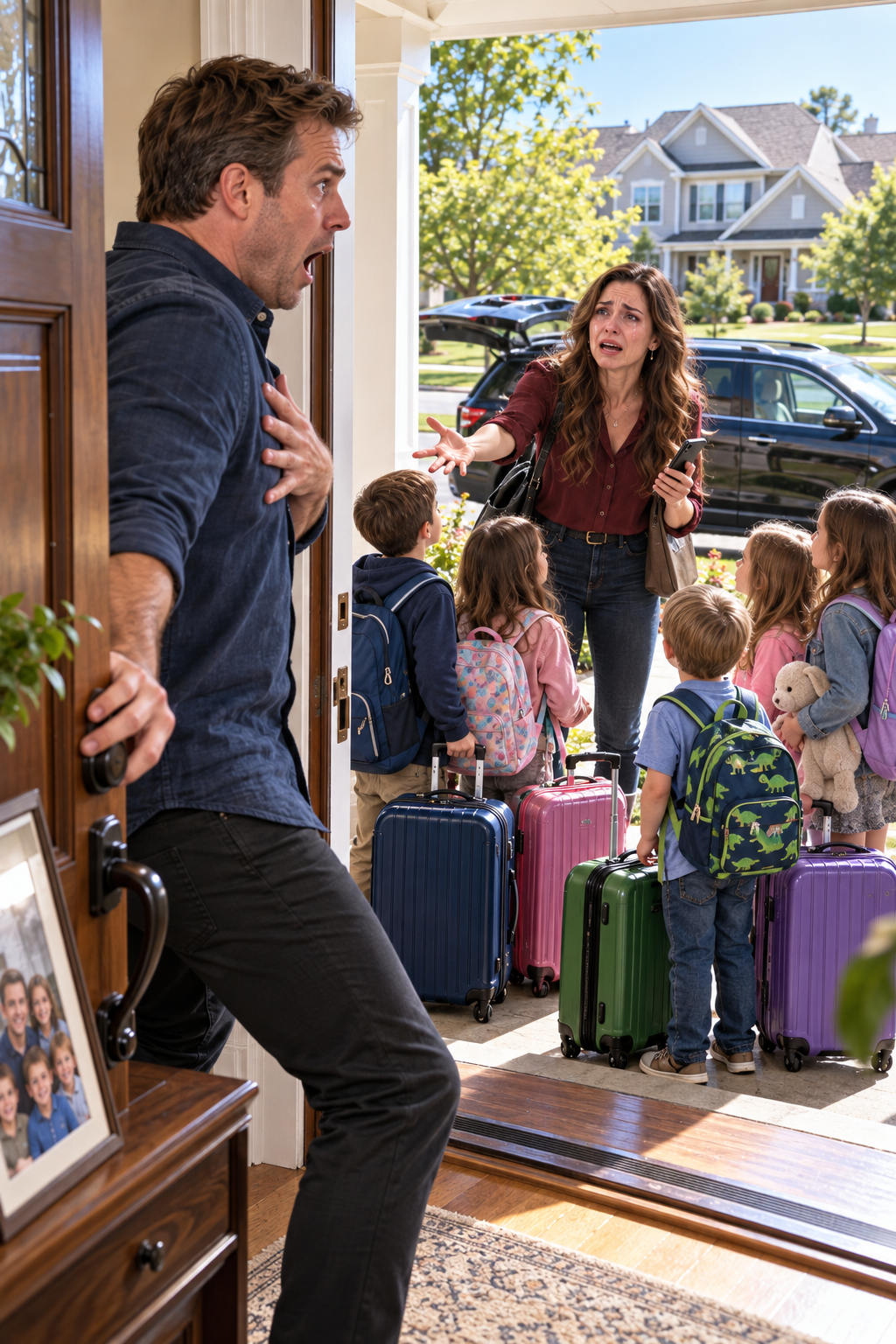
I opened the door and found five children, nine bags, and my sister wearing a flowered sundress that probably cost more than my weekly groceries. Eleven-year-old Mason stood at the front of the group holding his little brother, Benji, against his hip, while nine-year-old Clara kept four-year-old Ivy from wandering toward the driveway. Seven-year-old Theo was sitting on a suitcase, dragging its wheels against the porch boards with his sneakers. At the curb, a white rideshare sedan waited with its engine running.
“Laurel, what’s going on?” I asked, looking from the children to the enormous pile of luggage.
She lifted her sunglasses, kissed my cheek, and smiled with the nervous confidence of someone who had rehearsed an explanation. “Okay, first, don’t get upset, because everything’s already arranged,” she said, shifting a leather carry-on higher on her shoulder. “I’m going to Europe for three weeks, and the kids are staying with you until I get back. Dad knows, the van is yours, and I’ve packed absolutely everything.”
I stared at her, waiting for the punch line, but Laurel was already reaching into her purse for her passport. “You can’t leave five children here without asking me,” I said, stepping between her and the porch steps. “I work full-time, Laurel, and I don’t even have enough beds.” She sighed as though I’d complained about watering her plants, then told me she’d been struggling for two years and deserved an opportunity to feel like herself again.
“We both know you’ll figure it out,” she said, glancing toward the waiting car. “You’re always telling everyone how independent you are, June, so here’s your chance to prove it.”
Before I could respond, she called goodbye to the children and hurried down the steps. Ivy reached toward her, and Laurel promised to bring back something beautiful from Paris without slowing down. The car door closed, the driver pulled away, and suddenly I was standing in my driveway with five children who were watching me for instructions. Benji pressed his sleepy face against Mason’s shoulder and asked whether we were having breakfast.
I brought everyone inside, found cereal, and called Dad while Clara helped the younger children choose something to watch on television. He answered immediately, which told me more than his first sentence did. “Laurel said she needed a little time away,” he explained before I finished describing what had happened. “I told her you would help because you’re her sister.”
“You told her I would take five kids for three weeks without speaking to me?”
“Because you would have found a reason to say no,” he replied. “Your sister has been through enough, June, and those children are your family. Don’t be selfish.”
I looked at the luggage blocking my hallway, the small shoes scattered across my rug, and the untouched coffee I’d been looking forward to drinking. “Then why aren’t they staying with you?” I asked, trying to keep my voice level. Dad said he was sixty-five, had a bad knee, and couldn’t handle five children running around his house. When I pointed out that I had a job and responsibilities of my own, he told me families made sacrifices and ended the conversation.
My mother died in 2015, and something inside our family rearranged itself afterward. Dad had always adored Laurel, but after Mom’s funeral, he began treating every difficulty in her life as an emergency that the rest of us were expected to solve. Laurel needed money, he found it; Laurel needed someone to blame, he agreed; Laurel needed a favor, he volunteered me before asking. I became the dependable daughter, which sounds complimentary until you discover it means nobody believes you have limits.
My sister had married Adrian Beck, an electrician from Nashville, and for years I’d thought they were reasonably happy. Adrian was quiet and broad-shouldered, with a patient manner that seemed perfectly suited to the noise generated by five children. I remembered a fishing trip on Old Hickory Lake when Mason was little, watching Adrian spend twenty minutes untangling a fishing line without getting irritated once. When Mason finally caught a tiny bluegill, Adrian celebrated as though his son had won a national championship.
Then, in 2024, Laurel announced that she was leaving him because he was controlling and frightening behind closed doors. She described arguments, angry messages, and an incident when he supposedly grabbed her arm during a disagreement. I hadn’t witnessed those things, and I knew that being pleasant in public didn’t prove how someone behaved at home. When Dad insisted that Adrian was dangerous, I believed Laurel deserved the benefit of the doubt.
Their divorce had been finalized that June, and shortly afterward Laurel said she’d obtained a protective order. Dad helped her move the children from Nashville to Bowling Green, and I carried boxes into her rental house without asking many questions. Adrian’s name gradually disappeared from family conversations, and the children learned that mentioning their father made their mother upset. Over time, it became easier for everyone to pretend he’d simply stopped existing.
That Monday, pretending was getting considerably harder.
I called my supervisor, apologized, and asked to use emergency leave for the rest of the week. Then I canceled my dentist appointment, made a grocery list, and loaded five children into Laurel’s minivan, carefully checking every seat belt and child restraint. At Walmart, I spent $238 on food, diapers, toothpaste, extra towels, and a cheap inflatable mattress. Theo accidentally knocked over a display of cereal boxes, Benji lost a shoe, and Clara patiently explained that Ivy wouldn’t eat anything green unless someone called it dinosaur food.
At the checkout, an older cashier looked at my exhausted face and asked, “Honey, are you all right?”
“Ask me on Friday,” I said, and she laughed without realizing I was serious.
That afternoon, I took the children to a small park near the river so they could burn off some energy while I tried to make sense of my new responsibilities. Clara asked whether Paris had real castles, Theo wanted to know if I could build him a wooden airplane, and Ivy carried a handful of smooth rocks she insisted were valuable treasures. Mason sat alone on a swing, gently moving his feet through the gravel without looking at the playground. He’d once been an endlessly talkative boy, but lately I’d noticed that he seemed to study every adult conversation before deciding whether he should speak.
At dinner, Mason finally asked the question I’d been avoiding. “Aunt June, Mom really is coming back in three weeks, right?” I told him that’s what she’d promised, and he stared at his plate while Theo attempted to balance a carrot on his nose. Then Mason said something that made me set down my fork.
“She said we’re all getting on a plane after she comes back,” he whispered. “Only it’s supposed to be a secret, even from Grandpa, because she doesn’t want anybody ruining the surprise.”
I asked where they were supposed to go, but he only shrugged. “Someplace with castles,” he said, then asked whether he could have another hot dog. I told myself Laurel had been planning a family vacation and hadn’t wanted to explain it yet. It was an easy explanation, and I wanted it badly enough to believe it.
By eight that evening, my living room looked like a discount furniture store after a tornado. Two inflatable mattresses covered most of the floor, Theo had built a fort out of couch cushions, and Ivy refused to sleep without a purple blanket she couldn’t remember packing. Benji was crying for his green pacifier, so I carried the diaper bag into the spare bedroom and started searching through the pockets. Beneath some wipes and a packet of crackers, my fingers touched five small booklets held together with a rubber band.
I pulled them out and saw the gold American eagle stamped across their navy covers.
They were United States passports, one for each child, all issued seven weeks earlier.
Part 2
I sat on the bedroom floor with the passports spread across my knees, listening to the refrigerator hum through the open doorway. Each photograph showed one of my nieces or nephews against the same pale background, wearing the kind of clean, carefully chosen clothing Laurel reserved for school pictures. Mason looked uncomfortable, Clara had a neat braid, and little Benji appeared bewildered by the photographer’s instructions. The issue dates were all in July, several weeks before Laurel had mentioned taking a European vacation.
Behind the passports were a folded itinerary and several pages of official-looking paperwork. The itinerary listed five child passengers on a September 20 flight from Nashville to Paris, and under the accompanying adult was my father’s full name, Warren Michael Calder. I examined the reservation three times, searching for a return flight that wasn’t there. Laurel had booked five one-way seats and arranged for Dad to accompany the children abroad while she was already waiting in France.
The remaining papers appeared to be parental consent statements for the children’s passport applications. Each form contained Adrian Beck’s name and what was supposed to be his signature, although the writing looked unusually neat and deliberate. I remembered Adrian’s handwriting from Christmas cards, broad uneven letters that slanted noticeably to the right. These signatures were perfectly rounded, like something copied from an example.
A small voice interrupted me. “Those are ours,” Mason said from the doorway, wearing striped pajamas and holding a stuffed fox by one ear. “Mom took us to get pictures during summer break, and she made us promise not to tell anybody.” I asked whether his father had gone with them or signed anything, and Mason shook his head. “We haven’t seen Dad in two years, Aunt June, so how could he?”
I couldn’t answer that.
After getting Mason back into bed, I opened my laptop and searched for the Davidson County court records from Laurel’s divorce. Their final parenting agreement appeared in the publicly accessible case information, followed by a series of later filings I hadn’t known existed. Laurel and Adrian had shared legal custody, with Adrian entitled to alternating weekends and substantial summer parenting time. Both parents were also required to follow written procedures before relocating the children, and nothing I found suggested those responsibilities had simply disappeared.
Then I located the protective-order case Dad had used to explain why Adrian wasn’t allowed near the children. A temporary order had been issued in July 2024, pending a hearing, but the docket showed the case was dismissed after Laurel failed to appear. Whatever had happened between them, the temporary order hadn’t remained in force for the following two years. Our family had continued discussing it as though it were permanent.
I kept scrolling and discovered that Adrian had repeatedly returned to court requesting help locating his children and enforcing the parenting agreement. There were motions from September 2024, correspondence about unsuccessful attempts to contact Laurel, and additional filings extending into the summer of 2026. Each new entry made my stomach tighten because it contradicted what we’d been told about a father who supposedly wanted nothing to do with his children. I couldn’t judge every accusation from an online docket, but I could see that the story we’d accepted was missing entire chapters.
I found Adrian on social media shortly before nine. His profile photograph was old, showing all five children sitting on a beach blanket with their backs to the ocean. His most recent public post included photographs of birthday cards he’d written and an appeal asking anyone with reliable information about his children to contact his attorney. I read the comments twice, recognizing the names of former neighbors who remembered the family from Nashville.
I called through the application, expecting him not to answer an unfamiliar number.
“Hello?” he said after two rings, his voice lower than I remembered.
“Adrian, it’s June Calder,” I began. “Laurel’s sister, from Bowling Green.”
There was a long silence, and then his voice changed. “June, are the kids okay?” he asked, each word coming faster than the last. “Please tell me they’re all right.”
I told him all five children were asleep in my house and that Laurel had left them with me before boarding a plane to France. His breathing became uneven, and for several seconds he couldn’t seem to decide what to ask first. Finally, he said he’d been looking for them since August 2024 and had no idea where Laurel was living. He asked whether I was absolutely certain they were safe, and I told him I’d fed them dinner myself.
Then I asked about the passports.
“Did you sign consent papers for the children to travel internationally?”
“No,” he said immediately. “I haven’t signed anything for Laurel since the divorce papers. What passports?”
I explained the July issue dates, the September flight, and the signature on each consent statement. Adrian asked me to repeat the accompanying adult’s name, then said he needed to contact his attorney before doing anything else. He told me their custody arrangement didn’t authorize Laurel to move the children to another country without addressing his parental rights. When I mentioned the protective order, he quietly said the case had been dismissed long before she’d moved.
We spoke for nearly forty minutes, and he emailed me copies of the parenting plan, correspondence from his attorney, and the notices he’d filed with the court. Some documents matched the public records exactly, while others filled in details about unanswered inquiries and unsuccessful attempts to locate the children. I asked why he hadn’t simply driven to Bowling Green, since he’d known Laurel had family there. He said he’d tried that twice but hadn’t known where the children lived and feared a confrontation might be used against him.
“Your dad told me never to contact your family again,” he added. “He said the kids didn’t want me around.”
I remembered Dad handing Mason a bicycle for his ninth birthday and announcing that the boy didn’t need anyone but his real family. At the time, I’d thought the comment was directed at an absent father who’d disappointed his children. Now I wondered how many of those disappointments had been manufactured by the people surrounding them. The realization made me feel as though the familiar rooms of my childhood home had been quietly rearranged while I wasn’t looking.
Adrian’s attorney, Naomi Bell, joined our call after reviewing the documents I’d found. She explained that the immediate priority was keeping the children safe, preserving the records, and bringing the situation before the Tennessee court as quickly as possible. She also said Adrian’s status under the existing parenting order gave him a legitimate basis to arrange their return, although he would need formal court guidance on the larger dispute. Rather than have him arrive at my house during a confrontation with Dad, we agreed I would bring the children to Nashville and remain available until his attorney could act.
Before packing, I called my father.
“Dad, why are you listed on five one-way tickets to Paris?” I asked.
Silence filled the line, followed by the faint clicking of his kitchen clock. Finally, he said, “Where did you find those?”
“In the diaper bag Laurel left here, along with the children’s passports and consent forms. Were you planning to take them out of the country?”
He drew a heavy breath and told me Laurel intended to start over with her boyfriend in France. According to Dad, the man owned a large home near Lyon, had a successful restaurant, and could provide the children with opportunities they would never have in Kentucky. Dad had agreed to escort them because Laurel supposedly wanted a few weeks to prepare their new home. He insisted it was all legal because she’d told him Adrian had signed the required papers.
“She told you he’d given permission?” I asked.
“She showed me documents, June,” he snapped. “Your sister wouldn’t do something this important without making sure it was right.”
I told him the protective order had been dismissed and that Adrian had spent two years filing requests to find his children. Then I explained that Adrian denied signing the passport papers and that his actual signature looked nothing like the ones in Laurel’s bag. Dad accused me of believing a stranger over my sister, then reminded me of every frightening story she’d told about her marriage. I said those allegations deserved to be taken seriously, but they didn’t erase the court orders or explain the documents I was holding.
“You stay out of this,” Dad warned. “Laurel has made arrangements, and I won’t let you ruin her life.”
I looked toward the bedroom where five children were sleeping because their mother had decided my house was a convenient place to leave them. “Their lives matter too, Dad,” I said, and ended the call.
At 9:30, I began getting everyone ready for the drive. I packed pajamas, toothbrushes, a few familiar toys, and the children’s important belongings, checking that the younger ones were properly secured in their seats. Mason was already awake, sitting on the edge of a mattress with his sneakers on and his stuffed fox tucked beneath one arm. When I told him we were going to see his father, he stood up so quickly that the mattress shifted beneath him.
“Does Dad know we’re coming?” he asked.
“He’s waiting for you,” I said.
For the first twenty minutes, everyone was quiet except Benji, who fell asleep against his car-seat padding. Then Clara woke and asked where we were going, and Mason answered before I could. She stared at him through the darkness, her eyes growing wide as she realized which father he meant. Finally, she asked whether Adrian would be angry because they hadn’t called him.
I told her he had spent a long time trying to reach them and was very glad they were coming. She watched the highway lights for a moment, then reached across the space between their seats and took Ivy’s hand. Mason leaned forward to ask how much farther we had to drive, and I told him about forty minutes. After that, he checked the dashboard clock every few miles.
We reached Donelson shortly before midnight.
Adrian’s house was a small brick ranch with a basketball hoop above the driveway and a wide front porch illuminated by a single yellow bulb. He was sitting on the front step in jeans and a faded gray shirt, and he stood as soon as our headlights swept across the lawn. I parked beside his pickup, turned off the engine, and looked back at the five faces I’d been responsible for since sunrise. Mason was already reaching for his seat belt, his expression caught somewhere between excitement and disbelief.
Then he whispered, “Aunt June, what if Dad doesn’t remember us?”
I looked through the windshield at Adrian, who hadn’t moved from the bottom of the steps.
“He remembers you,” I said. “Every single one of you.”
Part 3
Mason opened the sliding door before I’d finished unbuckling my seat belt. He stepped onto the driveway, hesitated when Adrian took a step toward him, then crossed the distance so quickly that his father’s arms were barely ready. Adrian caught him against his chest and held him with both hands pressed firmly against the boy’s back. Neither spoke for several seconds, and I turned away because it felt like watching something too private to belong to me.
Clara followed, stopping near the driveway until Adrian called her name. She ran into his free arm, and Theo hurried after her, immediately asking whether Adrian still knew how to make pancakes shaped like cartoon characters. Adrian laughed through his tears and promised they would have pancakes for breakfast. Ivy studied him from my arms before accepting his invitation to sit beside him on the porch.
Benji was different because he had been an infant when Laurel took the children away. When Adrian reached toward him, Benji leaned into my shoulder and shook his head. Adrian didn’t insist, and I watched him swallow before saying, “That’s okay, little man. We can get acquainted tomorrow.” Then he thanked me for bringing all five children home, quietly enough that only I could hear.
Inside, the house looked as though somebody had been preparing for a holiday visit for years. The bunk beds still stood beneath faded dinosaur decals, a shelf held old picture books, and five new toothbrushes waited in the bathroom. Adrian admitted he’d bought fresh bedding and groceries after our call, then apologized because he hadn’t had time to make everything perfect. I told him the children didn’t need perfect; they needed a familiar place where nobody was going to make promises and disappear.
Once everyone was settled, I stepped outside to give them privacy. Adrian had offered me the couch, but the house already felt crowded with emotions that didn’t need another adult watching. I climbed into Laurel’s minivan, reclined the seat, and checked my phone. There were forty missed calls, most from Dad, several from Laurel’s number, and a few from Adrian during our drive.
At 12:21, a new message appeared from my sister.
“What did you do?”
A minute later, another arrived. “Dad says you took my children. Where are they?”
I didn’t answer because anything I said at that moment would become an argument rather than an explanation. Instead, I photographed the itinerary and consent forms, saved the images separately, and placed the originals in an envelope. My father’s messages grew increasingly demanding before finally stopping around one in the morning. I sat awake watching the porch light until the sky began turning gray.
At seven, Laurel called again, and this time I answered.
“Tell me where my children are,” she demanded, her voice sharp enough that I pulled the phone away from my ear. She said she’d contact the authorities, accused me of taking her children without permission, and repeated that Adrian was dangerous. I told her they were safe with their father and that I had spoken to his attorney. For a moment, she became so furious that I could barely distinguish her words.
“You have always been jealous of me,” she finally said. “Dad knew you’d try to ruin something good if I gave you the chance.”
I let her finish, then asked why she’d booked one-way tickets for the children and arranged for Dad to fly them to France. Her breathing changed, and I heard a muffled voice speaking French somewhere behind her. I told her I’d found the passport consent forms bearing Adrian’s name and that he denied signing them. Laurel went silent, then abruptly disconnected.
I drove back to Bowling Green later that morning after making sure Adrian had everything he needed for the children. A police cruiser was waiting outside my house when I arrived, with two officers standing beside the porch railing. Dad had reported that I’d taken children across state lines without their mother’s permission. I explained what had happened, showed the documents Adrian had supplied, and provided the officers with his contact information.
The older officer listened carefully without making assumptions about either parent. He said he couldn’t resolve a custody dispute on my porch and that the Tennessee court would need to address the competing claims. He recorded my account, confirmed the children were with their father, and advised me to preserve the documents. Before leaving, he mentioned that my father had sounded extremely upset.
I almost laughed at the understatement.
Around noon, Adrian called on video from his kitchen. Theo was helping prepare lunch, Clara was reading directions on a box of pasta, and Ivy had discovered an old pair of Adrian’s work gloves that reached almost to her shoulders. Benji sat nearby with a small toy truck, watching his father move around the room with the careful suspicion of a toddler encountering a new adult. Mason appeared briefly behind Adrian and proudly announced that his old bicycle was still in the garage.
“He’s going to help me fix it,” Mason said. “Then maybe we can get one that actually fits.”
Adrian smiled, but his eyes looked tired. He told me he’d been awake most of the night checking on the children, half afraid he’d open a bedroom door and discover he’d imagined their return. His attorney had scheduled an urgent meeting, and he planned to take time away from work while everything was sorted out. When he thanked me again, I told him to save his energy because five kids would give him plenty to do.
After the call, Naomi Bell phoned and asked me to prepare a written account of everything that had happened. She wanted the exact time Laurel arrived, what she said, when I found the documents, and the details of my conversation with Dad. She also asked me not to discuss the evidence with Laurel or any other relatives until she’d had a chance to review it. I promised I would write everything down that evening.
Then Adrian called back with a practical problem. Theo had a recurring breathing condition, and Laurel hadn’t packed the equipment he sometimes needed after strenuous activity. Mason remembered a spare in a kitchen drawer at Laurel’s rental house, and Adrian was arranging care through a local doctor. The key to Laurel’s house was on the ring she’d left with the minivan, so I offered to collect the supplies while the doctor handled the replacement arrangements.
Laurel’s house looked different when I entered it alone. The countertops were nearly empty, several family photographs had been taken down, and cardboard boxes stood along the living room wall. Their labels weren’t the usual instructions for storage; they said things like “Kitchen—Overseas,” “Winter Clothes—France,” and “Personal Photos—Ship.” I found the equipment in the drawer where Mason said it would be, then noticed a folder beside the printer marked “Enrollment.”
Inside were copies of the children’s school records, translated forms, and an email confirmation from a school admissions office outside Lyon. The message thanked Laurel for submitting information about five prospective students for the coming term. Another page contained a request to withdraw Mason, Clara, and Theo from their Kentucky schools, dated three days before Laurel left them on my porch. There was nothing temporary about any of it.
I photographed the documents without altering their order and called Naomi from the driveway. She told me to describe what I’d seen and preserve the images while she determined the proper way to obtain records through formal channels. I stood beside the minivan, looking back at the carefully packed boxes through Laurel’s front window. My sister hadn’t simply planned to take her children on an extended holiday; she’d been quietly dismantling their lives in Kentucky.
Then Naomi asked whether I’d seen anything connected to the passport signatures, and I remembered the yellow legal pad beside Laurel’s printer.
I went back through my photographs and enlarged the corner of the kitchen counter. Beneath the folder was a sheet of paper covered with faint impressions, and one name appeared repeatedly in the indentations. Even on my phone, I could make out the same rounded letters I’d seen on the consent forms.
Adrian Beck.
Part 4
The next morning, I drove to Nashville with an envelope of photographs, my handwritten notes, and the original documents I’d found in the diaper bag. Naomi met me in a small conference room overlooking a parking garage, where a ceiling vent rattled every few minutes. She read my account without interrupting, occasionally writing a date in the margin. When she finished, she asked me to explain exactly how I’d discovered the indentations on Laurel’s legal pad.
I told her I’d noticed the repeated name while photographing the kitchen counter. I hadn’t taken the pad because I wasn’t certain whether I had the right to remove anything from Laurel’s home. Naomi said that was sensible and that any potentially relevant original material should be obtained and preserved through appropriate procedures. She carefully separated the documents I’d brought into individual sleeves and asked me to sign a detailed statement describing their discovery.
“I can’t promise what the court will conclude,” she said. “But these records are important, and we need to establish where they came from.”
I asked whether Adrian would automatically receive custody because Laurel had left the children with me. Naomi shook her head and explained that the judge would consider the existing parenting order, the children’s circumstances, the allegations raised by both parents, and the evidence of their proposed relocation. Family courts didn’t make decisions because one relative seemed more sympathetic than another. They needed reliable facts, and right now there were several facts Laurel would have difficulty explaining.
Adrian arrived halfway through our meeting carrying a battered folder that looked as though it had been opened a thousand times. Inside were copies of court correspondence, school photographs, birthday cards, and notes he’d kept whenever he tried to contact the children. He admitted that his work had suffered and he’d spent most of his savings seeking legal help. When Naomi asked him whether he could manage all five children at home, he looked offended by the question before recognizing why she needed to ask it.
“I’ll need after-school care and help from my neighbors,” he said. “My sister can come down from Clarksville for a few days, and my supervisor says I can take leave. But if you’re asking whether I want them here, there’s nothing to discuss.”
Naomi nodded and returned to her paperwork.
After the meeting, I accompanied Adrian to his house to bring in the children’s remaining luggage. Laurel had packed nine bags, yet half the clothing inside was unsuitable for the weather, and several familiar toys were missing. Adrian’s neighbor, Mrs. Landry, appeared with a casserole and offered to watch the younger children while we sorted everything. She’d known the family before the separation, and seeing Mason carry a box through the front door left her wiping her eyes with a kitchen towel.
That evening, I sat at Adrian’s dining table while the children played in the next room. He showed me a stack of envelopes containing birthday cards that had been returned to him over the past two years. Some bore ordinary postal notices, while others had been marked “Refused” in handwriting I didn’t recognize. Adrian said he’d sent cards to Laurel’s last known addresses and had eventually been advised to stop trying to contact her directly.
I picked up the envelope addressed to Clara on her ninth birthday. Inside was a card with a watercolor horse on the front and a message telling her that he loved her, remembered how much she enjoyed drawing, and hoped she was happy. The handwriting was irregular, with large letters pressed hard into the paper. It looked nothing like the signatures on the passport forms.
“Did Warren ever contact you after Laurel moved?” I asked.
Adrian shook his head. “I called him the first night because I thought he might know where the kids were. He told me to leave his daughter alone and never call again.” He turned an envelope over in his hand before adding that he’d sent Warren a certified letter explaining the custody order a few weeks later. According to the delivery record, my father had signed for it.
I sat completely still.
Dad had told me Adrian never tried to reach the family after Laurel left Nashville. He’d repeated that claim at Thanksgiving, at Christmas, and every time the children asked questions. But a signed delivery record meant he had received at least one direct attempt to explain the situation. I wondered whether he’d read it, thrown it away, or simply decided that nothing Adrian said deserved consideration.
On Thursday, September 3, I attended the emergency custody hearing in Davidson County. Adrian sat beside Naomi, wearing a freshly ironed shirt that didn’t quite fit across his shoulders. Laurel appeared remotely from France with a lawyer, her face framed by unfamiliar hotel curtains. She looked exhausted but immediately regained her composure when the judge began asking questions.
Laurel said she’d gone to Europe for a temporary break and intended to return for her children. She repeated allegations about Adrian’s behavior during their marriage, and Naomi acknowledged that any safety concerns needed proper consideration. Then Naomi presented the existing parenting order, the court history, the September itinerary, and the records indicating that the children were being prepared for an overseas move. When Laurel insisted the tickets were for a holiday, Naomi asked why there were no return reservations.
“We hadn’t finalized our plans,” Laurel replied, shifting uncomfortably in her chair.
The judge asked about the school withdrawal requests, and Laurel said she’d been exploring different educational options. Naomi then produced copies of the enrollment correspondence that Adrian had lawfully obtained through the relevant channels after contacting the schools. One message included a planned arrival date in France, and another discussed registering the children at their new address. Laurel’s lawyer requested time to examine the material, which the judge allowed before returning to the immediate question of where the children should remain.
When the judge asked about the passport consent statements, Laurel insisted Adrian had agreed to their issuance. Naomi produced a comparison of the signatures and explained that Adrian denied providing consent. The judge didn’t declare the signatures false on the spot, but she treated the dispute and the proposed international relocation as serious concerns requiring further examination. I sat behind Adrian, listening to the quiet scratching of the court reporter’s keyboard.
Near the end, I was asked to confirm how I’d found the passports.
I walked forward, took the oath, and described searching the diaper bag for Benji’s pacifier. I explained that the passports and itinerary had been bundled together and that I hadn’t known the documents existed before that evening. When the judge asked whether Laurel had obtained my consent to care for the children, I said she’d informed me of her plans while a rideshare driver waited outside. I tried not to look at Laurel’s face on the monitor.
The court issued temporary orders placing the children in Adrian’s care while the custody questions were examined further. The passports were to be surrendered and held, and both parents were instructed to comply with additional safeguards and future hearings. Adrian would have to continue demonstrating that the children were safe and properly supported, but they would not be leaving the country while the dispute remained unresolved. I handed over the passports and received a signed receipt from the clerk.
In the hallway afterward, Adrian leaned against a wall and covered his face with both hands. Naomi spoke quietly with him about the next steps, including school enrollment, counseling support, and a fuller hearing. I walked to the vending machines and bought three bottles of water because I needed something ordinary to do. For the first time since Monday, the ground beneath my feet felt reasonably solid.
That feeling lasted until Naomi called me the following afternoon.
A federal investigator had contacted her office concerning the children’s passport applications, and he wanted to interview me about the original documents. Naomi said the investigator was particularly interested in the identity of the person listed as their traveling companion. I thought of Dad’s name printed beneath the five children’s names and asked whether he might be in trouble.
“I don’t know yet,” she said. “But June, there’s something else you should understand. Your father may have known considerably more than he’s admitting.”
Part 5
Special Agent Daniel Rusk introduced himself over the telephone on Friday afternoon, speaking in the calm, deliberate tone of someone accustomed to hearing explanations that didn’t quite fit the evidence. He worked with the State Department’s Diplomatic Security Service and was reviewing questions surrounding the children’s passport applications. He asked when I’d found the paperwork, whether I’d seen Adrian sign anything, and what Laurel had told me about her intended trip. I answered carefully, giving dates rather than guesses whenever possible.
When he asked about my father’s involvement, I told him Warren had acknowledged planning to accompany the children to France. Rusk wanted to know whether Dad had prepared any documents, traveled with Laurel to appointments, or seen the consent statements before the passports were issued. I couldn’t answer those questions because nobody had told me the children were getting passports in the first place. He thanked me and said further interviews would help establish who had done what.
Afterward, I went back to work.
The machining plant smelled of cutting fluid and warm metal, and I found the familiar noise of the equipment strangely comforting. My supervisor, Denise Harwell, had covered my absence without asking intrusive questions, although she told me I’d used nearly all my available emergency leave. I spent Friday afternoon inspecting a batch of aluminum housings while trying not to think about lawyers or passports. The measurements were predictable, the work had clear standards, and a part was either within tolerance or it wasn’t.
On Saturday, Dad arrived in the parking lot as I was finishing an overtime shift.
He stood beside his pickup with his arms folded, wearing the dark work jacket he’d owned since before Mom died. Several coworkers were heading toward their cars, and he made no effort to lower his voice when he accused me of humiliating Laurel. He said I’d turned a private family disagreement into a public spectacle and handed five innocent children to a man he considered dangerous. When I asked whether he wanted to talk somewhere private, he told me he was finished protecting my feelings.
“Your mother would be ashamed of you,” he said.
That sentence hurt more than I wanted him to see. Mom had been gone eleven years, and Dad still invoked her judgment whenever he wanted an argument to end. I remembered her working double shifts at a medical clinic, taking care of both daughters, and refusing to let either of us escape responsibility for something we’d done. I couldn’t imagine her approving of Laurel’s decision to abandon five children on a doorstep.
I took two papers from my bag and held them where Dad could see them. One was a copy of Adrian’s signature from the divorce documents, and the other showed the name written on the passport consent statements. Dad stared at them, his expression changing from anger to uncertainty. I asked him again whether he’d actually witnessed Adrian sign anything.
“Laurel said he agreed,” Dad replied.
“That’s not what I asked.”
He looked down at the documents. “No, June. I didn’t see him sign.”
I asked whether he’d known the temporary protective order was dismissed in August 2024. He insisted Laurel had told him there were still restrictions, but when I mentioned Adrian’s certified letter, Dad looked away. I told him I had seen the delivery confirmation bearing his signature. For several seconds, his attention remained fixed on a crack in the asphalt between our shoes.
“He sent you a letter about the custody order,” I said. “You received it. Why didn’t you tell me?”
Dad rubbed his face. “Because your sister was scared, and I thought that man was trying to frighten her again.”
“Did you read it?”
“Yes.”
The word was barely audible.
I waited while he explained that the letter had mentioned court dates and Adrian’s right to see the children. Dad believed Laurel when she said it was an attempt to pressure her, so he put the letter away and told her not to worry about it. He hadn’t contacted an attorney or checked the court records. He’d simply decided that helping Laurel meant making sure Adrian couldn’t reach them.
“You knew he was looking,” I said.
Dad nodded without meeting my eyes.
For two years, he’d told everyone that Adrian had abandoned his children. He’d watched Mason withdraw into himself, listened to Clara ask why her father never called, and accepted every explanation Laurel offered. Even if Dad genuinely believed he was protecting them, he had ignored information that might have changed their lives. That was the part I couldn’t get past.
Before leaving, Dad admitted he’d already paid for his September flight and contributed money toward Laurel’s plans in France. When I asked how much, he refused to answer and said his finances were none of my business. I didn’t argue because I had stopped expecting him to tell the truth merely because I asked. He folded the signature comparisons into his jacket pocket and drove away without apologizing.
The following day, I went to Nashville.
Adrian had set up a sprinkler in the backyard, and the children were taking turns running through it while Mrs. Landry watched from a lawn chair. Ivy wore her purple blanket as a superhero cape, and Theo had convinced Benji that the sprinkler was a machine for washing toy trucks. The scene looked almost ordinary, although Adrian admitted the evenings were harder than the afternoons. Clara sometimes asked questions about her mother, and Mason seemed afraid that the arrangements might change without warning.
I found Mason sitting on the back steps after lunch, turning a bicycle reflector over in his hands. He told me Adrian had shown him the birthday cards he’d tried to send, including a letter written when Mason turned ten. The boy said he’d always believed his father stopped calling because he didn’t care anymore. Now he knew there had been letters he never received.
“Was Mom lying about everything?” he asked.
I told him I didn’t know everything that had happened between his parents, and he shouldn’t have to carry the responsibility of figuring it out. What I did know was that Adrian had tried to see him and that none of the children had caused the separation. Mason nodded and studied the reflector again. After a while, he asked whether his father would come to his next soccer game.
“He’ll probably be the loudest person there,” I said.
Mason smiled, and the relief of seeing it nearly undid me.
That evening, Adrian and I sat on his porch while the children watched a movie indoors. He described coming home from work in August 2024 to find their belongings gone and the house nearly empty. He’d called Laurel, then Dad, then the authorities, and eventually hired an attorney when he couldn’t arrange contact with the children. Every unsuccessful attempt seemed to convince Laurel’s relatives that he was troublesome rather than a father trying to exercise the rights recorded in his parenting plan.
Adrian admitted that he wasn’t proud of every argument during his marriage. He said he’d raised his voice, searched for answers when Laurel became distant, and struggled to accept how quickly their relationship deteriorated. He denied the allegations of physical intimidation, but he also said he understood that the court would need to assess any concerns independently. What hurt him most was that the children had been told he didn’t want them.
“I kept thinking they’d be old enough to find me eventually,” he said. “I counted the years until Mason turned eighteen, then wondered how many more birthdays I’d miss.”
I didn’t know how to answer him.
On Monday, Naomi called with another development. Through records obtained during the ongoing proceedings, she’d learned that Laurel had submitted notice to end her Kentucky rental agreement in September and had arranged to ship several boxes overseas. None of those steps was unlawful by itself, but together with the school withdrawal requests and one-way tickets, they supported Adrian’s position that Laurel had planned a permanent relocation. Naomi said the court would consider them at the next hearing.
Then she told me an investigator had discovered discrepancies involving the notarizations on the passport consent forms. He was working to establish how the documents had been presented and whether the required consent had actually been provided. Naomi warned me not to draw conclusions before the review was complete. I promised I wouldn’t, although I couldn’t stop thinking about the repeated signatures on Laurel’s legal pad.
Later that night, I received an unexpected email from Dad.
It contained a scanned copy of Adrian’s certified letter from 2024, complete with the delivery information and references to the parenting agreement. Dad had kept it inside a folder in his bedroom for two years. Beneath the attachment was one sentence.
“I should have shown you this when it arrived.”
I read it twice, then noticed that he’d included an additional page from his own records.
It was a bank confirmation showing a substantial transfer from his retirement savings to Laurel, made six days before she left the children on my doorstep.
Part 6
The transfer was for $32,000, an amount that represented years of careful saving for my father. He’d spent most of his working life at an automobile parts warehouse and had always been cautious with money, repairing appliances instead of replacing them and wearing shoes long after the soles began to thin. Yet he’d sent Laurel more than thirty thousand dollars without discussing it with me or apparently questioning where it would go. The transaction description was only two words: “Family relocation.”
I called him the next morning.
Dad sounded exhausted and admitted that Laurel had asked for help establishing herself in France. She’d told him the money would cover housing, school arrangements, and the cost of moving the children’s belongings. He believed she’d eventually repay him, although she hadn’t signed any agreement. When I asked whether he’d checked the overseas housing arrangements, he said Laurel had shown him photographs.
“Photographs aren’t proof, Dad,” I said.
“I know that now.”
He explained that Laurel had become increasingly frightened of losing custody after receiving court notices earlier that summer. She told him Adrian intended to take the children away permanently, and the French relocation was presented as their only chance at a stable future. Dad didn’t know whether her fears were genuine or whether she’d used them to persuade him. He admitted that he’d been more concerned about keeping her calm than establishing what the court documents actually said.
I asked why he’d included the bank confirmation in his email. He said he wanted me to understand how involved he’d become and that he’d decided to tell the investigator everything. I told him that was the right decision, but it wouldn’t erase the choices he’d already made. Dad accepted that without arguing, which was unusual enough to make me feel sad rather than satisfied.
A few hours later, Special Agent Rusk called to arrange another interview. He asked about the money, Laurel’s plans to move overseas, and Dad’s knowledge of the children’s travel itinerary. I described what Dad had told me and supplied the documents he’d voluntarily sent. Rusk said financial records could help establish the sequence of events, although they didn’t necessarily prove someone knew about inaccurate passport paperwork.
I appreciated that distinction.
I didn’t want Dad punished for something he hadn’t done, even while struggling to forgive what he had done. Laurel’s actions were her responsibility, but Dad’s refusal to question her had helped create the conditions in which she believed nobody would stop her. The difference mattered, especially now that official investigators were involved. I wasn’t interested in seeing my family destroyed; I wanted the lies to stop determining where five children were allowed to live.
Meanwhile, Adrian was discovering that having children back in his house involved considerably more than getting a favorable court order.
The school district needed updated information, teachers wanted to understand the transition, and the younger children were adjusting to unfamiliar routines. Adrian arranged appropriate support through the school and a family counselor, and Mrs. Landry helped with afternoon pickups until his work schedule could be modified. His sister, Celeste, came from Clarksville for a long weekend and filled the freezer with meals. I spent one Saturday assembling a second dresser and repairing a closet door that hadn’t closed properly in years.
The children were gradually rediscovering the house. Clara found a box of old drawings she’d made in kindergarten, Theo discovered a collection of wooden trains under a bed, and Ivy became fascinated by a photograph of herself as a baby. Benji began following Adrian around the kitchen, handing him spoons and demanding to help with simple tasks. Mason still watched carefully whenever adults discussed plans, but he was sleeping better and had started asking about joining a soccer team.
One afternoon, I arrived to find Adrian crouched beside a bicycle in the driveway. Mason held a wrench while his father adjusted the seat, explaining why an old bike could be repaired but couldn’t necessarily be made large enough for an eleven-year-old. They’d already chosen a larger bicycle from a local shop and were fixing the old one for Theo. When Mason noticed me, he grinned and showed me the streak of grease across his palm.
“Turns out Dad remembers how to do everything,” he said.
Adrian looked embarrassed. “Not everything. Apparently, I can’t operate the new television without help.”
I stayed for dinner, then drove home feeling something I hadn’t experienced since the beginning of September: the possibility that our family could eventually have ordinary problems again. There were still appointments, hearings, and painful conversations ahead, but the children no longer seemed to be living between unanswered questions. Adrian had begun creating schedules they could rely on. I realized that reliability, rather than dramatic promises, was what they’d been missing most.
The next morning, Laurel sent me her first direct message since the call from France.
“I’m coming home Saturday. You will pick me up at the Nashville airport and take me to my children. If you have any loyalty left, you’ll fix what you’ve done.”
She included her flight number and arrival time, as though my cooperation had already been arranged. Then she added that if I refused, she would never speak to me again. I stared at the message while my coffee cooled beside the kitchen sink. Two weeks earlier, that threat might have devastated me.
Instead, I forwarded it to Naomi and contacted Agent Rusk.
He listened while I read the message aloud and asked whether Laurel had said anything about avoiding the ongoing legal proceedings. I told him she’d demanded immediate access to the children but hadn’t mentioned attending court. Rusk said investigators were aware of her intended return and wanted to speak with her about the passport applications. He asked whether I’d be comfortable appearing at the airport because Laurel expected to see me there.
“You don’t have to participate,” he said. “And I don’t want you attempting to question her yourself.”
I thought about refusing.
Whatever Laurel had done, she was still the little sister whose bicycle I’d held upright while she learned to ride. I remembered giving her half my allowance so she could buy a birthday gift for Mom and sitting beside her hospital bed when she had her appendix removed at sixteen. Families contain memories that don’t disappear simply because someone has done something terrible. Those memories make setting a boundary more complicated, but they don’t make the boundary unnecessary.
I told Rusk I’d be at the airport.
Before ending the call, he asked whether I understood that Laurel might face serious legal consequences if investigators established that false consent information had been used. I said I understood, although knowing something intellectually felt different from imagining my sister being questioned by federal agents. He explained that his responsibility was to investigate the documents, not to settle our family disagreement. My responsibility was simply to provide truthful information.
That evening, Dad appeared at my house carrying a cardboard box.
Inside were family photographs, school programs, and several letters Adrian had mailed that Dad had never passed along. Some were addressed to him, while others were copies he’d received from Laurel after she’d refused delivery at her house. Dad admitted he’d kept them because throwing them away felt wrong, but giving them to the children would have meant admitting their mother wasn’t telling them the whole truth. He sat at my kitchen table staring at the box long after he’d finished speaking.
“I kept telling myself I was protecting them,” he said.
“Protecting them from what?”
He couldn’t answer.
I told him I would arrange for Adrian’s attorney to receive any relevant correspondence, and he agreed to cooperate. Then Dad asked whether he could visit the children, and I said that decision belonged to Adrian and would need to respect the court’s arrangements. He nodded, looking older than he had two weeks earlier. For once, he didn’t ask me to convince anyone to make an exception for him.
Before leaving, he paused beside the front door.
“Are you going to pick Laurel up Saturday?”
“Yes.”
He studied my face, then looked down at the box he’d brought. “She still thinks she can make all this disappear if she gets everyone in the same room.”
I didn’t tell him about Agent Rusk.
But after he left, I checked Laurel’s arrival time again and wondered what she would do when she discovered that, for the first time in her life, nobody in our family was going to rearrange the truth to protect her.
Part 7
Nashville International Airport was crowded on Saturday, September 12, with families returning from vacations, business travelers pulling small suitcases, and people waiting beneath the arrival monitors. I stood near the baggage claim area holding a cup of coffee I couldn’t bring myself to drink. Agent Rusk had spoken with me earlier and pointed out where I should wait, emphasizing that I wasn’t to confront Laurel or interfere with his investigation. Two other officials remained nearby, dressed like ordinary travelers.
Laurel’s flight arrived slightly behind schedule.
At 3:58, I spotted her descending the escalator with a leather carry-on and a silk scarf tied loosely around her neck. She wore oversized sunglasses despite being indoors, and her hair was pulled into a careless knot that made her look younger than thirty-four. When she saw me, her expression shifted from irritation to unmistakable relief. For one brief second, she looked like the sister I remembered from childhood.
She hurried toward me and wrapped her arms around my shoulders.
“You actually came,” she whispered, holding on tightly.
I didn’t hug her back, but I didn’t push her away either. When she stepped back, she began demanding to know where the children were and why Adrian hadn’t been forced to return them. She spoke rapidly, complaining about the lawyers she’d hired and the embarrassment I’d caused her. Then she grabbed my wrist and said we were leaving immediately.
“Laurel, we need to talk,” I said.
“We can talk in the car. Right now I want my kids.”
Agent Rusk stepped forward before I could answer.
“Ms. Beck? My name is Daniel Rusk, and I’m a special agent with the Diplomatic Security Service. We need to speak with you about the applications submitted for your children’s passports.”
Laurel stopped moving.
He identified himself and explained the purpose of his presence, while the other officials moved closer without creating a scene. Laurel looked between them and me, apparently waiting for someone to explain that this was a misunderstanding. When Rusk mentioned questions about the parental consent statements, she immediately insisted that everything had been properly completed. He told her investigators had obtained additional information that required her response.
“What additional information?” she demanded.
Rusk didn’t disclose the details there in the baggage claim area. He asked her to accompany him, and when she demanded a lawyer, he explained the next steps and her rights. Investigators had obtained authorization for further action following their review of the applications, and Laurel was taken into custody without any physical struggle. The people around us continued collecting luggage, most of them never realizing what had happened.
Laurel turned toward me as the officials prepared to leave.
“You arranged this,” she said.
I looked at the scarf she’d brought from France, the same blue-and-white silk she would probably have shown everyone during our next family dinner. I thought of the nine bags she’d left on my porch and the empty place at Adrian’s breakfast table that had remained empty for two years. Then I remembered Clara asking whether her father would be angry when he saw her.
“No, Laurel,” I said. “You made the arrangements. I finally stopped helping you hide them.”
Her face tightened, and she looked away.
I remained beside the baggage carousel until she’d been escorted out. My coffee was cold, and a suitcase had circled the conveyor belt three times without anyone claiming it. When I finally walked into the parking garage, I expected to feel triumphant. Instead, I felt tired and deeply sad that the girl I’d grown up protecting had become someone I could no longer trust.
Dad called an hour later.
He already knew Laurel had been questioned, although he didn’t know the details. He asked whether I’d witnessed what happened, and I told him I had. For once, he didn’t accuse me of betrayal or demand that I fix things. He simply asked whether the children were safe.
“They’re at home with Adrian,” I said. “That’s where they’re staying tonight.”
Dad was quiet for a while before answering, “Good.”
Over the following days, the investigation became part of an increasingly complicated legal situation. Laurel was charged in connection with inaccurate statements submitted during the passport application process, and her attorney began addressing the allegations through the federal court. She was released under conditions restricting her travel while the case proceeded. The custody matter remained separate, with the Tennessee family court examining the children’s welfare and the evidence concerning the attempted overseas relocation.
Some details emerged gradually.
The review of the passport paperwork supported Adrian’s statement that he hadn’t provided the disputed consent. Additional records connected Laurel to the submissions, while information from the school district and her shipping arrangements reinforced the timeline of her planned move. Her lawyer challenged aspects of the evidence, as lawyers are supposed to do, but the court was no longer dealing with a disagreement based solely on competing family stories. There were dates, documents, witnesses, and records that could be checked independently.
The situation in France also turned out to be different from what Laurel had told Dad.
The man she had been visiting, Lucien Moreau, worked in hospitality near Lyon, but the expensive house in her photographs belonged to his relatives. According to information Laurel later provided during the proceedings, they had discussed living together, but he hadn’t agreed to assume responsibility for five children or provide the permanent home she’d described to our father. When her legal problems began, their relationship deteriorated rapidly. Within weeks of her return, they were no longer together.
Dad learned about that before I did.
He came to my house one evening carrying a grocery bag containing coffee, bread, and the brand of strawberry preserves Mom used to buy. After setting everything on my counter, he told me Laurel had admitted the housing arrangements weren’t finalized when he sent her the money. She’d believed that once the children arrived, Lucien would accept the situation because he loved her. Dad had built his understanding of the entire relocation around a future that existed mostly in Laurel’s imagination.
“She told me it was already settled,” he said.
I looked at the groceries he’d brought and wondered whether he expected them to count as an apology.
“Did you ever ask to speak to him?” I asked.
Dad shook his head.
“Did you ask to see a lease, a school acceptance, or anything showing where the children would live?”
“No.”
“Then you weren’t helping her make a plan,” I said. “You were paying for a promise she hadn’t kept.”
He sank into a chair at my kitchen table. The man who had spent two years telling me not to be selfish now looked genuinely uncertain about how to help anyone. I wanted to comfort him because he was my father, but I also wanted him to understand that our family couldn’t continue living according to Laurel’s latest explanation. Both feelings sat in my chest without canceling each other.
In October, the Davidson County court issued a revised custody arrangement placing the children primarily with Adrian. Laurel was permitted supervised contact under specified conditions while the family continued receiving appropriate support. The arrangement included procedures for future reviews, communication between the parents, and safeguards concerning international travel. Adrian understood that the children could still love their mother even while the adults established firmer boundaries around her decisions.
Laurel reacted angrily.
Through her attorney, she argued that Adrian had manipulated the situation and that I’d interfered in matters that weren’t mine to resolve. She sent me messages accusing me of ruining her relationship, her finances, and her future. I saved the messages but didn’t respond to them. The responsibility for her choices belonged to her, and I was finished accepting blame for refusing to conceal their consequences.
Then, at the end of October, Dad called me late one evening.
“I spoke to Adrian,” he said.
That surprised me because Adrian hadn’t mentioned any plans to contact him. Dad explained that he’d apologized for refusing the letter, repeating inaccurate claims, and discouraging contact with the children. Adrian had listened and said he would consider carefully arranged visits if they were appropriate for the children. He hadn’t offered instant forgiveness, and Dad didn’t sound as though he’d expected it.
Before hanging up, Dad said something I’d never heard him admit.
“I kept choosing your sister because I thought she needed me more than you did. I never stopped to think what that was doing to you.”
I looked around my quiet kitchen, remembering every holiday I’d handled alone because Laurel’s problems had come first. There wasn’t a sentence that could restore those years or remove the damage caused by ignoring Adrian. But admitting the truth was at least different from asking me to pretend nothing had happened. I told Dad I needed time, and for once, he said he understood.
Part 8
By the following spring, Adrian’s house in Nashville had settled into the untidy rhythm of a home occupied by five children. The kitchen calendar was covered in school events, soccer practices, appointments, and colorful reminders that Clara had written herself. A row of shoes accumulated beside the front door despite Adrian’s repeated efforts to organize them. The refrigerator was crowded with drawings, spelling tests, and photographs that made the house look increasingly like it belonged to the people living there.
I visited every other Sunday.
Adrian had returned to a regular work schedule, with a reliable childcare arrangement and help from his sister when necessary. Mason was playing soccer again, and his coach said he had a good instinct for recognizing where the ball would go before anyone else. Clara had joined an art club, Theo was fascinated by electrical circuits, and Ivy had become notorious for bringing strange objects to preschool and explaining their imaginary histories. Benji now called Adrian “Daddy” without hesitation and followed him everywhere carrying a plastic toolbox.
Their lives weren’t magically repaired.
Sometimes the older children still asked questions that had no simple answers, and their mother remained important to them despite what had happened. Adrian worked with their counselor to make sure those conversations didn’t turn into adult accusations disguised as explanations. The children were allowed to talk about missing Laurel without being made to feel disloyal to their father. I admired that more than I could express because bitterness would have been much easier for Adrian to justify.
Laurel’s federal case moved forward over the winter. Eventually, she entered a guilty plea to charges connected with the passport applications, while the remaining questions about sentencing and restitution were handled through the court. Her lawyer helped arrange compliance with the family court’s contact requirements, and she began participating in supervised visits with the children. Whether she would build a trustworthy relationship with them again depended on what she did consistently over time, not what she promised during a single emotional conversation.
She made several attempts to contact me.
The first was a long email accusing Dad of encouraging her plans and claiming that she’d only wanted to give the children a better future. The second was shorter, asking whether I truly believed she was a terrible mother. The third arrived on a rainy Thursday in February and contained a single sentence: “I was scared, June, and nobody understands that.” I read all three and answered none of them.
I didn’t doubt that Laurel had been frightened of something.
Maybe she was afraid of losing custody, being alone, or accepting that her marriage had ended and she couldn’t control how her children felt about their father. Maybe the relationship in France had offered an escape from responsibilities that felt unbearable. Fear can explain why people make desperate choices, but it doesn’t automatically justify those choices. She had multiple opportunities to tell the truth, seek legitimate help, or reconsider the plan, and each time she chose concealment instead.
In March, I received a letter from her attorney asking whether I’d be willing to participate in a mediated family conversation. The invitation said Laurel wanted to repair our relationship and believed my involvement would help her demonstrate accountability. I thought about it for several days, mainly because I knew Mom would once have wanted her daughters to remain close. Then I wrote a brief reply saying I wasn’t prepared to resume personal contact and didn’t want to be included in Laurel’s legal or therapeutic process.
I mailed the letter and felt no need to defend it.
Dad’s relationship with me changed more gradually.
For years, he’d called only when Laurel needed something or when he wanted to remind me about a family obligation. Now he began asking ordinary questions about my work, my garden, and the old pickup I was restoring on weekends. He stopped offering advice before listening and no longer expected me to change my plans whenever he had a problem. Sometimes our conversations lasted only five minutes, but they felt more honest than the long family dinners we’d shared when everyone was pretending not to notice what was wrong.
He also began making an effort with Adrian.
The first visit was brief and arranged in advance. Dad brought a box of photographs from the children’s early years, apologized again, and spent most of the afternoon helping Theo repair a wooden train. Adrian remained polite but cautious, and Dad respected that caution rather than demanding recognition for his efforts. Later, he told me he was grateful for the opportunity and had no right to expect anything more.
The money he’d given Laurel was mostly gone.
He recovered a small portion from arrangements that had been canceled, but the larger loss meant postponing some retirement plans. He sold an old camper he rarely used and began working part-time at a hardware store to rebuild his savings. I didn’t offer to replace the money because doing so would have repeated the same pattern our family had relied upon for years. Dad never asked me to.
One Saturday, while helping him clear out the garage, I found a cardboard box labeled with Mom’s handwriting. Inside were old recipe cards, a collection of holiday photographs, and a small notebook where she’d written reminders for family birthdays. Near the back was a page titled “Things the girls need to learn,” followed by two entries. Laurel needed to understand that love didn’t mean everyone would agree with her, and I needed to learn that being dependable didn’t mean carrying everyone else’s responsibilities.
I sat on an overturned paint bucket reading those sentences.
Mom had written them years before Laurel’s divorce, before the children disappeared from their father’s life, and before I became the person who handled every inconvenient family emergency. She’d recognized something about both daughters that Dad had failed to see after losing her. I took a photograph of the page and returned the notebook to the box. It was a private reminder, not a lesson I needed to deliver to anyone else.
In April, my supervisor offered me an opportunity to train new machinists on a recently installed production line. The position paid more, involved a steadier schedule, and required me to attend a short certification course in Louisville. Two years earlier, I might have turned it down because Dad needed help around the house or Laurel was having another crisis. This time, I accepted before anyone could manufacture a reason I should stay available.
The new role suited me.
I liked explaining complicated equipment to people who wanted to learn, and I discovered that years of being the quiet problem solver had made me unusually patient with beginners. I started setting aside money for improvements to my house, including a covered back patio and a proper workbench in the garage. On weekends, I invited friends over without worrying that Laurel might call with an emergency that would require me to cancel everything. My life became fuller without needing a dramatic transformation.
One Sunday in May, Adrian called to ask whether I could come down for breakfast. He’d bought a special griddle mold because Theo had been reminding him for months about the cartoon-shaped pancakes he’d promised on the night I brought them home. I drove to Nashville with fresh strawberries and a small box of tools Mason had asked to borrow. When I arrived, the kitchen windows were open, music was playing softly, and somebody had spilled flour across the counter.
Clara was reading a recipe aloud while Adrian tried to convince Benji that pancake batter wasn’t something to taste directly from the bowl. Ivy sat at the table wearing an enormous sunhat she’d discovered in a costume box. Theo was explaining the mechanics of volcanoes to anyone who would listen, and Mason was outside practicing soccer moves with a ball that kept striking the side of the garage. Adrian looked up when I entered and greeted me as though I’d always been expected.
“Aunt June!” Clara called. “You’re just in time. Dad’s already ruined the first batch.”
“They were practice pancakes,” Adrian protested.
I set down the strawberries and took a seat while he poured another round of batter into the mold. Benji climbed onto the chair beside me, placed his small hand on my arm, and proudly announced that Daddy had let him stir the mixture. I congratulated him, then watched Adrian flip a pancake that looked more like a lopsided cloud than anything else. Nobody seemed to mind.
Later, when everyone had eaten, Mason followed me outside to help carry some tools from my truck. He was taller than the previous fall and had begun developing the awkward confidence of a boy discovering what his body could do. He asked whether I’d come to his soccer game the following weekend, and I promised I’d check my work schedule. Then he leaned against the truck and studied me for a moment.
“Can I ask you something?”
“Sure.”
“Back when Mom left us at your house, were you mad about having us there?”
I felt my throat tighten because I remembered the anger I’d experienced that morning, the resentment of being volunteered for something I hadn’t agreed to do. I also remembered the children waiting on my porch with their luggage, none of them responsible for the decision that had placed them there. I told Mason the truth as carefully as I could.
“I was upset that your mom hadn’t asked me,” I said. “That’s different from being upset with you.”
He considered that for a moment.
“So you weren’t mad at us?”
“Not even for a second.”
Mason smiled and returned to carrying the tools.
I watched him head back toward the garage, where his father was standing beside an old workbench explaining how to adjust a bicycle brake. Adrian reached over and ruffled Mason’s hair while continuing to talk, and Mason leaned toward him without interrupting. It was such a small, ordinary gesture that someone passing by might not have noticed it. But I remembered a night when that same boy had stood beside my minivan, afraid his father might have forgotten him.
After breakfast, Dad called to ask how the children were doing. I told him about the pancakes, the soccer game, and Benji’s enthusiasm for stirring everything within reach. He listened without trying to turn the conversation toward Laurel, then asked whether I’d like him to help build my new patio when he had some free weekends. I told him I’d appreciate that, provided we planned the work together.
He laughed softly and agreed.
There are things my family can never recover. Adrian lost two years with his children, the children lost time they should have spent knowing both parents, and my father lost the certainty that his judgment had always been protecting the people he loved. Laurel lost the unquestioned trust she’d spent a lifetime receiving. I lost my relationship with a sister I once believed would always be part of my life.
I don’t intend to forgive Laurel simply because she’s my sister, and I no longer mistake silence for kindness or sacrifice for love. Perhaps someday we’ll be able to speak without arguing over what happened, but that possibility isn’t something I owe her. I’m building a life in which responsibility belongs to the person who makes the decision. For the first time, I understand that refusing to carry someone else’s choices can be an act of care.
As I left Adrian’s house that afternoon, five children ran onto the porch to wave goodbye. Their father stood behind them with a dish towel over his shoulder, laughing as Benji tried to wave with both hands at once. I backed down the driveway slowly, watching them grow smaller in my rearview mirror. At the corner, I glanced back one last time and saw Adrian ushering everyone inside because lunch preparations had already begun.
The porch light was off now.
He didn’t need to leave it burning for children who might someday find their way home.
They were already there.
THE END!